

Talladega Superspeedway

Encyclopedia
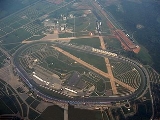
Talladega Superspeedway is a motorsports complex located north of Talladega, Alabama
, United States
. It is located on the former Anniston Air Force Base
just outside the small city of Lincoln
. It was constructed by International Speedway Corporation
, a business controlled by the France Family
, in the 1960s. Talladega is most known for its steep banking and the location of the start/finish line which is closer to turn one than at Daytona International Speedway
. The track currently hosts the NASCAR
series such as the Sprint Cup Series, Nationwide Series, and the Camping World Truck Series. Talladega Superspeedway is the longest NASCAR
oval with a length of 2.66 miles (4.3 km), and the track also has a seating capacity
of 175,000 spectators.
. He would end up breaking ground on an old airfield on May 23, 1968. The track would be named Alabama International Motor Speedway (AIMS), but the name would not carry on and was later changed to Talladega Superspeedway. The track opened on September 13, 1969 costing $4 million. The first race at the new track was unlike any other; all the original drivers abandoned the track because of tire problems which caused Bill France to hire substitute drivers. The first finish was amazing with three cars side by side with the winner being Richard Brickhouse
. After the first race, Talladega would host two Sprint Cup Series races a year, one of which would become part of the 10-race Chase for the Sprint Cup. Since the opening year Talladega has hosted many races and has been repaved four times. Talladega would also have many first time winners such as Larry Schild Sr, Richard Brickhouse, Brian Vickers
, and Brad Keselowski
.
A 4 miles (6.4 km) infield road course was in operation from the track's founding until 1983. Six IMSA GT Championship
races were held in the 1970s, including a six hour race in 1978.
 During May 2006 Talladega Superspeedway started to re-surface the track and the apron. Construction started on May 1, 2006 and lasted until September 18, 2006. The first race on the resurfaced race track was the NASCAR Craftsman Truck Series on October 7, 2006.
on June 9, 2004. Wallace circled the 2.66-mile (4.28-km) trioval in 44.270 seconds, which surpassed the previous record held by Bill Elliott
(212.809 mph) set in 1987, but doesn't replace the record due to the fact it was a radio test and not a NASCAR sanctioned event. Buddy Baker
was the first driver to test at a speed over 200 mph, with a 200.447 mph lap during testing on March 24, 1970. Baker's record was set while driving the #88 Chrysler Engineering Charger Daytona, which is currently undergoing restoration in Detroit, after being found in the late 1990s in Iowa. The late Benny Parsons was the first driver to qualify at over 200 mph, doing so in 1982 with a speed of 200.176 mph.
In May 1987 Bobby Allison
, after a blown engine, cut his right-rear tire from the debris while going through the tri-oval portion of the track. The car was vaulted airborne. His car damaged a portion of the frontstretch catch fence, but did not enter the spectator area. NASCAR imposed rule changes to slow the cars after the incident, with a 1988 rule requiring cars running there and at Daytona to use restrictor plate
s. The most often cited reason is a fear that the increasing speeds were exceeding the capabilities of the tires available at the time, as high-speed tire failure had led to some gruesome crashes at slightly lower speeds. The plates limit the amount of air and fuel entering the intake manifolds of the engine, greatly reducing the power of the cars and hence their speed. This has led to an extremely competitive style of racing at Talladega and Daytona.
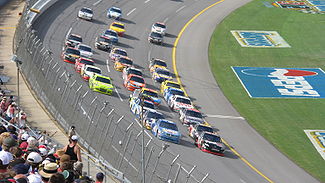 The reduced power affects not only the maximum speed reached by the cars but the time it takes them to achieve their full speed as well, which can be nearly one full circuit of the track. The racing seen at Talladega today is extremely tight; often in rows of three or four cars, and sometimes even 5 wide on the straightaways throughout most of the field, as the track is wide enough to permit such racing. Breaking away from the pack is very difficult as well.
Such close quarters, however, makes it extremely difficult for a driver to avoid an incident as it is unfolding in front of him, and the slightest mistake can lead to a multi-car accident – dubbed "the Big One
" by fans and drivers. It is uncommon, but possible, to see 20 or more cars collected in the crashes.
The danger of "the Big One" can cause extensive damage to cars during a race and can affect the overall points standings, especially since the second race was moved from July to October because of the Alabama heat, and since NASCAR's playoff system now incorporates the second race, currently the AMP Energy 500. However, such wrecks also occurred before the restrictor plates were introduced.
d. Stories of the origin of the curse vary. Some claim that a local Native American
tribe held horse races in the valley where the track currently resides where a chief was killed when he was thrown from his horse. Others say that the site of the superspeedway was once an Indian burial ground
. Still another version says that after the local tribe was driven out by the Creek nation for their collaborating with the forces of Andrew Jackson
, a shaman put a curse on the valley.
Since the construction of the track, many strange happenings and untimely deaths have fueled the rumors of a curse. In 1973, Bobby Isaac
left his car during the race on lap 90 because of voices he claimed to have heard which told him to park his car and get out. Earlier on lap 14 in the same race, young driver Larry Smith
died in a seemingly minor wreck. In 1974, the morning before the Winston 500, drivers and crews alike found multiple cars sabotaged by cut brake lines and sand in the gas tank.
To some, Bobby Allison's 1987 wreck described above was yet another reminder of the curse. In 1993, Bobby's son, Davey Allison
, died in a helicopter crash in the infield of Talladega.
events which include two Sprint Cup Series races, one Nationwide Series race, and one Camping World Truck Series race. The Sprint Cup Series races include the Aaron's 499
, and the Talladega 500 which are both 188 laps each or 500.08 miles (804.8 km). The Nationwide Series race has historically been a 500-kilometer race (117 laps) since its 1992 inception, but was cut to 300 miles (482.8 km) (113 laps) in 1998 because of a spectator's letter questioning the metric distance, but restored to 500 kilometers by its current sponsor. The Camping World Truck Series race is 250 miles (94 laps). The ARCA race, once a 500 kilometer affair, was shortened to 300 miles in 1998, and to 250 miles in 2006 when it was moved to Friday.
* from minimum 10 starts.
NOTES:
The circuit's infield also hosts the Birmingham Ultimate Disc Association Mud Bowl tournament in the winter.
Talladega, Alabama
Talladega is a city in Talladega County, Alabama, United States. At the 2000 census the population was 15,143. The city is the county seat of Talladega County. Talladega is approximately 50 miles east of Birmingham, Alabama....
, United States
United States
The United States of America is a federal constitutional republic comprising fifty states and a federal district...
. It is located on the former Anniston Air Force Base
Anniston Air Force Base
Anniston Air Force Base is a former United States Air Force airfield located approximately 10 miles north-northeast of Talladega, Alabama. It was active from 1942 to 1945 and 1949 to 1952. It is currently the site of the Talladega Superspeedway.-History:...
just outside the small city of Lincoln
Lincoln, Alabama
Lincoln is a city in Talladega County, Alabama, United States. At the 2000 census the population was 4,577. It was named for Major General Benjamin Lincoln, who served in the American Army during the Revolutionary War.-Geography:...
. It was constructed by International Speedway Corporation
International Speedway Corporation
International Speedway Corporation is a corporation whose primary business is the ownership and management of NASCAR race tracks. ISC was founded by NASCAR founder Bill France, Sr. in 1953 for the construction of Daytona International Speedway and in 1999 they merged with Penske Motorsports to...
, a business controlled by the France Family
France Family
The France Family is known as the "first family" of NASCAR racing. NASCAR was founded by Bill France, Sr. in 1948 and to this day France family members hold many high-ranking positions within the company...
, in the 1960s. Talladega is most known for its steep banking and the location of the start/finish line which is closer to turn one than at Daytona International Speedway
Daytona International Speedway
Daytona International Speedway is a race track in Daytona Beach, Florida, United States. Since opening in 1959, it has been the home of the Daytona 500, one of the most prestigious races in NASCAR. In addition to NASCAR, the track also hosts races of ARCA, AMA Superbike, Grand-Am and Motocross...
. The track currently hosts the NASCAR
NASCAR
The National Association for Stock Car Auto Racing is a family-owned and -operated business venture that sanctions and governs multiple auto racing sports events. It was founded by Bill France Sr. in 1947–48. As of 2009, the CEO for the company is Brian France, grandson of the late Bill France Sr...
series such as the Sprint Cup Series, Nationwide Series, and the Camping World Truck Series. Talladega Superspeedway is the longest NASCAR
NASCAR
The National Association for Stock Car Auto Racing is a family-owned and -operated business venture that sanctions and governs multiple auto racing sports events. It was founded by Bill France Sr. in 1947–48. As of 2009, the CEO for the company is Brian France, grandson of the late Bill France Sr...
oval with a length of 2.66 miles (4.3 km), and the track also has a seating capacity
Seating capacity
Seating capacity refers to the number of people who can be seated in a specific space, both in terms of the physical space available, and in terms of limitations set by law. Seating capacity can be used in the description of anything ranging from an automobile that seats two to a stadium that seats...
of 175,000 spectators.
History
During 1960s Bill France was wanting to build a track faster and longer than Daytona International SpeedwayDaytona International Speedway
Daytona International Speedway is a race track in Daytona Beach, Florida, United States. Since opening in 1959, it has been the home of the Daytona 500, one of the most prestigious races in NASCAR. In addition to NASCAR, the track also hosts races of ARCA, AMA Superbike, Grand-Am and Motocross...
. He would end up breaking ground on an old airfield on May 23, 1968. The track would be named Alabama International Motor Speedway (AIMS), but the name would not carry on and was later changed to Talladega Superspeedway. The track opened on September 13, 1969 costing $4 million. The first race at the new track was unlike any other; all the original drivers abandoned the track because of tire problems which caused Bill France to hire substitute drivers. The first finish was amazing with three cars side by side with the winner being Richard Brickhouse
Richard Brickhouse
Richard Brickhouse is a retired NASCAR driver. He is best known for winning the inaugural Talladega 500 in 1969 after a boycott of the top stars of the sport at the time because concerns with tire wear with the high rate of speeds at the racetrack. He retired in 1982 with 13 career top 10's in 39...
. After the first race, Talladega would host two Sprint Cup Series races a year, one of which would become part of the 10-race Chase for the Sprint Cup. Since the opening year Talladega has hosted many races and has been repaved four times. Talladega would also have many first time winners such as Larry Schild Sr, Richard Brickhouse, Brian Vickers
Brian Vickers
Brian Lee Vickers is a American NASCAR driver. He was the 2003 Busch Series champion, and at age 20, became the youngest champion in any of NASCAR's three top-tier series...
, and Brad Keselowski
Brad Keselowski
Bradley Robert Keselowski is an American auto racing driver currently competing in the #2 Miller Lite Dodge Charger in the Sprint Cup Series and the #22 Discount Tire Company/Ruby Tuesday Dodge Challenger in the Nationwide Series for Penske Racing...
.
A 4 miles (6.4 km) infield road course was in operation from the track's founding until 1983. Six IMSA GT Championship
IMSA GT Championship
IMSA GT was a sports car racing series organized by International Motor Sports Association. Races took place primarily in the United States and occasionally in Canada.-History:...
races were held in the 1970s, including a six hour race in 1978.
Nicknamed "the Big One"
Speeds well in excess of 200 mph (321.9 km/h) were commonplace at Talladega. Talladega Superspeedway has the record for the fastest recorded time by a NASCAR stock car in a closed oval course, with the record of 216.309 mph set by Rusty WallaceRusty Wallace
Russell William Wallace, Jr. is a past NASCAR Winston Cup Champion, currently a broadcaster on ESPN, car owner in the Nationwide Series, and a co-host of NASCAR Angels.-Early racing career:...
on June 9, 2004. Wallace circled the 2.66-mile (4.28-km) trioval in 44.270 seconds, which surpassed the previous record held by Bill Elliott
Bill Elliott
William Clyde "Bill" Elliott , also known as Awesome Bill from Dawsonville or Million Dollar Bill, is a part-time driver and former champion of the NASCAR Sprint Cup Series. Elliott was inducted into the Motorsports Hall of Fame of America on August 15, 2007. He won the 1988 NASCAR Winston Cup...
(212.809 mph) set in 1987, but doesn't replace the record due to the fact it was a radio test and not a NASCAR sanctioned event. Buddy Baker
Buddy Baker
Elzie Wylie Baker, Jr. , nicknamed "Leadfoot" or more famously Buddy, is a former American NASCAR racecar driver.-Early life:...
was the first driver to test at a speed over 200 mph, with a 200.447 mph lap during testing on March 24, 1970. Baker's record was set while driving the #88 Chrysler Engineering Charger Daytona, which is currently undergoing restoration in Detroit, after being found in the late 1990s in Iowa. The late Benny Parsons was the first driver to qualify at over 200 mph, doing so in 1982 with a speed of 200.176 mph.
In May 1987 Bobby Allison
Bobby Allison
Robert Arthur Allison is a former NASCAR Winston Cup driver and was named one of NASCAR's 50 greatest drivers. His two sons, Clifford Allison and Davey Allison followed him into racing, and both died within a year of each other....
, after a blown engine, cut his right-rear tire from the debris while going through the tri-oval portion of the track. The car was vaulted airborne. His car damaged a portion of the frontstretch catch fence, but did not enter the spectator area. NASCAR imposed rule changes to slow the cars after the incident, with a 1988 rule requiring cars running there and at Daytona to use restrictor plate
Restrictor plate
A restrictor plate or air restrictor is a device installed at the intake of an engine to limit its power. This kind of system is occasionally used in road vehicles for insurance purposes, but mainly in automobile racing, to limit top speed and thus increase safety, to provide equal level of...
s. The most often cited reason is a fear that the increasing speeds were exceeding the capabilities of the tires available at the time, as high-speed tire failure had led to some gruesome crashes at slightly lower speeds. The plates limit the amount of air and fuel entering the intake manifolds of the engine, greatly reducing the power of the cars and hence their speed. This has led to an extremely competitive style of racing at Talladega and Daytona.
Such close quarters, however, makes it extremely difficult for a driver to avoid an incident as it is unfolding in front of him, and the slightest mistake can lead to a multi-car accident – dubbed "the Big One
The Big One (NASCAR)
The phrase The Big One refers to an accident involving roughly eight or more cars in NASCAR stock car racing.Though multi-car pileups have occurred at nearly every NASCAR track, the term is largely reserved for large Sprint Cup accidents at Daytona International Speedway and Talladega Superspeedway...
" by fans and drivers. It is uncommon, but possible, to see 20 or more cars collected in the crashes.
The danger of "the Big One" can cause extensive damage to cars during a race and can affect the overall points standings, especially since the second race was moved from July to October because of the Alabama heat, and since NASCAR's playoff system now incorporates the second race, currently the AMP Energy 500. However, such wrecks also occurred before the restrictor plates were introduced.
The Talladega jinx
The high number of crashes over the years, along with other factors, have led to rumors of Talladega Superspeedway being curseCurse
A curse is any expressed wish that some form of adversity or misfortune will befall or attach to some other entity—one or more persons, a place, or an object...
d. Stories of the origin of the curse vary. Some claim that a local Native American
Native Americans in the United States
Native Americans in the United States are the indigenous peoples in North America within the boundaries of the present-day continental United States, parts of Alaska, and the island state of Hawaii. They are composed of numerous, distinct tribes, states, and ethnic groups, many of which survive as...
tribe held horse races in the valley where the track currently resides where a chief was killed when he was thrown from his horse. Others say that the site of the superspeedway was once an Indian burial ground
Burial Ground
Burial Ground is the ninth studio album by Swedish death metal band Grave, released in June 2010.-Track listing:# "Liberation" - 3:40# "Semblance In Black" - 7:50# "Dismembered Mind" - 6:10# "Ridden With Belief" - 7:57# "Conquerer" - 4:44...
. Still another version says that after the local tribe was driven out by the Creek nation for their collaborating with the forces of Andrew Jackson
Andrew Jackson
Andrew Jackson was the seventh President of the United States . Based in frontier Tennessee, Jackson was a politician and army general who defeated the Creek Indians at the Battle of Horseshoe Bend , and the British at the Battle of New Orleans...
, a shaman put a curse on the valley.
Since the construction of the track, many strange happenings and untimely deaths have fueled the rumors of a curse. In 1973, Bobby Isaac
Bobby Isaac
Bobby Isaac is a former NASCAR Grand National champion.-Early life:Isaac grew up on a farm near Catawba, North Carolina, the second youngest of nine children...
left his car during the race on lap 90 because of voices he claimed to have heard which told him to park his car and get out. Earlier on lap 14 in the same race, young driver Larry Smith
Larry Smith (NASCAR)
Larry Smith , born in Lenoir, North Carolina, United States, was a former NASCAR driver. He made his debut in the 1971 World 600 in the #92 Ford, finishing 22nd. He would go on to run three more races that year, acquiring one top-ten finish...
died in a seemingly minor wreck. In 1974, the morning before the Winston 500, drivers and crews alike found multiple cars sabotaged by cut brake lines and sand in the gas tank.
To some, Bobby Allison's 1987 wreck described above was yet another reminder of the curse. In 1993, Bobby's son, Davey Allison
Davey Allison
David Carl "Davey" Allison was a NASCAR driver. He was best known for driving the #28 Texaco-Havoline Ford for Robert Yates Racing in the Winston Cup Series. Born in Hollywood, Florida, he was the eldest of four children born to Bobby Allison and wife Judy...
, died in a helicopter crash in the infield of Talladega.
Scheduled races
Talladega Superspeedway hosts many NASCARNASCAR
The National Association for Stock Car Auto Racing is a family-owned and -operated business venture that sanctions and governs multiple auto racing sports events. It was founded by Bill France Sr. in 1947–48. As of 2009, the CEO for the company is Brian France, grandson of the late Bill France Sr...
events which include two Sprint Cup Series races, one Nationwide Series race, and one Camping World Truck Series race. The Sprint Cup Series races include the Aaron's 499
Aaron's 499
The Aaron's 499 is a NASCAR Sprint Cup Series stock car auto race held at Talladega Superspeedway in Talladega, Alabama. The race has always been held in late April or early May. The Aaron's 499 is also one of four races currently run with restrictor plates, the others being the AMP Energy 500,...
, and the Talladega 500 which are both 188 laps each or 500.08 miles (804.8 km). The Nationwide Series race has historically been a 500-kilometer race (117 laps) since its 1992 inception, but was cut to 300 miles (482.8 km) (113 laps) in 1998 because of a spectator's letter questioning the metric distance, but restored to 500 kilometers by its current sponsor. The Camping World Truck Series race is 250 miles (94 laps). The ARCA race, once a 500 kilometer affair, was shortened to 300 miles in 1998, and to 250 miles in 2006 when it was moved to Friday.
NASCAR Sprint Cup Series records
(As of 10/31/10)| Most Wins | 10 | Dale Earnhardt Dale Earnhardt Ralph Dale Earnhardt, Sr. was an American race car driver, best known for his involvement in stock car racing for NASCAR... |
Most Top 5s | 23 | Dale Earnhardt Dale Earnhardt Ralph Dale Earnhardt, Sr. was an American race car driver, best known for his involvement in stock car racing for NASCAR... |
Most Top 10s | 27 | Dale Earnhardt Dale Earnhardt Ralph Dale Earnhardt, Sr. was an American race car driver, best known for his involvement in stock car racing for NASCAR... |
Starts | 61 | Dave Marcis Dave Marcis Dave Marcis is a retired driver on the NASCAR Winston Cup circuit whose career spanned five decades. Marcis won five times over this tenure, twice at Richmond, including his final win in 1982... |
Poles | 8 | Bill Elliott Bill Elliott William Clyde "Bill" Elliott , also known as Awesome Bill from Dawsonville or Million Dollar Bill, is a part-time driver and former champion of the NASCAR Sprint Cup Series. Elliott was inducted into the Motorsports Hall of Fame of America on August 15, 2007. He won the 1988 NASCAR Winston Cup... |
Most Laps Completed | 9777 | Dave Marcis Dave Marcis Dave Marcis is a retired driver on the NASCAR Winston Cup circuit whose career spanned five decades. Marcis won five times over this tenure, twice at Richmond, including his final win in 1982... |
Most Laps Led | 1377 | Dale Earnhardt Dale Earnhardt Ralph Dale Earnhardt, Sr. was an American race car driver, best known for his involvement in stock car racing for NASCAR... |
Avg. Start* | 5.3 | Davey Allison Davey Allison David Carl "Davey" Allison was a NASCAR driver. He was best known for driving the #28 Texaco-Havoline Ford for Robert Yates Racing in the Winston Cup Series. Born in Hollywood, Florida, he was the eldest of four children born to Bobby Allison and wife Judy... |
Avg. Finish* | 12.4 | Dale Earnhardt Dale Earnhardt Ralph Dale Earnhardt, Sr. was an American race car driver, best known for his involvement in stock car racing for NASCAR... |
NASCAR Sprint Cup Series race winners
| Season | Date | Winning Driver | Car # | Sponsor | Make | Avg Speed | Margin of Victory |
|---|---|---|---|---|---|---|---|
| 1969 | September 14 | Richard Brickhouse Richard Brickhouse Richard Brickhouse is a retired NASCAR driver. He is best known for winning the inaugural Talladega 500 in 1969 after a boycott of the top stars of the sport at the time because concerns with tire wear with the high rate of speeds at the racetrack. He retired in 1982 with 13 career top 10's in 39... |
99 | Nichels Engineering | ’69 Dodge | 153.778 mi/h | 7 sec |
| 1970 1970 in NASCAR The 1970 NASCAR Grand National Series season began on Sunday January 18 and ended on Sunday November 22. Bobby Isaac was the champions of the series as NASCAR transitioned itself from the Grand National era to the Winston Cup era... |
April 12 | Pete Hamilton Pete Hamilton Pete Hamilton is a retired American NASCAR racer. He won four times in his career , three times driving for Petty Enterprises. His father was a Ph.D. from Harvard University.... |
40 | Petty Enterprises Petty Enterprises Petty Enterprises was a NASCAR racing team based in Randleman, North Carolina, USA. The team was owned by Richard Petty, his son Kyle Petty, and Boston Ventures. At the time of its folding the team operated the #43 and #45 Dodge Chargers in the NASCAR Sprint Cup Series. Petty Enterprises ran from... |
’70 Plymouth | 152.321 mi/h | 44 sec |
| 1970 1970 in NASCAR The 1970 NASCAR Grand National Series season began on Sunday January 18 and ended on Sunday November 22. Bobby Isaac was the champions of the series as NASCAR transitioned itself from the Grand National era to the Winston Cup era... |
August 23 | Pete Hamilton Pete Hamilton Pete Hamilton is a retired American NASCAR racer. He won four times in his career , three times driving for Petty Enterprises. His father was a Ph.D. from Harvard University.... |
40 | Petty Enterprises Petty Enterprises Petty Enterprises was a NASCAR racing team based in Randleman, North Carolina, USA. The team was owned by Richard Petty, his son Kyle Petty, and Boston Ventures. At the time of its folding the team operated the #43 and #45 Dodge Chargers in the NASCAR Sprint Cup Series. Petty Enterprises ran from... |
’70 Plymouth | 158.517 mi/h | 10 sec |
| 1971 | May 16 | Donnie Allison Donnie Allison Dunkiny "Donnie" Allison is a former driver on the NASCAR Grand National/Winston Cup circuit, who won ten times during his racing career, which spanned the 1960s, 1970s and early 1980s. He was part of the "Alabama Gang," and is the brother of 1983 champion Bobby Allison and uncle of Davey Allison... |
21 | Wood Brothers Wood Brothers Racing Wood Brothers Racing is an American auto racing team that competes in the NASCAR Sprint Cup, Nationwide, and Camping World Truck Series. The team was formed in 1950 by the sons of Walter and Ada Wood, thus the Wood Brothers... |
’69 Mercury | 147.419 mi/h | 6 cl |
| 1971 | August 22 | Bobby Allison Bobby Allison Robert Arthur Allison is a former NASCAR Winston Cup driver and was named one of NASCAR's 50 greatest drivers. His two sons, Clifford Allison and Davey Allison followed him into racing, and both died within a year of each other.... |
12 | Holman-Moody | ’69 Mercury | 145.945 mi/h | 2.1sec |
| 1972 | May 7 | David Pearson | 21 | Wood Brothers | ’71 Mercury | 134.4 mi/h | 4.9 sec |
| 1972 | August 6 | James Hylton James Hylton James Harvey Hylton is a part-time race car driver. He is a two-time winner in NASCAR and competes in the ARCA RE/MAX Series,finishing 16th in points in 2006. He made headlines while attempting to qualify for the 2007 Daytona 500 at age 72... |
48 | Hylton Engineering | ’71 Mercury | 148.728 mi/h | 1 cl |
| 1973 | May 6 | David Pearson | 21 | Purolator Purolator Purolator may refer to:* Purolator Courier, a Canadian courier company* Purolator Filters, a joint venture of Bosch and Mann-Hummel, which distributes the Purolator brand of automotive filtration products... |
’71 Mercury | 131.956 mi/h | 1 lap |
| 1973 | August 12 | Dick Brooks Dick Brooks Richard "Dick" Brooks was an American NASCAR driver. Born in Porterville, California, he was the 1969 NASCAR Rookie of the Year, and went on to win the 1973 Talladega 500... |
22 | Eastern Airlines | ’72 Plymouth | 145.454 mi/h | 7.2 sec |
| 1974 | May 5 | David Pearson | 21 | Purolator Purolator Purolator may refer to:* Purolator Courier, a Canadian courier company* Purolator Filters, a joint venture of Bosch and Mann-Hummel, which distributes the Purolator brand of automotive filtration products... |
’73 Mercury | 130.22 mi/h | 0.17 sec |
| 1974 | August 11 | Richard Petty Richard Petty Richard Lee Petty is a former NASCAR driver who raced in the Strictly Stock/Grand National Era and the NASCAR Winston Cup Series... |
43 | STP STP (motor oil company) STP is an American brand and trade name for the automotive additives, lubricants and performance division of Armored AutoGroup.Founded in 1953 in Saint Joseph, Missouri, the company’s name, STP, was derived from “Scientifically Treated Petroleum”... |
’74 Dodge | 148.637 mi/h | UC |
| 1975 | May 4 | Buddy Baker Buddy Baker Elzie Wylie Baker, Jr. , nicknamed "Leadfoot" or more famously Buddy, is a former American NASCAR racecar driver.-Early life:... |
15 | Sunny King | ’75 Ford | 144.948 mi/h | 1 cl |
| 1975 | August 17 | Buddy Baker Buddy Baker Elzie Wylie Baker, Jr. , nicknamed "Leadfoot" or more famously Buddy, is a former American NASCAR racecar driver.-Early life:... |
15 | Sunny King | ’75 Ford | 130.892 mi/h | 5 feet |
| 1976 1976 in NASCAR The 1976 NASCAR Grand National Winston Cup Series season began on Sunday, January 18 and ended on Sunday, November 21. Cale Yarborough, driving the #11 Junior Johnson Holly Farms Chevrolet scored his first of three consecutive NASCAR Grand National Series Winston Cup Championships... |
May 2 | Buddy Baker Buddy Baker Elzie Wylie Baker, Jr. , nicknamed "Leadfoot" or more famously Buddy, is a former American NASCAR racecar driver.-Early life:... |
15 | Norris Industries | Ford | 169.887 mi/h | 35 sec |
| 1976 1976 in NASCAR The 1976 NASCAR Grand National Winston Cup Series season began on Sunday, January 18 and ended on Sunday, November 21. Cale Yarborough, driving the #11 Junior Johnson Holly Farms Chevrolet scored his first of three consecutive NASCAR Grand National Series Winston Cup Championships... |
August 8 | Dave Marcis Dave Marcis Dave Marcis is a retired driver on the NASCAR Winston Cup circuit whose career spanned five decades. Marcis won five times over this tenure, twice at Richmond, including his final win in 1982... |
71 | K&K Insurance | Dodge Dodge Dodge is a United States-based brand of automobiles, minivans, and sport utility vehicles, manufactured and marketed by Chrysler Group LLC in more than 60 different countries and territories worldwide.... |
157.547 mi/h | 29.5 sec |
| 1977 | May 1 | Darrell Waltrip Darrell Waltrip Darrell Lee Waltrip is a 3-time NASCAR Cup Series champion , 3-time runner-up , winner of the 1989 Daytona 500 and 5-time winner of the prestigeous Coca-Cola 600 ,... |
88 | Gatorade Gatorade Gatorade is a brand of sports-themed food and beverage products, built around its signature product: a line of sports drinks. Gatorade is currently manufactured by PepsiCo, distributed in over 80 countries... |
Chevrolet Chevrolet Chevrolet , also known as Chevy , is a brand of vehicle produced by General Motors Company . Founded by Louis Chevrolet and ousted GM founder William C. Durant on November 3, 1911, General Motors acquired Chevrolet in 1918... |
164.877 mi/h | 0.29 sec |
| 1977 | August 7 | Donnie Allison Donnie Allison Dunkiny "Donnie" Allison is a former driver on the NASCAR Grand National/Winston Cup circuit, who won ten times during his racing career, which spanned the 1960s, 1970s and early 1980s. He was part of the "Alabama Gang," and is the brother of 1983 champion Bobby Allison and uncle of Davey Allison... |
1 | Hawaiian Tropic Hawaiian Tropic Hawaiian Tropic is a brand of suntan lotion sold around the world, but more widely available in the United States.The Company was founded by Ron Rice in 1969. It was the largest private manufacturer of sun care products in the United States until being acquired in May 2007 by Playtex Products, Inc... |
Chevrolet Chevrolet Chevrolet , also known as Chevy , is a brand of vehicle produced by General Motors Company . Founded by Louis Chevrolet and ousted GM founder William C. Durant on November 3, 1911, General Motors acquired Chevrolet in 1918... |
162.524 mi/h | UC |
| 1978 1978 in NASCAR The 1978 NASCAR Grand National Winston Cup Series season began on Sunday, January 22 and ended on Sunday, November 19. Cale Yarborough driving the Junior Johnson #11 First National City Travelers Checks Oldsmobile won his then record third consecutive NASCAR Grand National Series Winston Cup... |
May 14 | Cale Yarborough Cale Yarborough William Caleb "Cale" Yarborough , is a farmer, businessman and former NASCAR Winston Cup Series driver and owner. He is one of only two drivers in NASCAR history to win three consecutive championships... |
11 | First National City Citibank Citibank, a major international bank, is the consumer banking arm of financial services giant Citigroup. Citibank was founded in 1812 as the City Bank of New York, later First National City Bank of New York... |
Oldsmobile Oldsmobile Oldsmobile was a brand of American automobile produced for most of its existence by General Motors. It was founded by Ransom E. Olds in 1897. In its 107-year history, it produced 35.2 million cars, including at least 14 million built at its Lansing, Michigan factory... |
155.699 mi/h | 2 cl |
| 1978 1978 in NASCAR The 1978 NASCAR Grand National Winston Cup Series season began on Sunday, January 22 and ended on Sunday, November 19. Cale Yarborough driving the Junior Johnson #11 First National City Travelers Checks Oldsmobile won his then record third consecutive NASCAR Grand National Series Winston Cup... |
August 6 | Lennie Pond Lennie Pond Lennie Pond is a former NASCAR driver. He won NASCAR Winston Cup Rookie of the Year honors in 1973, and won his only race at Talladega Superspeedway in 1978 for Ronnie Elder and Harry Ranier.... |
54 | W.I.N. | Oldsmobile Oldsmobile Oldsmobile was a brand of American automobile produced for most of its existence by General Motors. It was founded by Ransom E. Olds in 1897. In its 107-year history, it produced 35.2 million cars, including at least 14 million built at its Lansing, Michigan factory... |
174.7 mi/h | 2 cl |
| 1979 | May 6 | Bobby Allison Bobby Allison Robert Arthur Allison is a former NASCAR Winston Cup driver and was named one of NASCAR's 50 greatest drivers. His two sons, Clifford Allison and Davey Allison followed him into racing, and both died within a year of each other.... |
15 | Hodgdon/Moore | Ford | 154.77 mi/h | 1 lap + 50 sec |
| 1979 | August 5 | Darrell Waltrip Darrell Waltrip Darrell Lee Waltrip is a 3-time NASCAR Cup Series champion , 3-time runner-up , winner of the 1989 Daytona 500 and 5-time winner of the prestigeous Coca-Cola 600 ,... |
88 | Gatorade Gatorade Gatorade is a brand of sports-themed food and beverage products, built around its signature product: a line of sports drinks. Gatorade is currently manufactured by PepsiCo, distributed in over 80 countries... |
Oldsmobile Oldsmobile Oldsmobile was a brand of American automobile produced for most of its existence by General Motors. It was founded by Ransom E. Olds in 1897. In its 107-year history, it produced 35.2 million cars, including at least 14 million built at its Lansing, Michigan factory... |
161.229 mi/h | 62 sec |
| 1980 | May 4 | Buddy Baker Buddy Baker Elzie Wylie Baker, Jr. , nicknamed "Leadfoot" or more famously Buddy, is a former American NASCAR racecar driver.-Early life:... |
28 | NAPA National Automotive Parts Association The National Automotive Parts Association was founded in 1925 to meet America's growing need for an auto parts distribution system. It is a retailers' cooperative that distributes parts to both corporately and independently owned auto parts stores.NAPA's parent company is Genuine Parts Company , ... |
Oldsmobile Oldsmobile Oldsmobile was a brand of American automobile produced for most of its existence by General Motors. It was founded by Ransom E. Olds in 1897. In its 107-year history, it produced 35.2 million cars, including at least 14 million built at its Lansing, Michigan factory... |
170.481 mi/h | 3 feet |
| 1980 | August 3 | Neil Bonnett Neil Bonnett Lawrence Neil Bonnett was a NASCAR driver who compiled 18 victories and 20 poles over his 18-year career. The Alabama native currently ranks 35th in all-time NASCAR Cup victories. He appeared in the 1983 film Stroker Ace and the 1990 film Days of Thunder... |
21 | Purolator Purolator Purolator may refer to:* Purolator Courier, a Canadian courier company* Purolator Filters, a joint venture of Bosch and Mann-Hummel, which distributes the Purolator brand of automotive filtration products... |
Mercury Mercury (automobile) Mercury was an automobile marque of the Ford Motor Company launched in 1938 by Edsel Ford, son of Henry Ford, to market entry-level luxury cars slotted between Ford-branded regular models and Lincoln-branded luxury vehicles, similar to General Motors' Buick brand, and Chrysler's namesake brand... |
166.894 mi/h | 6 cl |
| 1981 | May 3 | Bobby Allison Bobby Allison Robert Arthur Allison is a former NASCAR Winston Cup driver and was named one of NASCAR's 50 greatest drivers. His two sons, Clifford Allison and Davey Allison followed him into racing, and both died within a year of each other.... |
28 | The 5 Racers | Buick Buick Buick is a premium brand of General Motors . Buick models are sold in the United States, Canada, Mexico, China, Taiwan, and Israel, with China being its largest market. Buick holds the distinction as the oldest active American make... |
149.376 mi/h | 0.1 sec |
| 1981 | August 2 | Ron Bouchard Ron Bouchard Ron Bouchard is a former NASCAR driver who was the 1981 NASCAR Winston Cup Rookie of the Year. His brother Ken Bouchard was the 1988 NASCAR Winston Cup Rookie of the Year.-Local driving career:... |
47 | Race Hill Farm | Buick Buick Buick is a premium brand of General Motors . Buick models are sold in the United States, Canada, Mexico, China, Taiwan, and Israel, with China being its largest market. Buick holds the distinction as the oldest active American make... |
156.737 mi/h | 2 feet |
| 1982 | May 2 | Darrell Waltrip Darrell Waltrip Darrell Lee Waltrip is a 3-time NASCAR Cup Series champion , 3-time runner-up , winner of the 1989 Daytona 500 and 5-time winner of the prestigeous Coca-Cola 600 ,... |
11 | Mountain Dew Mountain Dew Mountain Dew is a citrus-flavored carbonated soft drink brand produced and owned by PepsiCo. The original formula was invented in the 1940s by Tennessee beverage bottlers Barney and Ally Hartman and was first marketed in Marion, VA, Knoxville and Johnson City, Tennessee. A revised formula was... |
Buick Buick Buick is a premium brand of General Motors . Buick models are sold in the United States, Canada, Mexico, China, Taiwan, and Israel, with China being its largest market. Buick holds the distinction as the oldest active American make... |
156.597 mi/h | 3 cl |
| 1982 | August 1 | Darrell Waltrip Darrell Waltrip Darrell Lee Waltrip is a 3-time NASCAR Cup Series champion , 3-time runner-up , winner of the 1989 Daytona 500 and 5-time winner of the prestigeous Coca-Cola 600 ,... |
11 | Mountain Dew Mountain Dew Mountain Dew is a citrus-flavored carbonated soft drink brand produced and owned by PepsiCo. The original formula was invented in the 1940s by Tennessee beverage bottlers Barney and Ally Hartman and was first marketed in Marion, VA, Knoxville and Johnson City, Tennessee. A revised formula was... |
Buick Buick Buick is a premium brand of General Motors . Buick models are sold in the United States, Canada, Mexico, China, Taiwan, and Israel, with China being its largest market. Buick holds the distinction as the oldest active American make... |
168.157 mi/h | 1 cl |
| 1983 | May 1 | Richard Petty Richard Petty Richard Lee Petty is a former NASCAR driver who raced in the Strictly Stock/Grand National Era and the NASCAR Winston Cup Series... |
43 | STP STP (motor oil company) STP is an American brand and trade name for the automotive additives, lubricants and performance division of Armored AutoGroup.Founded in 1953 in Saint Joseph, Missouri, the company’s name, STP, was derived from “Scientifically Treated Petroleum”... |
Pontiac Pontiac Pontiac was an automobile brand that was established in 1926 as a companion make for General Motors' Oakland. Quickly overtaking its parent in popularity, it supplanted the Oakland brand entirely by 1933 and, for most of its life, became a companion make for Chevrolet. Pontiac was sold in the... |
153.936 mi/h | 2 cl |
| 1983 | July 31 | Dale Earnhardt Dale Earnhardt Ralph Dale Earnhardt, Sr. was an American race car driver, best known for his involvement in stock car racing for NASCAR... |
15 | Wrangler Wrangler Jeans Wrangler is a manufacturer of jeans and other clothing items. The brand is owned by the VF Corporation, who also own Lee, JanSport and The North Face, among others. Its headquarters is in downtown Greensboro, North Carolina, with production plants in a variety of locations throughout the world... |
Ford | 170.611 mi/h | 4 cl |
| 1984 | May 6 | Cale Yarborough Cale Yarborough William Caleb "Cale" Yarborough , is a farmer, businessman and former NASCAR Winston Cup Series driver and owner. He is one of only two drivers in NASCAR history to win three consecutive championships... |
28 | Hardee’s Hardee's Hardee's is a restaurant chain, located mostly in the Southeast and Midwestern regions of the United States. It has evolved through several corporate ownerships since its establishment in 1960. It is currently owned and operated by CKE Restaurants. Along with its sibling restaurant chain, Carl's... |
Chevrolet Chevrolet Chevrolet , also known as Chevy , is a brand of vehicle produced by General Motors Company . Founded by Louis Chevrolet and ousted GM founder William C. Durant on November 3, 1911, General Motors acquired Chevrolet in 1918... |
172.988 mi/h | 2 cl |
| 1984 | July 29 | Dale Earnhardt Dale Earnhardt Ralph Dale Earnhardt, Sr. was an American race car driver, best known for his involvement in stock car racing for NASCAR... |
3 | Wrangler Wrangler Jeans Wrangler is a manufacturer of jeans and other clothing items. The brand is owned by the VF Corporation, who also own Lee, JanSport and The North Face, among others. Its headquarters is in downtown Greensboro, North Carolina, with production plants in a variety of locations throughout the world... |
Chevrolet Chevrolet Chevrolet , also known as Chevy , is a brand of vehicle produced by General Motors Company . Founded by Louis Chevrolet and ousted GM founder William C. Durant on November 3, 1911, General Motors acquired Chevrolet in 1918... |
155.485 mi/h | 1.66 sec |
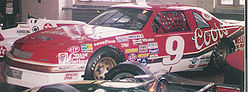
| 1985 | May 5 | Bill Elliott Bill Elliott William Clyde "Bill" Elliott , also known as Awesome Bill from Dawsonville or Million Dollar Bill, is a part-time driver and former champion of the NASCAR Sprint Cup Series. Elliott was inducted into the Motorsports Hall of Fame of America on August 15, 2007. He won the 1988 NASCAR Winston Cup... |
9 | Coors Coors Brewing Company The Coors Brewing Company is a regional division of the world's fifth-largest brewing company, the Canadian Molson Coors Brewing Company and is the third-largest brewer in the United States... |
Ford Thunderbird Ford Thunderbird The Thunderbird , is an automobile manufactured by the Ford Motor Company in the United States over eleven model generations from 1955 through 2005... |
186.288 mi/h | 1.72 sec |
| 1985 | July 28 | Cale Yarborough Cale Yarborough William Caleb "Cale" Yarborough , is a farmer, businessman and former NASCAR Winston Cup Series driver and owner. He is one of only two drivers in NASCAR history to win three consecutive championships... |
28 | Hardee’s Hardee's Hardee's is a restaurant chain, located mostly in the Southeast and Midwestern regions of the United States. It has evolved through several corporate ownerships since its establishment in 1960. It is currently owned and operated by CKE Restaurants. Along with its sibling restaurant chain, Carl's... |
Ford Thunderbird Ford Thunderbird The Thunderbird , is an automobile manufactured by the Ford Motor Company in the United States over eleven model generations from 1955 through 2005... |
148.772 mi/h | 0.66 sec |
| 1986 1986 in NASCAR The 1986 NASCAR Winston Cup Series Season began February 16 and ended November 16. Dale Earnhardt of RCR Enterprises won his second championship this year.See also: 1986 NASCAR Busch Series- Busch Clash :... |
May 4 | Bobby Allison Bobby Allison Robert Arthur Allison is a former NASCAR Winston Cup driver and was named one of NASCAR's 50 greatest drivers. His two sons, Clifford Allison and Davey Allison followed him into racing, and both died within a year of each other.... |
22 | Miller American SABMiller SABMiller plc is a global brewing and bottling company headquartered in London, United Kingdom. It is the world's second-largest brewing company measured by revenues and is also a major bottler of Coca-Cola. Its brands include Grolsch, Miller Genuine Draft, Peroni Nastro Azzurro and Pilsner Urquell... |
Buick Regal Buick Regal The Buick Regal is a mid-size car introduced by General Motors for the 1973 model year. North American production ended in 2004 and began again in 2011. For the 2011 model year, Buick re-introduced the Regal to the North American market, positioned as an upscale sport sedan... |
157.698 mi/h | 0.19 sec |
| 1986 1986 in NASCAR The 1986 NASCAR Winston Cup Series Season began February 16 and ended November 16. Dale Earnhardt of RCR Enterprises won his second championship this year.See also: 1986 NASCAR Busch Series- Busch Clash :... |
July 27 | Bobby Hillin Jr | 8 | Miller American SABMiller SABMiller plc is a global brewing and bottling company headquartered in London, United Kingdom. It is the world's second-largest brewing company measured by revenues and is also a major bottler of Coca-Cola. Its brands include Grolsch, Miller Genuine Draft, Peroni Nastro Azzurro and Pilsner Urquell... |
Buick Regal Buick Regal The Buick Regal is a mid-size car introduced by General Motors for the 1973 model year. North American production ended in 2004 and began again in 2011. For the 2011 model year, Buick re-introduced the Regal to the North American market, positioned as an upscale sport sedan... |
151.522 mi/h | 3 cl |
| 1987 1987 in NASCAR The 1987 NASCAR Winston Cup Series Season began February 8 and ended November 22. Dale Earnhardt of RCR Enterprises won the championship for the third time... |
May 3 | Davey Allison Davey Allison David Carl "Davey" Allison was a NASCAR driver. He was best known for driving the #28 Texaco-Havoline Ford for Robert Yates Racing in the Winston Cup Series. Born in Hollywood, Florida, he was the eldest of four children born to Bobby Allison and wife Judy... |
28 | Texaco Havoline Chevron Corporation Chevron Corporation is an American multinational energy corporation headquartered in San Ramon, California, United States and active in more than 180 countries. It is engaged in every aspect of the oil, gas, and geothermal energy industries, including exploration and production; refining,... |
Ford Thunderbird Ford Thunderbird The Thunderbird , is an automobile manufactured by the Ford Motor Company in the United States over eleven model generations from 1955 through 2005... |
154.228 mi/h | 0.78 sec |
| 1987 1987 in NASCAR The 1987 NASCAR Winston Cup Series Season began February 8 and ended November 22. Dale Earnhardt of RCR Enterprises won the championship for the third time... |
July 26 | Bill Elliott Bill Elliott William Clyde "Bill" Elliott , also known as Awesome Bill from Dawsonville or Million Dollar Bill, is a part-time driver and former champion of the NASCAR Sprint Cup Series. Elliott was inducted into the Motorsports Hall of Fame of America on August 15, 2007. He won the 1988 NASCAR Winston Cup... |
9 | Coors Coors Brewing Company The Coors Brewing Company is a regional division of the world's fifth-largest brewing company, the Canadian Molson Coors Brewing Company and is the third-largest brewer in the United States... |
Ford Thunderbird Ford Thunderbird The Thunderbird , is an automobile manufactured by the Ford Motor Company in the United States over eleven model generations from 1955 through 2005... |
171.293 mi/h | 0.15 sec |
| 1988 1988 in NASCAR The 1988 NASCAR Winston Cup Season began February 7 and ended November 20. Bill Elliott of Melling Racing won the championship.See also: 1988 in NASCAR Busch Series- 1988 Team Chart :- Busch Clash :... |
May 1 | Phil Parsons Phil Parsons Phil Parsons , is a former NASCAR driver and owner of MSRP Motorsports . He is also the younger brother of the late 1973 Winston Cup champion and former NBC/TNT commentator Benny Parsons. Years later, he returned to the Busch Series, where he enjoyed modest success... |
55 | Crown Petroleum / Skoal Classic UST UST is a three letter acronym that may refer to:* Equatorial Guinea Workers' Union* Hong Kong University of Science and Technology * Northeast Florida Regional Airport in St... |
Oldsmobile Cutlass Oldsmobile Cutlass The Oldsmobile Cutlass is a line of automobiles made by the Oldsmobile division of General Motors. The Cutlass began as a unibody compact car, but saw its greatest success as a body-on-frame intermediate car.... |
156.547 mi/h | 0.21 sec |
| 1988 1988 in NASCAR The 1988 NASCAR Winston Cup Season began February 7 and ended November 20. Bill Elliott of Melling Racing won the championship.See also: 1988 in NASCAR Busch Series- 1988 Team Chart :- Busch Clash :... |
July 31 | Ken Schrader Ken Schrader Kenneth Schrader is a second-generation race car driver. He currently races on local dirt and asphalt tracks around the country while driving part-time in the NASCAR Camping World Truck Series and the ARCA Racing Series for his own Ken Schrader Racing. He also runs part time in the NASCAR Camping... |
25 | Folgers Folgers Folgers Coffee is a major brand of coffee in the United States, part of the food and beverage division of The J.M. Smucker Co.-Company history:... |
Chevrolet Monte Carlo Chevrolet Monte Carlo The Chevrolet Monte Carlo was an American-made two-door coupe introduced for model year 1970, and manufactured over six generations through model year 2007. It was marketed as a personal-luxury coupe through most of its history, with the last model version being classified as a full-sized coupe... |
154.505 mi/h | 2 cl |
| 1989 1989 in NASCAR The 1989 NASCAR Winston Cup Season began February 12 and ended November 19. Rusty Wallace of the #27 Kodiak Pontiac for Blue Max Racing won the championship... |
May 7 | Davey Allison Davey Allison David Carl "Davey" Allison was a NASCAR driver. He was best known for driving the #28 Texaco-Havoline Ford for Robert Yates Racing in the Winston Cup Series. Born in Hollywood, Florida, he was the eldest of four children born to Bobby Allison and wife Judy... |
28 | Texaco Havoline Chevron Corporation Chevron Corporation is an American multinational energy corporation headquartered in San Ramon, California, United States and active in more than 180 countries. It is engaged in every aspect of the oil, gas, and geothermal energy industries, including exploration and production; refining,... |
Ford Thunderbird Ford Thunderbird The Thunderbird , is an automobile manufactured by the Ford Motor Company in the United States over eleven model generations from 1955 through 2005... |
155.869 mi/h | 2 cl |
| 1989 1989 in NASCAR The 1989 NASCAR Winston Cup Season began February 12 and ended November 19. Rusty Wallace of the #27 Kodiak Pontiac for Blue Max Racing won the championship... |
July 30 | Terry Labonte Terry Labonte Terrance Lee Labonte is a semi-retired NASCAR driver who occasionally drives in the Sprint Cup Series when called upon and is a two-time Winston Cup and IROC champion. He currently drives the #32 U.S. Chrome Ford for FAS Lane Racing. Labonte was introduced to the sport through his father, who had... |
11 | Budweiser Budweiser (Anheuser-Busch) Budweiser is a 5.0% abv American-style lager introduced in 1876 by Adolphus Busch and one of the highest selling beers in the United States. It is made with up to 30% rice in addition to hops and barley malt. Budweiser is produced in various breweries located around the world... |
Ford Thunderbird Ford Thunderbird The Thunderbird , is an automobile manufactured by the Ford Motor Company in the United States over eleven model generations from 1955 through 2005... |
157.354 mi/h | 0.2 sec |
| 1990 1990 in NASCAR The 1990 NASCAR Winston Cup began on Sunday February 11 and ended on Sunday November 18. Because of a highly controversial penalty to Mark Martin early in the season, Dale Earnhardt with Richard Childress Racing was crowned the Winston Cup champion for the fourth time, edging out Martin by 21... |
May 6 | Dale Earnhardt Dale Earnhardt Ralph Dale Earnhardt, Sr. was an American race car driver, best known for his involvement in stock car racing for NASCAR... |
3 | Goodwrench | Chevrolet Lumina Chevrolet Lumina The North American Chevrolet Lumina sedan , coupe and minivan were first introduced in 1989 for the 1990 model year as a new range of vehicles from the Chevrolet brand of General Motors to replace the Chevrolet Camaro, Chevrolet Celebrity sedan, and the Monte Carlo coupe. The Lumina was an answer... |
159.571 mi/h | 2 cl |
| 1990 1990 in NASCAR The 1990 NASCAR Winston Cup began on Sunday February 11 and ended on Sunday November 18. Because of a highly controversial penalty to Mark Martin early in the season, Dale Earnhardt with Richard Childress Racing was crowned the Winston Cup champion for the fourth time, edging out Martin by 21... |
July 29 | Dale Earnhardt Dale Earnhardt Ralph Dale Earnhardt, Sr. was an American race car driver, best known for his involvement in stock car racing for NASCAR... |
3 | Goodwrench | Chevrolet Lumina Chevrolet Lumina The North American Chevrolet Lumina sedan , coupe and minivan were first introduced in 1989 for the 1990 model year as a new range of vehicles from the Chevrolet brand of General Motors to replace the Chevrolet Camaro, Chevrolet Celebrity sedan, and the Monte Carlo coupe. The Lumina was an answer... |
174.43 mi/h | 0.26 sec |
| 1991 1991 in NASCAR The 1991 NASCAR Winston Cup Season began February 10 and ended November 17. Dale Earnhardt of Richard Childress Racing was crowned champion at the end of the season. It was his fifth championship.-1991 Team Chart:-Busch Clash:... |
May 6 | Harry Gant Harry Gant Harry Phil Gant is a retired American racecar driver best known for driving the #33 Skoal Bandit car on the NASCAR Winston Cup circuit during the 1980s and 1990s.-Nicknames:... |
33 | Skoal Bandit | Oldsmobile Cutlass Oldsmobile Cutlass The Oldsmobile Cutlass is a line of automobiles made by the Oldsmobile division of General Motors. The Cutlass began as a unibody compact car, but saw its greatest success as a body-on-frame intermediate car.... |
165.62 mi/h | 11 sec |
| 1991 1991 in NASCAR The 1991 NASCAR Winston Cup Season began February 10 and ended November 17. Dale Earnhardt of Richard Childress Racing was crowned champion at the end of the season. It was his fifth championship.-1991 Team Chart:-Busch Clash:... |
July 28 | Dale Earnhardt Dale Earnhardt Ralph Dale Earnhardt, Sr. was an American race car driver, best known for his involvement in stock car racing for NASCAR... |
3 | Goodwrench | Chevrolet Lumina Chevrolet Lumina The North American Chevrolet Lumina sedan , coupe and minivan were first introduced in 1989 for the 1990 model year as a new range of vehicles from the Chevrolet brand of General Motors to replace the Chevrolet Camaro, Chevrolet Celebrity sedan, and the Monte Carlo coupe. The Lumina was an answer... |
147.383 mi/h | 1.5 cl |
| 1992 1992 in NASCAR The 1992 NASCAR Winston Cup Series Season began on February 9, 1992 and ended on November 15, 1992. Independent owner/driver Alan Kulwicki of AK Racing won the Winston Cup championship in the closest championship battle in NASCAR history to-date.... |
May 3 | Davey Allison Davey Allison David Carl "Davey" Allison was a NASCAR driver. He was best known for driving the #28 Texaco-Havoline Ford for Robert Yates Racing in the Winston Cup Series. Born in Hollywood, Florida, he was the eldest of four children born to Bobby Allison and wife Judy... |
28 | Texaco Havoline Chevron Corporation Chevron Corporation is an American multinational energy corporation headquartered in San Ramon, California, United States and active in more than 180 countries. It is engaged in every aspect of the oil, gas, and geothermal energy industries, including exploration and production; refining,... |
Ford Thunderbird Ford Thunderbird The Thunderbird , is an automobile manufactured by the Ford Motor Company in the United States over eleven model generations from 1955 through 2005... |
167.609 mi/h | 2 cl |
| 1992 1992 in NASCAR The 1992 NASCAR Winston Cup Series Season began on February 9, 1992 and ended on November 15, 1992. Independent owner/driver Alan Kulwicki of AK Racing won the Winston Cup championship in the closest championship battle in NASCAR history to-date.... |
July 26 | Ernie Irvan Ernie Irvan Virgil Earnest Irvan, more commonly known as Ernie Irvan is a former race driver in NASCAR. He is best remembered for his comeback after a serious head injury at Michigan International Speedway which earned him numerous awards and respect from his fellow drivers... |
4 | Kodak Film | Chevrolet Lumina Chevrolet Lumina The North American Chevrolet Lumina sedan , coupe and minivan were first introduced in 1989 for the 1990 model year as a new range of vehicles from the Chevrolet brand of General Motors to replace the Chevrolet Camaro, Chevrolet Celebrity sedan, and the Monte Carlo coupe. The Lumina was an answer... |
176.309 mi/h | 0.19 sec |
| 1993 1993 in NASCAR The 1993 NASCAR Winston Cup Series Season began on February 7 and ended on November 14. Dale Earnhardt of Richard Childress Racing won the title, the sixth of his career.... |
May 2 | Ernie Irvan Ernie Irvan Virgil Earnest Irvan, more commonly known as Ernie Irvan is a former race driver in NASCAR. He is best remembered for his comeback after a serious head injury at Michigan International Speedway which earned him numerous awards and respect from his fellow drivers... |
4 | Kodak Film | Chevrolet Lumina Chevrolet Lumina The North American Chevrolet Lumina sedan , coupe and minivan were first introduced in 1989 for the 1990 model year as a new range of vehicles from the Chevrolet brand of General Motors to replace the Chevrolet Camaro, Chevrolet Celebrity sedan, and the Monte Carlo coupe. The Lumina was an answer... |
155.412 mi/h | 2 cl |
| 1993 1993 in NASCAR The 1993 NASCAR Winston Cup Series Season began on February 7 and ended on November 14. Dale Earnhardt of Richard Childress Racing won the title, the sixth of his career.... |
July 25 | Dale Earnhardt Dale Earnhardt Ralph Dale Earnhardt, Sr. was an American race car driver, best known for his involvement in stock car racing for NASCAR... |
3 | Goodwrench | Chevrolet Lumina Chevrolet Lumina The North American Chevrolet Lumina sedan , coupe and minivan were first introduced in 1989 for the 1990 model year as a new range of vehicles from the Chevrolet brand of General Motors to replace the Chevrolet Camaro, Chevrolet Celebrity sedan, and the Monte Carlo coupe. The Lumina was an answer... |
153.858 mi/h | 0.005 sec |
| 1994 1994 in NASCAR The 1994 NASCAR Winston Cup Season began on Sunday February 20 and ended on Sunday November 13. Dale Earnhardt of Richard Childress Racing was crowned champion at season's end, winning consecutive Winston Cups for the third time in his career and tying Richard Petty for the record of most top-level... |
May 1 | Dale Earnhardt Dale Earnhardt Ralph Dale Earnhardt, Sr. was an American race car driver, best known for his involvement in stock car racing for NASCAR... |
3 | Goodwrench | Chevrolet Lumina Chevrolet Lumina The North American Chevrolet Lumina sedan , coupe and minivan were first introduced in 1989 for the 1990 model year as a new range of vehicles from the Chevrolet brand of General Motors to replace the Chevrolet Camaro, Chevrolet Celebrity sedan, and the Monte Carlo coupe. The Lumina was an answer... |
157.478 mi/h | 0.06 sec |
| 1994 1994 in NASCAR The 1994 NASCAR Winston Cup Season began on Sunday February 20 and ended on Sunday November 13. Dale Earnhardt of Richard Childress Racing was crowned champion at season's end, winning consecutive Winston Cups for the third time in his career and tying Richard Petty for the record of most top-level... |
July 24 | Jimmy Spencer Jimmy Spencer Jimmy Spencer is a current television commentator, and a former NASCAR driver. He formerly hosted the NASCAR inspired talk show, “What’s the Deal?”, on SPEED. He is the former co-host, with John Roberts and Kenny Wallace, of the SPEED's pre-race and post-race NASCAR shows NASCAR RaceDay and... |
27 | McDonald’s | Ford Thunderbird Ford Thunderbird The Thunderbird , is an automobile manufactured by the Ford Motor Company in the United States over eleven model generations from 1955 through 2005... |
163.217 mi/h | 0.025 sec |
| 1995 1995 in NASCAR The 1995 NASCAR Winston Cup Season began on February 12 and concluded November 12. Jeff Gordon of Hendrick Motorsports won his first career championship.- Overview :... |
April 30 | Mark Martin | 6 | Valvoline | Ford Thunderbird Ford Thunderbird The Thunderbird , is an automobile manufactured by the Ford Motor Company in the United States over eleven model generations from 1955 through 2005... |
178.902 mi/h | 0.18 sec |
| 1995 1995 in NASCAR The 1995 NASCAR Winston Cup Season began on February 12 and concluded November 12. Jeff Gordon of Hendrick Motorsports won his first career championship.- Overview :... |
July 23 | Sterling Marlin Sterling Marlin Sterling Marlin is a retired NASCAR Sprint Cup Series driver. He is the son of late NASCAR driver Coo Coo Marlin. He is married to Paula and has a daughter, Sutherlin, and a son, Steadman, who sometimes races in the Nationwide Series.... |
4 | Kodak Film | Chevrolet Monte Carlo Chevrolet Monte Carlo The Chevrolet Monte Carlo was an American-made two-door coupe introduced for model year 1970, and manufactured over six generations through model year 2007. It was marketed as a personal-luxury coupe through most of its history, with the last model version being classified as a full-sized coupe... |
173.188 mi/h | 0.05 sec |
| 1996 1996 in NASCAR The 1996 NASCAR Winston Cup Series started on February 18, 1996 and ended on November 10, 1996 with Terry Labonte pulling off a massive upset and winning his second championship.-1996 Team Chart:-Busch Clash:... |
April 28 | Sterling Marlin Sterling Marlin Sterling Marlin is a retired NASCAR Sprint Cup Series driver. He is the son of late NASCAR driver Coo Coo Marlin. He is married to Paula and has a daughter, Sutherlin, and a son, Steadman, who sometimes races in the Nationwide Series.... |
4 | Kodak Film | Chevrolet Monte Carlo Chevrolet Monte Carlo The Chevrolet Monte Carlo was an American-made two-door coupe introduced for model year 1970, and manufactured over six generations through model year 2007. It was marketed as a personal-luxury coupe through most of its history, with the last model version being classified as a full-sized coupe... |
149.999 mi/h | 0.22 sec |
| 1996 1996 in NASCAR The 1996 NASCAR Winston Cup Series started on February 18, 1996 and ended on November 10, 1996 with Terry Labonte pulling off a massive upset and winning his second championship.-1996 Team Chart:-Busch Clash:... |
July 28 | Jeff Gordon Jeff Gordon Jeffery Michael "Jeff" Gordon is a professional NASCAR driver. He is the driver of the #24 Drive to End Hunger/DuPont/Pepsi Chevrolet Impala. He is a four-time Sprint Cup Series champion and a three-time Daytona 500 winner. He is third on the all-time wins list, with 85 career wins, and has the... |
24 | DuPont DuPont E. I. du Pont de Nemours and Company , commonly referred to as DuPont, is an American chemical company that was founded in July 1802 as a gunpowder mill by Eleuthère Irénée du Pont. DuPont was the world's third largest chemical company based on market capitalization and ninth based on revenue in 2009... Refinishes |
Chevrolet Monte Carlo Chevrolet Monte Carlo The Chevrolet Monte Carlo was an American-made two-door coupe introduced for model year 1970, and manufactured over six generations through model year 2007. It was marketed as a personal-luxury coupe through most of its history, with the last model version being classified as a full-sized coupe... |
133.387 mi/h | 0.146 sec |
| 1997 1997 in NASCAR - 1997 Team Chart :- Busch Clash :The Busch Clash, a race for polewinners from the previous season, and drivers who have won the event before, was run on February 9 in Daytona Beach, Florida. Terry Labonte drew the pole... |
May 10 | Mark Martin | 6 | Valvoline | Ford Thunderbird Ford Thunderbird The Thunderbird , is an automobile manufactured by the Ford Motor Company in the United States over eleven model generations from 1955 through 2005... |
188.354 mi/h | 0.146 sec |
| 1997 1997 in NASCAR - 1997 Team Chart :- Busch Clash :The Busch Clash, a race for polewinners from the previous season, and drivers who have won the event before, was run on February 9 in Daytona Beach, Florida. Terry Labonte drew the pole... |
October 12 | Terry Labonte Terry Labonte Terrance Lee Labonte is a semi-retired NASCAR driver who occasionally drives in the Sprint Cup Series when called upon and is a two-time Winston Cup and IROC champion. He currently drives the #32 U.S. Chrome Ford for FAS Lane Racing. Labonte was introduced to the sport through his father, who had... |
5 | Kellogg's | Chevrolet Monte Carlo Chevrolet Monte Carlo The Chevrolet Monte Carlo was an American-made two-door coupe introduced for model year 1970, and manufactured over six generations through model year 2007. It was marketed as a personal-luxury coupe through most of its history, with the last model version being classified as a full-sized coupe... |
156.601 mi/h | 0.146 sec |
| 1998 1998 in NASCAR See Also: 1998 in NASCAR Busch Series-1998 Team Chart:-Bud Shootout Qualifier:The Bud Shootout Qualifier, a race for the fastest second round qualifier, from each race from the previous season, was run on February 8 in Daytona Beach, Florida. Sterling Marlin drew the pole... |
April 26 | Bobby Labonte Bobby Labonte Robert Alan "Bobby" Labonte is an American race car driver in the NASCAR Sprint Cup Series. He currently drives the #47 Kroger/Clorox/Kimberly-Clark/Kingsford/Reese Towpower Hitches Toyota Camry for JTG Daugherty Racing. He currently resides in Trinity, North Carolina. He is married to his wife... |
18 | Interstate Batteries Interstate Batteries Interstate Battery System of America, Inc., a.k.a. Interstate Batteries, is a privately owned company that markets automotive batteries manufactured by Johnson Controls through independent distributors to more than 200,000 automotive shops worldwide. The company is based in Dallas, Texas... |
Pontiac Grand Prix Pontiac Grand Prix Picking up where the Pontiac Ventura model left off, the Grand Prix first appeared in the Pontiac line for 1962. It was essentially a standard Pontiac Catalina coupe with minimal outside chrome trim and a sportier interior... |
144.428 mi/h | 0.167 sec |
| 1998 1998 in NASCAR See Also: 1998 in NASCAR Busch Series-1998 Team Chart:-Bud Shootout Qualifier:The Bud Shootout Qualifier, a race for the fastest second round qualifier, from each race from the previous season, was run on February 8 in Daytona Beach, Florida. Sterling Marlin drew the pole... |
October 11 | Dale Jarrett Dale Jarrett Dale Arnold Jarrett is a former American race car driver and current sports commentator known for winning the 1999 NASCAR Winston Cup Series championship... |
88 | Quality Care/Ford Credit | Ford Taurus Ford Taurus The Ford Taurus is an automobile manufactured by the Ford Motor Company in the United States. Originally introduced in the 1986 model year, it has remained in near-continuous production for more than two decades, making it the fourth oldest nameplate that is currently sold in the North American... |
159.318 mi/h | 0.14 sec |
| 1999 1999 in NASCAR The 1999 NASCAR Winston Cup Season began on Sunday February 7 and ended on Sunday November 21. Robert Yates Racing driver Dale Jarrett was crowned the champion... |
April 25 | Dale Earnhardt Dale Earnhardt Ralph Dale Earnhardt, Sr. was an American race car driver, best known for his involvement in stock car racing for NASCAR... |
3 | Goodwrench | Chevrolet Monte Carlo Chevrolet Monte Carlo The Chevrolet Monte Carlo was an American-made two-door coupe introduced for model year 1970, and manufactured over six generations through model year 2007. It was marketed as a personal-luxury coupe through most of its history, with the last model version being classified as a full-sized coupe... |
163.395 mi/h | 0.137 sec |
| 1999 1999 in NASCAR The 1999 NASCAR Winston Cup Season began on Sunday February 7 and ended on Sunday November 21. Robert Yates Racing driver Dale Jarrett was crowned the champion... |
October 17 | Dale Earnhardt Dale Earnhardt Ralph Dale Earnhardt, Sr. was an American race car driver, best known for his involvement in stock car racing for NASCAR... |
3 | Goodwrench | Chevrolet Monte Carlo Chevrolet Monte Carlo The Chevrolet Monte Carlo was an American-made two-door coupe introduced for model year 1970, and manufactured over six generations through model year 2007. It was marketed as a personal-luxury coupe through most of its history, with the last model version being classified as a full-sized coupe... |
166.632 mi/h | 0.114 sec |
| 2000 2000 in NASCAR The 2000 NASCAR Winston Cup Season began on Sunday February 13 and ended on Sunday November 20. Joe Gibbs Racing driver Bobby Labonte was crowned champion at season's end. The NASCAR Manufacturers' Championship was won by Ford when they captured 14 wins and 234 points to better Pontiac's 11 wins... |
April 16 | Jeff Gordon Jeff Gordon Jeffery Michael "Jeff" Gordon is a professional NASCAR driver. He is the driver of the #24 Drive to End Hunger/DuPont/Pepsi Chevrolet Impala. He is a four-time Sprint Cup Series champion and a three-time Daytona 500 winner. He is third on the all-time wins list, with 85 career wins, and has the... |
24 | DuPont DuPont E. I. du Pont de Nemours and Company , commonly referred to as DuPont, is an American chemical company that was founded in July 1802 as a gunpowder mill by Eleuthère Irénée du Pont. DuPont was the world's third largest chemical company based on market capitalization and ninth based on revenue in 2009... |
Chevrolet Monte Carlo Chevrolet Monte Carlo The Chevrolet Monte Carlo was an American-made two-door coupe introduced for model year 1970, and manufactured over six generations through model year 2007. It was marketed as a personal-luxury coupe through most of its history, with the last model version being classified as a full-sized coupe... |
161.157 mi/h | 0.189 sec |
| 2000 2000 in NASCAR The 2000 NASCAR Winston Cup Season began on Sunday February 13 and ended on Sunday November 20. Joe Gibbs Racing driver Bobby Labonte was crowned champion at season's end. The NASCAR Manufacturers' Championship was won by Ford when they captured 14 wins and 234 points to better Pontiac's 11 wins... |
October 15 | Dale Earnhardt Dale Earnhardt Ralph Dale Earnhardt, Sr. was an American race car driver, best known for his involvement in stock car racing for NASCAR... |
3 | Goodwrench | Chevrolet Monte Carlo Chevrolet Monte Carlo The Chevrolet Monte Carlo was an American-made two-door coupe introduced for model year 1970, and manufactured over six generations through model year 2007. It was marketed as a personal-luxury coupe through most of its history, with the last model version being classified as a full-sized coupe... |
165.681 mi/h | 0.119 sec |
| 2001 2001 in NASCAR The 2001 NASCAR Winston Cup season began on February 11 at the Daytona International Speedway and ended on November 23 at the New Hampshire International Speedway. Jeff Gordon of Hendrick Motorsports was crowned series champion for the fourth time in seven years. The season was marked by tragedy,... |
April 22 | Bobby Hamilton Bobby Hamilton Charles Robert Hamilton, Sr. was a driver and owner in the NASCAR Craftsman Truck Series circuit and the winner of the 2004 NASCAR Craftsman Truck Series championship. Hamilton owned Bobby Hamilton Racing, which fielded three entries in each NCWTS event... |
55 | Square D Square D Square D is an American manufacturer of equipment used to control and distribute electric power headquartered in Palatine, Illinois.Square D was founded in 1903 in Detroit, Michigan by Bryson Dexter Horton who is credited with the invention of the safety switch which encased high voltage switches... |
Chevrolet Monte Carlo Chevrolet Monte Carlo The Chevrolet Monte Carlo was an American-made two-door coupe introduced for model year 1970, and manufactured over six generations through model year 2007. It was marketed as a personal-luxury coupe through most of its history, with the last model version being classified as a full-sized coupe... |
184.003 mi/h | 0.163 sec |
| 2001 2001 in NASCAR The 2001 NASCAR Winston Cup season began on February 11 at the Daytona International Speedway and ended on November 23 at the New Hampshire International Speedway. Jeff Gordon of Hendrick Motorsports was crowned series champion for the fourth time in seven years. The season was marked by tragedy,... |
October 21 | Dale Earnhardt Jr | 8 | Budweiser Budweiser (Anheuser-Busch) Budweiser is a 5.0% abv American-style lager introduced in 1876 by Adolphus Busch and one of the highest selling beers in the United States. It is made with up to 30% rice in addition to hops and barley malt. Budweiser is produced in various breweries located around the world... |
Chevrolet Monte Carlo Chevrolet Monte Carlo The Chevrolet Monte Carlo was an American-made two-door coupe introduced for model year 1970, and manufactured over six generations through model year 2007. It was marketed as a personal-luxury coupe through most of its history, with the last model version being classified as a full-sized coupe... |
164.185 mi/h | 0.388 sec |
| 2002 2002 in NASCAR The 2002 NASCAR Winston Cup began on Saturday, February 10, and ended on Sunday, November 17. Tony Stewart with Joe Gibbs Racing was crowned the Winston Cup champion. The NASCAR Manufacturers' Championship was captured by Ford after winning 14 events, and gaining 245 points over second place... |
April 21 | Dale Earnhardt Jr | 8 | Budweiser Budweiser (Anheuser-Busch) Budweiser is a 5.0% abv American-style lager introduced in 1876 by Adolphus Busch and one of the highest selling beers in the United States. It is made with up to 30% rice in addition to hops and barley malt. Budweiser is produced in various breweries located around the world... |
Chevrolet Monte Carlo Chevrolet Monte Carlo The Chevrolet Monte Carlo was an American-made two-door coupe introduced for model year 1970, and manufactured over six generations through model year 2007. It was marketed as a personal-luxury coupe through most of its history, with the last model version being classified as a full-sized coupe... |
159.022 mi/h | 0.060 sec |
| 2002 2002 in NASCAR The 2002 NASCAR Winston Cup began on Saturday, February 10, and ended on Sunday, November 17. Tony Stewart with Joe Gibbs Racing was crowned the Winston Cup champion. The NASCAR Manufacturers' Championship was captured by Ford after winning 14 events, and gaining 245 points over second place... |
October 6 | Dale Earnhardt Jr | 8 | Budweiser Budweiser (Anheuser-Busch) Budweiser is a 5.0% abv American-style lager introduced in 1876 by Adolphus Busch and one of the highest selling beers in the United States. It is made with up to 30% rice in addition to hops and barley malt. Budweiser is produced in various breweries located around the world... |
Chevrolet Monte Carlo Chevrolet Monte Carlo The Chevrolet Monte Carlo was an American-made two-door coupe introduced for model year 1970, and manufactured over six generations through model year 2007. It was marketed as a personal-luxury coupe through most of its history, with the last model version being classified as a full-sized coupe... |
183.665 mi/h | 0.118 sec |
| 2003 2003 in NASCAR The 2003 NASCAR Winston Cup began on Saturday February 8 and ended on Sunday November 16. Matt Kenseth with Roush Racing driving a Ford was crowned the Winston Cup champion, despite winning only one race all year. Chevrolet took home the NASCAR Manufacturers' Championship after capturing 19 wins... |
April 6 | Dale Earnhardt Jr | 8 | Budweiser Budweiser (Anheuser-Busch) Budweiser is a 5.0% abv American-style lager introduced in 1876 by Adolphus Busch and one of the highest selling beers in the United States. It is made with up to 30% rice in addition to hops and barley malt. Budweiser is produced in various breweries located around the world... |
Chevrolet Monte Carlo Chevrolet Monte Carlo The Chevrolet Monte Carlo was an American-made two-door coupe introduced for model year 1970, and manufactured over six generations through model year 2007. It was marketed as a personal-luxury coupe through most of its history, with the last model version being classified as a full-sized coupe... |
144.625 mi/h | 0.125 sec |
| 2003 2003 in NASCAR The 2003 NASCAR Winston Cup began on Saturday February 8 and ended on Sunday November 16. Matt Kenseth with Roush Racing driving a Ford was crowned the Winston Cup champion, despite winning only one race all year. Chevrolet took home the NASCAR Manufacturers' Championship after capturing 19 wins... |
September 28 | Michael Waltrip Michael Waltrip Michael Curtis Waltrip is a semi-former professional race car driver, co-owner of Michael Waltrip Racing, and a published author. He is the younger brother of three-time NASCAR champion and racing commentator Darrell Waltrip. Waltrip is a two-time winner of the Daytona 500; having won the race in... |
15 | NAPA National Automotive Parts Association The National Automotive Parts Association was founded in 1925 to meet America's growing need for an auto parts distribution system. It is a retailers' cooperative that distributes parts to both corporately and independently owned auto parts stores.NAPA's parent company is Genuine Parts Company , ... |
Chevrolet Monte Carlo Chevrolet Monte Carlo The Chevrolet Monte Carlo was an American-made two-door coupe introduced for model year 1970, and manufactured over six generations through model year 2007. It was marketed as a personal-luxury coupe through most of its history, with the last model version being classified as a full-sized coupe... |
156.045 mi/h | 0.095 sec |
| 2004 2004 in NASCAR The 2004 NASCAR Nextel Cup season began on Saturday, February 7 and ended on Sunday, November 21. Kurt Busch with Roush Racing driving a Ford was the Nextel Cup champion.... |
April 25 | Jeff Gordon Jeff Gordon Jeffery Michael "Jeff" Gordon is a professional NASCAR driver. He is the driver of the #24 Drive to End Hunger/DuPont/Pepsi Chevrolet Impala. He is a four-time Sprint Cup Series champion and a three-time Daytona 500 winner. He is third on the all-time wins list, with 85 career wins, and has the... |
24 | DuPont DuPont E. I. du Pont de Nemours and Company , commonly referred to as DuPont, is an American chemical company that was founded in July 1802 as a gunpowder mill by Eleuthère Irénée du Pont. DuPont was the world's third largest chemical company based on market capitalization and ninth based on revenue in 2009... /Pepsi Pepsi Pepsi is a carbonated soft drink that is produced and manufactured by PepsiCo... |
Chevrolet Monte Carlo Chevrolet Monte Carlo The Chevrolet Monte Carlo was an American-made two-door coupe introduced for model year 1970, and manufactured over six generations through model year 2007. It was marketed as a personal-luxury coupe through most of its history, with the last model version being classified as a full-sized coupe... |
129.396 mi/h | UC |
| 2004 2004 in NASCAR The 2004 NASCAR Nextel Cup season began on Saturday, February 7 and ended on Sunday, November 21. Kurt Busch with Roush Racing driving a Ford was the Nextel Cup champion.... |
October 3 | Dale Earnhardt Jr | 8 | Budweiser Budweiser (Anheuser-Busch) Budweiser is a 5.0% abv American-style lager introduced in 1876 by Adolphus Busch and one of the highest selling beers in the United States. It is made with up to 30% rice in addition to hops and barley malt. Budweiser is produced in various breweries located around the world... |
Chevrolet Monte Carlo Chevrolet Monte Carlo The Chevrolet Monte Carlo was an American-made two-door coupe introduced for model year 1970, and manufactured over six generations through model year 2007. It was marketed as a personal-luxury coupe through most of its history, with the last model version being classified as a full-sized coupe... |
156.929 mi/h | 0.117 sec |
| 2005 2005 in NASCAR The 2005 NASCAR Nextel Cup Series began on Saturday, February 12. The ten race Chase for the Nextel Cup started with the Sylvania 300 on Sunday, September 18, and ended on Sunday, November 20, with the Ford 400.... |
May 1 | Jeff Gordon Jeff Gordon Jeffery Michael "Jeff" Gordon is a professional NASCAR driver. He is the driver of the #24 Drive to End Hunger/DuPont/Pepsi Chevrolet Impala. He is a four-time Sprint Cup Series champion and a three-time Daytona 500 winner. He is third on the all-time wins list, with 85 career wins, and has the... |
24 | DuPont DuPont E. I. du Pont de Nemours and Company , commonly referred to as DuPont, is an American chemical company that was founded in July 1802 as a gunpowder mill by Eleuthère Irénée du Pont. DuPont was the world's third largest chemical company based on market capitalization and ninth based on revenue in 2009... |
Chevrolet Monte Carlo Chevrolet Monte Carlo The Chevrolet Monte Carlo was an American-made two-door coupe introduced for model year 1970, and manufactured over six generations through model year 2007. It was marketed as a personal-luxury coupe through most of its history, with the last model version being classified as a full-sized coupe... |
146.904 mi/h | 0.193 sec/GWC |
| 2005 2005 in NASCAR The 2005 NASCAR Nextel Cup Series began on Saturday, February 12. The ten race Chase for the Nextel Cup started with the Sylvania 300 on Sunday, September 18, and ended on Sunday, November 20, with the Ford 400.... |
October 2 | Dale Jarrett Dale Jarrett Dale Arnold Jarrett is a former American race car driver and current sports commentator known for winning the 1999 NASCAR Winston Cup Series championship... |
88 | UPS United Parcel Service United Parcel Service, Inc. , typically referred to by the acronym UPS, is a package delivery company. Headquartered in Sandy Springs, Georgia, United States, UPS delivers more than 15 million packages a day to 6.1 million customers in more than 220 countries and territories around the... |
Ford Taurus Ford Taurus The Ford Taurus is an automobile manufactured by the Ford Motor Company in the United States. Originally introduced in the 1986 model year, it has remained in near-continuous production for more than two decades, making it the fourth oldest nameplate that is currently sold in the North American... |
143.818 mi/h | UC/GWC |
| 2006 2006 in NASCAR The 2006 NASCAR NEXTEL Cup season started at Daytona International Speedway on Sunday, February 12 with the Bud Shootout and ended on Sunday, November 19 with the Ford 400 at Homestead-Miami Speedway. The Chase for the NEXTEL Cup began with the Sylvania 300 on Sunday, September 17 at New Hampshire... |
May 1 | Jimmie Johnson Jimmie Johnson Jimmie Kenneth Johnson is an American NASCAR Sprint Cup Series race car driver. He currently drives the No. 48 Lowe's Chevrolet for Hendrick Motorsports.... |
48 | Lowe’s Lowe's Lowe's Companies, Inc. is a U.S.-based chain of retail home improvement and appliance stores. Founded in 1946 in North Wilkesboro, North Carolina, the chain now serves more than 14 million customers a week in its 1,710 stores in the United States and 20 in Canada. Expansion into Canada began in... |
Chevrolet Monte Carlo Chevrolet Monte Carlo The Chevrolet Monte Carlo was an American-made two-door coupe introduced for model year 1970, and manufactured over six generations through model year 2007. It was marketed as a personal-luxury coupe through most of its history, with the last model version being classified as a full-sized coupe... |
142.891 mi/h | 0.120 sec |
| 2006 2006 in NASCAR The 2006 NASCAR NEXTEL Cup season started at Daytona International Speedway on Sunday, February 12 with the Bud Shootout and ended on Sunday, November 19 with the Ford 400 at Homestead-Miami Speedway. The Chase for the NEXTEL Cup began with the Sylvania 300 on Sunday, September 17 at New Hampshire... |
October 8 | Brian Vickers Brian Vickers Brian Lee Vickers is a American NASCAR driver. He was the 2003 Busch Series champion, and at age 20, became the youngest champion in any of NASCAR's three top-tier series... |
25 | GMAC | Chevrolet Monte Carlo Chevrolet Monte Carlo The Chevrolet Monte Carlo was an American-made two-door coupe introduced for model year 1970, and manufactured over six generations through model year 2007. It was marketed as a personal-luxury coupe through most of its history, with the last model version being classified as a full-sized coupe... |
157.602 mi/h | UC |
| 2007 2007 in NASCAR The 2007 NASCAR NEXTEL Cup season began on February 10, 2007 at Daytona International Speedway with the Budweiser Shootout and ended on November 18 of that same year at Homestead-Miami Speedway with the Ford 400. The Chase for the NEXTEL Cup began with the Sylvania 300 at New Hampshire... |
April 29 | Jeff Gordon Jeff Gordon Jeffery Michael "Jeff" Gordon is a professional NASCAR driver. He is the driver of the #24 Drive to End Hunger/DuPont/Pepsi Chevrolet Impala. He is a four-time Sprint Cup Series champion and a three-time Daytona 500 winner. He is third on the all-time wins list, with 85 career wins, and has the... |
24 | DuPont DuPont E. I. du Pont de Nemours and Company , commonly referred to as DuPont, is an American chemical company that was founded in July 1802 as a gunpowder mill by Eleuthère Irénée du Pont. DuPont was the world's third largest chemical company based on market capitalization and ninth based on revenue in 2009... |
Chevrolet Monte Carlo Chevrolet Monte Carlo The Chevrolet Monte Carlo was an American-made two-door coupe introduced for model year 1970, and manufactured over six generations through model year 2007. It was marketed as a personal-luxury coupe through most of its history, with the last model version being classified as a full-sized coupe... |
154.167 mi/h | UC/GWC |
| 2007 2007 in NASCAR The 2007 NASCAR NEXTEL Cup season began on February 10, 2007 at Daytona International Speedway with the Budweiser Shootout and ended on November 18 of that same year at Homestead-Miami Speedway with the Ford 400. The Chase for the NEXTEL Cup began with the Sylvania 300 at New Hampshire... |
October 7 | Jeff Gordon Jeff Gordon Jeffery Michael "Jeff" Gordon is a professional NASCAR driver. He is the driver of the #24 Drive to End Hunger/DuPont/Pepsi Chevrolet Impala. He is a four-time Sprint Cup Series champion and a three-time Daytona 500 winner. He is third on the all-time wins list, with 85 career wins, and has the... |
24 | Pepsi Pepsi Pepsi is a carbonated soft drink that is produced and manufactured by PepsiCo... |
Chevrolet Impala SS | 143.445 mi/h | 0.066 |
| 2008 2008 in NASCAR There were three NASCAR national series in 2008:*2008 NASCAR Sprint Cup Series - The top racing series in NASCAR*2008 NASCAR Nationwide Series - The second-tier NASCAR racing series*2008 NASCAR Craftsman Truck Series - The third-tier NASCAR racing series... |
April 27 | Kyle Busch Kyle Busch Kyle Thomas Busch, is an American NASCAR driver and team owner. He currently drives the No. 18 Mars/Interstate Batteries Toyota Camry for Joe Gibbs Racing in the Sprint Cup Series, the No. 18 Z-Line Designs/NOS Energy Drink Toyota Camry for Joe Gibbs in the Nationwide Series, and the No... |
18 | M&M's M&M's M&M's are dragée-like "colorful button-shaped candies" produced by Mars, Incorporated... |
Toyota Camry Toyota Camry The Toyota Camry is a series of mid-size automobiles manufactured by Toyota since 1982, and sold in the majority of automotive markets throughout the world... |
157.409 mi/h | UC |
| 2008 2008 in NASCAR There were three NASCAR national series in 2008:*2008 NASCAR Sprint Cup Series - The top racing series in NASCAR*2008 NASCAR Nationwide Series - The second-tier NASCAR racing series*2008 NASCAR Craftsman Truck Series - The third-tier NASCAR racing series... |
October 5 | Tony Stewart Tony Stewart Anthony Wayne "Tony" Stewart is an American auto racing driver and owner. Throughout his racing career, Stewart has won titles in Indy cars and stock cars as well as midget, sprint and USAC Silver Crown cars, giving him the recognition of "one of the finest racers of his generation."Stewart... |
20 | Home Depot / Subway Subway (restaurant) Subway is an American restaurant franchise that primarily sells submarine sandwiches and salads. It is owned and operated by Doctor's Associates, Inc. . Subway is one of the fastest growing franchises in the world with 35,519 restaurants in 98 countries and territories as of October 25th, 2011... |
Toyota Camry Toyota Camry The Toyota Camry is a series of mid-size automobiles manufactured by Toyota since 1982, and sold in the majority of automotive markets throughout the world... |
140.281 mi/h | .052 sec / GWC |
| 2009 2009 in NASCAR There were three NASCAR national series in 2009:*2009 NASCAR Sprint Cup Series - The top racing series in NASCAR*2009 NASCAR Nationwide Series - The second-highest racing series in NASCAR... |
April 26 | Brad Keselowski Brad Keselowski Bradley Robert Keselowski is an American auto racing driver currently competing in the #2 Miller Lite Dodge Charger in the Sprint Cup Series and the #22 Discount Tire Company/Ruby Tuesday Dodge Challenger in the Nationwide Series for Penske Racing... |
09 | Miccosukee Miccosukee The Miccosukee Tribe of Indians of Florida are a federally recognized Native American tribe in the U.S. state of Florida. They were part of the Seminole nation until the mid-20th century, when they organized as an independent tribe, receiving federal recognition in 1962... |
Chevrolet Impala SS | 147.565 mi/h | .175 sec |
| 2009 2009 in NASCAR There were three NASCAR national series in 2009:*2009 NASCAR Sprint Cup Series - The top racing series in NASCAR*2009 NASCAR Nationwide Series - The second-highest racing series in NASCAR... |
November 1 | Jamie McMurray Jamie McMurray James Christopher "Jamie" McMurray is a professional American race car driver. McMurray is best known for winning the 2002 UAW-GM Quality 500 as a substitute driver in his second Winston Cup start, and is one of three drivers to win both the Daytona 500 and Brickyard 400 in the same year... |
26 | IRWIN IRWIN IRWIN is a collective of Slovenian artists, primarily painters, and an original founding member of Neue Slowenische Kunst .- History :In 1983, the artists Dušan Mandič, Miran Mohar, Andrej Savski, Roman Uranjek, and Borut Vogelnik, coming from the punk and graffiti scene in Ljubljana, formed an... |
Ford Fusion | 149.759 mi/h | UC/GWC |
| 2010 2010 in NASCAR There were three NASCAR national series in 2010:*2010 NASCAR Sprint Cup Series – The top racing series in NASCAR*2010 NASCAR Nationwide Series – The second-highest racing series in NASCAR... |
April 25 | Kevin Harvick Kevin Harvick Kevin Michael Harvick is an American stock car auto racing race car driver and car owner currently competing in the NASCAR Sprint Cup Series for Richard Childress Racing, driving the No. 29 Budweiser/Jimmy John's/Rheem/Okuma/Realtree Outdoors/Bad Boy Buggies Chevrolet Impala... |
29 | Shell Shell Oil Company Shell Oil Company is the United States-based subsidiary of Royal Dutch Shell, a multinational oil company of Anglo Dutch origins, which is amongst the largest oil companies in the world. Approximately 22,000 Shell employees are based in the U.S. The head office in the U.S. is in Houston, Texas... / Penzoil |
Chevrolet Impala Chevrolet Impala The Chevrolet Impala is a full-size automobile built by the Chevrolet division of General Motors introduced for the 1958 model year. Deriving its name from the southern African antelope, Chevrolet's most expensive passenger model through 1965 had become the best-selling automobile in the United... |
.011 sec / GWC | |
| 2010 2010 in NASCAR There were three NASCAR national series in 2010:*2010 NASCAR Sprint Cup Series – The top racing series in NASCAR*2010 NASCAR Nationwide Series – The second-highest racing series in NASCAR... |
October 31 | Clint Bowyer Clint Bowyer Clint Bowyer is a NASCAR driver. He drives the #15 5 Hour Energy Toyota Camry in the Sprint Cup Series for Michael Waltrip Racing. Early in his career, he drove for Richard Childress Racing. He won the 2008 Nationwide Series championship.... |
33 | BB&T BB&T BB&T Corporation is an American bank with assets of $157 billion , offering full-service commercial and retail banking services along with other financial services like insurance, investments, retail brokerage, mortgage, corporate finance, consumer finance, payment services, international... |
Chevrolet Impala Chevrolet Impala The Chevrolet Impala is a full-size automobile built by the Chevrolet division of General Motors introduced for the 1958 model year. Deriving its name from the southern African antelope, Chevrolet's most expensive passenger model through 1965 had become the best-selling automobile in the United... |
UC | |
| 2011 2011 in NASCAR The following NASCAR national series are scheduled to be held in 2011:*2011 NASCAR Sprint Cup Series – The top racing series in NASCAR*2011 NASCAR Nationwide Series – The second-highest racing series in NASCAR... |
April 17 | Jimmie Johnson Jimmie Johnson Jimmie Kenneth Johnson is an American NASCAR Sprint Cup Series race car driver. He currently drives the No. 48 Lowe's Chevrolet for Hendrick Motorsports.... |
48 | Lowe's Lowe's Lowe's Companies, Inc. is a U.S.-based chain of retail home improvement and appliance stores. Founded in 1946 in North Wilkesboro, North Carolina, the chain now serves more than 14 million customers a week in its 1,710 stores in the United States and 20 in Canada. Expansion into Canada began in... |
Chevrolet Impala Chevrolet Impala The Chevrolet Impala is a full-size automobile built by the Chevrolet division of General Motors introduced for the 1958 model year. Deriving its name from the southern African antelope, Chevrolet's most expensive passenger model through 1965 had become the best-selling automobile in the United... |
.002 sec | |
| 2011 2011 in NASCAR The following NASCAR national series are scheduled to be held in 2011:*2011 NASCAR Sprint Cup Series – The top racing series in NASCAR*2011 NASCAR Nationwide Series – The second-highest racing series in NASCAR... |
October 23 | Clint Bowyer Clint Bowyer Clint Bowyer is a NASCAR driver. He drives the #15 5 Hour Energy Toyota Camry in the Sprint Cup Series for Michael Waltrip Racing. Early in his career, he drove for Richard Childress Racing. He won the 2008 Nationwide Series championship.... |
33 | Chevy 100 Year Anniversary | Chevrolet Impala Chevrolet Impala The Chevrolet Impala is a full-size automobile built by the Chevrolet division of General Motors introduced for the 1958 model year. Deriving its name from the southern African antelope, Chevrolet's most expensive passenger model through 1965 had become the best-selling automobile in the United... |
.018 sec |
- UC = Race finished under caution
- GWC = Race extended by green-white-checkered finish.
NOTES:
- 2008 AMP Energy 500: Regan Smith (#01 The Principal Financial Group Chevrolet Impala SS) crossed the start/finish line first, but was penalized for passing Tony Stewart below the yellow line to prevent contact with Stewart; thus was sent to the tail end of the lead lap. Margin of victory is related to official second-place finisher Paul Menard.
- 2009 Aaron's 499: The caution waved and race scoring stopped after the top three drivers had crossed the finish line. An official margin of victory was scored before the caution was given.
- Starting in 1993, timing has been scored by electronic sensors.
Current races
- NASCARNASCARThe National Association for Stock Car Auto Racing is a family-owned and -operated business venture that sanctions and governs multiple auto racing sports events. It was founded by Bill France Sr. in 1947–48. As of 2009, the CEO for the company is Brian France, grandson of the late Bill France Sr...
Sprint Cup Series: Aaron's 499Aaron's 499The Aaron's 499 is a NASCAR Sprint Cup Series stock car auto race held at Talladega Superspeedway in Talladega, Alabama. The race has always been held in late April or early May. The Aaron's 499 is also one of four races currently run with restrictor plates, the others being the AMP Energy 500,... - NASCARNASCARThe National Association for Stock Car Auto Racing is a family-owned and -operated business venture that sanctions and governs multiple auto racing sports events. It was founded by Bill France Sr. in 1947–48. As of 2009, the CEO for the company is Brian France, grandson of the late Bill France Sr...
Sprint Cup Series: Good Sam Club 500 - NASCARNASCARThe National Association for Stock Car Auto Racing is a family-owned and -operated business venture that sanctions and governs multiple auto racing sports events. It was founded by Bill France Sr. in 1947–48. As of 2009, the CEO for the company is Brian France, grandson of the late Bill France Sr...
Nationwide Series: Aaron's 312Aaron's 312The Aaron's 312 is a NASCAR Nationwide Series race held at Talladega Superspeedway. The race's sponsor, Aaron's, is a lease-to-own retailer. The twelve extra miles are tacked on to what would normally be a race for targeted advertising purposes.... - NASCARNASCARThe National Association for Stock Car Auto Racing is a family-owned and -operated business venture that sanctions and governs multiple auto racing sports events. It was founded by Bill France Sr. in 1947–48. As of 2009, the CEO for the company is Brian France, grandson of the late Bill France Sr...
Camping World Truck Series: Coca-Cola 250 - ARCA RE/MAX SeriesARCA RE/MAX Series-History:The series started as a local touring group. Led by John Marcum, the Midwest Association for Race Cars was formed with drivers like Iggy Katona and Nelson Stacy being early drivers.The series became a part of the Daytona Speedweeks in 1964...
: Food World 250Food World 250The Food World 250 is a ARCA RE/MAX Series held during the NASCAR Sprint Cup Series AMP Energy 500 weekend at Talladega Superspeedway. In 2009 the race was moved to the spring.-Past winners:*1969 Jim Vandiver...
The circuit's infield also hosts the Birmingham Ultimate Disc Association Mud Bowl tournament in the winter.
Records
- March 24, 1970: Buddy Baker, driving the Chrysler Engineering #88 Dodge Charger Daytona, officially becomes the first driver in NASCAR history to break the 200 mph barrier by turning a lap of 200.447 mph (322.588 km/h). This was also a World Record at the time for any vehicle on a closed course. It was achieved using official NASCAR Scoring and Timing equipment.
- August 20, 1971: Paula Murphy, "Miss STP" made a record closed course run for a female at 171.499 mph (276.001 km/h).
- August, 1974: A.J. Foyt tests an Indy car at a speed of 217.854 mph (350.602 km/h).
- August 9, 1975: Mark DonohueMark DonohueMark Neary Donohue, Jr. , nicknamed "Captain Nice", was an American racecar driver known for his ability to set up his own race car as well as driving it to victories. Donohue is probably best known as the driver of the 1500+ bhp “Can-Am Killer” Porsche 917-30 and as the winner of the 1972...
sets a closed-course world record in a Porsche 917-30Porsche 917The Porsche 917 is a racecar that gave Porsche its first overall wins at the 24 Hours of Le Mans in 1970 and 1971. Powered by the Type 912 flat-12 engine of 4.5, 4.9, or 5 litres, the 917/30 variant was capable of a 0- time of 2.3 seconds, 0– in 5.3 seconds, and a top speed of over .There are 6...
at 221.160 mph. It would stand as a world record for four years, and as a United States record until 1986. - May 6, 1984: The Winston 500Winston 500Winston 500 may refer to the following NASCAR Sprint Cup races:* Aaron's 499, held at Talladega Superspeedway from 1971 to 1993 and in 1997* Good Sam Club 500, held at Talladega Superspeedway from 1998 to 2000...
set a motorsports record with 75 lead changes in a single race. - May 5, 1985: Bill ElliottBill ElliottWilliam Clyde "Bill" Elliott , also known as Awesome Bill from Dawsonville or Million Dollar Bill, is a part-time driver and former champion of the NASCAR Sprint Cup Series. Elliott was inducted into the Motorsports Hall of Fame of America on August 15, 2007. He won the 1988 NASCAR Winston Cup...
sets a 500-mile race record, winning the Winston 500Winston 500Winston 500 may refer to the following NASCAR Sprint Cup races:* Aaron's 499, held at Talladega Superspeedway from 1971 to 1993 and in 1997* Good Sam Club 500, held at Talladega Superspeedway from 1998 to 2000...
at an average speed of 186.288 mph. Elliott won the race despite losing nearly two laps during a lengthy early pit stop to fix a broken oil line, and despite the race only having two caution flags. Elliott made up the entire distance he lost under one lengthy, green-flag period. The record stood as the fastest 500-mile race of any kind until 1990, when Al Unser, Jr.Al Unser, Jr.Alfred Unser, Jr. , nicknamed "Little Al", "Al Junior" or simply "Junior" is a retired American race car driver and two-time Indianapolis 500 winner.-History:...
broke it by winning the CARTChamp CarChamp Car was the name for a class and specification of open wheel cars used in American Championship Car Racing for many decades, primarily for use in the Indianapolis 500 auto race...
Michigan 500Firestone Indy 400The Firestone Indy 400 was an IndyCar Series race held at Michigan International Speedway in Brooklyn, Michigan.Between 1970 and 2007, Michigan International Speedway hosted at least one open-wheel race in every season, hosting 55 open-wheel races over 38 years...
at Michigan International SpeedwayMichigan International SpeedwayMichigan International Speedway is a two-mile moderate-banked D-shaped superspeedway located off U.S. Highway 12 on more than in Brooklyn, in the scenic Irish Hills area of southeastern Michigan. The track is used primarily for NASCAR events. It is sometimes known as a "sister track" to Texas...
at an average speed of 189.727 mph (305.336 km/h). Mark Martin later broke the record for fastest 500-mile NASCARNASCARThe National Association for Stock Car Auto Racing is a family-owned and -operated business venture that sanctions and governs multiple auto racing sports events. It was founded by Bill France Sr. in 1947–48. As of 2009, the CEO for the company is Brian France, grandson of the late Bill France Sr...
race (see below). - November 26, 1985: Lyn St. JamesLyn St. JamesLyn St. James is a retired professional IndyCar driver with 8 CART and 5 Indy Racing League starts to her name. She is just one of seven women who successfully qualified for the Indianapolis 500, and became the first woman to win the Indianapolis 500 Rookie of the Year award...
sets a record closed course run for a female, at over 200 mph (320 km/h). - March 24, 1986: Bobby UnserBobby UnserRobert William "Bobby" Unser is a retired U.S. automobile racer. He is the brother of Al Unser, Jerry Unser and Louie Unser, the father of Robby Unser, and the uncle of Al Unser, Jr. and Johnny Unser...
sets a closed-course speed record for four-wheel drive vehicles with an AudiAudiAudi AG is a German automobile manufacturer, from supermini to crossover SUVs in various body styles and price ranges that are marketed under the Audi brand , positioned as the premium brand within the Volkswagen Group....
5000CS Turbo Quattro at 206.825 mph (332.853 km/h) with a top speed over 350 km/h (over 219 mph) the car was complying with NASCAR rules. - 1986: The Saab Long Run – set of 2 world and 21 international records with three series SAAB 9000 TurboSaab 9000The Saab 9000 is an automobile that was produced by the Swedish company Saab from 1984 to 1997. The 9000 was replaced by the 9-5 in the late 1997....
– 100,000 km with an average speed of 213.299 km/h and 50,000 miles with an average speed of 213.686 km/h.
- April 30, 1987: Bill Elliott sets the all-time NASCARNASCARThe National Association for Stock Car Auto Racing is a family-owned and -operated business venture that sanctions and governs multiple auto racing sports events. It was founded by Bill France Sr. in 1947–48. As of 2009, the CEO for the company is Brian France, grandson of the late Bill France Sr...
qualifying record, winning the pole for the Winston 500Winston 500Winston 500 may refer to the following NASCAR Sprint Cup races:* Aaron's 499, held at Talladega Superspeedway from 1971 to 1993 and in 1997* Good Sam Club 500, held at Talladega Superspeedway from 1998 to 2000...
at a speed of 212.809 mph (342.483 km/h) (44.998 seconds). The record still stands due strictly to the use of the carburetorCarburetorA carburetor , carburettor, or carburetter is a device that blends air and fuel for an internal combustion engine. It is sometimes shortened to carb in North America and the United Kingdom....
restrictor plateRestrictor plateA restrictor plate or air restrictor is a device installed at the intake of an engine to limit its power. This kind of system is occasionally used in road vehicles for insurance purposes, but mainly in automobile racing, to limit top speed and thus increase safety, to provide equal level of...
, mandated after the 1987 season. - October 11, 1988: Lyn St. James sets a record closed course run for a female at 212.577 mph (342.110 km/h), driving a Ford Thunderbird.
- December 14, 1989: Patty MoisePatty MoisePatty Moise is a former NASCAR driver. She drove in five Winston Cup races from 1987 to 1989, and 133 Busch Series races from 1986 to 1998. She is the wife of former fellow NASCAR driver Elton Sawyer....
sets a record closed course run for a female at 216.607 mph (348.595 km/h), driving a BuickBuickBuick is a premium brand of General Motors . Buick models are sold in the United States, Canada, Mexico, China, Taiwan, and Israel, with China being its largest market. Buick holds the distinction as the oldest active American make...
. - January 23, 1990: Patty Moise sets a record closed course run for a female at 217.498 mph (350.029 km/h), driving a Buick.
- 1996: SaabSaab AutomobileSaab Automobile AB, better known as Saab , is a Swedish car manufacturer owned by Dutch automobile manufacturer Swedish Automobile NV, formerly Spyker Cars NV. It is the exclusive automobile Royal Warrant holder as appointed by the King of Sweden...
set endurance and speed record-breaking runs in their 900 Talladega. - May 10, 1997: Mark Martin wins the Winston Select 500, a race which had no caution flags, at a NASCAR 500-mile record speed of 188.354 mph (303.126 km/h), nearly ten years after the introduction of restrictor plates.
- October 15, 2000: Dale Earnhardt sets a record for the Most wins at the Track, 10. This was also his last Win before He died at the 2001 Daytona 500.
- June 10, 2004: Rusty WallaceRusty WallaceRussell William Wallace, Jr. is a past NASCAR Winston Cup Champion, currently a broadcaster on ESPN, car owner in the Nationwide Series, and a co-host of NASCAR Angels.-Early racing career:...
tests a stock car without a restrictor plate for series sponsor Nextel to test communication capabilities, gets an overall lap time of 44.27 seconds (216.309 mph), beating Elliott's old record by more than seven-tenths of a second. - April 25, 2010: The Aaron's 499Aaron's 499The Aaron's 499 is a NASCAR Sprint Cup Series stock car auto race held at Talladega Superspeedway in Talladega, Alabama. The race has always been held in late April or early May. The Aaron's 499 is also one of four races currently run with restrictor plates, the others being the AMP Energy 500,...
broke the 1984 mark of 75 lead changes with 88; it also set a new motorsports record with 29 different leaders.
First-time winners
A large number of drivers won the first race of their careers at Talladega. As of April 17, 2011, 9 drivers have won their first race at Talladega.- Richard BrickhouseRichard BrickhouseRichard Brickhouse is a retired NASCAR driver. He is best known for winning the inaugural Talladega 500 in 1969 after a boycott of the top stars of the sport at the time because concerns with tire wear with the high rate of speeds at the racetrack. He retired in 1982 with 13 career top 10's in 39...
* - Dick BrooksDick BrooksRichard "Dick" Brooks was an American NASCAR driver. Born in Porterville, California, he was the 1969 NASCAR Rookie of the Year, and went on to win the 1973 Talladega 500...
- Lennie PondLennie PondLennie Pond is a former NASCAR driver. He won NASCAR Winston Cup Rookie of the Year honors in 1973, and won his only race at Talladega Superspeedway in 1978 for Ronnie Elder and Harry Ranier....
* - Ron BouchardRon BouchardRon Bouchard is a former NASCAR driver who was the 1981 NASCAR Winston Cup Rookie of the Year. His brother Ken Bouchard was the 1988 NASCAR Winston Cup Rookie of the Year.-Local driving career:...
* - Bobby Hillin, Jr.Bobby Hillin, Jr.Bobby Hillin, Jr. , is an American stock car racecar driver. Hillin's love for racing began when he was a young boy watching his father's USAC Sprint and Indy cars race across the Midwest. At the age of 13, after a short period of racing go-karts and motocross, Hillin drove his first race car in...
* - Davey AllisonDavey AllisonDavid Carl "Davey" Allison was a NASCAR driver. He was best known for driving the #28 Texaco-Havoline Ford for Robert Yates Racing in the Winston Cup Series. Born in Hollywood, Florida, he was the eldest of four children born to Bobby Allison and wife Judy...
- Phil ParsonsPhil ParsonsPhil Parsons , is a former NASCAR driver and owner of MSRP Motorsports . He is also the younger brother of the late 1973 Winston Cup champion and former NBC/TNT commentator Benny Parsons. Years later, he returned to the Busch Series, where he enjoyed modest success...
* - Brian VickersBrian VickersBrian Lee Vickers is a American NASCAR driver. He was the 2003 Busch Series champion, and at age 20, became the youngest champion in any of NASCAR's three top-tier series...
- Brad KeselowskiBrad KeselowskiBradley Robert Keselowski is an American auto racing driver currently competing in the #2 Miller Lite Dodge Charger in the Sprint Cup Series and the #22 Discount Tire Company/Ruby Tuesday Dodge Challenger in the Nationwide Series for Penske Racing...
- * As of 2011, this is/was their only career win in the series.
Further reading
- Bolton, Mike and Jim Nunn (October 7, 2006) "Talladega doesn't measure up." Birmingham News. – Updates previously published track dimensions with new measurements taken during 2006 repaving.
- Fielden, Greg. NASCAR Chronicle. Lincolnwood, IL: Publications International, Ltd., 2004.
External links
- Talladega Superspeedway Official Site
- Talladega Superspeedway Page on NASCAR.com
- GNEXTINC.com: Talladega Superspeedway Page – Local area information, track specs, mapping, news and more.
- Jayski's Talladega Superspeedway Page – Current and Past Talladega Superspeedway News