

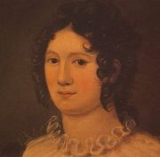
Claire Clairmont

Encyclopedia
Clara Mary Jane Clairmont (27 April 1798 – 19 March 1879), or Claire Clairmont as she was commonly known, was a stepsister of writer Mary Shelley
and the mother of Lord Byron's daughter Allegra
.
of Sandhill Park
, near Taunton
, Somerset
. Her mother had identified him as a "Charles Clairmont", adopting the name Clairmont for herself and her children, to disguise their illegitimacy. It appears that the father of her first child, Charles, was Charles Abram Marc Gaulis, "a merchant and member of a prominent Swiss family, whom she met in Cadiz".
In December 1801, Mary Jane Clairmont married her neighbor William Godwin
. Godwin had a daughter, Mary
, who was eight months older than Claire Clairmont, and a stepdaughter Fanny Imlay
. The girls would grow to be close and remain in contact with one another throughout the duration of their lives. Clairmont, like Mary Shelley
, was influenced by Godwin's radical anarchist philosophical beliefs. Her mother was well-educated and co-wrote children's primers on Biblical
and classical
history along with Godwin. Godwin encouraged all of his children to read widely and give lectures as soon as they could read. Mary Jane Godwin was also a sharp-tongued woman who often quarreled with Godwin and favoured her own children over Godwin's daughters. She contrived to send Clairmont to boarding school
for a time, thus providing the equally volatile and emotionally intense Clairmont, who was known as "Jane" when she was a child, with more formal education than her stepsisters. Clairmont, unlike Mary Shelley, was fluent in French
when she was a teenager and later was credited with fluency in five different languages.
 At sixteen, Clairmont was a lively, voluptuous brunette with a good singing voice and a hunger for recognition. Her home life had become increasingly tense, as her stepfather William Godwin sank deeper into debt and her mother's relations with Godwin's daughter Mary became more strained. Clairmont aided her stepsister's clandestine meetings with Percy Bysshe Shelley
, who had professed a belief in free love
and soon left his own wife and two small children to be with Mary. When Mary ran away with Shelley in July 1814, Clairmont went with them. Clairmont's mother traced the group to an inn in Calais
, but couldn't make the girl go home with her. Godwin needed the financial assistance that the aristocratic Shelley could provide. Clairmont remained in the Shelley household in their wanderings across Europe. The three young people traipsed across war-torn France, into Switzerland, fancying themselves like characters in a romantic novel, as Mary Shelley later recalled, but always reading widely, writing, and discussing the creative process. On the journey, Clairmont read Rousseau, Shakespeare, and the works of Mary's mother, Mary Wollstonecraft
. "What shall poor Cordelia do - Love & be silent," Clairmont wrote in her journal while reading King Lear
. “Oh [th]is is true – Real Love will never [sh]ew itself to the eye of broad day – it courts the secret glades.” Clairmont's emotions were so stirred by Cordelia that she had one of her "horrors," a hysterical fit, Mary Shelley recorded in her own journal entry for the same day. Clairmont, who was surrounded by poets and writers, also made her own literary attempts. During the summer of 1814, she started a story called "The Idiot," which has since been lost. In 1817-1818, she wrote a book which Percy Bysshe Shelley tried without success to have published. But though Claire lacked the literary talent of her stepsister and brother-in-law, she always longed to take center stage. It was during this period that she changed her name from "Jane" to first "Clara" and finally the more romantic-sounding "Claire."
Any romantic designs Clairmont might have had on Shelley were frustrated initially, but she did bring the Shelleys into contact with Lord Byron, with whom she entered into an affair before he left England in 1816 to live abroad. Clairmont had hopes of becoming a writer or an actress and wrote to Byron asking for "career advice" in March 1816, when she was almost eighteen. Byron was a director at the Drury Lane Theatre
. Clairmont later followed up her letters with visits, sometimes with her stepsister Mary Godwin, whom she seemed to suggest Byron might also find attractive. "Do you know I cannot talk to you when I see you? I am so awkward and only feel inclined to take a little stool and sit at your feet," Clairmont wrote to Byron. She "bombarded him with passionate daily communiques" telling him he need only accept "that which it has long been the passionate wish of my heart to give you". She arranged for them to meet at a country inn. Byron, in a depressed state after the break-up of his marriage to Annabella Milbanke and scandal over his relationship with his half-sister Augusta Leigh
, made it very clear to Clairmont before he left that she would not be a part of his life. Clairmont, on the other hand, was determined she would change his mind. She convinced Mary and Percy Bysshe Shelley
, that they should follow Byron to Switzerland
, where they met him and John William Polidori (Byron's personal physician) at the Villa Diodati by Lake Geneva
. It is unknown whether or not Clairmont knew she was pregnant with Byron's child at the commencement of the trip, but it soon became apparent to both her traveling companions and to Byron not long after their arrival at his door. At first he maintained his refusal of Clairmont's companionship and only allowed her to be in his presence in the company of the Shelleys; later, they resumed their sexual relationship for a time in Switzerland. Clairmont and Mary Shelley
also made fair copies of Byron's work-in-progress, Childe Harold's Pilgrimage
, which he was in the process of writing.
Clairmont was the only lover, other than Caroline Lamb, whom Byron referred to as a "little fiend." Confessing the affair in a letter to his half-sister Augusta Leigh
, Byron wrote
He referred to her also in the following manner, in a letter to Douglas Kinnaird (20 January 1817):
"[Claire Clairmont] You know--& I believe saw once that odd-headed girl—who introduced herself to me shortly before I left England—but you do not know—that I found her with Shelley
and her sister at Geneva—I never loved her nor pretended to love her—but a man is a man--& if a girl of eighteen comes prancing to you at all hours of the night—there is but one way—the suite of all this is that she was with child--& returned to England to assist in peopling that desolate island...This comes of "putting it about" (as Jackson calls it) & be dammed to it—and thus people come into the world."
Clairmont was to say later that her relationship with Byron had given her only a few minutes of pleasure, but a lifetime of trouble.
. Clairmont took up residence in Bath and in January 1817 she gave birth to a daughter, Alba, whose name was eventually changed to Allegra
. Throughout the pregnancy, Clairmont had written long letters to Byron, pleading for his attention and a promise to care for her and the baby, sometimes making fun of his friends, reminding him how much he had enjoyed making love to her, and sometimes threatening suicide. Byron, who by this time hated her, ignored the letters. The following year, Clairmont and the Shelleys left England and journeyed once more to Byron, who now resided in Italy
. Clairmont felt that the future Byron could provide for their daughter would be greater than any she herself would be able to grant the child and, therefore, wished to deliver Allegra into his care.
Upon arriving in Italy, Clairmont was again refused by Byron. He arranged to have Allegra delivered to his house in Venice
and agreed to raise the child on the condition that Clairmont keep her distance from him. Clairmont reluctantly gave Allegra over to Byron.
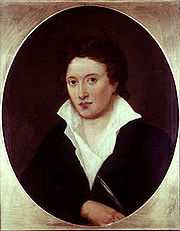 Clairmont may have been sexually involved with Percy Bysshe Shelley at different periods, though Clairmont's biographers, Gittings
and Manton, find no hard evidence. Their friend Thomas Jefferson Hogg
joked about "Shelley and his two wives," Mary and Claire, a remark that Clairmont recorded in her own journal. Clairmont was also entirely in sympathy, more so than Mary, with Shelley's theories about free love, communal living, and the right of a woman to choose her own lovers and initiate sexual contact outside of marriage. She seemed to conceive of love as a "triangle
" and enjoyed being the third. She had also formed a close friendship with Shelley, who called her "my sweet child" and inspired and fed off his work. Mary Shelley's early journals record several times when Clairmont and Shelley shared visions of Gothic horror
and let their imaginings take flight, stirring each others' emotions to the point of hysteria
and nightmares. In October 1814, Shelley deliberately frightened Clairmont by assuming a particularly sinister and horrifying facial expression. "How horribly you look ... Take your eyes off!" she cried. She was put to bed after yet another of her "horrors." Percy Bysshe Shelley described her expression to Mary Shelley as “distorted most unnaturally by horrible dismay”. In the autumn of 1814 Clairmont and Shelley also discussed forming "an association of philosophical people" and Clairmont's conception of an idealized community in which women were the ones in charge.
Shelley's poem "To Constantia, Singing" is thought to be about her:
Mary Shelley revised this poem, completely altering the first two stanzas, when she included it in a posthumous collection of Shelley's works published in 1824.< In Shelley's "Epipsychidion," some scholars believe that he is addressing Clairmont as his
At the time Percy Shelley wrote the poem, in Pisa
, Clairmont was living in Florence
, and the lines may reveal how much he missed her.
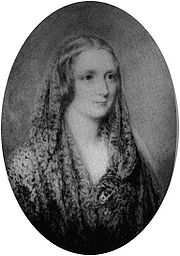 It has occasionally been suggested that Clairmont was also the mother of a daughter fathered by Percy Shelley. The possibility goes back to the accusation by Shelley's servants, Elise and Paolo Foggi, that Clairmont gave birth to Percy Shelley's baby during a stay in Naples
, where, on 27 February 1819, Percy Shelley registered a baby named Elena Adelaide Shelley as having been born on 27 December 1818. The registrar recorded her as the daughter of Percy Shelley and "Maria" or "Marina Padurin" (possibly an Italian mispronounciation of "Mary Godwin"), and she was baptized the same day as the lawfully begotten child of Percy Shelley and Mary Godwin. It is, however, almost impossible that Mary Shelley was the mother, and this has given rise to several theories, including that the child was indeed Clairmont's. Claire herself had ascended Mount Vesuvius
, carried on a palanquin, on 16 December 1818, only nine days before the date given for the birth of Elena. It may be significant, however, that she was taken ill at about the same time—according to Mary Shelley's journal she was ill on 27 December—and that her journal of June 1818 to early March 1819 has been lost. In a letter to Isabella Hoppner of 10 August 1821, Mary Shelley, however, stated emphatically that "Claire had no child". She also insisted:
The infant Elena was placed with foster parents and later died on 10 June 1820. Byron believed the rumors about Elena and used them as one more reason not to let Clairmont influence Allegra.
 Clairmont was granted only a few brief visits with her daughter after surrendering her to Byron. When Byron arranged to place her in a Capuchin
convent in Bagnacavallo
, Italy
, Clairmont was outraged. In 1821, she wrote Byron a letter accusing him of breaking his promise that their daughter would never be apart from one of her parents. She felt that the physical conditions in convents were unhealthy and the education provided was poor and was responsible for "the state of ignorance & profligacy of Italian women, all pupils of Convents. They are bad wives & most unnatural mothers, licentious & ignorant they are the dishonour & unhappiness of society ... This step will procure to you an innumerable addition of enemies & of blame." By March 1822 it had been two years since she had seen her daughter. She plotted to kidnap Allegra from the convent and asked Shelley to forge a letter of permission from Byron. Shelley refused her request. Byron's seemingly callous treatment of the child was further vilified when Allegra
died there at age five from a fever some scholars identify as typhus
and others speculate was a malarial-type fever
. Clairmont held Byron entirely responsible for the loss of their daughter and hated him for the rest of her life. Percy Bysshe Shelley's
death followed only two months later.
, who was to play a major role in the short remaining lives of both poets. After Shelley's death, Trelawny sent her love letters from Florence pleading with her to marry him, but she was not interested. Still, she remained in contact with him the rest of her long life. Clairmont wrote to Mary Shelley; “He [Trelawny] likes a turbid and troubled life; I a quiet one; he is full of fine feeling and has no principles; I am full of fine principles but never had a feeling (in my life).”
Devastated after Shelley's death, Mary returned to England. She paid for Clairmont to travel to her brother's home in Vienna
where she stayed for a year, before relocating to Russia, where she worked as a governess from 1825 to 1828. The people she worked for treated her almost as a member of the family. Still, what Clairmont longed for most of all was privacy and peace and quiet, as she complained in letters to Mary Shelley.
Two Russian men she met commented on her general disdain for the male sex; irritated by their assumption that since she was always falling in love, she would return their affections if they flirted with her, Clairmont joked in a letter to Mary Shelley that perhaps she should fall in love with both of them at once and prove them wrong. She returned to England in 1828, but remained there only a short while before departing for Dresden
, where she was employed as a companion and housekeeper. Scholar Bradford A. Booth suggested in 1938 that Clairmont, driven by a need for money, might have been the true author of most of "The Pole," an 1830 short story that appeared in the magazine The Court Assembly and Belle Assemblée as by "The Author of Frankenstein
" Unlike Mary Shelley, Clairmont was familiar with the Polish
used in the story. At one point, she thought of writing a book about the dangers that might result from "erroneous opinions" about the relations between men and women, using examples from the lives of Shelley and Byron. She did not make many literary attempts, as she explained to her friend Jane Williams:
Clairmont returned to England in 1836 and worked as a music teacher. She cared for her mother when she was dying. In 1841, after Mary Jane Godwin's death, Clairmont moved to Pisa, where she lived with Lady Margaret Mount Cashell, an old pupil of Mary Wollstonecraft
. She lived in Paris for a time in the 1840s. Percy Bysshe Shelley had left her twelve thousand pounds in his will, which she finally received in 1844. She carried on a sometimes turbulent, bitter correspondence with her stepsister Mary Shelley until she died in 1851. She converted to Catholicism, despite having hated the religion earlier in her life. She moved to Florence
in 1870 and lived there in an expatriate colony with her niece, Paulina. Clairmont also clung to memorabilia of Percy Bysshe Shelley. The Aspern Papers
by Henry James
is based on the narrator's attempts to gain ownership of these items. She died in Florence on 19 March 1879, at the age of eighty. Of all the members of Shelley's Circle, Clairmont outlived all except Trelawny and Jane Williams.
in the Goya award winning 1988 Spanish film Rowing with the Wind
. She was portrayed by Myriam Cyr in the 1986 Ken Russell
film "Gothic
"; and by Laura Dern
in "Haunted Summer" (1988). All three films focus on the 1816 trip to Switzerland during which Clairmont aimed to reunite with Byron and Mary Shelley
began writing Frankenstein
.
Mary Shelley
Mary Shelley was a British novelist, short story writer, dramatist, essayist, biographer, and travel writer, best known for her Gothic novel Frankenstein: or, The Modern Prometheus . She also edited and promoted the works of her husband, the Romantic poet and philosopher Percy Bysshe Shelley...
and the mother of Lord Byron's daughter Allegra
Allegra Byron
Clara Allegra Byron , initially named Alba, meaning "dawn," or "white," by her mother, was the illegitimate daughter of the poet George Gordon, Lord Byron and Claire Clairmont, the stepsister of Mary Shelley....
.
Early life
She was born in 1798 in Brislington, near Bristol, the second child and only daughter of Mary Jane Vial Clairmont. In 2010 the identity of her father was discovered: John (later Sir John) LethbridgeLethbridge Baronets
The Lethbridge Baronetcy, of Westaway House and Winkley Court in the County of Somerset, is a title in the Baronetage of the United Kingdom. It was created on 15 June 1804 for John Lethbridge. The second Baronet sat as Member of Parliament for Somerset between 1806 and 1812 and 1826 and 1830...
of Sandhill Park
Sandhill Park
Sandhill Park in Bishops Lydeard, Somerset, England was built as a country house around 1720. It was later used as a prisoner of war camp, home for handicapped children and later as a military and civilian hospital....
, near Taunton
Taunton
Taunton is the county town of Somerset, England. The town, including its suburbs, had an estimated population of 61,400 in 2001. It is the largest town in the shire county of Somerset....
, Somerset
Somerset
The ceremonial and non-metropolitan county of Somerset in South West England borders Bristol and Gloucestershire to the north, Wiltshire to the east, Dorset to the south-east, and Devon to the south-west. It is partly bounded to the north and west by the Bristol Channel and the estuary of the...
. Her mother had identified him as a "Charles Clairmont", adopting the name Clairmont for herself and her children, to disguise their illegitimacy. It appears that the father of her first child, Charles, was Charles Abram Marc Gaulis, "a merchant and member of a prominent Swiss family, whom she met in Cadiz".
In December 1801, Mary Jane Clairmont married her neighbor William Godwin
William Godwin
William Godwin was an English journalist, political philosopher and novelist. He is considered one of the first exponents of utilitarianism, and the first modern proponent of anarchism...
. Godwin had a daughter, Mary
Mary Shelley
Mary Shelley was a British novelist, short story writer, dramatist, essayist, biographer, and travel writer, best known for her Gothic novel Frankenstein: or, The Modern Prometheus . She also edited and promoted the works of her husband, the Romantic poet and philosopher Percy Bysshe Shelley...
, who was eight months older than Claire Clairmont, and a stepdaughter Fanny Imlay
Fanny Imlay
Frances "Fanny" Imlay , also known as Fanny Godwin, was the illegitimate daughter of the British feminist Mary Wollstonecraft and the American commercial speculator Gilbert Imlay.Although Mary Wollstonecraft and Gilbert Imlay lived together happily for brief periods before and after the birth...
. The girls would grow to be close and remain in contact with one another throughout the duration of their lives. Clairmont, like Mary Shelley
Mary Shelley
Mary Shelley was a British novelist, short story writer, dramatist, essayist, biographer, and travel writer, best known for her Gothic novel Frankenstein: or, The Modern Prometheus . She also edited and promoted the works of her husband, the Romantic poet and philosopher Percy Bysshe Shelley...
, was influenced by Godwin's radical anarchist philosophical beliefs. Her mother was well-educated and co-wrote children's primers on Biblical
Bible
The Bible refers to any one of the collections of the primary religious texts of Judaism and Christianity. There is no common version of the Bible, as the individual books , their contents and their order vary among denominations...
and classical
Classics
Classics is the branch of the Humanities comprising the languages, literature, philosophy, history, art, archaeology and other culture of the ancient Mediterranean world ; especially Ancient Greece and Ancient Rome during Classical Antiquity Classics (sometimes encompassing Classical Studies or...
history along with Godwin. Godwin encouraged all of his children to read widely and give lectures as soon as they could read. Mary Jane Godwin was also a sharp-tongued woman who often quarreled with Godwin and favoured her own children over Godwin's daughters. She contrived to send Clairmont to boarding school
Boarding school
A boarding school is a school where some or all pupils study and live during the school year with their fellow students and possibly teachers and/or administrators. The word 'boarding' is used in the sense of "bed and board," i.e., lodging and meals...
for a time, thus providing the equally volatile and emotionally intense Clairmont, who was known as "Jane" when she was a child, with more formal education than her stepsisters. Clairmont, unlike Mary Shelley, was fluent in French
French language
French is a Romance language spoken as a first language in France, the Romandy region in Switzerland, Wallonia and Brussels in Belgium, Monaco, the regions of Quebec and Acadia in Canada, and by various communities elsewhere. Second-language speakers of French are distributed throughout many parts...
when she was a teenager and later was credited with fluency in five different languages.
Byron
Percy Bysshe Shelley
Percy Bysshe Shelley was one of the major English Romantic poets and is critically regarded as among the finest lyric poets in the English language. Shelley was famous for his association with John Keats and Lord Byron...
, who had professed a belief in free love
Free love
The term free love has been used to describe a social movement that rejects marriage, which is seen as a form of social bondage. The Free Love movement’s initial goal was to separate the state from sexual matters such as marriage, birth control, and adultery...
and soon left his own wife and two small children to be with Mary. When Mary ran away with Shelley in July 1814, Clairmont went with them. Clairmont's mother traced the group to an inn in Calais
Calais
Calais is a town in Northern France in the department of Pas-de-Calais, of which it is a sub-prefecture. Although Calais is by far the largest city in Pas-de-Calais, the department's capital is its third-largest city of Arras....
, but couldn't make the girl go home with her. Godwin needed the financial assistance that the aristocratic Shelley could provide. Clairmont remained in the Shelley household in their wanderings across Europe. The three young people traipsed across war-torn France, into Switzerland, fancying themselves like characters in a romantic novel, as Mary Shelley later recalled, but always reading widely, writing, and discussing the creative process. On the journey, Clairmont read Rousseau, Shakespeare, and the works of Mary's mother, Mary Wollstonecraft
Mary Wollstonecraft
Mary Wollstonecraft was an eighteenth-century British writer, philosopher, and advocate of women's rights. During her brief career, she wrote novels, treatises, a travel narrative, a history of the French Revolution, a conduct book, and a children's book...
. "What shall poor Cordelia do - Love & be silent," Clairmont wrote in her journal while reading King Lear
King Lear
King Lear is a tragedy by William Shakespeare. The title character descends into madness after foolishly disposing of his estate between two of his three daughters based on their flattery, bringing tragic consequences for all. The play is based on the legend of Leir of Britain, a mythological...
. “Oh [th]is is true – Real Love will never [sh]ew itself to the eye of broad day – it courts the secret glades.” Clairmont's emotions were so stirred by Cordelia that she had one of her "horrors," a hysterical fit, Mary Shelley recorded in her own journal entry for the same day. Clairmont, who was surrounded by poets and writers, also made her own literary attempts. During the summer of 1814, she started a story called "The Idiot," which has since been lost. In 1817-1818, she wrote a book which Percy Bysshe Shelley tried without success to have published. But though Claire lacked the literary talent of her stepsister and brother-in-law, she always longed to take center stage. It was during this period that she changed her name from "Jane" to first "Clara" and finally the more romantic-sounding "Claire."
Any romantic designs Clairmont might have had on Shelley were frustrated initially, but she did bring the Shelleys into contact with Lord Byron, with whom she entered into an affair before he left England in 1816 to live abroad. Clairmont had hopes of becoming a writer or an actress and wrote to Byron asking for "career advice" in March 1816, when she was almost eighteen. Byron was a director at the Drury Lane Theatre
Theatre Royal, Drury Lane
The Theatre Royal, Drury Lane is a West End theatre in Covent Garden, in the City of Westminster, a borough of London. The building faces Catherine Street and backs onto Drury Lane. The building standing today is the most recent in a line of four theatres at the same location dating back to 1663,...
. Clairmont later followed up her letters with visits, sometimes with her stepsister Mary Godwin, whom she seemed to suggest Byron might also find attractive. "Do you know I cannot talk to you when I see you? I am so awkward and only feel inclined to take a little stool and sit at your feet," Clairmont wrote to Byron. She "bombarded him with passionate daily communiques" telling him he need only accept "that which it has long been the passionate wish of my heart to give you". She arranged for them to meet at a country inn. Byron, in a depressed state after the break-up of his marriage to Annabella Milbanke and scandal over his relationship with his half-sister Augusta Leigh
Augusta Leigh
Augusta Maria Byron, later Augusta Maria Leigh , styled "The Honourable" from birth, was the only daughter of John "Mad Jack" Byron, the poet Lord Byron's father, by his first wife, Amelia Osborne .-Early...
, made it very clear to Clairmont before he left that she would not be a part of his life. Clairmont, on the other hand, was determined she would change his mind. She convinced Mary and Percy Bysshe Shelley
Percy Bysshe Shelley
Percy Bysshe Shelley was one of the major English Romantic poets and is critically regarded as among the finest lyric poets in the English language. Shelley was famous for his association with John Keats and Lord Byron...
, that they should follow Byron to Switzerland
Switzerland
Switzerland name of one of the Swiss cantons. ; ; ; or ), in its full name the Swiss Confederation , is a federal republic consisting of 26 cantons, with Bern as the seat of the federal authorities. The country is situated in Western Europe,Or Central Europe depending on the definition....
, where they met him and John William Polidori (Byron's personal physician) at the Villa Diodati by Lake Geneva
Lake Geneva
Lake Geneva or Lake Léman is a lake in Switzerland and France. It is one of the largest lakes in Western Europe. 59.53 % of it comes under the jurisdiction of Switzerland , and 40.47 % under France...
. It is unknown whether or not Clairmont knew she was pregnant with Byron's child at the commencement of the trip, but it soon became apparent to both her traveling companions and to Byron not long after their arrival at his door. At first he maintained his refusal of Clairmont's companionship and only allowed her to be in his presence in the company of the Shelleys; later, they resumed their sexual relationship for a time in Switzerland. Clairmont and Mary Shelley
Mary Shelley
Mary Shelley was a British novelist, short story writer, dramatist, essayist, biographer, and travel writer, best known for her Gothic novel Frankenstein: or, The Modern Prometheus . She also edited and promoted the works of her husband, the Romantic poet and philosopher Percy Bysshe Shelley...
also made fair copies of Byron's work-in-progress, Childe Harold's Pilgrimage
Childe Harold's Pilgrimage
Childe Harold's Pilgrimage is a lengthy narrative poem in four parts written by Lord Byron. It was published between 1812 and 1818 and is dedicated to "Ianthe". The poem describes the travels and reflections of a world-weary young man who, disillusioned with a life of pleasure and revelry, looks...
, which he was in the process of writing.
Clairmont was the only lover, other than Caroline Lamb, whom Byron referred to as a "little fiend." Confessing the affair in a letter to his half-sister Augusta Leigh
Augusta Leigh
Augusta Maria Byron, later Augusta Maria Leigh , styled "The Honourable" from birth, was the only daughter of John "Mad Jack" Byron, the poet Lord Byron's father, by his first wife, Amelia Osborne .-Early...
, Byron wrote
What could I do? -- a foolish girl -- in spite of all I could say or do -- would come after me -- or rather went before me -- for I found her here ... I could not exactly play the StoicSTOICSTOIC was a variant of Forth.It started out at the MIT and Harvard Biomedical Engineering Centre in Boston, and was written in the mid 1970s by Jonathan Sachs...
with a woman -- who had scrambled eight hundred miles to unphilosophize me."
He referred to her also in the following manner, in a letter to Douglas Kinnaird (20 January 1817):
"[Claire Clairmont] You know--& I believe saw once that odd-headed girl—who introduced herself to me shortly before I left England—but you do not know—that I found her with Shelley
and her sister at Geneva—I never loved her nor pretended to love her—but a man is a man--& if a girl of eighteen comes prancing to you at all hours of the night—there is but one way—the suite of all this is that she was with child--& returned to England to assist in peopling that desolate island...This comes of "putting it about" (as Jackson calls it) & be dammed to it—and thus people come into the world."
Clairmont was to say later that her relationship with Byron had given her only a few minutes of pleasure, but a lifetime of trouble.
Birth of Allegra
The group left Byron in Switzerland at the end of the summer and returned to EnglandEngland
England is a country that is part of the United Kingdom. It shares land borders with Scotland to the north and Wales to the west; the Irish Sea is to the north west, the Celtic Sea to the south west, with the North Sea to the east and the English Channel to the south separating it from continental...
. Clairmont took up residence in Bath and in January 1817 she gave birth to a daughter, Alba, whose name was eventually changed to Allegra
Allegra Byron
Clara Allegra Byron , initially named Alba, meaning "dawn," or "white," by her mother, was the illegitimate daughter of the poet George Gordon, Lord Byron and Claire Clairmont, the stepsister of Mary Shelley....
. Throughout the pregnancy, Clairmont had written long letters to Byron, pleading for his attention and a promise to care for her and the baby, sometimes making fun of his friends, reminding him how much he had enjoyed making love to her, and sometimes threatening suicide. Byron, who by this time hated her, ignored the letters. The following year, Clairmont and the Shelleys left England and journeyed once more to Byron, who now resided in Italy
Italy
Italy , officially the Italian Republic languages]] under the European Charter for Regional or Minority Languages. In each of these, Italy's official name is as follows:;;;;;;;;), is a unitary parliamentary republic in South-Central Europe. To the north it borders France, Switzerland, Austria and...
. Clairmont felt that the future Byron could provide for their daughter would be greater than any she herself would be able to grant the child and, therefore, wished to deliver Allegra into his care.
Upon arriving in Italy, Clairmont was again refused by Byron. He arranged to have Allegra delivered to his house in Venice
Venice
Venice is a city in northern Italy which is renowned for the beauty of its setting, its architecture and its artworks. It is the capital of the Veneto region...
and agreed to raise the child on the condition that Clairmont keep her distance from him. Clairmont reluctantly gave Allegra over to Byron.
Percy Bysshe Shelley
Robert Gittings
Robert William Victor Gittings CBE , was an English writer, biographer, BBC Radio producer, playwright and minor poet...
and Manton, find no hard evidence. Their friend Thomas Jefferson Hogg
Thomas Jefferson Hogg
Thomas Jefferson Hogg was a British barrister and writer best known for his friendship with the Romantic poet Percy Bysshe Shelley. Hogg was raised in County Durham, but spent most of his life in London. He and Shelley became friends while studying at University College, Oxford, and remained close...
joked about "Shelley and his two wives," Mary and Claire, a remark that Clairmont recorded in her own journal. Clairmont was also entirely in sympathy, more so than Mary, with Shelley's theories about free love, communal living, and the right of a woman to choose her own lovers and initiate sexual contact outside of marriage. She seemed to conceive of love as a "triangle
Love triangle
A love triangle is usually a romantic relationship involving three people. While it can refer to two people independently romantically linked with a third, it usually implies that each of the three people has some kind of relationship to the other two...
" and enjoyed being the third. She had also formed a close friendship with Shelley, who called her "my sweet child" and inspired and fed off his work. Mary Shelley's early journals record several times when Clairmont and Shelley shared visions of Gothic horror
Gothic fiction
Gothic fiction, sometimes referred to as Gothic horror, is a genre or mode of literature that combines elements of both horror and romance. Gothicism's origin is attributed to English author Horace Walpole, with his 1764 novel The Castle of Otranto, subtitled "A Gothic Story"...
and let their imaginings take flight, stirring each others' emotions to the point of hysteria
Hysteria
Hysteria, in its colloquial use, describes unmanageable emotional excesses. People who are "hysterical" often lose self-control due to an overwhelming fear that may be caused by multiple events in one's past that involved some sort of severe conflict; the fear can be centered on a body part, or,...
and nightmares. In October 1814, Shelley deliberately frightened Clairmont by assuming a particularly sinister and horrifying facial expression. "How horribly you look ... Take your eyes off!" she cried. She was put to bed after yet another of her "horrors." Percy Bysshe Shelley described her expression to Mary Shelley as “distorted most unnaturally by horrible dismay”. In the autumn of 1814 Clairmont and Shelley also discussed forming "an association of philosophical people" and Clairmont's conception of an idealized community in which women were the ones in charge.
Shelley's poem "To Constantia, Singing" is thought to be about her:
Mary Shelley revised this poem, completely altering the first two stanzas, when she included it in a posthumous collection of Shelley's works published in 1824.< In Shelley's "Epipsychidion," some scholars believe that he is addressing Clairmont as his
At the time Percy Shelley wrote the poem, in Pisa
Pisa
Pisa is a city in Tuscany, Central Italy, on the right bank of the mouth of the River Arno on the Tyrrhenian Sea. It is the capital city of the Province of Pisa...
, Clairmont was living in Florence
Florence
Florence is the capital city of the Italian region of Tuscany and of the province of Florence. It is the most populous city in Tuscany, with approximately 370,000 inhabitants, expanding to over 1.5 million in the metropolitan area....
, and the lines may reveal how much he missed her.
Naples
Naples is a city in Southern Italy, situated on the country's west coast by the Gulf of Naples. Lying between two notable volcanic regions, Mount Vesuvius and the Phlegraean Fields, it is the capital of the region of Campania and of the province of Naples...
, where, on 27 February 1819, Percy Shelley registered a baby named Elena Adelaide Shelley as having been born on 27 December 1818. The registrar recorded her as the daughter of Percy Shelley and "Maria" or "Marina Padurin" (possibly an Italian mispronounciation of "Mary Godwin"), and she was baptized the same day as the lawfully begotten child of Percy Shelley and Mary Godwin. It is, however, almost impossible that Mary Shelley was the mother, and this has given rise to several theories, including that the child was indeed Clairmont's. Claire herself had ascended Mount Vesuvius
Mount Vesuvius
Mount Vesuvius is a stratovolcano in the Gulf of Naples, Italy, about east of Naples and a short distance from the shore. It is the only volcano on the European mainland to have erupted within the last hundred years, although it is not currently erupting...
, carried on a palanquin, on 16 December 1818, only nine days before the date given for the birth of Elena. It may be significant, however, that she was taken ill at about the same time—according to Mary Shelley's journal she was ill on 27 December—and that her journal of June 1818 to early March 1819 has been lost. In a letter to Isabella Hoppner of 10 August 1821, Mary Shelley, however, stated emphatically that "Claire had no child". She also insisted:
I am perfectly convinced in my own mind that Shelley never had an improper connexion [sic] with Claire ... we lived in lodgings where I had momentary entrance into every room and such a thing could not have passed unknown to me ... I do remember that Claire did keep to her bed there for two days—but I attended on her—I saw the physician—her illness was one that she had been accustomed to for years—and the same remedies were employed as I had before ministered to her in England.
The infant Elena was placed with foster parents and later died on 10 June 1820. Byron believed the rumors about Elena and used them as one more reason not to let Clairmont influence Allegra.
Death of Allegra
Order of Friars Minor Capuchin
The Order of Friars Minor Capuchin is an Order of friars in the Catholic Church, among the chief offshoots of the Franciscans. The worldwide head of the Order, called the Minister General, is currently Father Mauro Jöhri.-Origins :...
convent in Bagnacavallo
Bagnacavallo
Bagnacavallo is a town and comune in the province of Ravenna, Emilia-Romagna, Italy. .The Renaissance painter Bartolommeo Ramenghi bore the nickname of his native city.- Main sights:*Castellaccio * Giardino dei Semplici...
, Italy
Italy
Italy , officially the Italian Republic languages]] under the European Charter for Regional or Minority Languages. In each of these, Italy's official name is as follows:;;;;;;;;), is a unitary parliamentary republic in South-Central Europe. To the north it borders France, Switzerland, Austria and...
, Clairmont was outraged. In 1821, she wrote Byron a letter accusing him of breaking his promise that their daughter would never be apart from one of her parents. She felt that the physical conditions in convents were unhealthy and the education provided was poor and was responsible for "the state of ignorance & profligacy of Italian women, all pupils of Convents. They are bad wives & most unnatural mothers, licentious & ignorant they are the dishonour & unhappiness of society ... This step will procure to you an innumerable addition of enemies & of blame." By March 1822 it had been two years since she had seen her daughter. She plotted to kidnap Allegra from the convent and asked Shelley to forge a letter of permission from Byron. Shelley refused her request. Byron's seemingly callous treatment of the child was further vilified when Allegra
Allegra Byron
Clara Allegra Byron , initially named Alba, meaning "dawn," or "white," by her mother, was the illegitimate daughter of the poet George Gordon, Lord Byron and Claire Clairmont, the stepsister of Mary Shelley....
died there at age five from a fever some scholars identify as typhus
Typhus
Epidemic typhus is a form of typhus so named because the disease often causes epidemics following wars and natural disasters...
and others speculate was a malarial-type fever
Malaria
Malaria is a mosquito-borne infectious disease of humans and other animals caused by eukaryotic protists of the genus Plasmodium. The disease results from the multiplication of Plasmodium parasites within red blood cells, causing symptoms that typically include fever and headache, in severe cases...
. Clairmont held Byron entirely responsible for the loss of their daughter and hated him for the rest of her life. Percy Bysshe Shelley's
Percy Bysshe Shelley
Percy Bysshe Shelley was one of the major English Romantic poets and is critically regarded as among the finest lyric poets in the English language. Shelley was famous for his association with John Keats and Lord Byron...
death followed only two months later.
Later life
Shortly after Clairmont had introduced Shelley to Byron she met Edward John TrelawnyEdward John Trelawny
Edward John Trelawny was a biographer, novelist and adventurer who is best known for his friendship with the Romantic poets Percy Bysshe Shelley and Lord Byron. Trelawny was born in England to a family of modest income but extensive ancestral history...
, who was to play a major role in the short remaining lives of both poets. After Shelley's death, Trelawny sent her love letters from Florence pleading with her to marry him, but she was not interested. Still, she remained in contact with him the rest of her long life. Clairmont wrote to Mary Shelley; “He [Trelawny] likes a turbid and troubled life; I a quiet one; he is full of fine feeling and has no principles; I am full of fine principles but never had a feeling (in my life).”
Devastated after Shelley's death, Mary returned to England. She paid for Clairmont to travel to her brother's home in Vienna
Vienna
Vienna is the capital and largest city of the Republic of Austria and one of the nine states of Austria. Vienna is Austria's primary city, with a population of about 1.723 million , and is by far the largest city in Austria, as well as its cultural, economic, and political centre...
where she stayed for a year, before relocating to Russia, where she worked as a governess from 1825 to 1828. The people she worked for treated her almost as a member of the family. Still, what Clairmont longed for most of all was privacy and peace and quiet, as she complained in letters to Mary Shelley.
Two Russian men she met commented on her general disdain for the male sex; irritated by their assumption that since she was always falling in love, she would return their affections if they flirted with her, Clairmont joked in a letter to Mary Shelley that perhaps she should fall in love with both of them at once and prove them wrong. She returned to England in 1828, but remained there only a short while before departing for Dresden
Dresden
Dresden is the capital city of the Free State of Saxony in Germany. It is situated in a valley on the River Elbe, near the Czech border. The Dresden conurbation is part of the Saxon Triangle metropolitan area....
, where she was employed as a companion and housekeeper. Scholar Bradford A. Booth suggested in 1938 that Clairmont, driven by a need for money, might have been the true author of most of "The Pole," an 1830 short story that appeared in the magazine The Court Assembly and Belle Assemblée as by "The Author of Frankenstein
Frankenstein
Frankenstein; or, The Modern Prometheus is a novel about a failed experiment that produced a monster, written by Mary Shelley, with inserts of poems by Percy Bysshe Shelley. Shelley started writing the story when she was eighteen, and the novel was published when she was twenty-one. The first...
" Unlike Mary Shelley, Clairmont was familiar with the Polish
Polish language
Polish is a language of the Lechitic subgroup of West Slavic languages, used throughout Poland and by Polish minorities in other countries...
used in the story. At one point, she thought of writing a book about the dangers that might result from "erroneous opinions" about the relations between men and women, using examples from the lives of Shelley and Byron. She did not make many literary attempts, as she explained to her friend Jane Williams:
But in our family, if you cannot write an epic or novel, that by its originality knocks all other novels on the head, you are a despicable creature, not worth acknowledging.
Clairmont returned to England in 1836 and worked as a music teacher. She cared for her mother when she was dying. In 1841, after Mary Jane Godwin's death, Clairmont moved to Pisa, where she lived with Lady Margaret Mount Cashell, an old pupil of Mary Wollstonecraft
Mary Wollstonecraft
Mary Wollstonecraft was an eighteenth-century British writer, philosopher, and advocate of women's rights. During her brief career, she wrote novels, treatises, a travel narrative, a history of the French Revolution, a conduct book, and a children's book...
. She lived in Paris for a time in the 1840s. Percy Bysshe Shelley had left her twelve thousand pounds in his will, which she finally received in 1844. She carried on a sometimes turbulent, bitter correspondence with her stepsister Mary Shelley until she died in 1851. She converted to Catholicism, despite having hated the religion earlier in her life. She moved to Florence
Florence
Florence is the capital city of the Italian region of Tuscany and of the province of Florence. It is the most populous city in Tuscany, with approximately 370,000 inhabitants, expanding to over 1.5 million in the metropolitan area....
in 1870 and lived there in an expatriate colony with her niece, Paulina. Clairmont also clung to memorabilia of Percy Bysshe Shelley. The Aspern Papers
The Aspern Papers
The Aspern Papers is a novella written by Henry James, originally published in The Atlantic Monthly in 1888, with its first book publication later in the same year. One of James' best-known and most acclaimed longer tales, The Aspern Papers is based on an anecdote that James heard about a Shelley...
by Henry James
Henry James
Henry James, OM was an American-born writer, regarded as one of the key figures of 19th-century literary realism. He was the son of Henry James, Sr., a clergyman, and the brother of philosopher and psychologist William James and diarist Alice James....
is based on the narrator's attempts to gain ownership of these items. She died in Florence on 19 March 1879, at the age of eighty. Of all the members of Shelley's Circle, Clairmont outlived all except Trelawny and Jane Williams.
In popular culture
Clairmont was portrayed by Elizabeth HurleyElizabeth Hurley
Elizabeth Jane Hurley is an English model and actress who became known as a girlfriend of Hugh Grant in the 1990s. In 1994, as Grant became the focus of worldwide media attention due to the global box office success of his film Four Weddings and a Funeral, Hurley accompanied him to the film's Los...
in the Goya award winning 1988 Spanish film Rowing with the Wind
Rowing with the Wind
Rowing with the Wind aka Remando al viento is a 1988 Spanish film written and directed by Gonzalo Suárez. The film won seven Goya Awards...
. She was portrayed by Myriam Cyr in the 1986 Ken Russell
Ken Russell
Henry Kenneth Alfred "Ken" Russell was an English film director, known for his pioneering work in television and film and for his flamboyant and controversial style. He attracted criticism as being obsessed with sexuality and the church...
film "Gothic
Gothic (film)
Gothic is a 1986 film directed by Ken Russell. It starred Gabriel Byrne as Lord Byron, Julian Sands as Percy Bysshe Shelley, Natasha Richardson as Mary Shelley and Timothy Spall as Dr John William Polidori...
"; and by Laura Dern
Laura Dern
Laura Elizabeth Dern is an American actress, film director and producer. Dern has acted in such films as Smooth Talk , Blue Velvet , Fat Man and Little Boy , Wild at Heart , Jurassic Park and October Sky...
in "Haunted Summer" (1988). All three films focus on the 1816 trip to Switzerland during which Clairmont aimed to reunite with Byron and Mary Shelley
Mary Shelley
Mary Shelley was a British novelist, short story writer, dramatist, essayist, biographer, and travel writer, best known for her Gothic novel Frankenstein: or, The Modern Prometheus . She also edited and promoted the works of her husband, the Romantic poet and philosopher Percy Bysshe Shelley...
began writing Frankenstein
Frankenstein
Frankenstein; or, The Modern Prometheus is a novel about a failed experiment that produced a monster, written by Mary Shelley, with inserts of poems by Percy Bysshe Shelley. Shelley started writing the story when she was eighteen, and the novel was published when she was twenty-one. The first...
.
See also
- Godwin-Shelley family tree
External links
- Biography of Claire Clairmont
- The story of the unconventional menage a trois was filmed in 1988 with Laura DernLaura DernLaura Elizabeth Dern is an American actress, film director and producer. Dern has acted in such films as Smooth Talk , Blue Velvet , Fat Man and Little Boy , Wild at Heart , Jurassic Park and October Sky...
playing the part of ShelleyPercy Bysshe ShelleyPercy Bysshe Shelley was one of the major English Romantic poets and is critically regarded as among the finest lyric poets in the English language. Shelley was famous for his association with John Keats and Lord Byron...
's future sister-in-law, released as Haunted Summer (see Youtube for trailer) where the dramatists evoke certain salutory lessons on intimate relationships the mature Clairmont envisaged publishing herself)