

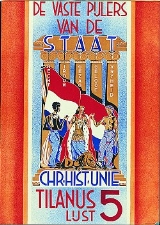
Christian Historical Union

Encyclopedia
The Christian Historical Union (in Dutch: Christelijk-Historische Unie, CHU) was a Dutch
conservative
Protestant political party
. The CHU is one of the predecessors of the Christian Democratic Appeal
.
(ARP) was founded by a group of orthodox reformed Protestants, who had split from the main Dutch Reformed Church to form the Reformed Churches in the Netherlands
. It advocated equal funding for religious schools, universal suffrage
and Protestant morality. Their main tactic was the anti-thesis
between religious and non-religious parties, which meant that it sought to break the cooperation between liberals and Catholics and to create an alliance between Catholics and Protestants. Furthermore it was the first party with a strong centralised organization - previously parties were organized as factions
. The party was joined by many conservatives, who agreed with part of their program, many of whom were still members of the Dutch Reformed Church
.
The Anti-Revolutionaries were rather successful winning 13 (out of 100) seats in the House of Representatives in the 1879 election, although not all MPs who campaigned as "Anti-Revolutionaries" were members of the ARP. After the 1888 election
the party formed a coalition cabinet with Anti-Revolutionaries and Catholics. In the 1891 election
the Catholic-Protestant coalition lost its majority. A liberal cabinet was formed. The liberal minister Tak proposed drastic changes to the census
, which would result practically in universal male suffrage. The ARP supported enlarged franchise.
Several of these events caused considerable tension between the core of the ARP and the conservatives who support them.
Because of these reasons a group of conservatives led by Alexander de Savorin-Lohman left the party. The group was composed out of members of the Dutch Reformed Church and many had an aristocratic background. In the 1894 election
they ran on individual "free anti-revolutionary" tickets and formed a free anti-revolutionary faction in parliament with six members. In 1896 they set up a committee to found a new party. In the 1897 election
the individual free anti-revolutionaries won five seats. The Christian Historical Voters' League
, another dissenting anti-revolutionary party, also won a seat, taken by Dutch Reformed minister De Visser. In 1898 the free anti revolutionaries founded a separate party the Free Anti Revolutionary Party
. In the 1901 elections
the party won nine seats, four more than the five the free Anti Revolutionaries had won as individual candidates in 1897. The religious parties won a majority in this election, a cabinet was formed by ARP leader Kuyper, which the VAR supported without providing any ministers. The Frisian League
, another dissenting anti revolutionary party also won one seat, taken by Dutch Reformed minister Schokking. In 1903 the VAR merged with the Christian Historical Voters' League to form the Christian Historical Party
. In 1908 the Christian Historical Party merged with the Frisian League
to found the Christian Historical Union.
. In the 1909 elections
the party won 10 seats, two more than the CHP and Frisian League won in 1905. In the 1913 elections
the party stayed stable. Between 1913 and 1918 the country was governed by an extra parliamentary cabinet
formed by liberals. Its main goal was to implement a constitutional reform combining both male universal suffrage and equal payment for religious schools. At the end of the cabinets term, two CHU ministers joined the cabinet, as they were relatively neutral politicians.
In the 1918 elections
, in which male universal suffrage and proportional representation
were used for the first time, the party lost three seats. Together the ARP, CHU and the Catholic RKSP won fifty seats. The CHU started to cooperate fully in the confessional coalition
. They formed a cabinet led by the Catholic Charles Ruijs de Beerenbrouck
. The CHU provided only one minister (De Visser became minister of Education, Arts and Sciences) and two non-partisan sympathisers of the CHU were appointed. During the cabinet's term one CHU member, Dirk Jan de Geer
and another CHU sympathiser were appointed as ministers, while the two CHU-sympathisers stepped down. In the 1922 elections
the party won four seats and the cabinet of Ruys de Beerenbrouck continued to govern, the CHU supplied two ministers and one non-partisan CHU-sympathiser is appointed. During the term one CHU minister, minister of finance De Geer, stepped down, after the budget of the ministry of the Navy is rejected. In the 1925 election
the party remained stable at 11 seats. A party which is closely related to the CHU, the HGS
, an orthodox version of the CHU, also won one seat. Another RKSP-ARP-CHU cabinet is formed now led by Hendrikus Colijn
, the CHU supplies to minister. In 1925 the cabinet fell prematurely because of a motion supported by the CHU parliamentary party. Each year the anti-Papist Political Reformed Party would propose a motion to remove the Dutch representative at the Holy See
, (a symbolic motion to show their opposition to the Pope) which was supported by the CHU. In 1925 the left-liberal Freethinking Democratic League and socialist Social-Democratic Workers' Party
supported this motion because they see it as an opportunity to bring about the downfall of the cabinet and form a progressive coalition after the elections. After lengthy formation talks an extra-parliamentary cabinet
is formed, led by De Geer of the CHU, with one other CHU member appointed and one further CHU member joining during the cabinet's lifetime. De Geer was chosen because he was a reliable administrator and a less divisive figure. In the 1929 election
the party remained stable at 11 seats. It cooperated in a new coalition cabinet led by Ruys de Beerenbrouck, supplying two ministers, with one CHU-sympathizer also serving as a minister.
After the 1933 election
, in which the party lost one seat, another coalition cabinet led by Colijn was formed, which was joined by members of the liberal Freethinking Democratic League and the Liberal State Party
. The CHU supplied only one minister and a further CHU member was appointed minister during the cabinet's term, who left after a cabinet crisis. During the 1930s a groups of the party's younger members, including Piet Lieftinck
begin to develop support for state intervention in the economy and form a Christian basis for this intervention on basis of the work of the theologian Karl Barth
. In the 1937 election
the party lost two additional seats, leaving eight. The party continued to govern in an ARP-RKSP-CHU coalition. In 1939 a national cabinet was formed with the SDAP and the three confessional parties. De Geer, as a reliable, respected administrator, led this cabinet. During the Second World War, De Geer's position becomes less tenable, as he attempted to negotiate a peace with the Germans against the will of the government. When the Dutch government went into exile
he is replaced by ARP-member Pieter Sjoerds Gerbrandy
and the CHU provided one minister in these cabinets in exile.
, joined the new social democratic Labour Party
(PvdA).
Between 1945 and 1948 the CHU was marginalized politically as the re-founded Catholic Catholic People's Party
(KVP) rejected cooperation with the confessional parties in favour of cooperation with the re-founded social-democratic Labour Party (PvdA). Some prominent progressive CHU-members left the CHU to join this new PvdA. It was kept out of the progressive Cabinet Schermerhorn
. In the 1946 elections
it kept it eight seats, which it also had before the war. The CHU was also kept out of the Beel I
which also just consisted of the KVP and PvdA.
After the 1948 elections
in which the party won one seat it was invited to join the cabinet again. It joined the broad basis cabinet Drees-I
which combined the KVP, PvdA, CHU and the conservative liberal VVD, that is every major party except for the Communist Party of the Netherlands
and the Anti Revolutionary Party
. These parties were excluded because they opposed the major reforms the cabinets were implementing, including the welfare state
, in the case of the CPN, and the decolonization of the Dutch Indies in the case of the ARP. The CHU endorsed both these policies, creating considerable conflict internally. The CHU parliamentary party in the Senate voted for the independence of Indonesia. The CHU provides one minister, which is expanded to two after a 1951 cabinet crisis. After the 1952 elections
a new cabinet
was formed and the VVD was replaced by the ARP, while the CHU retained two ministers. In the 1956 election
the party retained the same percentage of vote, but due to the expansion of parliament it gets 13 seats (out of 150). A new cabinet was formed with the same composition and the CHU retained its two ministers. In 1959 the cabinet fell prematurely. A care taker cabinet
was formed by ARP, KVP and CHU.
After the 1959 elections
in which the party lost one seat, a cabinet
is formed by KVP, ARP, CHU and VVD. The CHU still supplied two ministers. After the 1963 elections
, in which the CHU gained one seat, the cabinet
continued. In 1965 this cabinet fell, and a new cabinet was formed, without the CHU and the VVD, but with the PvdA. This cabinet fell after one year. In the 1967 election campaign
the ARP, CHU and KVP declare that will continue to govern together. The CHU lost one seat but still supplied two ministers in the new KVP-ARP-CHU-VVD coalition cabinet
. During this period the differences between the ARP and CHU became more pronounced, with the ARP becoming more progressive and the CHU remaining more conservative. In the 1971 election
the party's leader Udink made a fool out of himself by posing as a hippie
: the party lost three seats. It joins a coalition cabinet
of with same parties, now joined by the moderate social democratic DS70 which broke away from the PvdA. The cabinet falls after one year. In the 1972 election campaign
the CHU lost three seats, and was left with seven. Furthermore CHU was blocked from the newly formed cabinet by the PvdA and its allies, which cooperated with the KVP and ARP.
Meanwhile a process of merger had started between the KVP, ARP and CHU, under pressure of poor election results. In 1974 they found a federation called the Christian Democratic Appeal
(CDA). In the 1977 elections
they campaign together under the name of the CDA.
The power of the CHU current within the CDA is relatively small. Although there are some prominent CDA politicians with a background in the CHU, the better organized KVP and ARP are far stronger currents within the party.
with Protestant Christianity
. The label conservative was already taken by a parliamentary group of monarchists and colonialists, who fell from favour during the late 19th century. In its early years the terms anti-revolutionary and Christian-historical were used interchangeable. With the split between the Anti Revolutionary Party
and the CHU the terms began to gain their own separate meanings. Furthermore the party styled itself a loose union of individual MPs and municipal caucuses and therefore used the term Union instead of party.
Generally the political course of the party can be seen as conservative
and Christian-democratic
. It saw the government as the servant of God and emphasized the special role of the Netherlands, with its history
of Protestantism. The CHU had relatively constant positions on several issues:
, as well as the party's political leadership: the fractievoorzitter, is the chair of the parliamentary party and the lijsttrekker is the party's top candidate in the general election, these posts are normally taken by the party's leader. If the party is in government, a high ranking minister, often the prime minister can also be party leader. If the high ranking minister is the Prime Minister, this can be seen by the "PM" behind his name. If he is in the cabinet without support of his party his is listed as "independent". The party's membership is also presented in this figure.
* Independent but sympathiser of the CH
. The party performed well in Friesland
, Overijssel
, Utrecht
and Zeeland
. The Western part of Friesland and the islands Zuid-Beveland
and Walcheren
and the island Marken
were the party's stronghold.
In the following figure one can see the election results of the provincial election of 1931 per province. It shows the areas where the CHU is strong, namely the Protestant rural provinces, the party is very weak in catholic provinces.
organization with strong local branches and an independent parliamentary party, without party discipline
.
was the De Savornin Lohman foundation.
its members sat in the Christian Democratic faction.
, the Protestant broadcaster NCRV
, the employers' organization
NCW
, the trade union
CNV
and the Christian Farmers' Organization. Together these organizations formed the Protestant pillar, over which the Anti Revolutionary Party
had far more control than the CHU. Rather than use a pillar the CHU appealed to unaffiliated conservative Protestants. The party did own its own newspaper De Nederlander.
Although the CHU didn't had a separate party organisation for women, several women did play an important role within the party and in parliament, like jkvr. Christine Wttewaall van Stoetwegen, who served as a member of the House of Representatives from 1945 till 1971 and was one of the most popular politicians in the Netherlands in the 1960s. Another female member of the House of Representatives was Dr. Frida Katz who was elected in 1922 and remained a member of parliament after she was married (1937) with baron Mackay and finally resigned as MP in 1941.
, and through that party it got involved in the coalition
with the Catholic parties (General League
/RKSP/KVP
), although it was opposed to Catholicism as a religion.
in the late 19th century and to some extent American Party
of the United States.
As a conservative Protestant party, the CHU is very similar to the Scandinavian Christian Democrats (such as the Swedish
, Norwegian
, Danish
and the Finnish
Christian Democrats), they are all socially and fiscally conservative, with a social heart. All have their roots in orthodox tendencies within the national church. It also shared similarities in its conservative policy with the current policies of the UK Conservatives
and the US Republicans
.
Politics of the Netherlands
The politics of the Netherlands take place within the framework of a parliamentary representative democracy, a constitutional monarchy and a decentralised unitary state. The Netherlands is described as a consociational state...
conservative
Conservatism
Conservatism is a political and social philosophy that promotes the maintenance of traditional institutions and supports, at the most, minimal and gradual change in society. Some conservatives seek to preserve things as they are, emphasizing stability and continuity, while others oppose modernism...
Protestant political party
Political party
A political party is a political organization that typically seeks to influence government policy, usually by nominating their own candidates and trying to seat them in political office. Parties participate in electoral campaigns, educational outreach or protest actions...
. The CHU is one of the predecessors of the Christian Democratic Appeal
Christian Democratic Appeal
The Christian Democratic Appeal is a centre-right Dutch Christian democratic political party. It suffered severe losses in the 2010 elections and fell from the first to the fourth place...
.
History before 1908
In 1879 the Anti Revolutionary PartyAnti Revolutionary Party
The Anti Revolutionary Party was a Dutch Protestant Christian democratic political party. The ARP is one of the predecessors of the Christian Democratic Appeal. After 1917 the party never received more than twenty percent of the vote.-History before 1879:The anti-revolutionary parliamentary caucus...
(ARP) was founded by a group of orthodox reformed Protestants, who had split from the main Dutch Reformed Church to form the Reformed Churches in the Netherlands
Reformed Churches in the Netherlands
The Reformed Churches in the Netherlands was the second largest Protestant church in the Netherlands until it merged into the Protestant Church in the Netherlands in 2004.-History:...
. It advocated equal funding for religious schools, universal suffrage
Universal suffrage
Universal suffrage consists of the extension of the right to vote to adult citizens as a whole, though it may also mean extending said right to minors and non-citizens...
and Protestant morality. Their main tactic was the anti-thesis
Antithesis (Netherlands)
The Antithesis is a conflict between Christian-democratic, confessional parties, united in the Coalition and Liberal parties, united in the Concentratie between 1888 and 1918. The conflict concerned the equalization of payment for religious schools...
between religious and non-religious parties, which meant that it sought to break the cooperation between liberals and Catholics and to create an alliance between Catholics and Protestants. Furthermore it was the first party with a strong centralised organization - previously parties were organized as factions
Political faction
A political faction is a grouping of individuals, such as a political party, a trade union, or other group with a political purpose. A faction or political party may include fragmented sub-factions, “parties within a party," which may be referred to as power blocs, or voting blocs. The individuals...
. The party was joined by many conservatives, who agreed with part of their program, many of whom were still members of the Dutch Reformed Church
Dutch Reformed Church
The Dutch Reformed Church was a Reformed Christian denomination in the Netherlands. It existed from the 1570s to 2004, the year it merged with the Reformed Churches in the Netherlands and the Evangelical Lutheran Church in the Kingdom of the Netherlands to form the Protestant Church in the...
.
The Anti-Revolutionaries were rather successful winning 13 (out of 100) seats in the House of Representatives in the 1879 election, although not all MPs who campaigned as "Anti-Revolutionaries" were members of the ARP. After the 1888 election
Dutch general election, 1888
A general election was held in the Netherlands in 1888.-National summary:-Parties:* Anti Revolutionary Party * Liberal Union * Social Democratic League...
the party formed a coalition cabinet with Anti-Revolutionaries and Catholics. In the 1891 election
Dutch general election, 1891
A general election of the House of Representatives of the Dutch Parliament was held in the Netherlands in 1891.-National summary:-Parties:* Anti Revolutionary Party * Liberal Union...
the Catholic-Protestant coalition lost its majority. A liberal cabinet was formed. The liberal minister Tak proposed drastic changes to the census
Householder Franchise
Householder Franchise or census suffrage is where a homeowner has the right to vote in an election. This is a limited form of suffrage, but different from equal voting because, to borrow a dictum, householder franchise is one Household, one vote because it entitles only the householder one vote....
, which would result practically in universal male suffrage. The ARP supported enlarged franchise.
Several of these events caused considerable tension between the core of the ARP and the conservatives who support them.
- These conservatives were opposed to CatholicismRoman Catholicism in the NetherlandsThe Catholic Church in the Netherlands; , is part of the worldwide Catholic Church, under the spiritual leadership of the Pope and curia in Rome. Although the number of Catholics in the Netherlands has decreased significantly in recent decades, the Dutch Catholic Church is today the largest...
and dismissed the alliance between Catholics and Protestants; instead they wanted to form an alliance between Protestants, other conservatives and conservative liberals; - They opposed the extension of suffrage, while the conservatives supported divine sovereigntyDivine Right of KingsThe divine right of kings or divine-right theory of kingship is a political and religious doctrine of royal and political legitimacy. It asserts that a monarch is subject to no earthly authority, deriving his right to rule directly from the will of God...
. - They disagreed with the strong organization of the party with strong party disciplineParty disciplineParty discipline is the ability of a parliamentary group of a political party to get its members to support the policies of their party leadership. In liberal democracies, it usually refers to the control that party leaders have over its legislature...
, instead they wanted to form a loose association of caucuses, with individualist MPs. - Different views on the relationship between church and stateSeparation of church and stateThe concept of the separation of church and state refers to the distance in the relationship between organized religion and the nation state....
formed the theoretic issue of contention between the groups while the ARP adhered to sphere sovereigntySphere sovereigntyIn Neo-Calvinism, sphere sovereignty is the concept that each sphere of life has its own distinct responsibilities and authority or competence, and stands equal to other spheres of life. Sphere sovereignty involves the idea of an all encompassing created order, designed and governed by God...
, the conservatives advocated theocracyTheocracyTheocracy is a form of organization in which the official policy is to be governed by immediate divine guidance or by officials who are regarded as divinely guided, or simply pursuant to the doctrine of a particular religious sect or religion....
.
Because of these reasons a group of conservatives led by Alexander de Savorin-Lohman left the party. The group was composed out of members of the Dutch Reformed Church and many had an aristocratic background. In the 1894 election
Dutch general election, 1894
A general election of the House of Representatives of the Dutch Parliament was held in the Netherlands in 1894.-National summary:-Parties:* Anti Revolutionary Party * Liberal Union...
they ran on individual "free anti-revolutionary" tickets and formed a free anti-revolutionary faction in parliament with six members. In 1896 they set up a committee to found a new party. In the 1897 election
Dutch general election, 1897
A general election of the House of Representatives of the Dutch Parliament was held in the Netherlands in 1897.-National summary:-Parties:* Anti Revolutionary Party...
the individual free anti-revolutionaries won five seats. The Christian Historical Voters' League
Christian Historical Voters' League
The Christian Historical Voters' League is a Dutch conservative protestant political party. The CHK is historically linked to the Christian Democratic Appeal which is currently one of the major parties of the Netherlands.-Party History:The CHK was founded in 1897...
, another dissenting anti-revolutionary party, also won a seat, taken by Dutch Reformed minister De Visser. In 1898 the free anti revolutionaries founded a separate party the Free Anti Revolutionary Party
Free Anti Revolutionary Party
The Free Anti Revolutionary Party was a Dutch conservative Reformed political party, which existed from 1898 to 1903...
. In the 1901 elections
Dutch general election, 1901
A general election of the House of Representatives of the Dutch Parliament was held in the Netherlands in 1901.-National summary:-Parties:* Anti Revolutionary Party...
the party won nine seats, four more than the five the free Anti Revolutionaries had won as individual candidates in 1897. The religious parties won a majority in this election, a cabinet was formed by ARP leader Kuyper, which the VAR supported without providing any ministers. The Frisian League
Frisian League
The League of caucuses on Christian Historical foundation in the province of Friesland is a Dutch conservative Reformed political party...
, another dissenting anti revolutionary party also won one seat, taken by Dutch Reformed minister Schokking. In 1903 the VAR merged with the Christian Historical Voters' League to form the Christian Historical Party
Christian Historical Party
The Christian Historical Party was a Dutch conservative Reformed political party, which existed from 1903 to 1908...
. In 1908 the Christian Historical Party merged with the Frisian League
Frisian League
The League of caucuses on Christian Historical foundation in the province of Friesland is a Dutch conservative Reformed political party...
to found the Christian Historical Union.
1908-1945
Between 1908 and 1913 the CHU supported a minority confessional cabinet of ARP and the Catholic General LeagueAlgemeene Bond van RK-kiesverenigingen
The General League of Roman Catholic Caucuses was a Dutch Catholic political party...
. In the 1909 elections
Dutch general election, 1909
A general election of the House of Representatives of the Dutch Parliament was held in the Netherlands in 1909.-National summary:-Parties:* Anti Revolutionary Party...
the party won 10 seats, two more than the CHP and Frisian League won in 1905. In the 1913 elections
Dutch general election, 1913
A general election of the House of Representatives of the Dutch Parliament was held in the Netherlands in 1913.-National summary:-Parties:* Anti Revolutionary Party...
the party stayed stable. Between 1913 and 1918 the country was governed by an extra parliamentary cabinet
Cabinet of the Netherlands
The cabinet of the Netherlands is the main executive body of the Dutch government. The current cabinet of the Netherlands is the Rutte cabinet.-Composition and role:...
formed by liberals. Its main goal was to implement a constitutional reform combining both male universal suffrage and equal payment for religious schools. At the end of the cabinets term, two CHU ministers joined the cabinet, as they were relatively neutral politicians.
In the 1918 elections
Dutch general election, 1918
A general election of the House of Representatives of the Dutch Parliament was held in the Netherlands on July 3, 1918. It was the first election in which universal male suffrage was applied, and the first in which a system of proportional representation was used...
, in which male universal suffrage and proportional representation
Proportional representation
Proportional representation is a concept in voting systems used to elect an assembly or council. PR means that the number of seats won by a party or group of candidates is proportionate to the number of votes received. For example, under a PR voting system if 30% of voters support a particular...
were used for the first time, the party lost three seats. Together the ARP, CHU and the Catholic RKSP won fifty seats. The CHU started to cooperate fully in the confessional coalition
Christian democracy in the Netherlands
This article gives an overview of christian democracy in the Netherlands, which is also called confessional politics, including political Catholicism and Protestantism. It is limited to Christian democratic parties with substantial support, mainly proved by having had a representation in parliament...
. They formed a cabinet led by the Catholic Charles Ruijs de Beerenbrouck
Charles Ruijs de Beerenbrouck
Jhr. Charles Joseph Maria Ruijs de Beerenbrouck was a Dutch nobleman and Prime Minister of the Netherlands from 1918 to 1925 and again from 1929 to 1933...
. The CHU provided only one minister (De Visser became minister of Education, Arts and Sciences) and two non-partisan sympathisers of the CHU were appointed. During the cabinet's term one CHU member, Dirk Jan de Geer
Dirk Jan de Geer
Jonkheer Dirk Jan de Geer was a Dutch nobleman, lawyer, conservative statesman and prime minister of the Netherlands . He was disgraced for advocating a peace settlement between the Kingdom and Nazi Germany in 1940.Born in Groningen, he was a descendant of the de Geer family painted by Rembrandt...
and another CHU sympathiser were appointed as ministers, while the two CHU-sympathisers stepped down. In the 1922 elections
Dutch general election, 1922
A general election of the House of Representatives of the Dutch Parliament was held in the Netherlands on July 5, 1922. It was the first election under universal suffrage, which became reality after the acceptance of a proposal by Marchant in 1919 that gave women full voting rights...
the party won four seats and the cabinet of Ruys de Beerenbrouck continued to govern, the CHU supplied two ministers and one non-partisan CHU-sympathiser is appointed. During the term one CHU minister, minister of finance De Geer, stepped down, after the budget of the ministry of the Navy is rejected. In the 1925 election
Dutch general election, 1925
A general election of the House of Representatives of the Dutch Parliament was held in the Netherlands on July 1, 1925.-National summary:-Parties:* Anti Revolutionary Party * Agrarians' League...
the party remained stable at 11 seats. A party which is closely related to the CHU, the HGS
Hervormd Gereformeerde Staatspartij
The Hervormd Gereformeerde Staatspartij was a Dutch orthodox Protestant political party during the interbellum...
, an orthodox version of the CHU, also won one seat. Another RKSP-ARP-CHU cabinet is formed now led by Hendrikus Colijn
Hendrikus Colijn
Hendrikus Colijn was a successful Dutch soldier, businessman and politician.-Early life:He was born in 1869 in the Haarlemmermeer to Antonie Colijn and Anna Verkuil, who had migrated to the Haarlemmermeer polder from the Land of Heusden and Altena for religious reasons...
, the CHU supplies to minister. In 1925 the cabinet fell prematurely because of a motion supported by the CHU parliamentary party. Each year the anti-Papist Political Reformed Party would propose a motion to remove the Dutch representative at the Holy See
Holy See
The Holy See is the episcopal jurisdiction of the Catholic Church in Rome, in which its Bishop is commonly known as the Pope. It is the preeminent episcopal see of the Catholic Church, forming the central government of the Church. As such, diplomatically, and in other spheres the Holy See acts and...
, (a symbolic motion to show their opposition to the Pope) which was supported by the CHU. In 1925 the left-liberal Freethinking Democratic League and socialist Social-Democratic Workers' Party
Social Democratic Workers' Party (Netherlands)
The Social Democratic Workers' Party was a Dutch socialist political party and a predecessor of the social-democratic PvdA.-1893-1904:...
supported this motion because they see it as an opportunity to bring about the downfall of the cabinet and form a progressive coalition after the elections. After lengthy formation talks an extra-parliamentary cabinet
Cabinet of the Netherlands
The cabinet of the Netherlands is the main executive body of the Dutch government. The current cabinet of the Netherlands is the Rutte cabinet.-Composition and role:...
is formed, led by De Geer of the CHU, with one other CHU member appointed and one further CHU member joining during the cabinet's lifetime. De Geer was chosen because he was a reliable administrator and a less divisive figure. In the 1929 election
Dutch general election, 1929
A general election of the House of Representatives of the Dutch Parliament was held in the Netherlands on July 3, 1929.-National summary:-Parties:* Anti Revolutionary Party * Agrarians' League...
the party remained stable at 11 seats. It cooperated in a new coalition cabinet led by Ruys de Beerenbrouck, supplying two ministers, with one CHU-sympathizer also serving as a minister.
After the 1933 election
Dutch general election, 1933
A general election of the House of Representatives of the Dutch Parliament was held in the Netherlands on April 26, 1933.-National summary:-Parties:* Anti Revolutionary Party...
, in which the party lost one seat, another coalition cabinet led by Colijn was formed, which was joined by members of the liberal Freethinking Democratic League and the Liberal State Party
Liberal State Party
The Liberal State Party, "the Freedom League" , was a Dutch conservative liberal political party from 1921 to 1948...
. The CHU supplied only one minister and a further CHU member was appointed minister during the cabinet's term, who left after a cabinet crisis. During the 1930s a groups of the party's younger members, including Piet Lieftinck
Piet Lieftinck
Pieter Lieftinck was a Dutch civil servant, chief executive, professor and politician. He became minister of Finance in the following administrations Schermerhorn/Drees , Beel-1 , Drees/Van Schaik and Drees-2...
begin to develop support for state intervention in the economy and form a Christian basis for this intervention on basis of the work of the theologian Karl Barth
Karl Barth
Karl Barth was a Swiss Reformed theologian whom critics hold to be among the most important Christian thinkers of the 20th century; Pope Pius XII described him as the most important theologian since Thomas Aquinas...
. In the 1937 election
Dutch general election, 1937
A general election of the House of Representatives of the Dutch Parliament was held in the Netherlands on May 26, 1937.-National summary:-Parties:* Anti Revolutionary Party...
the party lost two additional seats, leaving eight. The party continued to govern in an ARP-RKSP-CHU coalition. In 1939 a national cabinet was formed with the SDAP and the three confessional parties. De Geer, as a reliable, respected administrator, led this cabinet. During the Second World War, De Geer's position becomes less tenable, as he attempted to negotiate a peace with the Germans against the will of the government. When the Dutch government went into exile
Dutch government in exile
The Dutch government in exile was the government of the Netherlands, headed by Queen Wilhelmina, that evacuated to London after the German invasion of the country at the outset of World War II....
he is replaced by ARP-member Pieter Sjoerds Gerbrandy
Pieter Sjoerds Gerbrandy
Pieter Sjoerds Gerbrandy was a Dutch politician of the Anti Revolutionary Party . He served as Prime Minister of the Netherlands from September 3, 1940 until June 24, 1945. He was the Prime Minister of the Dutch government in exile during World War II...
and the CHU provided one minister in these cabinets in exile.
1945-1977
After the Second World War, prominent CHU politicians wanted to end the pillarization of Dutch politics. Some wanted to unite the CHU with the ARP, others, like Piet LieftinckPiet Lieftinck
Pieter Lieftinck was a Dutch civil servant, chief executive, professor and politician. He became minister of Finance in the following administrations Schermerhorn/Drees , Beel-1 , Drees/Van Schaik and Drees-2...
, joined the new social democratic Labour Party
Labour Party (Netherlands)
The Labour Party , is a social-democratic political party in the Netherlands. Since the 2003 Dutch General Election, the PvdA has been the second largest political party in the Netherlands. The PvdA was a coalition member in the fourth Balkenende cabinet following 22 February 2007...
(PvdA).
Between 1945 and 1948 the CHU was marginalized politically as the re-founded Catholic Catholic People's Party
Catholic People's Party
The Catholic People's Party was a Catholic Christian democratic Dutch political party. During its entire existence, the party was in government. The party is one of the precursors of the Christian Democratic Appeal.- 1945-1965 :The KVP was founded on 22 December, 1945...
(KVP) rejected cooperation with the confessional parties in favour of cooperation with the re-founded social-democratic Labour Party (PvdA). Some prominent progressive CHU-members left the CHU to join this new PvdA. It was kept out of the progressive Cabinet Schermerhorn
Netherlands cabinet Schermerhorn/Drees
The Schermerhorn-Drees cabinet was in office in the Netherlands from 24 June 1945 until 3 July 1946.- Introduction :The Schermerhorn-Drees cabinet, the first Dutch cabinet after World War II, was appointed by Queen Wilhelmina just a month after the Netherlands were liberated by the Allied forces...
. In the 1946 elections
Dutch general election, 1946
A general election of the House of Representatives of the Dutch Parliament was held in the Netherlands on May 17, 1946.After the German occupation of the Netherlands during World War II, parties that existed prior to the war underwent mergers and reorganizations.-National summary:-Parties:* Anti...
it kept it eight seats, which it also had before the war. The CHU was also kept out of the Beel I
Netherlands cabinet Beel-1
Beel I was the first post-World War II cabinet of the Netherlands that was the result of elections . It consisted of ministers of PvdA and KVP and three independent ministers. The cabinet was headed by Louis Beel.A major issue was the independence of the Dutch East Indies...
which also just consisted of the KVP and PvdA.
After the 1948 elections
Dutch general election, 1948
A general election of the House of Representatives of the Dutch Parliament was held in the Netherlands on July 7, 1948.-National summary:-Parties:* Anti Revolutionary Party...
in which the party won one seat it was invited to join the cabinet again. It joined the broad basis cabinet Drees-I
Netherlands cabinet Drees-1
Drees-Van Schaik , under prime minister Willem Drees, consisted of ministers of PvdA, KVP, VVD and CHU and two independent ministers.This coalition had a 76% representation in the second chamber of parliament...
which combined the KVP, PvdA, CHU and the conservative liberal VVD, that is every major party except for the Communist Party of the Netherlands
Communist Party of the Netherlands
The Communist Party of the Netherlands was a Dutch communist political party. The CPN is one of the predecessors of the GreenLeft.- Foundation :...
and the Anti Revolutionary Party
Anti Revolutionary Party
The Anti Revolutionary Party was a Dutch Protestant Christian democratic political party. The ARP is one of the predecessors of the Christian Democratic Appeal. After 1917 the party never received more than twenty percent of the vote.-History before 1879:The anti-revolutionary parliamentary caucus...
. These parties were excluded because they opposed the major reforms the cabinets were implementing, including the welfare state
Welfare state
A welfare state is a "concept of government in which the state plays a key role in the protection and promotion of the economic and social well-being of its citizens. It is based on the principles of equality of opportunity, equitable distribution of wealth, and public responsibility for those...
, in the case of the CPN, and the decolonization of the Dutch Indies in the case of the ARP. The CHU endorsed both these policies, creating considerable conflict internally. The CHU parliamentary party in the Senate voted for the independence of Indonesia. The CHU provides one minister, which is expanded to two after a 1951 cabinet crisis. After the 1952 elections
Dutch general election, 1952
A general election of the House of Representatives of the Dutch Parliament was held in the Netherlands on June 25, 1952.-National summary:-Parties:* Anti Revolutionary Party...
a new cabinet
Netherlands cabinet Drees-3
Drees III , was the fourth Dutch cabinet under prime minister Willem Drees, with ministers from PvdA, KVP, ARP end CHU....
was formed and the VVD was replaced by the ARP, while the CHU retained two ministers. In the 1956 election
Dutch general election, 1956
A general election of the House of Representatives of the Dutch Parliament was held in the Netherlands on June 13, 1956.The 1956 election marks an important change in the history of the Dutch House of Representatives: the number of seats in the House was increased from 100 to 150.-National...
the party retained the same percentage of vote, but due to the expansion of parliament it gets 13 seats (out of 150). A new cabinet was formed with the same composition and the CHU retained its two ministers. In 1959 the cabinet fell prematurely. A care taker cabinet
Netherlands cabinet Beel-2
Beel II was a Dutch rump cabinet, headed by Louis Beel, installed after the fall of the fourth Drees cabinet.-Source: , Rijksoverheid.nl...
was formed by ARP, KVP and CHU.
After the 1959 elections
Dutch general election, 1959
A general election of the House of Representatives of the Dutch Parliament was held in the Netherlands on March 12, 1959.-National summary:-Parties:* Anti Revolutionary Party...
in which the party lost one seat, a cabinet
Netherlands cabinet de Quay
De Quay was the name given to a Dutch cabinet with ministers from KVP, VVD, ARP and CHU.Cabinet formation was again difficult due to the growing friction between PvdA and KVP...
is formed by KVP, ARP, CHU and VVD. The CHU still supplied two ministers. After the 1963 elections
Dutch general election, 1963
A general election of the House of Representatives of the Dutch Parliament was held in the Netherlands on May 15, 1963.-National summary:-Parties:* Anti Revolutionary Party...
, in which the CHU gained one seat, the cabinet
Netherlands cabinet Marijnen
Marijnen was the name given to a Dutch cabinet consisting of ministers from KVP, VVD, ARP and CHU, the same parties that formed the previous cabinet De Quay and can be seen as a continuation of that cabinet....
continued. In 1965 this cabinet fell, and a new cabinet was formed, without the CHU and the VVD, but with the PvdA. This cabinet fell after one year. In the 1967 election campaign
Dutch general election, 1967
A general election of the House of Representatives of the Dutch Parliament was held in the Netherlands on 15 February 1967.-National summary:-Parties:* Anti Revolutionary Party...
the ARP, CHU and KVP declare that will continue to govern together. The CHU lost one seat but still supplied two ministers in the new KVP-ARP-CHU-VVD coalition cabinet
Netherlands cabinet De Jong
The De Jong cabinet was a Dutch centre-right cabinet with ministers from Catholic People's Party , People's Party for Freedom and Democracy , Anti Revolutionary Party and the Christian Historical Union . It was the first Cabinet of the Netherlands after World War II that completed a full term...
. During this period the differences between the ARP and CHU became more pronounced, with the ARP becoming more progressive and the CHU remaining more conservative. In the 1971 election
Dutch general election, 1971
The General Election to the House of Representatives of the States-General of the Netherlands was held in the Netherlands on April 28, 1971.-National summary:turnout: 79.1%...
the party's leader Udink made a fool out of himself by posing as a hippie
Hippie
The hippie subculture was originally a youth movement that arose in the United States during the mid-1960s and spread to other countries around the world. The etymology of the term 'hippie' is from hipster, and was initially used to describe beatniks who had moved into San Francisco's...
: the party lost three seats. It joins a coalition cabinet
Netherlands cabinet Biesheuvel-1
The first Biesheuvel cabinet was a Dutch cabinet with ministers from ARP, CHU , Roman Catholic KVP, the conservative-liberal VVD and moderate socialist DS'70, which had just split off from PvdA....
of with same parties, now joined by the moderate social democratic DS70 which broke away from the PvdA. The cabinet falls after one year. In the 1972 election campaign
Dutch general election, 1972
The General Election to the House of Representatives of the States-General of the Netherlands was held in the Netherlands on November 29, 1972.-National summary:...
the CHU lost three seats, and was left with seven. Furthermore CHU was blocked from the newly formed cabinet by the PvdA and its allies, which cooperated with the KVP and ARP.
Meanwhile a process of merger had started between the KVP, ARP and CHU, under pressure of poor election results. In 1974 they found a federation called the Christian Democratic Appeal
Christian Democratic Appeal
The Christian Democratic Appeal is a centre-right Dutch Christian democratic political party. It suffered severe losses in the 2010 elections and fell from the first to the fourth place...
(CDA). In the 1977 elections
Dutch general election, 1977
The General Election to the House of Representatives of the States-General of the Netherlands was held in the Netherlands on May 25, 1977....
they campaign together under the name of the CDA.
The power of the CHU current within the CDA is relatively small. Although there are some prominent CDA politicians with a background in the CHU, the better organized KVP and ARP are far stronger currents within the party.
Name
The CHU derived its name "Christian Historical Union" from its combination of conservatism, the orientation to that which has historically grownHistory
History is the discovery, collection, organization, and presentation of information about past events. History can also mean the period of time after writing was invented. Scholars who write about history are called historians...
with Protestant Christianity
Christianity
Christianity is a monotheistic religion based on the life and teachings of Jesus as presented in canonical gospels and other New Testament writings...
. The label conservative was already taken by a parliamentary group of monarchists and colonialists, who fell from favour during the late 19th century. In its early years the terms anti-revolutionary and Christian-historical were used interchangeable. With the split between the Anti Revolutionary Party
Anti Revolutionary Party
The Anti Revolutionary Party was a Dutch Protestant Christian democratic political party. The ARP is one of the predecessors of the Christian Democratic Appeal. After 1917 the party never received more than twenty percent of the vote.-History before 1879:The anti-revolutionary parliamentary caucus...
and the CHU the terms began to gain their own separate meanings. Furthermore the party styled itself a loose union of individual MPs and municipal caucuses and therefore used the term Union instead of party.
Ideology & Issues
The CHU lacked a coherent political ideology as it was formed by politicians who emphasized their own independent position. Furthermore many times it served as the counterpart of the ARP:- Between 1908 and 1918 the party served as the more conservative of the two main Protestant parties. It was more anti-papal than the ARP, which was more oriented towards cooperation with Catholics. It was also more sceptical about universal suffrage.
- In the period 1918-1940 the differences between the ARP and CHU were mainly religious, with parties advocating similar policies, like a strong defense and fiscal conservatism. With the ARP representing the Reformed Churches in the NetherlandsReformed Churches in the NetherlandsThe Reformed Churches in the Netherlands was the second largest Protestant church in the Netherlands until it merged into the Protestant Church in the Netherlands in 2004.-History:...
and the CHU conservative parts of the Dutch Reformed ChurchDutch Reformed ChurchThe Dutch Reformed Church was a Reformed Christian denomination in the Netherlands. It existed from the 1570s to 2004, the year it merged with the Reformed Churches in the Netherlands and the Evangelical Lutheran Church in the Kingdom of the Netherlands to form the Protestant Church in the...
and other non-aligned churches. Arguably, the CHU inclined to be “both more sophisticated and (...) more dogmatic” than the ARP - Between 1945 and 1960 the differences between the ARP and the CHU were focused on the issue of decolonization of the Dutch Indies: while the ARP was vehemently against this, the CHU was pragmatic about the issue.
- In the 1960s and 1970s the ARP became more progressive, while the CHU began to emphasize its conservatism.
Generally the political course of the party can be seen as conservative
Conservatism
Conservatism is a political and social philosophy that promotes the maintenance of traditional institutions and supports, at the most, minimal and gradual change in society. Some conservatives seek to preserve things as they are, emphasizing stability and continuity, while others oppose modernism...
and Christian-democratic
Christian Democracy
Christian democracy is a political ideology that seeks to apply Christian principles to public policy. It emerged in nineteenth-century Europe under the influence of conservatism and Catholic social teaching...
. It saw the government as the servant of God and emphasized the special role of the Netherlands, with its history
History of the Netherlands
The history of the Netherlands is the history of a maritime people thriving on a watery lowland river delta at the edge of northwestern Europe. When the Romans and written history arrived in 57 BC, the country was sparsely populated by various tribal groups at the periphery of the empire...
of Protestantism. The CHU had relatively constant positions on several issues:
- The party was conservative in social and ethical matters, rejecting divorceDivorceDivorce is the final termination of a marital union, canceling the legal duties and responsibilities of marriage and dissolving the bonds of matrimony between the parties...
and protecting the position of religious schoolsSpecial school (Netherlands)A special school , in the education system of the Netherlands, is a separate category from a public or private school. It is not to be confused with "speciaal onderwijs", which refers to schools specialized to deal with severe learning disabilities.It is administered by an independent board, as...
. - The party took a strong position in favour of law and orderLaw and order (politics)In politics, law and order refers to demands for a strict criminal justice system, especially in relation to violent and property crime, through harsher criminal penalties...
and it favoured the Dutch monarchy - The party was fiscally conservativeFiscal conservatismFiscal conservatism is a political term used to describe a fiscal policy that advocates avoiding deficit spending. Fiscal conservatives often consider reduction of overall government spending and national debt as well as ensuring balanced budget of paramount importance...
, combining support for the welfare stateWelfare stateA welfare state is a "concept of government in which the state plays a key role in the protection and promotion of the economic and social well-being of its citizens. It is based on the principles of equality of opportunity, equitable distribution of wealth, and public responsibility for those...
with tight budgetary controls.
Representation
This table shows the CHU's results in elections to the House of Representatives, Senate and States-ProvincialStates-Provincial
The States'-Provincial is the provincial parliament and legislative assembly in each of the Provinces of the Netherlands. It is elected for each province simultaneously once every four years and has the responsibility for matters of sub-national or regional importance...
, as well as the party's political leadership: the fractievoorzitter, is the chair of the parliamentary party and the lijsttrekker is the party's top candidate in the general election, these posts are normally taken by the party's leader. If the party is in government, a high ranking minister, often the prime minister can also be party leader. If the high ranking minister is the Prime Minister, this can be seen by the "PM" behind his name. If he is in the cabinet without support of his party his is listed as "independent". The party's membership is also presented in this figure.
| Year | HoR | S | SP States-Provincial The States'-Provincial is the provincial parliament and legislative assembly in each of the Provinces of the Netherlands. It is elected for each province simultaneously once every four years and has the responsibility for matters of sub-national or regional importance... |
Fractievoorzitter | Lijsttrekker Lijsttrekker Lijsttrekker is a Dutch term for the top candidate of a party on a party list. He or she is almost always the party's political leader. After an election, this person usually leads the party's faction in the States-General, or serves in a senior position in the Cabinet if his party is part of... |
Cabinet Cabinet (government) A Cabinet is a body of high ranking government officials, typically representing the executive branch. It can also sometimes be referred to as the Council of Ministers, an Executive Council, or an Executive Committee.- Overview :... |
Membership | Partijvoorzitter |
|---|---|---|---|---|---|---|---|---|
| 1908 | 8 | 4 | unknown | Alexander de Savorin Lohman | n/a | supports the cabinet of Heemskerk Theo Heemskerk Theodorus "Theo" Heemskerk , son of Jan Heemskerk, was a Dutch politician in the party ARP. From 1908 to 1913 Heemskerk was minister of the Interior and president of the Council of Ministers . Heemskerk is particularly known as the founder of the Dutch poverty and vaccination laws.... |
unknown | Alexander de Savorin Lohman |
| 1909 Dutch general election, 1909 A general election of the House of Representatives of the Dutch Parliament was held in the Netherlands in 1909.-National summary:-Parties:* Anti Revolutionary Party... |
10 | 4 | unknown | Alexander de Savorin Lohman | n/a | supports the cabinet of Heemskerk | unknown | Alexander de Savorin Lohman |
| 1910 | 10 | 4 | unknown | Alexander de Savorin Lohman | n/a | supports the cabinet of Heemskerk | unknown | Alexander de Savorin Lohman |
| 1911 | 10 | 4 | unknown | Alexander de Savorin Lohman | n/a | supports the cabinet of Heemskerk | unknown | Alexander de Savorin Lohman |
| 1912 | 10 | 4 | unknown | Alexander de Savorin Lohman | n/a | supports the cabinet of Heemskerk | unknown | Alexander de Savorin Lohman |
| 1913 Dutch general election, 1913 A general election of the House of Representatives of the Dutch Parliament was held in the Netherlands in 1913.-National summary:-Parties:* Anti Revolutionary Party... |
9+1* | 4 | unknown | Alexander de Savorin Lohman | n/a | opposition | unknown | Johannes de Visser |
| 1914 | 9+1* | 4 | unknown | Alexander de Savorin Lohman | n/a | opposition | unknown | Johannes de Visser |
| 1915 | 9+1* | 4 | unknown | Alexander de Savorin Lohman | n/a | opposition | unknown | Johannes de Visser |
| 1916 | 9+1* | 4 | unknown | Alexander de Savorin Lohman | n/a | opposition | unknown | Johannes de Visser |
| 1917 Dutch general election, 1917 A general election of the House of Representatives of the Dutch Parliament was held in the Netherlands in 1917.In this election, the parties agreed to hold elections in which the incumbent members of parliament were the only candidates in order to allow a change in the constitution to introduce... |
9+1* | 4 | unknown | Alexander de Savorin Lohman | n/a | Bonifacius de Jonge | unknown | Johannes de Visser |
| 1918 Dutch general election, 1918 A general election of the House of Representatives of the Dutch Parliament was held in the Netherlands on July 3, 1918. It was the first election in which universal male suffrage was applied, and the first in which a system of proportional representation was used... |
7 | 4 | unknown | Alexander de Savorin Lohman | Alexander de Savorin Lohman | Johannes de Visser | unknown | Jan Schokking Jan Schokking Jan Schokking was a Dutch politician and Christian minister.-References:... |
| 1919 | 7 | 4 | 54 | Alexander de Savorin Lohman | n/a | Johannes de Visser | unknown | Jan Schokking |
| 1920 | 7 | 4 | 54 | Alexander de Savorin Lohman | n/a | Johannes de Visser | unknown | Jan Schokking |
| 1921 | 7 | 4 | 54 | Alexander de Savorin Lohman | n/a | Dirk Jan de Geer Dirk Jan de Geer Jonkheer Dirk Jan de Geer was a Dutch nobleman, lawyer, conservative statesman and prime minister of the Netherlands . He was disgraced for advocating a peace settlement between the Kingdom and Nazi Germany in 1940.Born in Groningen, he was a descendant of the de Geer family painted by Rembrandt... |
unknown | Jan Schokking |
| 1922 Dutch general election, 1922 A general election of the House of Representatives of the Dutch Parliament was held in the Netherlands on July 5, 1922. It was the first election under universal suffrage, which became reality after the acceptance of a proposal by Marchant in 1919 that gave women full voting rights... |
11 | 7 | 54 | Jan de Schokking | Jan de Schokking | Dirk Jan de Geer | unknown | Jan Schokking |
| 1923 | 11 | 7 | 75 | Jan de Schokking | n/a | Dirk Jan de Geer | unknown | Jan Schokking |
| 1924 | 11 | 7 | 75 | Jan de Schokking | n/a | Johannes de Visser | unknown | Jan Schokking |
| 1925 Dutch general election, 1925 A general election of the House of Representatives of the Dutch Parliament was held in the Netherlands on July 1, 1925.-National summary:-Parties:* Anti Revolutionary Party * Agrarians' League... |
11 | 7 | 75 | Johannes de Visser | Jan de Schokking | Jan de Schokking | unknown | unknown |
| 1926 | 11 | 7 | 75 | Johannes de Visser | n/a | Dirk Jan de Geer (PM) | unknown | unknown |
| 1927 | 11 | 7 | 73 | Jan de Schokking | n/a | Dirk Jan de Geer (PM) | unknown | Jan Schokking |
| 1928 | 11 | 7 | 73 | Johannes de Visser | n/a | Dirk Jan de Geer (PM) | unknown | Jan Schokking |
| 1929 Dutch general election, 1929 A general election of the House of Representatives of the Dutch Parliament was held in the Netherlands on July 3, 1929.-National summary:-Parties:* Anti Revolutionary Party * Agrarians' League... |
11 | 7 | 73 | Jan de Schokking | n/a | Dirk Jan de Geer | unknown | Jan Schokking |
| 1930 | 11 | 7 | 73 | Jan de Schokking | n/a | Dirk Jan de Geer | unknown | Jan Schokking |
| 1931 | 11 | 7 | 71 | Jan de Schokking | n/a | Dirk Jan de Geer | unknown | Jan Schokking |
| 1932 | 11 | 7 | 71 | Reinhardt Snoeck Henkemans | n/a | Dirk Jan de Geer | unknown | Jan Schokking |
| 1933 Dutch general election, 1933 A general election of the House of Representatives of the Dutch Parliament was held in the Netherlands on April 26, 1933.-National summary:-Parties:* Anti Revolutionary Party... |
10 | 7 | 71 | Dirk Jan de Geer | Dirk Jan de Geer | Jan Rudolph Slotemaker de Bruïne Jan Rudolph Slotemaker de Bruïne Jan Rudolph Slotemaker de Bruïne was a Dutch politician and Christian minister.-References:... |
unknown | Dirk Jan de Geer Dirk Jan de Geer Jonkheer Dirk Jan de Geer was a Dutch nobleman, lawyer, conservative statesman and prime minister of the Netherlands . He was disgraced for advocating a peace settlement between the Kingdom and Nazi Germany in 1940.Born in Groningen, he was a descendant of the de Geer family painted by Rembrandt... |
| 1934 | 10 | 7 | 71 | Dirk Jan de Geer | n/a | Jan Rudolph Slotemaker de Bruïne | unknown | Dirk Jan de Geer |
| 1935 | 10 | 7 | 61 | Dirk Jan de Geer | n/a | Jan Rudolph Slotemaker de Bruïne | unknown | Dirk Jan de Geer |
| 1936 | 10 | 7 | 61 | Dirk Jan de Geer | n/a | Jan Rudolph Slotemaker de Bruïne | unknown | Dirk Jan de Geer |
| 1937 Dutch general election, 1937 A general election of the House of Representatives of the Dutch Parliament was held in the Netherlands on May 26, 1937.-National summary:-Parties:* Anti Revolutionary Party... |
8 | 6 | 61 | Dirk Jan de Geer | Dirk Jan de Geer | Jan Rudolph Slotemaker de Bruïne | unknown | Dirk Jan de Geer |
| 1938 | 8 | 6 | 61 | Dirk Jan de Geer | n/a | Jan Rudolph Slotemaker de Bruïne | unknown | Dirk Jan de Geer |
| 1939 | 8 | 6 | 63 | Hendrik Tilanus | n/a | Dirk Jan de Geer (MP) | unknown | Hendrik Tilanus |
| 1940 | German Occupation | Hendrik van Boeijen Hendrik van Boeijen Hendrik van Boeijen was a Dutch politician.-References:... |
unknown | Hendrik Tilanus | ||||
| 1941 | German Occupation | Hendrik van Boeijen | unknown | Hendrik Tilanus | ||||
| 1942 | German occupation | Hendrik van Boeijen | unknown | Hendrik Tilanus | ||||
| 1943 | German occupation | Hendrik van Boeijen | unknown | Hendrik Tilanus | ||||
| 1944 | German occupation | Hendrik van Boeijen | unknown | Hendrik Tilanus | ||||
| 1945 | German occupation | Hendrik van Boeijen | unknown | Hendrik Tilanus | ||||
| 1946 Dutch general election, 1946 A general election of the House of Representatives of the Dutch Parliament was held in the Netherlands on May 17, 1946.After the German occupation of the Netherlands during World War II, parties that existed prior to the war underwent mergers and reorganizations.-National summary:-Parties:* Anti... |
8 | 5 | 62 | Hendrik Tilanus | Hendrik Tilanus | opposition | 30.000 | Hendrik Tilanus |
| 1947 | 8 | 5 | 62 | Hendrik Tilanus | n/a | opposition | 50.000 | Hendrik Tilanus |
| 1948 Dutch general election, 1948 A general election of the House of Representatives of the Dutch Parliament was held in the Netherlands on July 7, 1948.-National summary:-Parties:* Anti Revolutionary Party... |
9 | 5 | 62 | Hendrik Tilanus | Hendrik Tilanus | Wim Schokking Wim Schokking Willem Frederik Schokking was a Dutch politician.-References:... |
unknown | Hendrik Tilanus |
| 1949 | 9 | 5 | 62 | Hendrik Tilanus | n/a | Wim Schokking | unknown | Hendrik Tilanus |
| 1950 | 9 | 5 | 71 | Hendrik Tilanus | n/a | Wim Schokking | unknown | Hendrik Tilanus |
| 1951 | 9 | 6 | 71 | Hendrik Tilanus | n/a | Hans s'Jacob* | unknown | Hendrik Tilanus |
| 1952 Dutch general election, 1952 A general election of the House of Representatives of the Dutch Parliament was held in the Netherlands on June 25, 1952.-National summary:-Parties:* Anti Revolutionary Party... |
9 | 6 | 71 | Hendrik Tilanus | Hendrik Tilanus | Kees Staf Kees Staf Cornelis Staf was a Dutch politician and civil servant.-References:... |
unknown | Hendrik Tilanus |
| 1953 | 9 | 6 | 71 | Hendrik Tilanus | n/a | Kees Staff | unknown | Hendrik Tilanus |
| 1954 | 9 | 6 | 64 | Hendrik Tilanus | n/a | Kees Staff | unknown | Hendrik Tilanus |
| 1955 | 9 | 6 | 64 | Hendrik Tilanus | n/a | Kees Staff | unknown | Hendrik Tilanus |
| 1956 Dutch general election, 1956 A general election of the House of Representatives of the Dutch Parliament was held in the Netherlands on June 13, 1956.The 1956 election marks an important change in the history of the Dutch House of Representatives: the number of seats in the House was increased from 100 to 150.-National... |
13 | 8 | 64 | Hendrik Tilanus | Hendrik Tilanus | Kees Staff | unknown | Hendrik Tilanus |
| 1957 | 13 | 8 | 64 | Hendrik Tilanus | n/a | Kees Staff | unknown | Hendrik Tilanus |
| 1958 | 13 | 8 | 62 | Hendrik Tilanus | n/a | Kees Staff | 37.000 | Hendrik Tilanus |
| 1959 Dutch general election, 1959 A general election of the House of Representatives of the Dutch Parliament was held in the Netherlands on March 12, 1959.-National summary:-Parties:* Anti Revolutionary Party... |
12 | 8 | 62 | Hendrik Tilanus | Hendrik Tilanus | Jan de Pous | unknown | Henk Beernink |
| 1960 | 12 | 8 | 62 | Hendrik Tilanus | n/a | Jan de Pous | 48.000 | Henk Beernink |
| 1961 | 12 | 8 | 62 | Hendrik Tilanus | n/a | Jan de Pous | unknown | Henk Beernink |
| 1962 | 12 | 8 | 66 | Hendrik Tilanus | n/a | Jan de Pous | 50.000 | Henk Beernink |
| 1963 Dutch general election, 1963 A general election of the House of Representatives of the Dutch Parliament was held in the Netherlands on May 15, 1963.-National summary:-Parties:* Anti Revolutionary Party... |
13 | 7 | 66 | Henk Beernink | Henk Beernink | Yvo Scholten | 50.000 | Henk Beernink |
| 1964 | 13 | 7 | 66 | Henk Beernink | n/a | Yvo Scholten | unknown | Henk Beernink |
| 1965 | 13 | 7 | 66 | Henk Beernink | n/a | opposition | 50.000 | Henk Beernink |
| 1966 | 13 | 7 | 75 | Henk Beernink | n/a | opposition | 45.000 | Henk Beernink |
| 1967 Dutch general election, 1967 A general election of the House of Representatives of the Dutch Parliament was held in the Netherlands on 15 February 1967.-National summary:-Parties:* Anti Revolutionary Party... |
12 | 7 | 75 | Jur Mellema | Henk Beernink | Henk Beernink | 40.000 | Arnold Tilanus |
| 1968 | 12 | 7 | 75 | Arnold Tilanus | n/a | Henk Beernink | unknown | Arnold Tilanus |
| 1969 | 12 | 8 | 75 | Jur Mellema | n/a | Henk Beernink | unknown | J.W. van Hulst Johan van Hulst Johan Wilhelm van Hulst is a Dutch emeritus professor and retired politician of the dissolved Christian Historical Union , now merged into the Christian Democratic Appeal and an emeritus professor of education.-Early life:... |
| 1970 | 12 | 8 | 65 | Jur Mellema | n/a | Henk Beernink | 28.900 | J.W. van Hulst |
| 1971 Dutch general election, 1971 The General Election to the House of Representatives of the States-General of the Netherlands was held in the Netherlands on April 28, 1971.-National summary:turnout: 79.1%... |
10 | 7 | 65 | Jur Mellema | Berend-Jan Udink | Berend-Jan Udink | 29.358 | J.W. van Hulst |
| 1972 Dutch general election, 1972 The General Election to the House of Representatives of the States-General of the Netherlands was held in the Netherlands on November 29, 1972.-National summary:... |
7 | 7 | 65 | Arnold Tilanus | Arnold Tilanus | Berend-Jan Udink | 28.450 | O.W.A. baron van Verschuer |
| 1973 | 7 | 7 | 65 | Roelof Kruizinga | n/a | opposition | 27.740 | O.W.A. Baron van Verschuer |
| 1974 | 7 | 7 | 54 | Roelof Kruizinga | n/a | opposition | 28.085 | O.W.A. Baron van Verschuer |
| 1975 | 7 | 7 | 54 | Roelof Kruizinga | n/a | opposition | 27.850 | O.W.A. Baron van Verschuer |
| 1976 | 6 | 7 | 54 | Roelof Kruizinga | n/a | opposition | unknown | O.W.A. Baron van Verschuer |
Municipal and Provincial Government
The party was particularly strong in rural municipal and provincial governmentsStates-Provincial
The States'-Provincial is the provincial parliament and legislative assembly in each of the Provinces of the Netherlands. It is elected for each province simultaneously once every four years and has the responsibility for matters of sub-national or regional importance...
. The party performed well in Friesland
Friesland
Friesland is a province in the north of the Netherlands and part of the ancient region of Frisia.Until the end of 1996, the province bore Friesland as its official name. In 1997 this Dutch name lost its official status to the Frisian Fryslân...
, Overijssel
Overijssel
Overijssel is a province of the Netherlands in the central eastern part of the country. The region has a NUTS classification of NL21. The province's name means "Lands across river IJssel". The capital city of Overijssel is Zwolle and the largest city is Enschede...
, Utrecht
Utrecht (province)
Utrecht is the smallest province of the Netherlands in terms of area, and is located in the centre of the country. It is bordered by the Eemmeer in the north, Gelderland in the east, the river Rhine in the south, South Holland in the west, and North Holland in the northwest...
and Zeeland
Zeeland
Zeeland , also called Zealand in English, is the westernmost province of the Netherlands. The province, located in the south-west of the country, consists of a number of islands and a strip bordering Belgium. Its capital is Middelburg. With a population of about 380,000, its area is about...
. The Western part of Friesland and the islands Zuid-Beveland
Zuid-Beveland
Zuid-Beveland is a part of the province of Zeeland in the Netherlands north of the Westerschelde and south of the Oosterschelde. It is a former island, now peninsula, crossed by the Canal through Zuid-Beveland on the west and the Scheldt-Rhine Canal on the east.It consists of four...
and Walcheren
Walcheren
thumb|right|250px|Campveer Tower in Veere, built in 1500Walcheren is a former island in the province of Zeeland in the Netherlands at the mouth of the Scheldt estuary. It lies between the Oosterschelde in the north and the Westerschelde in the south and is roughly the shape of a rhombus...
and the island Marken
Marken
Marken is a peninsula in the IJsselmeer, the Netherlands, located in the municipality Waterland in the province North Holland. It is an island, which nowadays is connected to the North Holland mainland by a causeway. Also, Marken is a well-known tourist attraction, well-known for its characteristic...
were the party's stronghold.
In the following figure one can see the election results of the provincial election of 1931 per province. It shows the areas where the CHU is strong, namely the Protestant rural provinces, the party is very weak in catholic provinces.
| Province | Result (seats) |
|---|---|
| Groningen Groningen (province) Groningen [] is the northeasternmost province of the Netherlands. In the east it borders the German state of Niedersachsen , in the south Drenthe, in the west Friesland and in the north the Wadden Sea... |
5 |
| Friesland Friesland Friesland is a province in the north of the Netherlands and part of the ancient region of Frisia.Until the end of 1996, the province bore Friesland as its official name. In 1997 this Dutch name lost its official status to the Frisian Fryslân... |
10 |
| Drenthe Drenthe Drenthe is a province of the Netherlands, located in the north-east of the country. The capital city is Assen. It is bordered by Overijssel to the south, Friesland to the west, Groningen to the north, and Germany to the east.-History:Drenthe, unlike many other parts of the Netherlands, has been a... |
5 |
| Overijssel Overijssel Overijssel is a province of the Netherlands in the central eastern part of the country. The region has a NUTS classification of NL21. The province's name means "Lands across river IJssel". The capital city of Overijssel is Zwolle and the largest city is Enschede... |
8 |
| Gelderland Gelderland Gelderland is the largest province of the Netherlands, located in the central eastern part of the country. The capital city is Arnhem. The two other major cities, Nijmegen and Apeldoorn have more inhabitants. Other major regional centers in Gelderland are Ede, Doetinchem, Zutphen, Tiel, Wijchen,... |
10 |
| Utrecht Utrecht (province) Utrecht is the smallest province of the Netherlands in terms of area, and is located in the centre of the country. It is bordered by the Eemmeer in the north, Gelderland in the east, the river Rhine in the south, South Holland in the west, and North Holland in the northwest... |
6 |
| North Holland North Holland North Holland |West Frisian]]: Noard-Holland) is a province situated on the North Sea in the northwest part of the Netherlands. The provincial capital is Haarlem and its largest city is Amsterdam.-Geography:... |
7 |
| South Holland South Holland South Holland is a province situated on the North Sea in the western part of the Netherlands. The provincial capital is The Hague and its largest city is Rotterdam.South Holland is one of the most densely populated and industrialised areas in the world... |
10 |
| Zeeland Zeeland Zeeland , also called Zealand in English, is the westernmost province of the Netherlands. The province, located in the south-west of the country, consists of a number of islands and a strip bordering Belgium. Its capital is Middelburg. With a population of about 380,000, its area is about... |
7 |
| North Brabant North Brabant North Brabant , sometimes called Brabant, is a province of the Netherlands, located in the south of the country, bordered by Belgium in the south, the Meuse River in the north, Limburg in the east and Zeeland in the west.- History :... |
2 |
| Limburg Limburg (Netherlands) Limburg is the southernmost of the twelve provinces of the Netherlands. It is located in the southeastern part of the country and bordered by the province of Gelderland to the north, Germany to the east, Belgium to the south and part of the west, andthe Dutch province of North Brabant partly to... |
1 |
Electorate
The electorate of the CHU has seen three decisive shifts, especially in its relation with the ARP, the other Protestant party. Although dates are given here, the changes were gradual- Between 1908 and 1917 the CHU appealed to the aristocracy, the people with double namesDouble-barrelled nameIn English speaking and some other Western countries, a double-barrelled name is a family name with two parts, which may or may not be joined with a hyphen and is also known as a hyphenated name. An example of a hyphenated double-barrelled surname is Bowes-Lyon; an example of an unhyphenated...
, nobilityNobilityNobility is a social class which possesses more acknowledged privileges or eminence than members of most other classes in a society, membership therein typically being hereditary. The privileges associated with nobility may constitute substantial advantages over or relative to non-nobles, or may be...
, land owners, high officers and high-ranking civil servants, who opposed universal suffrage. - Between 1917 and 1967 the CHU appealed to members of the Dutch Reformed ChurchDutch Reformed ChurchThe Dutch Reformed Church was a Reformed Christian denomination in the Netherlands. It existed from the 1570s to 2004, the year it merged with the Reformed Churches in the Netherlands and the Evangelical Lutheran Church in the Kingdom of the Netherlands to form the Protestant Church in the...
. - Between 1967 and 1977, in the time of secularization and depillarization the party retained its conservative image.
National Organization
The party had a federalFederation
A federation , also known as a federal state, is a type of sovereign state characterized by a union of partially self-governing states or regions united by a central government...
organization with strong local branches and an independent parliamentary party, without party discipline
Party discipline
Party discipline is the ability of a parliamentary group of a political party to get its members to support the policies of their party leadership. In liberal democracies, it usually refers to the control that party leaders have over its legislature...
.
Linked organisations
The party published the magazine "C.H. Nederlander" ("Christian Historical Dutchman"). Its youth organization was the Christelijk-Historische Jongeren Organisatie (English: Christian Historical Youth Organization Anti-Revolutionary Youth Studyclubs). Its scientific instituteThink tank
A think tank is an organization that conducts research and engages in advocacy in areas such as social policy, political strategy, economics, military, and technology issues. Most think tanks are non-profit organizations, which some countries such as the United States and Canada provide with tax...
was the De Savornin Lohman foundation.
International organisations
Internationally the CHU was a relatively isolated party. In the European ParliamentEuropean Parliament
The European Parliament is the directly elected parliamentary institution of the European Union . Together with the Council of the European Union and the Commission, it exercises the legislative function of the EU and it has been described as one of the most powerful legislatures in the world...
its members sat in the Christian Democratic faction.
Pillarized organisations
The party had weak ties to many Protestant organizations, such as the Dutch Reformed ChurchDutch Reformed Church
The Dutch Reformed Church was a Reformed Christian denomination in the Netherlands. It existed from the 1570s to 2004, the year it merged with the Reformed Churches in the Netherlands and the Evangelical Lutheran Church in the Kingdom of the Netherlands to form the Protestant Church in the...
, the Protestant broadcaster NCRV
NCRV
NCRV is a public radio and television broadcaster in the Netherlands, mostly transmitting on Nederland 1 and Nederland 2....
, the employers' organization
Employers' organization
An employers' organization, employers' association or employers' federation is an association of employers. A trade union, which organizes employees is the opposite of an employers' organization...
NCW
NCW
NCW may refer to:* National Commission for Women, an Indian government organization* Newcastlewest, a town in Limerick, Ireland* New College Worcester* Network Centric Warfare* New construction waste* Northern Championship Wrestling...
, the trade union
Trade union
A trade union, trades union or labor union is an organization of workers that have banded together to achieve common goals such as better working conditions. The trade union, through its leadership, bargains with the employer on behalf of union members and negotiates labour contracts with...
CNV
Christelijk Nationaal Vakverbond
The Christelijk Nationaal Vakverbond is a federation of trade unions of the Netherlands.-History:...
and the Christian Farmers' Organization. Together these organizations formed the Protestant pillar, over which the Anti Revolutionary Party
Anti Revolutionary Party
The Anti Revolutionary Party was a Dutch Protestant Christian democratic political party. The ARP is one of the predecessors of the Christian Democratic Appeal. After 1917 the party never received more than twenty percent of the vote.-History before 1879:The anti-revolutionary parliamentary caucus...
had far more control than the CHU. Rather than use a pillar the CHU appealed to unaffiliated conservative Protestants. The party did own its own newspaper De Nederlander.
Although the CHU didn't had a separate party organisation for women, several women did play an important role within the party and in parliament, like jkvr. Christine Wttewaall van Stoetwegen, who served as a member of the House of Representatives from 1945 till 1971 and was one of the most popular politicians in the Netherlands in the 1960s. Another female member of the House of Representatives was Dr. Frida Katz who was elected in 1922 and remained a member of parliament after she was married (1937) with baron Mackay and finally resigned as MP in 1941.
Relationships to other parties
The party's primary ally was the Anti Revolutionary PartyAnti Revolutionary Party
The Anti Revolutionary Party was a Dutch Protestant Christian democratic political party. The ARP is one of the predecessors of the Christian Democratic Appeal. After 1917 the party never received more than twenty percent of the vote.-History before 1879:The anti-revolutionary parliamentary caucus...
, and through that party it got involved in the coalition
Christian democracy in the Netherlands
This article gives an overview of christian democracy in the Netherlands, which is also called confessional politics, including political Catholicism and Protestantism. It is limited to Christian democratic parties with substantial support, mainly proved by having had a representation in parliament...
with the Catholic parties (General League
Algemeene Bond van RK-kiesverenigingen
The General League of Roman Catholic Caucuses was a Dutch Catholic political party...
/RKSP/KVP
Catholic People's Party
The Catholic People's Party was a Catholic Christian democratic Dutch political party. During its entire existence, the party was in government. The party is one of the precursors of the Christian Democratic Appeal.- 1945-1965 :The KVP was founded on 22 December, 1945...
), although it was opposed to Catholicism as a religion.
International Comparison
As a party for Protestant dissenters of a catholic-Protestant alliance the CHU is a unique phenomenon in international perspective. Its political course which included support of limited government, rejection of universal suffrage and hostility against Catholicism, is comparable to the course of the British Conservative PartyConservative Party (UK)
The Conservative Party, formally the Conservative and Unionist Party, is a centre-right political party in the United Kingdom that adheres to the philosophies of conservatism and British unionism. It is the largest political party in the UK, and is currently the largest single party in the House...
in the late 19th century and to some extent American Party
Know Nothing
The Know Nothing was a movement by the nativist American political faction of the 1840s and 1850s. It was empowered by popular fears that the country was being overwhelmed by German and Irish Catholic immigrants, who were often regarded as hostile to Anglo-Saxon Protestant values and controlled by...
of the United States.
As a conservative Protestant party, the CHU is very similar to the Scandinavian Christian Democrats (such as the Swedish
Christian Democrats (Sweden)
The Christian Democrats ) is a political party in Sweden. The party was founded in 1964 but did not enter parliament until 1985 in an electoral cooperation with the Centre Party and on the Christian Democrats' own accord in 1991. The leader since April 3, 2004 is Göran Hägglund. He succeeded Alf...
, Norwegian
Christian People's Party (Norway)
The Christian Democratic Party , is a Christian Democratic Norwegian political party founded in 1933. The Norwegian name literally translates to Christian People's Party...
, Danish
Christian Democrats (Denmark)
The Christian Democrats are a political party in Denmark. The party was founded in 1970 to oppose the liberalization of restrictions on pornography and the legalization of abortion....
and the Finnish
Christian Democrats (Finland)
The Christian Democrats is a Christian democratic political party in Finland. Formerly known as the Finnish Christian League , the Christian Democrats have six seats in the Finnish Parliament and one in the European Parliament.The party was founded in 1958, chiefly from the Christian faction of...
Christian Democrats), they are all socially and fiscally conservative, with a social heart. All have their roots in orthodox tendencies within the national church. It also shared similarities in its conservative policy with the current policies of the UK Conservatives
Conservative Party (UK)
The Conservative Party, formally the Conservative and Unionist Party, is a centre-right political party in the United Kingdom that adheres to the philosophies of conservatism and British unionism. It is the largest political party in the UK, and is currently the largest single party in the House...
and the US Republicans
Republican Party (United States)
The Republican Party is one of the two major contemporary political parties in the United States, along with the Democratic Party. Founded by anti-slavery expansion activists in 1854, it is often called the GOP . The party's platform generally reflects American conservatism in the U.S...
.
Chairmen 1908-1980
- 1908 - 1913 : Jhr. Mr. Alexander de Savornin LohmanAlexander de Savornin LohmanJkr. Alexander Frederik de Savornin Lohman was a Dutch politician and leader of the Christian Historical Union during the first quarter of the 20th century....
- 1913 - September 1918 : Rev. Dr. Johannes Theodoor de Visser
- 1919 - 4 August 1925 : Rev. Mr. Jan SchokkingJan SchokkingJan Schokking was a Dutch politician and Christian minister.-References:...
- August 1925 - March 1926 : Rev. Dr. Jan Rudolph Slotemaker de BruïneJan Rudolph Slotemaker de BruïneJan Rudolph Slotemaker de Bruïne was a Dutch politician and Christian minister.-References:...
(provisional chairman) - 11 March 1927 - 1 March 1932 : Rev. Dr. Jan Schokking
- 1 October 1932 - June 1933 : Rev. Dr. Jan Rudolph Slotemaker de Bruïne
- 29 November 1933 - 10 August 1939 : Jhr. Mr. Dirk Jan de GeerDirk Jan de GeerJonkheer Dirk Jan de Geer was a Dutch nobleman, lawyer, conservative statesman and prime minister of the Netherlands . He was disgraced for advocating a peace settlement between the Kingdom and Nazi Germany in 1940.Born in Groningen, he was a descendant of the de Geer family painted by Rembrandt...
- 29 November 1939 - 9 July 1958 : Dr. Hendrik Willem TilanusHendrik Willem TilanusHendrik Willem Tilanus was a Dutch politician and leader of the Christian Historical Union party from 1939 to 1962....
- 9 July 1958 - 19 March 1966 : Mr. Hendrik Karel Jan Beernink
- 19 March 1966 - 5 October 1968 : Drs. Arnold Tilanus
- 5 October 1968 - 13 September 1969 : Cornelis Johannes van Mastrigt
- 13 September 1969 - 19 February 1972 : Dr. Johan Wilhelm HulstJohan van HulstJohan Wilhelm van Hulst is a Dutch emeritus professor and retired politician of the dissolved Christian Historical Union , now merged into the Christian Democratic Appeal and an emeritus professor of education.-Early life:...
- 19 February 1972 - 19 November 1977 : Mr. Otto Willem Arnold baron van Verschuer
- 19 November 1977 - 11 October 1980 : Dr. Leendert Marten van Leeuwen