


Chevrolet Monza

Encyclopedia
The Chevrolet Monza is a subcompact
, four-passenger automobile produced by the Chevrolet
division of General Motors
for the 1975–1980 model year
s. The Monza is based on the Chevrolet Vega
, sharing its wheelbase
, width and 140 CID (2300 cc) inline-4 engine. The 1975 Monza 2+2 was designed to accommodate the GM-Wankel
rotary engine, but due to mediocre fuel economy and emissions compliance issues the engine was cancelled, and a fuel-efficient 4.3 liter V8 engine option was substituted.
The Monza 2+2 and Monza Towne Coupe competed with the Ford Mustang II and other sporty coupes.H-body
variants Buick Skyhawk
and Oldsmobile Starfire
were produced using the Monza 2+2 body with grill and trim variations and Buick
's 3.8 liter V6 engine
. The Pontiac Sunbird
variant was introduced the following model year, eventually offered in both Monza body styles. The Monza nameplate originated in mid-1960 for the sporty version of the Chevrolet Corvair
.
.
The 1975 Monza was initially slated to introduce the GM Wankel
rotary engine which is licensed from NSU
. Notable rotary issues included mediocre fuel economy compounded at a time of comparatively high fuel prices following the Arab oil boycotts of 1973 and 1974, and GM canceled the engine. Thus the 1975 Chevrolet Monza was launched carrying conventional piston engines instead.
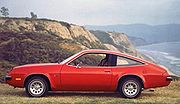 The 1975 Monza 2+2 wore its newly approved rectangular headlights and a slot-style grille in a slanted nose made of resilient urethane. The side window louvers are functional, part of the flow-through ventilation system. The Monza 2+2's two-door hatchback
body style was shared with the Oldsmobile Starfire
and Buick Skyhawk
. The standard Monza engine was the Vega aluminum-block 140 CID (2.3 liter)
inline-4 engine with a single barrel carburetor
generating 78 hp at 4200 rpm. Optional was the 2-barrel carburetor version that generates 87 hp at 4400 rpm.
Chevrolet's new 4.3 liter (262 cid) V-8 engine was optional. The smallest V8 ever offered by Chevrolet, it features a Rochester 2-barrel carburetor and generates 110 hp at 3600 rpm. For 1975 only, Monzas sold in California and high altitude areas met the stricter emissions requirnment by substituting a version of the 5.7 liter (350 cid) V8 engine
with a 2-barrel carburetor tuned to just 125 hp. The Monza 2+2 and its Buick
and Oldsmobile
variants feature GM's first use of a torque arm rear suspension, also adopted for the 1975 Cosworth Vega introduced mid-1975, and later, all 1976-77 Vegas and Pontiac Astre
s. The basic design was also incorporated into GM's third and fourth generation F-bodies, Chevrolet Camaro
and Pontiac Firebird
In April 1975, the Monza Towne Coupe was introduced - a notchback
body-style with a conventional trunk featuring different sheetmetal than the 2+2 hatchback, although sharing its windshield, front fenders, and doors. It features single round headlamps, instead of the dual rectangular headlamps on the 2+2. The Towne Coupe was offered in response to the sales success of the Ford Mustang II notchback coupe and its luxury version, the Mustang II Ghia. The Towne Coupe is 1.5 inches (38.1 mm) shorter and 135 pounds (61.2 kg) lighter than the 2+2 and has slightly more rear head room.
A lower priced "S" version of the 2+2 Hatchback was introduced mid-year. It featured as standard the Vega 1-barrel engine with a 3-speed manual transmission
. The sport suspension, full console, sport steering wheel, day/night and wheel opening moldings were deleted on the "S". The Chevrolet Monza 2+2 won Motor Trend
magazine's "Car of the Year"
award for 1975.
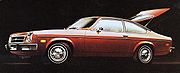
1976 saw the introduction of Chevrolet's new 5.0 liter (305 cid) V-8 engine with a 2-barrel carburetor generating 140 hp at 3800 rpm, but only for California and high-altitude Monza customers, and replaced the 350 CID (5.7 liter) V-8. The 262 V8 was again, the optional engine in the 49 states.
A mid-year option for the 1976 model year was a sport front end available for the Towne Coupe, which features the 2+2's urethane
front end and quad headlamps. The Monza Spyder option package was first introduced in 1976. It features a 2-barrel carburetor
version of the 4-cylinder engine as standard, a floor console, F41 suspension with larger front and rear stabilizer bars, and special shock absorbers. This equipment had been standard on the original 1975 2+2 (excluding the mid-year 'S' model).
The 1977 Monza was highlighted by the addition of a two new Spyder option packages, a $274 performance package, the other a $199 appearance add-on package that was available only on hatchbacks. An 84-horsepower four-cylinder engine was standard, but Monzas could be ordered with a 145-horsepower 305-cubic-inch V-8 instead. The Monza dashboard contained round gauges in a brushed-aluminum instrument panel. The Towne Coupe Cabriolet was deleted, but a half-vinyl roof and opera windows could still be ordered.
The Monza Mirage was produced by Michigan Auto Techniques, an aftermarket
company contracted by GM. The Mirage is painted white, with red and blue racing stripes along the length of the car. It also features flared body panels, and a special airdam & spoiler. The vehicles were built in GM's St. Therese plant, and sent to MAT for modification, after which they would ship completed cars to the dealer. There were approx 4,097 1977 Mirages made from MAT, but there were also Mirages created by Chevrolet dealerships, as the body add-ons and stripes were available ordered through dealer parts. The 5.0 liter (305 cid) engine was the only V8 option for the 1977 model year. The standard Vega 2.3 aluminum-block engine was discontinued at the end of the model year, replaced with the Pontiac 2.5 "Iron Duke."
The 1978 Monza line expanded to include rebadged
holdovers from the Vega line, which ended production after the 1977 model year. Chevy grafted a new Monza front end onto the previous Vega hatchback and wagon body-styles. The Monza 'S', marketed as the Monza price leader, used the Vega hatchback body. With production of only 2,000 units, it was speculated that this was simply an effort to use up a stock of leftover 1977 Vega bodies. The Monza wagon, was also offered in an Estate wood-trimmed version, used the Vega wagon body. The 1978 Monza line gained a new base coupe and 2+2 hatchback with round headlights in an upright front end with a crossbar grille. The Sport 2+2 hatchback and Sport notchback used a modified version of the previous quad rectangular headlamps, now above a full-width open-slot grill. The 151 CID (2.5 liter) inline-4 'Iron Duke' was standard for 1978, replacing the Vega inline-4 engine. Engine options were a Chevrolet-designed 3.2 liter (196 cid) V-6 engine with a 2-barrel carburetor that produced 90 hp at 3600 rpm. Replacing the 3.2 liter V-6 in California and high-altitude areas was Buick's 3.8 liter (231 cid) 105-hp V-6 engine. Four-cylinder engines and the 3.2 liter V-6 were not available in high-altitude areas. The 145-horsepower 305-cubic-inch V-8 remained optional in all but the "S" hatchback and wagon models. Discontinued at the end of the 1978 model year were the 'S' hatchback, Towne Coupe Sport option and the Estate version of the wagon.
The 1979 Chevrolet Monza linup was trimmed to four models. Added standard equipment was added for 1979 including an AM radio, tinted glass, bodyside moldings, and sport steering wheel. Only one Monza model kept the sloped Euro-look front end, the 2+2 Sport hatchback. Others had a freshened grille. A more-potent standard 151-cubic-inch (2.5-liter) four-cylinder with a redesigned cross-flow cylinder head and two-barrel carburetor developed 90-horsepower - five more than in 1978. Three optional engines were available: the 105-horsepower 196-cubic-inch V-6, 115-horsepower 231 V-6, or 130-horsepower 305 V-8. The Spyder performance package cost $164, the Spyder appearance package added $231. All Monzas had a color-keyed instrument panel, and all except the base coupe had a center console, and corrosion protection was improved. Discontinued at the end of the 1979 model year were the Monza wagon, the 196 CID (3.2 liter) V6 and the 305 CID (5.0 liter) V8.
The 1980 model year lineup consisted of a base 2+2 hatchback and notchback and 2+2 Sport hatchback; the 151-cubic-inch (2.5-liter) four-cylinder engine remained standard; the only engine option was the 3.8 liter (231 cid) Buick V6. Chevrolet decided to shelve the antiquated design and let base models of the Chevrolet Camaro
and the new Chevrolet Citation
X-11 hold the division's place sporty-coupe market.
The 'Spyder' name was introduced for the Chevrolet Monza in 1976. This package included performance equipment and some small appearance items. The Monza Spyder Equipment package was available on all 2+2 Hatchbacks and Monza Towne Coupes (with 'Sport Equipment' package) with 5-speed manual and Turbo Hydra-matic automatic transmission
s. The Spyder Equipment package included 2-barrel, Dura-Built 2.3 litre engine, floor console unit, large front/rear stabilizer bars, special shock absorbers, steel-belted radial ply blackwall tires, wheel opening mouldings (chrome), Day-Night inside mirror, Sport Steering Wheel (2-spoke wheel), Special instrumentation and 'stitched' instrument panel pad with added wood-grain vinyl accents (standard on 2+2), Distinctive "Spyder" identification (script fender emblems, steering wheel horn button insert and Spyder front facia and rear-lock cover)
Chevrolet made extensive changes to the Spyder package including separate Equipment and Appearance packages with separate RPO codes found on the build sheet. The Spyder Equipment Package was regular production option (RPO) Z01, while the Spyder Appearance Package was RPO Z02. The Spyder packages were available on Monza 2+2 Sport Hatchback. Spyder decal colors were determined by the body color of the Monza ordered. There were 4 color combinations for 1977. For 79, there were 6 combos, which included a green and a blue color scheme.
Z01 - Spyder Equipment
-- BR70-13C Steel-belted radial ply blackwall tires, Sport suspension, Sport Steering Wheel (2-spoke wheel), Center Console, Inside day/night rearview mirror, Spyder identification, Wheel opening moldings (available if the Z02 - Spyder Appearance Package was not ordered), Dual tailpipe system and white lettered tires were available in 1979.
Z02 - Spyder Appearance
-- Black highlights on front, side and rear of body headlight openings, parking light openings, windshield, rear window and side window moldings, body sill, door and center pillar louvers, rear end panel - (bright window moldings with black exterior), Black or gold rear accents (taillight blackouts and rear end panel decals), Body color front air dam and rear spoiler, Spyder emblems (front facia, rear lock cover and sport steering wheel horn button insert), Body side stripes with Spyder lettering in red, white or gold depending on body color, Black painted styled-steel wheels with trim rings and center caps, Black sport mirrors, Special hood decal and rear spoiler decal.
For the 1980 model year, Chevrolet combined the Spyder Equipment and Appearance packages into one Spyder Equipment package with an RPO code of Z29 and included newly re-designed bold Spyder side decals and a new front air dam that blends into the front fender wheel openings. Spyder decal color choices (five) were based primarily upon the interior color specified rather than the body color as in previous years.
Z29 - Spyder Equipment Package
-- BR70-13C steel-belted radial ply blackwall tires (with option for raised white lettering), Sport suspension, Black front and rear bumper rub strips, Black headlights frames, Black windshield, belt, side and rear window moldings (not available with black exterior), Black painted body sill (also not available with black exterior), Black door and center pillar louvers, Black painted taillight frames, Body color front air dam and rear spoiler, Spyder emblems on front facia, rear lock cover and sport steering wheel (horn button insert), Black sport mirrors (LH remote, RH manual), Rear Spoiler and body stripes with Spyder lettering outlined in accent body colour, Spyder hood decal, Black painted Rally II wheels with bright trim rings and center caps.
, and GM President Ed Cole projected its release in three years. The GM Wankel was initially targeted for an October 1973 introduction as a 1974 Vega option. The General Motors Rotary Combustion Engine
(GMRCE) had two rotors displacing 206 cid, twin distributors and coils, and aluminum housing,
Unwilling to face gas mileage criticism that Mazda
withstood, GM felt it could meet 1975 emissions standards with the engine tuned to provide better mileage. Other refinements improved mileage to a remarkable 20 mpg, but with the fuel breakthrough came related side-effect problems — apex seal failures, as well as a rotor tip-seal problem. By December 1973, it was clear the Wankel, now planned for the Monza 2+2, would not be ready for either production or emissions certification in time for the start of the 1975 model year. and after paying another $10 million against its rotary licence fees, the company announced the first postponement. Motor Trend in April 1974 predicted the final outcome — On September 24, 1974, Ed Cole postponed the Wankel engine ostensibly due to emissions difficulties. He retired the same month. GM admitted fuel economy for the rotary was sub-standard and postponed production in favor of further development. Pete Estes
succeeded Ed Cole as GM President and never showed any special interest in the Wankel or in the perpetuation of Cole's ideas.
line-up, the J-car
models: Chevrolet Cavalier
, Oldsmobile Firenza
, Buick Skyhawk
, and the Pontiac J2000 introduced as 1982 models. Because the forthcoming J-body cars were to be sold as 1982 models, there was a long production run of 1980 H-body models in order to provide sufficient inventory to carry dealers until the spring of 1981.
engines. Chevrolet Monzas were the challengers in the new AAGT class. The class was designed to allow such cars to compete with the best GT cars in the world. The 1975 season was launched with the new cars that would compete with the dominating Porsche Carreras. A very liberal set of rules allowed some body panels to be retained - the windshield, the rear window and the roof. Everything else was built from scratch.
Al Holbert
saw the Monza's potential. By the end of the 1975 season, he had ordered a brand new car, prepared by Dekon Engineering built by Lee Dykstra. Chassis #1008 would be used starting for the 1976 season. In 1976 and 1977, he was the IMSA Camel GT Champion, beating Hans Stuck
to Brian Redman
to Peter Gregg
. In Al Holbert successful 1977 campaign he captured another Camel GT crown. Unfortunately, it would be the last title for an American car. The Porsche 935s were becoming unbeatable right from the beginning of the 1978 season. However, the Dekon built Chevrolet Monza left its footprint on the IMSA Camel GT. They were quite unbeatable in 1976-1977. Chevrolet Monzas were to be seen in IMSA until 1986.
Subcompact car
Subcompact car is a North American term used to describe automobiles whose class size is smaller than that of a compact car, usually not exceeding in length, but larger than a microcar...
, four-passenger automobile produced by the Chevrolet
Chevrolet
Chevrolet , also known as Chevy , is a brand of vehicle produced by General Motors Company . Founded by Louis Chevrolet and ousted GM founder William C. Durant on November 3, 1911, General Motors acquired Chevrolet in 1918...
division of General Motors
General Motors
General Motors Company , commonly known as GM, formerly incorporated as General Motors Corporation, is an American multinational automotive corporation headquartered in Detroit, Michigan and the world's second-largest automaker in 2010...
for the 1975–1980 model year
Model year
The model year of a product is a number used worldwide, but with a high level of prominence in North America, to describe approximately when a product was produced, and indicates the coinciding base specification of that product....
s. The Monza is based on the Chevrolet Vega
Chevrolet Vega
The Chevrolet Vega is a subcompact, two-door automobile that was produced by the Chevrolet division of General Motors for the 1971-1977 model years. Named after the star Vega, the car was powered by a lightweight aluminum-block inline four-cylinder engine...
, sharing its wheelbase
Wheelbase
In both road and rail vehicles, the wheelbase is the distance between the centers of the front and rear wheels.- Road :In automobiles, the wheelbase is the horizontal distance between the center of the front wheel and the center of the rear wheel...
, width and 140 CID (2300 cc) inline-4 engine. The 1975 Monza 2+2 was designed to accommodate the GM-Wankel
Wankel engine
The Wankel engine is a type of internal combustion engine using an eccentric rotary design to convert pressure into a rotating motion instead of using reciprocating pistons. Its four-stroke cycle takes place in a space between the inside of an oval-like epitrochoid-shaped housing and a rotor that...
rotary engine, but due to mediocre fuel economy and emissions compliance issues the engine was cancelled, and a fuel-efficient 4.3 liter V8 engine option was substituted.
The Monza 2+2 and Monza Towne Coupe competed with the Ford Mustang II and other sporty coupes.H-body
GM H platform (RWD)
The General Motors H platform or H-body is an automobile platform designation used for the 1971–1980 model year rear wheel drive line of subcompact cars...
variants Buick Skyhawk
Buick Skyhawk
The Buick Skyhawk are automobiles produced by the Buick division of General Motors in two generations for the 1975 through 1989 model years. 1975 through 1980 models, all 2-door hatchbacks, were built on the subcompact, rear-wheel drive H-body platform...
and Oldsmobile Starfire
Oldsmobile Starfire
Oldsmobile Starfire are automobiles produced by the Oldsmobile division of General Motors in two generations from 1961–1966 and 1975–1980. The Starfire nameplate was also used for the 1954–1956 Ninety- Eight series convertibles, and all 1957 Ninety-Eight series models. 1961 was the first year for...
were produced using the Monza 2+2 body with grill and trim variations and Buick
Buick
Buick is a premium brand of General Motors . Buick models are sold in the United States, Canada, Mexico, China, Taiwan, and Israel, with China being its largest market. Buick holds the distinction as the oldest active American make...
's 3.8 liter V6 engine
V6 engine
A V6 engine is a V engine with six cylinders mounted on the crankcase in two banks of three cylinders, usually set at either a right angle or an acute angle to each other, with all six pistons driving a common crankshaft...
. The Pontiac Sunbird
Pontiac Sunbird
The Pontiac Sunbird, produced by the Pontiac division of General Motors, was Pontiac's second small-car offering of the 70's. The Sunbird model ran for 18 years and was then replaced in 1995 by the Pontiac Sunfire...
variant was introduced the following model year, eventually offered in both Monza body styles. The Monza nameplate originated in mid-1960 for the sporty version of the Chevrolet Corvair
Chevrolet Corvair
-First generation :The 1960 Corvair 500 and 700 series four-door sedans were conceived as economy cars offering few amenities in order to keep the price competitive, with the 500 selling for under $2,000...
.
Origin
The Monza 2+2, Chevy's sporty successor to the Vega debuted as the single-model 2+2 hatchback. The Monza is 4 inches (101.6 mm) longer and weighs 180 pounds more than the Vega from which it is derived.John DeLorean nicknamed it the Italian Vega citing styling with a strong resemblance to the Ferrari 365 GTC/4Ferrari 365 GTC/4
The Ferrari 365 GTC/4 was a 2+2 sports car produced from 1971-1972. It was based on the chassis of the Ferrari 365GTB/4 Daytona.-365 GTC/4:...
.
The 1975 Monza was initially slated to introduce the GM Wankel
Wankel engine
The Wankel engine is a type of internal combustion engine using an eccentric rotary design to convert pressure into a rotating motion instead of using reciprocating pistons. Its four-stroke cycle takes place in a space between the inside of an oval-like epitrochoid-shaped housing and a rotor that...
rotary engine which is licensed from NSU
NSU Motorenwerke AG
NSU Motorenwerke AG, normally just NSU, was a German manufacturer of automobiles, motorcycles and pedal cycles, founded in 1873. It was acquired by Volkswagen Group in 1969...
. Notable rotary issues included mediocre fuel economy compounded at a time of comparatively high fuel prices following the Arab oil boycotts of 1973 and 1974, and GM canceled the engine. Thus the 1975 Chevrolet Monza was launched carrying conventional piston engines instead.
Overview
Hatchback
A Hatchback is a car body style incorporating a shared passenger and cargo volume, with rearmost accessibility via a rear third or fifth door, typically a top-hinged liftgate—and features such as fold-down rear seats to enable flexibility within the shared passenger/cargo volume. As a two-box...
body style was shared with the Oldsmobile Starfire
Oldsmobile Starfire
Oldsmobile Starfire are automobiles produced by the Oldsmobile division of General Motors in two generations from 1961–1966 and 1975–1980. The Starfire nameplate was also used for the 1954–1956 Ninety- Eight series convertibles, and all 1957 Ninety-Eight series models. 1961 was the first year for...
and Buick Skyhawk
Buick Skyhawk
The Buick Skyhawk are automobiles produced by the Buick division of General Motors in two generations for the 1975 through 1989 model years. 1975 through 1980 models, all 2-door hatchbacks, were built on the subcompact, rear-wheel drive H-body platform...
. The standard Monza engine was the Vega aluminum-block 140 CID (2.3 liter)
GM 2300 engine
The 2300 is a 2.3 L/140 cu in inline-4 automobile engine produced by the Chevrolet division of General Motors for the 1971–1977 model years. The Chevrolet Vega engine was ahead of its time with its die-cast aluminum-alloy cylinder block. The high-tech block features an alloy with...
inline-4 engine with a single barrel carburetor
Carburetor
A carburetor , carburettor, or carburetter is a device that blends air and fuel for an internal combustion engine. It is sometimes shortened to carb in North America and the United Kingdom....
generating 78 hp at 4200 rpm. Optional was the 2-barrel carburetor version that generates 87 hp at 4400 rpm.
Chevrolet's new 4.3 liter (262 cid) V-8 engine was optional. The smallest V8 ever offered by Chevrolet, it features a Rochester 2-barrel carburetor and generates 110 hp at 3600 rpm. For 1975 only, Monzas sold in California and high altitude areas met the stricter emissions requirnment by substituting a version of the 5.7 liter (350 cid) V8 engine
V8 engine
A V8 engine is a V engine with eight cylinders mounted on the crankcase in two banks of four cylinders, in most cases set at a right angle to each other but sometimes at a narrower angle, with all eight pistons driving a common crankshaft....
with a 2-barrel carburetor tuned to just 125 hp. The Monza 2+2 and its Buick
Buick
Buick is a premium brand of General Motors . Buick models are sold in the United States, Canada, Mexico, China, Taiwan, and Israel, with China being its largest market. Buick holds the distinction as the oldest active American make...
and Oldsmobile
Oldsmobile
Oldsmobile was a brand of American automobile produced for most of its existence by General Motors. It was founded by Ransom E. Olds in 1897. In its 107-year history, it produced 35.2 million cars, including at least 14 million built at its Lansing, Michigan factory...
variants feature GM's first use of a torque arm rear suspension, also adopted for the 1975 Cosworth Vega introduced mid-1975, and later, all 1976-77 Vegas and Pontiac Astre
Pontiac Astre
The Pontiac Astre is a subcompact automobile that was produced by the Pontiac division of General Motors. Essentially a rebadged Chevrolet Vega, it was introduced in Canada for the 1973 model year and sold there exclusively through 1974. It debuted in the U.S...
s. The basic design was also incorporated into GM's third and fourth generation F-bodies, Chevrolet Camaro
Chevrolet Camaro
The Chevrolet Camaro is an automobile manufactured by General Motors under the Chevrolet brand, classified as a pony car and some versions also as a muscle car. It went on sale on September 29, 1966, for the 1967 model year and was designed as a competing model to the Ford Mustang...
and Pontiac Firebird
Pontiac Firebird
The Pontiac Firebird was built by the Pontiac division of General Motors between 1967 and 2002. The Firebird was introduced the same year as the automaker's platform-sharing model, the Chevrolet Camaro...
In April 1975, the Monza Towne Coupe was introduced - a notchback
Notchback
Notchback is a styling term describing a car body style, a variation of three-box styling where the third distinct volume or "box" is less pronounced — especially where the rear deck is short or where the rear window is upright...
body-style with a conventional trunk featuring different sheetmetal than the 2+2 hatchback, although sharing its windshield, front fenders, and doors. It features single round headlamps, instead of the dual rectangular headlamps on the 2+2. The Towne Coupe was offered in response to the sales success of the Ford Mustang II notchback coupe and its luxury version, the Mustang II Ghia. The Towne Coupe is 1.5 inches (38.1 mm) shorter and 135 pounds (61.2 kg) lighter than the 2+2 and has slightly more rear head room.
A lower priced "S" version of the 2+2 Hatchback was introduced mid-year. It featured as standard the Vega 1-barrel engine with a 3-speed manual transmission
Manual transmission
A manual transmission, also known as a manual gearbox or standard transmission is a type of transmission used in motor vehicle applications...
. The sport suspension, full console, sport steering wheel, day/night and wheel opening moldings were deleted on the "S". The Chevrolet Monza 2+2 won Motor Trend
Motor Trend
Motor Trend is an American automobile magazine. It first appeared in September 1949, issued by Petersen Publishing Company in Los Angeles, and bearing the tag line "The Magazine for a Motoring World". Petersen Publishing was sold to British publisher EMAP in 1998, who sold the former Petersen...
magazine's "Car of the Year"
Motor Trend Car of the Year
The Motor Trend Car of the Year is an award given by Motor Trend magazine, an American monthly that is published since 1949.- Background :...
award for 1975.
Model year changes
The 1976 140-cubic inch four-cylinder engine, as used in the Vega got some refinements. Named "Dura-built 140", it features quieter hydraulic lifters eliminating valve adjustments. The basic four developed 70 horsepower, but two-barrel carburetion upped the rating to 84.1976 saw the introduction of Chevrolet's new 5.0 liter (305 cid) V-8 engine with a 2-barrel carburetor generating 140 hp at 3800 rpm, but only for California and high-altitude Monza customers, and replaced the 350 CID (5.7 liter) V-8. The 262 V8 was again, the optional engine in the 49 states.
A mid-year option for the 1976 model year was a sport front end available for the Towne Coupe, which features the 2+2's urethane
Urethane
Urethane can refer to*Carbamates, compounds with the functional group RONHR'*Ethyl carbamate, the colloquial name of which is urethane*Polyurethane in colloquial usage...
front end and quad headlamps. The Monza Spyder option package was first introduced in 1976. It features a 2-barrel carburetor
Carburetor
A carburetor , carburettor, or carburetter is a device that blends air and fuel for an internal combustion engine. It is sometimes shortened to carb in North America and the United Kingdom....
version of the 4-cylinder engine as standard, a floor console, F41 suspension with larger front and rear stabilizer bars, and special shock absorbers. This equipment had been standard on the original 1975 2+2 (excluding the mid-year 'S' model).
The 1977 Monza was highlighted by the addition of a two new Spyder option packages, a $274 performance package, the other a $199 appearance add-on package that was available only on hatchbacks. An 84-horsepower four-cylinder engine was standard, but Monzas could be ordered with a 145-horsepower 305-cubic-inch V-8 instead. The Monza dashboard contained round gauges in a brushed-aluminum instrument panel. The Towne Coupe Cabriolet was deleted, but a half-vinyl roof and opera windows could still be ordered.
The Monza Mirage was produced by Michigan Auto Techniques, an aftermarket
Aftermarket (automotive)
The automotive aftermarket is the secondary market of the automotive industry, concerned with the manufacturing, remanufacturing, distribution, retailing, and installation of all vehicle parts, chemicals, tools, equipment and accessories for light and heavy vehicles, after the sale of the...
company contracted by GM. The Mirage is painted white, with red and blue racing stripes along the length of the car. It also features flared body panels, and a special airdam & spoiler. The vehicles were built in GM's St. Therese plant, and sent to MAT for modification, after which they would ship completed cars to the dealer. There were approx 4,097 1977 Mirages made from MAT, but there were also Mirages created by Chevrolet dealerships, as the body add-ons and stripes were available ordered through dealer parts. The 5.0 liter (305 cid) engine was the only V8 option for the 1977 model year. The standard Vega 2.3 aluminum-block engine was discontinued at the end of the model year, replaced with the Pontiac 2.5 "Iron Duke."
The 1978 Monza line expanded to include rebadged
Badge engineering
Badge engineering is an ironic term that describes the rebadging of one product as another...
holdovers from the Vega line, which ended production after the 1977 model year. Chevy grafted a new Monza front end onto the previous Vega hatchback and wagon body-styles. The Monza 'S', marketed as the Monza price leader, used the Vega hatchback body. With production of only 2,000 units, it was speculated that this was simply an effort to use up a stock of leftover 1977 Vega bodies. The Monza wagon, was also offered in an Estate wood-trimmed version, used the Vega wagon body. The 1978 Monza line gained a new base coupe and 2+2 hatchback with round headlights in an upright front end with a crossbar grille. The Sport 2+2 hatchback and Sport notchback used a modified version of the previous quad rectangular headlamps, now above a full-width open-slot grill. The 151 CID (2.5 liter) inline-4 'Iron Duke' was standard for 1978, replacing the Vega inline-4 engine. Engine options were a Chevrolet-designed 3.2 liter (196 cid) V-6 engine with a 2-barrel carburetor that produced 90 hp at 3600 rpm. Replacing the 3.2 liter V-6 in California and high-altitude areas was Buick's 3.8 liter (231 cid) 105-hp V-6 engine. Four-cylinder engines and the 3.2 liter V-6 were not available in high-altitude areas. The 145-horsepower 305-cubic-inch V-8 remained optional in all but the "S" hatchback and wagon models. Discontinued at the end of the 1978 model year were the 'S' hatchback, Towne Coupe Sport option and the Estate version of the wagon.
The 1979 Chevrolet Monza linup was trimmed to four models. Added standard equipment was added for 1979 including an AM radio, tinted glass, bodyside moldings, and sport steering wheel. Only one Monza model kept the sloped Euro-look front end, the 2+2 Sport hatchback. Others had a freshened grille. A more-potent standard 151-cubic-inch (2.5-liter) four-cylinder with a redesigned cross-flow cylinder head and two-barrel carburetor developed 90-horsepower - five more than in 1978. Three optional engines were available: the 105-horsepower 196-cubic-inch V-6, 115-horsepower 231 V-6, or 130-horsepower 305 V-8. The Spyder performance package cost $164, the Spyder appearance package added $231. All Monzas had a color-keyed instrument panel, and all except the base coupe had a center console, and corrosion protection was improved. Discontinued at the end of the 1979 model year were the Monza wagon, the 196 CID (3.2 liter) V6 and the 305 CID (5.0 liter) V8.
The 1980 model year lineup consisted of a base 2+2 hatchback and notchback and 2+2 Sport hatchback; the 151-cubic-inch (2.5-liter) four-cylinder engine remained standard; the only engine option was the 3.8 liter (231 cid) Buick V6. Chevrolet decided to shelve the antiquated design and let base models of the Chevrolet Camaro
Chevrolet Camaro
The Chevrolet Camaro is an automobile manufactured by General Motors under the Chevrolet brand, classified as a pony car and some versions also as a muscle car. It went on sale on September 29, 1966, for the 1967 model year and was designed as a competing model to the Ford Mustang...
and the new Chevrolet Citation
Chevrolet Citation
The Chevrolet Citation was a compact car sold by the Chevrolet brand of American automaker General Motors for model years 1980-1985. The Citation and its X-body siblings were among GM's first front wheel drive compact cars, following the trend of front drive compacts such as the Honda Accord...
X-11 hold the division's place sporty-coupe market.
Monza Spyder
The Spyder nameplate was originally used to designate the 1962-1964 Corvair turbocharged model.The 'Spyder' name was introduced for the Chevrolet Monza in 1976. This package included performance equipment and some small appearance items. The Monza Spyder Equipment package was available on all 2+2 Hatchbacks and Monza Towne Coupes (with 'Sport Equipment' package) with 5-speed manual and Turbo Hydra-matic automatic transmission
Automatic transmission
An automatic transmission is one type of motor vehicle transmission that can automatically change gear ratios as the vehicle moves, freeing the driver from having to shift gears manually...
s. The Spyder Equipment package included 2-barrel, Dura-Built 2.3 litre engine, floor console unit, large front/rear stabilizer bars, special shock absorbers, steel-belted radial ply blackwall tires, wheel opening mouldings (chrome), Day-Night inside mirror, Sport Steering Wheel (2-spoke wheel), Special instrumentation and 'stitched' instrument panel pad with added wood-grain vinyl accents (standard on 2+2), Distinctive "Spyder" identification (script fender emblems, steering wheel horn button insert and Spyder front facia and rear-lock cover)
Chevrolet made extensive changes to the Spyder package including separate Equipment and Appearance packages with separate RPO codes found on the build sheet. The Spyder Equipment Package was regular production option (RPO) Z01, while the Spyder Appearance Package was RPO Z02. The Spyder packages were available on Monza 2+2 Sport Hatchback. Spyder decal colors were determined by the body color of the Monza ordered. There were 4 color combinations for 1977. For 79, there were 6 combos, which included a green and a blue color scheme.
Z01 - Spyder Equipment
-- BR70-13C Steel-belted radial ply blackwall tires, Sport suspension, Sport Steering Wheel (2-spoke wheel), Center Console, Inside day/night rearview mirror, Spyder identification, Wheel opening moldings (available if the Z02 - Spyder Appearance Package was not ordered), Dual tailpipe system and white lettered tires were available in 1979.
Z02 - Spyder Appearance
-- Black highlights on front, side and rear of body headlight openings, parking light openings, windshield, rear window and side window moldings, body sill, door and center pillar louvers, rear end panel - (bright window moldings with black exterior), Black or gold rear accents (taillight blackouts and rear end panel decals), Body color front air dam and rear spoiler, Spyder emblems (front facia, rear lock cover and sport steering wheel horn button insert), Body side stripes with Spyder lettering in red, white or gold depending on body color, Black painted styled-steel wheels with trim rings and center caps, Black sport mirrors, Special hood decal and rear spoiler decal.
For the 1980 model year, Chevrolet combined the Spyder Equipment and Appearance packages into one Spyder Equipment package with an RPO code of Z29 and included newly re-designed bold Spyder side decals and a new front air dam that blends into the front fender wheel openings. Spyder decal color choices (five) were based primarily upon the interior color specified rather than the body color as in previous years.
Z29 - Spyder Equipment Package
-- BR70-13C steel-belted radial ply blackwall tires (with option for raised white lettering), Sport suspension, Black front and rear bumper rub strips, Black headlights frames, Black windshield, belt, side and rear window moldings (not available with black exterior), Black painted body sill (also not available with black exterior), Black door and center pillar louvers, Black painted taillight frames, Body color front air dam and rear spoiler, Spyder emblems on front facia, rear lock cover and sport steering wheel (horn button insert), Black sport mirrors (LH remote, RH manual), Rear Spoiler and body stripes with Spyder lettering outlined in accent body colour, Spyder hood decal, Black painted Rally II wheels with bright trim rings and center caps.
Stillborn Wankel engine
In November 1970, GM paid $50 million for initial licenses to produce the Wankel rotary engineWankel engine
The Wankel engine is a type of internal combustion engine using an eccentric rotary design to convert pressure into a rotating motion instead of using reciprocating pistons. Its four-stroke cycle takes place in a space between the inside of an oval-like epitrochoid-shaped housing and a rotor that...
, and GM President Ed Cole projected its release in three years. The GM Wankel was initially targeted for an October 1973 introduction as a 1974 Vega option. The General Motors Rotary Combustion Engine
General Motors Rotary Combustion Engine
The General Motors Rotary Combustion Engine is an internal combustion Wankel engine which uses a rotary design to convert pressure into a rotating motion instead of using reciprocating pistons. In November 1970, GM paid $50 million for initial licenses to produce their version of the Wankel rotary...
(GMRCE) had two rotors displacing 206 cid, twin distributors and coils, and aluminum housing,
Unwilling to face gas mileage criticism that Mazda
Mazda
is a Japanese automotive manufacturer based in Fuchū, Aki District, Hiroshima Prefecture, Japan.In 2007, Mazda produced almost 1.3 million vehicles for global sales...
withstood, GM felt it could meet 1975 emissions standards with the engine tuned to provide better mileage. Other refinements improved mileage to a remarkable 20 mpg, but with the fuel breakthrough came related side-effect problems — apex seal failures, as well as a rotor tip-seal problem. By December 1973, it was clear the Wankel, now planned for the Monza 2+2, would not be ready for either production or emissions certification in time for the start of the 1975 model year. and after paying another $10 million against its rotary licence fees, the company announced the first postponement. Motor Trend in April 1974 predicted the final outcome — On September 24, 1974, Ed Cole postponed the Wankel engine ostensibly due to emissions difficulties. He retired the same month. GM admitted fuel economy for the rotary was sub-standard and postponed production in favor of further development. Pete Estes
Pete Estes
Elliot Marantette "Pete" Estes was an American automotive engineer and executive, most known as being the fifteenth president of General Motors, from 1974 to 1981...
succeeded Ed Cole as GM President and never showed any special interest in the Wankel or in the perpetuation of Cole's ideas.
End of the H-body
A total 731,504 Monzas were produced in six model years. The rear-wheel drive (RWD) H-body Monza, Sunbird, Skyhawk, and Starfire were replaced in the spring of 1981 with a new front-wheel drive (FWD)Front-wheel drive
Front-wheel drive is a form of engine/transmission layout used in motor vehicles, where the engine drives the front wheels only. Most modern front-wheel drive vehicles feature a transverse engine, rather than the conventional longitudinal engine arrangement generally found in rear-wheel drive and...
line-up, the J-car
GM J platform
The J platform, or J-body, was General Motors' inexpensive front-wheel drive automobile platform from the 1980s and 1990s. The platform replaced the GM H platform. The J-platform is the only platform of GM to have a model in each of its "Original 5" passenger car divisions...
models: Chevrolet Cavalier
Chevrolet Cavalier
The Chevrolet Cavalier was a compact automobile produced from 1982 to 2005 by General Motors. Built on the company's J platform, the Cavalier was one of the best-selling cars in the United States throughout its life.- Predecessors :...
, Oldsmobile Firenza
Oldsmobile Firenza
The Oldsmobile Firenza was a compact car produced by the Oldsmobile division of General Motors from 1982 to 1988. It was based on the front-wheel drive GM J platform, which was shared with the Buick Skyhawk, Cadillac Cimarron, Chevrolet Cavalier and Pontiac Sunbird...
, Buick Skyhawk
Buick Skyhawk
The Buick Skyhawk are automobiles produced by the Buick division of General Motors in two generations for the 1975 through 1989 model years. 1975 through 1980 models, all 2-door hatchbacks, were built on the subcompact, rear-wheel drive H-body platform...
, and the Pontiac J2000 introduced as 1982 models. Because the forthcoming J-body cars were to be sold as 1982 models, there was a long production run of 1980 H-body models in order to provide sufficient inventory to carry dealers until the spring of 1981.
Motorsports
Chevrolet Monzas participated in the IMSA GT Series powered by Chevrolet CorvetteChevrolet Corvette
The Chevrolet Corvette is a sports car by the Chevrolet division of General Motors that has been produced in six generations. The first model, a convertible, was designed by Harley Earl and introduced at the GM Motorama in 1953 as a concept show car. Myron Scott is credited for naming the car after...
engines. Chevrolet Monzas were the challengers in the new AAGT class. The class was designed to allow such cars to compete with the best GT cars in the world. The 1975 season was launched with the new cars that would compete with the dominating Porsche Carreras. A very liberal set of rules allowed some body panels to be retained - the windshield, the rear window and the roof. Everything else was built from scratch.
Al Holbert
Al Holbert
Alvah Robert "Al" Holbert was an American automobile racing driver who was a five-time champion of the IMSA Camel GT series.- Life and career :...
saw the Monza's potential. By the end of the 1975 season, he had ordered a brand new car, prepared by Dekon Engineering built by Lee Dykstra. Chassis #1008 would be used starting for the 1976 season. In 1976 and 1977, he was the IMSA Camel GT Champion, beating Hans Stuck
Hans Stuck
Hans Stuck was a German motor racing driver...
to Brian Redman
Brian Redman
Brian Herman Thomas Redman is a British racing driver from England....
to Peter Gregg
Peter Gregg (racing driver)
Peter Holden Gregg was a racecar driver during the golden age of the Trans-Am Series and a four-time winner of the 24 Hours of Daytona...
. In Al Holbert successful 1977 campaign he captured another Camel GT crown. Unfortunately, it would be the last title for an American car. The Porsche 935s were becoming unbeatable right from the beginning of the 1978 season. However, the Dekon built Chevrolet Monza left its footprint on the IMSA Camel GT. They were quite unbeatable in 1976-1977. Chevrolet Monzas were to be seen in IMSA until 1986.
See also
- General Motors H-platformGM H platform (RWD)The General Motors H platform or H-body is an automobile platform designation used for the 1971–1980 model year rear wheel drive line of subcompact cars...
- Opel Monza, an unrelated vehicle marketed by General Motors' European subsidiary
- Corvair MonzaChevrolet Corvair-First generation :The 1960 Corvair 500 and 700 series four-door sedans were conceived as economy cars offering few amenities in order to keep the price competitive, with the 500 selling for under $2,000...
, an unrelated vehicle produced by Chevrolet 1960-1969 - Chevrolet Monza, an unrelated vehicle produced by GM do Brasil during the mid-1980s based on GM's J-car platform
Sources
- Flammang, James M. & Kowalke, Ron, Standard Catalog of American Cars: 1976-199, 3rd Edition (Iola, Wisconsin: Krause Publications, 1999)
- Gunnell, John, Standard Catalog of American Cars: 1946-1975, Revised 4th Edition (Iola, Wisconsin: Krause Publications, 2002)