
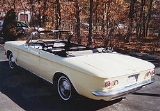
First generation
The 1960 Corvair 500 and 700 series four-door sedans were conceived as economy cars offering few amenities in order to keep the price competitive, with the 500 (base model) selling for under $2,000. Powered by an 80 hp engine and three-speed manual or two-speed
PowerglideThe Powerglide is a two-speed automatic transmission designed by General Motors. It was available primarily on Chevrolet from January, 1950 through 1973, although some Pontiac models also used this automatic transmission, extensively on models produced for the Canadian market with Chevrolet...
automatic transmission, the Corvair was designed to have comparable acceleration to the six-cylinder full-size Chevrolet Biscayne. Introduced in January 1960, two-door models have a fold-down rear seat for added storage capacity, which was greatly needed as the spare tire was stowed in the forward trunk compartment.
The passenger compartment was heated by a
gasoline heaterA gasoline heater is a small, mounted or portable, gasoline-fueled, space-heating device.In the United States they were used mainly for supplemental heat for the passenger compartments of automobiles and aircraft. Some aircraft continue to use gasoline heaters.-Operation:First, fuel is brought to...
mounted next to the spare tire in the luggage compartment. While it offered immediate hot air, customers complained of what they thought might be decreased gas mileage on cold days and through long winters. Chevrolet redesigned the heating system for the 1961 model year, yet left it up to customers to choose the gas heater until the end of the 1964 model year.
The line quickly grew from utilitarian bench seat sedans and coupes to the more plushly appointed bucket seat interiors of the new 900 series Monza. It hit showroom floors in the Spring 1960. Two available options on Monza were a more powerful engine, rated at 95 hp thanks to a more radical
camshaftA camshaft is a shaft to which a cam is fastened or of which a cam forms an integral part.-History:An early cam was built into Hellenistic water-driven automata from the 3rd century BC. The camshaft was later described in Iraq by Al-Jazari in 1206. He employed it as part of his automata,...
paired with low-restriction exhaust, and the introduction of a fully synchronized, four-speed transmission. Despite its late introduction, the Monza sold 12,000 units, making it one of the most popular Corvairs. The floor was flat. A padded dash was optional.
The Corvair was
Motor TrendMotor Trend is an American automobile magazine. It first appeared in September 1949, issued by Petersen Publishing Company in Los Angeles, and bearing the tag line "The Magazine for a Motoring World". Petersen Publishing was sold to British publisher EMAP in 1998, who sold the former Petersen...
magazine's
Car of the YearThe Motor Trend Car of the Year is an award given by Motor Trend magazine, an American monthly that is published since 1949.- Background :...
for 1960.
The 1961 Monza was heavily promoted and sometimes referred to as "the poor man's Porsche". The Monza series expanded with a four-door sedan body style in addition to the two-door coupe, and garnered about 144,000 sales.
A
station wagonA station wagon is a body style variant of a sedan/saloon with its roof extended rearward over a shared passenger/cargo volume with access at the back via a third or fifth door , instead of a trunk lid...
body-style, marketed as the
LakewoodThe Chevrolet Lakewood is a 4 door station wagon produced by Chevrolet in the 1961 and 1962 model years. It was the station wagon version of the Corvair and therefore the entrance level station wagon series. In size, appearance and technical respects it resembled to the Volkswagen Type 3 and power...
joined the lineup in 1961 with its engine located under the cargo floor and offering 68 ft³ (1.9 m³) of cargo room; 58 in the main passenger compartment, and another 10 in the front trunk. For 1961 an optional four-speed
manual transmissionA manual transmission, also known as a manual gearbox or standard transmission is a type of transmission used in motor vehicle applications...
was added. The Corvair engine received its first size increase to 145 cu in (2.4 l) via a slight increase in bore size. The base engine was still rated at 80 hp when paired with the manual transmissions and 84 hp when mated to the optional automatic transmission in Monza models. The high-performance engine was rated at 98 hp. To increase luggage capacity in the front trunk, the spare tire was relocated to the engine compartment (in cars not ordered with air-conditioning) and the gasoline heater was replaced by a system of ducts that redirected warmed air from the cylinder heads to the passenger compartment. The gasoline heater remained available as an option through 1964. Factory air conditioning was offered as a mid-1961 option introduction. The condenser lay flat atop the horizontal engine fan. A large, green-painted reverse rotation version of the standard GM Frigidaire air conditioning compressor was used, and an evaporator housing was added under the dash with integrated outlets surrounding the radio housing. Air conditioning was not available on wagons, Greenbrier/Corvair 95, or the turbocharged models introduced later due to space conflicts in those models. Chevrolet also introduced the Corvair 95 line of light-duty
truckA truck or lorry is a motor vehicle designed to transport cargo. Trucks vary greatly in size, power, and configuration, with the smallest being mechanically similar to an automobile...
s, which used the Corvair driveline and are forward-control, with the driver sitting over the front wheels, as in the
Volkswagen Type 2The Volkswagen Type 2, officially known as the Transporter or Kombi informally as Bus or Camper , was a panel van introduced in 1950 by German automaker Volkswagen as its second car model – following and initially deriving from Volkswagen's first model, the Type 1 , it was given the factory...
.
The
Greenbrier SportswagonChevrolet introduced the Corvair line up for the 1960 model year as the first of a series of generations of passenger compact cars. Chevrolet introduced a more utilitarian style of vehicle the following year under the model designation "Corvair 95"...
used the same body as the "Corvan 95"
panel vanA panel van is a form of solid van, smaller than a lorry or truck, without rear side windows...
with the side windows option, but was marketed as a
station wagonA station wagon is a body style variant of a sedan/saloon with its roof extended rearward over a shared passenger/cargo volume with access at the back via a third or fifth door , instead of a trunk lid...
and was available with trim and paint options similar to the passenger cars. The "Corvan 95" model was also built in
pickupA pickup truck is a light motor vehicle with an open-top rear cargo area .-Definition:...
versions; the Loadside was a fairly typical pickup of the era, except for the rear engine, forward controls, and a pit in the middle of the bed. The popular Rampside, which had a large fold-down ramp on the side of the pickup bed.
In 1962 Chevrolet introduced the 150 hp
turbochargedA turbocharger, or turbo , from the Greek "τύρβη" is a centrifugal compressor powered by a turbine that is driven by an engine's exhaust gases. Its benefit lies with the compressor increasing the mass of air entering the engine , thereby resulting in greater performance...
Monza Spyder option for Monza coupes and convertibles mid-year, making the Corvair the second production automobile to come with a turbocharger as a factory option, with the Oldsmobile F-85 Turbo Jetfire of the same year. The 500 station wagon was dropped in favor of the Monza wagon at introduction, however all station wagons were discontinued mid-year in favor the new Corvair
ConvertibleA convertible is a type of automobile in which the roof can retract and fold away having windows which wind-down inside the doors, converting it from an enclosed to an open-air vehicle...
and Chevy II (built at the same assembly plant). Self adjusting brakes were new for 1962.
Metallic brake linings and a heavy duty suspension consisting of a front anti roll bar, rear axle limit straps, revised spring rates and recalibrated shock absorbers were introduced as optional equipment. The Monza Spyder featured a multi-gauge instrument cluster which included a
tachometerA tachometer is an instrument measuring the rotation speed of a shaft or disk, as in a motor or other machine. The device usually displays the revolutions per minute on a calibrated analogue dial, but digital displays are increasingly common...
, cylinder head temperature and intake manifold pressure gauges, Spyder fender script and Turbo logo deck emblems in addition to the high performance engine.
The Monza Coupe was the most popular model with 151,738 produced out of 292,531 total Corvair passenger car production for 1962.
The 1963 model year saw the availability of a long 3.08 gear for improved fuel economy, but the Corvair otherwise remained largely carryover with minor trim and engineering changes. The Loadside
pickupA pickup truck is a light motor vehicle with an open-top rear cargo area .-Definition:...
was discontinued at the end of the model year.
For 1964 significant engineering and safety changes occurred, while the model lineup remained relatively unchanged. The engine displacement was increased from 145 to 164 cu in (2.3 to 2.7 L) due to an increase in stroke; the base engine power increased from 80 to 95 hp (60 to 70 kW), and the high performance engine increased from 95 to 110 hp (70 to 80 kW). The Spyder engine rating remained at 150 hp (112 kW) despite the displacement increase of the engine. 1964 saw an improvement in the car's swing axle rear suspension; a transverse leaf spring was added in an effort to diminish rear roll stiffness and foster more neutral handling attributes in addition to supporting a high proportion of the engine weight. Spring rates could now be softer at both ends of the car compared to previous models. The heavy duty suspension was no longer optional, although all models now had a front anti-roll bar as standard. Brakes were improved with finned rear drums. The remaining
pickupA pickup truck is a light motor vehicle with an open-top rear cargo area .-Definition:...
, the Rampside, was discontinued at the end of the model year.
Second generation (1965–1969)
A dramatic redesign of the Corvair came in 1965. The new body showed influence from the
Corvette StingrayThe Chevrolet Corvette , also known as the Corvette Sting Ray, is a sports car produced by the Chevrolet division of General Motors for the 1963 through 1967 model years.-Origin and development:...
and the 1963
Buick RivieraThe Riviera by Buick is an automobile produced by Buick in the United States from the 1963 to 1999 model years, with 1,127,261 produced.A full-size coupé or personal luxury car, the early models of the Riviera in particular have been highly praised by automotive journalists and writers.A common...
. The mild
coke bottle stylingCoke bottle styling is a term used to describe any automotive body styling bearing an overall body shape resembling the classic glass Coca-Cola soft drink's contour bottle design. It is a style of automobile bodies with outward curving fenders with a narrow center. In contrast to "straight-edge"...
set the trend for GM cars for the next fifteen years, foreshadowing the 1967 Camaro. For the first time, none of the passenger cars had a "B" pillar, making all closed models true hardtops. The second generation's styling was rated timeless when new, and considered contemporary today in comparison to the first generation. A new fully
independent suspensionIndependent suspension is a broad term for any automobile suspension system that allows each wheel on the same axle to move vertically independently of each other. This is contrasted with a beam axle, live axle or deDion axle system in which the wheels are linked – movement on one side affects...
, similar in design to the Corvette, replaced the original
swing axleA swing axle is a simple type of independent suspension first used in early aircraft , such as the Sopwith and Fokker, usually with rubber bungee and no damping....
rear suspension.
Car and DriverCar and Driver is an American automotive enthusiast magazine. Its total circulation is 1.31 million. It is owned by Hearst Magazines, who purchased prior owner Hachette Filipacchi Media U.S. in 2011...
magazine's David E. Davis Jr. showed enthusiasm for the 1965 Corvair in their October 1964 issue:
"And it is here too, that we have to go on record and say that the Corvair is — in our opinion — the most important new car of the entire crop of '65 models, and the most beautiful car to appear in this country since before World War II." "When the pictures of the '65 Corvair arrived in our offices, the man who opened the envelope actually let out a great shout of delight and amazement on first seeing the car, and in thirty seconds the whole staff was charging around, each wanting to be the first to show somebody else, each wanting the vicarious kick of hearing that characteristic war-whoop from the first-time viewer." "Our ardor had cooled a little by the time we got to drive the cars — then we went nuts all over again. The new rear suspension, the new softer spring rates in front, the bigger brakes, the addition of some more power, all these factors had us driving around like idiots — zooming around the handling loop dragging with each other, standing on the brakes — until we had to reluctantly turn the car over to some other impatient journalist ... The '65 Corvair is an outstanding car. It doesn't go fast enough, but we love it."
The base 95 hp (71 kW) and optional 110 hp (82 kW) engines were carried forward from 1964. The previous 150 hp (112 kW) Spyder engine was replaced by the normally aspirated 140 hp (104 kW) for the new Corsa. The engine was unusual in offering four single-throat
carburetorA carburetor , carburettor, or carburetter is a device that blends air and fuel for an internal combustion engine. It is sometimes shortened to carb in North America and the United Kingdom....
s, to which were added larger valves and a dual exhaust system; The 180 hp (134 kW) turbocharged engine was optional on the Corsa, which offered either standard three-speed or optional (US$92) four-speed manual transmissions. The 140 hp (104 kW) engine was optional on 500 and Monza models with manual or Powerglide transmissions.
Many new refinements appeared on the beautiful new 1965 redesign. The Corsa came standard with an instrument panel featuring a 140 mph (225.3 km/h) speedometer with resettable trip odometer, a 6,000 rpm tachometer, cylinder head temperature gauge, analog clock with a sweeping second hand, a manifold vacuum/pressure gauge and fuel gauge. A much better heater system, larger brakes borrowed from the Chevelle, a stronger differential ring gear, a Delcotron alternator (replacing the generator), and significant chassis refinements were made. AM/FM stereo radio, in-dash All Weather Air Conditioning, telescopically adjustable steering column, and a Special Purpose Chassis Equipment ("Z17") handling package, consisting of a special performance suspension and quick ratio steering box, were significant new options for 1965.
By this time, the
station wagonA station wagon is a body style variant of a sedan/saloon with its roof extended rearward over a shared passenger/cargo volume with access at the back via a third or fifth door , instead of a trunk lid...
, panel van, and
pickupA pickup truck is a light motor vehicle with an open-top rear cargo area .-Definition:...
body styles had all been dropped and 1965 was the last year for the Greenbrier window van, which was retained mainly for fleet orders, with 1528 being built. In all, 235,528 Corvairs were built in 1965.
Chevrolet replaced the Corvair-based vans with the Chevrolet Sportvan/GMC Handi-Van, which used a traditional front engine/rear drive axle borrowed from the Chevy II.
The 1966 lineup remained essentially unchanged from 1965. One change of note was a more robust 4-speed synchromesh transmission using the standard Saginaw gear set with 3.11:1 first gear ratio used by other GM 6-cylinder vehicles. The steering column was changed to a two-piece design with universal joint, lessening the danger of intrusion during a front end collision. A plastic air dam was installed below the front valence panel to conceal the front suspension and underbody, and lessen crosswind sensitivity. In front, The "lock door" emblem (covering the
locksetA lockset or alternatively lock set is the hardware and components that comprise the locking mechanism that can usually be found on a door or other hinged object but can also include sliding doors and dividers....
for the trunk lock) was changed from red to blue and featured a shorter bar. Air conditioned cars received a new condenser that was mounted behind the engine, eliminating previous efficient but huge, awkward condenser that was mounted atop the engine, requiring its removal out of the way for most underhood servicing. The Corvair script nameplate was moved from atop the trunk lid to a position next to the driver's side headlight bezel. Sales began a decline as a result of Nader's book and the new Mustang that offered V8s up to 271 hp compared to Corvair's 180 hp top powertrain. and rumors of the upcoming "Panther'-the code name for the forthcoming Camaro, slated as a direct competitor for the Mustang. A decision was made to discontinue further development of the Corvair. Production for the model year was down to 103,743.
In 1967, the Corvair line was trimmed to the 500 and Monza Hardtop Coupes and Hardtop Sedans, and the Monza Convertible. This model year was the first with a collapsible steering column. A dual circuit master cylinder with warning light, nylon reinforced brake hoses, stronger steel (instead of aluminum) door hinges, "mushroomed" instrument panel knobs and a vinyl-edged day/night mirror were all made standard equipment. Chevrolet introduced a 50000 mi (80,467 km) engine warranty on all Chevrolet models including the Corvair. Chevrolet was still actively marketing the Corvair in 1967, including color print ads and an "I Love My Corvair" bumper sticker campaign by dealers, but production and sales continued to fall off drastically. Only 27,253 copies were built.
In 1968, the four-door hardtop was discontinued, leaving three models—the 500 and Monza Hardtop Coupes and the Monza Convertible. All Weather air conditioning was dropped as an option, due to concerns about thermal loading added by the now-standard Air Injection Reactor ("smog pump") which probably hurt sales as factory air became more popular generally in automobiles. The GM multiplex stereo system was also discontinued when new units changed wiring adapters; the Corvair's 9-pin connector would no longer fit the new units. Additional safety features, including side marker lights, and shoulder belts for closed models, were fitted per the federal government's requirements. All advertising was virtually stopped and sales were down to 15,400.

The final model-year 1969 Corvairs were assembled with the Nova in Willow Run, Michigan, the same facility Corvairs had been built from the beginning. A total of 6,000 Corvairs were produced of which only 521 were Monza Convertibles. There are a number of unique features which can be found in the 1969 models. Corvair was the only 1969 GM car that did not get a locking steering column. Demand for Novas was high and a decision was made in November 1968 to move Corvair assembly to a special off-line area in the plant, dubbed the "Corvair Room", making Corvairs produced between that time and May 14, 1969 essentially hand-built by a dedicated Corvair team. Assembled bodies arrived from Fisher Body and awaited assembly in the off-line area.
Stillborn third generation
Chevrolet had a proposed a third generation (1970-on) Corvair, essentially a re-skin of the 1965–69 model resembling the 1973 GM A Body intermediates, particularly the 1973 Pontiac Grand Am, retaining Corvair proportions. Having passed the point of full scale clay models, Chevrolet stopped developing the model in early 1968. Unlike the Turbo Hydramatic 400, the Turbo Hydramatic 350 transmission, introduced in the 1968 Camaro and later adopted by most Chevrolet models had been configured for use in the third generation Corvair.
End of production
According to noted GM historian Dave Newell, Chevrolet had planned on ending Corvair production after the 1966 model year. Development and engineering changes were halted in 1966 on the year-old, redesigned second-generation cars with mainly federally mandated emissions and safety changes made thereafter.
Ralph Nader, attorney and consumer advocate highlighted the Corvair's handling in his 1965 book Unsafe At Any Speed. 1966 Corvair sales subsequently fell to half from the sales of 1965.
The Corvair faced competition from the Ford Mustang, Chevy's own
CamaroThe Chevrolet Camaro is an automobile manufactured by General Motors under the Chevrolet brand, classified as a pony car and some versions also as a muscle car. It went on sale on September 29, 1966, for the 1967 model year and was designed as a competing model to the Ford Mustang...
, and other
pony carPony car is an American class of automobile launched and inspired by the Ford Mustang in 1964. The term describes an affordable, compact, highly styled car with a sporty or performance-oriented image.-Origins of the breed:...
s. The car had been costly to produce, yet was not offered at a premium price; not a high profit earner for Chevrolet as was the Corvette for example. An increasing lack of interest from the company, especially from Chevrolet's General Manager John DeLorean, and a complete absence of Corvair advertising after 1967 reflected the company's priorities, including promotion of three redesigned models for 1968—the Corvette,
ChevelleThe Chevrolet Chevelle is a mid-sized automobile produced by the Chevrolet division of General Motors in three generations for the 1964 through 1977 model years. Part of the GM A-Body platform, the Chevelle was one of Chevrolet's most successful nameplates. Body styles include coupes, sedans,...
and Chevy II Nova.
The Corvair was referred to as "the phantom" by Car Life magazine in their 1968 Monza road test, and by 1969 Chevrolet's Corvair four-page brochure was "by request only". During its final year of production, 6000 cars were produced.
Handling controversy
First Generation (1960–1963) Corvair handling characteristics became the subject of controversy when
Ralph NaderRalph Nader is an American political activist, as well as an author, lecturer, and attorney. Areas of particular concern to Nader include consumer protection, humanitarianism, environmentalism, and democratic government....
addressed them in his 1965 book,
Unsafe at Any SpeedUnsafe at Any Speed: The Designed-In Dangers of the American Automobile by Ralph Nader, published in 1965, is a book detailing resistance by car manufacturers to the introduction of safety features, like seat belts, and their general reluctance to spend money on improving safety...
. GM had over 100 lawsuits pending in connection with accidents involving the Corvair, which subsequently became the initial material for Nader's investigations. The book highlighted accidents related to the Corvair's suspension and identified the Chevrolet suspension mechanic who had fought management for removing (for cost reasons) the front anti-sway bar installed on later models. Nader's book cited a promotional film created by
Ford Motor CompanyFord Motor Company is an American multinational automaker based in Dearborn, Michigan, a suburb of Detroit. The automaker was founded by Henry Ford and incorporated on June 16, 1903. In addition to the Ford and Lincoln brands, Ford also owns a small stake in Mazda in Japan and Aston Martin in the UK...
, in which a Ford test driver purposely turned the Corvair in a way to make it appear unstable, as evidence against the Corvair. Nader said during subsequent Congressional hearings, the Corvair is "the leading candidate for the un-safest-car title." Subsequently, Corvair sales fell from 220,000 in 1965 to 109,880 in 1966. By 1968 production fell to 14,800. Public response to the book played a role in the
National Traffic and Motor Vehicle Safety ActThe National Traffic and Motor Vehicle Safety Act was enacted in the United States in 1966 to empower the federal government to set and administer new safety standards for motor vehicles and road traffic safety. The Act created the National Highway Safety Bureau...
in 1966.
A 1972 safety commission report conducted by
Texas A&M UniversityTexas A&M University is a coeducational public research university located in College Station, Texas . It is the flagship institution of the Texas A&M University System. The sixth-largest university in the United States, A&M's enrollment for Fall 2011 was over 50,000 for the first time in school...
concluded that the 1960–1963 Corvair possessed no greater potential for loss of control than its contemporaries in extreme situations. The U.S. Department of Transportation (DOT) issued a press release dated August 12, 1972, setting out the findings of
NHTSAThe National Highway Traffic Safety Administration is an agency of the Executive Branch of the U.S. government, part of the Department of Transportation...
testing from the previous year — after the Corvair had been out of production for more than three years. NHTSA had conducted a series of comparative tests in 1971 studying the handling of the 1963 Corvair and four contemporary cars, a Ford Falcon,
Plymouth ValiantThe Plymouth Valiant is an automobile manufactured by the Plymouth division of Chrysler Corporation in the United States from 1960 to 1976. It was created to give the company an entry in the compact car market emerging in the late 1950s...
,
Volkswagen BeetleThe Volkswagen Type 1, widely known as the Volkswagen Beetle or Volkswagen Bug, is an economy car produced by the German auto maker Volkswagen from 1938 until 2003...
,
Renault DauphineRenault Dauphine is a rear-engined economy car manufactured by Renault in one body style — a three-box, four-door sedan — as the successor to the Renault 4CV, with over two million examples marketed worldwide during its production from 1956-1967....
—along with a second generation Corvair (with its completely redesigned, independent rear suspension). The subsequent 143-page report (PB 211-015, available from
NTISThe National Technical Information Service is an agency within the United States Department of Commerce that serves as the U.S. government repository for research and development results and for other information produced by and for the government as well as a variety of public and private sources...
) reviewed NHTSA's extreme-condition handling tests, national accident data for the cars in the test as well as General Motors/Chevrolet internal documentation regarding the Corvair's handling. NHTSA went on to contract an independent advisory panel of engineers to review the tests. This review panel issued their own 24 page report (PB 211-014, available from
NTISThe National Technical Information Service is an agency within the United States Department of Commerce that serves as the U.S. government repository for research and development results and for other information produced by and for the government as well as a variety of public and private sources...
)—which concluded that "the 1960–63 Corvair compares favorably with contemporary vehicles used in the tests...the handling and stability performance of the 1960–63 Corvair does not result in an abnormal potential for loss of control or rollover, and it is at least as good as the performance of some contemporary vehicles both foreign and domestic." Former GM executive John DeLorean asserted in On a Clear Day You Can See General Motors (1979) that Nader's criticisms were valid.
Car and DriverCar and Driver is an American automotive enthusiast magazine. Its total circulation is 1.31 million. It is owned by Hearst Magazines, who purchased prior owner Hachette Filipacchi Media U.S. in 2011...
magazine criticized Nader for ignoring the need of drivers to cope with changes in driving style when operating the Corvair, not least keeping the rear tires properly inflated. None of the issues Nader raised were problems among owners of the
Porsche 911The Porsche 911 is a luxury 2-door sports coupe made by Porsche AG of Stuttgart, Germany. It has a distinctive design, rear-engined and with independent rear suspension, an evolution of the swing axle on the Porsche 356. The engine was also air-cooled until the introduction of the Type 996 in 1998...
, which had the same layout and similar suspension, nor with the less powerful Volkswagen Type 1 Beetle.
Journalist
David E. DavisDavid Evan Davis, Jr. was an automotive journalist and magazine publisher widely known as a contributing writer, editor and publisher at Car and Driver magazine and as the founder of Automobile magazine....
, in a 2009 article in
Automobile MagazineAutomobile magazine is an automobile magazine in the United States and is owned by Source Interlink. It was founded by a group of former employees of Car and Driver magazine, led by that publications’s former editor, David E. Davis, and originally published by News Corporation...
, noted that despite Nader's claim that swing-axle rear suspension were dangerous,
PorschePorsche Automobil Holding SE, usually shortened to Porsche SE a Societas Europaea or European Public Company, is a German based holding company with investments in the automotive industry....
,
Mercedes-BenzMercedes-Benz is a German manufacturer of automobiles, buses, coaches, and trucks. Mercedes-Benz is a division of its parent company, Daimler AG...
and
VolkswagenVolkswagen is a German automobile manufacturer and is the original and biggest-selling marque of the Volkswagen Group, which now also owns the Audi, Bentley, Bugatti, Lamborghini, SEAT, and Škoda marques and the truck manufacturer Scania.Volkswagen means "people's car" in German, where it is...
all used similar swing-axle concepts during that era.
Handling characteristics
The first generation Corvair featured a rear
swing axleA swing axle is a simple type of independent suspension first used in early aircraft , such as the Sopwith and Fokker, usually with rubber bungee and no damping....
design similar to that of the
Renault DauphineRenault Dauphine is a rear-engined economy car manufactured by Renault in one body style — a three-box, four-door sedan — as the successor to the Renault 4CV, with over two million examples marketed worldwide during its production from 1956-1967....
and Volkswagen Beetle – a design which eliminates
universal jointA universal joint, universal coupling, U joint, Cardan joint, Hardy-Spicer joint, or Hooke's joint is a joint or coupling in a rigid rod that allows the rod to 'bend' in any direction, and is commonly used in shafts that transmit rotary motion...
s at the wheels and where the rear wheels are always perpendicular to the driveshafts. The design can allow rear tires to undergo large
camber anglethumb|100px|From the front of the car, a right wheel with a negative camber angleCamber angle is the angle made by the wheels of a vehicle; specifically, it is the angle between the vertical axis of the wheels used for steering and the vertical axis of the vehicle when viewed from the front or...
changes during fast cornering, leading to oversteer—a
dynamically unstableDirectional stability is stability of a moving body or vehicle about an axis which is perpendicular to its direction of motion. Stability of a vehicle concerns itself with the tendency of a vehicle to return to its original direction in relation to the oncoming medium when disturbed away from...
condition where a vehicle can lose control and spin — and in extreme cases produce
lift-off oversteerLift-off oversteer is a form of oversteer in an automobile that occurs when the vertical load on the tires shifts from the rear to the front quickly due to throttle release while cornering...
.
Design options to ameliorate Swing-Axle handling:
- Anti-roll bar: As a design option, engineers had advocated but management rejected the inclusion of a front anti-roll bar on the original 1960 Corvair, which would have ameliorated the car's handling – shifting weight transfer
Weight transfer and load transfer are two expressions used somewhat confusingly to describe two distinct effects: the change in load borne by different wheels of even perfectly rigid vehicles during acceleration, and the change in center of mass location relative to the wheels because of...
to the front outboard tire, considerably reducing rear slip angleIn vehicle dynamics, slip angle or sideslip angle is the angle between a rolling wheel's actual direction of travel and the direction towards which it is pointing...
s—thereby avoiding potential oversteer.
- Tire pressure differential: As with the Renault Dauphine
Renault Dauphine is a rear-engined economy car manufactured by Renault in one body style — a three-box, four-door sedan — as the successor to the Renault 4CV, with over two million examples marketed worldwide during its production from 1956-1967....
and pre-1968 Volkswagen Beetle, Corvair engineers relied on a cost-free tire pressure differential to eliminate oversteer characteristics – low front and high rear tire pressure – a strategy which induced understeerUndersteer and oversteer are vehicle dynamics terms used to describe the sensitivity of a vehicle to steering. Simply put, oversteer is what occurs when a car turns by more than the amount commanded by the driver...
(increasing front slip angles faster than the rear). Nonetheless, the strategy offered a significant disadvantage: owners and mechanics could inadvertently but easily re-introduce oversteer characteristics by over-inflating the front tires (e.g., to typical pressures for other cars with other, more prevalent suspension systems).
While the Corvair offered competent handling, "the average buyer more accustomed to front-engined cars, did not take [into] account the car's different handling characteristics."
Chevrolet made a succession of improvements to the first generation Corvair suspension. For the 1962 model year, the front anti–roll bar became available as an option. For the 1964 model year, the front anti-roll bar became standard equipment and the rear suspension was modified to include a camber compensating, transverse-mounted
leaf springOriginally called laminated or carriage spring, a leaf spring is a simple form of spring, commonly used for the suspension in wheeled vehicles...
extending between the rear wheels to limit rear wheel camber change, and carrying much of the rear weight combined with softer coil springs.
For the 1965 model year, the Corvair received a fully
independent rear suspensionA multi-link suspension is a type of vehicle suspension design typically used in independent suspensions, using three or more lateral arms, and one or more longitudinal arms....
closely resembling that of the contemporary Corvette. The redesigned suspension reduced the rear roll center to half its previous height, using fully articulated half-axles that offered constant camber on the rear tires in all driving situations.
Reception
Time (magazine)Time is a part of the measuring system used to sequence events, to compare the durations of events and the intervals between them, and to quantify rates of change such as the motions of objects....
featured Ed Cole and the 1960 Corvair on its cover for the Corvair introduction in 1959 and said: "its fresh engineering is hailed as the forerunner of a new age of innovation in Detroit." Time reported in 1960: Chevrolet sold 26,000 Corvairs its first two days on the market, taking over 35% of Chevy's two-day total of 75,000. Chevrolet had intended to sell one Corvair for every five Chevrolets. By March 1960, the Corvair comprised 13% of Chevrolet's sales.
Shortly after its introduction, the Corvair faced competition from the
Ford FalconThe Ford Falcon is a full-size car which has been manufactured by Ford Australia since 1960. Each model from the XA series of 1972 onward has been designed, developed and built in Australia and/or New Zealand, following the phasing out of the American Falcon of 1960–71 which had been re-engineered...
and
Mercury CometThe Mercury Comet is an automobile produced by the Mercury division of the Ford Motor Company from 1960–1969 and 1971-1977 — variously as either a compact or an intermediate car.The Comet was based on the compact Ford Falcon and later the Ford Maverick...
and was plagued by problems—though according to a 1960 Time report, "many were the minor bugs that often afflict a completely new car." Problems included a slipping fan belt, carburetor icing and poor fuel mileage "which sometimes runs well under 20 m.p.g." The 1960 model gasoline heater was cited as a problem, which itself could consume up to a quart of gas an hour—with Chevrolet engineers quickly modifying the Corvair's carburetors to improve economy.
Motor TrendMotor Trend is an American automobile magazine. It first appeared in September 1949, issued by Petersen Publishing Company in Los Angeles, and bearing the tag line "The Magazine for a Motoring World". Petersen Publishing was sold to British publisher EMAP in 1998, who sold the former Petersen...
awarded the Corvair its "Car of the Year" award for 1960.
Car and DriverCar and Driver is an American automotive enthusiast magazine. Its total circulation is 1.31 million. It is owned by Hearst Magazines, who purchased prior owner Hachette Filipacchi Media U.S. in 2011...
reported upon introduction of Corvair's revised second generation – Editor
David E. DavisDavid Evan Davis, Jr. was an automotive journalist and magazine publisher widely known as a contributing writer, editor and publisher at Car and Driver magazine and as the founder of Automobile magazine....
said: "We have to go on record and say that the Corvair is – in our opinion – the most important new car of the entire crop of '65 models, and the most beautiful car to appear in this country since before World War II."
In 2007
Time (magazine)Time is a part of the measuring system used to sequence events, to compare the durations of events and the intervals between them, and to quantify rates of change such as the motions of objects....
named the Corvair one of the 50 Worst Cars of All Time, citing the controversy surrounding its rear-suspension and saying it "It leaked oil like a derelict tanker. Its heating system tended to pump noxious fumes into the cabin. It was offered for a while with a gasoline-burner heater located in the front "trunk", a common but dangerously dumb accessory at the time."
Production notes
| Year | Production | Base Price | Notes |
| 1960 |
253,268 |
|
500 and 700 4-door sedan are only models available at introduction; 500 and 700 Club Coupe become available January 1960, Monza Club Coupe introduced spring 1960 with 95 hp "Super Turbo Air" high performance engine option, and 4-speed transmission, gas heater optional, spare tire mounted in luggage compartment, central automatic choke. Sales impeded by U.S. Steel strike shortly after introduction, causing a shortage of new 1960 models. Monza is the first Chevrolet model with 'narrow' 1 in (25.4 mm) stripe whitewall tire. |
| 1961 |
337,371 |
|
Lakewood station wagon, Greenbrier, Corvan, and Loadside and Rampside pickups added; 145 in³ engine and optional three-speed manual; spare tire now rear-mounted on models not equipped with mid 1961 All Weather Air Conditioning option. Manual choke. First full year of Monza production demonstrates its sales success, pushes Ford to develop Falcon Sprint and eventually Mustang to exploit the small sporty car market uncovered by Corvair Monza. |
| 1962 |
336,005 |
|
Monza Convertible and Turbocharged Monza Spyder added mid-1962, heavy duty suspension optional with front anti roll bar, rear axle limit straps, positraction differential, new Monza full wheel covers, Kelsey Hayes knock off wire wheels added to options, Monza wagon becomes available, 500 wagon dropped- wagons lose 'Lakewood' designation. Station wagons discontinued mid-1962 to provide capacity for other Corvair and Chevy II models. |
| 1963 |
288,419 |
|
Self adjusting brakes and small engine improvements (belt guides, improved oil cooler), new Monza rocker moldings, Loadside pickup discontinued. |
| 1964 |
214,483 |
|
Larger 164 CID engine, improved rear suspension with added transverse leaf spring and revised coil springs, front stabilizer bar added as standard, finned rear brake drums, new optional full wheel covers-std. for Monza with specific centers, new Monza chrome rocker and wheel opening moldings, last year for Rampside pickup. |
| 1965 |
247,092 |
|
Major redesign of the Corvair- all new Fisher Z body, hardtop styling for all models, 700 series discontinued, Corsa series replaces Monza Spyder series; Greenbrier discontinued mid-year after 1528 built; revised front and redesigned fully independent rear suspension, improved heater and air conditioning systems, numerous small engine and chassis refinements. Mid year introduction of Z17 'steering and suspension" option includes special springs with rates increased approximately 25%, special shock absorbers, a 16:1 steering box and special steering arms. New options include 140 hp engine, telescopic steering column, AM/FM, FM stereo, heavy duty oil bath air cleaner precleaner system with engine shrouding for dust control. Front Chevy emblem painted red. |
| 1966 |
109,880 |
|
Improved 3 and 4-speed synchromesh manual transmissions; last year of Corsa model, Last year of Canadian production at Oshawa. Late 1965 modification to steering shaft adds a U-joint and floor reinforcement to reduce risks of column intrusion in collisions. Tire size upgraded to 7.00–13 from 6.50–13, with narrower 0.625 in (15.9 mm) whitewall. New "spoke" style wheel covers for all models with specific model centers. Front Chevy emblem now blue (remaining this color until the end of production). New optional equipment includes headrests, shoulder harnesses, 4-speaker Delco FM Stereo Multiplex, power rear antenna, 'Mag Style' (N96) wheelcovers. New, smaller condenser mounted behind the engine for air-conditioned cars. |
| 1967 |
27,253 |
|
Last year for the four-door hardtop sedan, GM Energy Absorbing steering column, dual circuit brake system, stronger door hinges introduced. New safety three-spoke steering wheel standard. Four-way hazard flashers, lane-change turn signal control, additional padding on instrument panel cover, safety control knobs introduced. 110 hp engine is only optional engine at introduction; eventually 140 hp becomes available as Central Office Production Order in limited production as COPO 9551"B". New "safety" Powerglide shift knob, shoulder belt mount points added. New style standard hub caps for 500. Chrome ring inside taillight lenses widened. New options included Speed Warning, Delco Stereo Tape system. New thin-shell "Astro-bucket" front seats with new vinyl pattern standard on Monzas. |
| 1968 |
15,399 |
|
Air Injection Reactor standard in all markets, 140 hp engine reintroduced as a regular production option, optional All Weather Air Conditioning discontinued, multiplex stereo option discontinued; fuel vapour return line and Ignition Key Warning buzzer new standard features. Front shoulder harnesses become standard after Jan 1, 1968, rear shoulder harnesses are optional all models. Side marker lights (clear in front with amber bulbs, red in rear) added to fenders on all models. New padding around central section of dash; thicker padding on top of dash, steering wheel spokes on Monzas now brushed aluminum (instead of chrome). |
| 1969 |
6,000 |
|
Last year—production through May 1969; 521 Monza Convertibles of 6000 Corvairs produced; minor changes; improved clutch cable design on manual transmission cars, wider bucket seats with new head restraints, wider interior mirror, refined front brake hose design, Front side markers now feature amber lenses and clear bulbs (opposite from '68). 140 hp engine, F41 'special purpose suspension', N44 'quick ratio steering box' Positraction and telescopic steering column remain available. Interior window handles featured clear-colored knobs. Deluxe steering wheel option discontinued. New style ignition, door and trunk keys introduced. The last few months of production cars were hand-built on a special off-line area of the Willow Run plant. |
| Total | 1,835,170 | | |
Corvair Production (Model years)
All locations are cars only, except as noted
Willow Run 1960-69
Kansas City 1960-61
Oakland, CA 1960-63
Van Nuys, CA 1963, 1965 & 1966
St Louis, MO 1961-65 (FCs)
Flint, MI 1961-64 (FCs)
Oshawa, Ontario 1960-66
Mexico City 1961-63 (CKD)
Caracas, Venezuela 1960-62 (CKD)
Bienne, Switzerland 1960-67 (CKD)
Antwerp, Belgium 1960-67 (CKD)
Copenhagen, Denmark 1960-61
Port Elizabeth, South Africa 1960-62 (All 1960 CKD models)
Note that WR, KC, Oakland, & VN were Chevrolet assembly plants with
adjacent Fisher Body plants.
St Louis & Flint were Chevrolet truck plants, although Chevy had full-size car plants in both cities and in St Louis the plants were adjacent.
Oshawa was operated solely by GM of Canada Ltd.
The CKD plants were operated by GM Overseas Operations (GMOO).
Concept cars
The Corvair spawned a number of innovative concept vehicles including the Corvair SS, Monza GT, Monza SS, Astro I, and even two Carrozzeria
PininfarinaPininfarina S.p.A. is an Italian car design firm and coachbuilder in Cambiano, Italy.Founded as Società anonima Carrozzeria Pinin Farina in 1930 by automobile designer and builder Battista "Pinin" Farina, Pininfarina has been employed by a wide variety of high-end automobile manufacturers,...
"Corvair Speciale" show cars and the Testudo, designed by Carrozeria Bertone.
The Chevrolet Corvair Monza GT coupe toured together with the Monza SS (Spyder) in early 1963, making a further public appearance at the New York Auto Show. Although both cars were based on the Corvair drive train, each represented a futuristic development of the adaptable Corvair design. In the SS convertible, the engine (with a four-carburetor setup) was left in its stock location behind the transaxle, allowing a shorter (88 in (2,235.2 mm)) wheelbase. Although the SS came very close to production, both cars remained concepts only. The Monza GT is housed at the GM's Heritage Center in Detroit.
A 1966 concept vehicle, the Electrovair II, was a 1966 Monza modified with a 532 volt 115-horsepower electric motor replacing the gasoline engine — following a 1964 version known as Electrovair I. With the 1966 model, silver-zinc batteries were used and placed in the trunk and engine compartment, and the body was slightly modified to accept the conversion. The car was handicapped by the high cost of the batteries ($160,000), a limited driving range (40–80 miles), and short battery life.
Yenko Stinger
Don Yenko, who had been racing Corvettes, could not compete successfully against the
Carroll ShelbyCarroll Hall Shelby is an American retired automotive designer and racing driver. He is most well known for making Mustangs for Ford Motor Company known as Mustang Cobras which he has done since 1965...
Mustangs after they arrived on the scene; he therefore decided to race modified Corvairs, beginning with the 1966 model. As the stock Corvair did not fit into any of the SCCA categories, Yenko had to modify four-carburetor Corsas into "sports cars" by removing the back seat; in the process he introduced various performance improvements. As the SCCA required 100 cars to be manufactured to homologate the model for production racing, Yenko completed 100 Stingers in one month in 1965. Although all were white, as the SCCA required for American cars at the time, there was a great deal of variety between individual cars; some had exterior modifications including fiberglass engine covers with spoilers, some did not; some received engine upgrades developing 160, 190, 220, or 240 hp (119, 142, 164, or 179 kW). All were equipped by the Chevrolet factory with heavy duty
suspensionSuspension is the term given to the system of springs, shock absorbers and linkages that connects a vehicle to its wheels. Suspension systems serve a dual purpose — contributing to the car's roadholding/handling and braking for good active safety and driving pleasure, and keeping vehicle occupants...
, four speed
transmissionA machine consists of a power source and a power transmission system, which provides controlled application of the power. Merriam-Webster defines transmission as: an assembly of parts including the speed-changing gears and the propeller shaft by which the power is transmitted from an engine to a...
, quicker
steeringSteering is the term applied to the collection of components, linkages, etc. which will allow a vessel or vehicle to follow the desired course...
ratio,
positractionPositraction was the last album released by New York band Live Skull. It was released by Caroline Records in 1988.-Track listing:All songs written by Live Skull, unless otherwise noted.# "Circular Saw" 2:06# "Richie's House" 3:39# "Mr...
differentials (50 with 3.89 gears, and 50 with 3.55 when Chevrolet dropped the 3.89) and dual brake
master cylinderThe master cylinder is a control device that converts non-hydraulic pressure into hydraulic pressure, in order to move other device which are located at the other end of the hydraulic system, such as one or more slave cylinders...
s (the first application of this by Chevrolet, to become stock equipment the next year).
The Stingers competed in Class D Production, which was dominated by the
TriumphThe Triumph Motor Company was a British car and motor manufacturing company. The Triumph marque is owned currently by BMW. The marque had its origins in 1885 when Siegfried Bettmann of Nuremberg initiated S. Bettmann & Co and started importing bicycles from Europe and selling them with his own...
TR4, which was very quick in racing trim; however in its first race in January 1966, the Stinger was able to come in second by only one second. By the end of the 1966 season, Jerry Thompson had won the Central Division Championship and placed fifth in the 1966 Nationals,
Dick ThompsonDr. Dick Thompson is a retired American racecar driver. A Washington, D.C. dentist by trade, he is known as "The Flying Dentist". He won numerous Sports Car Club of America championships and was inducted in the Corvette Hall of Fame. Thompson brought credibility to the Corvette as a world-class...
, a highly successful Corvette race driver, had won the Northeast Division Championship, and Jim Spencer had won the Central Division Championship, with Dino Milani taking second place. The next year, however, Chevrolet dropped the Corsa line, and the Monza line was not initially available stock with the four carburetor engine; the engine was eventually offered as a special performance option, however, along with the 3.89 differential. The Monza instrumentation did not have a tachometer or head temperature gauges, which had to be separately installed. The SCCA, on the other hand, had relaxed its ruling regarding color, and the cars were available in red or blue. It is believed that only fourteen 1967 Stingers were built, but Dana Chevrolet, who distributed Stingers on the U.S. West Coast, ordered an additional three similar cars to be built to Stinger specifications, but with the AIR injection system to meet
California emissions lawsThe California Air Resources Board, also known as CARB or ARB, is the "clean air agency" in the government of California. Established in 1967 in the Mulford-Carrell Act, combining the Bureau of Air Sanitation and the Motor Vehicle Pollution Control Board, CARB is a department within the...
, with Yenko's permission. A total of 185 Stingers are believed to have been built, the last being YS-9700 built for
Goodyear Tire and Rubber CompanyThe Goodyear Tire & Rubber Company was founded in 1898 by Frank Seiberling. Goodyear manufactures tires for automobiles, commercial trucks, light trucks, SUVs, race cars, airplanes, farm equipment and heavy earth-mover machinery....
as a tire test vehicle in 1969–1970.
ComedianA comedian or comic is a person who seeks to entertain an audience, primarily by making them laugh. This might be through jokes or amusing situations, or acting a fool, as in slapstick, or employing prop comedy...
, television star, and car enthusiast
Tim AllenTim Allen is an American comedian, actor, voice-over artist, and entertainer, known for his role in the sitcom Home Improvement...
owned and raced Yenko Stinger #YS-043 until he sold it around June, 2009.
Fitch Sprint
Longtime roadracer
John FitchJohn Cooper Fitch is a racecar driver born in Indianapolis, Indiana. He was the first American to race automobiles successfully in Europe in the postwar era...
was particularly interested in the Corvair as the basis for a spirited road and track oriented car, due to its handling. The basic Sprint received only minor modifications to the engine, bringing it to 155 hp (116 kW), but upgrades to the
shock absorberA shock absorber is a mechanical device designed to smooth out or damp shock impulse, and dissipate kinetic energy. It is a type of dashpot.-Nomenclature:...
s and
springsA spring is an elastic object used to store mechanical energy. Springs are usually made out of spring steel. Small springs can be wound from pre-hardened stock, while larger ones are made from annealed steel and hardened after fabrication...
, adjustments to the
wheel alignmentWheel alignment sometimes referred to as tracking, is part of standard automobile maintenance that consists of adjusting the angles of the wheels so that they are set to the car maker's specification. The purpose of these adjustments is to reduce tire wear, and to ensure that vehicle travel is...
, quicker
steering ratioSteering ratio refers to the ratio between the turn of the steering wheel or handlebars and the turn of the wheels .The steering ratio, is the amount of degrees you have to turn the steering wheel, for the wheels to turn an amount of degrees.In motorcycles and bicycles, the steering ratio is...
, alloy wheels, metallic
brake liningBrake linings are the consumable surfaces in brake systems, such as drum brakes and disc brakes used in transport vehicles.-History:Brake linings were invented by Bertha Benz during her historic first long distance car trip in the world in August 1888.-Structure and function:Brake linings are...
s, the obligatory wood-rimmed steering wheel (leather available for an additional $9.95) and other such minor alterations made it extremely competitive with European sports cars costing much more. Body options such as spoilers were available, but the most visually remarkable option was the "Ventop", a fiberglass overlay for the C-pillars and rear of the roof that gave the car a "flying buttress" profile.
Fitch went on to design and build a prototype of the Fitch Phoenix, a Corvair-based two-seat
sports carA sports car is a small, usually two seat, two door automobile designed for high speed driving and maneuverability....
, superficially resembling a smaller version of the Mako Shark based Corvette. With a total weight of 1,950 pounds (885 kg), even with a steel body, and with the Corvair engine modified with
Weber carburetorWeber is an Italian company producing carburetors, currently owned by Magneti Marelli Powertrain S.p.A., in turn part of the Fiat Group.The company was established as...
s to deliver 175 hp (130 kW), the car delivered spirited performance for $8,760. Unfortunately, the
Traffic Safety Act of 1966The National Traffic and Motor Vehicle Safety Act was enacted in the United States in 1966 to empower the federal government to set and administer new safety standards for motor vehicles and road traffic safety. The Act created the National Highway Safety Bureau...
placed restrictions on the ability to produce automobiles on a small scale; this was followed by Chevrolet's decision to terminate production of the Corvair, which confirmed the end of Fitch's plan. He still retains the prototype however, and occasionally exhibits it at car shows. The car may be glimpsed briefly in the documentary film Gullwing at Twilight: The Bonneville Ride of John Fitch.
Custom, dune buggies and aircraft
Corvair flat-six engines were a popular alternative to Volkswagen engines in
dune buggyA dune buggy is a recreational vehicle with large wheels, and wide tires, designed for use on sand dunes or beaches. The design is usually a modified vehicle and engine mounted on an open chassis. The modifications usually attempt to increase the power-to-weight ratio by either lightening the...
applications, and off-road racing. Some Corvair engines have also been used to power light aircraft.
Customizer Gene Winfield created the Reactor aluminum car, using a turbocharged Corvair engine to drive the front wheels, with other drivetrain components, including the chassis, from a
Citroën DSThe Citroën DS is an executive car produced by the French manufacturer Citroën between 1955 and 1975. Styled by Italian sculptor and industrial designer Flaminio Bertoni and the French aeronautical engineer André Lefèbvre, the DS was known for its aerodynamic futuristic body design and innovative...
. This vehicle appeared in numerous television programs in the 1960's, including
Star TrekStar Trek is an American science fiction entertainment franchise created by Gene Roddenberry. The core of Star Trek is its six television series: The Original Series, The Animated Series, The Next Generation, Deep Space Nine, Voyager, and Enterprise...
.
Photo gallery
See also
- Chevrolet Corvair engine
The Chevrolet Corvair engine was a flat-6 piston engine used exclusively in the 1960s Chevrolet Corvair automobile. It was a highly unusual engine for General Motors: It was air-cooled, used a flat design, with aluminum heads and crankcase, with individual iron cylinder barrels...
- Chevrolet Corvair Powerglide
Chevrolet Corvair Powerglide is a two-speed automatic transmission designed specially for the then all-new 1960 Chevrolet Corvair compact car that emerged in the fall of 1959 as Chevrolet's competitor in the then booming small car market. The Corvair was powered by a six-cylinder rear engine that...
- Yenko Chevrolet
Yenko Chevrolet, located in Canonsburg, Pennsylvania, was one of largest custom muscle car shops of the late 1960s and early 1970s. Don Yenko, son of the dealership founder, first sold specially ordered and equipped Corvairs in 1965 through 1967 as the Yenko Stinger.-History:In 1966, Don Yenko was...
- Unsafe at Any Speed
Unsafe at Any Speed: The Designed-In Dangers of the American Automobile by Ralph Nader, published in 1965, is a book detailing resistance by car manufacturers to the introduction of safety features, like seat belts, and their general reluctance to spend money on improving safety...
External links