

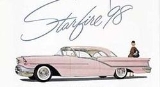
Oldsmobile Starfire

Encyclopedia
Oldsmobile Starfire are automobiles produced by the Oldsmobile
division of General Motors
in two generations from 1961–1966 and 1975–1980. The Starfire nameplate
was also used for the 1954–1956 Ninety- Eight series convertibles, and all 1957 Ninety-Eight series models. 1961 was the first year for the Starfire as a separate model
, available in a single convertible body style. The Starfire competed in the growing personal-luxury car market as was typified by the 4-passenger Ford Thunderbird
first introduced for the 1958 model year
. However, the Starfire shared most of its sheet metal with other models, and was considered part of the full-sized Oldsmobile line. The Starfire Hardtop Coupe joined the convertible for the 1962 model year. The convertible was dropped for the final 1966 model year, moving to the Eighty-Eight model line. The Starfire returned as Oldsmobile's first subcompact
car for the 1975 model year, featuring a V6 engine supplied by Buick
. The 1977 Starfire featured the first-ever Oldsmobile four-cylinder engine as standard equipment, with the V6, and a V8 engine optional.
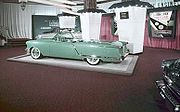 The Starfire name was first used by Oldsmobile on a one-of-a-kind dream car that was shown at the 1953 Motorama auto show. Named after a Lockheed
jet fighter plane, namely the F-94, the original Starfire was a 5-passenger convertible
that had a fiberglass
body, a 200 hp Rocket V8 engine, and a wraparound windshield like that used on the top-of-the-line and limited-production 1953 Fiesta 98 convertible.
The name was then used for the 1954–1956 model years to designate the convertible models of the 98
line in much the same way that the Holiday name was used to designate hardtop body-styles. The 1954–1956 Oldsmobile 98 Starfire convertibles were the most expensive Oldsmobiles offered during those years. During the 1957 model year, all 98
models were referred to as being Starfire 98s. The name was dropped from the 98 series beginning with the 1958 model year.
and floor shifter for the Hydra-matic transmission, and was the first U.S. full-sized production car to feature an automatic transmission with a console-mounted floor shifter, brushed aluminum side panels and power steering, brakes, windows and driver's seat. With a base price of $4,647 in 1961, it was the most expensive Oldsmobile, even more than the larger Ninety-Eight models. The standard 394 cubic inch V-8 Skyrocket V8 engine - Oldsmobile's most powerful in 1961 - used a 4-barrel Rochester carburetor and generated 330 hp at 4600 rpm. Sales of the 1961 model were 7,800.
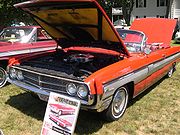 For the 1962 model year, the convertible was joined by a two-door hardtop
, which featured a new convertible roofline shared with other Olds 88 coupes. Horsepower was up to 345 hp. 1962 was the best sales year for the first generation Starfire with sales of the hardtop coupe being 34,839 and sales of the convertible being 7,149.
Styling changes for the 1963 model year included a move away from the sculpted sides of the previous years model, to a flatter, more conventional look with an exclusive squared off roofline that included a concave rear window. Sales of the coupe were down to 21,489 and the convertible was down to 4,401, a drop of 38%,. probably due to intense competition from Buick's all-new Riviera, which was in the same price range as the Starfire but had its own unique bodyshell.
The 1964 model appeared very similar to the 1963. Curb weight was down, but overall length was up to 215.3 inches (5,468.6 mm). Sales dropped further, to 13,753 coupes (down 36%) and 2,410 convertibles (down 45%). The Starfire now shared its basic bodyshell with the new and lower-priced Jetstar I
hardtop coupe which competed directly against the Pontiac Grand Prix
. The Jetstar also used the Starfire's 345 hp 394 cid "Ultra High Compression" Rocket V8, but had a pricetag that was over $500 lower than the Starfire due to the use of a vinyl bucket seat interior and the fact that many Starfire standard features were optional on the Jetstar including Hydra-Matic transmission, power steering and brakes.
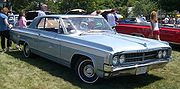 For the 1965 model year, all Oldsmobiles would receive new styling, and the Starfire Hardtop Sports Coupe would receive a modified version of the 1963-64 unique roofline with an inversely curved rear window. The Hardtop Sports Coupe body-style was again shared with the Jetstar I. Other 88 models adopted a Holiday Hardtop Coupe body-style that featured more of a fastback roof design, while the Ninety-Eight featured a more squared-off formal roof-line.
A new version of the Rocket V8 engine was offered for the 1965 model year, this one measuring 425 cid displacement, still using a Rochester
4-barrel carburetor, and generating 375 hp at 4800 rpm. This was still the most powerful engine in the Oldsmobile lineup and used only in the Starfire and the Jetstar I. Also new for 1965 was the three-speed Turbo Hydra-Matic automatic transmission
which replaced the previous fluid-coupling Hydra-Matic used by Oldsmobile since 1940. Added to the option list for the first time on Starfires and other B-body cars was a four-speed manual transmission with Hurst
shifter that was rarely ordered.
1965 sales were 13,024 for the coupe and 2,236 for the convertible.
Only the Starfire coupe was offered for 1966 as the convertible was discontinued for this final year for that nameplate as a full-sized sporty/luxury coupe. The Starfire price and equipment level both dropped considerably from previous years and was now at the same level as the former Jetstar I series with a less plush interior thanks to the leather seats being replaced by Morroceen vinyl for both the Strato bucket seats or no-cost optional notchback bench seat, and the movement of power windows and seats from standard equipment to the option list. Also downgraded from standard to optional equipment were the Turbo Hydra-Matic transmission, power steering and power brakes. Horsepower was up to 375, but the Starfire no longer had the most powerful engine offered for sale in an Oldsmobile. The new Toronado
had a similar engine offering 385 hp. Sales of the 1966 Starfire coupe were 13,019.
For 1967, the Starfire was replaced by a new Delta 88 Custom Holiday coupe which had interior trimmings similar to the '66 Starfire and was complemented by a four-door Holiday sedan with the notchback bench seat. Later full-sized Oldsmobile coupes to carry on the Starfire tradition included the 1969-70 Delta 88 Royale and 1978-81 Delta Holiday 88 coupe.
and shares its wheelbase
and width. It would be the smallest car bearing the Oldsmobile
name since before World War II
. An upgraded SX model was available, and the GT was introduced in mid-1975.
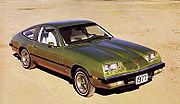 The Starfire has a 97 inches (2,463.8 mm) wheelbase
and a 65.4 inches (1,661.2 mm) width.
The Starfire, Chevrolet Monza
, and Buick Skyhawk
were among the first vehicles to adopt the newly approved quad rectangular headlamps. The body style is noted for having a resemblance to the Ferrari 365 GTC/4
. Starfire's standard engine for 1975-76 model years was the Buick 231 cid V6 engine using a 2-barrel carburetor that generates 110 hp at 4000.
The front suspension is short and long control arms with coil springs, and anti-roll bar; the rear suspension is a torque-arm design with coil springs and an anti-roll bar. The first generation Skyhawk is a rear wheel drive vehicle with a live rear axle
design. Variable-ratio power steering
was standard of a recirculating ball
type. The brake system features standard power assist including front disc brakes with solid rotors, and rear drum brakes.
This was the first GM product to incorporate a torque arm rear suspension (rear coil springs with 2 links) - its design was later incorporated into GM's third and fourth generation F-bodies (Camaro and Firebird
).
For the 1977 model year, the 140 CID (2.3 liter) aluminum-block inline 4-cylinder engine with 2-barrel carburetor became standard, while the Buick 231 cid (3.8 liter) V6 became optional on the base model. The GT package included the V6 engine. The Chevrolet 305 (5.0 liter) V8 engine
option was added later in the year. The Vega 140 CID aluminum-block L4 was discontinued at the end of the 1977 model year
The 1978 standard engine was Pontiac's 151 CID (2.5 liter) Iron Duke
inline 4-cylinder engine with a 2-barrel carburetor, generating 85 hp at 4400 rpm. Late in the year, Oldsmobile added the Starfire Firenza package which included special rallye suspension, a front air dam, rear spoiler, flared wheel openings, sport wheels and special paint and trim.
The 1979 model year saw a face lift, with twin rectangular headlamps replacing the previous quad rectangular headlamp design.
The V8 engine option was dropped at the end of the 1979 model year, as was the 5-speed manual transmission
.
The 1980 model year was the last one for the Starfire and its derivatives. Production ceased December 21, 1979, as Oldsmobile traded H-body production to Chevrolet and Pontiac in exchange for a higher allotment of new FWD X-bodies.
The rear-wheel-drive H-body cars including the Starfire were replaced in the spring of 1981 with the new front-wheel drive J-cars
designated as early 1982 models, including the Oldsmobile Firenza
.
A total 125,188 H-body Starfires were produced in six model years.
Oldsmobile
Oldsmobile was a brand of American automobile produced for most of its existence by General Motors. It was founded by Ransom E. Olds in 1897. In its 107-year history, it produced 35.2 million cars, including at least 14 million built at its Lansing, Michigan factory...
division of General Motors
General Motors
General Motors Company , commonly known as GM, formerly incorporated as General Motors Corporation, is an American multinational automotive corporation headquartered in Detroit, Michigan and the world's second-largest automaker in 2010...
in two generations from 1961–1966 and 1975–1980. The Starfire nameplate
Nameplate
A nameplate identifies and displays a person or product's name. Name plates are usually shaped as rectangles but are also seen in other shapes, sometimes taking on the shape of someone’s name...
was also used for the 1954–1956 Ninety- Eight series convertibles, and all 1957 Ninety-Eight series models. 1961 was the first year for the Starfire as a separate model
Car model
An automobile model is a particular brand of vehicle sold under a marque by a manufacturer, usually within a range of models, usually of different sizes or capabilities...
, available in a single convertible body style. The Starfire competed in the growing personal-luxury car market as was typified by the 4-passenger Ford Thunderbird
Ford Thunderbird
The Thunderbird , is an automobile manufactured by the Ford Motor Company in the United States over eleven model generations from 1955 through 2005...
first introduced for the 1958 model year
Model year
The model year of a product is a number used worldwide, but with a high level of prominence in North America, to describe approximately when a product was produced, and indicates the coinciding base specification of that product....
. However, the Starfire shared most of its sheet metal with other models, and was considered part of the full-sized Oldsmobile line. The Starfire Hardtop Coupe joined the convertible for the 1962 model year. The convertible was dropped for the final 1966 model year, moving to the Eighty-Eight model line. The Starfire returned as Oldsmobile's first subcompact
Subcompact car
Subcompact car is a North American term used to describe automobiles whose class size is smaller than that of a compact car, usually not exceeding in length, but larger than a microcar...
car for the 1975 model year, featuring a V6 engine supplied by Buick
Buick
Buick is a premium brand of General Motors . Buick models are sold in the United States, Canada, Mexico, China, Taiwan, and Israel, with China being its largest market. Buick holds the distinction as the oldest active American make...
. The 1977 Starfire featured the first-ever Oldsmobile four-cylinder engine as standard equipment, with the V6, and a V8 engine optional.
Origin
Lockheed Corporation
The Lockheed Corporation was an American aerospace company. Lockheed was founded in 1912 and later merged with Martin Marietta to form Lockheed Martin in 1995.-Origins:...
jet fighter plane, namely the F-94, the original Starfire was a 5-passenger convertible
Convertible
A convertible is a type of automobile in which the roof can retract and fold away having windows which wind-down inside the doors, converting it from an enclosed to an open-air vehicle...
that had a fiberglass
Fiberglass
Glass fiber is a material consisting of numerous extremely fine fibers of glass.Glassmakers throughout history have experimented with glass fibers, but mass manufacture of glass fiber was only made possible with the invention of finer machine tooling...
body, a 200 hp Rocket V8 engine, and a wraparound windshield like that used on the top-of-the-line and limited-production 1953 Fiesta 98 convertible.
The name was then used for the 1954–1956 model years to designate the convertible models of the 98
Oldsmobile 98
The Oldsmobile 98 was a full-size automobile and the flagship model of the Oldsmobile division of General Motors. The name first appeared in 1941 and was used again after American consumer automobile production resumed post-World War II...
line in much the same way that the Holiday name was used to designate hardtop body-styles. The 1954–1956 Oldsmobile 98 Starfire convertibles were the most expensive Oldsmobiles offered during those years. During the 1957 model year, all 98
Oldsmobile 98
The Oldsmobile 98 was a full-size automobile and the flagship model of the Oldsmobile division of General Motors. The name first appeared in 1941 and was used again after American consumer automobile production resumed post-World War II...
models were referred to as being Starfire 98s. The name was dropped from the 98 series beginning with the 1958 model year.
First generation (1961–1966)
Introduced in January 1961 as a convertible, the first Starfire shared its body and wheelbase with the Super 88 and the lower-priced Dynamic 88. It was loaded with standard equipment including leather bucket seats, center console with tachometerTachometer
A tachometer is an instrument measuring the rotation speed of a shaft or disk, as in a motor or other machine. The device usually displays the revolutions per minute on a calibrated analogue dial, but digital displays are increasingly common...
and floor shifter for the Hydra-matic transmission, and was the first U.S. full-sized production car to feature an automatic transmission with a console-mounted floor shifter, brushed aluminum side panels and power steering, brakes, windows and driver's seat. With a base price of $4,647 in 1961, it was the most expensive Oldsmobile, even more than the larger Ninety-Eight models. The standard 394 cubic inch V-8 Skyrocket V8 engine - Oldsmobile's most powerful in 1961 - used a 4-barrel Rochester carburetor and generated 330 hp at 4600 rpm. Sales of the 1961 model were 7,800.
Hardtop
A hardtop is a term for a rigid, rather than canvas, automobile roof. It has been used in several contexts: detachable hardtops, retractable hardtop roofs, and the so-called pillarless hardtop body style....
, which featured a new convertible roofline shared with other Olds 88 coupes. Horsepower was up to 345 hp. 1962 was the best sales year for the first generation Starfire with sales of the hardtop coupe being 34,839 and sales of the convertible being 7,149.
Styling changes for the 1963 model year included a move away from the sculpted sides of the previous years model, to a flatter, more conventional look with an exclusive squared off roofline that included a concave rear window. Sales of the coupe were down to 21,489 and the convertible was down to 4,401, a drop of 38%,. probably due to intense competition from Buick's all-new Riviera, which was in the same price range as the Starfire but had its own unique bodyshell.
The 1964 model appeared very similar to the 1963. Curb weight was down, but overall length was up to 215.3 inches (5,468.6 mm). Sales dropped further, to 13,753 coupes (down 36%) and 2,410 convertibles (down 45%). The Starfire now shared its basic bodyshell with the new and lower-priced Jetstar I
Oldsmobile Jetstar I
The Oldsmobile Jetstar 1 was produced for only two model years - 1964 and 1965. It was designed as a sporty, high-performance full-sized car and only offered as a two-door hardtop for both years, based on the Olds 88's B-body.-1964:...
hardtop coupe which competed directly against the Pontiac Grand Prix
Pontiac Grand Prix
Picking up where the Pontiac Ventura model left off, the Grand Prix first appeared in the Pontiac line for 1962. It was essentially a standard Pontiac Catalina coupe with minimal outside chrome trim and a sportier interior...
. The Jetstar also used the Starfire's 345 hp 394 cid "Ultra High Compression" Rocket V8, but had a pricetag that was over $500 lower than the Starfire due to the use of a vinyl bucket seat interior and the fact that many Starfire standard features were optional on the Jetstar including Hydra-Matic transmission, power steering and brakes.
A new version of the Rocket V8 engine was offered for the 1965 model year, this one measuring 425 cid displacement, still using a Rochester
Rochester Products Division
Rochester Products Division was a division of General Motors that manufactured carburetors, and related components including emissions control devices and cruise control systems in Rochester, New York...
4-barrel carburetor, and generating 375 hp at 4800 rpm. This was still the most powerful engine in the Oldsmobile lineup and used only in the Starfire and the Jetstar I. Also new for 1965 was the three-speed Turbo Hydra-Matic automatic transmission
Automatic transmission
An automatic transmission is one type of motor vehicle transmission that can automatically change gear ratios as the vehicle moves, freeing the driver from having to shift gears manually...
which replaced the previous fluid-coupling Hydra-Matic used by Oldsmobile since 1940. Added to the option list for the first time on Starfires and other B-body cars was a four-speed manual transmission with Hurst
Hurst Performance
Hurst Performance, Inc. of Warminster Township, Pennsylvania, manufactured and marketed products for enhancing the performance of automobiles, most notably for muscle cars.-Products:...
shifter that was rarely ordered.
1965 sales were 13,024 for the coupe and 2,236 for the convertible.
Only the Starfire coupe was offered for 1966 as the convertible was discontinued for this final year for that nameplate as a full-sized sporty/luxury coupe. The Starfire price and equipment level both dropped considerably from previous years and was now at the same level as the former Jetstar I series with a less plush interior thanks to the leather seats being replaced by Morroceen vinyl for both the Strato bucket seats or no-cost optional notchback bench seat, and the movement of power windows and seats from standard equipment to the option list. Also downgraded from standard to optional equipment were the Turbo Hydra-Matic transmission, power steering and power brakes. Horsepower was up to 375, but the Starfire no longer had the most powerful engine offered for sale in an Oldsmobile. The new Toronado
Oldsmobile Toronado
The original Toronado began as a design painting by Oldsmobile stylist David North in 1962. His design, dubbed the "Flame Red Car," was for a compact sports/personal car never intended for production...
had a similar engine offering 385 hp. Sales of the 1966 Starfire coupe were 13,019.
For 1967, the Starfire was replaced by a new Delta 88 Custom Holiday coupe which had interior trimmings similar to the '66 Starfire and was complemented by a four-door Holiday sedan with the notchback bench seat. Later full-sized Oldsmobile coupes to carry on the Starfire tradition included the 1969-70 Delta 88 Royale and 1978-81 Delta Holiday 88 coupe.
Second generation (1975–1980)
The Oldsmobile Starfire is a subcompact four-passenger automobile introduced in September 1974, and produced for the 1975 through 1980 model years. The Starfire is based on the Chevrolet VegaChevrolet Vega
The Chevrolet Vega is a subcompact, two-door automobile that was produced by the Chevrolet division of General Motors for the 1971-1977 model years. Named after the star Vega, the car was powered by a lightweight aluminum-block inline four-cylinder engine...
and shares its wheelbase
Wheelbase
In both road and rail vehicles, the wheelbase is the distance between the centers of the front and rear wheels.- Road :In automobiles, the wheelbase is the horizontal distance between the center of the front wheel and the center of the rear wheel...
and width. It would be the smallest car bearing the Oldsmobile
Oldsmobile
Oldsmobile was a brand of American automobile produced for most of its existence by General Motors. It was founded by Ransom E. Olds in 1897. In its 107-year history, it produced 35.2 million cars, including at least 14 million built at its Lansing, Michigan factory...
name since before World War II
World War II
World War II, or the Second World War , was a global conflict lasting from 1939 to 1945, involving most of the world's nations—including all of the great powers—eventually forming two opposing military alliances: the Allies and the Axis...
. An upgraded SX model was available, and the GT was introduced in mid-1975.
Overview
Wheelbase
In both road and rail vehicles, the wheelbase is the distance between the centers of the front and rear wheels.- Road :In automobiles, the wheelbase is the horizontal distance between the center of the front wheel and the center of the rear wheel...
and a 65.4 inches (1,661.2 mm) width.
The Starfire, Chevrolet Monza
Chevrolet Monza
The Chevrolet Monza is a subcompact, four-passenger automobile produced by the Chevrolet division of General Motors for the 1975–1980 model years. The Monza is based on the Chevrolet Vega, sharing its wheelbase, width and 140 CID inline-4 engine...
, and Buick Skyhawk
Buick Skyhawk
The Buick Skyhawk are automobiles produced by the Buick division of General Motors in two generations for the 1975 through 1989 model years. 1975 through 1980 models, all 2-door hatchbacks, were built on the subcompact, rear-wheel drive H-body platform...
were among the first vehicles to adopt the newly approved quad rectangular headlamps. The body style is noted for having a resemblance to the Ferrari 365 GTC/4
Ferrari 365 GTC/4
The Ferrari 365 GTC/4 was a 2+2 sports car produced from 1971-1972. It was based on the chassis of the Ferrari 365GTB/4 Daytona.-365 GTC/4:...
. Starfire's standard engine for 1975-76 model years was the Buick 231 cid V6 engine using a 2-barrel carburetor that generates 110 hp at 4000.
The front suspension is short and long control arms with coil springs, and anti-roll bar; the rear suspension is a torque-arm design with coil springs and an anti-roll bar. The first generation Skyhawk is a rear wheel drive vehicle with a live rear axle
Live axle
A live axle, sometimes called a solid axle, is a type of beam axle suspension system that uses the driveshafts that transmit power to the wheels to connect the wheels laterally so that they move together as a unit....
design. Variable-ratio power steering
Power steering
Power steering helps drivers steer vehicles by augmenting steering effort of the steering wheel.Hydraulic or electric actuators add controlled energy to the steering mechanism, so the driver needs to provide only modest effort regardless of conditions. Power steering helps considerably when a...
was standard of a recirculating ball
Recirculating ball
Recirculating ball, also known as recirculating ball and nut or worm and sector, is a steering mechanism commonly found in older automobiles, and some trucks...
type. The brake system features standard power assist including front disc brakes with solid rotors, and rear drum brakes.
This was the first GM product to incorporate a torque arm rear suspension (rear coil springs with 2 links) - its design was later incorporated into GM's third and fourth generation F-bodies (Camaro and Firebird
Pontiac Firebird
The Pontiac Firebird was built by the Pontiac division of General Motors between 1967 and 2002. The Firebird was introduced the same year as the automaker's platform-sharing model, the Chevrolet Camaro...
).
Changes
1976 models could be had with the new optional Borg-Warner 5-speed manual with overdrive transmission. Starting with the 1976 models the front disc rotors were of the vented type.For the 1977 model year, the 140 CID (2.3 liter) aluminum-block inline 4-cylinder engine with 2-barrel carburetor became standard, while the Buick 231 cid (3.8 liter) V6 became optional on the base model. The GT package included the V6 engine. The Chevrolet 305 (5.0 liter) V8 engine
V8 engine
A V8 engine is a V engine with eight cylinders mounted on the crankcase in two banks of four cylinders, in most cases set at a right angle to each other but sometimes at a narrower angle, with all eight pistons driving a common crankshaft....
option was added later in the year. The Vega 140 CID aluminum-block L4 was discontinued at the end of the 1977 model year
The 1978 standard engine was Pontiac's 151 CID (2.5 liter) Iron Duke
GM Iron Duke engine
Iron Dukes were fitted with fuel injection in 1982. This version was christened the Tech IV, though Car and Driver later ridiculed it as the low-Tech IV. Power output remained at ....
inline 4-cylinder engine with a 2-barrel carburetor, generating 85 hp at 4400 rpm. Late in the year, Oldsmobile added the Starfire Firenza package which included special rallye suspension, a front air dam, rear spoiler, flared wheel openings, sport wheels and special paint and trim.
The 1979 model year saw a face lift, with twin rectangular headlamps replacing the previous quad rectangular headlamp design.
The V8 engine option was dropped at the end of the 1979 model year, as was the 5-speed manual transmission
Manual transmission
A manual transmission, also known as a manual gearbox or standard transmission is a type of transmission used in motor vehicle applications...
.
The 1980 model year was the last one for the Starfire and its derivatives. Production ceased December 21, 1979, as Oldsmobile traded H-body production to Chevrolet and Pontiac in exchange for a higher allotment of new FWD X-bodies.
The rear-wheel-drive H-body cars including the Starfire were replaced in the spring of 1981 with the new front-wheel drive J-cars
GM J platform
The J platform, or J-body, was General Motors' inexpensive front-wheel drive automobile platform from the 1980s and 1990s. The platform replaced the GM H platform. The J-platform is the only platform of GM to have a model in each of its "Original 5" passenger car divisions...
designated as early 1982 models, including the Oldsmobile Firenza
Oldsmobile Firenza
The Oldsmobile Firenza was a compact car produced by the Oldsmobile division of General Motors from 1982 to 1988. It was based on the front-wheel drive GM J platform, which was shared with the Buick Skyhawk, Cadillac Cimarron, Chevrolet Cavalier and Pontiac Sunbird...
.
A total 125,188 H-body Starfires were produced in six model years.
Interesting facts
Starfire of first generation is a kind of "first action hero" of the third part of Ivan Efremov's "Razor's Edge" novel which was released in 1963. Seventh chapter is the third part is called - "Starfire". The car is in this chapter, one of the central roles. And is described in great detail. Personifying a great opportunity, which gives man the modern technique.Sources
- Flammang, James M. & Kowlake, Ron, Standard Catalog of American Cars: 1976-199, 3rd Edition (Iola, WI: Krause Publications, 1999)
- Gunnell, John, Standard Catalog of American Cars: 1946-1975, Revised 4th Edition (Iola, WI: Krause Publications, 2002)