
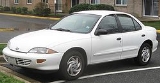
The
Chevrolet Cavalier was a compact automobile produced from 1982 to 2005 by
General MotorsGeneral Motors Company , commonly known as GM, formerly incorporated as General Motors Corporation, is an American multinational automotive corporation headquartered in Detroit, Michigan and the world's second-largest automaker in 2010...
. Built on the company's
J platformThe J platform, or J-body, was General Motors' inexpensive front-wheel drive automobile platform from the 1980s and 1990s. The platform replaced the GM H platform. The J-platform is the only platform of GM to have a model in each of its "Original 5" passenger car divisions...
, the Cavalier was one of the best-selling cars in the
United StatesThe United States of America is a federal constitutional republic comprising fifty states and a federal district...
throughout its life.
Predecessors
The Cavalier replaced the
MonzaThe Chevrolet Monza is a subcompact, four-passenger automobile produced by the Chevrolet division of General Motors for the 1975–1980 model years. The Monza is based on the Chevrolet Vega, sharing its wheelbase, width and 140 CID inline-4 engine...
, which was available as a 2-door
coupeA coupé or coupe is a closed car body style , the precise definition of which varies from manufacturer to manufacturer, and over time...
, a 3-door
hatchbackA Hatchback is a car body style incorporating a shared passenger and cargo volume, with rearmost accessibility via a rear third or fifth door, typically a top-hinged liftgate—and features such as fold-down rear seats to enable flexibility within the shared passenger/cargo volume. As a two-box...
and a 3-door
wagonA station wagon is a body style variant of a sedan/saloon with its roof extended rearward over a shared passenger/cargo volume with access at the back via a third or fifth door , instead of a trunk lid...
(using the same body as the discontinued
VegaThe Chevrolet Vega is a subcompact, two-door automobile that was produced by the Chevrolet division of General Motors for the 1971-1977 model years. Named after the star Vega, the car was powered by a lightweight aluminum-block inline four-cylinder engine...
wagon, the model it replaced). The inexpensive
ChevetteThe Chevrolet Chevette was introduced in September, 1975 and manufactured for model years 1976-1987 based on GM's worldwide T platform and superseding the Vega as Chevrolet's entry-level subcompact...
was retained even as sales declined, and was formally replaced by even smaller
captive importCaptive import is a marketing term and a strategy for an automobile part or entire vehicle that is foreign-built and sold under the name of an importer or by a domestic automaker through its own dealer distribution system....
s. Both previous platforms had rear-drive layouts while the new design followed the front wheel drive trend, as in the
Dodge OmniThe Dodge Omni and the similar Plymouth Horizon were front wheel drive cars introduced by the Dodge and Plymouth divisions of the Chrysler Corporation in North America in 1978, and were based on a European Simca-based design of the same name...
and
Honda CivicThe Honda Civic is a line of subcompact and subsequently compact cars made and manufactured by Honda. The Civic, along with the Accord and Prelude, comprised Honda's vehicles sold in North America until the 1990s, when the model lineup was expanded...
.
FordFord Motor Company is an American multinational automaker based in Dearborn, Michigan, a suburb of Detroit. The automaker was founded by Henry Ford and incorporated on June 16, 1903. In addition to the Ford and Lincoln brands, Ford also owns a small stake in Mazda in Japan and Aston Martin in the UK...
and
Chrysler Chrysler Group LLC is a multinational automaker headquartered in Auburn Hills, Michigan, USA. Chrysler was first organized as the Chrysler Corporation in 1925....
also introduced new front drive compacts. The largely successful mission of capturing the bulk of domestic compact sales would fall on the Cavalier's 2-door
coupeA coupé or coupe is a closed car body style , the precise definition of which varies from manufacturer to manufacturer, and over time...
, 4-door sedan and 4-door
station wagonA station wagon is a body style variant of a sedan/saloon with its roof extended rearward over a shared passenger/cargo volume with access at the back via a third or fifth door , instead of a trunk lid...
, the relatively short-lived 3-door
hatchbackA Hatchback is a car body style incorporating a shared passenger and cargo volume, with rearmost accessibility via a rear third or fifth door, typically a top-hinged liftgate—and features such as fold-down rear seats to enable flexibility within the shared passenger/cargo volume. As a two-box...
(which replaced the Monza 2+2 Sport 2-door hatchback) and, in later years, a 2-door
convertibleA convertible is a type of automobile in which the roof can retract and fold away having windows which wind-down inside the doors, converting it from an enclosed to an open-air vehicle...
. The small Cavalier even helped fill in lagging sales of the
compactA compact car , or small family car , is a classification of cars which are larger than a supermini but smaller than or equal to a mid-size car...
CitationThe Chevrolet Citation was a compact car sold by the Chevrolet brand of American automaker General Motors for model years 1980-1985. The Citation and its X-body siblings were among GM's first front wheel drive compact cars, following the trend of front drive compacts such as the Honda Accord...
(a
NovaThe Chevrolet Chevy II/Nova is a compact automobile manufactured by the Chevrolet division of General Motors produced in four generations for the 1962 through 1979 model years. Nova was the top model in the Chevy II lineup through 1968. The Chevy II nameplate was dropped, Nova becoming the...
replacement).
First generation
The Cavalier first went on sale in early 1981 as a 1982 model with front-wheel-drive, a choice of two carbureted four-cylinder pushrod engines, and 2 and 4-door sedan, hatchback, and station wagon body styles. Convertibles were added in 1983, initial production totaling less than 1000.
1983 Cavaliers offered throttle body
fuel injectionFuel injection is a system for admitting fuel into an internal combustion engine. It has become the primary fuel delivery system used in automotive petrol engines, having almost completely replaced carburetors in the late 1980s....
, and a
V6 engineA V6 engine is a V engine with six cylinders mounted on the crankcase in two banks of three cylinders, usually set at either a right angle or an acute angle to each other, with all six pistons driving a common crankshaft...
became available in 1985, uncommon for a subcompact car. The 1984 models received a mild facelift featuring quad headlights.
The Cavalier was largely identical to the
Pontiac SunbirdThe Pontiac Sunbird, produced by the Pontiac division of General Motors, was Pontiac's second small-car offering of the 70's. The Sunbird model ran for 18 years and was then replaced in 1995 by the Pontiac Sunfire...
. Before the
PontiacPontiac was an automobile brand that was established in 1926 as a companion make for General Motors' Oakland. Quickly overtaking its parent in popularity, it supplanted the Oakland brand entirely by 1933 and, for most of its life, became a companion make for Chevrolet. Pontiac was sold in the...
brand was officially introduced in
MexicoThe United Mexican States , commonly known as Mexico , is a federal constitutional republic in North America. It is bordered on the north by the United States; on the south and west by the Pacific Ocean; on the southeast by Guatemala, Belize, and the Caribbean Sea; and on the east by the Gulf of...
in 1992, Cavaliers sold there featured Sunbird body panels, as opposed to US-spec Cavalier panels. From 1993 on, the sibling marques were both offered, as in the United States.
Second generation
The Cavalier was restyled in 1988. The two door hatchback was dropped, while the coupe, sedan, wagon and convertible carried over. The sedan and wagon were unchanged from the doors back, while the coupe's exterior was completely redesigned. This resulted in different trunk designs for the coupe and sedan. Three trim levels were available in 1988: VL, RS, and Z24. The convertible was only available as a Z24. The VL and RS came standard with the
2.0 L L4This engine family, produced by General Motors globally, was originally designed by Opel in Germany. In OHV form, it was available in the US beginning in 1982 for the GM J platform compact cars and S-series trucks, although originally in use from the 1970s globally. It is different than the engine...
engine producing 90 hp, while the 2.8 L V6 producing 125 hp was optional on the RS and standard on the Z24. With all trims, 5-speed manual transmission was standard, and a 3-speed automatic was optional. An electronic dashboard was available with the RS and Z24 trims.
In 1989, the
steering columnThe automotive steering column is a device intended primarily for connecting the steering wheel to the steering mechanism or transferring the driver's input torque from the steering wheel.-Secondary functions:...
was redesigned to be adjustable, as well as the addition of 3-point
seat beltA seat belt or seatbelt, sometimes called a safety belt, is a safety harness designed to secure the occupant of a vehicle against harmful movement that may result from a collision or a sudden stop...
s for the rear outboard seats. The optional V6 was retooled to 130 hp.
In 1990, the base engine was enlarged to a 2.2 L L4, and power increased to 95 hp. The optional V6 engine was also upgraded to the 3.1 L V6 and 140 horsepower. The convertible was dropped from availability to prevent internal competition with a planned
Beretta convertibleThe Chevrolet Beretta is a front wheel drive coupé produced by the Chevrolet division of General Motors for the 1987–1996 model years. The Beretta was designed in the same design studio as the Camaro and the Corvette, Chevrolet Exterior Studio 3, and was built at the Wilmington, Delaware and...
. However, the Beretta convertible was shelved at the eleventh hour, before a 1990 Cavalier convertible could be prepared.
The Cavalier got a more extensive restyling in 1991 that involved a new hood, bumpers, headlights, taillights, wheel covers and a redesigned interior. Most notably, the cooling system was redesigned to draw air from the bumper, giving it a Ford Taurus-style bumper and grille-less nose. The new bumpers were unpainted, with the option to have them colored grey, black or white; the latter only available on white-colored models. The Z24 eschewed this for a color keyed body kit. Z24 models also gained the options for a height adjustable driver's seat and a CD player. The platform and trim lines were carried over, while the convertible was brought back mid-year in the RS trim only with the V6 standard.
In 1992, the 2.2 L standard engine adopted multi-point fuel injection to improve output to 110 hp. The convertible was now available in both RS and Z24 trims, with the V6 standard in the Z24 and optional with the RS. Antilock brakes were added as a standard feature, as Delco Moraine had managed to develop a low-cost system. Power locks were also standard, and were designed to automatically lock when the car is shifted out of park, or if the car is traveling at least 8 miles per hour in manual transmission equipped models.
1993 brought minimal changes to the Cavalier line. The convertibles receive a glass rear window, allowing rear window defrost as an option.
1994 models were also carryovers, as a new model of Cavalier was in development. The VL trim was dropped on the wagon, while the 2.2 L OHV L4's fuel delivery was improved to sequential fuel injection, increasing its output to 120 horsepower. Additional changes included a slightly redesigned climate control interface and the power locking system being again redesigned: the doors would still lock automatically when put into gear, but they would also unlock automatically when the ignition was switched off.
Third generation
The Cavalier received its first total redesign in 1995, with expanded dimensions and more modern looks. Some of the basic styling cues remained however, such as the coupes' dipped beltline. The wagon was discontinued, but the coupe, sedan, and convertible body styles returned. This Chevrolet Cavalier generation lost the
V6 engineA V6 engine is a V engine with six cylinders mounted on the crankcase in two banks of three cylinders, usually set at either a right angle or an acute angle to each other, with all six pistons driving a common crankshaft...
entirely. It is the only Chevrolet Cavalier generation that did not offer a V6 option, all were four-cylinder.
The Cavalier Z24 received a new engine in 1996, the
LD9 2.4 liter engine. This engine cranked out 150 hp and 155 lbft of torque and was used until 2002. In 1999, the car lost the "CHEVROLET" text badge at the trunklid. This engine came mated standard with the
Getrag F23The F23 is a five-speed manual transmission manufactured by Getrag in Italy. It is designed for transverse engine applications, primarily by General Motors. It can handle torque inputs of up to .In the U.S...
5-speed
manual transmissionA manual transmission, also known as a manual gearbox or standard transmission is a type of transmission used in motor vehicle applications...
. The Z24 only came in 2-door coupe models up until 2000 and featured a sport-tuned suspension, 16-inch tires and alloy wheels and improved interior electronics. Aesthetically inside and out little changed from the other models other than a ground effects kit and taller rear spoiler. In 2000 a 4-door Z24 Sedan debuted, featuring the same mechanics but having a less sporty body. The Z24 Trim also received several other upgrades including a wider front sway bar and FE2 Sports Suspension for better handling characteristics, and less aggressive ABS anti-lock braking system. In 2003 the Cavalier Z24 line was dropped and replaced by the LS Sport line, which featured the new
Ecotec L61 motors (140 hp and 150 lbft torque). These engines improved fuel economy, featuring a smaller engine, while maintaining the power of the now-outdated LD9 motors. These motors remained in the Cavaliers up until 2005 when the Chevrolet Cavalier was replaced by the
Chevrolet CobaltThe Chevrolet Cobalt is a compact car introduced by Chevrolet in 2004 for the 2005 model year. The Cobalt replaced both the Cavalier and the Prizm as Chevrolet's compact car....
.
A GM Eaton M45 Supercharger kit was also offered for the Z24 trim as well. The supercharger kit was developed and tested by General Motors and could only be installed at a GM dealer. This upgrade drastically increased performance due to a pressure of 4.7 PSI which in turn added approximately 40 hp and 40 lbft of torque increase; raising the Z24's ratings to approximately 190 hp and 195 lbft of torque.
The Cavalier was facelifted in 2000 and in 2003. The convertible was discontinued after 2000.
Toyota Cavalier
As part of a wider effort to avoid additional restrictions on exports to the US, the third generation model was briefly sold in
JapanJapan is an island nation in East Asia. Located in the Pacific Ocean, it lies to the east of the Sea of Japan, China, North Korea, South Korea and Russia, stretching from the Sea of Okhotsk in the north to the East China Sea and Taiwan in the south...
by Toyota under an agreement with GM, badged as the
Toyota Cavalier as in return for the Geo/Chevrolet Prizm. Aside from the fact that it was right hand drive, the Toyota Cavalier also featured a leather-wrapped shift knob and steering wheel, wider front fenders,
amberAmber is an orange-yellow color that got its name from the material known as amber. Due to this, amber can refer not to one but to a series of shades of orange, since the natural material varies from nearly yellow when newer to orange or reddish-orange when older.-Amber:Amber is a pure chroma color...
turn signals for Japanese regulations, power folding side mirrors, side turn signal repeater lights on the front fenders, and carpeting on the inside of the trunk lid. Interior seats were often flecked with color, and the rear seat had a fold-down armrest. Vehicles produced between February through December 1998 were available with a leather interior equipped with an automatic transmission only. All models featured wheels borrowed from the Pontiac Sunfire. The Toyota Cavalier was available in 2.4G and 2.4Z trim levels. While all Chevrolet-badged Cavaliers received a facelift for 2000, the Toyota did as well with the updated center console, head-lights/hood/front bumper, tail-lights, and colors available.
TRDToyota Racing Development or TRD is the in-house tuning shop for all Toyota, Lexus, and Scion cars. TRD is responsible both for improving street cars for more performance and supporting Toyota's racing interests around the world. TRD produces various tuning products and accessories, including...
made a body kit and rear wing for the Cavalier, available exclusively in Japan.
The Cavalier wasn't the only GM product sold in Japan; the
Saturn S-seriesThe S-Series was part of a family of compact cars from the Saturn automobile company. This was the first series of Saturn vehicles. The automobile platform, the Z-body, was developed entirely in-house at Saturn and shared very little with the rest of the General Motors model line...
was sold in right hand drive conversions at Saturn dealerships (some former
Isuzu, is a Japanese car, commercial vehicle and heavy truck manufacturing company, headquartered in Tokyo. In 2005, Isuzu became the world's largest manufacturer of medium to heavy duty trucks. It has assembly and manufacturing plants in the Japanese city of Fujisawa, as well as in the prefectures...
dealerships) from 1996 until 2003, and some
Toyota Vista Shops also retailed Saturns.
The Toyota Cavalier was entirely produced by GM in the USA and sold from 1995–2000. 1996-2000 Toyota Cavaliers came equipped with the 2.4 L LD9 engine, while the 1995 used the 2.3 L Quad 4. Due to the engine displacement and width dimensions (1740 mm (69 in) for the coupe, 1735 mm (68 in) for the sedan ) exceeding Japanese government regulations concerning exterior dimensions and maximum engine displacement, it was not considered a "compact" and incurred an additional yearly tax, which had an effect on sales. Prices for the coupe started at ¥ 2 million yen for the coupe, and ¥ 1,81 million yen for the sedan.
Due to higher than typically average
Motor-vehicle inspection (Japan), a contraction of , is the name of the vehicle inspection program in Japan for motor vehicles over 250 cc in engine displacement.- Reason for existence :...
costs, a fair number of these vehicles are re-exported as Japanese used cars, most notably to
AustraliaAustralia , officially the Commonwealth of Australia, is a country in the Southern Hemisphere comprising the mainland of the Australian continent, the island of Tasmania, and numerous smaller islands in the Indian and Pacific Oceans. It is the world's sixth-largest country by total area...
and
New ZealandNew Zealand is an island country in the south-western Pacific Ocean comprising two main landmasses and numerous smaller islands. The country is situated some east of Australia across the Tasman Sea, and roughly south of the Pacific island nations of New Caledonia, Fiji, and Tonga...
. Production of the Toyota Cavalier ceased in June 2000. Despite the fact that Toyota made great attempts to market the Cavalier to Japanese buyers, the Japanese public was not impressed with the quality of workmanship, typically expected of cars sold in Japan.
Safety
The third-generation Cavalier earned several low scores in crash tests by the
Insurance Institute for Highway SafetyThe Insurance Institute for Highway Safety is a U.S. non-profit organization funded by auto insurers, established in 1959 and headquartered in Arlington, Virginia. It works to reduce the number of motor vehicle crashes, and the rate of injuries and amount of property damage in the crashes that...
and
National Highway Traffic Safety AdministrationThe National Highway Traffic Safety Administration is an agency of the Executive Branch of the U.S. government, part of the Department of Transportation...
. Also, IIHS fatality risks statistics rated the Cavalier among the "Highest rates of driver deaths," with 150 (4 door) to 171 (2 door) driver deaths per million registered vehicle years. Average for the Cavalier class (small) was 103 (4 door) to 134 (2 door) driver deaths per million registered vehicle years.
The IIHS gave the 1995-2005 Cavalier a "Poor" overall score in their frontal offset collision test.
2005
National Highway Traffic Safety AdministrationThe National Highway Traffic Safety Administration is an agency of the Executive Branch of the U.S. government, part of the Department of Transportation...
(NHTSA) Crash Test Ratings (coupe):
- Frontal Driver:
- Frontal Passenger:
- Side Driver: *safety concern*
- Side Rear Passenger:
- Rollover:
2002 National Highway Traffic Safety Administration (NHTSA) Crash Test Ratings (sedan):
- Frontal Driver:
- Frontal Passenger:
- Side Driver: *safety concern*
- Side Rear Passenger:
- Rollover:
Production
Most Cavaliers were built at
Lordstown AssemblyThe Lordstown Complex is a General Motors automobile factory in Lordstown, Ohio comprising three facilities: Vehicle Assembly, Metal Center, and Paint Shop. The plant opened in 1966. Lordstown currently builds the global Chevrolet Cruze compact car....
, although they have also been produced in
South Gate, CaliforniaSouth Gate is a city in Los Angeles County, California, United States. The sixteenth largest city in Los Angeles County, it encompasses . South Gate is located just southeast of downtown Los Angeles It is part of the Gateway Cities region of southeastern Los Angeles County...
(1982 model year only),
Lansing Car AssemblyLansing Car Assembly was a General Motors automobile factory in Lansing, Michigan. It contained two elements, a 1901 automobile plant in downtown Lansing, and the 1920 Durant Motors factory on Lansing's Far Westside....
(1996-1998 coupes),
Lansing Craft CentreThe Lansing Craft Centre was a specialized General Motors automobile assembly factory in Lansing Township, Michigan. The plant started production in 1987 and closed in 2006...
(1996-2000 convertibles),
Janesville AssemblyJanesville Assembly Plant is an automobile factory owned by General Motors located in Janesville, Wisconsin. Opened in 1919, it is the oldest-operating GM plant.-History:...
, Ramos Arizpe, and
Leeds AssemblyLeeds Assembly was a General Motors automobile factory in Leeds, Missouri . It was closed in 1988. The factory produced the A-bodies and J-bodies.-See also:* List of GM factories...
.
Production ended on October 6, 2004
United States sales figures
- 58,904 - 1982
- 268,587 - 1983
- 462,611 - 1984
- 383,752 - 1985
- 432,101 - 1986
- 346,254 - 1987
- 322,939 - 1988
- 376,626 - 1989
- 310,501 - 1990
- 326,847 - 1991
- 225,633 - 1992
- 251,590 - 1993
- 254,426 - 1994
- 151,669 - 1995
- 261,686 - 1996
- 315,136 - 1997
- 238,861 - 1998
Sources:
Edmunds.comEdmunds.com is a provider of automotive information via Web sites, books, and other media. The company is headquartered in Santa Monica, California and maintains an office outside of Detroit, Michigan...
(1992–98), Autoworld.com (1999 estimate)
Engines used
- 1982 — 1.8 L OHV 2-barrel inline-4, 88 horsepower
- mid 1982–1984 — 2.0 L OHV 2-barrel inline-4, 90 horsepower
- 1983–1989 — 2.0 L OHV TBI inline-4, 86 horsepower (1983–1984), 88 horsepower (1985–1986), 90 horsepower (1987–89)
- 1985–1989 — 2.8 L OHV MPFI V6, 120-130 horsepower (125 in 1985, 120 in 1986, 130 in 1987, 125 in 1988, and 130 in 1989)
- 1990–1994 — 2.8 L OHV MPFI V6, 130 horsepower (Mexico and Venezuela only, *Colombia used a version of 116 hp.
Magazine Motor El Tiempo, http://www.carrosyclasicos.com/a.php?a=864 (Information in spanish language).
- 1990–1991 — 2.2 L OHV TBI inline-4, 95 hp
- 1990–1994 — 3.1 L OHV MPFI V6, 140 hp
- 1992–2002 — 2.2 L OHV MPFI L4, 110 horsepower (1992–93), 120 horsepower (1994–97, 1994 upgrade to SFI), 115 horsepower (1998–2002)
- 1995 — 2.3 L DOHC MPFI Quad 4, 150 hp
- 1996–2002 — 2.4 L DOHC SFI L4, 150 hp
- 2002–2005 — 2.2 L DOHC Ecotec SFI L4, 140 hp
External links