

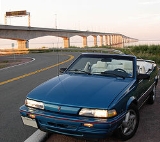
Pontiac Sunbird

Encyclopedia
The Pontiac Sunbird, produced by the Pontiac
division of General Motors
, was Pontiac's second small-car offering of the 70's. The Sunbird model ran for 18 years (with a lapse during the 1981 & 1982 model years, as the 1982 model was called J2000) and was then replaced in 1995 by the Pontiac Sunfire
. Through the years the Sunbird was available in notchback coupe, sedan, hatchback, station wagon, and convertible body styles.
sharing the Vega's wheelbase
and width, Built on the H-body platform
, its intended competitors were other small sporty two-door vehicles including the Toyota Celica, Ford Capri, and the Ford Mustang II.
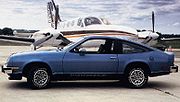 The Sunbird has a 97 inches (2,463.8 mm) wheelbase
and a 65.4 inches (1,661.2 mm) width. The first generation Sunbird is a rear wheel drive vehicle with a live rear axle
design. The standard engine was the Vega aluminum-block 140 CID inline-4
. Equipped with a single barrel carburetor, it generates a peak power output of 78 hp at 4200 rpm. the standard transmission was a 4-speed manual, with a 5-speed manual
and 3-speed automatic transmission
options.
This engine was also available with a 2-barrel carburetor that increased peak power to 87 hp at 4400 rpm, as well as Buick
's 3.8 L (231 cid) V6 engine rated at 110 hp at 4000 rpm.
The front suspension is short and long control arms with coil springs, and anti-roll bar; the rear suspension is a torque-arm design with coil springs and an anti-roll bar. Variable-ratio power steering
was standard of a recirculating ball
type. The brake system features front disc brakes with vented rotors, and rear drum brakes. Power-assist was standard.
body-style was added. It is noted for having a resemblance to the Ferrari 365 GTC/4
.
All Sunbirds had a new standard engine: Pontiac's 151 CID "Iron Duke" inline four-cylinder engine using a 2-barrel Holley carburetor
and generating 90 hp at 4400 rpm. A Formula option was available on coupe and hatchback. It includes the handling package, a chrome valve cover, three-piece spoiler, T/A steering wheel, and special body decals.
For 1978 and 1979, the station wagon from the discontinued Astre series was added to the Sunbird line. They continued to use the same front fascia as the Astre with Sunbird badging. The 2.3 L engine was simultaneously discontinued.
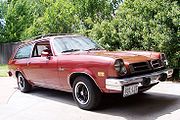 For the 1979 model year, the Chevrolet
's 5.0 L (305 cid) V8 engine was made optional in the notchback
and hatchback, while the Sunbird Safari wagon continued for its final year with a revised vertical styled grill. The 1979 engine options included 301-V8,305-V8,350-V8,400-V8,403-V8, 3.8L-V6 and an 2.5L-I4. Body options included Firebird Redbird Package, Sunbird Formula Package, and sunroof. Air conditioning was available as was 4 Speed manual transmission or 3 speed automatic transmission.
1980 was the final production year of the H-bodied Sunbird. By this time the wagon body style and the optional V8 engine were discontinued. The year featured an unusually long production run in order to provide sufficient inventory to carry dealers into the 1981 model year, in anticipation of the Sunbird's replacement.
A total 479,967 H-body Sunbirds were produced in five model years.
platform with the Chevrolet Cavalier
, Oldsmobile Firenza
, Buick Skyhawk
, Cadillac Cimarron
in North America.
For 1983, the "J" prefix was dropped. This was in an effort to market the J2000 as a smaller version of the Pontiac 6000
, which had a similar appearance. Both engines were replaced by a new SOHC 1.8L four, imported from GM of Brazil. This engine used throttle-body electronic fuel injection, in contrast to the carburetor that was used in the 1982 engines, making 84 hp. A 5-speed manual was newly optional. A convertible called the 2000 Sunbird was also new for 1983.
1984 brought a new front fascia for a smoother, less angular look. Also, the lineup was renamed "2000 Sunbird", a title used only on the convertible the previous year. A new turbocharged four-cylinder was available. Based on the standard 1.8L inline-four that powered other 2000 Sunbirds, it used multi-port fuel injection, for a total output of 150 hp. This engine was popular, and more powerful than many V6 engines in competing brands. 1985 was a carryover year, except for the "2000" prefix being dropped. A GT model arrived in 1986. It featured fender flares, hidden headlamps, and the Turbo engine standard. It was available in sedan, coupe or convertible. The GT sedan is very rare, with less than 5000 sold. The GT convertible is the rarest variant, with fewer than 1,300 sold.
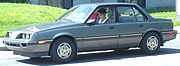 A redesigned gauge cluster and new engines made news for the 1987 model year. The gauge cluster featured different graphics, and featured a 120 mi/h speedometer on Turbo equipped models, where 1984-86 Turbo models had just an 85 mi/h speedometer. The new engines were "punched out" versions of the 1.8L, displacing 2.0L. The base engine still used throttle-body injection, for a new total of 96 hp, and the turbo still used port-injection, for a new total of 165 hp. Also, the convertible could only be ordered in GT trim. The rear fascia was redesigned in 1988, and the 4-speed manual was discontinued.
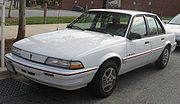 Production under the Sunbird name was continued until 1994. The trim levels on both the sedan and coupe were base, SE and GT. The Sunbird SE coupe, SE sedan and the GT coupe
and convertible
had partially concealed headlamps, a feature that originally appeared on the Honda CR-X
, that gave the appearance of "raised eyebrows" when the headlights were on. The base model initially had the 1984-87 front fascia with exposed sealed beam headlamps. The engines were both the carryover 2.0L 96 hp I4 and the turbocharged 165 horsepower 2.0L four.
In 1989, the base model received a smoother, more aerodynamic front fascia and the model was renamed "LE". An LE coupe joined the lineup also, with the same features as the LE sedan, but for a slightly lower price. The SE sedan was discontinued. In all models, however, a new dashboard was added. It somewhat resembled that of the Pontiac Grand Prix, redesigned for 1988. The most notable change from the previous dashboard is the placement of the stereo. A redesigned AM/FM stereo unit was placed high in the dash. If a cassette player or compact disc player
(new for 1989) were ordered, they were relocated at the bottom of the dash. The Safari wagon was dropped.
For 1990, the GT and SE coupes received a smoother front fascia with hidden headlamps. The GT convertible is discontinued, replaced by a turbocharged LE convertible, which also retains the GT suspension and steering. In all models, GM's passive seatbelt system was introduced. The seatbelts were mounted on the doors and would stretch out when latched.
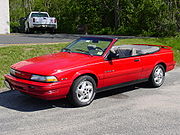 The turbo four was deleted for 1991, replaced by the Cavalier
's 3.1L V6. With Multi-Port Fuel Injection
, it produced 140 hp at 5200 rpm, and 185 lbft of torque at 4800 rpm. Although there was less horsepower under the hood, power came much quicker and smoother than the Turbo, with about the same fuel economy. The V6 engine could be ordered in any model, save the new-for 1991 base value model. The SE coupe received the LE coupe front fascia, but the GT's fascia could still be ordered with a sport package exclusive to SE coupes.
The largest change for the '92 model year was a revision of the base engine. The 2.0 L SOHC TBI four was replaced with the 2.0 L SOHC MPFI four resulting in a fuel economy increase and power increase. Power was increased from 96 hp to 110 hp and torque increased from 118 to 124 lbft. An SE sedan was once again available, and the base models were dropped and the convertible moved from LE to SE.
The only change for 1993 was the addition of a glass rear window with defroster on convertibles.
As the Sunbird came to a close, the trims were pared down. The SE sedan, SE convertible and GT coupe were dropped for 1994. The LE sedan, LE coupe and LE convertible (moved from SE to LE), and SE coupe stood pat for one more year. The SE coupe was essentially the '93 GT coupe with a lower price.
Most Sunbirds were built in Lordstown, Ohio
and Ramos Arizpe
, Mexico
.
The Sunbird was replaced by the Pontiac Sunfire
in 1995.
4-cylinder engine of the GM 122 family as standard equipment. The 150 hp 1.8 L turbo engine had been available since 1984. In 1987 the engine was upgraded to the 165 hp LT3.
All GTs featured semi-concealed headlamps and fender flares and "Turbo GT" badges replacing "Sunbird" badges, except on the turbo delete cars where the "Sunbird" badges were replaced by "Sunbird GT" badges. The sedan was dropped for 1988 and the interior was redesigned for 1989. The convertible was dropped for 1990 and the turbo was gone for 1991. Replacing the turbo four-cylinder for 1991 was GMs venerable 3.1L V6
that produced 140 hp, but was quieter and smoother than the turbo. After 1993, the GT coupe became the SE coupe when the lineup was consolidated prior to the new model to arrive for 1995.
there.
Pontiac
Pontiac was an automobile brand that was established in 1926 as a companion make for General Motors' Oakland. Quickly overtaking its parent in popularity, it supplanted the Oakland brand entirely by 1933 and, for most of its life, became a companion make for Chevrolet. Pontiac was sold in the...
division of General Motors
General Motors
General Motors Company , commonly known as GM, formerly incorporated as General Motors Corporation, is an American multinational automotive corporation headquartered in Detroit, Michigan and the world's second-largest automaker in 2010...
, was Pontiac's second small-car offering of the 70's. The Sunbird model ran for 18 years (with a lapse during the 1981 & 1982 model years, as the 1982 model was called J2000) and was then replaced in 1995 by the Pontiac Sunfire
Pontiac Sunfire
The Pontiac Sunfire was introduced for the 1995 model year as the compact car to replace the Sunbird. Not only was the name changed, but dramatic styling changes were included as well. The new styling was shared with the redesigned Chevrolet Cavalier...
. Through the years the Sunbird was available in notchback coupe, sedan, hatchback, station wagon, and convertible body styles.
1976–1980
The Pontiac Sunbird is a subcompact, four-passenger automobile introduced in September 1975, and produced for the 1976 through 1980 model years. The first-generation Sunbird is derived from the Chevrolet VegaChevrolet Vega
The Chevrolet Vega is a subcompact, two-door automobile that was produced by the Chevrolet division of General Motors for the 1971-1977 model years. Named after the star Vega, the car was powered by a lightweight aluminum-block inline four-cylinder engine...
sharing the Vega's wheelbase
Wheelbase
In both road and rail vehicles, the wheelbase is the distance between the centers of the front and rear wheels.- Road :In automobiles, the wheelbase is the horizontal distance between the center of the front wheel and the center of the rear wheel...
and width, Built on the H-body platform
GM H platform (RWD)
The General Motors H platform or H-body is an automobile platform designation used for the 1971–1980 model year rear wheel drive line of subcompact cars...
, its intended competitors were other small sporty two-door vehicles including the Toyota Celica, Ford Capri, and the Ford Mustang II.
Overview
Wheelbase
In both road and rail vehicles, the wheelbase is the distance between the centers of the front and rear wheels.- Road :In automobiles, the wheelbase is the horizontal distance between the center of the front wheel and the center of the rear wheel...
and a 65.4 inches (1,661.2 mm) width. The first generation Sunbird is a rear wheel drive vehicle with a live rear axle
Live axle
A live axle, sometimes called a solid axle, is a type of beam axle suspension system that uses the driveshafts that transmit power to the wheels to connect the wheels laterally so that they move together as a unit....
design. The standard engine was the Vega aluminum-block 140 CID inline-4
GM 2300 engine
The 2300 is a 2.3 L/140 cu in inline-4 automobile engine produced by the Chevrolet division of General Motors for the 1971–1977 model years. The Chevrolet Vega engine was ahead of its time with its die-cast aluminum-alloy cylinder block. The high-tech block features an alloy with...
. Equipped with a single barrel carburetor, it generates a peak power output of 78 hp at 4200 rpm. the standard transmission was a 4-speed manual, with a 5-speed manual
Manual transmission
A manual transmission, also known as a manual gearbox or standard transmission is a type of transmission used in motor vehicle applications...
and 3-speed automatic transmission
Automatic transmission
An automatic transmission is one type of motor vehicle transmission that can automatically change gear ratios as the vehicle moves, freeing the driver from having to shift gears manually...
options.
This engine was also available with a 2-barrel carburetor that increased peak power to 87 hp at 4400 rpm, as well as Buick
Buick
Buick is a premium brand of General Motors . Buick models are sold in the United States, Canada, Mexico, China, Taiwan, and Israel, with China being its largest market. Buick holds the distinction as the oldest active American make...
's 3.8 L (231 cid) V6 engine rated at 110 hp at 4000 rpm.
The front suspension is short and long control arms with coil springs, and anti-roll bar; the rear suspension is a torque-arm design with coil springs and an anti-roll bar. Variable-ratio power steering
Power steering
Power steering helps drivers steer vehicles by augmenting steering effort of the steering wheel.Hydraulic or electric actuators add controlled energy to the steering mechanism, so the driver needs to provide only modest effort regardless of conditions. Power steering helps considerably when a...
was standard of a recirculating ball
Recirculating ball
Recirculating ball, also known as recirculating ball and nut or worm and sector, is a steering mechanism commonly found in older automobiles, and some trucks...
type. The brake system features front disc brakes with vented rotors, and rear drum brakes. Power-assist was standard.
Changes
In 1977 the hatchbackHatchback
A Hatchback is a car body style incorporating a shared passenger and cargo volume, with rearmost accessibility via a rear third or fifth door, typically a top-hinged liftgate—and features such as fold-down rear seats to enable flexibility within the shared passenger/cargo volume. As a two-box...
body-style was added. It is noted for having a resemblance to the Ferrari 365 GTC/4
Ferrari 365 GTC/4
The Ferrari 365 GTC/4 was a 2+2 sports car produced from 1971-1972. It was based on the chassis of the Ferrari 365GTB/4 Daytona.-365 GTC/4:...
.
All Sunbirds had a new standard engine: Pontiac's 151 CID "Iron Duke" inline four-cylinder engine using a 2-barrel Holley carburetor
Carburetor
A carburetor , carburettor, or carburetter is a device that blends air and fuel for an internal combustion engine. It is sometimes shortened to carb in North America and the United Kingdom....
and generating 90 hp at 4400 rpm. A Formula option was available on coupe and hatchback. It includes the handling package, a chrome valve cover, three-piece spoiler, T/A steering wheel, and special body decals.
For 1978 and 1979, the station wagon from the discontinued Astre series was added to the Sunbird line. They continued to use the same front fascia as the Astre with Sunbird badging. The 2.3 L engine was simultaneously discontinued.
Chevrolet
Chevrolet , also known as Chevy , is a brand of vehicle produced by General Motors Company . Founded by Louis Chevrolet and ousted GM founder William C. Durant on November 3, 1911, General Motors acquired Chevrolet in 1918...
's 5.0 L (305 cid) V8 engine was made optional in the notchback
Notchback
Notchback is a styling term describing a car body style, a variation of three-box styling where the third distinct volume or "box" is less pronounced — especially where the rear deck is short or where the rear window is upright...
and hatchback, while the Sunbird Safari wagon continued for its final year with a revised vertical styled grill. The 1979 engine options included 301-V8,305-V8,350-V8,400-V8,403-V8, 3.8L-V6 and an 2.5L-I4. Body options included Firebird Redbird Package, Sunbird Formula Package, and sunroof. Air conditioning was available as was 4 Speed manual transmission or 3 speed automatic transmission.
1980 was the final production year of the H-bodied Sunbird. By this time the wagon body style and the optional V8 engine were discontinued. The year featured an unusually long production run in order to provide sufficient inventory to carry dealers into the 1981 model year, in anticipation of the Sunbird's replacement.
A total 479,967 H-body Sunbirds were produced in five model years.
1982–1988
For 1982, the rear-wheel-drive Sunbird was replaced by a new front-wheel-drive compact called the J2000. Appearing as a sedan, coupe, wagon or hatchback, the J2000 was powered by either a 1.8L or 2.0L four cylinder engine. The J2000 shared GM's internationally used J-BodyGM J platform
The J platform, or J-body, was General Motors' inexpensive front-wheel drive automobile platform from the 1980s and 1990s. The platform replaced the GM H platform. The J-platform is the only platform of GM to have a model in each of its "Original 5" passenger car divisions...
platform with the Chevrolet Cavalier
Chevrolet Cavalier
The Chevrolet Cavalier was a compact automobile produced from 1982 to 2005 by General Motors. Built on the company's J platform, the Cavalier was one of the best-selling cars in the United States throughout its life.- Predecessors :...
, Oldsmobile Firenza
Oldsmobile Firenza
The Oldsmobile Firenza was a compact car produced by the Oldsmobile division of General Motors from 1982 to 1988. It was based on the front-wheel drive GM J platform, which was shared with the Buick Skyhawk, Cadillac Cimarron, Chevrolet Cavalier and Pontiac Sunbird...
, Buick Skyhawk
Buick Skyhawk
The Buick Skyhawk are automobiles produced by the Buick division of General Motors in two generations for the 1975 through 1989 model years. 1975 through 1980 models, all 2-door hatchbacks, were built on the subcompact, rear-wheel drive H-body platform...
, Cadillac Cimarron
Cadillac Cimarron
The Cadillac Cimarron was a compact car built by Cadillac based on the GM J platform. It was first introduced in 1981 for the 1982 model year, and sold through 1988. During its seven-year model run, 132,499 Cimarrons were built.-Development:...
in North America.
For 1983, the "J" prefix was dropped. This was in an effort to market the J2000 as a smaller version of the Pontiac 6000
Pontiac 6000
The Pontiac 6000 was a mid-size car introduced by the Pontiac division of General Motors in 1981 for the 1982 model year, positioned between the smaller Phoenix and the slightly upscale Bonneville...
, which had a similar appearance. Both engines were replaced by a new SOHC 1.8L four, imported from GM of Brazil. This engine used throttle-body electronic fuel injection, in contrast to the carburetor that was used in the 1982 engines, making 84 hp. A 5-speed manual was newly optional. A convertible called the 2000 Sunbird was also new for 1983.
1984 brought a new front fascia for a smoother, less angular look. Also, the lineup was renamed "2000 Sunbird", a title used only on the convertible the previous year. A new turbocharged four-cylinder was available. Based on the standard 1.8L inline-four that powered other 2000 Sunbirds, it used multi-port fuel injection, for a total output of 150 hp. This engine was popular, and more powerful than many V6 engines in competing brands. 1985 was a carryover year, except for the "2000" prefix being dropped. A GT model arrived in 1986. It featured fender flares, hidden headlamps, and the Turbo engine standard. It was available in sedan, coupe or convertible. The GT sedan is very rare, with less than 5000 sold. The GT convertible is the rarest variant, with fewer than 1,300 sold.
1988.5–1994
Coupé
A coupé or coupe is a closed car body style , the precise definition of which varies from manufacturer to manufacturer, and over time...
and convertible
Convertible
A convertible is a type of automobile in which the roof can retract and fold away having windows which wind-down inside the doors, converting it from an enclosed to an open-air vehicle...
had partially concealed headlamps, a feature that originally appeared on the Honda CR-X
Honda CR-X
This article is about the first and second generations of the CR-X. For the third generation, see Honda CR-X del Sol.The Honda CR-X, originally launched as the Honda Ballade Sports CR-X in Japan, was a front-wheel-drive sports compact car manufactured by Honda. The first generation CR-X was sold in...
, that gave the appearance of "raised eyebrows" when the headlights were on. The base model initially had the 1984-87 front fascia with exposed sealed beam headlamps. The engines were both the carryover 2.0L 96 hp I4 and the turbocharged 165 horsepower 2.0L four.
In 1989, the base model received a smoother, more aerodynamic front fascia and the model was renamed "LE". An LE coupe joined the lineup also, with the same features as the LE sedan, but for a slightly lower price. The SE sedan was discontinued. In all models, however, a new dashboard was added. It somewhat resembled that of the Pontiac Grand Prix, redesigned for 1988. The most notable change from the previous dashboard is the placement of the stereo. A redesigned AM/FM stereo unit was placed high in the dash. If a cassette player or compact disc player
Compact disc player
A Compact Disc player , or CD player, is an electronic device that plays audio Compact Discs. CD players are often a part of home stereo systems, car audio systems, and personal computers. They are also manufactured as portable devices...
(new for 1989) were ordered, they were relocated at the bottom of the dash. The Safari wagon was dropped.
For 1990, the GT and SE coupes received a smoother front fascia with hidden headlamps. The GT convertible is discontinued, replaced by a turbocharged LE convertible, which also retains the GT suspension and steering. In all models, GM's passive seatbelt system was introduced. The seatbelts were mounted on the doors and would stretch out when latched.
Chevrolet Cavalier
The Chevrolet Cavalier was a compact automobile produced from 1982 to 2005 by General Motors. Built on the company's J platform, the Cavalier was one of the best-selling cars in the United States throughout its life.- Predecessors :...
's 3.1L V6. With Multi-Port Fuel Injection
Fuel injection
Fuel injection is a system for admitting fuel into an internal combustion engine. It has become the primary fuel delivery system used in automotive petrol engines, having almost completely replaced carburetors in the late 1980s....
, it produced 140 hp at 5200 rpm, and 185 lbft of torque at 4800 rpm. Although there was less horsepower under the hood, power came much quicker and smoother than the Turbo, with about the same fuel economy. The V6 engine could be ordered in any model, save the new-for 1991 base value model. The SE coupe received the LE coupe front fascia, but the GT's fascia could still be ordered with a sport package exclusive to SE coupes.
The largest change for the '92 model year was a revision of the base engine. The 2.0 L SOHC TBI four was replaced with the 2.0 L SOHC MPFI four resulting in a fuel economy increase and power increase. Power was increased from 96 hp to 110 hp and torque increased from 118 to 124 lbft. An SE sedan was once again available, and the base models were dropped and the convertible moved from LE to SE.
The only change for 1993 was the addition of a glass rear window with defroster on convertibles.
As the Sunbird came to a close, the trims were pared down. The SE sedan, SE convertible and GT coupe were dropped for 1994. The LE sedan, LE coupe and LE convertible (moved from SE to LE), and SE coupe stood pat for one more year. The SE coupe was essentially the '93 GT coupe with a lower price.
Most Sunbirds were built in Lordstown, Ohio
Lordstown, Ohio
Lordstown is a village in Trumbull County, Ohio, United States. It is part of the Youngstown-Warren-Boardman, OH-PA Metropolitan Statistical Area...
and Ramos Arizpe
Ramos Arizpe
Ramos Arizpe is a city and seat of the surrounding municipality of the same name in the Mexican state of Coahuila. Ramos Arizpe is located 11 km from the state capital of Saltillo. It is part of the Saltillo metropolitan area. The city reported a population of 48,228 in the 2005 census; the...
, Mexico
Mexico
The United Mexican States , commonly known as Mexico , is a federal constitutional republic in North America. It is bordered on the north by the United States; on the south and west by the Pacific Ocean; on the southeast by Guatemala, Belize, and the Caribbean Sea; and on the east by the Gulf of...
.
The Sunbird was replaced by the Pontiac Sunfire
Pontiac Sunfire
The Pontiac Sunfire was introduced for the 1995 model year as the compact car to replace the Sunbird. Not only was the name changed, but dramatic styling changes were included as well. The new styling was shared with the redesigned Chevrolet Cavalier...
in 1995.
GT
The Sunbird GT model was introduced in 1986 as a coupe, sedan, convertible or fastback hatch with a 1.8 L turbochargedTurbocharger
A turbocharger, or turbo , from the Greek "τύρβη" is a centrifugal compressor powered by a turbine that is driven by an engine's exhaust gases. Its benefit lies with the compressor increasing the mass of air entering the engine , thereby resulting in greater performance...
4-cylinder engine of the GM 122 family as standard equipment. The 150 hp 1.8 L turbo engine had been available since 1984. In 1987 the engine was upgraded to the 165 hp LT3.
All GTs featured semi-concealed headlamps and fender flares and "Turbo GT" badges replacing "Sunbird" badges, except on the turbo delete cars where the "Sunbird" badges were replaced by "Sunbird GT" badges. The sedan was dropped for 1988 and the interior was redesigned for 1989. The convertible was dropped for 1990 and the turbo was gone for 1991. Replacing the turbo four-cylinder for 1991 was GMs venerable 3.1L V6
GM 60-Degree V6 engine
The General Motors 60° V6 family of engines began with the 1980 Chevrolet 2.8 L V6 and continues to be produced today . Its use in the X-body cars leads some to refer to it as the X engine.It is a 60° vee block with pushrod heads, except for a single DOHC member, the LQ1...
that produced 140 hp, but was quieter and smoother than the turbo. After 1993, the GT coupe became the SE coupe when the lineup was consolidated prior to the new model to arrive for 1995.
Sunbird in Mexico
The Sunbird was first sold in Mexico in 1992; prior to this, the Sunbird had been badged as the Chevrolet CavalierChevrolet Cavalier
The Chevrolet Cavalier was a compact automobile produced from 1982 to 2005 by General Motors. Built on the company's J platform, the Cavalier was one of the best-selling cars in the United States throughout its life.- Predecessors :...
there.
Engines
The 1982–1994 Sunbird came with one of these engines:- 1982: 1.8 L carbureted OHV I4Straight-4The inline-four engine or straight-four engine is an internal combustion engine with all four cylinders mounted in a straight line, or plane along the crankcase. The single bank of cylinders may be oriented in either a vertical or an inclined plane with all the pistons driving a common crankshaft....
- 1982: 2.0 L carbureted OHVOverhead valveAn overhead valve engine, also informally called pushrod engine or I-head engine, is a type of piston engine that places the camshaft within the cylinder block , and uses pushrods or rods to actuate rocker arms above the cylinder...
I4 - 1983–1986: 1.8 L TBI SOHC I4
- 1983–1986: 1.8 L turbocharged MPFI SOHC I4
- 1987–1991: 2.0 L TBI SOHC I4
- 1987–1990: 2.0 L turbocharged MPFI SOHC I4
- 1991–1994: 3.1 L (191 CID) 60° V6
- 1992–1994: 2.0 L MPFI SOHC I4
See also
- Chevrolet Vega: Vega variants-Pontiac Sunbird Safari Wagon
- General Motors H-platformGM H platform (RWD)The General Motors H platform or H-body is an automobile platform designation used for the 1971–1980 model year rear wheel drive line of subcompact cars...
Sources
- Flammang, James M. & Kowlake, Ron, Standard Catalog of American Cars: 1976-199, 3rd Edition (Iola, WI: Krause Publications, 1999)
- Gunnell, John, Standard Catalog of American Cars: 1946-1975, Revised 4th Edition (Iola, WI: Krause Publications, 2002)
External links
- H-Body FAQ
- The Official H-Body Internet Community
- J-body FAQ at J-Body.Org
- Dedicated Forum to the J-Body platform. v6z24.com
- J-body Ontario http://www.j-body.com