


Checker Motors Corporation

Encyclopedia
Checker Motors Corporation was a Kalamazoo, Michigan
based vehicle manufacturer and tier-one subcontractor that manufactured taxicab
s used by Checker Taxi
. Checker Motors Corporation was established by Morris Markin
in 1922 through a merger of 'Commonwealth Motors' and 'Markin Automobile Body'.
Checker made the iconic American taxi
cab which was valued by taxicab companies for its durability in heavy use. Special features included large rear seats and trunks. The company had trouble competing with fleet discounts offered by the larger manufacturers as well as economies of scale in procuring components. The final models were produced in 1982.
On January 16, 2009, the company filed for Chapter 11 protection in U.S. Bankruptcy Court
.
following a default by the owner on a $15,000 personal loan. The facility made bodies for 'Commonwealth Motors' who marketed the vehicles to cab companies under the trade name 'Mogul'.
Commonwealth Motors was on the verge of bankruptcy but had an order from Checker Taxi
(a privately-owned cab company in Chicago that had no affiliation with Markin at the time). Markin merged Commonwealth Motors with Markin Automobile Body in order to honor the contractual commitment. In 1930 Checkers came in either black, maroon, yellow or canary.
Markin was later to buy the Checker Taxi Company.
1920's Models
The company entered the consumer passenger car business in 1958 and consumer automobiles were phased in regionally across the US in 1959 starting in New York and New England
. Nationally, introduction of the Checker Superba
took place at the Chicago Auto Show
on February 8, 1960.
The dealer network continued to grow throughout the early 1960s, and throughout the decade Checker usually managed its target volume of 6000-7000 cars a year. In 1962, production topped 8000, although most of those were taxis. Four-door sedans and station wagons (Superba and Marathon models) also were advertised to individual customers in upscale publications. The ads emphasized the durability of the Checker and the attention to quality improvements. In 1962 almost 3,000 cars were sold to individuals, 20% of production, but that percentage declined to 10% in the 1970s.
In addition to automobile production, Checker played a significant role as a third-party automotive supplier of OEM body stampings. In the late 1930s, Checker produced truck bodies for Hudson in addition to manufacturing complete Ford truck cabs. Checker also produced truck bodies for REO Motor Car Company
.
In 1964 the state of New York pursued Markin and Checker on antitrust charges, alleging that it controlled both the taxi service and manufacture of taxis, and thus favored itself in fulfilling orders. Rather than allow Checker drivers to begin buying different brands of cars, Markin began selling licenses in New York City.
The next year, the company switched from the standard Continental
engine, offering either Chevy
230 cid "stovebolt" I6
s or 283 cid small block V8s.
bought into Checker with the intent of re-energizing the company and developing a new, more modern Checker. Cole's plan was to purchase partially completed Volkswagen
s from VW's new Westmoreland Assembly Plant
. Cole was going to ship the VWs to the Checker Motors factory in Kalamazoo, cut them in half, insert a section to lengthen the VW, raise the roof and then sell the reconfigured vehicle as a taxi. Shortly thereafter, however, Cole died when his plane crashed near Kalamazoo.
1970's Model Data
(Great Dane Trailers), and the company later changed its name to CRA Holdings. The company was reorganized in 1995 into three wholly owned subsidiaries: Yellow Cab (owns and leases taxicabs in Chicago), Chicago Autoworks (taxi-cab repair and other services) and CMC Kalamazoo. Other subsidiaries include American Country Insurance Company, a provider of property and casualty insurance, Great Dane, (the largest manufacturer of truck trailers, containers and chassis), and South Charleston Stamping & Manufacturing Company.
The company was renamed as Great Dane Limited Partnership, and was acquired by Chicago based CC Industries.
Purchased in August 1989, South Charleston Stamping was sold by Checker to Mayflower Corp. In November 1996. South Charleston Stamping had been owned previously by Volkswagen and supported Volkswagen automobile production in Pennsylvania in the late 70's.
Checker Motors operated as a subsidiary of CC Industries as an automotive subcontractor
, primarily for General Motors into the 21st century. Checker made body stamping for various GMC/Chevrolet truck lines and chassis components for Cadillac. David Markin, son of founder Morris Markin, continued to act as CMC Chief Executive Officer.
prices, sales at GM and other automakers plummeted. As a major supplier to GM, Checker saw its sales drop significantly. The company had net sales of $61 million in 2008 and projected 2009 sales of only $34.5 million, a decline of 43%. During the summer of 2008, Checker employed about 340 workers.
While the US economy was in full recession, Checker Motors CEO, David Markin unfortunately fell victim to Bernie Madoff. David Markin's name appears five times on the official list of Madoff victims. One address on the list was 2016 North Pitcher Street, Kalamazoo, the same address as Checker Motors Corp.
On January 16, 2009, the 87-year-old Kalamazoo company filed in U.S. Bankruptcy Court in Grand Rapids, Michigan. Escalating raw material prices and dwindling sales for their customers' products were cited as the main reasons for the filing, but another reason was labor costs. It was reported that a deal with unionized labor could not be reached after a year of negotiations.
At the time of the bankruptcy, Checker's customer base included General Motors, Chrysler LLC, Ford Motor Company
, Navistar International
and GM Shanghai. Checker was the eighth largest American auto supplier to go bankrupt in recent years. GM and Chrysler followed Checker's bankruptcy just several months later.
In February, Checker asked the U.S. Bankruptcy Court for Western Michigan to reject its contract with 125 union workers and eliminate health care and pension benefits for 176 union retirees. On February 27, 2009, the judge in Checker Motors Corp.'s bankruptcy case threw out the company's request to eliminate its labor agreement. Bankruptcy Judge James D. Gregg agreed with United Steelworkers Union Local 2-682 attorneys, that the company had not treated all parties involved in the proceeding fairly when it awarded four top executives a total of $275,000 in retention bonuses prior to filing for bankruptcy.
In Late March 2009, a committee of unsecured creditors in the bankruptcy case asked U.S. Bankruptcy Court Judge James D. Gregg to consider whether negotiations between the union, United Steel Workers Local 2-682, and Checker Motors can resume and reach concessions, or if a mediator should be brought in, according to court documents.
On April 4, 2009, Checker notified its more than 270 employees that CMC would close its business by the end of June.
In a bankruptcy court hearing Monday, April 6, 2009, CMC and labor union representatives said they intended to continue trying to negotiate a new union contract that would allow Checker Motors to survive.
In May, Checker was given permission to enter into agreements with General Motors Corp. that were intended to help the bankrupt supplier stay afloat until it could negotiate the sale of itself to a new owner.
In Late May, Checker announced that they found a potential buyer, The Narmco Group.
On June 9, 2009, Judge Gregg approved the sale of Checker Motors Corp. to the subsidiaries of two Canadian automotive suppliers, Narmco Group LLC and Van-Rob Inc.
The Narmco Group, based Windsor, Ontario
, paid $650,000 for Checker's business of making stamped metal and welded assemblies for GM trucks and other vehicles. Van-Rob Inc., based in Aurora, Ontario, paid $950,000 for some of Checker's manufacturing equipment.
Christopher Grosman, an attorney representing Checker Motors, told Judge Gregg that the offers from Narmco and Van-Rob represented the ``highest and best value to Checker's creditors. Grosman said much of the company's machinery could not be sold because, in the wake of downsizing throughout the automotive industry, the market has been flooded with similar equipment.
The $1.6 million sale meant the end of the road for Checker. Approximately 125 Checker workers in Kalamazoo made parts until June 30, then the business was transferred to Canada.
In July 2009, General Motors Corp paid $1.5 million dollars to Walker Tool & Dies for tools and dies that remained on site at Checker. Walker Tool had liens on the tools, so payment was required in order to move the tools to Canada. The tooling was transferred to Canada to make the Buick Lacrosse.
On January 14, 2010 the Checker Motor Company ceased to exist with the sale of its Kalamazoo headquarters. It was purchased for just under $3 million by a holding company, the Jones Group, which will sell off the assets and clear the 72 acres. Checker president David Markin was quoted in the New York Times, "It's finished. Our family is very distressed about the closing of the company, but it became inevitable."
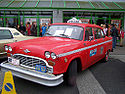
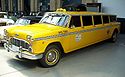 Checker is best known for its taxicab
, on which it built its business and reputation. In its early years, Markin not only produced the vehicles but also ran Checker Cab, a taxi company which was in direct competition with John D. Hertz
, owner of the Yellow Cab
of taxicabs.
During the 1930s, Checker built trailers for Sears-Roebuck and truck cabs for the Ford Motor Company
. Checker also built four prototype jeeps that were tested by the U.S. Army. They were called the Bantam and featured four wheel drive and four wheel steering. During World War II
Checker built tank retrieval trailers, tank recovery vehicles, as well as semi, petroleum and other types of trailers.
Checker designs changed infrequently; Markin held on to certain design features long after they were discontinued by major automobile manufacturers. For example, open front fenders were retained by Markin into the 1940s because it saved operators the expense of repairing minor dents. Taxicab models were designated by a letter series; significant modifications in models (new major systems, etc.) were designated by a number following the model letter.
Checker's commercial vehicles were usually given letter designations instead of model names (most notably variations of the Checker Model A
). An exception to this rule was the Checker Aerobus
, an extended version of its cars, built on a stretched wheelbase allowing for each row of seats to have its own doors. The Aerobus was often associated with airports and train stations, although vacation resorts also used Aerobuses for transporting guests.
Beginning in 1960, Checker introduced the Superba
, its first model specifically built for the consumer market. Joining the Superba in 1962 was the Marathon
, which took the place of the Superba Special. The Marathon consisted of standard and long-wheelbase sedans, plus station wagons. Wagons came standard with a motorized fold-down rear seat, which combined with different bodies pushed the price tag up $350 more than the sedan. Limousines were also offered as Checker sought to tap into yet another specialty market. The only engine was the Continental inline six, which had been used in dozens of cars (including Kaiser-Frazer) and trucks since the 1930s. Two versions were offered, a low-compression L-head unit with only 80 hp, and an OHV unit with higher compression and 122 hp. Three-on-the-tree manual shift was standard, and a Borg-Warner 3-speed automatic with optional overdrive was an option. Civilian models were as utilitarian as their fleet counterparts, sporting a simple, flat dashboard with round gauges (this would remain unchanged up to the final Checkers in 1982), rubber mats instead of carpeting, and hardboard ceilings. Floors were flat to allow easy entry and exit.
Checker's cars were lightly marketed using campaigns that centered on their durability and unchanging style. Checker also promoted their vehicles as 200000 mi (321,868 km) cars at a time when most US automakers shied away from mileage promises.
The Marathon and A11 design had its origins based on the 1956 Checker Model A8. The A8 was Checker's response to the new New York City taxi laws that mandated that taxis could not run on a chassis wheelbase longer than 120 in (3,048 mm). The main difference between the A8 and A11/Marathon was the use of quad headlights in the latter. Checker cars and taxicabs used the same basic body and chassis design from 1956 until production ceased, as Morris Markin declared that there would be no major changes as long as there was a demand for the car. However, there were numerous alterations in the appearance of the cars throughout its production, especially in the later 1960s and 1970s. Starting in 1967, an energy-absorbing Steering column
was fitted to meet safety regulations, similar in appearance to AMC's column. 1968 saw round side marker lights on each fender. Seat belts were fitted as mandated by the US Government, including shoulder belts on Checkers built after December, 1967. '69 cars got high-rise headrests, and 1970 models adapted the Government-required steering column and shift lever lock. 1974 Checkers eschewed the attractive, chrome-plated bumpers for girder-like, aluminum-painted units. '75s featured the Catalytic converter
emissions device, which came with an "Unleaded Fuel Only" label for both gas gauge and fuel filler. During the 1970s, Checkers adopted a standard Chevrolet steering column assembly, including steering wheel (sans the "Chevrolet" badges), shift lever and ignition switch. 1978 and later models can be identified when Chevrolet switched to a "Delta Spoke" steering wheel design, duly used on Checkers. The rear fold-down jump seats were also removed as they failed all safety tests. The car had very poor gas mileage as the tall front end and engine compartment had been designed for a Continental 226 cubic inch inline 6, which required the large engine compartment. Overall, Checker sales began shrinking in the 1970s, causing the company to reduce its production capacity. Limousines were dropped after 1970, and wagons followed in 1974. The standard and long-wheelbase sedans would stay until the end. This decline was due to a number of factors. Firstly, the oil embargo of 1973-1974 (and later the 1979-1982 recession) caused the Big Three to lose consumer sales, and so they attempted to make up for this by targeting the fleet market more aggressively. Checker could not hope to compete on price, which thanks to inflation sent its cars soaring to almost $5000 by the middle of the decade, which was Buick or Chrysler territory and a large sum for a dated car with unimpressive build quality. Safety and emissions requirements added further costs. Meanwhile, the company refused several proposals for a replacement to its 20-year old design in part due to lack of funding, and also due to managerial resistance. Ed Cole's death put an end to his ambitious plans, and car production finally ceased in 1982 after Checker's output was down to less than 1000 a year.
In 1964, Checker stopped using Continental engines. Continental had been losing money on each unit sold to Checker for several years and Checker was not interested in a price increase. Checker experimented with several engine options including the Chrysler 318. Eventually Checker went to a Chevrolet straight six
. That engine, along with an optional Chevrolet V-8
were used until the late 1970s. Engines and drivetrains matched the full-size Chevy models. During the 1970s, the Impala's Turbo-Hydramatic 400 transmission was fitted to all Checker sedans. Some of the last Checkers built were equipped with Oldsmobile 350 diesel V8s.
When GM ceased offering the straight six in its Impala models for 1979, Checker purchased a small V6 that was also used in the big Chevys. But the large and tall grill and hood made for poor aerodynamics which was part of the reason for the low gas mileage. A number of the V6s were thus converted to use propane
as fuel. Many of the body stamping dies were worn out after 20 years of use, and that required manual body adjustments by body and fender mechanics to make the parts fit. The fenders and doors were the parts with the most problem fit, as taxis are involved in numerous minor accidents due to their heavy usage patterns. With the Marathon outmoded and not selling in viable quantities, and lacking the resources to develop a new model, Checker decided to leave the auto manufacturing business. The last models were produced for the 1982 model year, and the final automobile rolled off the assembly line on July 12, 1982, after members of the Markin family decided to end automobile production rather than meet labor demands.
Kalamazoo, Michigan
The area on which the modern city stands was once home to Native Americans of the Hopewell culture, who migrated into the area sometime before the first millennium. Evidence of their early residency remains in the form of a small mound in downtown's Bronson Park. The Hopewell civilization began to...
based vehicle manufacturer and tier-one subcontractor that manufactured taxicab
Taxicab
A taxicab, also taxi or cab, is a type of vehicle for hire with a driver, used by a single passenger or small group of passengers, often for a non-shared ride. A taxicab conveys passengers between locations of their choice...
s used by Checker Taxi
Checker Taxi
Checker Taxi was an American taxi company. It used the Checker Taxi Cab produced by the Checker Motors Corporation of Kalamazoo, Michigan. Both Checker Taxi and its parent company Checker Motors Corporation were owned by Morris Markin....
. Checker Motors Corporation was established by Morris Markin
Morris Markin
Morris Markin was a Russian-born American entrepreneur and businessman who founded the Checker Cab Manufacturing Company .-Early years:...
in 1922 through a merger of 'Commonwealth Motors' and 'Markin Automobile Body'.
Checker made the iconic American taxi
Taxicab
A taxicab, also taxi or cab, is a type of vehicle for hire with a driver, used by a single passenger or small group of passengers, often for a non-shared ride. A taxicab conveys passengers between locations of their choice...
cab which was valued by taxicab companies for its durability in heavy use. Special features included large rear seats and trunks. The company had trouble competing with fleet discounts offered by the larger manufacturers as well as economies of scale in procuring components. The final models were produced in 1982.
On January 16, 2009, the company filed for Chapter 11 protection in U.S. Bankruptcy Court
Chapter 11, Title 11, United States Code
Chapter 11 is a chapter of the United States Bankruptcy Code, which permits reorganization under the bankruptcy laws of the United States. Chapter 11 bankruptcy is available to every business, whether organized as a corporation or sole proprietorship, and to individuals, although it is most...
.
History
Morris Markin, (a clothier from Chicago, Illinois) became the owner of 'Markin Automobile Body', an auto-body manufacturer based in Joliet, IllinoisJoliet, Illinois
Joliet is a city in Will and Kendall Counties in the U.S. state of Illinois, located southwest of Chicago. It is the county seat of Will County. As of the 2010 census, the city was the fourth-most populated in Illinois, with a population of 147,433. It continues to be Illinois' fastest growing...
following a default by the owner on a $15,000 personal loan. The facility made bodies for 'Commonwealth Motors' who marketed the vehicles to cab companies under the trade name 'Mogul'.
Commonwealth Motors was on the verge of bankruptcy but had an order from Checker Taxi
Checker Taxi
Checker Taxi was an American taxi company. It used the Checker Taxi Cab produced by the Checker Motors Corporation of Kalamazoo, Michigan. Both Checker Taxi and its parent company Checker Motors Corporation were owned by Morris Markin....
(a privately-owned cab company in Chicago that had no affiliation with Markin at the time). Markin merged Commonwealth Motors with Markin Automobile Body in order to honor the contractual commitment. In 1930 Checkers came in either black, maroon, yellow or canary.
Markin was later to buy the Checker Taxi Company.
1920's Models
| Model(year) | Engine | HP | wheelbase | Passengers |
|---|---|---|---|---|
| Model C-44(1922) | 4-cylinder | 40 | N/A | 5-7 |
| Model H-2(1923) | 4-cylinder | 22.5 | 127 in (3,226 mm) | 5 |
| Model E(1924) | 4-cylinder | 22.5 | 117 in (2,972 mm) | 5 |
| Model E(1925-1926) | 4-cylinder | 22.5 | 117 in (2,972 mm) | 5 |
| Model F(1926-1927)) | 4-cylinder | 22.5 | 117 in (2,972 mm) | 5 |
| Model G-4(1927-1928) | 4-cylinder | 22.5 | 117 in (2,972 mm) | 5 |
| Model G-6(1927-1928) | 6-cylinder | 27.30 | 124.75 in (3,169 mm) | 5 |
| Model K-6(1929) | 6-cylinder | 27.30 | 127 in (3,226 mm) | 6 |
The company entered the consumer passenger car business in 1958 and consumer automobiles were phased in regionally across the US in 1959 starting in New York and New England
New England
New England is a region in the northeastern corner of the United States consisting of the six states of Maine, New Hampshire, Vermont, Massachusetts, Rhode Island, and Connecticut...
. Nationally, introduction of the Checker Superba
Checker Superba
The Checker Superba was an automobile produced by Checker Motors Company of Kalamazoo, Michigan, between 1961 and 1963. The Superba used the Checker taxi cab bodies and were produced in two trim lines, standard and Custom, both in two body styles, four-door sedan and a five-door station wagon.On...
took place at the Chicago Auto Show
Chicago Auto Show
The Chicago Auto Show is held annually in February at Chicago's McCormick Placeconvention complex. It is among the largest auto shows in North America....
on February 8, 1960.
The dealer network continued to grow throughout the early 1960s, and throughout the decade Checker usually managed its target volume of 6000-7000 cars a year. In 1962, production topped 8000, although most of those were taxis. Four-door sedans and station wagons (Superba and Marathon models) also were advertised to individual customers in upscale publications. The ads emphasized the durability of the Checker and the attention to quality improvements. In 1962 almost 3,000 cars were sold to individuals, 20% of production, but that percentage declined to 10% in the 1970s.
In addition to automobile production, Checker played a significant role as a third-party automotive supplier of OEM body stampings. In the late 1930s, Checker produced truck bodies for Hudson in addition to manufacturing complete Ford truck cabs. Checker also produced truck bodies for REO Motor Car Company
REO Motor Car Company
The REO Motor Car Company was a Lansing, Michigan based company that produced automobiles and trucks from 1905 to 1975. At one point the company also manufactured buses on its truck platforms.REO was initiated by Ransom E. Olds during August 1904...
.
In 1964 the state of New York pursued Markin and Checker on antitrust charges, alleging that it controlled both the taxi service and manufacture of taxis, and thus favored itself in fulfilling orders. Rather than allow Checker drivers to begin buying different brands of cars, Markin began selling licenses in New York City.
The next year, the company switched from the standard Continental
Continental Motors Company
Continental Motors Company was an American engine and automobile manufacturer. The company produced engines for various independent manufacturers of automobiles, tractors, and stationary equipment from the 1900s through the 1960s. Continental Motors also produced Continental-branded automobiles in...
engine, offering either Chevy
Chevrolet Straight-6 engine
The Chevrolet inline 6 was Chevy's main engine from 1929 , through 1954, and was the base engine starting in 1955 when they added the small block V8 to the lineup. It had finally been completely phased out by 1990 in North America, but Brazil held on to their fuel-injected straight-6 through the...
230 cid "stovebolt" I6
Chevrolet Straight-6 engine
The Chevrolet inline 6 was Chevy's main engine from 1929 , through 1954, and was the base engine starting in 1955 when they added the small block V8 to the lineup. It had finally been completely phased out by 1990 in North America, but Brazil held on to their fuel-injected straight-6 through the...
s or 283 cid small block V8s.
1970s
In 1977, seven years after the death of Morris Markin, retired GM President Ed ColeEd Cole
Edward Nicholas Cole was an American automotive executive for General Motors.- Career :Cole was the son of a dairy farmer. In his youth, he designed, built, and sold homemade radio sets, and as a teenager became a field representative for a tractor manufacturer...
bought into Checker with the intent of re-energizing the company and developing a new, more modern Checker. Cole's plan was to purchase partially completed Volkswagen
Volkswagen
Volkswagen is a German automobile manufacturer and is the original and biggest-selling marque of the Volkswagen Group, which now also owns the Audi, Bentley, Bugatti, Lamborghini, SEAT, and Škoda marques and the truck manufacturer Scania.Volkswagen means "people's car" in German, where it is...
s from VW's new Westmoreland Assembly Plant
Volkswagen Westmoreland Assembly Plant
The Volkswagen Westmoreland Assembly Plant is a manufacturing plant formerly operated by Volkswagen of America , south of Pittsburgh in Westmoreland County, Pennsylvania near New Stanton. The complex manufactured 1.15 million vehicles from 1978 to 1988...
. Cole was going to ship the VWs to the Checker Motors factory in Kalamazoo, cut them in half, insert a section to lengthen the VW, raise the roof and then sell the reconfigured vehicle as a taxi. Shortly thereafter, however, Cole died when his plane crashed near Kalamazoo.
1970's Model Data
| Model | Engine | Power | Transmission | Wheelbase | Length | Width | Ground Clearance |
|---|---|---|---|---|---|---|---|
| Marathon | 250CID V6 | 145 hp (1971); 110 hp (1978) | 3-speed automatic | 120 in (3,048 mm) | 204 in (5,182 mm) | 76 in (1,930 mm) | 7.5 in (191 mm) |
| A11E | 350CID V8 | 245 hp (1971); 160 hp (1978) | 3-speed automatic | 129 in (3,277 mm) | 213 in (5,410 mm) | 76 in (1,930 mm) | 7.5 in (191 mm) |
1980s
In 1989, Checker Motors and Checker Holding Company were involved in a reverse acquisition with International Controls CorporationInternational Controls Corporation
International Controls Corporation was an American holding company incorporated in 1965. Before being taken private in 1997, its subsidiaries included Checker Motors Corporation and Great Dane Trailers...
(Great Dane Trailers), and the company later changed its name to CRA Holdings. The company was reorganized in 1995 into three wholly owned subsidiaries: Yellow Cab (owns and leases taxicabs in Chicago), Chicago Autoworks (taxi-cab repair and other services) and CMC Kalamazoo. Other subsidiaries include American Country Insurance Company, a provider of property and casualty insurance, Great Dane, (the largest manufacturer of truck trailers, containers and chassis), and South Charleston Stamping & Manufacturing Company.
The company was renamed as Great Dane Limited Partnership, and was acquired by Chicago based CC Industries.
Purchased in August 1989, South Charleston Stamping was sold by Checker to Mayflower Corp. In November 1996. South Charleston Stamping had been owned previously by Volkswagen and supported Volkswagen automobile production in Pennsylvania in the late 70's.
Checker Motors operated as a subsidiary of CC Industries as an automotive subcontractor
Subcontractor
A subcontractor is an individual or in many cases a business that signs a contract to perform part or all of the obligations of another's contract....
, primarily for General Motors into the 21st century. Checker made body stamping for various GMC/Chevrolet truck lines and chassis components for Cadillac. David Markin, son of founder Morris Markin, continued to act as CMC Chief Executive Officer.
2000s
In 2008, due to the Late-2000s recession and high gasolineGasoline
Gasoline , or petrol , is a toxic, translucent, petroleum-derived liquid that is primarily used as a fuel in internal combustion engines. It consists mostly of organic compounds obtained by the fractional distillation of petroleum, enhanced with a variety of additives. Some gasolines also contain...
prices, sales at GM and other automakers plummeted. As a major supplier to GM, Checker saw its sales drop significantly. The company had net sales of $61 million in 2008 and projected 2009 sales of only $34.5 million, a decline of 43%. During the summer of 2008, Checker employed about 340 workers.
While the US economy was in full recession, Checker Motors CEO, David Markin unfortunately fell victim to Bernie Madoff. David Markin's name appears five times on the official list of Madoff victims. One address on the list was 2016 North Pitcher Street, Kalamazoo, the same address as Checker Motors Corp.
On January 16, 2009, the 87-year-old Kalamazoo company filed in U.S. Bankruptcy Court in Grand Rapids, Michigan. Escalating raw material prices and dwindling sales for their customers' products were cited as the main reasons for the filing, but another reason was labor costs. It was reported that a deal with unionized labor could not be reached after a year of negotiations.
At the time of the bankruptcy, Checker's customer base included General Motors, Chrysler LLC, Ford Motor Company
Ford Motor Company
Ford Motor Company is an American multinational automaker based in Dearborn, Michigan, a suburb of Detroit. The automaker was founded by Henry Ford and incorporated on June 16, 1903. In addition to the Ford and Lincoln brands, Ford also owns a small stake in Mazda in Japan and Aston Martin in the UK...
, Navistar International
Navistar International
Navistar International Corporation is a United States-based holding company that owns the manufacturer of International brand commercial trucks, MaxxForce brand diesel engines, IC Bus school and commercial buses, Workhorse brand chassis for motor homes and step vans, and is a private label...
and GM Shanghai. Checker was the eighth largest American auto supplier to go bankrupt in recent years. GM and Chrysler followed Checker's bankruptcy just several months later.
In February, Checker asked the U.S. Bankruptcy Court for Western Michigan to reject its contract with 125 union workers and eliminate health care and pension benefits for 176 union retirees. On February 27, 2009, the judge in Checker Motors Corp.'s bankruptcy case threw out the company's request to eliminate its labor agreement. Bankruptcy Judge James D. Gregg agreed with United Steelworkers Union Local 2-682 attorneys, that the company had not treated all parties involved in the proceeding fairly when it awarded four top executives a total of $275,000 in retention bonuses prior to filing for bankruptcy.
In Late March 2009, a committee of unsecured creditors in the bankruptcy case asked U.S. Bankruptcy Court Judge James D. Gregg to consider whether negotiations between the union, United Steel Workers Local 2-682, and Checker Motors can resume and reach concessions, or if a mediator should be brought in, according to court documents.
On April 4, 2009, Checker notified its more than 270 employees that CMC would close its business by the end of June.
In a bankruptcy court hearing Monday, April 6, 2009, CMC and labor union representatives said they intended to continue trying to negotiate a new union contract that would allow Checker Motors to survive.
In May, Checker was given permission to enter into agreements with General Motors Corp. that were intended to help the bankrupt supplier stay afloat until it could negotiate the sale of itself to a new owner.
In Late May, Checker announced that they found a potential buyer, The Narmco Group.
On June 9, 2009, Judge Gregg approved the sale of Checker Motors Corp. to the subsidiaries of two Canadian automotive suppliers, Narmco Group LLC and Van-Rob Inc.
The Narmco Group, based Windsor, Ontario
Windsor, Ontario
Windsor is the southernmost city in Canada and is located in Southwestern Ontario at the western end of the heavily populated Quebec City – Windsor Corridor. It is within Essex County, Ontario, although administratively separated from the county government. Separated by the Detroit River, Windsor...
, paid $650,000 for Checker's business of making stamped metal and welded assemblies for GM trucks and other vehicles. Van-Rob Inc., based in Aurora, Ontario, paid $950,000 for some of Checker's manufacturing equipment.
Christopher Grosman, an attorney representing Checker Motors, told Judge Gregg that the offers from Narmco and Van-Rob represented the ``highest and best value to Checker's creditors. Grosman said much of the company's machinery could not be sold because, in the wake of downsizing throughout the automotive industry, the market has been flooded with similar equipment.
The $1.6 million sale meant the end of the road for Checker. Approximately 125 Checker workers in Kalamazoo made parts until June 30, then the business was transferred to Canada.
In July 2009, General Motors Corp paid $1.5 million dollars to Walker Tool & Dies for tools and dies that remained on site at Checker. Walker Tool had liens on the tools, so payment was required in order to move the tools to Canada. The tooling was transferred to Canada to make the Buick Lacrosse.
On January 14, 2010 the Checker Motor Company ceased to exist with the sale of its Kalamazoo headquarters. It was purchased for just under $3 million by a holding company, the Jones Group, which will sell off the assets and clear the 72 acres. Checker president David Markin was quoted in the New York Times, "It's finished. Our family is very distressed about the closing of the company, but it became inevitable."
Commercial vehicles
Taxicab
A taxicab, also taxi or cab, is a type of vehicle for hire with a driver, used by a single passenger or small group of passengers, often for a non-shared ride. A taxicab conveys passengers between locations of their choice...
, on which it built its business and reputation. In its early years, Markin not only produced the vehicles but also ran Checker Cab, a taxi company which was in direct competition with John D. Hertz
John D. Hertz
John Daniel Hertz, Sr. was an American businessman, thoroughbred racehorse owner, and philanthropist.-Biography:...
, owner of the Yellow Cab
Yellow Cab
There are many Yellow Cabs taxicab operators around the world . The original Yellow Cab Company, based in Chicago, Illinois is one of the largest taxicab companies in the United States.- History :...
of taxicabs.
During the 1930s, Checker built trailers for Sears-Roebuck and truck cabs for the Ford Motor Company
Ford Motor Company
Ford Motor Company is an American multinational automaker based in Dearborn, Michigan, a suburb of Detroit. The automaker was founded by Henry Ford and incorporated on June 16, 1903. In addition to the Ford and Lincoln brands, Ford also owns a small stake in Mazda in Japan and Aston Martin in the UK...
. Checker also built four prototype jeeps that were tested by the U.S. Army. They were called the Bantam and featured four wheel drive and four wheel steering. During World War II
World War II
World War II, or the Second World War , was a global conflict lasting from 1939 to 1945, involving most of the world's nations—including all of the great powers—eventually forming two opposing military alliances: the Allies and the Axis...
Checker built tank retrieval trailers, tank recovery vehicles, as well as semi, petroleum and other types of trailers.
Checker designs changed infrequently; Markin held on to certain design features long after they were discontinued by major automobile manufacturers. For example, open front fenders were retained by Markin into the 1940s because it saved operators the expense of repairing minor dents. Taxicab models were designated by a letter series; significant modifications in models (new major systems, etc.) were designated by a number following the model letter.
Checker's commercial vehicles were usually given letter designations instead of model names (most notably variations of the Checker Model A
Checker Model A
The Checker Model A was introduced mid-model year in 1939, and was built until 1941, when Checker switched over to wartime manufacturing, as did the rest of the auto industry. The Model A was offered in a new landaulet version that included an electric disappearing top, and early sun roof...
). An exception to this rule was the Checker Aerobus
Checker Aerobus
The Checker Aerobus is a seven- or nine-door station wagon, or a six- or eight-door sedan, manufactured on two different wheelbases by the Checker Motors Corporation from 1962 until 1977 . Meant primarily to serve as an airport shuttle, as indicated by the name, it is an extended version of the...
, an extended version of its cars, built on a stretched wheelbase allowing for each row of seats to have its own doors. The Aerobus was often associated with airports and train stations, although vacation resorts also used Aerobuses for transporting guests.
Consumer vehicles
From 1922-1959, Checker's production vehicles were built almost exclusively for the commercial livery (taxi) business, although cars for personal use were available on request. Checker entered the consumer vehicle market when it saw purchases of its taxis decline.Beginning in 1960, Checker introduced the Superba
Checker Superba
The Checker Superba was an automobile produced by Checker Motors Company of Kalamazoo, Michigan, between 1961 and 1963. The Superba used the Checker taxi cab bodies and were produced in two trim lines, standard and Custom, both in two body styles, four-door sedan and a five-door station wagon.On...
, its first model specifically built for the consumer market. Joining the Superba in 1962 was the Marathon
Checker Marathon
The Checker Marathon was an automobile produced by the Checker Motors Company of Kalamazoo, Michigan, between 1961 and 1982.Marathons were produced in both four-door sedan and four-door station wagon forms, and the rare eight-door, 12-seater "Aerobus" wagon....
, which took the place of the Superba Special. The Marathon consisted of standard and long-wheelbase sedans, plus station wagons. Wagons came standard with a motorized fold-down rear seat, which combined with different bodies pushed the price tag up $350 more than the sedan. Limousines were also offered as Checker sought to tap into yet another specialty market. The only engine was the Continental inline six, which had been used in dozens of cars (including Kaiser-Frazer) and trucks since the 1930s. Two versions were offered, a low-compression L-head unit with only 80 hp, and an OHV unit with higher compression and 122 hp. Three-on-the-tree manual shift was standard, and a Borg-Warner 3-speed automatic with optional overdrive was an option. Civilian models were as utilitarian as their fleet counterparts, sporting a simple, flat dashboard with round gauges (this would remain unchanged up to the final Checkers in 1982), rubber mats instead of carpeting, and hardboard ceilings. Floors were flat to allow easy entry and exit.
Checker's cars were lightly marketed using campaigns that centered on their durability and unchanging style. Checker also promoted their vehicles as 200000 mi (321,868 km) cars at a time when most US automakers shied away from mileage promises.
The Marathon and A11 design had its origins based on the 1956 Checker Model A8. The A8 was Checker's response to the new New York City taxi laws that mandated that taxis could not run on a chassis wheelbase longer than 120 in (3,048 mm). The main difference between the A8 and A11/Marathon was the use of quad headlights in the latter. Checker cars and taxicabs used the same basic body and chassis design from 1956 until production ceased, as Morris Markin declared that there would be no major changes as long as there was a demand for the car. However, there were numerous alterations in the appearance of the cars throughout its production, especially in the later 1960s and 1970s. Starting in 1967, an energy-absorbing Steering column
Steering column
The automotive steering column is a device intended primarily for connecting the steering wheel to the steering mechanism or transferring the driver's input torque from the steering wheel.-Secondary functions:...
was fitted to meet safety regulations, similar in appearance to AMC's column. 1968 saw round side marker lights on each fender. Seat belts were fitted as mandated by the US Government, including shoulder belts on Checkers built after December, 1967. '69 cars got high-rise headrests, and 1970 models adapted the Government-required steering column and shift lever lock. 1974 Checkers eschewed the attractive, chrome-plated bumpers for girder-like, aluminum-painted units. '75s featured the Catalytic converter
Catalytic converter
A catalytic converter is a device used to convert toxic exhaust emissions from an internal combustion engine into non-toxic substances. Inside a catalytic converter, a catalyst stimulates a chemical reaction in which noxious byproducts of combustion are converted to less toxic substances by dint...
emissions device, which came with an "Unleaded Fuel Only" label for both gas gauge and fuel filler. During the 1970s, Checkers adopted a standard Chevrolet steering column assembly, including steering wheel (sans the "Chevrolet" badges), shift lever and ignition switch. 1978 and later models can be identified when Chevrolet switched to a "Delta Spoke" steering wheel design, duly used on Checkers. The rear fold-down jump seats were also removed as they failed all safety tests. The car had very poor gas mileage as the tall front end and engine compartment had been designed for a Continental 226 cubic inch inline 6, which required the large engine compartment. Overall, Checker sales began shrinking in the 1970s, causing the company to reduce its production capacity. Limousines were dropped after 1970, and wagons followed in 1974. The standard and long-wheelbase sedans would stay until the end. This decline was due to a number of factors. Firstly, the oil embargo of 1973-1974 (and later the 1979-1982 recession) caused the Big Three to lose consumer sales, and so they attempted to make up for this by targeting the fleet market more aggressively. Checker could not hope to compete on price, which thanks to inflation sent its cars soaring to almost $5000 by the middle of the decade, which was Buick or Chrysler territory and a large sum for a dated car with unimpressive build quality. Safety and emissions requirements added further costs. Meanwhile, the company refused several proposals for a replacement to its 20-year old design in part due to lack of funding, and also due to managerial resistance. Ed Cole's death put an end to his ambitious plans, and car production finally ceased in 1982 after Checker's output was down to less than 1000 a year.
In 1964, Checker stopped using Continental engines. Continental had been losing money on each unit sold to Checker for several years and Checker was not interested in a price increase. Checker experimented with several engine options including the Chrysler 318. Eventually Checker went to a Chevrolet straight six
Chevrolet Straight-6 engine
The Chevrolet inline 6 was Chevy's main engine from 1929 , through 1954, and was the base engine starting in 1955 when they added the small block V8 to the lineup. It had finally been completely phased out by 1990 in North America, but Brazil held on to their fuel-injected straight-6 through the...
. That engine, along with an optional Chevrolet V-8
Chevrolet Small-Block engine
The Chevrolet small-block engine is a series of automobile V8 engines built by the Chevrolet Division of General Motors using the same basic small engine block...
were used until the late 1970s. Engines and drivetrains matched the full-size Chevy models. During the 1970s, the Impala's Turbo-Hydramatic 400 transmission was fitted to all Checker sedans. Some of the last Checkers built were equipped with Oldsmobile 350 diesel V8s.
When GM ceased offering the straight six in its Impala models for 1979, Checker purchased a small V6 that was also used in the big Chevys. But the large and tall grill and hood made for poor aerodynamics which was part of the reason for the low gas mileage. A number of the V6s were thus converted to use propane
Propane
Propane is a three-carbon alkane with the molecular formula , normally a gas, but compressible to a transportable liquid. A by-product of natural gas processing and petroleum refining, it is commonly used as a fuel for engines, oxy-gas torches, barbecues, portable stoves, and residential central...
as fuel. Many of the body stamping dies were worn out after 20 years of use, and that required manual body adjustments by body and fender mechanics to make the parts fit. The fenders and doors were the parts with the most problem fit, as taxis are involved in numerous minor accidents due to their heavy usage patterns. With the Marathon outmoded and not selling in viable quantities, and lacking the resources to develop a new model, Checker decided to leave the auto manufacturing business. The last models were produced for the 1982 model year, and the final automobile rolled off the assembly line on July 12, 1982, after members of the Markin family decided to end automobile production rather than meet labor demands.
External links
- Checker History The requested URL /checker_history/ was not found.
- The Checker Taxi Stand
- Checker Car Club of America
- The Checker Aerobus Site The site you requested has been disabled.
- "Blue Collar" (1978) - movie shot inside Checker factory