

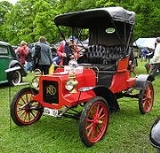
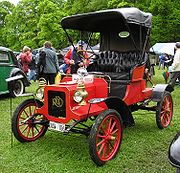
REO Motor Car Company

Encyclopedia
Lansing, Michigan
Lansing is the capital of the U.S. state of Michigan. It is located mostly in Ingham County, although small portions of the city extend into Eaton County. The 2010 Census places the city's population at 114,297, making it the fifth largest city in Michigan...
based company that produced automobile
Automobile
An automobile, autocar, motor car or car is a wheeled motor vehicle used for transporting passengers, which also carries its own engine or motor...
s and truck
Truck
A truck or lorry is a motor vehicle designed to transport cargo. Trucks vary greatly in size, power, and configuration, with the smallest being mechanically similar to an automobile...
s from 1905 to 1975. At one point the company also manufactured buses on its truck platforms.
REO was initiated by Ransom E. Olds
Ransom E. Olds
Ransom Eli Olds was a pioneer of the American automotive industry, for whom both the Oldsmobile and REO brands were named. He claimed to have built his first steam car as early as 1894, and his first gasoline powered car in 1896...
during August 1904. Olds had 52 percent of the stock and the titles of president and general manager.
To ensure a reliable supply of parts, he organized a number of subsidiary firms like the National Coil Company, the Michigan Screw Company, and the Atlas Drop Forge Company.
Originally the company was to be called "R. E. Olds Motor Car Company," but the owner of Olds' previous company, then called Olds Motor Works
Oldsmobile
Oldsmobile was a brand of American automobile produced for most of its existence by General Motors. It was founded by Ransom E. Olds in 1897. In its 107-year history, it produced 35.2 million cars, including at least 14 million built at its Lansing, Michigan factory...
, objected and threatened legal action on the grounds of likely confusion of names by consumers.
Olds then changed the name to his initials. Olds Motor Works soon adopted the popular name of its vehicles, Oldsmobile
Oldsmobile
Oldsmobile was a brand of American automobile produced for most of its existence by General Motors. It was founded by Ransom E. Olds in 1897. In its 107-year history, it produced 35.2 million cars, including at least 14 million built at its Lansing, Michigan factory...
(which, along with Buick
Buick
Buick is a premium brand of General Motors . Buick models are sold in the United States, Canada, Mexico, China, Taiwan, and Israel, with China being its largest market. Buick holds the distinction as the oldest active American make...
and Cadillac, became the founding division of General Motors Corporation).
The company's name was spelled alternately in all capitals REO or with only an initial capital as Reo, and the company's own literature was inconsistent in this regard, with early advertising using all capitals and later advertising
Advertising
Advertising is a form of communication used to persuade an audience to take some action with respect to products, ideas, or services. Most commonly, the desired result is to drive consumer behavior with respect to a commercial offering, although political and ideological advertising is also common...
using the "Reo" capitalization. The pronunciation, however, was as a single word. Lansing is home to the R. E. Olds Transportation Museum
R. E. Olds Transportation Museum
The R.E. Olds Transportation Museum is named for Ransom E. Olds, founder of Oldsmobile, and is located in Lansing, Michigan. It is one of the top-rated automotive museums in the United States....
.
Early REO production
By 1907, REO had gross sales of $4.5 million and the company was one of the four wealthiest automobile manufacturers in the U.S. After 1908 however, despite the introduction of improved cars designed by Olds, REO's share of the automobile market decreased due in part to competition from emerging companies like FordFord Motor Company
Ford Motor Company is an American multinational automaker based in Dearborn, Michigan, a suburb of Detroit. The automaker was founded by Henry Ford and incorporated on June 16, 1903. In addition to the Ford and Lincoln brands, Ford also owns a small stake in Mazda in Japan and Aston Martin in the UK...
and General Motors.
REO added a truck manufacturing division and a Canadian plant in St. Catharines, Ontario
St. Catharines, Ontario
St. Catharines is the largest city in Canada's Niagara Region and the sixth largest urban area in Ontario, Canada, with 97.11 square kilometres of land...
in 1910. Two years later, Olds claimed he had built the best car he could, a tourer
Touring car
A touring car, or tourer, is an open car seating five or more. Touring cars may have two or four doors. Often, the belt line is lowered in the front doors to give the car a more sportive character. They were often fitted with a folding roof and side curtains. Engines on early models were either in...
able to seat two, four, or five, with a 30–35 hp (22–26 kW) engine, 112 in (2845 mm) wheelbase
Wheelbase
In both road and rail vehicles, the wheelbase is the distance between the centers of the front and rear wheels.- Road :In automobiles, the wheelbase is the horizontal distance between the center of the front wheel and the center of the rear wheel...
, and 32 inch (81 cm) wheels, for US$
United States dollar
The United States dollar , also referred to as the American dollar, is the official currency of the United States of America. It is divided into 100 smaller units called cents or pennies....
1055 (not including top, windshield
Windshield
The windshield or windscreen of an aircraft, car, bus, motorbike or tram is the front window. Modern windshields are generally made of laminated safety glass, a type of treated glass, which consists of two curved sheets of glass with a plastic layer laminated between them for safety, and are glued...
, or gas tank, which were US$100 extra); self-starter
Automobile self starter
A starter motor is an electric motor for rotating an internal-combustion engine so as to initiate the engine's operation under its own power.- History :...
was US$25 on top of that. By comparison, the Cole 30 and Colt Runabout were priced at US$1500, Kirk
Kirk Manufacturing Company (automobile company)
Kirk Manufacturing Company was a pioneer brass era American automobile company, built at 958 Oakwood Avenue, Toledo, Ohio, from 1902 until 1905....
's Yale side-entrance US$1,000, the high-volume Oldsmobile
Oldsmobile
Oldsmobile was a brand of American automobile produced for most of its existence by General Motors. It was founded by Ransom E. Olds in 1897. In its 107-year history, it produced 35.2 million cars, including at least 14 million built at its Lansing, Michigan factory...
Runabout
Oldsmobile Curved Dash
The gasoline powered Curved Dash Oldsmobile is credited as being the first mass-produced automobile, meaning that it was built on an assembly line using interchangeable parts. It was introduced by the Oldsmobile company in 1901 and produced through 1907...
went for US$650, Western
Western Tool Works (automobile company)
Western Tool Works was a pioneering brass era automobile manufacturer in Galesburg, Illinois.Western in 1905 produced the Gale Model A, an open roadster, for sale at US$500, which was less than high-volume Oldsmobile Runabout, at US$650, the Ford "Doctor's Car" at US$850, or the Holsman high...
's Gale Model A was US$500, a Brush Runabout
Brush Motor Car Company
This article is about a USA auto-maker. For the British rail-locomotive company, see Brush TractionBrush Motor Company, or the "Brush Runabout Company," based in Detroit, Michigan, was founded by Alanson Partridge Brush , who designed a light car with a wooden chassis This article is about a USA...
US$485, the Black
Black Motor Company
The Black was a brass era United States automobile, built at 124 East Ohio Street, Chicago, Illinois, in 1906.It was a high wheeler buggy priced at a surprisingly low US$375-$450, when Gale's Model A was US$500, the high-volume Oldsmobile Runabout went for US$650, and the Ford "Doctor's Car" was...
started at $375, and the Success
Success Automobile Manufacturing Company
Success was a brass era United States automobile, built at 532 De Ballviere Avenue, St. Louis, Missouri, in 1906.It was a high wheeler buggy priced at an exceedingly low US$250...
hit the amazingly low US$250.
In 1915, Olds relinquished the title of general manager to his protégé Richard H. Scott and eight years later he ended his tenure as the company's presidency as well, retaining the position of chairman of the board.
Perhaps the most famous REO episode was the 1912 Trans-Canada journey. Traveling 4,176 miles (6,720 km) from Halifax
City of Halifax
Halifax is a city in Canada, which was the capital of the province of Nova Scotia and shire town of Halifax County. It was the largest city in Atlantic Canada until it was amalgamated into Halifax Regional Municipality in 1996...
, Nova Scotia
Nova Scotia
Nova Scotia is one of Canada's three Maritime provinces and is the most populous province in Atlantic Canada. The name of the province is Latin for "New Scotland," but "Nova Scotia" is the recognized, English-language name of the province. The provincial capital is Halifax. Nova Scotia is the...
, to Vancouver
Vancouver
Vancouver is a coastal seaport city on the mainland of British Columbia, Canada. It is the hub of Greater Vancouver, which, with over 2.3 million residents, is the third most populous metropolitan area in the country,...
, British Columbia
British Columbia
British Columbia is the westernmost of Canada's provinces and is known for its natural beauty, as reflected in its Latin motto, Splendor sine occasu . Its name was chosen by Queen Victoria in 1858...
, in a 1912 REO special touring car, mechanic/driver Fonce V. (Jack) Haney and journalist Thomas W. Wilby made the first trip by automobile across Canada
Canada
Canada is a North American country consisting of ten provinces and three territories. Located in the northern part of the continent, it extends from the Atlantic Ocean in the east to the Pacific Ocean in the west, and northward into the Arctic Ocean...
(including one short jaunt into northeastern Washington State when the Canadian roads were virtually impassable.)
From 1915 to 1925, under Scott's direction REO remained profitable. During 1925, however, Scott, like many of his contemporaries/competitors, began an ambitious expansion program designed to make the company more competitive with other automobile manufacturers by offering cars in different price ranges. The failure of this program and the effects of the Depression caused such losses that Olds ended his retirement during 1933 and assumed control of REO again, but resigned in 1934. During 1936, REO abandoned the manufacture of automobiles to concentrate on trucks.
Reo Flying Cloud and Reo Royale
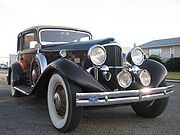
The Flying Cloud was the first car to use Lockheed's new hydraulic internal expanding brake system and featured styling by Fabio Segardi. While Ned Jordan is credited with changing the way advertising was written with his "Somewhere West of Laramie" ads for his Jordan Playboy, Reo's Flying Cloud—a name that provoked evocative images of speed and lightness—changed the way automobiles would be named in the future. The final REO model of 1936 was a Flying Cloud.
The 1931 Reo Royale was a trendsetting design, introducing design elements that were a precedent for true automotive streamlining
Streamliner
A streamliner is a vehicle incorporating streamlining in a shape providing reduced air resistance. The term is applied to high-speed railway trainsets of the 1930s to 1950s, and to their successor "bullet trains". Less commonly, the term is applied to fully faired recumbent bicycles...
in the American market. The model was vended until 1935. Beverly Kimes, editor of the Standard Catalog of American Cars, terms the Royale "the most fabulous Reo of all". In addition to its coachwork by Murray designed by their Amos Northup
Amos Northup
Amos Northup American automotive designerNorthup was employed by cabinet maker C. J. Wadsworth in Painesville, Ohio early in his career. Then he worked as a designer for automaker Wills Sainte Claire under Childe Wills...
, the Royale also provided buyers with a 125 hp straight-eight with a nine bearing crankshaft, one shot lubrication, and thermostatically controlled radiator shutters. The Royale rode upon factory wheelbases of 131 and 135 inches (3,429 mm); a 1932 custom version rode upon a 152 inches (3,860.8 mm) wheelbase. The Royale also featured REO's semi-automatic transmission, the Self-Shifter.
After passenger cars
Although truck orders during World War II enabled it to revive somewhat, the company remained unstable in the postwar era, resulting in a bankruptcy reorganization. In 1954, the company was still underperforming, and sold vehicle manufacturing operations (the primary asset of the company) to the Bohn Aluminum and Brass Company of Detroit. Three years later, in 1957, it became a subsidiary of the White Motor CompanyWhite Motor Company
White Motor Company was an American automobile and truck manufacturer from 1900 until 1980. The company also produced bicycles, roller skates, automatic lathes, and sewing machines. Before World War II, the company was based in Cleveland, Ohio.-History:...
. White then merged REO with Diamond T Trucks
Diamond T
The Diamond T was an American automobile manufactured in Chicago from 1905 until 1911 by the Diamond T Motor Car Company. It was a powerful touring car . The company later became known for its trucks...
in 1967 to form Diamond-Reo Trucks, Inc.
Diamond Reo Trucks
Diamond Reo Trucks was an American truck manufacturer. In 1967, Diamond T and Reo Trucks were combined to form the Diamond Reo Trucks Division of the White Motor Corporation. Reo dated back to 1904 when Ransom E. Olds, founder of Oldsmobile, began building motor cars, and Diamond T dated back to...
In 1975, this company filed for bankruptcy in the Western District of Michigan and most of its assets were liquidated.
Meanwhile, the corporation remained nominally after the 1954 Bohn sale. Management began liquidating the organization, but due to shareholder issues, instead acquired Nuclear Consultants, Inc., a nuclear medicine
Nuclear medicine
In nuclear medicine procedures, elemental radionuclides are combined with other elements to form chemical compounds, or else combined with existing pharmaceutical compounds, to form radiopharmaceuticals. These radiopharmaceuticals, once administered to the patient, can localize to specific organs...
or nuclear industry services organization (unclear), and renamed the combined company "Nuclear Corporation of America, Inc."
The company diversified, and purchased other companies, to become a conglomerate, including nuclear, prefabricated housing, and steel joist businesses. Most of these business were failures, except for the latter, and the company was bankrupted once again in 1965. Upon reorganizing, only the successful steel joist business remained; that company started producing recycled steel, leading to today's steel company, Nucor
Nucor
Nucor Corporation , a Fortune 300 company headquartered in Charlotte, North Carolina, is one of the largest steel producers in the United States, and the largest of the "mini-mill" operators...
.
Products
Trucks- 19 AS
- AC
- Apollo
- Comet
- DC
- GB
- Gold Comet
- M35
- Raider
- Royale
- Speed Wagon
- Speed Tanker
Buses
- 96HTD
- W series
REOs in popular culture
- The band REO SpeedwagonREO SpeedwagonREO Speedwagon is an American rock band. Formed in 1967, the band grew in popularity during the 1970s and peaked in the early 1980s. Hi Infidelity is the group's most commercially successful album, selling over ten million copies and charting four Top 40 hits in the US...
took their name from the REO manufactured REO Speed WagonREO Speed WagonThe REO Speed Wagon was a light motor truck manufactured by REO Motor Car Company. It was an ancestor of the pickup truck....
light delivery truck, an ancestor of pickup truckPickup truckA pickup truck is a light motor vehicle with an open-top rear cargo area .-Definition:...
s.
- An REO is mentioned in a humorous 1933 short story by James ThurberJames ThurberJames Grover Thurber was an American author, cartoonist and celebrated wit. Thurber was best known for his cartoons and short stories published in The New Yorker magazine.-Life:...
entitled, The Car We Had to Push. It tells the story of Thurber’s family car, which would only start if pushed a long way. After several odd adventures, the car is destroyed by a trolley car.
- In the John WayneJohn WayneMarion Mitchell Morrison , better known by his stage name John Wayne, was an American film actor, director and producer. He epitomized rugged masculinity and became an enduring American icon. He is famous for his distinctive calm voice, walk, and height...
movie Big JakeBig Jake (film)Big Jake is a 1971 Western film, filmed on location in Durango, Mexico, starring John Wayne and directed by George Sherman.Big Jake was released to box-office success and generally-positive critical reviews, despite a mixed reaction by John Wayne fans....
, the Texas RangersTexas Ranger DivisionThe Texas Ranger Division, commonly called the Texas Rangers, is a law enforcement agency with statewide jurisdiction in Texas, and is based in Austin, Texas...
were traveling in REOs, which were later destroyed by the bandits. (The cars destroyed were replicas, rather than the actual vehicles).
Advertisements
See also
- List of defunct United States automobile manufacturers
- List of automobile manufacturers
External links
- A Tribute To The REO Motor Car Company many photos; angelfire.com site may be slow loading and have javascript pop-up ads
- R.E. Olds Museum
- REO Gallery at White Glove Collection
- REO Club of America
- REO (and Diamond T) Trucks (Hank's Truck Pictures)