
All Topics  
Giant impact hypothesis


   Email Print
   Bookmark   Link


Giant impact hypothesis


The giant impact hypothesis (sometimes referred to as the big whack, or, less frequently, the big splash) is the now-dominant scientific hypothesis
Scientific hypothesis

Scientific hypothesis is a hypothesis used as a tentative explanation of an observation, but which has not yet been fully tested by the prediction validation process for a scientific theory....
 for the formation of the Moon
Moon

The Moon is Earth's only natural satellite and the List of natural satellites by diameter satellite in the Solar System. The average centre-to-centre distance from the Earth to the Moon is km, about thirty times the diameter of the Earth....
, which is thought to have formed as a result of a collision between the young Earth
Earth

Earth is the third planet from the Sun. Earth is the largest of the terrestrial planets in the Solar System in diameter, mass and density. It is also referred to as the World and Wiktionary:Terra.Note that by International Astronomical Union convention, the term "Terra" is used for naming extensive land masses, rather...
 and a Mars
MARS

In cryptography, MARS is a block cipher that was IBM's submission to the Advanced Encryption Standard process. MARS was selected as an AES finalist in August 1999, after the AES2 conference in March 1999, where it was voted as the fifth and last finalist algorithm....
-sized body that is sometimes called Theia
Theia (planet)

Theia is a hypothetical planet that, according to the giant impact hypothesis gave rise to the Moon. Theia is believed to have collided with Earth over 4.5 billion years ago....
. Evidence for this hypothesis includes moon samples which indicate the surface of the moon was once molten, the moon's apparently relatively small iron core, and evidence of similar collisions in other star systems. Questions remaining to be resolved about this hypothesis include why lunar samples do not have ratios of volatile elements, iron oxide, or siderophilic elements
Goldschmidt classification

The Goldschmidt classification, developed by Victor Goldschmidt, is a Geochemistry which groups the chemical elements according to their preferred host phases into lithophile , siderophile , chalcophile , and atmophile ....
 which would be implied by this hypothesis, as well as what evidence may suggest the earth ever had the magma ocean implied by this hypothesis.

hypothesis was first proposed by Reginald Aldworth Daly
Reginald Aldworth Daly

Reginald Aldworth Daly was a Canada geologist. He was a professor at Harvard University from 1912 until 1942, after working as a field geologist for the Canadian International Boundary Commission....
 of Harvard University
Harvard University

Harvard University is a private university in Cambridge, Massachusetts, Massachusetts, United States, and a member of the Ivy League. Founded in 1636 by the colonial Massachusetts legislature, Harvard is the Colonial Colleges institution of higher learning in the United States....
 in the 1940s as a challenge to or an adjustment of the previously dominant theory postulated by George Howard Darwin.


Discussion
Ask a question about 'Giant impact hypothesis'
Start a new discussion about 'Giant impact hypothesis'
Answer questions from other users
Full Discussion Forum


Encyclopedia


The giant impact hypothesis (sometimes referred to as the big whack, or, less frequently, the big splash) is the now-dominant scientific hypothesis
Scientific hypothesis

Scientific hypothesis is a hypothesis used as a tentative explanation of an observation, but which has not yet been fully tested by the prediction validation process for a scientific theory....
 for the formation of the Moon
Moon

The Moon is Earth's only natural satellite and the List of natural satellites by diameter satellite in the Solar System. The average centre-to-centre distance from the Earth to the Moon is km, about thirty times the diameter of the Earth....
, which is thought to have formed as a result of a collision between the young Earth
Earth

Earth is the third planet from the Sun. Earth is the largest of the terrestrial planets in the Solar System in diameter, mass and density. It is also referred to as the World and Wiktionary:Terra.Note that by International Astronomical Union convention, the term "Terra" is used for naming extensive land masses, rather...
 and a Mars
MARS

In cryptography, MARS is a block cipher that was IBM's submission to the Advanced Encryption Standard process. MARS was selected as an AES finalist in August 1999, after the AES2 conference in March 1999, where it was voted as the fifth and last finalist algorithm....
-sized body that is sometimes called Theia
Theia (planet)

Theia is a hypothetical planet that, according to the giant impact hypothesis gave rise to the Moon. Theia is believed to have collided with Earth over 4.5 billion years ago....
. Evidence for this hypothesis includes moon samples which indicate the surface of the moon was once molten, the moon's apparently relatively small iron core, and evidence of similar collisions in other star systems. Questions remaining to be resolved about this hypothesis include why lunar samples do not have ratios of volatile elements, iron oxide, or siderophilic elements
Goldschmidt classification

The Goldschmidt classification, developed by Victor Goldschmidt, is a Geochemistry which groups the chemical elements according to their preferred host phases into lithophile , siderophile , chalcophile , and atmophile ....
 which would be implied by this hypothesis, as well as what evidence may suggest the earth ever had the magma ocean implied by this hypothesis.

Origins

The hypothesis was first proposed by Reginald Aldworth Daly
Reginald Aldworth Daly

Reginald Aldworth Daly was a Canada geologist. He was a professor at Harvard University from 1912 until 1942, after working as a field geologist for the Canadian International Boundary Commission....
 of Harvard University
Harvard University

Harvard University is a private university in Cambridge, Massachusetts, Massachusetts, United States, and a member of the Ivy League. Founded in 1636 by the colonial Massachusetts legislature, Harvard is the Colonial Colleges institution of higher learning in the United States....
 in the 1940s as a challenge to or an adjustment of the previously dominant theory postulated by George Howard Darwin. Darwin's theory was that a molten moon was spun out of a parent planet, based on his belief that Newtonian mechanics showed the Moon had actually orbited much closer to the earth and was moving away from the earth. This was proved later by NASA and Soviet
Russian Federal Space Agency

The Russian Federal Space Agency , RKA, or RSA, formerly the Russian Aviation and Space Agency , is the government agency responsible for Russia's space science programme and general aerospace research....
 tests. Darwin's calculations could not be resolved, however, in a way that carried the moon back to the surface of the earth. Professor Daly's theory laid dormant until it was reintroduced at a conference on satellites in 1974 and then republished in Icarus
Icarus (journal)

ICARUS, International Journal of Solar System Studies is a premier scientific journal dedicated to the field of planetary science. It is published under the auspices of the American Astronomical Society's Division for Planetary Sciences ....
 in 1975 by Drs. William K. Hartmann
William Kenneth Hartmann

William K. Hartmann is a noted planetary science, author, and writer, and is currently a senior scientist at the Planetary Science Institute. His career spans over 40 years, from work in the early 1960s with Gerard P....
 and Donald R. Davis.

Theia

The name Theia is derived from the Greek goddess
Greek mythology

Greek mythology is the body of myths and legends belonging to the Ancient Greece concerning their List of Greek mythological figures#Immortals and Greek hero cult, Cosmology#Metaphysical cosmology, and the origins and significance of their own cult and ritual practices....
 Theia
Theia

In Greek mythology, Theia, goddess or divine, , also called Euryphaessa, wide-shining, was a Titan . The name Theia alone means simply, "goddess"; Theia Euryphaessa brings overtones of extent and brightness....
, a Titan
Titan (mythology)

In Greek mythology, the Titans ; were a race of powerful deities that ruled during the legendary golden age. Their role as Elder Gods was overthrown by a race of younger gods, the Twelve Olympians, effected a mythological paradigm shift that the Greeks borrowed from the Ancient Near East....
 that gave birth to the Moon goddess Selene
Selene

Selene is the Titan goddess of the moon.In Greek mythology, Selene was an archaic lunar deity and the daughter of the Titan Hyperion and Theia....
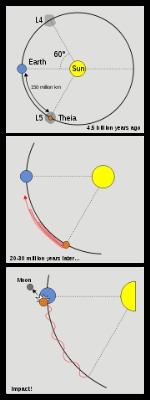
. According to the giant impact hypothesis, Theia formed along with the other planets of our solar system about 4.5 billion years ago, and was approximately the size of Mars. It would have materialized at the L4 or L5 Lagrangian point
Lagrangian point

The Lagrangian points , are the five positions in an orbital configuration where a small object affected only by gravity can theoretically be stationary relative to two larger objects ....
s relative to Earth (in about the same orbit and about 60° ahead or behind), similar to a trojan asteroid
Trojan asteroid

The Jupiter Trojans, commonly called Trojans or Trojan asteroids, are a large group of objects that share the orbit of the planet Jupiter around the Sun....
.

However, the stability of Theia's orbit was affected when its growing mass exceeded a threshold. At some point, greater gravitational interaction with the proto-Earth locked the bodies into an ultimate collision course.

Impact

In astronomical terms, the impact would have been of moderate velocity. Theia is thought to have struck the Earth at an oblique angle. Theia's iron core sank into the young Earth's core, as most of Theia's mantle
Mantle (geology)

The mantle is a part of an astronomical object. The interior of the Earth, similar to the other terrestrial planets, is chemically divided into layers....
 and a significant portion of the Earth's mantle and crust were ejected
Ejecta

Ejecta can mean:*In volcanology, particles that came out of a volcano vent, traveled through the air or under water, and fell back on the ground surface or on the ocean floor....
 into orbit around the Earth. This material quickly coalesced into the Moon (possibly within less than a month, but in no more than a century). Estimates based on computer simulation
Computer simulation

A computer simulation, a computer model or a computational model is a computer program, or network of computers, that attempts to simulation an abstract model of a particular system....
s of such an event suggest that some two percent of the original mass of Theia ended up as an orbiting ring of debris, and about half of this matter coalesced into the Moon
Moon

The Moon is Earth's only natural satellite and the List of natural satellites by diameter satellite in the Solar System. The average centre-to-centre distance from the Earth to the Moon is km, about thirty times the diameter of the Earth....
. The Earth would have gained significant amounts of angular momentum
Angular momentum

In physics, the angular momentum of a particle about an origin is a vector quantity related to rotation, equal to the mass of the particle multiplied by the cross product of the position vector of the particle with its velocity vector....
 and mass
Mass

In physical science, mass refers to the degree of acceleration a body acquires when subject to a force: bodies with greater mass are accelerated less by the same force....
 from such a collision. Regardless of the rotation and inclination the Earth had before the impact, it would have had a day some five hours long after the impact, and the Earth's equator would have shifted closer to the plane of the Moon's orbit.

It has been suggested that other significant objects may have been created by the impact, which could have remained in orbit between the Earth and Moon, stuck in Lagrangian point
Lagrangian point

The Lagrangian points , are the five positions in an orbital configuration where a small object affected only by gravity can theoretically be stationary relative to two larger objects ....
s. Such objects may have stayed within the Earth-Moon system for up to 100 million years, until the gravitational tugs of other planets destabilized the system enough to free the objects.

Evidence

Big Slash
Indirect evidence for this impact scenario comes from rocks collected during the Apollo Moon landings, which show oxygen
Oxygen

Oxygen no O2 produced; 2) O2 produced, but absorbed in oceans & seabed rock; 3) O2 starts to gas out of the oceans, but is absorbed by land surfaces and formation of ozone layer; 4-5) O2 sinks filled and the gas accumulates]]...
 isotope
Isotope

Isotopes are any of the different types of atoms of the same chemical element, each having a different atomic mass . Isotopes of an element have atomic nucleus with the same number of protons but different numbers of neutron....
 compositions that are nearly the same as the Earth. The highly anorthositic composition of the lunar crust, as well as the existence of KREEP
KREEP

KREEP, an acronym built from the letters K , REE and P , is a Geochemistry component of some lunar impact Melting breccia and basalt rocks....
-rich samples, gave rise to the idea that a large portion of the Moon was once molten, and a giant impact scenario could easily have supplied the energy needed to form such a magma ocean
Lunar magma ocean

According to the giant impact hypothesis a large amount of energy was liberated in the formation of the Moon and it is predicted that as a result a large portion of the Moon was once completely molten, forming a lunar magma ocean....
. Several lines of evidence show that if the Moon has an iron
Iron

Iron is a chemical element with the symbol Fe and atomic number 26. Iron is a Group 8 element and period 4 element. Iron is lustrous and silvery in color....
-rich core, it must be small. In particular, the mean density, moment of inertia, rotational signature, and magnetic induction response all suggest that the radius of the core is less than about 25% the radius of the Moon, in contrast to about 50% for most of the other terrestrial bodies. Impact conditions can be found that give rise to a Moon that formed mostly from the mantles of the Earth and impactor, with the core of the impactor accreting to the Earth, and which satisfy the angular momentum constraints of the Earth-Moon system.

A belt of warm dust in a zone between 0.25AU and 2AU from the young star HD 23514 in the Pleiades
Pleiades

Pleiades can refer to:*Pleiades ? open cluster of stars in the constellation Taurus**Pleiades in folklore and literature - interpretations and traditional meanings of the star cluster among various human cultures...
 cluster appears similar to the predicted results of Theia's collision with the embryonic Earth, and has been interpreted as the result of planet-sized objects colliding with each other. This is similar to another belt of warm dust detected around the star BD+20 307 (HIP 8920, SAO 75016).

Difficulties

This lunar origin hypothesis has some difficulties which have yet to be explained. These difficulties include:

  • Ratios of the Moon's volatile elements are not consistent with the giant impact hypothesis (not resolved )
  • There is no evidence that the Earth ever had a magma ocean (an implied result of the giant impact hypothesis), and it is likely there exists material which has never been processed by a magma ocean (not resolved )
  • Iron oxide (FeO) content of 13% of the bulk Moon properties rule out the derivation of the proto-lunar material from any but a small fraction of Earth's mantle (not resolved )
  • If the bulk of the proto-lunar material had come from the impactor, the Moon should be enriched in siderophilic
    Goldschmidt classification

    The Goldschmidt classification, developed by Victor Goldschmidt, is a Geochemistry which groups the chemical elements according to their preferred host phases into lithophile , siderophile , chalcophile , and atmophile ....
     elements, when it is actually deficient of those (not resolved )

Alternate hypotheses


Other mechanisms which have been suggested at various times for the Moon's origin are that the Moon was spun off of the Earth's surface by centrifugal force
Centrifugal force

In classical mechanics, centrifugal force is an outward force associated with rotation. Centrifugal force is one of several so-called pseudo-forces , so named because, unlike Fundamental interaction, they do not originate in interactions with other bodies situated in the environment of the particle upon which they act....
, that it was formed elsewhere and later captured by the Earth's gravitational field, and that the Moon formed at the same time and place as the Earth from the same accretion disk. Each of these mechanisms is claimed to lack a mechanism to account for the high angular momentum
Angular momentum

In physics, the angular momentum of a particle about an origin is a vector quantity related to rotation, equal to the mass of the particle multiplied by the cross product of the position vector of the particle with its velocity vector....
 of the Earth–Moon system.

See also

  • Geology of the Moon
    Geology of the Moon

    The geology of the Moon is quite different from that of the Earth. The Moon lacks a significant Celestial body atmosphere and any body of water, which eliminates erosion due to weather; it does not possess any form of plate tectonics, it has a lower gravitation, and because of its small size, it cools more rapidly....
  • History of Earth
    History of Earth

    The history of the Earth covers approximately Age of the Earth , from Earth?s formation out of the solar nebula to the present. This article presents a broad overview, summarizing the leading, most current scientific theories....
  • Roche limit
    Roche limit

    The Roche limit , sometimes referred to as the Roche radius, is the distance within which a celestial body, held together only by its own gravity, will disintegrate due to a second celestial body's tidal forces exceeding the first body's gravitational self-attraction....


Further reading

Academic articles

Non-academic books

External links

  • by Prof. AGW Cameron
  • (.wmv and .mov)
  • - Including articles about the giant impact hypothesis