


Sun-synchronous orbit

Encyclopedia
A Sun-synchronous orbit (sometimes called a heliosynchronous orbit) is a geocentric orbit
which combines altitude
and inclination
in such a way that an object on that orbit ascends or descends over any given point of the Earth's
surface
at the same local mean solar time. The surface illumination angle
will be nearly the same every time. This consistent lighting is a useful characteristic for satellite
s that image the Earth's surface in visible or infrared wavelengths (e.g. weather and spy satellites) and for other remote sensing satellites (e.g. those carrying ocean and atmospheric remote sensing instruments that require sunlight). For example, a satellite in sun-synchronous orbit might ascend across the equator twelve times a day each time at approximately 15:00 mean local time. This is achieved by having the osculating
orbital plane precess (rotate) approximately one degree each day with respect to the celestial sphere
, eastward, to keep pace with the Earth's revolution around the Sun
.
The uniformity of Sun angle is achieved by tuning the inclination to the altitude of the orbit (details in section "Technical details") such that the extra mass near the equator
causes orbital plane of the spacecraft to precess with the desired rate: the plane of the orbit is not fixed in space relative to the distant stars, but rotates slowly about the Earth's axis. Typical sun-synchronous orbits are about 600–800 km in altitude, with periods in the 96–100 minute
range, and inclinations of around 98°
(i.e. slightly retrograde
compared to the direction of Earth's rotation: 0° represents an equatorial orbit and 90° represents a polar orbit).
Special cases of the sun-synchronous orbit are the noon/midnight orbit, where the local mean solar time of passage for equatorial longitudes is around noon or midnight, and the dawn/dusk orbit, where the local mean solar time of passage for equatorial longitudes is around sunrise or sunset, so that the satellite rides the terminator between day and night. Riding the terminator is useful for active radar satellites as the satellites' solar panels can always see the Sun, without being shadowed by the Earth. It is also useful for some satellites with passive instruments which need to limit the Sun's influence on the measurements, as it is possible to always point the instruments towards the night side of the Earth. The dawn/dusk orbit has been used for solar observing scientific satellites such as Yohkoh
, TRACE
, Hinode
and Proba-2
, affording them a nearly continuous view of the Sun.
Sun-synchronous orbits are possible around other oblate planets, such as Mars
. But for example Venus
is too spherical for having a satellite in sun-synchronous orbit. See for example the article Venus
where a flattening coefficient of zero for this planet is cited.
gives that the precession rate of an orbit around an oblate planet is
radians per orbit.
As the orbital period of a spacecraft is and as
  for a circular or almost circular orbit it follows that such an orbit is sun-synchronous if and only if
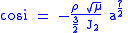
where is the mean motion of the Earth in its orbit around the Sun (
 )
)
 is the gravitational constant of the Earth (
 )
)
 is the coefficient for the second zonal term (
 )
)
As an example, for a=7200 km (the spacecraft about 800 km over the Earth surface) one gets with this formula a sun-synchronous inclination of 98.696 deg.
The definition of the Local time of the ascending node concept for Sun-synchronous spacecraft is only related to the position of the Sun indirectly through Newcomb's formula which gives the angle between the Greenwich meridian and the Vernal equinox in the form

where is the time in days from a reference epoch that corresponds to mid-night at the Greenwich meridian and
  is an extremely small coefficient.
Nowadays one uses 2000/01/01 00:00:00 corresponding to Modified Julian Day zero. This then means (counting angles in radians) that the angle from Vernal equinox to the direction away from the Sun projected down to the equatorial plane must be approximately

The right ascension of the ascending node
( ) for a sun-synchronous orbit increases with precisely this rate
 radian/day (
 )
)
which is the "mean motion"
of the Earth in its orbit around the Sun.
The local time of the ascending node in hours is then the constant value

where is
is  reduced modulo
  to the interval
The local time of the descending node is obtained by adding (or subtracting) 12 hours
The Sun-synchronous orbit is mostly selected for Earth observation satellite
s that should be operated at a relatively constant altitude suitable for its Earth observation instruments, this altitude typically being between 600 km and 1000 km over the Earth surface. Because of the deviations of the gravitational field of the Earth from that of a homogeneous sphere that are quite significant at such relatively low altitudes a strictly circular orbit is not possible for these satellites. Very often a frozen orbit
is therefore selected that is slightly higher over the Southern hemisphere than over the Northern hemisphere. ERS-1, ERS-2
and Envisat
of European Space Agency
as well as the MetOp
spacecraft of the European Organisation for the Exploitation of Meteorological Satellites
are all operated in Sun-synchronous, "frozen"
orbits.
Geocentric orbit
A geocentric orbit involves any object orbiting the Earth, such as the Moon or artificial satellites. Currently there are approximately 2,465 artificial satellites orbiting the Earth and 6,216 pieces of space debris as tracked by the Goddard Space Flight Center...
which combines altitude
Altitude
Altitude or height is defined based on the context in which it is used . As a general definition, altitude is a distance measurement, usually in the vertical or "up" direction, between a reference datum and a point or object. The reference datum also often varies according to the context...
and inclination
Inclination
Inclination in general is the angle between a reference plane and another plane or axis of direction.-Orbits:The inclination is one of the six orbital parameters describing the shape and orientation of a celestial orbit...
in such a way that an object on that orbit ascends or descends over any given point of the Earth's
Earth
Earth is the third planet from the Sun, and the densest and fifth-largest of the eight planets in the Solar System. It is also the largest of the Solar System's four terrestrial planets...
surface
Surface
In mathematics, specifically in topology, a surface is a two-dimensional topological manifold. The most familiar examples are those that arise as the boundaries of solid objects in ordinary three-dimensional Euclidean space R3 — for example, the surface of a ball...
at the same local mean solar time. The surface illumination angle
Illumination angle
The illumination angle is the angle between the inward surface normal and the direction of light. This means that the illumination angle of a certain point of the Earth's surface is zero if the Sun is precisely overhead and that it is 90 degrees at sunset and at sunrise....
will be nearly the same every time. This consistent lighting is a useful characteristic for satellite
Satellite
In the context of spaceflight, a satellite is an object which has been placed into orbit by human endeavour. Such objects are sometimes called artificial satellites to distinguish them from natural satellites such as the Moon....
s that image the Earth's surface in visible or infrared wavelengths (e.g. weather and spy satellites) and for other remote sensing satellites (e.g. those carrying ocean and atmospheric remote sensing instruments that require sunlight). For example, a satellite in sun-synchronous orbit might ascend across the equator twelve times a day each time at approximately 15:00 mean local time. This is achieved by having the osculating
Osculating orbit
In astronomy, and in particular in astrodynamics, the osculating orbit of an object in space is the gravitational Kepler orbit In astronomy, and in particular in astrodynamics, the osculating orbit of an object in space (at a given moment of time) is the gravitational Kepler orbit In astronomy,...
orbital plane precess (rotate) approximately one degree each day with respect to the celestial sphere
Celestial sphere
In astronomy and navigation, the celestial sphere is an imaginary sphere of arbitrarily large radius, concentric with the Earth and rotating upon the same axis. All objects in the sky can be thought of as projected upon the celestial sphere. Projected upward from Earth's equator and poles are the...
, eastward, to keep pace with the Earth's revolution around the Sun
Sun
The Sun is the star at the center of the Solar System. It is almost perfectly spherical and consists of hot plasma interwoven with magnetic fields...
.
The uniformity of Sun angle is achieved by tuning the inclination to the altitude of the orbit (details in section "Technical details") such that the extra mass near the equator
Equatorial bulge
An equatorial bulge is a difference between the equatorial and polar diameters of a planet, due to the centrifugal force of its rotation. A rotating body tends to form an oblate spheroid rather than a sphere...
causes orbital plane of the spacecraft to precess with the desired rate: the plane of the orbit is not fixed in space relative to the distant stars, but rotates slowly about the Earth's axis. Typical sun-synchronous orbits are about 600–800 km in altitude, with periods in the 96–100 minute
Minute
A minute is a unit of measurement of time or of angle. The minute is a unit of time equal to 1/60th of an hour or 60 seconds. In the UTC time scale, a minute on rare occasions has 59 or 61 seconds; see leap second. The minute is not an SI unit; however, it is accepted for use with SI units...
range, and inclinations of around 98°
Degree (angle)
A degree , usually denoted by ° , is a measurement of plane angle, representing 1⁄360 of a full rotation; one degree is equivalent to π/180 radians...
(i.e. slightly retrograde
Retrograde motion
Retrograde motion is motion in the direction opposite to the movement of something else, and is the contrary of direct or prograde motion. This motion can be the orbit of one body about another body or about some other point, or the rotation of a single body about its axis, or other phenomena such...
compared to the direction of Earth's rotation: 0° represents an equatorial orbit and 90° represents a polar orbit).
Special cases of the sun-synchronous orbit are the noon/midnight orbit, where the local mean solar time of passage for equatorial longitudes is around noon or midnight, and the dawn/dusk orbit, where the local mean solar time of passage for equatorial longitudes is around sunrise or sunset, so that the satellite rides the terminator between day and night. Riding the terminator is useful for active radar satellites as the satellites' solar panels can always see the Sun, without being shadowed by the Earth. It is also useful for some satellites with passive instruments which need to limit the Sun's influence on the measurements, as it is possible to always point the instruments towards the night side of the Earth. The dawn/dusk orbit has been used for solar observing scientific satellites such as Yohkoh
Yohkoh
Yohkoh , known before launch as Solar-A, was a Solar observatory spacecraft of the Institute of Space and Astronautical Science with United States and United Kingdom collaboration...
, TRACE
TRACE
TRACE was a NASA space telescope designed to investigate the connections between fine-scale magnetic fields and the associated plasma structures on the Sun by providing high resolution images and observation of the solar photosphere and transition region to the corona...
, Hinode
Hinode
Hinode , formerly Solar-B, is a Japan Aerospace Exploration Agency Solar mission with United States and United Kingdom collaboration. It is the follow-up to the Yohkoh mission and it was launched on the final flight of the M-V-7 rocket from Uchinoura Space Center, Japan on 22 September 2006 at...
and Proba-2
Proba-2
PROBA2 is the second satellite in the European Space Agency's series of PROBA low-cost satellites that are being used to validate new spacecraft technologies while also carrying scientific instruments. PROBA2 is a small satellite developed under an ESA General Support Technology Program contract...
, affording them a nearly continuous view of the Sun.
Sun-synchronous orbits are possible around other oblate planets, such as Mars
Mars
Mars is the fourth planet from the Sun in the Solar System. The planet is named after the Roman god of war, Mars. It is often described as the "Red Planet", as the iron oxide prevalent on its surface gives it a reddish appearance...
. But for example Venus
Venus
Venus is the second planet from the Sun, orbiting it every 224.7 Earth days. The planet is named after Venus, the Roman goddess of love and beauty. After the Moon, it is the brightest natural object in the night sky, reaching an apparent magnitude of −4.6, bright enough to cast shadows...
is too spherical for having a satellite in sun-synchronous orbit. See for example the article Venus
Venus
Venus is the second planet from the Sun, orbiting it every 224.7 Earth days. The planet is named after Venus, the Roman goddess of love and beauty. After the Moon, it is the brightest natural object in the night sky, reaching an apparent magnitude of −4.6, bright enough to cast shadows...
where a flattening coefficient of zero for this planet is cited.
Technical details
Equation (20) of the article Orbital perturbation analysis (spacecraft)Orbital perturbation analysis (spacecraft)
Isaac Newton in his Philosophiæ Naturalis Principia Mathematica demonstrated that the gravitational force between two mass points is inversely proportional to the square of the distance between the points and fully solved corresponding "two-body problem" demonstrating that radius vector between the...
gives that the precession rate of an orbit around an oblate planet is
radians per orbit.
As the orbital period of a spacecraft is
and as for a circular or almost circular orbit it follows that such an orbit is sun-synchronous if and only ifwhere
is the mean motion of the Earth in its orbit around the Sun () is the gravitational constant of the Earth () is the coefficient for the second zonal term ()As an example, for a=7200 km (the spacecraft about 800 km over the Earth surface) one gets with this formula a sun-synchronous inclination of 98.696 deg.
The definition of the Local time of the ascending node concept for Sun-synchronous spacecraft is only related to the position of the Sun indirectly through Newcomb's formula which gives the angle between the Greenwich meridian and the Vernal equinox in the form
where
is the time in days from a reference epoch that corresponds to mid-night at the Greenwich meridian and is an extremely small coefficient.Nowadays one uses 2000/01/01 00:00:00 corresponding to Modified Julian Day zero. This then means (counting angles in radians) that the angle from Vernal equinox to the direction away from the Sun projected down to the equatorial plane must be approximately
The right ascension of the ascending node
Kepler orbit
In celestial mechanics, a Kepler orbit describes the motion of an orbiting body as an ellipse, parabola, or hyperbola, which forms a two-dimensional orbital plane in three-dimensional space...
(
) for a sun-synchronous orbit increases with precisely this rate radian/day ()which is the "mean motion"
Kepler orbit
In celestial mechanics, a Kepler orbit describes the motion of an orbiting body as an ellipse, parabola, or hyperbola, which forms a two-dimensional orbital plane in three-dimensional space...
of the Earth in its orbit around the Sun.
The local time of the ascending node in hours is then the constant value
where
is reduced modulo to the intervalThe local time of the descending node is obtained by adding (or subtracting) 12 hours
The Sun-synchronous orbit is mostly selected for Earth observation satellite
Earth observation satellite
Earth observation satellites are satellites specifically designed to observe Earth from orbit, similar to reconnaissance satellites but intended for non-military uses such as environmental monitoring, meteorology, map making etc....
s that should be operated at a relatively constant altitude suitable for its Earth observation instruments, this altitude typically being between 600 km and 1000 km over the Earth surface. Because of the deviations of the gravitational field of the Earth from that of a homogeneous sphere that are quite significant at such relatively low altitudes a strictly circular orbit is not possible for these satellites. Very often a frozen orbit
Frozen orbit
For most spacecraft missions the "perturbing forces" caused by the oblateness of the Earth, the gravitational attraction from Sun/Moon, the solar radiation pressure and the air drag must be counteracted by orbit maneuvers to keep the spacecraft in the desired orbit...
is therefore selected that is slightly higher over the Southern hemisphere than over the Northern hemisphere. ERS-1, ERS-2
European Remote-Sensing Satellite
European remote sensing satellite was the European Space Agency's first Earth-observing satellite. It was launched on July 17, 1991 into a Sun-synchronous polar orbit at a height of 782–785 km.-Instruments:...
and Envisat
Envisat
Envisat is an Earth-observing satellite. It was launched on 1 March 2002 aboard an Ariane 5 from the Guyana Space Centre in Kourou, French Guyana into a Sun synchronous polar orbit at an altitude of...
of European Space Agency
European Space Agency
The European Space Agency , established in 1975, is an intergovernmental organisation dedicated to the exploration of space, currently with 18 member states...
as well as the MetOp
MetOp
MetOp is a series of polar orbiting meteorological satellites operated by the European Organisation for the Exploitation of Meteorological Satellites. The satellites are all part af the EUMETSAT Polar System. It is intended to replace the soon to be retired TIROS network...
spacecraft of the European Organisation for the Exploitation of Meteorological Satellites
European Organisation for the Exploitation of Meteorological Satellites
EUMETSAT is an intergovernmental organisation created through an international convention agreed by a current total of 26 European Member States: Austria, Belgium, Croatia, the Czech Republic, Denmark, Finland, France, Germany, Greece, Hungary, Ireland, Romania, Italy, Latvia, Luxembourg, the...
are all operated in Sun-synchronous, "frozen"
Frozen orbit
For most spacecraft missions the "perturbing forces" caused by the oblateness of the Earth, the gravitational attraction from Sun/Moon, the solar radiation pressure and the air drag must be counteracted by orbit maneuvers to keep the spacecraft in the desired orbit...
orbits.
See also
- Orbital perturbation analysis (spacecraft)Orbital perturbation analysis (spacecraft)Isaac Newton in his Philosophiæ Naturalis Principia Mathematica demonstrated that the gravitational force between two mass points is inversely proportional to the square of the distance between the points and fully solved corresponding "two-body problem" demonstrating that radius vector between the...
- AnalemmaAnalemmaIn astronomy, an analemma is a curve representing the angular offset of a celestial body from its mean position on the celestial sphere as viewed from another celestial body relative to the viewing body's celestial equator...
- Geosynchronous orbitGeosynchronous orbitA geosynchronous orbit is an orbit around the Earth with an orbital period that matches the Earth's sidereal rotation period...
- Geostationary orbitGeostationary orbitA geostationary orbit is a geosynchronous orbit directly above the Earth's equator , with a period equal to the Earth's rotational period and an orbital eccentricity of approximately zero. An object in a geostationary orbit appears motionless, at a fixed position in the sky, to ground observers...
- List of orbits
- Polar orbitPolar orbitA polar orbit is an orbit in which a satellite passes above or nearly above both poles of the body being orbited on each revolution. It therefore has an inclination of 90 degrees to the equator...
- World Geodetic SystemWorld Geodetic SystemThe World Geodetic System is a standard for use in cartography, geodesy, and navigation. It comprises a standard coordinate frame for the Earth, a standard spheroidal reference surface for raw altitude data, and a gravitational equipotential surface that defines the nominal sea level.The latest...