


Brazilian Integralism

Encyclopedia

Brazil
Brazil , officially the Federative Republic of Brazil , is the largest country in South America. It is the world's fifth largest country, both by geographical area and by population with over 192 million people...
, created on October 1932. Founded and led by Plínio Salgado
Plínio Salgado
Plínio Salgado was a Brazilian politician, writer, journalist, and theologian. He founded and led the Brazilian Integralist Action, a far-right political party inspired on the Italian Fascist movement....
, a literary figure who was somewhat famous for his participation in the 1922 Modern Art Week, the movement had adopted some characteristics of Europe
Europe
Europe is, by convention, one of the world's seven continents. Comprising the westernmost peninsula of Eurasia, Europe is generally 'divided' from Asia to its east by the watershed divides of the Ural and Caucasus Mountains, the Ural River, the Caspian and Black Seas, and the waterways connecting...
an mass movements of those times, specifically of Italian Fascism
Italian Fascism
Italian Fascism also known as Fascism with a capital "F" refers to the original fascist ideology in Italy. This ideology is associated with the National Fascist Party which under Benito Mussolini ruled the Kingdom of Italy from 1922 until 1943, the Republican Fascist Party which ruled the Italian...
, but differentiating itself from some forms of fascism in that Salgado did not preach racism
Racism
Racism is the belief that inherent different traits in human racial groups justify discrimination. In the modern English language, the term "racism" is used predominantly as a pejorative epithet. It is applied especially to the practice or advocacy of racial discrimination of a pernicious nature...
. As a matter of fact, they even had as their slogan
Slogan
A slogan is a memorable motto or phrase used in a political, commercial, religious and other context as a repetitive expression of an idea or purpose. The word slogan is derived from slogorn which was an Anglicisation of the Scottish Gaelic sluagh-ghairm . Slogans vary from the written and the...
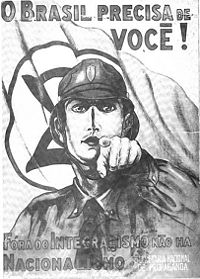
: "Union of all races and all peoples", although many of its militants adopted anti-semitic views. The name of the party created to support the ideology was Ação Integralista Brasileira (AIB, Brazilian Integralist Action). The reference to Integralism
Integralism
Integralism, or Integral nationalism, is an ideology according to which a nation is an organic unity. Integralism defends social differentiation and hierarchy with co-operation between social classes, transcending conflict between social and economic groups...
mirrored a traditionalist movement in Portugal
Portugal
Portugal , officially the Portuguese Republic is a country situated in southwestern Europe on the Iberian Peninsula. Portugal is the westernmost country of Europe, and is bordered by the Atlantic Ocean to the West and South and by Spain to the North and East. The Atlantic archipelagos of the...
, the Lusitan Integralism
Integralismo Lusitano
Integralismo Lusitano was a Portuguese integralist political movement, founded in Coimbra in 1914, that advocated traditionalism but not conservatism. It was against parliamentarism; instead, it favored decentralization, national syndicalism, the Roman Catholic Church, and the monarchy...
. For its symbol, the AIB used a flag with a white disk on a royal blue
Royal blue
Royal blue describes both a bright shade and a dark shade of azure blue. It is said to have been invented by millers in Rode, Somerset, a consortium of which won a competition to make a dress for the British queen, Charlotte of Mecklenburg-Strelitz....
background, with an uppercase sigma
Sigma
Sigma is the eighteenth letter of the Greek alphabet, and carries the 'S' sound. In the system of Greek numerals it has a value of 200. When used at the end of a word, and the word is not all upper case, the final form is used, e.g...
(Σ) in its center.
Character

Paramilitary
A paramilitary is a force whose function and organization are similar to those of a professional military, but which is not considered part of a state's formal armed forces....
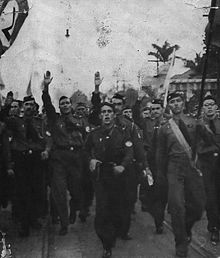
organization with uniform
Uniform
A uniform is a set of standard clothing worn by members of an organization while participating in that organization's activity. Modern uniforms are worn by armed forces and paramilitary organizations such as police, emergency services, security guards, in some workplaces and schools and by inmates...
ed ranks, highly regimented street demonstrations, and rhetoric against Marxism
Marxism
Marxism is an economic and sociopolitical worldview and method of socioeconomic inquiry that centers upon a materialist interpretation of history, a dialectical view of social change, and an analysis and critique of the development of capitalism. Marxism was pioneered in the early to mid 19th...
and liberalism
Liberalism
Liberalism is the belief in the importance of liberty and equal rights. Liberals espouse a wide array of views depending on their understanding of these principles, but generally, liberals support ideas such as constitutionalism, liberal democracy, free and fair elections, human rights,...
. However, it differed markedly from it in specific ideology: a prolific writer before turning political leader, Salgado interpreted human history at large as an opposition between "materialism
Materialism
In philosophy, the theory of materialism holds that the only thing that exists is matter; that all things are composed of material and all phenomena are the result of material interactions. In other words, matter is the only substance...
" – understood by him as the normal operation of natural law
Natural law
Natural law, or the law of nature , is any system of law which is purportedly determined by nature, and thus universal. Classically, natural law refers to the use of reason to analyze human nature and deduce binding rules of moral behavior. Natural law is contrasted with the positive law Natural...
s guided by blind necessity – and "spiritualism
Spiritualism
Spiritualism is a belief system or religion, postulating the belief that spirits of the dead residing in the spirit world have both the ability and the inclination to communicate with the living...
": the belief in God, in the immortality of the soul, and in the conditioning of individual existence to superior, eternal goals. Salgado advocated, therefore, the harnessing of individual interest to values such as pity, self-donation and concern to others. For him, Human history consisted of the eternal struggle of the human spirit against the laws of nature, as expressed by the atheism
Atheism
Atheism is, in a broad sense, the rejection of belief in the existence of deities. In a narrower sense, atheism is specifically the position that there are no deities...
of modern society in the twin forms of liberalism
Liberalism
Liberalism is the belief in the importance of liberty and equal rights. Liberals espouse a wide array of views depending on their understanding of these principles, but generally, liberals support ideas such as constitutionalism, liberal democracy, free and fair elections, human rights,...
and socialism
Socialism
Socialism is an economic system characterized by social ownership of the means of production and cooperative management of the economy; or a political philosophy advocating such a system. "Social ownership" may refer to any one of, or a combination of, the following: cooperative enterprises,...
- capitalist
Capitalism
Capitalism is an economic system that became dominant in the Western world following the demise of feudalism. There is no consensus on the precise definition nor on how the term should be used as a historical category...
competition leading eventually to the merger of private capitals in a single state-owned economy. Therefore the fact that the integralists favoured nationalism
Nationalism
Nationalism is a political ideology that involves a strong identification of a group of individuals with a political entity defined in national terms, i.e. a nation. In the 'modernist' image of the nation, it is nationalism that creates national identity. There are various definitions for what...
as a shared spiritual identity, in a context of heterogeneous and tolerant nation influenced by "Christian
Christianity
Christianity is a monotheistic religion based on the life and teachings of Jesus as presented in canonical gospels and other New Testament writings...
virtues" – such virtues being concretely enforced by means of an authoritarian government enforcing compulsory political activity under the guidance of an acknowledged leader. Integralism, therefore, had as its specific character the religious, traditional Catholic roots of its totalitarian ideology – something akin to the contemporary Irish blueshirts. Like the European Fascists, Integralists were essentially middle class
Middle class
The middle class is any class of people in the middle of a societal hierarchy. In Weberian socio-economic terms, the middle class is the broad group of people in contemporary society who fall socio-economically between the working class and upper class....
. In particular, they drew support from military officers, especially in the Brazilian Navy
Brazilian Navy
The Brazilian Navy is a branch of the Brazilian Armed Forces responsible for conducting naval operations. It is the largest navy in Latin America...
.
Integralism being a mass movement, there were marked differences in ideology among its leaders under the influence of various international fascist and quasi-fascist contemporary movements, as in the issue of anti-Semitism
Anti-Semitism
Antisemitism is suspicion of, hatred toward, or discrimination against Jews for reasons connected to their Jewish heritage. According to a 2005 U.S...
: Salgado was more or less indifferent to it, while Gustavo Barroso
Gustavo Barroso
Gustavo Dodt Barroso was a Brazilian writer and politician associated with Brazilian Integralism.- Biography :He was half German by birth, his mother coming from Württemberg....
, the party's chief doctrinnaire after Salgado, was known for his militant antisemitic views, being the translator into Portuguese of the Protocols of the Elders of Zion, as well as the author of various antisemitic works of his own (Judaism, Freemasonry and Communism; Sinagogues in São Paulo). This led to at least two serious ruptures in the movement: one in 1935 and the other, 1936, when Plínio almost renounced leadership of the movement.
One of the most important principles in an Integralist's life was the "Internal Revolution", or "Revolution of the Self", through which a man was encouraged to stop thinking only for himself, and instead start to integrate into the idea of a giant integralist family - becoming one with the Homeland, while also leaving behind selfish and "evil" values.
Attitudes of the Vargas regime
Revolution
A revolution is a fundamental change in power or organizational structures that takes place in a relatively short period of time.Aristotle described two types of political revolution:...
. The government led by President
President of Brazil
The president of Brazil is both the head of state and head of government of the Federative Republic of Brazil. The president leads the executive branch of the federal government and is the commander-in-chief of the Brazilian Armed Forces...
Getúlio Vargas
Getúlio Vargas
Getúlio Dornelles Vargas served as President of Brazil, first as dictator, from 1930 to 1945, and in a democratically elected term from 1951 until his suicide in 1954. Vargas led Brazil for 18 years, the most for any President, and second in Brazilian history to Emperor Pedro II...
had a degree of support from workers because of the labor laws he introduced, and competed with the Communist Party of Brazil
Communist Party of Brazil
The Communist Party of Brazil is a political party in Brazil. It has national reach and deep penetration in the trade union and students movements. PCdoB dispute with the Brazilian Communist Party the title of "oldest political party in Brazil"...
for working class support. In the face of communist advances, Vargas turned towards establishing the integralist Estado Novo
Estado Novo (Brazil)
Vargas Era is the period in the history of Brazil that lasted from 1930 to 1945, when the country was under the leadership of Getúlio Dornelles Vargas....
, the only mobilized base of support on the right
Right-wing politics
In politics, Right, right-wing and rightist generally refer to support for a hierarchical society justified on the basis of an appeal to natural law or tradition. To varying degrees, the Right rejects the egalitarian objectives of left-wing politics, claiming that the imposition of equality is...
, building upon his intensive crackdown against the Brazilian left
Left-wing politics
In politics, Left, left-wing and leftist generally refer to support for social change to create a more egalitarian society...
. With center-left tendencies out of the Vargas' coalition and the left crushed, Vargas gradually started seeking to co-opt the popular movement to attain a widespread support base.
Integralism, claiming a rapidly growing membership throughout Brazil by 1935, especially among the German-Brazilian
German-Brazilian
A German Brazilian is a Brazilian person of ethnic German ancestry or origin...
s and Italian-Brazilians (communities which together amounted to approximately one million people), began filling this ideological void. In 1934, the Integralists targeted the Communist movement led by Luiz Carlos Prestes, mobilizing a conservative mass support base engaging in street brawls. In 1934, following the disintegration of Vargas' delicate alliance with labor, and his new alliance with the AIB, Brazil entered one of the most agitated periods in its political history. Brazil's major cities began to resemble the 1932-33 street battles in Berlin
Berlin
Berlin is the capital city of Germany and is one of the 16 states of Germany. With a population of 3.45 million people, Berlin is Germany's largest city. It is the second most populous city proper and the seventh most populous urban area in the European Union...
between the Kommunistische Partei Deutschlands
Communist Party of Germany
The Communist Party of Germany was a major political party in Germany between 1918 and 1933, and a minor party in West Germany in the postwar period until it was banned in 1956...
and the National-Socialist German Workers' Party. By mid-1935, Brazilian politics had been drastically destabilized.
Crackdown and legacy
When Vargas established full dictatorial powersDictatorship
A dictatorship is defined as an autocratic form of government in which the government is ruled by an individual, the dictator. It has three possible meanings:...
under the Estado Novo in 1937, he turned against the movement. Although AIB favored Vargas' hard right turn, Salgado was overly ambitious, with overt presidential aspirations that threatened Vargas' grip on power. In 1938, the Integralists made a last attempt at achieving power, by attacking the Guanabara Palace during the night, but police and army troops arrived at the last minute, and the ensuing gunfight ended with around twenty casualties. This attempt was called the Integralist Assault and the Integralist Pajama Putsch.
AIB disintegrated after that failure in 1938, and some years later Salgado founded the Party of Popular Representation
Party of Popular Representation
The Party of Popular Representation was a political party in Brazil. The PRP was founded by Plínio Salgado on September 26 1945. He reassembled the former members of the Brazilian Integralism, and was ideologically aligned with the nationalist right. It always obtained representation in the...
(PRP), which maintained the ideology of Integralism, but without the uniforms, salutes, signals, and signs. The various political leaderships raised among Integralistm dispersed into various ideological positions during subsequent political struggles, including many of the former members of the partcipants in the 1964 military coup
Coup d'état
A coup d'état state, literally: strike/blow of state)—also known as a coup, putsch, and overthrow—is the sudden, extrajudicial deposition of a government, usually by a small group of the existing state establishment—typically the military—to replace the deposed government with another body; either...
that was to overthrow President João Goulart
João Goulart
João Belchior Marques Goulart was a Brazilian politician and the 24th President of Brazil until a military coup d'état deposed him on April 1, 1964. He is considered to have been the last left-wing President of the country until Luiz Inácio Lula da Silva took office in 2003.-Name:João Goulart is...
, as well as Goulart's Foreign Minister Santiago Dantas, the Catholic bishop D. Hélder Câmara
Hélder Câmara
Dom Hélder Pessoa Câmara was Roman Catholic Archbishop of Olinda and Recife.He was known as the 'Bishop of Corum' and took a clear position with the urban poor....
, and the Brazilian populist leader (and Goulart's brother-in-law) Leonel Brizola
Leonel Brizola
Leonel de Moura Brizola was a Brazilian politician. Launched in politics by Getúlio Vargas, Brizola was the only politician to serve as governor of two different states in the whole history of Brazil. In 1959 he was elected governor of Rio Grande do Sul, and in 1982 and 1990 he was elected...
. Today, there are very small and powerless groups in Brazil which uphold the strict integralist ideology.
Integralistas and the military regime (1964-1985)
Integralistas and former Integralistas took a range of positions vis-à-vis the military regime that succeeded the 1964 coup. Plínio Salgado joined the ARENANational Renewal Alliance Party
The National Renewal Alliance Party or Aliança Renovadora Nacional was a conservative political party that existed in Brazil between 1966 and 1985...
, the pro-military party. Augusto Rademaker and Márcio Melo, former Integralistas, were two of the three members of the junta that briefly ruled Brazil in 1969, during the transition from the second military government, that of Artur da Costa e Silva
Artur da Costa e Silva
Artur da Costa e Silva was a Brazilian Army General, the second President of Brazil during the military regime set up by the 1964 coup d'état; he was born only a month before the coup that overthrow Dom Pedro II. He was married to Iolanda Barbosa Costa e Silva, the daughter of a soldier...
, to the third, that of Emílio Médici. Rademaker was also vice-president in the third military government. He was considered one of the most radical admirals in the country. Many former Integralistas in the military occupied government posts in the second and third military administrations, usually thought to be aligned with hardliner sectors of the army. On the other side of the issue, D. Hélder Câmara, also a former Integralista, was, at the time, the best known opponent of the regime.