
Home      Discussion      Topics      Dictionary      Almanac
Signup       Login
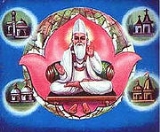
Kabir

Kabir

Overview
Kabīr (Hindi
Hindi
Standard Hindi, or more precisely Modern Standard Hindi, also known as Manak Hindi , High Hindi, Nagari Hindi, and Literary Hindi, is a standardized and sanskritized register of the Hindustani language derived from the Khariboli dialect of Delhi...

: कबीर, Punjabi
Punjabi language
Punjabi is an Indo-Aryan language spoken by inhabitants of the historical Punjab region . For Sikhs, the Punjabi language stands as the official language in which all ceremonies take place. In Pakistan, Punjabi is the most widely spoken language...

: ਕਬੀਰ, Urdu
Urdu
Urdu is a register of the Hindustani language that is identified with Muslims in South Asia. It belongs to the Indo-European family. Urdu is the national language and lingua franca of Pakistan. It is also widely spoken in some regions of India, where it is one of the 22 scheduled languages and an...

: کبير‎) (1440–1518) was a mystic
Mysticism
Mysticism is the knowledge of, and especially the personal experience of, states of consciousness, i.e. levels of being, beyond normal human perception, including experience and even communion with a supreme being.-Classical origins:...

 poet
Poet
A poet is a person who writes poetry. A poet's work can be literal, meaning that his work is derived from a specific event, or metaphorical, meaning that his work can take on many meanings and forms. Poets have existed since antiquity, in nearly all languages, and have produced works that vary...

 and saint
Saint
A saint is a holy person. In various religions, saints are people who are believed to have exceptional holiness.In Christian usage, "saint" refers to any believer who is "in Christ", and in whom Christ dwells, whether in heaven or in earth...

 of India
India
India , officially the Republic of India , is a country in South Asia. It is the seventh-largest country by geographical area, the second-most populous country with over 1.2 billion people, and the most populous democracy in the world...

, whose writings have greatly influenced the Bhakti movement
Bhakti movement
The Bhakti movement is a Hindu religious movement in which the main spiritual practice is loving devotion among the Shaivite and Vaishnava saints. The Bhakti movement originated in ancient Tamil Nadu and began to spread to the north during the late medieval ages when north India was under Islamic...

. The name Kabir comes from Arabic
Arabic language
Arabic is a name applied to the descendants of the Classical Arabic language of the 6th century AD, used most prominently in the Quran, the Islamic Holy Book...

 al-Kabīr which means 'The Great' - the 37th name of God in Islam.
Discussion
Ask a question about 'Kabir'
Start a new discussion about 'Kabir'
Answer questions from other users
Full Discussion Forum
 
Quotations

I've burned my own house down, the torch is in my hand. Now I'll burn down the house of anyone who wants to follow me.

The Bijak of Kabir (1983;2002) as translated by Linda Hess and Shukdeo Singh.

Admire the diamond that can bear the hits of a hammer. Many deceptive preachers, when critically examined, turn out to be false.

Sakhi, 168; translation by Yashwant K. Malaiya based on that of Puran Sahib.

Don't open your diamonds in a vegetable market. Tie them in bundle and keep them in your heart, and go your own way.

Sakhi, 170; translation by Yashwant K. Malaiya based on that of Puran Sahib.

A diamond was laying in the street covered with dirt. Many fools passed by. Someone who knew diamonds picked it up.

Sakhi, 171; translation by Yashwant K. Malaiya based on that of Puran Sahib. Translations of Kabir's poetry by Rabindranath Tagore, with alternate translations of some passages also provided. I

Kabîr says, "O Sadhu! God is the breath of all breath.

Variant translation: Kabir says: Student, tell me, what is God?He is the breath inside the breath

It is needless to ask of a saint the caste to which he belongs;For the priest, the warrior. the tradesman, and all the thirty-six castes, alike are seeking for God.It is but folly to ask what the caste of a saint may be;The barber has sought God, the washerwoman, and the carpenter — Even Raidas|Raidas was a seeker after God.

Hindus and Moslems alike have achieved that End, where remains no mark of distinction. III

O friend! hope for Him whilst you live, know whilst you live, understand whilst you live: for in life deliverance abides.If your bonds be not broken whilst living, what hope of deliverance in death?It is but an empty dream, that the soul shall have union with Him because it has passed from the body:If He is found now, He is found then,If not, we do but go to dwell in the City of Death.If you have union now, you shall have it hereafter. IV

Do not go to the garden of flowers!O Friend! go not there;In your body is the garden of flowers.Take your seat on the thousand petals of the lotus, and there gaze on the Infinite Beauty. LXXVI

Encyclopedia
Kabīr (Hindi
Hindi
Standard Hindi, or more precisely Modern Standard Hindi, also known as Manak Hindi , High Hindi, Nagari Hindi, and Literary Hindi, is a standardized and sanskritized register of the Hindustani language derived from the Khariboli dialect of Delhi...

: कबीर, Punjabi
Punjabi language
Punjabi is an Indo-Aryan language spoken by inhabitants of the historical Punjab region . For Sikhs, the Punjabi language stands as the official language in which all ceremonies take place. In Pakistan, Punjabi is the most widely spoken language...

: ਕਬੀਰ, Urdu
Urdu
Urdu is a register of the Hindustani language that is identified with Muslims in South Asia. It belongs to the Indo-European family. Urdu is the national language and lingua franca of Pakistan. It is also widely spoken in some regions of India, where it is one of the 22 scheduled languages and an...

: کبير‎) (1440–1518) was a mystic
Mysticism
Mysticism is the knowledge of, and especially the personal experience of, states of consciousness, i.e. levels of being, beyond normal human perception, including experience and even communion with a supreme being.-Classical origins:...

 poet
Poet
A poet is a person who writes poetry. A poet's work can be literal, meaning that his work is derived from a specific event, or metaphorical, meaning that his work can take on many meanings and forms. Poets have existed since antiquity, in nearly all languages, and have produced works that vary...

 and saint
Saint
A saint is a holy person. In various religions, saints are people who are believed to have exceptional holiness.In Christian usage, "saint" refers to any believer who is "in Christ", and in whom Christ dwells, whether in heaven or in earth...

 of India
India
India , officially the Republic of India , is a country in South Asia. It is the seventh-largest country by geographical area, the second-most populous country with over 1.2 billion people, and the most populous democracy in the world...

, whose writings have greatly influenced the Bhakti movement
Bhakti movement
The Bhakti movement is a Hindu religious movement in which the main spiritual practice is loving devotion among the Shaivite and Vaishnava saints. The Bhakti movement originated in ancient Tamil Nadu and began to spread to the north during the late medieval ages when north India was under Islamic...

. The name Kabir comes from Arabic
Arabic language
Arabic is a name applied to the descendants of the Classical Arabic language of the 6th century AD, used most prominently in the Quran, the Islamic Holy Book...

 al-Kabīr which means 'The Great' - the 37th name of God in Islam.

Apart from having an important influence on Sikhism
Sikhism
Sikhism is a monotheistic religion founded during the 15th century in the Punjab region, by Guru Nanak Dev and continued to progress with ten successive Sikh Gurus . It is the fifth-largest organized religion in the world and one of the fastest-growing...

, Kabir's legacy is today carried forward by the Kabir Panth ("Path of Kabir"), a religious community that recognizes him as its founder and is one of the Sant Mat
Sant Mat
Sant Mat was a loosely associated group of teachers that became prominent in the northern part of the Indian sub-continent from about the 13th century...

 sects. Its members, known as Kabir panthis, are estimated to be around 9,600,000. They are spread over north and central India, as well as dispersed with the Indian diaspora
Non-resident Indian and Person of Indian Origin
A Non-Resident Indian is an Indian citizen who has migrated to another country, a person of Indian origin who is born outside India, or a person of Indian origin who resides permanently outside India. Other terms with the same meaning are overseas Indian and expatriate Indian...

 across the world, up from 843,171 in the 1901 census.
His writings include Bijak, Sakhi Granth, Kabir Granthawali and Anurag Sagar.

Early life and background


Not much is known of Kabir's birth parents, but it is known that he was brought up in a family of Muslim weavers. He was found by a Muslim weaver named Niru and his wife, Nima, in Lehartara, situated in Varanasi. They adopted the boy and taught him the weaver's trade.

The story is told that on one particular day of the year, anyone can become a disciple by having a master speak the name of God
God
God is the English name given to a singular being in theistic and deistic religions who is either the sole deity in monotheism, or a single deity in polytheism....

 over him. It is common for those who live near the Ganges to take their morning bath there in the sacred waters. The bhakti
Bhakti
In Hinduism Bhakti is religious devotion in the form of active involvement of a devotee in worship of the divine.Within monotheistic Hinduism, it is the love felt by the worshipper towards the personal God, a concept expressed in Hindu theology as Svayam Bhagavan.Bhakti can be used of either...

 saint Ramananda
Ramananda
Ramananda , also referred to as Sant Ramanand or Swami Ramanand, was a Vaishnava sant. He is considered to be the reviver of the Ramanandi sect. Ramananda for the most part of his life lived in the holy city of Varanasi, and was a pioneer of the Bhakti movement, as well as a social reformer in...

 was in the habit of arising before dawn to take his bath. On this special day too, he awoke before dawn and found his way down to the steps of the Ganges. As he was walking down the steps to the waters, a little hand reached out and grabbed the saint's big toe. Ramananda was taken by surprise, and he involuntarily called out the name of God. Looking down, he saw in the early morning light the hand of the young Kabir. After his bath, he noticed that on the back of the little one's hand was written in Arabic
Arabic language
Arabic is a name applied to the descendants of the Classical Arabic language of the 6th century AD, used most prominently in the Quran, the Islamic Holy Book...

 the name Kabīr. He adopted him as son and disciple and brought him back to his ashram
Ashram
Traditionally, an ashram is a spiritual hermitage. Additionally, today the term ashram often denotes a locus of Indian cultural activity such as yoga, music study or religious instruction, the moral equivalent of a studio or dojo....

, much to the consternation of his Hindu students, some of whom left in protest.

Not much is known about what sort of spiritual training Kabir may have received. He did not become a sadhu
Sadhu
In Hinduism, sādhu denotes an ascetic, wandering monk. Although the vast majority of sādhus are yogīs, not all yogīs are sādhus. The sādhu is solely dedicated to achieving mokṣa , the fourth and final aśrama , through meditation and contemplation of brahman...

, nor did he ever abandon worldly life. Kabir chose instead to live the balanced life of a householder and mystic
Mysticism
Mysticism is the knowledge of, and especially the personal experience of, states of consciousness, i.e. levels of being, beyond normal human perception, including experience and even communion with a supreme being.-Classical origins:...

, a tradesman and contemplative.

Kabir's family is believed to have lived in the locality of Kabir Chaura
Kabir Chaura
Kabir Chaura is a locality in Varanasi, India. It is known as the place where mystic poet and saint Kabir grew up. The word 'Chaura' is a distortion of 'Chauraha', literally meaning a four-way crossing...

 in Varanasi
Varanasi
-Etymology:The name Varanasi has its origin possibly from the names of the two rivers Varuna and Assi, for the old city lies in the north shores of the Ganga bounded by its two tributaries, the Varuna and the Asi, with the Ganges being to its south...

. Kabīr maṭha
Matha
A matha ) is a term for monastic and similar religious establishments of Hinduism and Jainism. A matha is usually more formal, hierarchical, and rule-based than an ashram.-Advaita Mathas:...

, a maṭha located in the back alleys of Kabir Chaura, celebrates his life and times. Accompanying the property is a house named Nīrūṭīlā which houses Niru and Nima's graves. The house also accommodates students and scholars who live there and study Kabir's work.

Philosophies


Kabir was influenced by the prevailing religious mood of his times, such as old Brahmanic Hinduism, Hindu
Hindu
Hindu refers to an identity associated with the philosophical, religious and cultural systems that are indigenous to the Indian subcontinent. As used in the Constitution of India, the word "Hindu" is also attributed to all persons professing any Indian religion...

 and Buddhist
Buddhism
Buddhism is a religion and philosophy encompassing a variety of traditions, beliefs and practices, largely based on teachings attributed to Siddhartha Gautama, commonly known as the Buddha . The Buddha lived and taught in the northeastern Indian subcontinent some time between the 6th and 4th...

 Tantrism
Tantra
Tantra , anglicised tantricism or tantrism or tantram, is the name scholars give to an inter-religious spiritual movement that arose in medieval India, expressed in scriptures ....

, the teachings of Nath
Nath
The Sanskrit word nāthá or नाथ, is the proper name of a Hindu initiatory tradition and the word itself literally means "lord, protector, refuge"...

 yogis and the personal devotionalism of South India mixed with the imageless God of Islam
Islam
Islam . The most common are and .   : Arabic pronunciation varies regionally. The first vowel ranges from ~~. The second vowel ranges from ~~~...

. The influence of these various doctrines is clearly evident in Kabir's verses. Eminent historians like R.C. Majumdar
R. C. Majumdar
Ramesh Chandra Majumdar was an Indian historian of great repute. He is sometimes called "the dean of Indian historians" for his colossal contribution to the study of Indian history.-Early life and education:...

, P.N. Chopra, B.N. Puri and M.N. Das have held that Kabir is the first Indian saint to have harmonised Hinduism
Hinduism
Hinduism is the predominant and indigenous religious tradition of the Indian Subcontinent. Hinduism is known to its followers as , amongst many other expressions...

 and Islam by preaching a universal path which both Hindus and Muslims could tread together. But there are a few critics who contest such claims.

The basic religious principles he espoused are simple. According to Kabir, all life is an interplay of two spiritual principles. One is the personal soul (Jivatma) and the other is God (Paramatma). It is Kabir's view that salvation
Salvation
Within religion salvation is the phenomenon of being saved from the undesirable condition of bondage or suffering experienced by the psyche or soul that has arisen as a result of unskillful or immoral actions generically referred to as sins. Salvation may also be called "deliverance" or...

 is the process of bringing these two divine principles into union. The incorporation of much of his verse in Sikh scripture, and the fact that Kabir was a predecessor of Guru Nanak
Guru Nanak Dev
Guru Nanak was the founder of the religion of Sikhism and the first of the ten Sikh Gurus. The Sikhs believe that all subsequent Gurus possessed Guru Nanak’s divinity and religious authority, and were named "Nanak" in the line of succession.-Early life:Guru Nanak was born on 15 April 1469, now...

, have led some western scholars to mistakenly describe him as a forerunner of Sikhism.

His greatest work is the Bijak
Bijak
Bijak is the best known of the compilations of the compositions of Kabir, and as such is the holy scripture for followers of the Kabirpanthi religion.The Bijak is one of the earliest of the major texts in modern Hindi...

(the "Seedling"), an idea of the fundamental one. This collection of poems elucidates Kabir's universal view of spirituality. Though his vocabulary is replete with Hindu spiritual concepts, such as Brahman
Brahman
In Hinduism, Brahman is the one supreme, universal Spirit that is the origin and support of the phenomenal universe. Brahman is sometimes referred to as the Absolute or Godhead which is the Divine Ground of all being...

, karma
Karma
Karma in Indian religions is the concept of "action" or "deed", understood as that which causes the entire cycle of cause and effect originating in ancient India and treated in Hindu, Jain, Buddhist and Sikh philosophies....

 and reincarnation
Reincarnation
Reincarnation best describes the concept where the soul or spirit, after the death of the body, is believed to return to live in a new human body, or, in some traditions, either as a human being, animal or plant...

, he vehemently opposed dogmas, both in Hinduism and in Islam. His Hindi
Hindi
Standard Hindi, or more precisely Modern Standard Hindi, also known as Manak Hindi , High Hindi, Nagari Hindi, and Literary Hindi, is a standardized and sanskritized register of the Hindustani language derived from the Khariboli dialect of Delhi...

 was a vernacular
Vernacular
A vernacular is the native language or native dialect of a specific population, as opposed to a language of wider communication that is not native to the population, such as a national language or lingua franca.- Etymology :The term is not a recent one...

, straightforward kind, much like his philosophies. He often advocated leaving aside the Qur'an
Qur'an
The Quran , also transliterated Qur'an, Koran, Alcoran, Qur’ān, Coran, Kuran, and al-Qur’ān, is the central religious text of Islam, which Muslims consider the verbatim word of God . It is regarded widely as the finest piece of literature in the Arabic language...

 and Vedas
Vedas
The Vedas are a large body of texts originating in ancient India. Composed in Vedic Sanskrit, the texts constitute the oldest layer of Sanskrit literature and the oldest scriptures of Hinduism....

 and simply following Sahaja
Sahaja
Sahaja is a term of some importance in Indian spirituality, particularly in circles influenced by the Tantric Movement...

 path, or the Simple/Natural Way to oneness in God. He believed in the Vedantic
Vedanta
Vedānta was originally a word used in Hindu philosophy as a synonym for that part of the Veda texts known also as the Upanishads. The name is a morphophonological form of Veda-anta = "Veda-end" = "the appendix to the Vedic hymns." It is also speculated that "Vedānta" means "the purpose or goal...

 concept of atman
Atman (Hinduism)
Ātman is a Sanskrit word that means 'self'. In Hindu philosophy, especially in the Vedanta school of Hinduism it refers to one's true self beyond identification with phenomena...

, but unlike earlier orthodox Vedantins, he spurned the Hindu societal caste
Caste
Caste is an elaborate and complex social system that combines elements of endogamy, occupation, culture, social class, tribal affiliation and political power. It should not be confused with race or social class, e.g. members of different castes in one society may belong to the same race, as in India...

 system and murti
Murti
In Hinduism, a murti , or murthi, or vigraha or pratima typically refers to an image which expresses a Divine Spirit . Meaning literally "embodiment", a murti is a representation of a divinity, made usually of stone, wood, or metal, which serves as a means through which a divinity may be worshiped...

-poojan
(idol worship), showing clear belief in both bhakti and Sufi
Sufism
Sufism or ' is defined by its adherents as the inner, mystical dimension of Islam. A practitioner of this tradition is generally known as a '...

 ideas. The major part of Kabir's work as a bhagat
Bhagat
For the Sindhi performance art see Sindhi bhagatIn Sikhism, the Sikh Bhagats were holy men of various sects whose teachings are included in the Sikh holy book the Sri Guru Granth Sahib. The word "Bhagat" means devotee, and comes from the Sanskrit word Bhakti, which means devotion and love...

was collected by the fifth Sikh
Sikhism
Sikhism is a monotheistic religion founded during the 15th century in the Punjab region, by Guru Nanak Dev and continued to progress with ten successive Sikh Gurus . It is the fifth-largest organized religion in the world and one of the fastest-growing...

 guru
Guru
A guru is one who is regarded as having great knowledge, wisdom, and authority in a certain area, and who uses it to guide others . Other forms of manifestation of this principle can include parents, school teachers, non-human objects and even one's own intellectual discipline, if the...

, Guru Arjan Dev
Guru Arjan Dev
Guru Arjan Dev Ji was the fifth of the Ten Gurus of Sikhism. He was born in Goindval, Punjab, India, the youngest son of Guru Ram Das and Bibi Bhani, the daughter of Guru Amar Das. He became the Guru of the Sikhs on 1 September 1581 after the death of his father Guru Ram Das. Guru Arjan died in...

, and forms a part of the Sikh scripture Guru Granth Sahib
Guru Granth Sahib
Sri Guru Granth Sahib , or Adi Granth, is the religious text of Sikhism. It is the final and eternal guru of the Sikhs. It is a voluminous text of 1430 angs, compiled and composed during the period of Sikh gurus, from 1469 to 1708...

.

Poetry


Kabir composed in a pithy and earthy style, replete with surprise and inventive imagery. His poems resonate with praise for the true guru who reveals the divine through direct experience, and denounce more usual ways of attempting god-union such as chanting, austerities, etc. Kabir, being illiterate, expressed his poems orally in vernacular Hindi
Hindi
Standard Hindi, or more precisely Modern Standard Hindi, also known as Manak Hindi , High Hindi, Nagari Hindi, and Literary Hindi, is a standardized and sanskritized register of the Hindustani language derived from the Khariboli dialect of Delhi...

, borrowing from various dialects including Avadhi, Braj
Braj
Braj is a region mainly in Uttar Pradesh of India, around Mathura-Vrindavan. Braj, though never a clearly defined political region in India but is very well demarcated culturally, is considered to be the land of Krishna and is derived from the Sanskrit word vraja...

, and Bhojpuri. His verses often began with some strongly worded insult to get the attention of passers-by. Kabir has enjoyed a revival of popularity over the past half century as arguably the most accessible and understandable of the Indian saints, with a special influence over spiritual traditions such as those of Sant Mat
Sant Mat
Sant Mat was a loosely associated group of teachers that became prominent in the northern part of the Indian sub-continent from about the 13th century...

, Garib Das
Garib Das
Sant Garib Das was a saint and reformer noted for his piety and poetry. He was a religious person who was founder of a new religious sect known as 'Garibdasi sect' and composed granth called 'Garib Das ki granth Sahib'. It is a tenet of the sect that Kabir and Ram are identical-Ram men kabir men...

 and Radha Soami
Radha Soami
Radhasoami is a philosophical organization originating in 19th century India, and considered by adherents as a true way to attain God realization...

.

Legacy


A considerable body of poetical work has been attributed to Kabir. And while two of his disciples, Bhāgodās and Dharmadās, did write much of it down, "...there is also much that must have passed, with expected changes and distortions, from mouth to mouth, as part of a well-established oral tradition."

Poems and songs ascribed to Kabir are available today in several dialects, with varying wordings and spellings as befits an oral tradition. Opinions vary on establishing any given poem's authenticity. Despite this, or perhaps because of it, the spirit of this mystic comes alive through a "unique forcefulness... vigor of thought and rugged terseness of style."

Kabir and his followers named his poetic output as ‘bāņīs,’ utterances. These include songs, as above, and couplets, called variously dohe, śalokā (Sanskrit ślokā), or sākhī (Sanskrit sākşī). The latter term, meaning ‘witness,’ best indicates the use that Kabir and his followers envisioned for these poems: “As direct evidence of the Truth, a sākhī is… meant to be memorized… A sākhī is… meant to evoke the highest Truth.” As such, memorizing, reciting, and thus pondering over these utterances constitutes, for Kabir and his followers, a path to spiritual awakening.

Kabir's poetry today


There are several allusions to Kabir's poetry in mainstream Indian film music. The title song of the Sufi fusion band Indian Ocean
Indian Ocean (band)
Indian Ocean are an Indian rock band formed in New Delhi in 1990. They are considered to be the pioneers of fusion rock genre in India. Susmit Sen, Asheem Chakravarty, Rahul Ram and Amit Kilam formed the most stable and successful line-up in the band's timeline. This line-up lasted till Asheem's...

's album Jhini
Jhini
Jhini is the third studio album by the Indian Fusion band Indian Ocean recorded at Kosmic Studios in Varadeipalyam, Andhra Pradesh, in the midst of fields and hills, a hundred kilometres north of Chennai. Members of Indian Ocean used to laze in swings hung from mango trees, listen to the jackals at...

 is an energetic rendering of Kabir's famous poem "The intricately woven blanket", with influences from Indian folk, Sufi traditions and progressive rock.

Documentary filmmaker Shabnam Virmani
Shabnam Virmani
Shabnam Virmani, is a documentary film maker and artist in residence at the Srishti School of Art, Design and Technology in Bangalore since 2002.Co-founder of the , she has directed several documentaries in close partnership with grassroots women’s groups in the country, some of which have won awards...

, from the Kabir Project
Kabir Project
is an Artist-in-Residency project at the Srishti School of Art, Design and Technology.Shabnam Virmani is director of the Kabir Project. Started in 2003, the Kabir project brings together the experiences of a series of journeys in quest of this 15th century mystic poet in our contemporary worlds.It...

, has produced a series of documentaries and books tracing Kabir's philosophy, music and poetry in present day India and Pakistan. The documentaries feature Indian folk singers such as Prahlad Tipanya, Mukhtiyar Ali and the Pakistani Qawwal
Qawwali
Qawwali is a form of Sufi devotional music popular in South Asia, particularly in the Punjab and Sindh regions of Pakistan, Hyderabad, Delhi, and other parts of northern India...

 Fareed Ayaz
Fareed Ayaz
Ustad Ghulam Fariduddin Ayaz Al-Hussaini Qawwal is a Pakistani Qawwal. He belongs to Qawwal Bachchon Ka Gharana of Delhi. They are the flag-bearers of a school of music which also derives its name from the city — Dilli Gharana...

.

Kabir's poetry has appeared prominently in filmmaker Anand Gandhi
Anand Gandhi
Anand Gandhi is an independent filmmaker and screenwriter based in Mumbai. He was initially involved in parallel theatre, where he wrote and directed several critically acclaimed plays...

's films Right Here Right Now
Right Here Right Now
Right Here, Right Now or Right Here Right Now may refer to:*"Right Here, Right Now" , a 1991 song by Jesus Jones*"Right Here, Right Now" , a 1999 song by Fatboy Slim...

 and Continuum.

Further reading


  • Songs of Kabir, tr. by Rabindranath Tagore, 1985 ed., Forgotten Books. ISBN 1-60506-643-5.
  • Songs of Kabir from the Adi Granth, tr. by Nirmal Dass. SUNY Press, 1991. ISBN 0-7914-0560-5.
  • A Weaver Named Kabir: Selected Verses with a Detailed Biographical and Historical Introduction, new ed., by Charlotte Vaudeville, New York, 1998, Oxford U. Press. ISBN 0-19-563933-2.
  • Kabir: Ecstatic Poems, tr. by Robert Bly. Beacon Press, 2004. ISBN 0-8070-6384-3.
  • Kabir ke dohey Compilation of Kabir's dohas in Devanagiri

External links