

Battle of Sitka

Encyclopedia
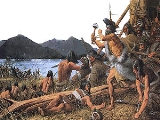
The Battle of Sitka was the last major armed conflict between Europeans and Alaska Natives
, and was initiated in response to the destruction of a Russian trading post two years prior. The primary combatant groups were the Kiks.ádi
(Frog/Raven) Clan of Sheet’-ká X'áat'l (Baranof Island
) of the Tlingit nation and agents of the Russian-American Company
assisted by the Imperial Russian Navy
. Though the Russians' initial assault (in which Alexandr Baranov
, head of the Russian expedition, sustained serious injuries) was repelled, their naval escorts bombarded the Tlingit fort Shis'kí Noow mercilessly, driving the natives into the surrounding forest after only a few days. The Russian victory was decisive, and resulted in the Sheet’-ká Kwáan being permanently displaced from their ancestral lands. They fled north and reestablished an old settlement on the neighboring Chichagof Island
to enforce a trade embargo
against the Russians.
Animosity between the two cultures, though greatly diminished, continued in the form of sporadic attacks by the natives against the Russian settlement as late as 1858. The battlefield location has been preserved at Sitka National Historical Park
. In September 2004, in recognition of the Battle's bicentennial, a direct descendant of Russian battle leader Baranov joined with descendants of the Kiks.ádi warriors for a traditional Tlingit "Cry Ceremony" to formally grieve for their lost ancestors.
, including Sheet’-ká X'áat'l (present-day Baranof Island), for some 11,000 years. Alexandr Baranov (Chief Manager of the Shelikhov-Golikov Company, a forerunner of the Russian-American Company) first visited the island aboard the Ekatarina in 1795 while searching for new sea otter
hunting grounds. Baranov paid the Tlingit a small sum for the rights to the land in order to prevent "interlopers" from conducting trade on the island.
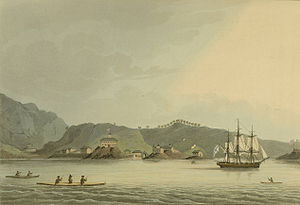
On May 25, 1799 Baranov and 100 employees of the Russian American Company (accompanied by their native wives) sailed into Sitka Sound
aboard the cutter Olga and sloop-of-war
Konstantin of the Imperial Russian Navy
; accompanying the Russian settlers was a fleet of some 550 baidarka
s, carrying 600–1,000 Aleut escorts. Wishing to avoid a confrontation with the Kiks.ádi, the group passed by the strategic hilltop encampment
where the Tlingit had established Noow Tlein ("Big Fort") and made landfall at their second-choice building site, some 7 miles (11 kilometers) north of the colony. The location of the Russian settlement at Katlianski Bay, "Redoubt Saint Michael," is known today as Starrigavan Bay, or "Old Harbor" (from Russian старая гавань) The outpost consisted of a large warehouse, blacksmith shop, cattle sheds, barracks
, stockade
, block house
, a bath house, quarters for the hunters, and a residence for Baranov.
 Though the Koloshi (the Russian name for the Tlingit, based on the Aleut name for the Tlingit) initially welcomed the newcomers, their animosity toward the Russians grew in relatively short order. The Kiks.ádi objected to the Russian traders' custom of taking native women as their wives, and were constantly taunted by other Tlingit clans
who looked upon the "Sitkas" as the outsiders' kalga, or slaves. The Kiks.ádi came to realize that the Russians' continued presence demanded their allegiance to the Tsar
, and that they therefore were expected to provide free labor to the Company. Competition between the two groups for the island's resources would escalate as well.
(then capital of Russian America
) in 1800. 25 Russians and 55 Aleuts, under the direction of Vasilii G. Medvednikov, were left to staff the post. In spring 1802, the population of Redoubt Saint Michael had grown to include 29 Russians, 3 British deserters, 200 Aleuts, and a few Kodiak women. It was rumored that the British (under the auspices of the Hudson's Bay Company
) staged a meeting with the northern Tlingit clans in Angoon
in 1801, wherein they offered muskets and gunpowder to the Tlingit in exchange for exclusive fur trading rights.
On June 20, 1802 a group of Tlingit warriors from along Kaasda Héen
and nearby Crab Apple Island, "painted like demons" and wearing animal masks carved out of wood, attacked the Russian fort. The natives were well-armed with spears and modern firearms (the latter acquired through trade with the British, French, Spanish, and Americans, whose ships frequented the waters of the Inside Passage
). Led by the chief Shk'awulyéil, the raiding party massacred all of the men (20 Russians and close to 130 Aleut workers), looted and burned the barracks and storehouses, destroyed a ship under construction, and enslaved the surviving women and children.
A few Russians and Aleuts who had been away from the post hunting, or who had fled into the forest, subsequently reached safety and relayed news of the attack to two foreign ships at anchor in the Sound. After brief negotiations, the Tlingit agreed to ransom a few of the survivors to the commander of the American ship Alert out of Boston. Captain James Barber
of the British ship Unicorn, also anchored nearby, lured Shk'awulyéil and several of his raiders aboard and placed them in the brig
, subsequently exchanging them for the remaining lone Russian and 18 Aleut captives (along with some 4,000 sea otter pelts that had been plundered during the raid).
The Unicorn then set sail for Kodiak, where it delivered the survivors and the news of the attack to Baranov on June 24. Barber extracted a ransom of 10,000 rubles
for the return of the colonists — a mere 20% of his initial demand.
Stoonookw (confident that the Russians would soon return, and in force) urged the Clan to construct a new fortification that was capable of withstanding cannon fire, and provided an ample water supply. Despite strong opposition, the Shaman's will prevailed, and the Kiks.ádi made preparations for war. The Sitkas sent messages to their allies requesting assistance, but none was forthcoming; they would face the Russian fleet on their own.
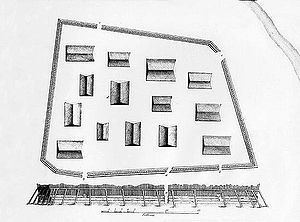
 The Tlingit chose to construct the roughly 240 feet by 165 feet (73 by 50 meters) Shis'kí Noow (the "Fort of Young Saplings") at the high water line near the mouth of the Indian River to take advantage of the long gravel beach flats that extend far out into the bay; it was hoped that the shallows would prevent the Russian ships from attacking the installation at close range. Some 1,000 native spruce
logs were used in the construction of 14 buildings (barabaras) and the thick palisade
wall that surrounded them. The Kiks.ádi battle plan was a simple one: they would gauge the Russians' strength and intentions at Noow Tlein, then strategically retreat to the perceived safety of the new fort. Baranov returned to Sitka Sound in late September, 1804 aboard the sloop-of-war
Neva under the command of Lieutenant Commander
Yuri Feodorovich Lisyansky. Neva was accompanied by the Ermak and two other smaller, armed sailing ship
s, manned by 150 promyshlenniks (fur traders), along with 400–500 Aleuts in 250 baidarkas.
In this engagement, fortune favored the Russians from the outset. On September 29, the Russians went ashore at the winter village. Lisyansky dubbed the site "Novo-Arkhangel'skaya
Mikhailovskaya" (or "New Archangel Saint Michael"), a reference to the largest city in the region where Governor Baranov was born. Baranov immediately sent forth envoys to the Tlingit settlement with offers of negotiation for the Noow Tlein site, all of which were rebuffed. The Tlingit merely hoped to stall the Russians long enough to allow the natives to abandon their winter village and occupy the "sapling fort" without the enemy fleet taking notice.
However, when the Kiks.ádi sent a small, armed party to retrieve their gunpowder reserves from an island in nearby Shaaseíyí Aan (Jamestown Bay), the group (electing not to wait for the cover of darkness, instead returning in broad daylight) was spotted and engaged in brief a firefight with the Russians. An errant round struck the canoe
in which the Tlingit were transporting the gunpowder, igniting the cargo and causing it to explode. When the smoke cleared, it was evident that none of the expedition, made up of upper-caste
young men from each house (all future Clan leaders) and a highly-respected elder, survived the encounter. Baranov's emissaries notified the Tlingit that the Russian ships would soon begin firing on the new fort.
, assaulted the Tlingit compound, only to be met by continuous volleys of gunfire. The Aleuts panicked and broke ranks, retreating to the shore where their baidarkas waited.
The Kiks.ádi warriors, led by their new War Chief K'alyaan (Katlian) — wearing a Raven mask and armed with a blacksmith's hammer, surged out of Shis'kí Noow and engaged the attacking force in hand-to-hand combat; a second wave of Tlingit emerged from the adjacent woods in a "pincer
" maneuver. Baranov was seriously injured and the Russians fell back to the water's edge, just as the Neva opened fire to cover the retreat. Twelve of the attackers were killed and many others injured during the melee, and the Russians were forced to abandon several small artillery pieces on the beach.
That night, the Tlingit rejoiced at having repulsed the Russian onslaught.
 Inasmuch as Baranov’s battlefield wounds prevented him from continuing the battle, Lieutenant Commander Lisyansky assumed command, ordering his ships to begin shore bombardment
of the Tlingit position. The initial barrage
consisted mainly of "ranging shots" as the vessels attempted to determine the optimum firing range. Unable to breach the fort's walls, the Russians ceased fire in the early afternoon and sent a messenger ashore under a flag of truce.
Much to the Kiks.ádi's amusement, the message demanded their surrender, which they rejected out of hand. The Tlingit replied with their own demand that the Russians surrender, which was also rejected. The Russian cannon fire resumed until nightfall. After dark, the Kiks.ádi met to consider their situation. They all believed that the Russians suffered too many losses the day before to mount another ground attack. The Tlingit's goal had been to hold out long enough to allow the northern clans to arrive and reinforce their numbers, but the shortage of gunpowder limited their ability to remain under siege
, a factor that
made ultimate victory seem less likely. The Tlingit concluded that a change in tactics was in order: rather than suffer the ignominy of defeat on the battlefield, they formulated a strategy wherein the Clan would disappear into the surrounding forest (where they felt that the Russians could not engage them) and establish a new settlement on the northern part of the island.
The Tlingit then departed undetected under the cover of darkness.
," that the Russians landed a large contingent of troops to secure the beachhead and to reconnoiter the area in and around Shis'kí Noow. To their great surprise, none of the natives were to be found (unbeknownst to the Russians, the Tlingit had embarked on what is now referred to as the "Sitka Kiks.ádi Survival March").
On October 8, Captain Lisianski visited the abandoned Tlingit fortification and recorded his impressions of what he saw as follows:
The fort was razed to preclude the possibility of its being used as a stronghold against the Russians and their allies ever again. Neva sailed out of Sitka Sound on November 10.
eggs, a traditional native food). From there, the group's exact path across the mountains north to Cháatl Káa Noow (the Kiks.ádi "Halibut Fort" at Point Craven in the Peril Strait
) is a matter of some conjecture. However, a coastal route around the bays of northwest Baranof Island appears to be the most likely course as it would have allowed the travelers to circumvent the Island's dense forests, based on significant firsthand research into the event conducted by Herb and Frank Hope of the Sheet'ká Kwáan — Sitka Tribe of Alaska
. Canoes fashioned out of red cedar
trunks facilitated the ocean crossing to Chichagof Island
.
Several warriors remained in the vicinity of Noow Tlein after the Battle as a sort of rear guard, in order to both harass the Russian settlers and to prevent them from pursuing the Kiks.ádi during their flight north. Shortly thereafter, eight Aleut trappers were killed in Jamestown Bay and another was shot in the woods adjacent to New Archangel. From that point forward, Russian hunting parties went out in force, ever alert to the possibility of attack. The Kiks.ádi encouraged other Tlingit clans to avoid contact with the Russians by any means possible.
' ) of their own, consisting of a high wooden palisade with three watchtower
s (armed with 32 cannon) for defense against Tlingit attacks. By the summer of 1805, a total of 8 buildings had been erected inside the compound, including workshops, barracks, and the Governor's Residence. Aside from their annual expeditions to "Herring Rock" near the mouth of the Indian River, the Kiks.ádi by-and-large steered clear of the ever-expanding settlement until 1821, when the Russians (who intended to profit from the natives' hunting prowess, and to put an end to the sporadic attacks on the village) invited the Tlingit to return to Sitka, which was designated as the new capital of Russian America
in 1808.
.jpg) The Tlingit who chose to return were allowed to reside in a part of the village just below the heavily-guarded stockade on "Blockhouse Hill" (an area known as the Ranche until around 1965). Russian cannon were constantly trained on the natives as a reminder of their defeat at Shis'kí Noow. The Kiks.ádi supplied the Russians with food (including corn, or maize
The Tlingit who chose to return were allowed to reside in a part of the village just below the heavily-guarded stockade on "Blockhouse Hill" (an area known as the Ranche until around 1965). Russian cannon were constantly trained on the natives as a reminder of their defeat at Shis'kí Noow. The Kiks.ádi supplied the Russians with food (including corn, or maize
, which the settlers taught them how to cultivate) and otter pelts, while the colonists introduced the Tlingit to the various aspects of Russian culture and the Russian Orthodox Church
. Occasional acts of Tlingit aggression continued until 1858, with one significant uprising (though quickly quelled) occurring in 1855. After Russian America was sold to the U.S. in 1867, all of the holdings of the Russian–American Company were liquidated. Following the transfer, many elders of the local Tlingit tribe maintained that "Castle Hill" comprised the only land that Russia was entitled to sell. Native land claims were not addressed until the latter half of the 20th century, with the signing of the Alaska Native Claims Settlement Act.
The 1880 census
reported a population of 43 Tlingit living in and around the Indian River, the Kiks.ádi's traditional summer fishing camp.
set aside the Shis'kí Noow site for public use in 1890. Sitka National Historical Park
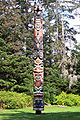
was established on the battle site on October 18, 1972 "...to commemorate the Tlingit and Russian experiences in Alaska." Today, the K'alyaan Pole
stands guard over the Shis'kí Noow site to honor the Tlingit casualties. Ta Éetl, a memorial to the Russian sailors who died in the Battle, is located across the Indian River at site of the Russians' landing. In September 2004, in observance of the Battle's bicentennial, descendants of the combatants from both sides joined in a traditional Tlingit "Cry Ceremony" to formally grieve their lost ancestors. The next day, the Kiks.ádi hosted a formal reconciliation ceremony to "put away" their two centuries of grief.
Alaska Natives
Alaska Natives are the indigenous peoples of Alaska. They include: Aleut, Inuit, Tlingit, Haida, Tsimshian, Eyak, and a number of Northern Athabaskan cultures.-History:In 1912 the Alaska Native Brotherhood was founded...
, and was initiated in response to the destruction of a Russian trading post two years prior. The primary combatant groups were the Kiks.ádi
Tlingit clans
The Tlingit clans of Southeast Alaska, in the United States, are one of the indigenous cultures within Alaska. The Tlingit people also live in the Northwest Interior of British Columbia, Canada, and in the southern Yukon Territory...
(Frog/Raven) Clan of Sheet’-ká X'áat'l (Baranof Island
Baranof Island
Baranof Island, also sometimes called Baranov Island, Shee or Sitka Island, is an island in the northern Alexander Archipelago in the Alaska Panhandle, in Alaska. The name Baranof was given in 1805 by Imperial Russian Navy captain U. F. Lisianski to honor Alexander Andreyevich Baranov...
) of the Tlingit nation and agents of the Russian-American Company
Russian-American Company
The Russian-American Company was a state-sponsored chartered company formed largely on the basis of the so-called Shelekhov-Golikov Company of Grigory Shelekhov and Ivan Larionovich Golikov The Russian-American Company (officially: Under His Imperial Majesty's Highest Protection (patronage)...
assisted by the Imperial Russian Navy
Imperial Russian Navy
The Imperial Russian Navy refers to the Tsarist fleets prior to the February Revolution.-First Romanovs:Under Tsar Mikhail Feodorovich, construction of the first three-masted ship, actually built within Russia, was completed in 1636. It was built in Balakhna by Danish shipbuilders from Holstein...
. Though the Russians' initial assault (in which Alexandr Baranov
Alexandr Baranov
Alexander Andreyevich Baranov , sometimes spelled Aleksander or Alexandr and Baranof, was born in 1746 in Kargopol, in St. Petersburg Governorate of the Russian Empire....
, head of the Russian expedition, sustained serious injuries) was repelled, their naval escorts bombarded the Tlingit fort Shis'kí Noow mercilessly, driving the natives into the surrounding forest after only a few days. The Russian victory was decisive, and resulted in the Sheet’-ká Kwáan being permanently displaced from their ancestral lands. They fled north and reestablished an old settlement on the neighboring Chichagof Island
Chichagof Island
Chichagof Island, or Shee Kaax, is an island in the Alexander Archipelago of the Alaska Panhandle. At long and wide, it has a land area of , making it the fifth largest island in the United States and the 109th largest island in the world. It's coastline measures 742 miles. There was a 2000...
to enforce a trade embargo
Embargo
An embargo is the partial or complete prohibition of commerce and trade with a particular country, in order to isolate it. Embargoes are considered strong diplomatic measures imposed in an effort, by the imposing country, to elicit a given national-interest result from the country on which it is...
against the Russians.
Animosity between the two cultures, though greatly diminished, continued in the form of sporadic attacks by the natives against the Russian settlement as late as 1858. The battlefield location has been preserved at Sitka National Historical Park
Sitka National Historical Park
Located approximately one–half mile from the Park, the Russian Bishop's House was constructed out of native spruce in 1842 by Finnish carpenters. It is one of only four surviving examples of Russian Colonial Style architecture in the Western Hemisphere...
. In September 2004, in recognition of the Battle's bicentennial, a direct descendant of Russian battle leader Baranov joined with descendants of the Kiks.ádi warriors for a traditional Tlingit "Cry Ceremony" to formally grieve for their lost ancestors.
Previous colonization and resistance
Members of the Kiks.ádi of the indigenous Tlingit people had occupied portions of the Alaska PanhandleAlaska Panhandle
Southeast Alaska, sometimes referred to as the Alaska Panhandle, is the southeastern portion of the U.S. state of Alaska, which lies west of the northern half of the Canadian province of British Columbia. The majority of Southeast Alaska's area is part of the Tongass National Forest, the United...
, including Sheet’-ká X'áat'l (present-day Baranof Island), for some 11,000 years. Alexandr Baranov (Chief Manager of the Shelikhov-Golikov Company, a forerunner of the Russian-American Company) first visited the island aboard the Ekatarina in 1795 while searching for new sea otter
Sea Otter
The sea otter is a marine mammal native to the coasts of the northern and eastern North Pacific Ocean. Adult sea otters typically weigh between 14 and 45 kg , making them the heaviest members of the weasel family, but among the smallest marine mammals...
hunting grounds. Baranov paid the Tlingit a small sum for the rights to the land in order to prevent "interlopers" from conducting trade on the island.
On May 25, 1799 Baranov and 100 employees of the Russian American Company (accompanied by their native wives) sailed into Sitka Sound
Sitka Sound
Sitka Sound is a body of water near the city of Sitka, Alaska. It is bordered by Baranof Island to the south and the northeast, by Kruzof Island to the northwest and by the Pacific Ocean to the southwest...
aboard the cutter Olga and sloop-of-war
Sloop-of-war
In the 18th and most of the 19th centuries, a sloop-of-war was a warship with a single gun deck that carried up to eighteen guns. As the rating system covered all vessels with 20 guns and above, this meant that the term sloop-of-war actually encompassed all the unrated combat vessels including the...
Konstantin of the Imperial Russian Navy
Imperial Russian Navy
The Imperial Russian Navy refers to the Tsarist fleets prior to the February Revolution.-First Romanovs:Under Tsar Mikhail Feodorovich, construction of the first three-masted ship, actually built within Russia, was completed in 1636. It was built in Balakhna by Danish shipbuilders from Holstein...
; accompanying the Russian settlers was a fleet of some 550 baidarka
Baidarka
Baidarka is the Russian name used for Aleutian style sea kayak. The ancient Unangan name is Iqyax. The word has its origins from early Russian settlers in Alaska. Iqya-x builders who kept the tradition of building skin-on-skeleton boats alive in the 20th century include Sergie Sovoroff.A prominent...
s, carrying 600–1,000 Aleut escorts. Wishing to avoid a confrontation with the Kiks.ádi, the group passed by the strategic hilltop encampment
Castle Hill (Sitka, Alaska)
Castle Hill or Noow Tlein, in Sitka, Alaska, is a National Historic Landmark and the historical site of Tlingit and Russian forts.Castle Hill is the area of land understood by the Tlingit people to be ceded to the Russian government following the battle of 1804...
where the Tlingit had established Noow Tlein ("Big Fort") and made landfall at their second-choice building site, some 7 miles (11 kilometers) north of the colony. The location of the Russian settlement at Katlianski Bay, "Redoubt Saint Michael," is known today as Starrigavan Bay, or "Old Harbor" (from Russian старая гавань) The outpost consisted of a large warehouse, blacksmith shop, cattle sheds, barracks
Barracks
Barracks are specialised buildings for permanent military accommodation; the word may apply to separate housing blocks or to complete complexes. Their main object is to separate soldiers from the civilian population and reinforce discipline, training and esprit de corps. They were sometimes called...
, stockade
Stockade
A stockade is an enclosure of palisades and tall walls made of logs placed side by side vertically with the tops sharpened to provide security.-Stockade as a security fence:...
, block house
Watchtower
A watchtower is a type of fortification used in many parts of the world. It differs from a regular tower in that its primary use is military, and from a turret in that it is usually a freestanding structure. Its main purpose is to provide a high, safe place from which a sentinel or guard may...
, a bath house, quarters for the hunters, and a residence for Baranov.
Tlingit clans
The Tlingit clans of Southeast Alaska, in the United States, are one of the indigenous cultures within Alaska. The Tlingit people also live in the Northwest Interior of British Columbia, Canada, and in the southern Yukon Territory...
who looked upon the "Sitkas" as the outsiders' kalga, or slaves. The Kiks.ádi came to realize that the Russians' continued presence demanded their allegiance to the Tsar
Tsar
Tsar is a title used to designate certain European Slavic monarchs or supreme rulers. As a system of government in the Tsardom of Russia and Russian Empire, it is known as Tsarist autocracy, or Tsarism...
, and that they therefore were expected to provide free labor to the Company. Competition between the two groups for the island's resources would escalate as well.
1802 battle
Despite a number of unsuccessful Tlingit attacks against the post during the winter of 1799, business soon prospered. Urgent matters required that Baranov return to KodiakKodiak, Alaska
Kodiak is one of 7 communities and the main city on Kodiak Island, Kodiak Island Borough, in the U.S. state of Alaska. All commercial transportation between the entire island and the outside world goes through this city either via ferryboat or airline...
(then capital of Russian America
Russian colonization of the Americas
The Russian colonization of the Americas covers the period, from 1732 to 1867, when the Tsarist Imperial Russian Empire laid claim to northern Pacific Coast territories in the Americas...
) in 1800. 25 Russians and 55 Aleuts, under the direction of Vasilii G. Medvednikov, were left to staff the post. In spring 1802, the population of Redoubt Saint Michael had grown to include 29 Russians, 3 British deserters, 200 Aleuts, and a few Kodiak women. It was rumored that the British (under the auspices of the Hudson's Bay Company
Hudson's Bay Company
The Hudson's Bay Company , abbreviated HBC, or "The Bay" is the oldest commercial corporation in North America and one of the oldest in the world. A fur trading business for much of its existence, today Hudson's Bay Company owns and operates retail stores throughout Canada...
) staged a meeting with the northern Tlingit clans in Angoon
Angoon, Alaska
Angoon is a city on Admiralty Island in Hoonah-Angoon Census Area, Alaska, United States. At the 2000 census the population was 572, by the 2010 census the population had declined to 459...
in 1801, wherein they offered muskets and gunpowder to the Tlingit in exchange for exclusive fur trading rights.
On June 20, 1802 a group of Tlingit warriors from along Kaasda Héen
Indian River (Alaska)
Indian River or Kaasda Héen, as known by the local Tlingit, is a roughly eight-mile long watershed that flows through the community of Sitka on Baranof Island in the Alexander Archipelago of Southeast Alaska....
and nearby Crab Apple Island, "painted like demons" and wearing animal masks carved out of wood, attacked the Russian fort. The natives were well-armed with spears and modern firearms (the latter acquired through trade with the British, French, Spanish, and Americans, whose ships frequented the waters of the Inside Passage
Inside Passage
The Inside Passage is a coastal route for oceangoing vessels along a network of passages which weave through the islands on the Pacific coast of North America. The route extends from southeastern Alaska, in the United States, through western British Columbia, in Canada, to northwestern Washington...
). Led by the chief Shk'awulyéil, the raiding party massacred all of the men (20 Russians and close to 130 Aleut workers), looted and burned the barracks and storehouses, destroyed a ship under construction, and enslaved the surviving women and children.
A few Russians and Aleuts who had been away from the post hunting, or who had fled into the forest, subsequently reached safety and relayed news of the attack to two foreign ships at anchor in the Sound. After brief negotiations, the Tlingit agreed to ransom a few of the survivors to the commander of the American ship Alert out of Boston. Captain James Barber
James Barber
James Barber was a Canadian cookbook author and host of Urban Peasant, a CBC cooking show.Born in the United Kingdom, Barber worked as an engineer before becoming a food critic for the Vancouver Sun. His lifelong interest in food and writing and his increased knowledge in these areas naturally led...
of the British ship Unicorn, also anchored nearby, lured Shk'awulyéil and several of his raiders aboard and placed them in the brig
Brig
A brig is a sailing vessel with two square-rigged masts. During the Age of Sail, brigs were seen as fast and manoeuvrable and were used as both naval warships and merchant vessels. They were especially popular in the 18th and early 19th centuries...
, subsequently exchanging them for the remaining lone Russian and 18 Aleut captives (along with some 4,000 sea otter pelts that had been plundered during the raid).
The Unicorn then set sail for Kodiak, where it delivered the survivors and the news of the attack to Baranov on June 24. Barber extracted a ransom of 10,000 rubles
Russian ruble
The ruble or rouble is the currency of the Russian Federation and the two partially recognized republics of Abkhazia and South Ossetia. Formerly, the ruble was also the currency of the Russian Empire and the Soviet Union prior to their breakups. Belarus and Transnistria also use currencies with...
for the return of the colonists — a mere 20% of his initial demand.
Russian reprisal
Following the Kiks.ádi victory, Tlingit ShamanShamanism
Shamanism is an anthropological term referencing a range of beliefs and practices regarding communication with the spiritual world. To quote Eliade: "A first definition of this complex phenomenon, and perhaps the least hazardous, will be: shamanism = technique of ecstasy." Shamanism encompasses the...
Stoonookw (confident that the Russians would soon return, and in force) urged the Clan to construct a new fortification that was capable of withstanding cannon fire, and provided an ample water supply. Despite strong opposition, the Shaman's will prevailed, and the Kiks.ádi made preparations for war. The Sitkas sent messages to their allies requesting assistance, but none was forthcoming; they would face the Russian fleet on their own.
Sitka Spruce
Picea sitchensis, the Sitka Spruce, is a large coniferous evergreen tree growing to 50–70 m tall, exceptionally to 95 m tall, and with a trunk diameter of up to 5 m, exceptionally to 6–7 m diameter...
logs were used in the construction of 14 buildings (barabaras) and the thick palisade
Palisade
A palisade is a steel or wooden fence or wall of variable height, usually used as a defensive structure.- Typical construction :Typical construction consisted of small or mid sized tree trunks aligned vertically, with no spacing in between. The trunks were sharpened or pointed at the top, and were...
wall that surrounded them. The Kiks.ádi battle plan was a simple one: they would gauge the Russians' strength and intentions at Noow Tlein, then strategically retreat to the perceived safety of the new fort. Baranov returned to Sitka Sound in late September, 1804 aboard the sloop-of-war
Sloop-of-war
In the 18th and most of the 19th centuries, a sloop-of-war was a warship with a single gun deck that carried up to eighteen guns. As the rating system covered all vessels with 20 guns and above, this meant that the term sloop-of-war actually encompassed all the unrated combat vessels including the...
Neva under the command of Lieutenant Commander
Lieutenant Commander
Lieutenant Commander is a commissioned officer rank in many navies. The rank is superior to a lieutenant and subordinate to a commander...
Yuri Feodorovich Lisyansky. Neva was accompanied by the Ermak and two other smaller, armed sailing ship
Sailing ship
The term sailing ship is now used to refer to any large wind-powered vessel. In technical terms, a ship was a sailing vessel with a specific rig of at least three masts, square rigged on all of them, making the sailing adjective redundant. In popular usage "ship" became associated with all large...
s, manned by 150 promyshlenniks (fur traders), along with 400–500 Aleuts in 250 baidarkas.
In this engagement, fortune favored the Russians from the outset. On September 29, the Russians went ashore at the winter village. Lisyansky dubbed the site "Novo-Arkhangel'skaya
Arkhangelsk
Arkhangelsk , formerly known as Archangel in English, is a city and the administrative center of Arkhangelsk Oblast, Russia. It lies on both banks of the Northern Dvina River near its exit into the White Sea in the north of European Russia. The city spreads for over along the banks of the river...
Mikhailovskaya" (or "New Archangel Saint Michael"), a reference to the largest city in the region where Governor Baranov was born. Baranov immediately sent forth envoys to the Tlingit settlement with offers of negotiation for the Noow Tlein site, all of which were rebuffed. The Tlingit merely hoped to stall the Russians long enough to allow the natives to abandon their winter village and occupy the "sapling fort" without the enemy fleet taking notice.
However, when the Kiks.ádi sent a small, armed party to retrieve their gunpowder reserves from an island in nearby Shaaseíyí Aan (Jamestown Bay), the group (electing not to wait for the cover of darkness, instead returning in broad daylight) was spotted and engaged in brief a firefight with the Russians. An errant round struck the canoe
Canoe
A canoe or Canadian canoe is a small narrow boat, typically human-powered, though it may also be powered by sails or small electric or gas motors. Canoes are usually pointed at both bow and stern and are normally open on top, but can be decked over A canoe (North American English) or Canadian...
in which the Tlingit were transporting the gunpowder, igniting the cargo and causing it to explode. When the smoke cleared, it was evident that none of the expedition, made up of upper-caste
Caste
Caste is an elaborate and complex social system that combines elements of endogamy, occupation, culture, social class, tribal affiliation and political power. It should not be confused with race or social class, e.g. members of different castes in one society may belong to the same race, as in India...
young men from each house (all future Clan leaders) and a highly-respected elder, survived the encounter. Baranov's emissaries notified the Tlingit that the Russian ships would soon begin firing on the new fort.
Day One
On or about October 1, the Neva was towed by the Aleut from Krestof Sound into the shoals near the mouth of the Indian River. A Russian landing party, led by Baranov and accompanied by 400 Aleuts acting as light infantryLight infantry
Traditionally light infantry were soldiers whose job was to provide a skirmishing screen ahead of the main body of infantry, harassing and delaying the enemy advance. Light infantry was distinct from medium, heavy or line infantry. Heavy infantry were dedicated primarily to fighting in tight...
, assaulted the Tlingit compound, only to be met by continuous volleys of gunfire. The Aleuts panicked and broke ranks, retreating to the shore where their baidarkas waited.
The Kiks.ádi warriors, led by their new War Chief K'alyaan (Katlian) — wearing a Raven mask and armed with a blacksmith's hammer, surged out of Shis'kí Noow and engaged the attacking force in hand-to-hand combat; a second wave of Tlingit emerged from the adjacent woods in a "pincer
Pincer
Pincer may refer to:*Pincer *Pincer , part of an animal*Pincer ligand, a terdentate, often planar molecule that tightly binds a variety of metal ions.*Pingas...
" maneuver. Baranov was seriously injured and the Russians fell back to the water's edge, just as the Neva opened fire to cover the retreat. Twelve of the attackers were killed and many others injured during the melee, and the Russians were forced to abandon several small artillery pieces on the beach.
That night, the Tlingit rejoiced at having repulsed the Russian onslaught.
Day Two
Bombardment
A bombardment is an attack by artillery fire directed against fortifications, troops or towns and buildings.Prior to World War I the term term was only applied to the bombardment of defenceless or undefended objects, houses, public buildings, it was only loosely employed to describe artillery...
of the Tlingit position. The initial barrage
Barrage
Barrage may refer to:In music* Barrage , a Canadian violin ensemble, or* Barrage , their self-titled debut albumIn engineering...
consisted mainly of "ranging shots" as the vessels attempted to determine the optimum firing range. Unable to breach the fort's walls, the Russians ceased fire in the early afternoon and sent a messenger ashore under a flag of truce.
- It was constructed of wood, so thick and strong, that the shot from my guns could not penetrate it at the short distance of a cable's lengthCable lengthA cable length or cable's length is a nautical unit of measure equal to one tenth of a nautical mile or 100 fathoms, or sometimes 120 fathoms. The unit is named after the length of a ship's anchor cable in the age of sail...
— from the log of Yuri Lisyansky, Captain of the Neva.
Much to the Kiks.ádi's amusement, the message demanded their surrender, which they rejected out of hand. The Tlingit replied with their own demand that the Russians surrender, which was also rejected. The Russian cannon fire resumed until nightfall. After dark, the Kiks.ádi met to consider their situation. They all believed that the Russians suffered too many losses the day before to mount another ground attack. The Tlingit's goal had been to hold out long enough to allow the northern clans to arrive and reinforce their numbers, but the shortage of gunpowder limited their ability to remain under siege
Siege
A siege is a military blockade of a city or fortress with the intent of conquering by attrition or assault. The term derives from sedere, Latin for "to sit". Generally speaking, siege warfare is a form of constant, low intensity conflict characterized by one party holding a strong, static...
, a factor that
made ultimate victory seem less likely. The Tlingit concluded that a change in tactics was in order: rather than suffer the ignominy of defeat on the battlefield, they formulated a strategy wherein the Clan would disappear into the surrounding forest (where they felt that the Russians could not engage them) and establish a new settlement on the northern part of the island.
Day Three
The Neva and her escorts resumed their day-long bombardment of the Tlingit fort at sunrise. The Kiks.ádi responded with offers of a truce, hostage exchanges, promises of more talks, and even the possibility of surrender. Unbeknownst to the Russians, the Clan's elderly and young children had already begun the trek to Gájaa Héen (Old Sitka). At nightfall, the House Chiefs met again to discuss their planned march across the island. Mothers with infant children were to depart in the morning.Day Four
The naval cannon fire began at daybreak, halting periodically to allow the Russians to extend offers of peace to the Kiks.ádi, which were in turn rejected. That afternoon, the Tlingits' response was that they had tired of battle, and would accede to the Russian demands to evacuate Shis'kí Noow the following day. Once the sun had set, the natives held their last gathering in the sapling fort. The elders offered praise for their clansmen who had defended the Kiks.ádi homeland against a formidable enemy. The Clan gathered together for a last song, one that ended with a loud drum roll and a wail of anguish (which the Russians interpreted as a sign of their surrender).The Tlingit then departed undetected under the cover of darkness.
Aftermath
It wasn't until October 7, days after the Kiks.ádi put forth their tragic "swan songSwan song
"Swan song" is a metaphorical phrase for a final gesture, effort, or performance given just before death or retirement. The phrase refers to an ancient belief that the Mute Swan is completely silent during its lifetime until the moment just before death, when it sings one beautiful song...
," that the Russians landed a large contingent of troops to secure the beachhead and to reconnoiter the area in and around Shis'kí Noow. To their great surprise, none of the natives were to be found (unbeknownst to the Russians, the Tlingit had embarked on what is now referred to as the "Sitka Kiks.ádi Survival March").
On October 8, Captain Lisianski visited the abandoned Tlingit fortification and recorded his impressions of what he saw as follows:
- Having come ashore, I observed the most barbaric sight that could bring even the most hardened heart to tremble and recoil. Assuming that we could trace them in the woods by the voices of infants and dogs, the Sitkans put them all to death...the entire set of circumstances led us to conclude that the fortress had contained no less than 800 persons of male gender.
The fort was razed to preclude the possibility of its being used as a stronghold against the Russians and their allies ever again. Neva sailed out of Sitka Sound on November 10.
"Sitka Kiks.ádi Survival March"
The first leg of the Tlingit's sojourn entailed a hike west from Gajaa Héen to Daxéit (the Clan's fishing camp at Nakwasina Sound, where each May the Kiks.ádi harvested herringHerring
Herring is an oily fish of the genus Clupea, found in the shallow, temperate waters of the North Pacific and the North Atlantic oceans, including the Baltic Sea. Three species of Clupea are recognized. The main taxa, the Atlantic herring and the Pacific herring may each be divided into subspecies...
eggs, a traditional native food). From there, the group's exact path across the mountains north to Cháatl Káa Noow (the Kiks.ádi "Halibut Fort" at Point Craven in the Peril Strait
Peril Strait
Peril Strait or Háat Ishkáak is a strait in the Alexander Archipelago in southeastern Alaska. It is between Chichagof Island to its north and Baranof Island and Catherine Island to its south. The strait is long and reaches from Salisbury Sound on the west to the Chatham Strait on the east...
) is a matter of some conjecture. However, a coastal route around the bays of northwest Baranof Island appears to be the most likely course as it would have allowed the travelers to circumvent the Island's dense forests, based on significant firsthand research into the event conducted by Herb and Frank Hope of the Sheet'ká Kwáan — Sitka Tribe of Alaska
Sitka Tribe of Alaska
The Sitka Tribe of Alaska is the federally recognized tribal government for more than 4,000 Alaska Natives living in or near Sitka in the U.S. state of Alaska. The tribal government was created through the passage of the Indian Reorganization Act of 1934. The Tlingit language name for the Sitka...
. Canoes fashioned out of red cedar
Thuja plicata
Thuja plicata, commonly called Western or pacific red cedar, giant or western arborvitae, giant cedar, or shinglewood, is a species of Thuja, an evergreen coniferous tree in the cypress family Cupressaceae native to western North America...
trunks facilitated the ocean crossing to Chichagof Island
Chichagof Island
Chichagof Island, or Shee Kaax, is an island in the Alexander Archipelago of the Alaska Panhandle. At long and wide, it has a land area of , making it the fifth largest island in the United States and the 109th largest island in the world. It's coastline measures 742 miles. There was a 2000...
.
Several warriors remained in the vicinity of Noow Tlein after the Battle as a sort of rear guard, in order to both harass the Russian settlers and to prevent them from pursuing the Kiks.ádi during their flight north. Shortly thereafter, eight Aleut trappers were killed in Jamestown Bay and another was shot in the woods adjacent to New Archangel. From that point forward, Russian hunting parties went out in force, ever alert to the possibility of attack. The Kiks.ádi encouraged other Tlingit clans to avoid contact with the Russians by any means possible.
Russian Alaska
Atop the kekoor (hill) at Noow Tlein, the Russians constructed a fortress (krepostWatchtower
A watchtower is a type of fortification used in many parts of the world. It differs from a regular tower in that its primary use is military, and from a turret in that it is usually a freestanding structure. Its main purpose is to provide a high, safe place from which a sentinel or guard may...
s (armed with 32 cannon) for defense against Tlingit attacks. By the summer of 1805, a total of 8 buildings had been erected inside the compound, including workshops, barracks, and the Governor's Residence. Aside from their annual expeditions to "Herring Rock" near the mouth of the Indian River, the Kiks.ádi by-and-large steered clear of the ever-expanding settlement until 1821, when the Russians (who intended to profit from the natives' hunting prowess, and to put an end to the sporadic attacks on the village) invited the Tlingit to return to Sitka, which was designated as the new capital of Russian America
Russian colonization of the Americas
The Russian colonization of the Americas covers the period, from 1732 to 1867, when the Tsarist Imperial Russian Empire laid claim to northern Pacific Coast territories in the Americas...
in 1808.
Maize
Maize known in many English-speaking countries as corn or mielie/mealie, is a grain domesticated by indigenous peoples in Mesoamerica in prehistoric times. The leafy stalk produces ears which contain seeds called kernels. Though technically a grain, maize kernels are used in cooking as a vegetable...
, which the settlers taught them how to cultivate) and otter pelts, while the colonists introduced the Tlingit to the various aspects of Russian culture and the Russian Orthodox Church
Russian Orthodox Church
The Russian Orthodox Church or, alternatively, the Moscow Patriarchate The ROC is often said to be the largest of the Eastern Orthodox churches in the world; including all the autocephalous churches under its umbrella, its adherents number over 150 million worldwide—about half of the 300 million...
. Occasional acts of Tlingit aggression continued until 1858, with one significant uprising (though quickly quelled) occurring in 1855. After Russian America was sold to the U.S. in 1867, all of the holdings of the Russian–American Company were liquidated. Following the transfer, many elders of the local Tlingit tribe maintained that "Castle Hill" comprised the only land that Russia was entitled to sell. Native land claims were not addressed until the latter half of the 20th century, with the signing of the Alaska Native Claims Settlement Act.
The 1880 census
Census
A census is the procedure of systematically acquiring and recording information about the members of a given population. It is a regularly occurring and official count of a particular population. The term is used mostly in connection with national population and housing censuses; other common...
reported a population of 43 Tlingit living in and around the Indian River, the Kiks.ádi's traditional summer fishing camp.
Tributes
U.S. President Benjamin HarrisonBenjamin Harrison
Benjamin Harrison was the 23rd President of the United States . Harrison, a grandson of President William Henry Harrison, was born in North Bend, Ohio, and moved to Indianapolis, Indiana at age 21, eventually becoming a prominent politician there...
set aside the Shis'kí Noow site for public use in 1890. Sitka National Historical Park
Sitka National Historical Park
Located approximately one–half mile from the Park, the Russian Bishop's House was constructed out of native spruce in 1842 by Finnish carpenters. It is one of only four surviving examples of Russian Colonial Style architecture in the Western Hemisphere...
was established on the battle site on October 18, 1972 "...to commemorate the Tlingit and Russian experiences in Alaska." Today, the K'alyaan Pole
Totem pole
Totem poles are monumental sculptures carved from large trees, mostly Western Red Cedar, by cultures of the indigenous peoples of the Pacific Northwest Coast of North America...
stands guard over the Shis'kí Noow site to honor the Tlingit casualties. Ta Éetl, a memorial to the Russian sailors who died in the Battle, is located across the Indian River at site of the Russians' landing. In September 2004, in observance of the Battle's bicentennial, descendants of the combatants from both sides joined in a traditional Tlingit "Cry Ceremony" to formally grieve their lost ancestors. The next day, the Kiks.ádi hosted a formal reconciliation ceremony to "put away" their two centuries of grief.
Historic designations
- National Register of Historic PlacesNational Register of Historic PlacesThe National Register of Historic Places is the United States government's official list of districts, sites, buildings, structures, and objects deemed worthy of preservation...
#NPS–66000162 — "Baranof Castle Hill" site - National Register of Historic Places #NPS–66000164 — "Battle of Sitka" site
- National Register of Historic Places #NPS–66000166 — Old Sitka ("Redoubt Saint Michael") site
See also
- Sitka City and Borough, AlaskaSitka City and Borough, AlaskaThe City and Borough of Sitka, originally called New Archangel under Russian Rule, is a unified city-borough located on Baranof Island and the southern half of Chichagof Island in the Alexander Archipelago of the Pacific Ocean , in the U.S...
- Sitka National Historical ParkSitka National Historical ParkLocated approximately one–half mile from the Park, the Russian Bishop's House was constructed out of native spruce in 1842 by Finnish carpenters. It is one of only four surviving examples of Russian Colonial Style architecture in the Western Hemisphere...
- List of conflicts in the United States
External links
- Sitka National Historic Park National Park ServiceNational Park ServiceThe National Park Service is the U.S. federal agency that manages all national parks, many national monuments, and other conservation and historical properties with various title designations...
official website - Glossary of Russian Terms
- Alex Andrews retelling the story of the Battle of 1804 in Tlingit dialect