

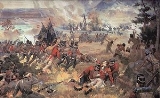
Battle of Queenston Heights

Encyclopedia
The Battle of Queenston Heights was the first major battle in the War of 1812
and resulted in a British
victory. It took place on 13 October 1812, near Queenston
, in the present-day province of Ontario
. It was fought between United States regulars and New York militia forces led by Major General Stephen Van Rensselaer
, and British forces and Canadian militia led by Major General Isaac Brock
, and Major General Roger Sheaffe, who took command when Brock was killed.
The battle, the largest in the war to that point, was fought as the result of an American attempt to establish a foothold on the Canadian side of the Niagara River
before campaigning ended with the onset of winter. This decisive battle was the result of a poorly managed American campaign, and may be most historically significant for the loss of the British commander.
Despite their numerical advantage and the wide dispersal of British forces against an invasion attempt, the Americans, who were stationed in Lewiston, New York
, were unable to get the bulk of their invasion force across the Niagara River due to the work of British artillery and reluctance on the part of the undertrained and inexperienced American militia. As a result, British reinforcements were able to arrive and force those Americans on the Canadian side to surrender.
's border strongpoints. From west to east, Brigadier General William Hull
would attack Amherstburg
through Detroit
, Major General Van Rensselaer would attack across the Niagara River
and another diversionary attack would cross the St. Lawrence River to take Kingston
. Major General Henry Dearborn
, the commander in chief of the United States Army, intended to make the major attack via Lake Champlain
to capture Montreal in Lower Canada
. These attacks would theoretically bring the colony to its knees and ensure a quick peace.
However, the main attacks on Upper Canada failed, or could not be launched. Hull was besieged in Detroit and, faced with the threat of a massacre by Britain's Native American
allies, surrendered the town and his entire army following the Siege of Detroit
. Dearborn and his army remained relatively inactive at Albany, New York
, and seemed to be in no hurry to attempt an invasion.
Van Rensselaer was also unable to launch any immediate attack, lacking troops and supplies. Although he held the rank of Major General in the New York state militia, Van Rensselaer had never commanded troops in battle, and was in fact considered the leading Federalist candidate for the governorship of New York
. Possibly hoping to get Van Rensselaer out of the way, New York Governor Daniel Tompkins had put Van Rensselaer's name forward to command the American army, and he officially took command on 13 July. Van Rensselaer did secure the appointment of his second cousin, Colonel Solomon Van Rensselaer
, as his aide-de-camp
. Solomon van Rensselaer was an experienced soldier (who had been wounded at the Battle of Fallen Timbers
in 1794), and a valuable source of advice to the General.
, was of a more cautious bent, and the two clashed over strategy.
Brock had hastened back from Detroit, intending to cross the Niagara, defeat Van Rensselaer before he could be reinforced and occupy upper New York State. Prevost vetoed this plan, ordering Brock to behave more defensively. Not only was Prevost concerned by Brock's apparently rash actions, but he was aware that the British Government had revoked several Orders in Council which affected American merchant ships, and thus removed some of the stated causes of the war. He believed that peace negotiations might result and did not wish to prejudice any talks by taking offensive action. He opened negotiations with General Dearborn, and negotiated local armistice
s. The United States government rejected Prevost's approach, and ordered Dearborn "to proceed with the utmost vigor in your operations", after giving Prevost notice of the resumption of hostilities. However, it took several weeks for this correspondence to travel between Washington and the frontier.
While Brock had been at Detroit, Major General Sheaffe had been in command of the troops on the Niagara. Acting under Prevost's orders, Sheaffe had concluded an armistice with Colonel Van Rensselaer on 20 August, and had even gone further than Prevost's orders by voluntarily restricting the movement of British troops and supplies. Brock returned to the Niagara on 22 August, to find the armistice in effect. The terms of the armistice permitted the use of the river by both powers as a common waterway and Brock could only watch as American reinforcements and supplies were moved to Van Rensselaer's army, without being able to take action to prevent it. The armistice ended on 8 September, by which time Van Rensselaer's army was considerably better supplied than it had been before.
The one aggressive action which Brock was able to take during the armistice was to facilitate the Siege of Fort Wayne
on the Maumee River
, which ended in a defeat of the Native attackers.
's force of 1,700 regular soldiers under his command. However, Smyth, who was a regular officer although originally a lawyer by trade, steadfastly refused to obey Van Rensselaer's orders or respond to his summons. As soon as his force reached the frontier, Smyth took it upon himself to deploy his force near Buffalo, New York
, at the head of the Niagara River.
Van Rensselaer laid a plan for the main force to cross the Niagara from Lewiston and take the heights near Queenston, while Smyth crossed the river near Fort Niagara
and attacked Fort George
from the rear. However, Smyth made no reply to Van Rensselaer's plan. When summoned to a council of officers in early October to plan the attack, Smyth did not respond, nor did he reply to a letter sent soon after. A direct order to arrive "with all possible dispatch" was also met with silence. Van Rensselaer, an amiable politician in a hurry to launch his attack, simply chose to proceed with the attack from Lewiston only, rather than bring Smyth before a court-martial
and possibly delay the start of the battle. His aim was to establish a fortified bridgehead around Queenston, where he could maintain his army in winter quarters while planning for a campaign in the spring. Over the previous few days, Colonel Van Rensselaer had been able to cross over to the British side under the escort of Brock's aide, Lieutenant-Colonel John Macdonell
, and had gained a fairly good idea of the lay of the land.
On 9 October, American sailors and marines under Lieutenant Jesse Elliot launched a successful boarding attack on two British brig
s near Fort Erie
at the head of the Niagara River and captured both (although one subsequently ran aground and was set on fire to prevent it being recaptured). Brock feared that this might presage an attack from Buffalo, and galloped to Fort Erie. Although he soon realised that there was no immediate danger from Smyth in Buffalo, and returned to his headquarters in Niagara
that night, it was mistakenly reported to Van Rensselaer that Brock had left in haste for Detroit, which Major General William Henry Harrison
was attempting to recover. Van Rensselaer decided to launch an attack at 3 a.m. on 11 October, even though Colonel Van Rensselaer was ill.
On 10 October, Van Rensselaer sent orders to Smyth to march his brigade to Lewiston in preparation for the attack "with every possible dispatch." Smyth set out upon receipt of the letter. However, he chose a bad route to Lewiston, in foul weather, on a road so bad that abandoned wagons could be seen "sticking in the road." The same tempestuous weather drenched Van Rensselaer's troops as they stood and waited to embark. One of the lead boatmen, a Lieutenant Sim, rowed his boat away and deserted the army, taking with him most of the oars. By the time the oars could be replaced, the attack had to be set back. General Van Rensselaer set the second attempt for 13 October.
Smyth received word that the attack had been postponed at 10 a.m. on 11 October. He then turned back to his camp at Black Rock, New York, near Buffalo, rather than press on to Lewiston. He wrote to Van Rensselaer on 12 October that his troops would be in condition to move out again on 14 October, a day after the postponed attack was to be launched.
at Fort George) crossed the Niagara River under a flag of truce to request an immediate exchange of prisoners taken in Elliot's raid on the British brigs three days before. He attempted to see Solomon Van Rensselaer, but was told that the Colonel was ill. Instead, he was met by a man who claimed to be General Stephen Van Rensselaer's secretary, Toock. Toock was probably Major John Lovett (Van Rensselaer's private military secretary) in disguise, and he repeatedly stated that no exchange could be arranged until "the day after tomorrow".
Evans was struck by the repetition of this phrase and was able to spot several boats hidden by the shore under some bushes. He deduced that a crossing was planned for 13 October, but on returning to the British lines he was met with laughter and mockery from a council of officers. However, Brock took Evans aside and after a meeting was convinced of the possibility. That evening he despatched several orders for the militia to assemble.
On 13 October, Brock was at his headquarters in Niagara. Major General Sheaffe was at Fort George
nearby with the main British force. There were other British detachments at Queenston, Chippawa, and Fort Erie.
The British detachment at Queenston consisted of the grenadier company of the 49th Regiment of Foot
(which Brock had formerly commanded) under Captain James Dennis, a flank company of the 2nd Regiment of York Militia
(the "York Volunteers") under Captain George Chisholm, and a detachment of the 41st Regiment of Foot
with a 3-pounder Grasshopper cannon
. The light company of the 49th under Captain John Williams was posted in huts on top of the heights. An 18-pounder gun and a mortar were mounted in a redan
halfway up the Heights, and a 24-pounder gun and a carronade were sited in a barbette at Vrooman's Point
, a mile north of the village, guarded by a company of the 5th Regiment of Lincoln Militia under Captain Samuel Hatt. Two more companies of York Militia under Captains Cameron and Heward were stationed at Brown's Point, three miles to the north. The remaining local militia of the 5th Lincoln Regiment were not on duty but could assemble at very short notice.
of the 13th U.S. Infantry
led the regulars.
The Americans began crossing the river in thirteen boats at 4 a.m. on 13 October. Three boats, including Chrystie's, were swept downstream by the current. One landed lower down and the other two under Chrystie returned to the American side of the river. Ten minutes after they began crossing, the remaining ten boats under Colonel Solomon van Rensselaer began landing at the village. A sentry noticed them and, rather than fire his musket to raise the alarm and thus warn the American troops that they had been spotted, ran to Dennis's headquarters. A few minutes later, Dennis's troops fired a volley into the Americans as they were still coming ashore. Colonel Van Rensselaer was hit by a musketball as soon as he stepped out of his boat on the Canadian shore. As he tried to form up his troops, he was promptly hit five more times, and though he survived, he spent most of the battle out of action, weak from loss of blood. Captain John E. Wool
of the 13th U.S. Infantry took over and fought to retain the American foothold in Queenston.
Meanwhile, the British guns opened fire in the direction of the American landing stage at Lewiston, and the American guns (two 18-pounder guns in an earthwork named "Fort Gray" on Lewiston Heights, two 6-pounder field guns and two 5.5 inches (139.7 mm) mortars near the landing stage) opened fire on Queenston village. Dennis's troops were driven back into the village but kept firing from the shelter of the houses.
As the light grew, the British guns became more accurate. As a second wave of six American boats began to cross the river, the crews of three of them, including their two largest, one of which was carrying Lieutenant-Colonel Chrystie, panicked as they came under fire. Chrystie's pilot turned the boat back for shore, despite Chrystie's efforts to restrain him. This later caused controversy when Captain Lawrence, commanding the next boat following, asserted that Chrystie had ordered him to retreat, leading to accusations of cowardice. One of the three remaining boats was sunk by a cannonball and another, carrying Lieutenant-Colonel John Fenwick (formerly the commandant at Fort Niagara), drifted downstream and was forced to land in Hamilton Cove, a hollow about 800 yards downriver, where British troops quickly surrounded Fenwick's men. Three men escaped in the boat, which sank on reaching the American side of the river. Fenwick was wounded in the face by a pistol shot and the other survivors of his party were forced to surrender. The last boat drifted within easy range of the gun at Vrooman's Point and surrendered.
The 18-pounder cannon and the howitzer in the redan were causing great carnage amongst the American boats. Since coming ashore an hour-and-a-half earlier, the U.S. forces had been pinned down along the river. Prompted by Lieutenant Gansevoort of the U.S. Artillery, who knew the area well, the wounded Colonel Solomon Van Rensselaer ordered Captains Wool and Ogilvie to take a detachment upstream "and ascend the heights by the point of the rock, and storm the battery". The Redan had very few troops guarding it, the light company of the 49th having been ordered from the heights into the town by Brock to join the fighting in the village in support of the grenadier company. Wool's troops attacked just after Brock had arrived, forcing his small party and the artillerymen to flee into the village, managing only to quickly spike the guns. Brock sent a message to Major General Sheaffe at Fort George, ordering him to bring as many troops as possible to Queenston. He then resolved to recapture the redan immediately rather than wait for reinforcements.
Brock's charge was made by Dennis' and Williams' two companies of the 49th and two companies of militia. The assault was halted by heavy fire and as he noticed unwounded men dropping to the rear, Brock shouted angrily that "This is the first time I have ever seen the 49th turn their backs! Surely the heroes of Egmont will not tarnish their record!" At this rebuke, the ranks promptly closed up and were joined by two more companies of militia, those of Cameron and Heward. Brock saw that the militia supports were lagging behind at the foot of the hill and ordered one of his Provincial aides-de-camp, Lieutenant Colonel John Macdonell
, to "Push on the York Volunteers" while he led his own party to the right, presumably intending to join his party with that of Williams' detachment who were beginning to make progress on that flank.
Brock was struck in the wrist of his sword arm by a musket ball but continued to press home the attack. His bright red coat with its gold epaulettes (and a gaudy sash given him by Tecumseh
) and his tall figure and energetic gestures made him a conspicuous target, and he was shot down by an unknown American who stepped forward from a thicket and fired at a range of barely fifty yards. Brock was struck in the chest, and died almost instantly.
Despite being a lawyer by trade with little military experience, Lieutenant-Colonel Macdonell led a second attempt to retake the redan, together with Williams. With Williams' men of the 49th starting from brush to the right of the line near the escarpment and Macdonell's anchoring the left, the force of between 70 and 80 men (more than half of whom were militia) advanced toward the redan. Wool had been reinforced by more troops who had just made their way up the path to the top of the Heights, and Macdonell faced some four hundred troops.
Despite the disadvantage in numbers as well as attacking a fixed position, Williams' and Macdonell's small force was driving the opposing force to the edge of the gorge on which the Redan was situated, and seemed on the verge of success before the Americans were able to regroup and stand firm. The momentum of the battle turned when a musket ball hit Macdonell's mount (causing it to rear and twist around) and another shot hit him in the small of the back, causing him to fall from the horse. He was removed from the battlefield but succumbed to his injuries early the next day. Captain Williams was laid low by a wound to the head, and Dennis by a severe wound to the thigh (although he continued to lead his detachment throughout the action). Carrying the bodies of Brock and Macdonell, the British fell back through Queenston to Durham's Farm a mile north near Vrooman's Point.
According to legend, Brock's last words were "Push on, brave York Volunteers", but this is very unlikely, since Brock was not with them when he fell. Moreover, the location of the wound (as seen on his coat, which is on display at the Canadian War Museum) suggests that Brock died almost instantly, without time to speak at all. According to historian J. Mackay Hitsman, Brock's earlier command to push on the York Volunteers, who had just arrived from Queenston, was transformed into the later legend.
Colonel Chrystie briefly took charge of the troops on the Canadian side but returned to Lewiston to collect reinforcements and entrenching tools. At about noon, General van Rensselaer and Chrystie crossed to the Canadian side of the river. They ordered the position on Queenston Heights to be fortified. Lieutenant Joseph Gilbert Totten
of the U.S. Engineers traced out the position of the proposed fortifications. Van Rensselaer appointed Lieutenant Colonel Winfield Scott
(who later became one of the most highly regarded generals in American history) to take command of the regulars on Queenston Heights. Brigadier General William Wadsworth, who was nominally present as a volunteer and who waived his right to overall command, took charge of the militia. There were few complete formed units; there was only a collection of unorganised detachments, some without their officers. Likewise some officers had crossed but their men had not followed them. Little more than a thousand of General Van Rensselaer's men had crossed the Niagara River.
Meanwhile, British reinforcements had begun to arrive from Fort George. A detachment of the Royal Artillery
(a "car brigade", with draught horses and drivers provided by Canadian farmers and militia) under Captain William Holcroft with two 6-pounder guns moved into Queenston village, supported by a company of the 41st under Captain Derenzy. Militia Captain Archibald Hamilton guided them to a firing position in the courtyard of his own house. When they opened fire at 1 p.m., it once again became hazardous for the American boats to attempt to cross the river. Two American boats and a scow were sunk, and shrapnel fire several times silenced the American batteries in Lewiston.
At the same time, 300 Mohawks
under Captains John Norton
and John Brant climbed up to the top of the heights and suddenly fell on Scott's outposts. None were killed, and the Mohawks were driven back into some woods, but the Americans' spirits were badly affected by their fear of the natives. Warcries could be clearly heard in Lewiston, and militia waiting there to cross the river refused to do so.
), with two 3-pounder guns, belonging to Swayze's Provincial Artillery (a militia unit) but commanded by Lieutenant Crowther of the 41st.
General Van Rensselaer determined at this point to re-cross to Lewiston to push forward reinforcements and munitions. Refugees and stragglers crowded into his boat and nearly capsized it. In Lewiston, he found that the troops had dissolved into a disorderly crowd and was unable to cajole any more of the militia into crossing the river. He then tried to induce the civilian boatmen to cross the river and retrieve his soldiers from Canada, but they refused even that. The General reported the next day that, "...to my utter astonishment, I found that at the very moment when complete victory was in our hands, the ardor of the unengaged troops had entirely subsided. I rode in all directions — urged men by every consideration to pass over — but in vain." He sent a message to Brigadier General Wadsworth which left the decision whether to stand and fight or withdraw across the Niagara to him, promising to send boats if the decision was made to withdraw.
As Sheaffe's force began their advance, Scott and Wadsworth received Van Rensselaer's message. At this point, according to Scott, the effective American force on the heights consisted of 125 regular infantry, 14 artillerymen and 296 militiamen. The Americans decided to abandon their incomplete field works and withdraw. Scott fell back to the top of the heights where he attempted to throw up a barricade of fence rails and brushwood to cover the evacuation with his regulars. He placed the 6-pounder gun in front of the line, and posted some riflemen on the right among the huts formerly occupied by the light company of the 49th.
Sheaffe took his time forming his men up and preparing them for battle and attacked at 4 p.m., twelve hours after Van Rensselaer launched his assault. The first attack was made by the light company of the 41st with 35 militia and some Indians against the riflemen on Scott's right. After firing a volley, they charged with the bayonet, forcing the riflemen to give way in confusion. Sheaffe immediately ordered a general advance, and the entire British line fired a volley, raised the Indian war-whoop and charged. The American militia, hearing war-cries from the Mohawks and believing themselves doomed, retreated en masse and without orders. Cursing the men who would not cross the river, General Wadsworth surrendered at the edge of the precipice with 300 men. Scott, Totten and some others scrambled down the steep bank to the edge of the river. With no boats arriving to evacuate his men and with the Mohawks furious over the deaths of two chiefs, Scott feared a massacre and surrendered to the British. Even so, the first two officers who tried to surrender were killed by Indians, and after Scott had personally waved a white flag (actually Totten's white cravat), excited Indians continued to fire from the heights into the crowd of Americans on the river bank below for several minutes.
Once the surrender was made, Scott was shocked to see five hundred U.S. militiamen, who had been hiding around the heights, emerging to surrender also.
.
The number of Americans killed in the battle has been variously estimated at 60, 90 and 100. 82 severely wounded Americans were evacuated across the Niagara before the surrender, of whom 2 soon died. 955 Americans were initially captured by the British, including 120 severely wounded officers and men. This was more than the hospital at Niagara could accommodate, so some of them had to be cared for in the court house or in nearby churches. These were only the men who were badly injured enough to require hospitalization: the numbers of the walking wounded, who were seen by the British surgeons and then kept with the other prisoners, have not been recorded. Of the severely wounded prisoners, 30 soon died, so by the time a full report on the prisoners was issued on 15 October, there were 19 officers and 417 enlisted men of the U.S. regulars and 54 officers and 435 other ranks of the New York Militia. The 80 surviving wounded in the American hospital and the 90 surviving wounded prisoners were presumably the basis for General Van Rensselaer's statement, in a letter to Dearborn on 20 October, that "the aggregate" of his information would indicate that 170 Americans had been wounded in the battle. This gives total American casualties of 60-100 killed, 80 wounded, 90 wounded prisoners and 835 other prisoners. 6 officers (4 regular and 2 militia) were among the killed; 11 officers (6 regular and 5 militia) were among the wounded who escaped capture and 8 officers (4 regular and 4 militia) were among the wounded prisoners. Those captured included Brigadier General William Wadsworth of the New York Militia, Lieutenant Colonel Scott and four other lieutenant-colonels. A 6-pounder gun and the colours of a New York Militia regiment were also captured.
but then bungled two attempts to cross the river near Fort Erie and drew the loathing of his soldiers. Universally castigated for his refusal to attack and with rumours of mutiny in the air, Smyth slipped away to his home in Virginia
rather than remain at his post.
At Albany, the defeat of Van Rensselaer only increased Henry Dearborn's reluctance to act. With two armies already defeated, Dearborn was not keen on leading the third. He led a half-hearted advance as far as Odelltown
, where his militia refused to proceed further. After his regulars were easily repulsed by the garrison of an outpost at Lacolle Mills
, Dearborn retired to American territory. (He would be replaced the following year with only minor successes to his credit).
The question of who was to blame for the defeat was one that was never resolved. Stephen Van Rensselaer's popularity remained high enough that he was able to make an (unsuccessful) attempt to unseat Daniel Tompkins as Governor of New York, and he later served in the United States House of Representatives
. General John Armstrong, Jr.
, the Secretary of War
for much of the war, pinned the blame on General Van Rensselaer in his Notices of the War of 1812. This provoked an indignant response from Solomon Van Rensselaer, who compared Armstrong to Benedict Arnold
and laid the blame squarely on Lieutenant-Colonel Chrystie, who he accused of cowardice and said "to his failure may mainly be attributed all our disasters."
The loss of General Brock was nevertheless a major blow to the British. Brock had inspired his own troops and the militia and civilian authorities in Upper Canada by his blustering confidence and activity. Sheaffe, his successor, received a baronetcy for his part in the victory but could not command the same respect. He was already known to many of the troops in Upper Canada as a harsh disciplinarian. His success where Brock had rashly sacrificed himself could not help him escape censure for not having followed up the victory at Queenston Heights with an attack on Fort Niagara (which had been left virtually evacuated by its garrison after a bombardment from British batteries that afternoon). The following April, he was defeated by a numerically superior American force at the Battle of York
. Although his decision to retreat with his few regulars was accepted by his superiors (and his American opponents) to be correct in military terms, it left the local militia, the Assembly of Upper Canada and the population of York feeling abandoned and aggrieved. He was relieved of his appointments in Upper Canada.
, the late Canadian folk singer Stan Rogers
immortalised one of Brock's aides-de-camp, John Macdonell, in the song MacDonnell on the Heights. He laments that despite Macdonell's courage, "not one in ten thousand knows your name".
The Battle of Queenston Heights is also mentioned in an unofficial Canadian national anthem, The Maple Leaf Forever
.
War of 1812
The War of 1812 was a military conflict fought between the forces of the United States of America and those of the British Empire. The Americans declared war in 1812 for several reasons, including trade restrictions because of Britain's ongoing war with France, impressment of American merchant...
and resulted in a British
United Kingdom of Great Britain and Ireland
The United Kingdom of Great Britain and Ireland was the formal name of the United Kingdom during the period when what is now the Republic of Ireland formed a part of it....
victory. It took place on 13 October 1812, near Queenston
Queenston, Ontario
Queenston is located 5 km north of Niagara Falls, Ontario in the Town of Niagara-on-the-Lake. The community is bordered by Highway 405 and the Niagara River; its location on the Niagara Escarpment led to the establishment of the now-defunct Queenston Quarry in the area...
, in the present-day province of Ontario
Ontario
Ontario is a province of Canada, located in east-central Canada. It is Canada's most populous province and second largest in total area. It is home to the nation's most populous city, Toronto, and the nation's capital, Ottawa....
. It was fought between United States regulars and New York militia forces led by Major General Stephen Van Rensselaer
Stephen Van Rensselaer III
Stephen Van Rensselaer III was Lieutenant Governor of New York as well as a statesman, soldier, and land-owner, the heir to one of the largest estates in the New York region at the time, which made him the tenth richest American of all time, based on the ratio of his fortune to contemporary GDP...
, and British forces and Canadian militia led by Major General Isaac Brock
Isaac Brock
Major-General Sir Isaac Brock KB was a British Army officer and administrator. Brock was assigned to Canada in 1802. Despite facing desertions and near-mutinies, he commanded his regiment in Upper Canada successfully for many years...
, and Major General Roger Sheaffe, who took command when Brock was killed.
The battle, the largest in the war to that point, was fought as the result of an American attempt to establish a foothold on the Canadian side of the Niagara River
Niagara River
The Niagara River flows north from Lake Erie to Lake Ontario. It forms part of the border between the Province of Ontario in Canada and New York State in the United States. There are differing theories as to the origin of the name of the river...
before campaigning ended with the onset of winter. This decisive battle was the result of a poorly managed American campaign, and may be most historically significant for the loss of the British commander.
Despite their numerical advantage and the wide dispersal of British forces against an invasion attempt, the Americans, who were stationed in Lewiston, New York
Lewiston, New York
Lewiston is a village in Niagara County, New York, United States. The population was 2,781 at the 2000 census. The village is named after Morgan Lewis, an early 19th-century governor of New York. It is part of the Buffalo–Niagara Falls Metropolitan Statistical Area.The Village of Lewiston,...
, were unable to get the bulk of their invasion force across the Niagara River due to the work of British artillery and reluctance on the part of the undertrained and inexperienced American militia. As a result, British reinforcements were able to arrive and force those Americans on the Canadian side to surrender.
Background
The United States invasion across the Niagara River was originally intended to be part of a four-pronged attack on Upper CanadaUpper Canada
The Province of Upper Canada was a political division in British Canada established in 1791 by the British Empire to govern the central third of the lands in British North America and to accommodate Loyalist refugees from the United States of America after the American Revolution...
's border strongpoints. From west to east, Brigadier General William Hull
William Hull
William Hull was an American soldier and politician. He fought in the American Revolution, was Governor of Michigan Territory, and was a general in the War of 1812, for which he is best remembered for surrendering Fort Detroit to the British.- Early life and Revolutionary War :He was born in...
would attack Amherstburg
Amherstburg, Ontario
Amherstburg is a Canadian town near the mouth of the Detroit River in Essex County, Ontario. It is approximately south of the U.S...
through Detroit
Detroit, Michigan
Detroit is the major city among the primary cultural, financial, and transportation centers in the Metro Detroit area, a region of 5.2 million people. As the seat of Wayne County, the city of Detroit is the largest city in the U.S. state of Michigan and serves as a major port on the Detroit River...
, Major General Van Rensselaer would attack across the Niagara River
Niagara River
The Niagara River flows north from Lake Erie to Lake Ontario. It forms part of the border between the Province of Ontario in Canada and New York State in the United States. There are differing theories as to the origin of the name of the river...
and another diversionary attack would cross the St. Lawrence River to take Kingston
Kingston, Ontario
Kingston, Ontario is a Canadian city located in Eastern Ontario where the St. Lawrence River flows out of Lake Ontario. Originally a First Nations settlement called "Katarowki," , growing European exploration in the 17th Century made it an important trading post...
. Major General Henry Dearborn
Henry Dearborn
Henry Dearborn was an American physician, a statesman and a veteran of both the American Revolutionary War and the War of 1812. Born to Simon Dearborn and Sarah Marston in North Hampton, New Hampshire, he spent much of his youth in Epping, where he attended public schools...
, the commander in chief of the United States Army, intended to make the major attack via Lake Champlain
Lake Champlain
Lake Champlain is a natural, freshwater lake in North America, located mainly within the borders of the United States but partially situated across the Canada—United States border in the Canadian province of Quebec.The New York portion of the Champlain Valley includes the eastern portions of...
to capture Montreal in Lower Canada
Lower Canada
The Province of Lower Canada was a British colony on the lower Saint Lawrence River and the shores of the Gulf of Saint Lawrence...
. These attacks would theoretically bring the colony to its knees and ensure a quick peace.
However, the main attacks on Upper Canada failed, or could not be launched. Hull was besieged in Detroit and, faced with the threat of a massacre by Britain's Native American
First Nations
First Nations is a term that collectively refers to various Aboriginal peoples in Canada who are neither Inuit nor Métis. There are currently over 630 recognised First Nations governments or bands spread across Canada, roughly half of which are in the provinces of Ontario and British Columbia. The...
allies, surrendered the town and his entire army following the Siege of Detroit
Siege of Detroit
The Siege of Detroit, also known as the Surrender of Detroit, or the Battle of Fort Detroit, was an early engagement in the Anglo-American War of 1812...
. Dearborn and his army remained relatively inactive at Albany, New York
Albany, New York
Albany is the capital city of the U.S. state of New York, the seat of Albany County, and the central city of New York's Capital District. Roughly north of New York City, Albany sits on the west bank of the Hudson River, about south of its confluence with the Mohawk River...
, and seemed to be in no hurry to attempt an invasion.
Van Rensselaer was also unable to launch any immediate attack, lacking troops and supplies. Although he held the rank of Major General in the New York state militia, Van Rensselaer had never commanded troops in battle, and was in fact considered the leading Federalist candidate for the governorship of New York
Governor of New York
The Governor of the State of New York is the chief executive of the State of New York. The governor is the head of the executive branch of New York's state government and the commander-in-chief of the state's military and naval forces. The officeholder is afforded the courtesy title of His/Her...
. Possibly hoping to get Van Rensselaer out of the way, New York Governor Daniel Tompkins had put Van Rensselaer's name forward to command the American army, and he officially took command on 13 July. Van Rensselaer did secure the appointment of his second cousin, Colonel Solomon Van Rensselaer
Solomon Van Rensselaer
Solomon Van Vechten Van Rensselaer was a United States Representative from the state of New York, a lieutenant colonel during the War of 1812, and postmaster of Albany. He was the son of Gen...
, as his aide-de-camp
Aide-de-camp
An aide-de-camp is a personal assistant, secretary, or adjutant to a person of high rank, usually a senior military officer or a head of state...
. Solomon van Rensselaer was an experienced soldier (who had been wounded at the Battle of Fallen Timbers
Battle of Fallen Timbers
The Battle of Fallen Timbers was the final battle of the Northwest Indian War, a struggle between American Indian tribes affiliated with the Western Confederacy and the United States for control of the Northwest Territory...
in 1794), and a valuable source of advice to the General.
British moves
Major General Isaac Brock was the Lieutenant Governor of Upper Canada and commander of the forces there. He was an aggressive commander, and his successful capture of Detroit had won him praise, the reputation as the "saviour of Upper Canada", and a knighthood which would only reach Upper Canada after his death. However, his superior at Quebec, Lieutenant General Sir George PrevostGeorge Prevost
Sir George Prévost, 1st Baronet was a British soldier and colonial administrator. Born in Hackensack, New Jersey, the eldest son of Swiss French Augustine Prévost, he joined the British Army as a youth and became a captain in 1784. Prévost served in the West Indies during the French Revolutionary...
, was of a more cautious bent, and the two clashed over strategy.
Brock had hastened back from Detroit, intending to cross the Niagara, defeat Van Rensselaer before he could be reinforced and occupy upper New York State. Prevost vetoed this plan, ordering Brock to behave more defensively. Not only was Prevost concerned by Brock's apparently rash actions, but he was aware that the British Government had revoked several Orders in Council which affected American merchant ships, and thus removed some of the stated causes of the war. He believed that peace negotiations might result and did not wish to prejudice any talks by taking offensive action. He opened negotiations with General Dearborn, and negotiated local armistice
Armistice
An armistice is a situation in a war where the warring parties agree to stop fighting. It is not necessarily the end of a war, but may be just a cessation of hostilities while an attempt is made to negotiate a lasting peace...
s. The United States government rejected Prevost's approach, and ordered Dearborn "to proceed with the utmost vigor in your operations", after giving Prevost notice of the resumption of hostilities. However, it took several weeks for this correspondence to travel between Washington and the frontier.
While Brock had been at Detroit, Major General Sheaffe had been in command of the troops on the Niagara. Acting under Prevost's orders, Sheaffe had concluded an armistice with Colonel Van Rensselaer on 20 August, and had even gone further than Prevost's orders by voluntarily restricting the movement of British troops and supplies. Brock returned to the Niagara on 22 August, to find the armistice in effect. The terms of the armistice permitted the use of the river by both powers as a common waterway and Brock could only watch as American reinforcements and supplies were moved to Van Rensselaer's army, without being able to take action to prevent it. The armistice ended on 8 September, by which time Van Rensselaer's army was considerably better supplied than it had been before.
The one aggressive action which Brock was able to take during the armistice was to facilitate the Siege of Fort Wayne
Siege of Fort Wayne
The Siege of Fort Wayne took place during the War of 1812, between United States and American Indian forces in the wake of the successful British campaigns of 1812.-Background:...
on the Maumee River
Maumee River
The Maumee River is a river in northwestern Ohio and northeastern Indiana in the United States. It is formed at Fort Wayne, Indiana by the confluence of the St. Joseph and St. Marys rivers, and meanders northeastwardly for through an agricultural region of glacial moraines before flowing into the...
, which ended in a defeat of the Native attackers.
American internal quarrels
Even with Hull's failure and Dearborn's inaction, Van Rensselaer's position appeared strong. While on 1 September he had only 691 unpaid men fit for duty, the arrival of reinforcements soon boosted his force considerably. In addition to his own force of around 6,000 regulars, volunteers and militia, Van Rensselaer had Brigadier General Alexander SmythAlexander Smyth
Alexander Smyth was an American lawyer, soldier, and politician from Virginia, who served in the United States House of Representatives and as a general during the War of 1812.-Biography:...
's force of 1,700 regular soldiers under his command. However, Smyth, who was a regular officer although originally a lawyer by trade, steadfastly refused to obey Van Rensselaer's orders or respond to his summons. As soon as his force reached the frontier, Smyth took it upon himself to deploy his force near Buffalo, New York
Buffalo, New York
Buffalo is the second most populous city in the state of New York, after New York City. Located in Western New York on the eastern shores of Lake Erie and at the head of the Niagara River across from Fort Erie, Ontario, Buffalo is the seat of Erie County and the principal city of the...
, at the head of the Niagara River.
Van Rensselaer laid a plan for the main force to cross the Niagara from Lewiston and take the heights near Queenston, while Smyth crossed the river near Fort Niagara
Fort Niagara
Fort Niagara is a fortification originally built to protect the interests of New France in North America. It is located near Youngstown, New York, on the eastern bank of the Niagara River at its mouth, on Lake Ontario.-Origin:...
and attacked Fort George
Fort George, Ontario
Fort George National Historic Site is a historic military structure at Niagara-on-the-Lake, Ontario, that was the scene of several battles during the War of 1812...
from the rear. However, Smyth made no reply to Van Rensselaer's plan. When summoned to a council of officers in early October to plan the attack, Smyth did not respond, nor did he reply to a letter sent soon after. A direct order to arrive "with all possible dispatch" was also met with silence. Van Rensselaer, an amiable politician in a hurry to launch his attack, simply chose to proceed with the attack from Lewiston only, rather than bring Smyth before a court-martial
Court-martial
A court-martial is a military court. A court-martial is empowered to determine the guilt of members of the armed forces subject to military law, and, if the defendant is found guilty, to decide upon punishment.Most militaries maintain a court-martial system to try cases in which a breach of...
and possibly delay the start of the battle. His aim was to establish a fortified bridgehead around Queenston, where he could maintain his army in winter quarters while planning for a campaign in the spring. Over the previous few days, Colonel Van Rensselaer had been able to cross over to the British side under the escort of Brock's aide, Lieutenant-Colonel John Macdonell
John Macdonell
Lieutenant Colonel John Macdonell of Greenfield was an aide-de-camp to British Major General Sir Isaac Brock during the War of 1812, dying in the Battle of Queenston Heights. He was born on 19 April 1785 in Scotland near Aberchalder and came to Canada when he was seven years old...
, and had gained a fairly good idea of the lay of the land.
On 9 October, American sailors and marines under Lieutenant Jesse Elliot launched a successful boarding attack on two British brig
Brig
A brig is a sailing vessel with two square-rigged masts. During the Age of Sail, brigs were seen as fast and manoeuvrable and were used as both naval warships and merchant vessels. They were especially popular in the 18th and early 19th centuries...
s near Fort Erie
Fort Erie, Ontario
Fort Erie is a town on the Niagara River in the Niagara Region, Ontario, Canada. It is located directly across the river from Buffalo, New York....
at the head of the Niagara River and captured both (although one subsequently ran aground and was set on fire to prevent it being recaptured). Brock feared that this might presage an attack from Buffalo, and galloped to Fort Erie. Although he soon realised that there was no immediate danger from Smyth in Buffalo, and returned to his headquarters in Niagara
Niagara-on-the-Lake
Niagara-on-the-Lake is a Canadian town located in Southern Ontario where the Niagara River meets Lake Ontario in the Niagara Region of the southern part of the province of Ontario. It is located across the Niagara river from Youngstown, New York, USA...
that night, it was mistakenly reported to Van Rensselaer that Brock had left in haste for Detroit, which Major General William Henry Harrison
William Henry Harrison
William Henry Harrison was the ninth President of the United States , an American military officer and politician, and the first president to die in office. He was 68 years, 23 days old when elected, the oldest president elected until Ronald Reagan in 1980, and last President to be born before the...
was attempting to recover. Van Rensselaer decided to launch an attack at 3 a.m. on 11 October, even though Colonel Van Rensselaer was ill.
On 10 October, Van Rensselaer sent orders to Smyth to march his brigade to Lewiston in preparation for the attack "with every possible dispatch." Smyth set out upon receipt of the letter. However, he chose a bad route to Lewiston, in foul weather, on a road so bad that abandoned wagons could be seen "sticking in the road." The same tempestuous weather drenched Van Rensselaer's troops as they stood and waited to embark. One of the lead boatmen, a Lieutenant Sim, rowed his boat away and deserted the army, taking with him most of the oars. By the time the oars could be replaced, the attack had to be set back. General Van Rensselaer set the second attempt for 13 October.
Smyth received word that the attack had been postponed at 10 a.m. on 11 October. He then turned back to his camp at Black Rock, New York, near Buffalo, rather than press on to Lewiston. He wrote to Van Rensselaer on 12 October that his troops would be in condition to move out again on 14 October, a day after the postponed attack was to be launched.
Brock's preparations
Brock was aware of the failed attempt to cross the river on 11 October, but could not be certain that this was not a mere demonstration. On 12 October, Major Thomas Evans (the Brigade MajorBrigade Major
In the British Army, a Brigade Major was the Chief of Staff of a brigade. He held the rank of Major and was head of the brigade's "G - Operations and Intelligence" section directly and oversaw the two other branches, "A - Administration" and "Q - Quartermaster"...
at Fort George) crossed the Niagara River under a flag of truce to request an immediate exchange of prisoners taken in Elliot's raid on the British brigs three days before. He attempted to see Solomon Van Rensselaer, but was told that the Colonel was ill. Instead, he was met by a man who claimed to be General Stephen Van Rensselaer's secretary, Toock. Toock was probably Major John Lovett (Van Rensselaer's private military secretary) in disguise, and he repeatedly stated that no exchange could be arranged until "the day after tomorrow".
Evans was struck by the repetition of this phrase and was able to spot several boats hidden by the shore under some bushes. He deduced that a crossing was planned for 13 October, but on returning to the British lines he was met with laughter and mockery from a council of officers. However, Brock took Evans aside and after a meeting was convinced of the possibility. That evening he despatched several orders for the militia to assemble.
On 13 October, Brock was at his headquarters in Niagara. Major General Sheaffe was at Fort George
Fort George, Ontario
Fort George National Historic Site is a historic military structure at Niagara-on-the-Lake, Ontario, that was the scene of several battles during the War of 1812...
nearby with the main British force. There were other British detachments at Queenston, Chippawa, and Fort Erie.
British dispositions
The village of Queenston consisted of a stone barracks and twenty houses each surrounded by gardens and peach orchards. Several farmhouses were scattered through the neighbouring fields and pastures. The village lay at the mouth of the gorge of the River Niagara. Immediately south of the village, the ground rose 300 feet (100 m) to Queenston Heights. The slope from the heights to the river bank was very steep but overgrown with shrubs and trees, making it fairly easy to climb. Lewiston was on the American side of the river, with the ground to its south rising to Lewiston Heights. The river was fast-flowing and 200 yards wide, but was described as being little trouble to even an indifferent oarsman. In time of peace, there was a regular boat service between Queenston and Lewiston. with permanent landing stages in both villages.The British detachment at Queenston consisted of the grenadier company of the 49th Regiment of Foot
49th (Princess Charlotte of Wales's) (Hertfordshire) Regiment of Foot
The 49th Regiment of Foot was a British Army line infantry regiment. During the Childers Reforms it was united with the 66th Regiment of Foot to form Princess Charlotte of Wales's Berkshire Regiment.-Service history:The 49th Regiment was formed in 1744, during the War of the Austrian Succession...
(which Brock had formerly commanded) under Captain James Dennis, a flank company of the 2nd Regiment of York Militia
2nd Regiment of York Militia
The 2nd York Militia were a Canadian Militia Line Infantry Regiment at the time of the War of 1812. They were part of the York Militia, which at that time was three Regiments strong. The 2nd Regiment was recruited arould the present-day Halton and Peel Regions.-War of 1812:At the beginning of the...
(the "York Volunteers") under Captain George Chisholm, and a detachment of the 41st Regiment of Foot
Welch Regiment
The Welch Regiment was an infantry regiment of the British Army from 1881 to 1969.-History:It was formed as the Welsh Regiment during the Childers Reforms of 1881, by the amalgamation of the 41st Regiment of Foot and the 69th Regiment of Foot...
with a 3-pounder Grasshopper cannon
Grasshopper cannon
The grasshopper cannon is a weapon designed by the British in the 18th century as a light gun to be carried around with infantry. It frequently saw service in rough terrain such as the frontiers of British North America....
. The light company of the 49th under Captain John Williams was posted in huts on top of the heights. An 18-pounder gun and a mortar were mounted in a redan
Redan
Redan is a term related to fortifications. It is a work in a V-shaped salient angle toward an expected attack...
halfway up the Heights, and a 24-pounder gun and a carronade were sited in a barbette at Vrooman's Point
Vrooman's Point
Vrooman's Point is a geographical feature in Ontario, Canada, near the border with the United States. The point projects out into the course of the Niagara River, and is located about a mile north of the town of Queenston, Ontario. The point is also near the city of Lewiston, New York across the...
, a mile north of the village, guarded by a company of the 5th Regiment of Lincoln Militia under Captain Samuel Hatt. Two more companies of York Militia under Captains Cameron and Heward were stationed at Brown's Point, three miles to the north. The remaining local militia of the 5th Lincoln Regiment were not on duty but could assemble at very short notice.
First American landing
The American forces involved were the 6th, 13th and 23rd U.S. Regiments of Infantry, with detachments of U.S. Artillery serving as infantry. There were also the 16th, 17th, 18th, 19th and 20th Regiments of New York Militia and a volunteer battalion of riflemen, totalling 900 regulars and 2,650 militia. Because the United States Army was being rapidly expanded, most of the regulars at Lewiston were recent recruits, and Van Rensselaer considered the militiamen's drill and discipline was superior to that of the regulars. The Americans had twelve boats, each of which could carry thirty men, and two large boats which could carry eighty men and which were fitted with platforms on which field guns or wagons could be carried. A last-minute squabble over seniority and precedence led to the command of the first landing party being split. Colonel Solomon Van Rensselaer led the militia contingent and Lieutenant Colonel John ChrystieJohn Chrystie
John Chrystie was a United States Army Lieutenant Colonel who played a major but controversial part in the Battle of Queenston Heights during the War of 1812....
of the 13th U.S. Infantry
13th Infantry Regiment (United States)
The 13th Infantry Regiment is a United States Army infantry regiment whose battalions are currently tasked as basic training battalions.- History :...
led the regulars.
The Americans began crossing the river in thirteen boats at 4 a.m. on 13 October. Three boats, including Chrystie's, were swept downstream by the current. One landed lower down and the other two under Chrystie returned to the American side of the river. Ten minutes after they began crossing, the remaining ten boats under Colonel Solomon van Rensselaer began landing at the village. A sentry noticed them and, rather than fire his musket to raise the alarm and thus warn the American troops that they had been spotted, ran to Dennis's headquarters. A few minutes later, Dennis's troops fired a volley into the Americans as they were still coming ashore. Colonel Van Rensselaer was hit by a musketball as soon as he stepped out of his boat on the Canadian shore. As he tried to form up his troops, he was promptly hit five more times, and though he survived, he spent most of the battle out of action, weak from loss of blood. Captain John E. Wool
John E. Wool
John Ellis Wool was an officer in the United States Army during three consecutive U.S. wars: the War of 1812, the Mexican-American War and the American Civil War. By the time of the Mexican-American War, he was widely considered one of the most capable officers in the army and a superb organizer...
of the 13th U.S. Infantry took over and fought to retain the American foothold in Queenston.
Meanwhile, the British guns opened fire in the direction of the American landing stage at Lewiston, and the American guns (two 18-pounder guns in an earthwork named "Fort Gray" on Lewiston Heights, two 6-pounder field guns and two 5.5 inches (139.7 mm) mortars near the landing stage) opened fire on Queenston village. Dennis's troops were driven back into the village but kept firing from the shelter of the houses.
As the light grew, the British guns became more accurate. As a second wave of six American boats began to cross the river, the crews of three of them, including their two largest, one of which was carrying Lieutenant-Colonel Chrystie, panicked as they came under fire. Chrystie's pilot turned the boat back for shore, despite Chrystie's efforts to restrain him. This later caused controversy when Captain Lawrence, commanding the next boat following, asserted that Chrystie had ordered him to retreat, leading to accusations of cowardice. One of the three remaining boats was sunk by a cannonball and another, carrying Lieutenant-Colonel John Fenwick (formerly the commandant at Fort Niagara), drifted downstream and was forced to land in Hamilton Cove, a hollow about 800 yards downriver, where British troops quickly surrounded Fenwick's men. Three men escaped in the boat, which sank on reaching the American side of the river. Fenwick was wounded in the face by a pistol shot and the other survivors of his party were forced to surrender. The last boat drifted within easy range of the gun at Vrooman's Point and surrendered.
Death of Isaac Brock
At Fort George, Brock had been awoken by the noise of the artillery at Queenston. As he considered this might only have been a diversion, he ordered only a few detachments to move to Queenston but galloped there himself, accompanied by only a few aides. He passed through the village as dawn broke, being cheered by the men of the 49th, many of whom knew him well, and moved up to the redan to gain a better view.The 18-pounder cannon and the howitzer in the redan were causing great carnage amongst the American boats. Since coming ashore an hour-and-a-half earlier, the U.S. forces had been pinned down along the river. Prompted by Lieutenant Gansevoort of the U.S. Artillery, who knew the area well, the wounded Colonel Solomon Van Rensselaer ordered Captains Wool and Ogilvie to take a detachment upstream "and ascend the heights by the point of the rock, and storm the battery". The Redan had very few troops guarding it, the light company of the 49th having been ordered from the heights into the town by Brock to join the fighting in the village in support of the grenadier company. Wool's troops attacked just after Brock had arrived, forcing his small party and the artillerymen to flee into the village, managing only to quickly spike the guns. Brock sent a message to Major General Sheaffe at Fort George, ordering him to bring as many troops as possible to Queenston. He then resolved to recapture the redan immediately rather than wait for reinforcements.
Brock's charge was made by Dennis' and Williams' two companies of the 49th and two companies of militia. The assault was halted by heavy fire and as he noticed unwounded men dropping to the rear, Brock shouted angrily that "This is the first time I have ever seen the 49th turn their backs! Surely the heroes of Egmont will not tarnish their record!" At this rebuke, the ranks promptly closed up and were joined by two more companies of militia, those of Cameron and Heward. Brock saw that the militia supports were lagging behind at the foot of the hill and ordered one of his Provincial aides-de-camp, Lieutenant Colonel John Macdonell
John Macdonell
Lieutenant Colonel John Macdonell of Greenfield was an aide-de-camp to British Major General Sir Isaac Brock during the War of 1812, dying in the Battle of Queenston Heights. He was born on 19 April 1785 in Scotland near Aberchalder and came to Canada when he was seven years old...
, to "Push on the York Volunteers" while he led his own party to the right, presumably intending to join his party with that of Williams' detachment who were beginning to make progress on that flank.
Brock was struck in the wrist of his sword arm by a musket ball but continued to press home the attack. His bright red coat with its gold epaulettes (and a gaudy sash given him by Tecumseh
Tecumseh
Tecumseh was a Native American leader of the Shawnee and a large tribal confederacy which opposed the United States during Tecumseh's War and the War of 1812...
) and his tall figure and energetic gestures made him a conspicuous target, and he was shot down by an unknown American who stepped forward from a thicket and fired at a range of barely fifty yards. Brock was struck in the chest, and died almost instantly.
Despite being a lawyer by trade with little military experience, Lieutenant-Colonel Macdonell led a second attempt to retake the redan, together with Williams. With Williams' men of the 49th starting from brush to the right of the line near the escarpment and Macdonell's anchoring the left, the force of between 70 and 80 men (more than half of whom were militia) advanced toward the redan. Wool had been reinforced by more troops who had just made their way up the path to the top of the Heights, and Macdonell faced some four hundred troops.
Despite the disadvantage in numbers as well as attacking a fixed position, Williams' and Macdonell's small force was driving the opposing force to the edge of the gorge on which the Redan was situated, and seemed on the verge of success before the Americans were able to regroup and stand firm. The momentum of the battle turned when a musket ball hit Macdonell's mount (causing it to rear and twist around) and another shot hit him in the small of the back, causing him to fall from the horse. He was removed from the battlefield but succumbed to his injuries early the next day. Captain Williams was laid low by a wound to the head, and Dennis by a severe wound to the thigh (although he continued to lead his detachment throughout the action). Carrying the bodies of Brock and Macdonell, the British fell back through Queenston to Durham's Farm a mile north near Vrooman's Point.
According to legend, Brock's last words were "Push on, brave York Volunteers", but this is very unlikely, since Brock was not with them when he fell. Moreover, the location of the wound (as seen on his coat, which is on display at the Canadian War Museum) suggests that Brock died almost instantly, without time to speak at all. According to historian J. Mackay Hitsman, Brock's earlier command to push on the York Volunteers, who had just arrived from Queenston, was transformed into the later legend.
Movements, 10 a.m. to 2 p.m
By 10 a.m., the Americans were opposed only by the 24-pounder at Vrooman's Point which was firing at the American boats at very long range. The Americans were able to push several hundred fresh troops and a 6-pounder field gun across the river. They unspiked the 18-pounder in the Redan and used it to fire into Queenston village, but it had a limited field of fire away from the river. Some American soldiers entered Queenston village and looted some houses. They also rescued Lieutenant Colonel Fenwick and other survivors from his party, but did not attempt to drive Dennis from his position near Vrooman's Point.Colonel Chrystie briefly took charge of the troops on the Canadian side but returned to Lewiston to collect reinforcements and entrenching tools. At about noon, General van Rensselaer and Chrystie crossed to the Canadian side of the river. They ordered the position on Queenston Heights to be fortified. Lieutenant Joseph Gilbert Totten
Joseph Gilbert Totten
Joseph Gilbert Totten fought in the War of 1812, served as Chief Engineer and was regent of the Smithsonian Institution and cofounder of the National Academy of Sciences.-Early life and education:...
of the U.S. Engineers traced out the position of the proposed fortifications. Van Rensselaer appointed Lieutenant Colonel Winfield Scott
Winfield Scott
Winfield Scott was a United States Army general, and unsuccessful presidential candidate of the Whig Party in 1852....
(who later became one of the most highly regarded generals in American history) to take command of the regulars on Queenston Heights. Brigadier General William Wadsworth, who was nominally present as a volunteer and who waived his right to overall command, took charge of the militia. There were few complete formed units; there was only a collection of unorganised detachments, some without their officers. Likewise some officers had crossed but their men had not followed them. Little more than a thousand of General Van Rensselaer's men had crossed the Niagara River.
Meanwhile, British reinforcements had begun to arrive from Fort George. A detachment of the Royal Artillery
Royal Artillery
The Royal Regiment of Artillery, commonly referred to as the Royal Artillery , is the artillery arm of the British Army. Despite its name, it comprises a number of regiments.-History:...
(a "car brigade", with draught horses and drivers provided by Canadian farmers and militia) under Captain William Holcroft with two 6-pounder guns moved into Queenston village, supported by a company of the 41st under Captain Derenzy. Militia Captain Archibald Hamilton guided them to a firing position in the courtyard of his own house. When they opened fire at 1 p.m., it once again became hazardous for the American boats to attempt to cross the river. Two American boats and a scow were sunk, and shrapnel fire several times silenced the American batteries in Lewiston.
At the same time, 300 Mohawks
Mohawk nation
Mohawk are the most easterly tribe of the Iroquois confederation. They call themselves Kanien'gehaga, people of the place of the flint...
under Captains John Norton
John Norton (Mohawk chief)
The Mohawk Major John Norton played a prominent role in the War of 1812, leading Iroquois warriors from Grand River into battle against American invaders at Queenston Heights, Stoney Creek, and Chippawa.-Early life:...
and John Brant climbed up to the top of the heights and suddenly fell on Scott's outposts. None were killed, and the Mohawks were driven back into some woods, but the Americans' spirits were badly affected by their fear of the natives. Warcries could be clearly heard in Lewiston, and militia waiting there to cross the river refused to do so.
Sheaffe's attack
Sheaffe arrived at Queenston at 2 p.m. and took charge of the British troops. He ordered yet more reinforcements to join him, and when they had done so, he led his force on a 3 miles (4.8 km) detour to the Heights, shielding them from the American artillery. Here, he was joined by another column of reinforcements from Chippawa under Captain Richard Bullock of the 41st. In all, he commanded over 800 men. In addition to the remnants of the force which had been engaged under Brock in the morning, he had five companies of the 41st and seven of militia (including Captain Runchey's Company of Coloured MenCaptain Runchey's Company of Coloured Men
Captain Runchey's Company of Coloured Men was a militia company of free negroes and indentured negro servants, raised in Upper Canada, which fought for the British during the early part of the Anglo-American War of 1812. In 1813, the company was transformed into the Provincial Corps of Artificers...
), with two 3-pounder guns, belonging to Swayze's Provincial Artillery (a militia unit) but commanded by Lieutenant Crowther of the 41st.
General Van Rensselaer determined at this point to re-cross to Lewiston to push forward reinforcements and munitions. Refugees and stragglers crowded into his boat and nearly capsized it. In Lewiston, he found that the troops had dissolved into a disorderly crowd and was unable to cajole any more of the militia into crossing the river. He then tried to induce the civilian boatmen to cross the river and retrieve his soldiers from Canada, but they refused even that. The General reported the next day that, "...to my utter astonishment, I found that at the very moment when complete victory was in our hands, the ardor of the unengaged troops had entirely subsided. I rode in all directions — urged men by every consideration to pass over — but in vain." He sent a message to Brigadier General Wadsworth which left the decision whether to stand and fight or withdraw across the Niagara to him, promising to send boats if the decision was made to withdraw.
As Sheaffe's force began their advance, Scott and Wadsworth received Van Rensselaer's message. At this point, according to Scott, the effective American force on the heights consisted of 125 regular infantry, 14 artillerymen and 296 militiamen. The Americans decided to abandon their incomplete field works and withdraw. Scott fell back to the top of the heights where he attempted to throw up a barricade of fence rails and brushwood to cover the evacuation with his regulars. He placed the 6-pounder gun in front of the line, and posted some riflemen on the right among the huts formerly occupied by the light company of the 49th.
Sheaffe took his time forming his men up and preparing them for battle and attacked at 4 p.m., twelve hours after Van Rensselaer launched his assault. The first attack was made by the light company of the 41st with 35 militia and some Indians against the riflemen on Scott's right. After firing a volley, they charged with the bayonet, forcing the riflemen to give way in confusion. Sheaffe immediately ordered a general advance, and the entire British line fired a volley, raised the Indian war-whoop and charged. The American militia, hearing war-cries from the Mohawks and believing themselves doomed, retreated en masse and without orders. Cursing the men who would not cross the river, General Wadsworth surrendered at the edge of the precipice with 300 men. Scott, Totten and some others scrambled down the steep bank to the edge of the river. With no boats arriving to evacuate his men and with the Mohawks furious over the deaths of two chiefs, Scott feared a massacre and surrendered to the British. Even so, the first two officers who tried to surrender were killed by Indians, and after Scott had personally waved a white flag (actually Totten's white cravat), excited Indians continued to fire from the heights into the crowd of Americans on the river bank below for several minutes.
Once the surrender was made, Scott was shocked to see five hundred U.S. militiamen, who had been hiding around the heights, emerging to surrender also.
Casualties
The British official casualty return gave 14 killed, 77 wounded and 21 missing, with the loss of Norton's Native Americans not included. Historian Robert Malcomson has demonstrated this computation to be in error and shows that the British and Canadian losses were 16 killed, 83 wounded and 21 captured, with a further 5 killed, 2 wounded and 1 captured among the Native American contingent. This gives a total loss of 21 killed, 85 wounded and 22 captured. Among the wounded Canadians was James Secord, husband of Laura SecordLaura Secord
Laura Ingersoll Secord was a Canadian heroine of the War of 1812. She is known for warning British forces of an impending American attack that led to the British victory at the Battle of Beaver Dams.-Early life:...
.
The number of Americans killed in the battle has been variously estimated at 60, 90 and 100. 82 severely wounded Americans were evacuated across the Niagara before the surrender, of whom 2 soon died. 955 Americans were initially captured by the British, including 120 severely wounded officers and men. This was more than the hospital at Niagara could accommodate, so some of them had to be cared for in the court house or in nearby churches. These were only the men who were badly injured enough to require hospitalization: the numbers of the walking wounded, who were seen by the British surgeons and then kept with the other prisoners, have not been recorded. Of the severely wounded prisoners, 30 soon died, so by the time a full report on the prisoners was issued on 15 October, there were 19 officers and 417 enlisted men of the U.S. regulars and 54 officers and 435 other ranks of the New York Militia. The 80 surviving wounded in the American hospital and the 90 surviving wounded prisoners were presumably the basis for General Van Rensselaer's statement, in a letter to Dearborn on 20 October, that "the aggregate" of his information would indicate that 170 Americans had been wounded in the battle. This gives total American casualties of 60-100 killed, 80 wounded, 90 wounded prisoners and 835 other prisoners. 6 officers (4 regular and 2 militia) were among the killed; 11 officers (6 regular and 5 militia) were among the wounded who escaped capture and 8 officers (4 regular and 4 militia) were among the wounded prisoners. Those captured included Brigadier General William Wadsworth of the New York Militia, Lieutenant Colonel Scott and four other lieutenant-colonels. A 6-pounder gun and the colours of a New York Militia regiment were also captured.
Aftermath
Sheaffe immediately proposed a temporary truce and invited Van Rensselaer to send surgeons to assist in treating the wounded. Having assented, General Van Rensselaer resigned immediately after the battle and was succeeded as senior officer on the Niagara by Alexander Smyth, the officer whose insolence had badly injured the invasion attempt. Smyth still had his regulars at Buffalo but refused to launch an attack until he had three thousand men under his command. He launched a successful raid to prepare the ground for a full-scale invasion at the Battle of Frenchman's CreekBattle of Frenchman's Creek
The Battle of Frenchman’s Creek took place during the War of 1812 between Great Britain and the United States in the early hours of November 28, 1812, in the Crown Colony of Upper Canada, near the Niagara River. The operation was conceived as a raid to prepare the ground for a larger American...
but then bungled two attempts to cross the river near Fort Erie and drew the loathing of his soldiers. Universally castigated for his refusal to attack and with rumours of mutiny in the air, Smyth slipped away to his home in Virginia
Virginia
The Commonwealth of Virginia , is a U.S. state on the Atlantic Coast of the Southern United States. Virginia is nicknamed the "Old Dominion" and sometimes the "Mother of Presidents" after the eight U.S. presidents born there...
rather than remain at his post.
At Albany, the defeat of Van Rensselaer only increased Henry Dearborn's reluctance to act. With two armies already defeated, Dearborn was not keen on leading the third. He led a half-hearted advance as far as Odelltown
Odelltown, Quebec
Odelltown is a former town in southern Quebec, Canada located at on Route 221, 4.7 km south of Lacolle, Quebec. The settlement was named after Joseph Odell, a United Empire Loyalist. The hamlet has since been made part of Lacolle. The area was the scene of a battle on June 28, 1814 during...
, where his militia refused to proceed further. After his regulars were easily repulsed by the garrison of an outpost at Lacolle Mills
Battle of Lacolle Mills (1812)
The Battle of Lacolle Mills was fought on November 20, 1812, during the War of 1812. In this relatively short and fast battle, a very small garrison of British troops and Canadian volunteers, with the assistance of Kahnawake Mohawk warriors, defended the Lacolle Mills Blockhouse near the village of...
, Dearborn retired to American territory. (He would be replaced the following year with only minor successes to his credit).
The question of who was to blame for the defeat was one that was never resolved. Stephen Van Rensselaer's popularity remained high enough that he was able to make an (unsuccessful) attempt to unseat Daniel Tompkins as Governor of New York, and he later served in the United States House of Representatives
United States House of Representatives
The United States House of Representatives is one of the two Houses of the United States Congress, the bicameral legislature which also includes the Senate.The composition and powers of the House are established in Article One of the Constitution...
. General John Armstrong, Jr.
John Armstrong, Jr.
John Armstrong, Jr. was an American soldier and statesman who was a delegate to the Continental Congress, U.S. Senator from New York, and Secretary of War.-Early life and Revolutionary War:...
, the Secretary of War
United States Secretary of War
The Secretary of War was a member of the United States President's Cabinet, beginning with George Washington's administration. A similar position, called either "Secretary at War" or "Secretary of War," was appointed to serve the Congress of the Confederation under the Articles of Confederation...
for much of the war, pinned the blame on General Van Rensselaer in his Notices of the War of 1812. This provoked an indignant response from Solomon Van Rensselaer, who compared Armstrong to Benedict Arnold
Benedict Arnold
Benedict Arnold V was a general during the American Revolutionary War. He began the war in the Continental Army but later defected to the British Army. While a general on the American side, he obtained command of the fort at West Point, New York, and plotted to surrender it to the British forces...
and laid the blame squarely on Lieutenant-Colonel Chrystie, who he accused of cowardice and said "to his failure may mainly be attributed all our disasters."
The loss of General Brock was nevertheless a major blow to the British. Brock had inspired his own troops and the militia and civilian authorities in Upper Canada by his blustering confidence and activity. Sheaffe, his successor, received a baronetcy for his part in the victory but could not command the same respect. He was already known to many of the troops in Upper Canada as a harsh disciplinarian. His success where Brock had rashly sacrificed himself could not help him escape censure for not having followed up the victory at Queenston Heights with an attack on Fort Niagara (which had been left virtually evacuated by its garrison after a bombardment from British batteries that afternoon). The following April, he was defeated by a numerically superior American force at the Battle of York
Battle of York
The Battle of York was a battle of the War of 1812 fought on 27 April 1813, at York, Upper Canada . An American force supported by a naval flotilla landed on the lake shore to the west, defeated the defending British force and captured the town and dockyard...
. Although his decision to retreat with his few regulars was accepted by his superiors (and his American opponents) to be correct in military terms, it left the local militia, the Assembly of Upper Canada and the population of York feeling abandoned and aggrieved. He was relieved of his appointments in Upper Canada.
The battle in popular culture
In his 1984 album From Fresh WaterFrom Fresh Water
From Fresh Water is a 1984 album by Stan Rogers. It was one of a series of concept albums Rogers intended to do about the regions of Canada...
, the late Canadian folk singer Stan Rogers
Stan Rogers
Stanley Allison "Stan" Rogers was a Canadian folk musician and songwriter.Rogers was noted for his rich, baritone voice and his finely crafted, traditional-sounding songs which were frequently inspired by Canadian history and the daily lives of working people, especially those from the fishing...
immortalised one of Brock's aides-de-camp, John Macdonell, in the song MacDonnell on the Heights. He laments that despite Macdonell's courage, "not one in ten thousand knows your name".
The Battle of Queenston Heights is also mentioned in an unofficial Canadian national anthem, The Maple Leaf Forever
The Maple Leaf Forever
"The Maple Leaf Forever" is a Canadian song written by Alexander Muir in 1867, the year of Canada's Confederation. He wrote the work after serving with The Queen's Own Rifles of Canada in the Battle of Ridgeway against the Fenians in 1866....
.
External links
- Van Rensselaer's explanation to Gen. Dearborn as to why the Americans lost the Battle of Queenston
- An Historic Account of the Battle of Queenston Heights
- Battle summary, map, photos of area
- Downloadable summary of Battle from Historic Lewiston, NY
- Art works in the collection of the Niagara Falls Public Library
- Poems of the Battle of Queenston Heights from the Niagara Falls Poetry Project
- PBS Documentary includes a chapter on this battle.