
Laura Ingersoll Secord (September 13, 1775 – October 17, 1868) was a Canadian heroine of the
War of 1812The War of 1812 was a military conflict fought between the forces of the United States of America and those of the British Empire. The Americans declared war in 1812 for several reasons, including trade restrictions because of Britain's ongoing war with France, impressment of American merchant...
. She is known for warning British forces of an impending American attack that led to the British victory at the
Battle of Beaver DamsThe Battle of Beaver Dams took place on 24 June 1813, during the War of 1812. An American column marched from Fort George and attempted to surprise a British outpost at Beaver Dams, billeting themselves overnight in the village of Queenston, Ontario...
.
Early life
Laura Ingersoll was born in
Great Barrington, MassachusettsGreat Barrington is a town in Berkshire County, Massachusetts, United States. It is part of the Pittsfield, Massachusetts Metropolitan Statistical Area. The population was 7,104 at the 2010 census. Both a summer resort and home to Ski Butternut, Great Barrington includes the villages of Van...
, in 1775. Following the aftermath of the
American RevolutionThe American Revolution was the political upheaval during the last half of the 18th century in which thirteen colonies in North America joined together to break free from the British Empire, combining to become the United States of America...
, her father,
Thomas IngersollThomas Ingersoll was an early settler in Upper Canada, later Ontario. He is best known as the father of Laura Secord, who warned the British of an impending American attack on Upper Canada during the War of 1812....
, who had supported the
loyalistsLoyalists were American colonists who remained loyal to the Kingdom of Great Britain during the American Revolutionary War. At the time they were often called Tories, Royalists, or King's Men. They were opposed by the Patriots, those who supported the revolution...
, moved his family to
CanadaCanada is a North American country consisting of ten provinces and three territories. Located in the northern part of the continent, it extends from the Atlantic Ocean in the east to the Pacific Ocean in the west, and northward into the Arctic Ocean...
in 1795, reportedly in hopes of regaining his lost family fortune. In 1797 Laura married a
United Empire LoyalistThe name United Empire Loyalists is an honorific given after the fact to those American Loyalists who resettled in British North America and other British Colonies as an act of fealty to King George III after the British defeat in the American Revolutionary War and prior to the Treaty of Paris...
, James Secord, son of an officer of
Butler's RangersButler's Rangers was a British provincial regiment composed of Loyalists in the American Revolutionary War, raised by Loyalist John Butler.Most members of the regiment were Loyalists from upstate New York...
. The couple resided in
Queenston, Upper CanadaQueenston is located 5 km north of Niagara Falls, Ontario in the Town of Niagara-on-the-Lake. The community is bordered by Highway 405 and the Niagara River; its location on the Niagara Escarpment led to the establishment of the now-defunct Queenston Quarry in the area...
(present-day Ontario), while her family went on to settle present day
Ingersoll, OntarioIngersoll is a town in Oxford County on the Thames River in southwestern Ontario, Canada. The nearest cities are Woodstock to the east and London to the west....
.
After helping carry
Isaac BrockMajor-General Sir Isaac Brock KB was a British Army officer and administrator. Brock was assigned to Canada in 1802. Despite facing desertions and near-mutinies, he commanded his regiment in Upper Canada successfully for many years...
's body from the battlefield during the
Battle of Queenston HeightsThe Battle of Queenston Heights was the first major battle in the War of 1812 and resulted in a British victory. It took place on 13 October 1812, near Queenston, in the present-day province of Ontario...
, James Secord was later wounded by a musket ball. Laura went searching for James and was tending his wounds when they encountered a trio of U.S. soldiers, two raising their muskets intending to dispatch the prone sergeant of the 1st Lincoln Militia. Captain
John E. WoolJohn Ellis Wool was an officer in the United States Army during three consecutive U.S. wars: the War of 1812, the Mexican-American War and the American Civil War. By the time of the Mexican-American War, he was widely considered one of the most capable officers in the army and a superb organizer...
of the 13th U.S. Infantry happened on the scene, preventing the attack. Wool and James Secord would remain life-long friends.
The attack
On May 27, 1813, the
AmericanThe United States of America is a federal constitutional republic comprising fifty states and a federal district...
army launched another attack across the Niagara River, successfully capturing
Fort GeorgeFort George National Historic Site is a historic military structure at Niagara-on-the-Lake, Ontario, that was the scene of several battles during the War of 1812...
. On the evening of June 21, Laura became aware of plans for a surprise American attack on British troops led by Lieutenant
James FitzGibbonJames FitzGibbon was a British soldier and hero of the War of 1812.Born to Garrett FitzGibbon and Mary Widenham in Glin, County Limerick, Ireland, he enlisted in the Knight of Glin's Yeomanry Corps at age 15...
at
Beaver DamsThe Battle of Beaver Dams took place on 24 June 1813, during the War of 1812. An American column marched from Fort George and attempted to surprise a British outpost at Beaver Dams, billeting themselves overnight in the village of Queenston, Ontario...
, which would have furthered American control in the
Niagara PeninsulaThe Niagara Peninsula is the portion of Southern Ontario, Canada lying between the south shore of Lake Ontario and the north shore of Lake Erie. It stretches from the Niagara River in the east to Hamilton, Ontario in the west. The population of the peninsula is roughly 1,000,000 people...
. While her husband was still suffering the effects of his injury from the previous October, Laura set out early the next morning to warn the Lieutenant herself, reportedly walking roughly twenty miles (30 km). from present day Queenston through St. David's, Homer, Shipman's Corners (present-day
St. CatharinesSt. Catharines is the largest city in Canada's Niagara Region and the sixth largest urban area in Ontario, Canada, with 97.11 square kilometres of land...
) and Short Hills at the
Niagara EscarpmentThe Niagara Escarpment is a long escarpment, or cuesta, in the United States and Canada that runs westward from New York State, through Ontario, Michigan, Wisconsin and Illinois...
before arriving at the camp of allied Native warriors who led her the rest of the way to FitzGibbon's headquarters at the Decew house. A small British force and a larger contingent of Mohawk warriors were then readied for the American attack with the result that almost all of the American soldiers were taken prisoner in the ensuing
Battle of Beaver DamsThe Battle of Beaver Dams took place on 24 June 1813, during the War of 1812. An American column marched from Fort George and attempted to surprise a British outpost at Beaver Dams, billeting themselves overnight in the village of Queenston, Ontario...
.
The legend
Secord's account of her trek changed throughout her life.
Pierre BertonPierre Francis de Marigny Berton, was a noted Canadian author of non-fiction, especially Canadiana and Canadian history, and was a well-known television personality and journalist....
noted that she was never entirely clear on how she learned of the impending attack. She told FitzGibbon that her husband had learned it from an American officer, but years later told her granddaughter that she had overheard plans directly after being forced to house and feed, i.e. quarter, American soldiers in Queenston. Ironically, the issue of forcible quartering of British soldiers is held to be one of the major bones of contention which led to the
American RevolutionThe American Revolution was the political upheaval during the last half of the 18th century in which thirteen colonies in North America joined together to break free from the British Empire, combining to become the United States of America...
. Berton has suggested Secord's informant could have been an American still resident in the United States, who would have been charged with
treasonIn law, treason is the crime that covers some of the more extreme acts against one's sovereign or nation. Historically, treason also covered the murder of specific social superiors, such as the murder of a husband by his wife. Treason against the king was known as high treason and treason against a...
had Secord revealed her source.
Historian Marsha Ann Tate notes that retellings of the story have diverged quite significantly in everything but the most basic details of the story. In the 1860s, as the story of Laura Secord gained prominence, historian William Foster Coffin invented new details including the claim that Laura had brought a cow with her as an excuse to leave her home in case of questioning by American patrols. Other versions hold that she left under the guise of visiting a sick relative in neighbouring St. David's, and that she walked barefoot for much of the journey.
The question of Secord's actual contribution to the British success has been contested. In the early 1920s, historians suggested that Native scouts had already informed FitzGibbon of the coming attack well before Secord had arrived on June 23. Later still, two earlier testimonials by FitzGibbon (written in 1820 and 1827) were found which supported Secord's claim. FitzGibbon asserted that Secord had arrived on June 22 (not the 23rd), and that, "in consequence of this information", he had been able to intercept the American troops.
Later life
Over the years, Laura Secord and James FitzGibbon petitioned the government in request of some kind of acknowledgment but to no avail. Finally, in 1860, when Laura was 85, Albert Edward, Prince of Wales (later
Edward VIIEdward VII was King of the United Kingdom and the British Dominions and Emperor of India from 22 January 1901 until his death in 1910...
), heard of her story while travelling in Canada. While stopped in Chippawa, near Niagara Falls, he was made aware of Laura's plight as an aging widow and later sent an award of £100. It was the only official recognition that she received in her lifetime.
Laura and her husband attended Holy Trinity Church in the Village of Chippawa (today part of
Niagara Falls, OntarioNiagara Falls is a Canadian city on the Niagara River in the Golden Horseshoe region of Southern Ontario. The municipality was incorporated on June 12, 1903...
) where their grave markers are presently located, as well as a few relics of the family. Laura Ingersoll Secord died in 1868 at the age of 93.
She was interred next to her husband in the Drummond Hill Cemetery in Niagara Falls. Her grave is marked by a monument with a bust of Laura on top (cast by the Bureau Brothers of Philadelphia) close to that marking the
Battle of Lundy's LaneThe Battle of Lundy's Lane was a battle of the Anglo-American War of 1812, which took place on 25 July 1814, in present-day Niagara Falls, Ontario...
. A cup and saucer from the family are displayed at Lundy's Lane Historical Museum in Niagara Falls, Canada.
Legacy
Laura Secord's historical reputation began to rise with the publication of
Sarah Anne Curzon's verse drama,
Laura Secord: The Heroine of 1812, in 1887. The play was responsible for "a deluge of articles and entries on Secord that filled Canadian histories and school textbooks at the turn of the 20th century."
Museum
43.16395°N 79.05523°W
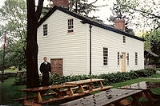
Laura Secord's restored homestead at 29 Queenston St, Queenston, Ontario is a museum near the bank of the Niagara River, with a commemorative plaque in front. The original home in Queenston has been rebuilt to the original floor plan including the original fireplaces.
Monument on Queenston Heights
43.160315°N 79.051084°W

Mr. and Mrs. Alex. Secord and Mr. and Mrs. T. E. M. Secord, and Miss Rachel, went to Lundy's Lane on Saturday to participate in the unveiling of a monument erected there as a tribute to the memory of Canada's heroine, Laura Secord. The monument consists of a shapely shaft of granite, rectangular in shape, some seven feet in height, resting upon a base of the same material. Upon three sides are polished shields bearing suitable inscriptions cut into the stone. Surmounting the shaft is a life-size bust in bronze of the heroine. Among the friends and descendants of the woman whose memory all honour present were Mrs. C. W. Young, wife of Mr. C. W. Young of the Cornwall Freeholder, who is the daughter of Mrs. Secord's youngest daughter; Messrs. T. E. Secord and Alex. Secord, Acton; Mr. W. F. Secord, Thorold, grand-nephew; Miss Laura Clarke, Toronto, and Miss Augusta Smith, Guelph, granddaughters, and Mr. Andrew Carnochan, who for many years was a next-door neighbor of the Secord family at Chippawa. These were all introduced to the thousands who thronged the historical spot by Rev. Canon Bell, President Lundy's Lane Historical Society. The unveiling was performed by Mrs. Geo. W. Ross, wife of the Premier. The event was one of very great interest.
— Secord, Laura, "Monument to Memory of Laura Secord", Acton Free Press, 27 Jun 1901, page 3, column 2
Grave marker in Drummond Hill Cemetery
43.08941°N 79.09576°W
The inscription on the marker reads:
To perpetuate the name and fame of Laura Secord, who walked alone nearly 20 miles by a circuitous difficult and perilous route, through woods and swamps and over miry roads to warn a British outpost at DeCew’s Falls of an intended attack and thereby enabled Lt. FitzGibbon on the 24th June 1813, with less than 50 men of H.M. 49th Regt., about 15 militiamen and a small force of Six Nations and other Indians under Capt. William Johnson Kerr and Dominique Ducharmes to surprise and attack the enemy at Beechwoods (or Beaver Dams) and after a short engagement, to capture Col. Bosler of the U.S. Army and his entire force of 542 men with two field pieces.
Namesakes
- Laura Secord Secondary School, St. Catharines, Ontario
St. Catharines is the largest city in Canada's Niagara Region and the sixth largest urban area in Ontario, Canada, with 97.11 square kilometres of land...
- École Laura Secord School, Winnipeg, Manitoba
- Laura Secord Elementary School
Laura Secord Elementary is a public elementary school in Vancouver, British Columbia part of School District 39 Vancouver.- History :The School was constructed by VSB in 1913 to a design by the Architect David Hormer . VSB liked the design and ended up using it for 3 schools...
, Vancouver, British Columbia
- Laura Secord Chocolates
Laura Secord is a Canadian chocolatier and ice cream company which was founded in 1913 by Frank P. O'Connor. It was named after the Canadian War of 1812 heroine Laura Secord. As of 2010, it has 125 retail outlets across the country....
, founded in 1913, was named in her honour. Laura Secord Chocolates is known for its ice-cream and dark chocolates, shaped in the pendant with Laura Secord's face in white chocolate as its logo, as seen on the monument of Laura Secord in Lundy's Lane
- The Canadian band Tanglefoot
Tanglefoot was a folk band from Ontario, Canada. Formed in the early 1980s by schoolteachers Joe Grant, Bob Wagar, and Tim Rowat to play traditional music, they became a five-piece band playing largely original music...
performed a song entitled "Secord's Warning", which tells Laura Secord's story, on their album, The Music In The Wood.
External links