

Battle of York

Encyclopedia
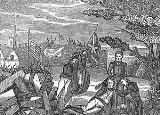
The Battle of York was a battle
of the War of 1812
fought on 27 April 1813, at York, Upper Canada
(present day Toronto
). An American force supported by a naval flotilla landed on the lake shore to the west, defeated the defending British force and captured the town and dockyard
. The American forces subsequently carried out several acts of arson and looting
in the town before withdrawing.
, stood on the north shore of Lake Ontario
. During the War of 1812, the lake was both the front line between the UK and the US, and also part of the principal British supply line from Quebec
to the various armies and outposts to the west. At the start of the war, the British had a small naval force, the Provincial Marine, with which they seized control of the lake, and also of Lake Erie
. This made it possible for Major General Isaac Brock
, leading the British forces in Upper Canada, to gain several important victories during 1812 by shifting his small force rapidly between threatened points to defeat disjointed American attacks individually.
The US Navy tasked Commodore Isaac Chauncey
to regain control of the lakes. He created a squadron of fighting ships at Sackett's Harbor, New York by purchasing and arming several lake schooners and laying down new purpose-built fighting vessels. However, no decisive action was possible before the onset of winter, during which the ships of both sides were confined to harbour by ice. To match Chauncey's ships, the British laid down a sloop of war at Kingston
, and another (named Isaac Brock
after the general, who had been killed at the Battle of Queenston Heights
) in the dockyard at York.
was appointed United States Secretary of War
. Having been a serving soldier, he quickly appreciated the situation on Lake Ontario, and devised a plan by which a force of 7,000 regular soldiers would be concentrated at Sackett's Harbor on 1 April. Working together with Chauncey's squadron, this force would capture Kingston before the Saint Lawrence River
thawed and substantial British reinforcements could arrive in Upper Canada. The capture of Kingston and the destruction of the Kingston Royal Naval Dockyard
together with most of the vessels of the Provincial Marine, would make almost every British post west of Kingston vulnerable if not untenable. After Kingston was captured, the Americans would then capture the British positions at York and Fort George
, at the mouth of the Niagara River
.
Armstrong conferred with Major General Henry Dearborn
, commander of the American Army of the North, at Albany, New York
during February. Both Dearborn and Chauncey agreed with Armstrong's plan at this point, but they subsequently had second thoughts. That month, Lieutenant General Sir George Prevost
, the British Governor General of Canada
, travelled up the frozen Saint Lawrence to visit Upper Canada. This visit was made necessary because Major General Roger Hale Sheaffe
, who had succeeded Brock as Lieutenant Governor of Upper Canada, was ill and unable to perform his various duties. Prevost was accompanied only by a few small detachments of reinforcements, which participated in the Battle of Ogdensburg
en route. Nevertheless, both Chauncey and Dearborn believed that Prevost's arrival indicated an imminent attack on Sackett's Harbor, and reported that Kingston now had a garrison of 6,000 or more British regulars.
Even though Prevost soon returned to Lower Canada, and deserters and pro-American Canadian civilians reported that the true size of Kingston's garrison was 600 regulars and 1,400 militia, Chauncey and Dearborn chose to accept the earlier inflated figure. Furthermore, even after two brigades of troops under Brigadier General Zebulon Pike
reinforced the troops at Sackett's Harbor after a gruelling winter march from Plattsburgh
, the number of effective troops available to Dearborn fell far short of the 7,000 planned, mainly as a result of sickness and exposure. During March, Chauncey and Dearborn recommended to Armstrong that when the ice on the lake thawed, they should attack the less well-defended town of York instead of Kingston. After capturing York, they would then attack Fort George.
Although York was the Provincial capital of Upper Canada, it was far less important than Kingston as a military objective. Armstrong, by now back in Washington, nevertheless acquiesced in this change of plan as Dearborn might well have better local information. Historians such as John R. Elting have pointed out that this effectively reversed Armstrong's original strategy. Also, by committing the bulk of the American forces at the western end of Lake Ontario, it would leave Sackett's Harbor vulnerable to an attack by British reinforcements arriving from Lower Canada.
 The Americans appeared off York late on 26 April. Chauncey's squadron consisted of a ship-rigged corvette
, a brig
and twelve schooner
s. The embarked force commanded by Brigadier General Zebulon Pike numbered between 1,600 and 1,800, mainly from the 6th, 15th and 16th U.S. Infantry, and the 3rd U.S. Artillery fighting as infantry. Dearborn, the overall army commander, remained aboard the corvette Madison
during the action.
The defences of York consisted of a fort a short distance west of the town, with the nearby "Government House Battery" mounting two 12-pounder guns. A mile west was the crude "Western Battery", with two obsolete 18-pounder guns. (These weapons were veterans of earlier wars and had been disabled by having their trunnions removed, but they were fixed to crude log carriages and could still be fired.) Further west were the ruins of Fort Rouillé
and another disused fortification, the "Half Moon Battery", neither of which was in use. Major General Sheaffe, the Lieutenant Governor of Upper Canada, was present at York to transact public business. He had under his command only four companies of regulars. The Militia was ordered to assemble, but only 300 of the 1st and 3rd York Regiments could be mustered at short notice. There were also about 40 to 50 natives
(Mississaugas
and Ojibwa
) in the area.
Early on 27 April, the first American wave of boats, carrying Major Benjamin Forsyth
's company of the U.S. 1st Rifle Regiment, landed about 4 miles (6.4 km) west of the town, supported by some of Chauncey's schooners firing grapeshot
. Because Sheaffe could not know where the Americans would land, Forsyth's riflemen were opposed only by some of the Indians led by Indian Agent
James Givins
, who were outflanked
and retreated into the woods after a stiff resistance. Sheaffe had ordered a company of the Glengarry Light Infantry to support the Natives, but they became lost in the outskirts of the town, having been misdirected by Major-General Æneas Shaw
, the Adjutant General
of the Canadian Militia, who took some of the militia north onto Dundas Street
to prevent any wide American outflanking move.
As three more companies of American infantry landed accompanied by General Pike, the grenadier company of the 8th (The King's) Regiment of Foot
charged them with the bayonet
. The grenadiers were already outnumbered and were repulsed with heavy loss. Pike ordered an advance by platoons, supported by two 6-pounder field guns, which steadily drove back the other two companies of Sheaffe's redcoats
(another company of the 8th regiment, and one from the Royal Newfoundland).
The British tried to rally around the Western battery, but the battery's travelling magazine (a portable chest containing cartridges) exploded, apparently as the result of an accident. This caused further loss (including 20 killed) and confusion among the British regulars, and they fell back to a ravine north of the fort, where the militia were forming up. Meanwhile, Chauncey's schooners, most of which carried a long 24-pounder or 32-pounder cannon, were bombarding the fort and Government House battery. (Chauncey himself was directing them from a small boat). British return fire was ineffective.
Sheaffe decided that the battle was lost and ordered the regulars to retreat, setting fire to the wooden bridge over the River Don east of the town to thwart pursuit. The militia and several prominent citizens were left "standing in the street like a parcel of sheep". Sheaffe instructed the militia to make the best terms they could with the Americans, but without informing the senior militia officers or any official of the legislature, he also dispatched Captain Tito LeLièvre of the Royal Newfoundland to set fire to the sloop of war (HMS Isaac Brock) under construction in the dockyard and to blow up the fort's magazine.
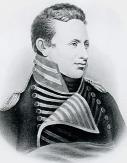 When the magazine exploded, Pike and the leading American troops were only 200 yards (182.9 m) away, or even closer. The flag had been left flying over the fort as a ruse, and Pike was questioning a prisoner as to how many troops were defending it. Pike was mortally injured by flying stones and debris. The explosion killed 38 American soldiers and wounded 222.
The British loss was officially reported by Sheaffe as 59 killed, 34 wounded, 43 wounded prisoners, 10 captured and 7 missing, for a total of 153 casualties. However, historian Robert Malcomson has found this return to be inaccurate: it did not include militia, sailors, dockyard workers or Natives and was incorrect even as to the casualties of the regulars. Malcomson demonstrates that the actual British loss was 82 killed, 43 wounded, 69 wounded prisoners, 274 captured and 7 missing, for a total of 475 casualties.
. The process took time. For their part, the Americans were angry over their losses, and because the ship and fort had apparently been destroyed after negotiations for surrender had begun. Nevertheless, Colonel Mitchell of the 3rd U.S. Artillery had agreed terms by 4 pm While they waited for Dearborn and Chauncey to ratify the terms, the surrendered militia were held prisoner in a blockhouse without food or medical attention for the few wounded. Forsyth's company of the 1st U.S. Rifle Regiment was left as guard in the town. At this stage, few Americans had entered the town.
The next morning, the terms had still not been ratified, as Dearborn had refused to leave the corvette Madison
. When he eventually did so, Reverend John Strachan
(who held no official position other than Rector
of York at the time) first brusquely tried to force him to sign the articles for capitulation on the spot, and then accused Chauncey to his face of delaying the capitulation to allow the American troops licence to commit outrages. Eventually, Dearborn formally agreed to the articles for surrender. The Americans took over the dockyard, where they captured a brig (the Duke of Gloucester
) in poor state of repair, and twenty 24-pounder carronade
s and other stores intended for the British squadron on Lake Erie
. The Brock was beyond salvage. The Americans had missed another ship-rigged vessel, the Prince Regent, which carried 16 guns, as it had sailed for Kingston to collect ordnance two days before the Americans had been sighted. The Americans also demanded and received several thousand pounds in Army Bills, which had been in the keeping of Prideaux Selby
, the Receiver General of Upper Canada, who was mortally ill.
. It was alleged that the American troops had found a scalp there, though folklore had it that the "scalp" was actually the Speaker
's wig. The Printing Office, used for publishing official documents as well as newspapers, was vandalised and the printing press was smashed. Other Americans looted empty houses on the pretext that their absent owners were militia who had not given their parole as required by the articles of capitulation. The homes of Canadians connected with the Indians, including that of James Givins, were also looted regardless of their owners' status. Dearborn emphatically denied giving orders for any buildings to be destroyed and deplored the worst of the atrocities in his letters, but he was nonetheless unable or unwilling to rein in his soldiers. Chauncey later returned some looted property, including books from the public library. Sheaffe was later to allege that local settlers had unlawfully come into possession of Government owned farming tools or other stores looted and discarded by the Americans, and demanded that they be handed back.
on the Niagara peninsula before they could be ready for another action. Sheaffe's troops endured an equally miserable fourteen-day retreat overland to Kingston. Many members of the Provincial Assembly and other prominent citizens severely criticised Sheaffe, both for his conduct generally and during the fighting at York. For example, Militia officers Chewitt and Allan, the Reverend Strachan and others wrote to Governor General Prevost on 8 May, that Sheaffe "kept too far from his troops after retreating from the woods, never cheered or animated them, nor showed by his personal conduct that he was hearty in the cause." Sheaffe lost his military and public offices in Upper Canada as the result of his defeat.
However, the Americans had not inflicted crippling damage on the Provincial Marine on Lake Ontario, and they admitted that by preserving his small force of regulars rather than sacrificing them in a fight against heavy odds, Sheaffe had robbed them of decisive victory. Secretary of War Armstrong wrote, "...we cannot doubt but that in all cases in which a British commander is compelled to act defensively, his policy will be that adopted by Sheaffe – to prefer the preservation of his troops to that of his post, and thus carrying off the kernel leave us the shell."
The most significant effects of the capture of York were probably felt on Lake Erie, since the capture of the ordnance and supplies destined for the British squadron there contributed eventually to their defeat in the Battle of Lake Erie
.
The many acts of arson and looting committed by American troops led the British to seek retaliation in the burning of Washington
.
Battle
Generally, a battle is a conceptual component in the hierarchy of combat in warfare between two or more armed forces, or combatants. In a battle, each combatant will seek to defeat the others, with defeat determined by the conditions of a military campaign...
of the War of 1812
War of 1812
The War of 1812 was a military conflict fought between the forces of the United States of America and those of the British Empire. The Americans declared war in 1812 for several reasons, including trade restrictions because of Britain's ongoing war with France, impressment of American merchant...
fought on 27 April 1813, at York, Upper Canada
York, Upper Canada
York was the name of Old Toronto between 1793 and 1834. It was the second capital of Upper Canada.- History :The town was established in 1793 by Governor John Graves Simcoe, with a new 'Fort York' on the site of the last French 'Fort Toronto'...
(present day Toronto
Toronto
Toronto is the provincial capital of Ontario and the largest city in Canada. It is located in Southern Ontario on the northwestern shore of Lake Ontario. A relatively modern city, Toronto's history dates back to the late-18th century, when its land was first purchased by the British monarchy from...
). An American force supported by a naval flotilla landed on the lake shore to the west, defeated the defending British force and captured the town and dockyard
Naval Shipyards, York (Upper Canada)
Naval Shipyards, York was one of the shipyards of the Royal Navy on Lake Ontario. The yards was called for by Lieutenant Governor John Graves Simcoe in 1793 and operated from 1798 long before the town of York was populated and up to the War of 1812...
. The American forces subsequently carried out several acts of arson and looting
Looting
Looting —also referred to as sacking, plundering, despoiling, despoliation, and pillaging—is the indiscriminate taking of goods by force as part of a military or political victory, or during a catastrophe, such as during war, natural disaster, or rioting...
in the town before withdrawing.
Background
York, the provincial capital of Upper CanadaUpper Canada
The Province of Upper Canada was a political division in British Canada established in 1791 by the British Empire to govern the central third of the lands in British North America and to accommodate Loyalist refugees from the United States of America after the American Revolution...
, stood on the north shore of Lake Ontario
Lake Ontario
Lake Ontario is one of the five Great Lakes of North America. It is bounded on the north and southwest by the Canadian province of Ontario, and on the south by the American state of New York. Ontario, Canada's most populous province, was named for the lake. In the Wyandot language, ontarío means...
. During the War of 1812, the lake was both the front line between the UK and the US, and also part of the principal British supply line from Quebec
Quebec City
Quebec , also Québec, Quebec City or Québec City is the capital of the Canadian province of Quebec and is located within the Capitale-Nationale region. It is the second most populous city in Quebec after Montreal, which is about to the southwest...
to the various armies and outposts to the west. At the start of the war, the British had a small naval force, the Provincial Marine, with which they seized control of the lake, and also of Lake Erie
Lake Erie
Lake Erie is the fourth largest lake of the five Great Lakes in North America, and the tenth largest globally. It is the southernmost, shallowest, and smallest by volume of the Great Lakes and therefore also has the shortest average water residence time. It is bounded on the north by the...
. This made it possible for Major General Isaac Brock
Isaac Brock
Major-General Sir Isaac Brock KB was a British Army officer and administrator. Brock was assigned to Canada in 1802. Despite facing desertions and near-mutinies, he commanded his regiment in Upper Canada successfully for many years...
, leading the British forces in Upper Canada, to gain several important victories during 1812 by shifting his small force rapidly between threatened points to defeat disjointed American attacks individually.
The US Navy tasked Commodore Isaac Chauncey
Isaac Chauncey
Isaac Chauncey was an officer in the United States Navy.-Biography:Chauncey, born in Black Rock, Connecticut, 20 February 1779, was appointed a Lieutenant in the Navy from 17 September 1798...
to regain control of the lakes. He created a squadron of fighting ships at Sackett's Harbor, New York by purchasing and arming several lake schooners and laying down new purpose-built fighting vessels. However, no decisive action was possible before the onset of winter, during which the ships of both sides were confined to harbour by ice. To match Chauncey's ships, the British laid down a sloop of war at Kingston
Kingston, Ontario
Kingston, Ontario is a Canadian city located in Eastern Ontario where the St. Lawrence River flows out of Lake Ontario. Originally a First Nations settlement called "Katarowki," , growing European exploration in the 17th Century made it an important trading post...
, and another (named Isaac Brock
HMS Sir Isaac Brock
HMS Sir Isaac Brock was a warship which was destroyed before being completed at York, Upper Canada during the War of 1812. The ship was named after the famed hero of the war, Major General Sir Isaac Brock....
after the general, who had been killed at the Battle of Queenston Heights
Battle of Queenston Heights
The Battle of Queenston Heights was the first major battle in the War of 1812 and resulted in a British victory. It took place on 13 October 1812, near Queenston, in the present-day province of Ontario...
) in the dockyard at York.
US planning
On 13 January 1813, John Armstrong, Jr.John Armstrong, Jr.
John Armstrong, Jr. was an American soldier and statesman who was a delegate to the Continental Congress, U.S. Senator from New York, and Secretary of War.-Early life and Revolutionary War:...
was appointed United States Secretary of War
United States Secretary of War
The Secretary of War was a member of the United States President's Cabinet, beginning with George Washington's administration. A similar position, called either "Secretary at War" or "Secretary of War," was appointed to serve the Congress of the Confederation under the Articles of Confederation...
. Having been a serving soldier, he quickly appreciated the situation on Lake Ontario, and devised a plan by which a force of 7,000 regular soldiers would be concentrated at Sackett's Harbor on 1 April. Working together with Chauncey's squadron, this force would capture Kingston before the Saint Lawrence River
Saint Lawrence River
The Saint Lawrence is a large river flowing approximately from southwest to northeast in the middle latitudes of North America, connecting the Great Lakes with the Atlantic Ocean. It is the primary drainage conveyor of the Great Lakes Basin...
thawed and substantial British reinforcements could arrive in Upper Canada. The capture of Kingston and the destruction of the Kingston Royal Naval Dockyard
Kingston Royal Naval Dockyard
The Kingston Royal Naval Dockyard was a Royal Navy Dockyard from 1788 to 1853 in Kingston, Ontario, Canada, at the site of the current Royal Military College of Canada.-History:...
together with most of the vessels of the Provincial Marine, would make almost every British post west of Kingston vulnerable if not untenable. After Kingston was captured, the Americans would then capture the British positions at York and Fort George
Fort George, Ontario
Fort George National Historic Site is a historic military structure at Niagara-on-the-Lake, Ontario, that was the scene of several battles during the War of 1812...
, at the mouth of the Niagara River
Niagara River
The Niagara River flows north from Lake Erie to Lake Ontario. It forms part of the border between the Province of Ontario in Canada and New York State in the United States. There are differing theories as to the origin of the name of the river...
.
Armstrong conferred with Major General Henry Dearborn
Henry Dearborn
Henry Dearborn was an American physician, a statesman and a veteran of both the American Revolutionary War and the War of 1812. Born to Simon Dearborn and Sarah Marston in North Hampton, New Hampshire, he spent much of his youth in Epping, where he attended public schools...
, commander of the American Army of the North, at Albany, New York
Albany, New York
Albany is the capital city of the U.S. state of New York, the seat of Albany County, and the central city of New York's Capital District. Roughly north of New York City, Albany sits on the west bank of the Hudson River, about south of its confluence with the Mohawk River...
during February. Both Dearborn and Chauncey agreed with Armstrong's plan at this point, but they subsequently had second thoughts. That month, Lieutenant General Sir George Prevost
George Prevost
Sir George Prévost, 1st Baronet was a British soldier and colonial administrator. Born in Hackensack, New Jersey, the eldest son of Swiss French Augustine Prévost, he joined the British Army as a youth and became a captain in 1784. Prévost served in the West Indies during the French Revolutionary...
, the British Governor General of Canada
Governor General of Canada
The Governor General of Canada is the federal viceregal representative of the Canadian monarch, Queen Elizabeth II...
, travelled up the frozen Saint Lawrence to visit Upper Canada. This visit was made necessary because Major General Roger Hale Sheaffe
Roger Hale Sheaffe
General Sir Roger Hale Sheaffe, 1st Baronet was an American-born General in the British Army in the first part of the 19th century.-Early career:...
, who had succeeded Brock as Lieutenant Governor of Upper Canada, was ill and unable to perform his various duties. Prevost was accompanied only by a few small detachments of reinforcements, which participated in the Battle of Ogdensburg
Battle of Ogdensburg
The Battle of Ogdensburg was a battle of the War of 1812. The British gained a victory over the Americans and captured the village of Ogdensburg, New York...
en route. Nevertheless, both Chauncey and Dearborn believed that Prevost's arrival indicated an imminent attack on Sackett's Harbor, and reported that Kingston now had a garrison of 6,000 or more British regulars.
Even though Prevost soon returned to Lower Canada, and deserters and pro-American Canadian civilians reported that the true size of Kingston's garrison was 600 regulars and 1,400 militia, Chauncey and Dearborn chose to accept the earlier inflated figure. Furthermore, even after two brigades of troops under Brigadier General Zebulon Pike
Zebulon Pike
Zebulon Montgomery Pike Jr. was an American officer and explorer for whom Pikes Peak in Colorado is named. As a United States Army captain in 1806-1807, he led the Pike Expedition to explore and document the southern portion of the Louisiana Purchase and to find the headwaters of the Red River,...
reinforced the troops at Sackett's Harbor after a gruelling winter march from Plattsburgh
Plattsburgh (city), New York
Plattsburgh is a city in and county seat of Clinton County, New York, United States. The population was 19,989 at the 2010 census. The population of the unincorporated areas within the Town of Plattsburgh was 11,870 as of the 2010 census; making the population for the immediate, urban Plattsburgh,...
, the number of effective troops available to Dearborn fell far short of the 7,000 planned, mainly as a result of sickness and exposure. During March, Chauncey and Dearborn recommended to Armstrong that when the ice on the lake thawed, they should attack the less well-defended town of York instead of Kingston. After capturing York, they would then attack Fort George.
Although York was the Provincial capital of Upper Canada, it was far less important than Kingston as a military objective. Armstrong, by now back in Washington, nevertheless acquiesced in this change of plan as Dearborn might well have better local information. Historians such as John R. Elting have pointed out that this effectively reversed Armstrong's original strategy. Also, by committing the bulk of the American forces at the western end of Lake Ontario, it would leave Sackett's Harbor vulnerable to an attack by British reinforcements arriving from Lower Canada.
Battle
Corvette
A corvette is a small, maneuverable, lightly armed warship, originally smaller than a frigate and larger than a coastal patrol craft or fast attack craft , although many recent designs resemble frigates in size and role...
, a brig
Brig
A brig is a sailing vessel with two square-rigged masts. During the Age of Sail, brigs were seen as fast and manoeuvrable and were used as both naval warships and merchant vessels. They were especially popular in the 18th and early 19th centuries...
and twelve schooner
Schooner
A schooner is a type of sailing vessel characterized by the use of fore-and-aft sails on two or more masts with the forward mast being no taller than the rear masts....
s. The embarked force commanded by Brigadier General Zebulon Pike numbered between 1,600 and 1,800, mainly from the 6th, 15th and 16th U.S. Infantry, and the 3rd U.S. Artillery fighting as infantry. Dearborn, the overall army commander, remained aboard the corvette Madison
USS Madison (1812)
USS Madison was a U.S. Navy corvette built during the War of 1812 for use on the Great Lakes.USS Madison was built at Sackets Harbor, New York by Henry Eckford. She was launched on Lake Ontario on 26 November 1812, Lieutenant Jesse D. Elliot in command. She was the first U.S...
during the action.
The defences of York consisted of a fort a short distance west of the town, with the nearby "Government House Battery" mounting two 12-pounder guns. A mile west was the crude "Western Battery", with two obsolete 18-pounder guns. (These weapons were veterans of earlier wars and had been disabled by having their trunnions removed, but they were fixed to crude log carriages and could still be fired.) Further west were the ruins of Fort Rouillé
Fort Rouillé
Fort Rouillé or Fort Toronto was a French trading post located in Toronto, Ontario, Canada, that was established around 1750 but abandoned in 1759. The fort site is now part of the public lands of Exhibition Place...
and another disused fortification, the "Half Moon Battery", neither of which was in use. Major General Sheaffe, the Lieutenant Governor of Upper Canada, was present at York to transact public business. He had under his command only four companies of regulars. The Militia was ordered to assemble, but only 300 of the 1st and 3rd York Regiments could be mustered at short notice. There were also about 40 to 50 natives
Indigenous peoples of the Americas
The indigenous peoples of the Americas are the pre-Columbian inhabitants of North and South America, their descendants and other ethnic groups who are identified with those peoples. Indigenous peoples are known in Canada as Aboriginal peoples, and in the United States as Native Americans...
(Mississaugas
Mississaugas
The Mississaugas are a subtribe of the Anishinaabe-speaking First Nations people located in southern Ontario, Canada. They are closely related to the Ojibwa...
and Ojibwa
Ojibwa
The Ojibwe or Chippewa are among the largest groups of Native Americans–First Nations north of Mexico. They are divided between Canada and the United States. In Canada, they are the third-largest population among First Nations, surpassed only by Cree and Inuit...
) in the area.
Early on 27 April, the first American wave of boats, carrying Major Benjamin Forsyth
Benjamin Forsyth
Benjamin Forsyth was an American officer of Rifle troops in the War of 1812 between Britain and America.Originally from Stokes County, North Carolina, he obtained a lieutenancy in the U.S. 1st Rifle Regiment when it was formed in 1808...
's company of the U.S. 1st Rifle Regiment, landed about 4 miles (6.4 km) west of the town, supported by some of Chauncey's schooners firing grapeshot
Grapeshot
In artillery, a grapeshot is a type of shot that is not a one solid element, but a mass of small metal balls or slugs packed tightly into a canvas bag. It was used both in land and naval warfare. When assembled, the balls resembled a cluster of grapes, hence the name...
. Because Sheaffe could not know where the Americans would land, Forsyth's riflemen were opposed only by some of the Indians led by Indian Agent
Indian Agent (Canada)
Indian Agent is the title of a position in Canada mandated by the Indian Act of that country. An Indian Agent was the chief administrator for Indian affairs in their respective districts, although the title now is largely in disuse in preference to Government Agent. The powers of the Indian...
James Givins
James Givins
Colonel James Givins was a British Army officer and militiaman who fought in the American Revolution and the War of 1812. He was also an Indian agent of Upper Canada, rising to Chief Superintendent of the Indian Department...
, who were outflanked
Flanking maneuver
In military tactics, a flanking maneuver, also called a flank attack, is an attack on the sides of an opposing force. If a flanking maneuver succeeds, the opposing force would be surrounded from two or more directions, which significantly reduces the maneuverability of the outflanked force and its...
and retreated into the woods after a stiff resistance. Sheaffe had ordered a company of the Glengarry Light Infantry to support the Natives, but they became lost in the outskirts of the town, having been misdirected by Major-General Æneas Shaw
Æneas Shaw
Æneas Shaw UE was a soldier and political figure in Upper Canada.He was born at Tordarroch House, Pitlochry, Scotland around 1740 and came to Staten Island, New York around 1770. He joined the Queen's Rangers at the start of the American Revolution, later becoming a captain. After the British...
, the Adjutant General
Adjutant general
An Adjutant General is a military chief administrative officer.-Imperial Russia:In Imperial Russia, the General-Adjutant was a Court officer, who was usually an army general. He served as a personal aide to the Tsar and hence was a member of the H. I. M. Retinue...
of the Canadian Militia, who took some of the militia north onto Dundas Street
Dundas Street (Toronto)
Dundas Street, also known as Highway 5 west of Toronto, is a major arterial road connecting the centre of that city with its western suburbs and southwestern Ontario beyond...
to prevent any wide American outflanking move.
As three more companies of American infantry landed accompanied by General Pike, the grenadier company of the 8th (The King's) Regiment of Foot
8th (The King's) Regiment of Foot
The 8th Regiment of Foot, also referred to diminutively as the 8th Foot and the King's, was an infantry regiment of the British Army, formed in 1685 and retitled the King's on 1 July 1881....
charged them with the bayonet
Bayonet
A bayonet is a knife, dagger, sword, or spike-shaped weapon designed to fit in, on, over or underneath the muzzle of a rifle, musket or similar weapon, effectively turning the gun into a spear...
. The grenadiers were already outnumbered and were repulsed with heavy loss. Pike ordered an advance by platoons, supported by two 6-pounder field guns, which steadily drove back the other two companies of Sheaffe's redcoats
Red coat (British army)
Red coat or Redcoat is a historical term used to refer to soldiers of the British Army because of the red uniforms formerly worn by the majority of regiments. From the late 17th century to the early 20th century, the uniform of most British soldiers, , included a madder red coat or coatee...
(another company of the 8th regiment, and one from the Royal Newfoundland).
The British tried to rally around the Western battery, but the battery's travelling magazine (a portable chest containing cartridges) exploded, apparently as the result of an accident. This caused further loss (including 20 killed) and confusion among the British regulars, and they fell back to a ravine north of the fort, where the militia were forming up. Meanwhile, Chauncey's schooners, most of which carried a long 24-pounder or 32-pounder cannon, were bombarding the fort and Government House battery. (Chauncey himself was directing them from a small boat). British return fire was ineffective.
Sheaffe decided that the battle was lost and ordered the regulars to retreat, setting fire to the wooden bridge over the River Don east of the town to thwart pursuit. The militia and several prominent citizens were left "standing in the street like a parcel of sheep". Sheaffe instructed the militia to make the best terms they could with the Americans, but without informing the senior militia officers or any official of the legislature, he also dispatched Captain Tito LeLièvre of the Royal Newfoundland to set fire to the sloop of war (HMS Isaac Brock) under construction in the dockyard and to blow up the fort's magazine.
Casualties
The American loss was officially reported as 52 killed and 254 wounded for the Army and 3 killed and 11 wounded for the Navy, for a total of 55 killed and 265 wounded. Of these, 38 were killed and 222 wounded in the explosion of the main magazine.The British loss was officially reported by Sheaffe as 59 killed, 34 wounded, 43 wounded prisoners, 10 captured and 7 missing, for a total of 153 casualties. However, historian Robert Malcomson has found this return to be inaccurate: it did not include militia, sailors, dockyard workers or Natives and was incorrect even as to the casualties of the regulars. Malcomson demonstrates that the actual British loss was 82 killed, 43 wounded, 69 wounded prisoners, 274 captured and 7 missing, for a total of 475 casualties.
Surrender
Colonel William Chewett and Major William Allen of the 3rd York Regiment of militia tried to arrange a capitulation, assisted by lawyer Captain John Beverley RobinsonSir John Robinson, 1st Baronet, of Toronto
Sir John Beverley Robinson, 1st Baronet CB, was a lawyer, judge and political figure in Upper Canada.Robinson was born in 1791 at Berthier, Lower Canada, the son of Christopher Robinson, a United Empire Loyalist of one of the First Families of Virginia, whose grandfather came there in 1641 as...
. The process took time. For their part, the Americans were angry over their losses, and because the ship and fort had apparently been destroyed after negotiations for surrender had begun. Nevertheless, Colonel Mitchell of the 3rd U.S. Artillery had agreed terms by 4 pm While they waited for Dearborn and Chauncey to ratify the terms, the surrendered militia were held prisoner in a blockhouse without food or medical attention for the few wounded. Forsyth's company of the 1st U.S. Rifle Regiment was left as guard in the town. At this stage, few Americans had entered the town.
The next morning, the terms had still not been ratified, as Dearborn had refused to leave the corvette Madison
USS Madison (1812)
USS Madison was a U.S. Navy corvette built during the War of 1812 for use on the Great Lakes.USS Madison was built at Sackets Harbor, New York by Henry Eckford. She was launched on Lake Ontario on 26 November 1812, Lieutenant Jesse D. Elliot in command. She was the first U.S...
. When he eventually did so, Reverend John Strachan
John Strachan
John Strachan was an influential figure in Upper Canada and the first Anglican Bishop of Toronto.-Early life:Strachan was the youngest of six children born to a quarry worker in Aberdeen, Scotland. He graduated from King's College, Aberdeen in 1797...
(who held no official position other than Rector
Rector
The word rector has a number of different meanings; it is widely used to refer to an academic, religious or political administrator...
of York at the time) first brusquely tried to force him to sign the articles for capitulation on the spot, and then accused Chauncey to his face of delaying the capitulation to allow the American troops licence to commit outrages. Eventually, Dearborn formally agreed to the articles for surrender. The Americans took over the dockyard, where they captured a brig (the Duke of Gloucester
HMS Duke of Gloucester (1813)
HMS Duke of Gloucester was a 10 gun brig of the Royal Navy which was launched at the Kingston Royal Naval Dockyard in Kingston, Ontario....
) in poor state of repair, and twenty 24-pounder carronade
Carronade
The carronade was a short smoothbore, cast iron cannon, developed for the Royal Navy by the Carron Company, an ironworks in Falkirk, Scotland, UK. It was used from the 1770s to the 1850s. Its main function was to serve as a powerful, short-range anti-ship and anti-crew weapon...
s and other stores intended for the British squadron on Lake Erie
Lake Erie
Lake Erie is the fourth largest lake of the five Great Lakes in North America, and the tenth largest globally. It is the southernmost, shallowest, and smallest by volume of the Great Lakes and therefore also has the shortest average water residence time. It is bounded on the north by the...
. The Brock was beyond salvage. The Americans had missed another ship-rigged vessel, the Prince Regent, which carried 16 guns, as it had sailed for Kingston to collect ordnance two days before the Americans had been sighted. The Americans also demanded and received several thousand pounds in Army Bills, which had been in the keeping of Prideaux Selby
Prideaux Selby
Prideaux Selby was an English soldier and political figure in Upper Canada.He was born in Alnwick, Northumberland, England a son of the Holy Island branch of the Selby family...
, the Receiver General of Upper Canada, who was mortally ill.
Burning of York
Between 28 April and 30 April, American troops carried out many acts of plunder. Some of them set fire to the buildings of the Legislative AssemblyLegislative Assembly of Upper Canada
The Legislative Assembly of Upper Canada was created by the Constitutional Act of 1791. It was the elected legislature for the province of Upper Canada and functioned as the province's lower house in the Parliament of Upper Canada...
. It was alleged that the American troops had found a scalp there, though folklore had it that the "scalp" was actually the Speaker
Speaker of the Canadian House of Commons
The Speaker of the House of Commons of Canada is the presiding officer of the lower house of the Parliament of Canada and is elected at the beginning of each new parliament by fellow Members of Parliament...
's wig. The Printing Office, used for publishing official documents as well as newspapers, was vandalised and the printing press was smashed. Other Americans looted empty houses on the pretext that their absent owners were militia who had not given their parole as required by the articles of capitulation. The homes of Canadians connected with the Indians, including that of James Givins, were also looted regardless of their owners' status. Dearborn emphatically denied giving orders for any buildings to be destroyed and deplored the worst of the atrocities in his letters, but he was nonetheless unable or unwilling to rein in his soldiers. Chauncey later returned some looted property, including books from the public library. Sheaffe was later to allege that local settlers had unlawfully come into possession of Government owned farming tools or other stores looted and discarded by the Americans, and demanded that they be handed back.
Aftermath
The Americans sent the captured military stores away on 2 May but were then penned in York harbour by a gale. They left York on 8 May, in miserable weather, and required a period of rest at Fort NiagaraFort Niagara
Fort Niagara is a fortification originally built to protect the interests of New France in North America. It is located near Youngstown, New York, on the eastern bank of the Niagara River at its mouth, on Lake Ontario.-Origin:...
on the Niagara peninsula before they could be ready for another action. Sheaffe's troops endured an equally miserable fourteen-day retreat overland to Kingston. Many members of the Provincial Assembly and other prominent citizens severely criticised Sheaffe, both for his conduct generally and during the fighting at York. For example, Militia officers Chewitt and Allan, the Reverend Strachan and others wrote to Governor General Prevost on 8 May, that Sheaffe "kept too far from his troops after retreating from the woods, never cheered or animated them, nor showed by his personal conduct that he was hearty in the cause." Sheaffe lost his military and public offices in Upper Canada as the result of his defeat.
However, the Americans had not inflicted crippling damage on the Provincial Marine on Lake Ontario, and they admitted that by preserving his small force of regulars rather than sacrificing them in a fight against heavy odds, Sheaffe had robbed them of decisive victory. Secretary of War Armstrong wrote, "...we cannot doubt but that in all cases in which a British commander is compelled to act defensively, his policy will be that adopted by Sheaffe – to prefer the preservation of his troops to that of his post, and thus carrying off the kernel leave us the shell."
The most significant effects of the capture of York were probably felt on Lake Erie, since the capture of the ordnance and supplies destined for the British squadron there contributed eventually to their defeat in the Battle of Lake Erie
Battle of Lake Erie
The Battle of Lake Erie, sometimes called the Battle of Put-in-Bay, was fought on 10 September 1813, in Lake Erie off the coast of Ohio during the War of 1812. Nine vessels of the United States Navy defeated and captured six vessels of Great Britain's Royal Navy...
.
The many acts of arson and looting committed by American troops led the British to seek retaliation in the burning of Washington
Burning of Washington
The Burning of Washington was an armed conflict during the War of 1812 between the United Kingdom of Great Britain and Ireland and the United States of America. On August 24, 1814, led by General Robert Ross, a British force occupied Washington, D.C. and set fire to many public buildings following...
.