

.gif)
Battle of Breitenfeld (1631)

Encyclopedia
The Battle of Breitenfeld or First Battle of Breitenfeld (sometimes First Breitenfeld and in older texts Battle of Leipzig) , was fought at the crossroads villages of Breitenfeld
51°24′N 12°20′E, Podelwitz 51°24′N 12°23′E, and Seehausen
51°24′N 12°25′E, approximately five miles northwest of the walled city of Leipzig
on September 17 (new style, or Gregorian dating
), or September 7 (by the older Julian calendar
, in wide use at the time), 1631. Breitenfeld represented the Protestants’ first major victory of the Thirty Years War.
The Protestant victory ensured that the German states would not be forcibly reconverted to Roman Catholicism
. The victory further confirmed Sweden’s Gustavus Adolphus
of the House of Vasa
as a great tactical leader and induced many Protestant German states to ally themselves with Sweden against the German Catholic League
, led by Maximilian I, Elector of Bavaria
, and the Holy Roman Emperor
Ferdinand II of Austria.
.
. France was Sweden’s ally and paid most of the Swedish campaign expenses. This marked a major shift away from a religious-based conflict, as the French were also Catholic.
to aid Sigismund III of Poland-Lithuania, which ended in Fall 1629 with the Truce of Altmark
.
Consequently, when Gustav Adolph and his force of 13,000 landed at Peenemünde
in 1630, the Imperial Commander of the German Catholic League
, Tilly, did not immediately respond, being engaged in what seemed to be more pressing matters in northern Italy. Gustav's sole ally was the city of Stralsund
, and over the ensuing months, the situation did not improve. While he could claim the support from German princes, these were the “dispossessed” like Mecklenburg
and Saxe-Weimar
, the expectant like the claimants to Brunswick-Lüneburg
, the occupied, like Magdeburg
, and the threatened, like Hesse-Kassel
. In terms of real support of money, men, supplies and arms, these alliances meant little. External alliances were little better: Russia offered duty free grain to be sold in Amsterdam, a scheme that raised only 78,000 thalers, and France hedged its bets. The difficulty in developing concrete alliances with German states was understandable. Unthreatened Lutheran princes saw the advantage in using the Swedish "menace" to wrest terms from Vienna, rather than commit what amounted to acts of treason. French reticence at entering an alliance was less understandable for, like Sweden, France had been engaged in several decades of fighting, so peace and demobilization offered significant advantages; like Sweden, though, there were significant and concrete gains to be achieved in territory, influence, and prestige, if they were to be on the winning side of the renewal of fighting in northern Europe. In early 1631, imperial forces captured Mantua
, effectively ending the Mantuan war, and the ensuing peace treaty at Cherasco
(February 1631) insured that the large imperial army tied up in northern Italy was now free to expend its energy in the German states.
, from a horrific sack by imperial troops, which began on May 20, and in which a major portion of the population was murdered and the city burned. The sack of Magdeburg, though, could be turned to good use: the broadsides and pamphlets distributed throughout Europe assured that prince and pauper alike understood how the Emperor, or at least his troops, treated the Protestant subjects. Over the next few months, Gustav consolidated his bridgehead and expanded across northern Germany, attracting support from German princes but mostly building his army from mercenary forces along the way. By the time he reached the Saxon border, his force had expanded over 23,000.
for permission to pass through the territory; the elector declined permission, noting that Saxon sweetmeats had not yet been touched. Tilly invaded Electoral Saxony because, first, it was the shortest distance between himself and Gustav’s flank; second, because he hoped to force its ruler to abandon any planned alliance with Gustav; and third, because the Saxon territories offered plenty of food and sustenance for his exhausted army. His plan was to avoid contact with the Swedes, and ultimately the Saxons, until his troops could unite with the units near Jena (about 5000 seasoned professionals), and the larger force of Count Otto von Fugger, en route from Hesse. Gustav and John George united their forces, planning to meet Tilly somewhere near Leipzig
.
and heavy
, from the ancient classical period until the late 17th century. Light troops used primarily ranged weapons while heavy infantry specialized in melee combat. Generally, light troops had less armor than heavy troops, but the types are not classified by armor. Some units of mixed type employed ranged or close weapons depending on the tactical situation, but they were a minority. There were dozens of specific types in use in every period. Most nations or regions commonly specialized in fielding specific variations, differing in specific weapons, armor, and tactics used. The forces employed at Breitenfeld on both sides used mostly one type of light infantry, musketeers armed with matchlock
muskets. Matchlock muskets of the period were still a heavy weapon, not the lighter flintlock variety that would eventually evolve, typically with barrels about four feet long and propelling a ball weighing about 2 ounces(˜55 grams), the gun itself weighing between 15 and 17 lbs. The rate of fire was comparatively slow, typically around 1 round per minute, and musketeers were typically deployed in six or more ranks to allow for a continuous stream of fire. Musketeers typically lacked any form of protection, although some might have worn light helmets and buff coat
s; they carried cheap swords as sidearms, although the butt stock of a reversed musket was often more effective in close combat situations. The Swedes and the imperials also used mostly the same type of heavy infantry, pikemen. Pikemen of the period employed ˜16-18 foot pikes and wore heavy half armor, ideally consisting of a breast and backplate with thigh-protecting tassets and a light helmet, and also a short sword for close combat. Combined together these mixed infantry units were very strong defensively against any form of cavalry
attacks. The musketeers had a greater range and rate of fire then a mounted man with a wheellock
pistol, while pikes too have greater reach compared to cavalry
sword
s and lance
s, without even taking into account the fact that horses would not naturally crash into dense formations of men.
Historically most infantry were organized with units of a single type, but in this case, both sides fielded units with a mixture of light and heavy troops. The imperials deployed their infantry in modified Spanish tercios. These units were rectangular, about 1500 men, with a dense center of pikemen and four "sleeves" of musketeers deployed on each sides or corners. Such a formation had very powerful all around defenses against cavalry, but was very slow moving and lacked firepower since at best only half of the available muskets could be brought to bear. The Swedes deployed in a linear formation developed by Maurice of Nassau. Swedish infantry were deployed with 6 ranks of musketeers to the front and 5 ranks of pikemen behind. The Swedish musketeers had also perfected the salvo firing technique, in which three ranks of musketeers would fire simultaneously, with the front rank kneeling, the second rank crouching and the third rank standing. The massive disruption caused by such a wall of lead slamming into the enemy was capable of stopping cavalry charges without the aid of pikes on many occasions, and allowed the Swedish pikemen or cavalry to immediately gain advantage over their opponent in the subsequent close combat. The tactical preferences of the two armies resulted from different operational philosophies: the imperial infantry were typically more static and defensive in battle, while the Swedish were more capable of offense but more vulnerable to flanking attacks. Most of the Saxon units were various heavy types deployed in unmixed squares; with only a few companies of musketeers.
, especially, unit names such as "heavy cavalry" are often misleading. The cavalry of both sides at Breitenfield were mostly units of cuirassier
s. This was a heavy type of cavalry armed with wheel-lock pistols and broadsword
s and ideally clad in heavy three-quarter armor with a bulletproof cuirass
. The second type of cavalry commonly used in Western Europe at the time was the harquebusier; a light, firearm-equipped cavalryman named after the long firearm they used. Theoretically, in battle the harquebusiers would provide supporting fire for the cuirassiers' charge, and their role was otherwise confined to skirmishing, scouting and other irregular operations. The cuirassiers themselves typically employed caracole
tactics, advancing to the charge at a trot, often in a dense formation six or ten ranks deep. At about ten paces from the opposing formation the troopers would discharge their pistols and wheel around to reload, allowing the next rank to also fire. Only after an enemy had been substantially weakened or disordered would they draw their swords and charge.
Practical realities faced by the Swedish, however, resulted in their cavalry being uniquely different. Sweden's lack of manufacturing capability at the time resulted in her cavalry lacking in armor and wheellock
pistols; the Swedish cuirassiers were only armored up to the standard of the typical imperial harquebusier, except for a few units raised in Livonia and recruited among the German mercenaries, while their Finnish light horse were often completely unarmored. Initially they were also largely outnumbered by their imperial counterparts, and thus often were forced to form up only two or three ranks deep to avoid being outflanked. The Swedes also had plenty of experience fighting against the vaunted Polish cavalry, which taught them the value of a full gallop charge using cold steel only. Also, to compensate for the lesser quality and quantity of his cavalry against the Poles, Gustavus also started using detached companies of musketeers to provide fire support for his horsemen. These tactical developments would prove extremely effective, and while not Swedish by invention were brought into renown by them and would shape Western military doctrine until the early 19th century.
with both combatants agreeing to battle on the field. The forces all had different structural organization. Mostly the technology was about the same level, with a slight advantage to the Swedish troops in newer and lighter cannon and matchlocks. Both Armies were well supplied and the terrain was relatively equivalent between the dispositions. Key differences between the Swedish and imperial forces (and the Swedish allies) were in the training and structure of infantry troops, and the Swedish different philosophy in using their cavalry.
and much fewer pikemen than the imperial forces tercio
. Overall the Unionist fielded about the same number matchlocks as the imperial troops.
could engage.
 The Swedes deployed their 15,000 infantry in 2 lines. The imperial army deployed 25,500 infantry in a single line of 17 tercios (1,500 infantrymen in each). The German allies extended the Protestant front to be overall slightly longer than the Catholic. The imperial line had its cavalry evenly distributed on its flanks. The Swedes had their cavalry weighted to their right. The German allies fielded their infantry in wedge formation with units in squares, and cavalry on their flanks. With their Saxon allies extending the Swede’s line, the Unionists had cavalry at the center and their flanks.
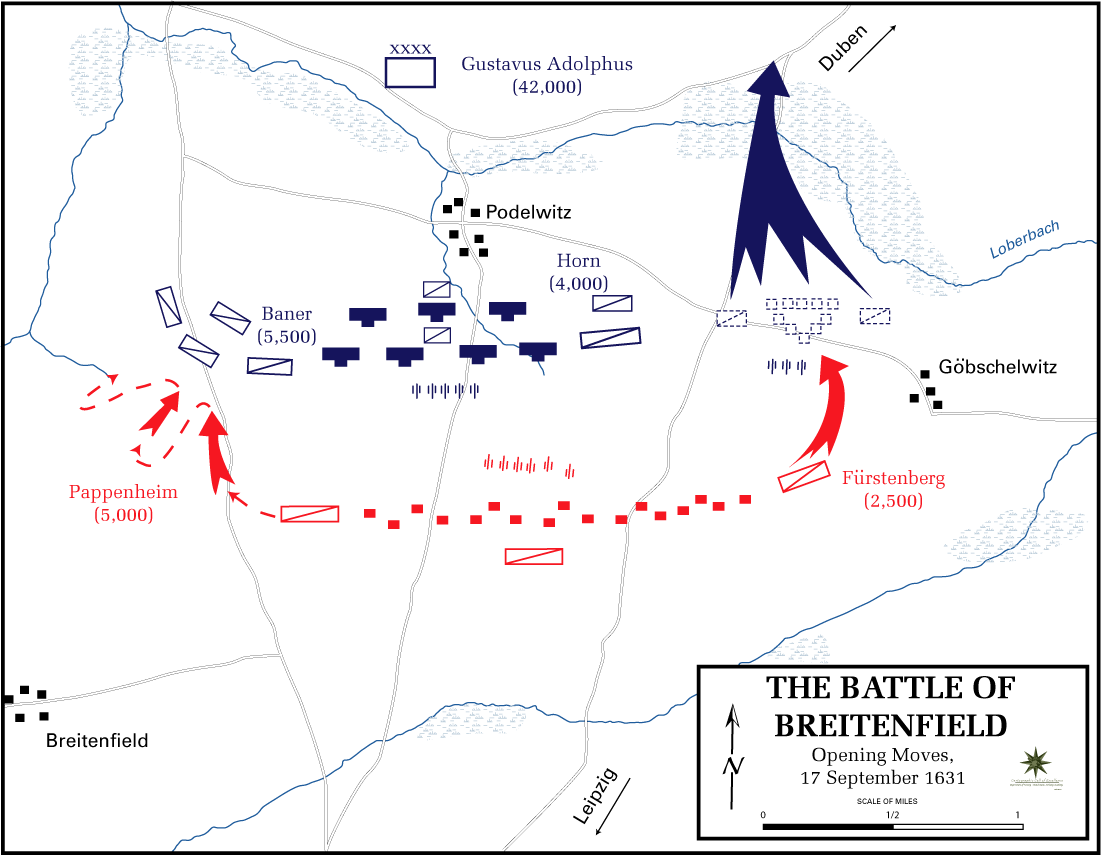 The combined Swedish-Saxon forces were oriented to the north of Leipzig centered around hamlet of Podelwitz, facing southwest toward Breitenfeld and Leipzig. The battle began around mid-day, with a two hour exchange of artillery fire, during which the Swedes demonstrated fire power
in a rate of fire of three-to-five volleys to one Imperial volley. Gustavus had lightened his artillery park, and each colonel had four highly mobile, rapid firing, copper-cast three pounders, the cream of Sweden’s metallurgical industry. When the artillery fire ceased, Pappenheim's Black Cuirassiers charged the Swedish line seven times, and were consistently beaten back by harquebus and pikemen. Gustavus had trained his men to aim for the cavalry mounts, and the falling animals made holes in the Catholic formations. The same tactics would work an hour or so later when the imperial cavalry charged the Swedish left flank. Following the rebuff of the seventh assault, General Banér sallied forth with both his light (Finnish and West Gotlanders
) and heavy cavalry (Smalanders
and East Gotlanders
). Banér’s cavalry had been taught to deliver its impact with the saber, not to caracole
with the hard-to-aim pistols or carbines, forcing Pappenheim and his cavalry quit the field in disarray, retreating 15 miles northwest to Halle
.
During the charges of the Cuirassiers, Tilly's infantry had remained stationary, but then the cavalry on his right charged the Saxon cavalry and routed it towards Eilenburg
. There may have been confusion in the imperial command at seeing Pappenheim’s charge; in their assessment of the battle, military historians have wondered if Pappenheim precipitated an attempted double envelopment, or if he followed Tilly’s preconceived plan. At any rate, recognizing an opportunity, Tilly sent the majority of his infantry against the remaining Saxon forces in an oblique march diagonally across his front.
 As Tilly was ordering his infantry to march ahead diagonally to the right, looking to roll up the Swedish line on its abandoned left flank, Gustavus reordered his second line, under the capable and steady General Gustav Horn, into an array at a right angle to the front, in a maneuver known as refusing the line. With this maneuver, the Swedish line developed a strong angle, anchored in the new center under General Lennart Torstenson
, whose men were able to deliver an artillery barrage with an overwhelmingly high rate of fire for the era. Tilly's right flank cavalry preceded his infantry across the field. Except for his musketeers, the infantry had yet to engage. Tilly's seventeen Tercio
s could only angle across the field. Tercios cannot turn easily, owing to the length of pikes extending through the faces of the essentially square formations. As they advanced obliquely, it left the Swedish right uncovered and free.
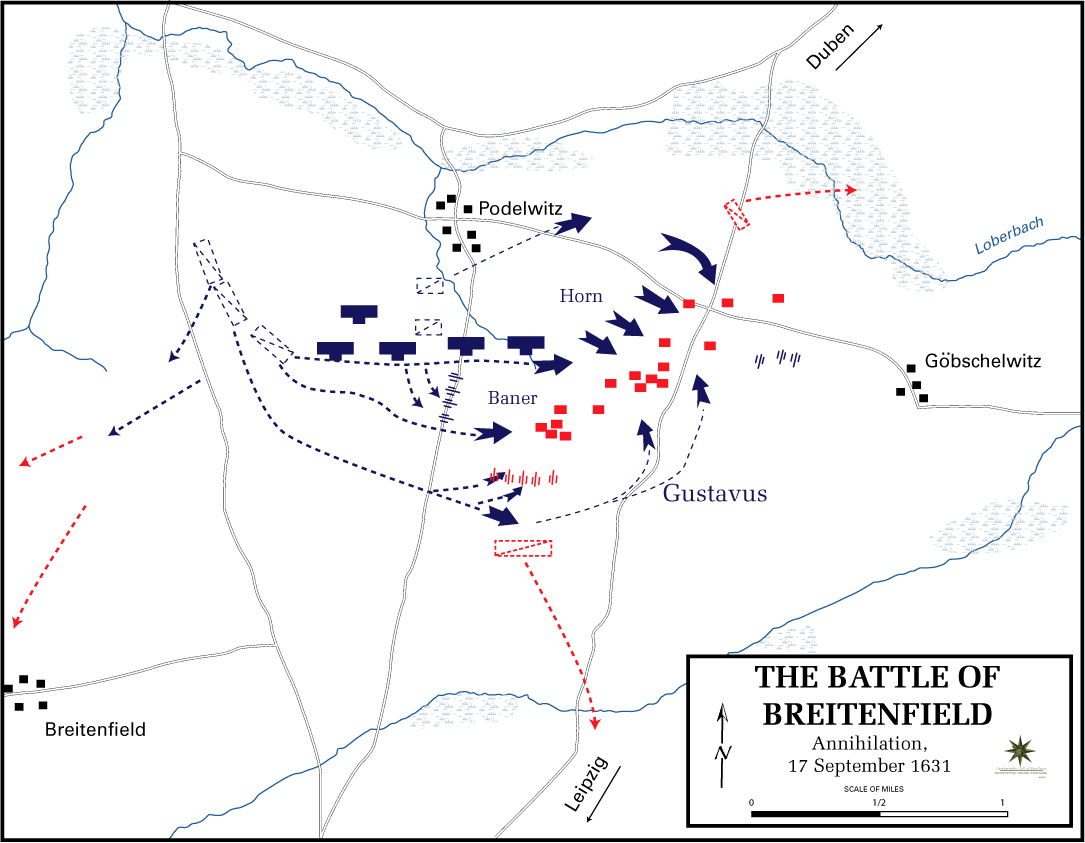 While this was taking place, the Swedish cavalry re-formed, and, preceded by the Finnish light cavalry (Hakkapeliitta
s), which Gustavus led personally, attacked across the former front to capture the Imperial artillery, followed in short succession by Banér's heavy cavalry and three regiments of infantry. This not only freed the Swedish field guns from an ongoing artillery duel, but allowed Gustavus's cross-trained cavalry to turn the captured Imperial guns upon Tilly's seventeen own Tercios, now outflanked and badly out of position.
Gustavus’ soldiers redeployed the captured artillery into a new line and angled so it could fire on the Catholic forces. Its position lay slightly to the rear of the Catholics on what had become the extreme right flank of a developing infantry battle. The unwieldy Catholic infantry was trapped in a crossfire of grazing artillery balls which were aimed to bounce and careen into the rank and files between knee and shoulder height—killing and wounding dozens with each ball. With these guns cutting into one end of Tilly's line, and the Swedish center showing no signs of breaking, the exchange of gunfire soon wore down the Imperial troops, and their lines ground to a halt against Horn's infantry.
After several hours of punishment, nearing sunset, the Catholic line finally broke. Tilly himself was injured twice by a so-called "piece of battle"—artillery propelled debris, such as a careening pikehead. Although the first time he remounted his horse, the second wound was more severe; unconscious, he was carted off to safety under the cover of night during the ensuing retreat, which quickly became a rout as the Catholic forces reached the nearby woods. The totally disorganized and demoralized Imperial and Catholic League force effectively lost all cohesion with the fall of night, and the desertion rate was consequently higher than the battle losses themselves. In effect, Gustav had entirely destroyed the only army the Catholics had in the field, placing the Imperial side on the defensive.
After the battle, Gustav moved on Halle
, following the same track that Tilly had taken coming east to enforce the Edict of Restitution
on the Electorate of Saxony
. Two days later Gustav's forces captured another 3,000 men after a brief skirmish at Merseburg
, and took Halle two days after that.
to throw its whole-hearted support to the militarily strong but economically weak Sweden. Finally, with the seventy-two year old Tilly's recovery far from certain (and he did indeed die within six months while crossing the Lech river), and with no alternative commander at hand, Emperor Ferdinand II
had no choice but to rehire Wallenstein.
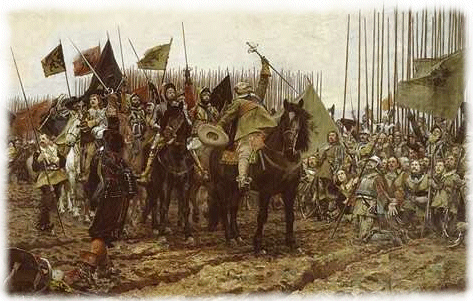 His success against the well-trained Imperial and League forces at Breitenfeld endorsed Gustav's linear tactics. In traditional battle tactics, the cavalry lined up on either side of the primary infantry force, theoretically protecting its flanks, but in actuality, cavalry would attempt to drive off the opposing force, leaving the infantry’s flank exposed. Gustav mixed infantry heavily weighted with musketeers among the cavalry in their "starting positions" on the flanks. As opposing cavalry attacked, the musketeers could pick them off, long before the cavalryman’s pistols could be useful. The thinner pike wall sufficiently prevented breakage of the line, but it could also be easily shifted, to allow Gustav’s cavalry to pass through. Normally detached infantry would be easily run down, but by being placed in the midst of the cavalry, if the opposing force did charge, they would do so right into the Swedish cavalry's own pistols. It was Gustavus' policy to have each arm support the other, so demonstrating an early appreciation of the benefits of combined arms
tactics, though long before the term was coined.
In the traditional square, muskets at the rear or sides of the formation could not fire effectively due to the ranks in front. The Dutch had thinned out their formations to place more men at the front, a concept Gustav adapted by converting his formations into rectangles only six ranks deep (as opposed to ten or more). This became known as a linear formation, and in historical terms, by one modification or another, it persisted in warfare to World War II
. Additionally, whereas the typical pike-and-shot formation placed the shot on the flanks of a full pike square, to overcome the friendly fire issue, Gustav placed most of the shot at the front, with the pike at the sides strictly in support, with a smattering of pike to keep charging cavalry at bay. In the common tercio of the day, the ratio of pikes to shot was generally about 2:1; Gustavus' armies were recast to ratios between 3:2 and sometimes approached 1:1—giving his forces a much greater amount of long range fire power
.
Along the same line of rate of fire thinking, he also placed small cannons, or so called infantry guns among the units. These were mobile, lightweight three-pound brass cannon, by some called the first field artillery
. Loaded with canister or grapeshot, they were devastating, like huge shotguns capable of gutting an opponent's formations. At long ranges, they fired solid shot aimed to bounce through the enemy's ranks doing nearly as much damage. The integration of small cannons among infantry gave his battalions cannon support even if they became separated from the main force, or if they were away from the massed artillery at the center of the field.
 These changes also made Gustav's formations easier to maneuver on the battlefield; the line formations he fielded could easily turn to face a new direction, compared to the squares Tilly and the Saxon Elector had been using— where the line of march was typically fixed (or else the unit would spear each other in turning the unwieldy pikes), once a unit took up positions in the field—his forces were able to change facings and march a different direction. Gustav's main formations could be re-aligned, even under fire, and even those where his mixed units used his concept of combined arms, although at the cost of some confusion while the pikemen reformed on the shot's flanks, the cavalry paraded back around and came up again.
, the military strength of the alliance had been secured through the addition of new armies. Even when Swedish leadership faltered, it did not fail, and the influx of French gold insured that the hostilities could continue. The reconstituted imperial and Catholic league forces and the opposition forces were so evenly matched that neither side could force a concession from the other. Wallenstein's efforts to negotiate a conclusion to the conflict ended in his own conviction of treason, and his assassination. This realization, confirmed at Westphalia
fundamentally changed the balance of power within the Holy Roman Empire.
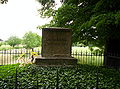 In the eastern portion of the village of Breitenfeld stands a monument to Gustav Adolf and the victory his army accomplished there in 1631. It was erected in 1831 on the two hundredth anniversary of the battle and bears the following inscription:
Breitenfeld, Leipzig
The village of Breitenfeld belongs to the city of Leipzig. The village lies in the vicinity of the old road to Landsberg. On the south, it borders of the borough of Gohlis, in the west on Lindenthal and in the east, on Wiederitzsch.- History :...
51°24′N 12°20′E, Podelwitz 51°24′N 12°23′E, and Seehausen
Seehausen, Leipzig
Seehausen is a northern district of Leipzig. In its district lies the new fairgrounds for the city. Including its villages and hamlets, Seehausen has 1967 residents...
51°24′N 12°25′E, approximately five miles northwest of the walled city of Leipzig
Leipzig
Leipzig Leipzig has always been a trade city, situated during the time of the Holy Roman Empire at the intersection of the Via Regia and Via Imperii, two important trade routes. At one time, Leipzig was one of the major European centres of learning and culture in fields such as music and publishing...
on September 17 (new style, or Gregorian dating
Gregorian calendar
The Gregorian calendar, also known as the Western calendar, or Christian calendar, is the internationally accepted civil calendar. It was introduced by Pope Gregory XIII, after whom the calendar was named, by a decree signed on 24 February 1582, a papal bull known by its opening words Inter...
), or September 7 (by the older Julian calendar
Julian calendar
The Julian calendar began in 45 BC as a reform of the Roman calendar by Julius Caesar. It was chosen after consultation with the astronomer Sosigenes of Alexandria and was probably designed to approximate the tropical year .The Julian calendar has a regular year of 365 days divided into 12 months...
, in wide use at the time), 1631. Breitenfeld represented the Protestants’ first major victory of the Thirty Years War.
The Protestant victory ensured that the German states would not be forcibly reconverted to Roman Catholicism
Roman Catholic Church
The Catholic Church, also known as the Roman Catholic Church, is the world's largest Christian church, with over a billion members. Led by the Pope, it defines its mission as spreading the gospel of Jesus Christ, administering the sacraments and exercising charity...
. The victory further confirmed Sweden’s Gustavus Adolphus
Gustavus Adolphus of Sweden
Gustav II Adolf has been widely known in English by his Latinized name Gustavus Adolphus Magnus and variously in historical writings also as Gustavus, or Gustavus the Great, or Gustav Adolph the Great,...
of the House of Vasa
House of Vasa
The House of Vasa was the Royal House of Sweden 1523-1654 and of Poland 1587-1668. It originated from a noble family in Uppland of which several members had high offices during the 15th century....
as a great tactical leader and induced many Protestant German states to ally themselves with Sweden against the German Catholic League
Catholic League (German)
The German Catholic League was initially a loose confederation of Roman Catholic German states formed on July 10, 1609 to counteract the Protestant Union , whereby the participating states concluded an alliance "for the defence of the Catholic religion and peace within the Empire." Modeled...
, led by Maximilian I, Elector of Bavaria
Maximilian I, Elector of Bavaria
Maximilian I, Duke/Elector of Bavaria , called "the Great", was a Wittelsbach ruler of Bavaria and a prince-elector of the Holy Roman Empire. His reign was marked by the Thirty Years' War ....
, and the Holy Roman Emperor
Holy Roman Empire
The Holy Roman Empire was a realm that existed from 962 to 1806 in Central Europe.It was ruled by the Holy Roman Emperor. Its character changed during the Middle Ages and the Early Modern period, when the power of the emperor gradually weakened in favour of the princes...
Ferdinand II of Austria.
Prelude to the Swedish phase of the Thirty Years War
If the first phase of the Thirty Years War, or Wars, as some historians call it, hinged on the Palatine inheritance, this phase hinged on the liberties of various bishoprics in Lorraine, and the autonomy of several Lutheran princes, including imperial Electors of Electoral Saxony and Electoral Brandenburg. The issue was not only about religion, although the issue manifested itself in the princely religious autonomy. At issue was the larger problem of imperial rule versus princely autonomy: at its most basic, the argument was over the nature of power and authority in the Holy Roman EmpireHoly Roman Empire
The Holy Roman Empire was a realm that existed from 962 to 1806 in Central Europe.It was ruled by the Holy Roman Emperor. Its character changed during the Middle Ages and the Early Modern period, when the power of the emperor gradually weakened in favour of the princes...
.
Swedish phase of the Thirty Years War
The Swedish phase of the 30 Years War began with the Swedish landing at Peenemünde. The Swedish campaign in central Europe gained control of great deal of territory.There were 3 major battles: Breitenfeld, the Battle of Lech, and the Battle of LützenBattle of Lützen (1632)
The Battle of Lützen was one of the most decisive battles of the Thirty Years' War. It was a Protestant victory, but cost the life of one of the most important leaders of the Protestant alliance, Gustavus Adolphus of Sweden, which caused the Protestant campaign to lose direction.- Prelude to the...
. France was Sweden’s ally and paid most of the Swedish campaign expenses. This marked a major shift away from a religious-based conflict, as the French were also Catholic.
Gustav's plan
When he had planned this invasion in 1629, after peace with Poland, with money in his pocket, and promises of French subsidy, Gustav ruled an orderly and loyal country; he possessed reserves of war material; and he had at his command an effective, well disciplined fighting force made up of recruits from Sweden and Finland and thus theoretically loyal to him. Gustav's efforts in Poland and Lithuania did not secure his Baltic possessions, nor did they solve his kingdom’s security issues; Polish, Lithuanian and English ships continued to prey upon Swedish trade, and Gustav considered his engagement in the Protestant causes in the German states to be part and parcel to securing his own interests in the Baltic. Initially, Sweden’s entrance into the war was considered a minor annoyance to the Catholic League and its allies; his only battles to this point had been inconclusive ones, or fought against generals of modest military ability, such as at Honigfeld, a minor affair in eastern Prussia against Imperial troops under Hans Georg von Arnim-BoitzenburgHans Georg von Arnim-Boitzenburg
Johann or Hans Georg von Arnim-Boitzenburg was a Field Marshal of Holy Roman Empire and the Electorate of Saxony, diplomat, and politician.Arnim was born in Boitzenburger Land, Brandenburg...
to aid Sigismund III of Poland-Lithuania, which ended in Fall 1629 with the Truce of Altmark
Truce of Altmark
The six-year Truce of Altmark was signed on 25 September 1629 at the Altmark , near Danzig by Sweden and Polish-Lithuanian Commonwealth during Thirty Years' War, ending the Polish–Swedish War ....
.
Consequently, when Gustav Adolph and his force of 13,000 landed at Peenemünde
Peenemünde
The Peenemünde Army Research Center was founded in 1937 as one of five military proving grounds under the Army Weapons Office ....
in 1630, the Imperial Commander of the German Catholic League
Catholic League (German)
The German Catholic League was initially a loose confederation of Roman Catholic German states formed on July 10, 1609 to counteract the Protestant Union , whereby the participating states concluded an alliance "for the defence of the Catholic religion and peace within the Empire." Modeled...
, Tilly, did not immediately respond, being engaged in what seemed to be more pressing matters in northern Italy. Gustav's sole ally was the city of Stralsund
Stralsund
- Main sights :* The Brick Gothic historic centre is a UNESCO World Heritage Site.* The heart of the old town is the Old Market Square , with the Gothic Town Hall . Behind the town hall stands the imposing Nikolaikirche , built in 1270-1360...
, and over the ensuing months, the situation did not improve. While he could claim the support from German princes, these were the “dispossessed” like Mecklenburg
Mecklenburg
Mecklenburg is a historical region in northern Germany comprising the western and larger part of the federal-state Mecklenburg-Vorpommern...
and Saxe-Weimar
Saxe-Weimar
Saxe-Weimar was one of the Saxon duchies held by the Ernestine branch of the Wettin dynasty in present-day Thuringia. The chief town and capital was Weimar.-Division of Leipzig:...
, the expectant like the claimants to Brunswick-Lüneburg
Brunswick-Lüneburg
The Duchy of Brunswick-Lüneburg , or more properly Duchy of Brunswick and Lüneburg, was an historical ducal state from the late Middle Ages until the late Early Modern era within the North-Western domains of the Holy Roman Empire of the German Nation, in what is now northern Germany...
, the occupied, like Magdeburg
Magdeburg
Magdeburg , is the largest city and the capital city of the Bundesland of Saxony-Anhalt, Germany. Magdeburg is situated on the Elbe River and was one of the most important medieval cities of Europe....
, and the threatened, like Hesse-Kassel
Hesse-Kassel
The Landgraviate of Hesse-Kassel or Hesse-Cassel was a state in the Holy Roman Empire under Imperial immediacy that came into existence when the Landgraviate of Hesse was divided in 1567 upon the death of Philip I, Landgrave of Hesse. His eldest son William IV inherited the northern half and the...
. In terms of real support of money, men, supplies and arms, these alliances meant little. External alliances were little better: Russia offered duty free grain to be sold in Amsterdam, a scheme that raised only 78,000 thalers, and France hedged its bets. The difficulty in developing concrete alliances with German states was understandable. Unthreatened Lutheran princes saw the advantage in using the Swedish "menace" to wrest terms from Vienna, rather than commit what amounted to acts of treason. French reticence at entering an alliance was less understandable for, like Sweden, France had been engaged in several decades of fighting, so peace and demobilization offered significant advantages; like Sweden, though, there were significant and concrete gains to be achieved in territory, influence, and prestige, if they were to be on the winning side of the renewal of fighting in northern Europe. In early 1631, imperial forces captured Mantua
Mantua
Mantua is a city and comune in Lombardy, Italy and capital of the province of the same name. Mantua's historic power and influence under the Gonzaga family, made it one of the main artistic, cultural and notably musical hubs of Northern Italy and the country as a whole...
, effectively ending the Mantuan war, and the ensuing peace treaty at Cherasco
Cherasco
Cherasco is a comune in the Province of Cuneo in the Italian region Piedmont, located about 50 km southeast of Turin and about 40 km northeast of Cuneo...
(February 1631) insured that the large imperial army tied up in northern Italy was now free to expend its energy in the German states.
Creating alliances
At the same time, the Protestant princes showed little interest in attaching themselves to the Swedish cause; Gustavus opted for “rough wooing.” In the ensuing months, his troops moved south into Brandenburg, taking and sacking the towns of Küstin and Frankfurt an der Oder. It was too late and too far to save one of Gustav’s “occupied” allies, MagdeburgMagdeburg
Magdeburg , is the largest city and the capital city of the Bundesland of Saxony-Anhalt, Germany. Magdeburg is situated on the Elbe River and was one of the most important medieval cities of Europe....
, from a horrific sack by imperial troops, which began on May 20, and in which a major portion of the population was murdered and the city burned. The sack of Magdeburg, though, could be turned to good use: the broadsides and pamphlets distributed throughout Europe assured that prince and pauper alike understood how the Emperor, or at least his troops, treated the Protestant subjects. Over the next few months, Gustav consolidated his bridgehead and expanded across northern Germany, attracting support from German princes but mostly building his army from mercenary forces along the way. By the time he reached the Saxon border, his force had expanded over 23,000.
Strategic importance of Electoral Saxony
In order for Swedes to attack the imperial troops in the south, they needed to pass through Saxony. In order for Tilly’s forces, now freed from northern Italy, to attack Gustav's army, they too needed to pass through Saxony. Electoral Saxony had not been touched by the war, at least not directly, and it hung like a ripe plum between the two combatants, full of hogs, cattle, horses, grain, fruit, all the stuff that the hungry Imperial and League troops craved. In midsummer, General Tilly asked John George IJohn George I, Elector of Saxony
John George I was Elector of Saxony from 1611 to 1656.-Biography:Born in Dresden, he was the second son of the Elector Christian I and Sophie of Brandenburg....
for permission to pass through the territory; the elector declined permission, noting that Saxon sweetmeats had not yet been touched. Tilly invaded Electoral Saxony because, first, it was the shortest distance between himself and Gustav’s flank; second, because he hoped to force its ruler to abandon any planned alliance with Gustav; and third, because the Saxon territories offered plenty of food and sustenance for his exhausted army. His plan was to avoid contact with the Swedes, and ultimately the Saxons, until his troops could unite with the units near Jena (about 5000 seasoned professionals), and the larger force of Count Otto von Fugger, en route from Hesse. Gustav and John George united their forces, planning to meet Tilly somewhere near Leipzig
Leipzig
Leipzig Leipzig has always been a trade city, situated during the time of the Holy Roman Empire at the intersection of the Via Regia and Via Imperii, two important trade routes. At one time, Leipzig was one of the major European centres of learning and culture in fields such as music and publishing...
.
17th Century forces
This period of warfare had 3 basic branches in military land forces: infantry, cavalry, and artillery. They had a relative balance, with the cavalry having much greater strength offensively than defensively and the infantry the opposite. Mostly, artillery was a supporting branch, delivering a slow rate of fire at very long range, and highly immobile.Infantry
Infantry had 2 basic types, lightLight infantry
Traditionally light infantry were soldiers whose job was to provide a skirmishing screen ahead of the main body of infantry, harassing and delaying the enemy advance. Light infantry was distinct from medium, heavy or line infantry. Heavy infantry were dedicated primarily to fighting in tight...
and heavy
Heavy infantry
Heavy infantry refers to heavily armed and armoured ground troops, as opposed to medium or light infantry, in which the warriors are relatively lightly armoured. As modern infantry troops usually define their subgroups differently , 'heavy infantry' almost always is used to describe pre-gunpowder...
, from the ancient classical period until the late 17th century. Light troops used primarily ranged weapons while heavy infantry specialized in melee combat. Generally, light troops had less armor than heavy troops, but the types are not classified by armor. Some units of mixed type employed ranged or close weapons depending on the tactical situation, but they were a minority. There were dozens of specific types in use in every period. Most nations or regions commonly specialized in fielding specific variations, differing in specific weapons, armor, and tactics used. The forces employed at Breitenfeld on both sides used mostly one type of light infantry, musketeers armed with matchlock
Matchlock
The matchlock was the first mechanism, or "lock" invented to facilitate the firing of a hand-held firearm. This design removed the need to lower by hand a lit match into the weapon's flash pan and made it possible to have both hands free to keep a firm grip on the weapon at the moment of firing,...
muskets. Matchlock muskets of the period were still a heavy weapon, not the lighter flintlock variety that would eventually evolve, typically with barrels about four feet long and propelling a ball weighing about 2 ounces(˜55 grams), the gun itself weighing between 15 and 17 lbs. The rate of fire was comparatively slow, typically around 1 round per minute, and musketeers were typically deployed in six or more ranks to allow for a continuous stream of fire. Musketeers typically lacked any form of protection, although some might have worn light helmets and buff coat
Buff coat
The European Buff coat was an item of leather clothing worn by both the infantry and cavalry during the 17th century, usually worn under armour...
s; they carried cheap swords as sidearms, although the butt stock of a reversed musket was often more effective in close combat situations. The Swedes and the imperials also used mostly the same type of heavy infantry, pikemen. Pikemen of the period employed ˜16-18 foot pikes and wore heavy half armor, ideally consisting of a breast and backplate with thigh-protecting tassets and a light helmet, and also a short sword for close combat. Combined together these mixed infantry units were very strong defensively against any form of cavalry
Cavalry
Cavalry or horsemen were soldiers or warriors who fought mounted on horseback. Cavalry were historically the third oldest and the most mobile of the combat arms...
attacks. The musketeers had a greater range and rate of fire then a mounted man with a wheellock
Wheellock
A wheellock, wheel-lock or wheel lock, is a friction-wheel mechanism to cause a spark for firing a firearm. It was the next major development in firearms technology after the matchlock and the first self-igniting firearm. The mechanism is so-called because it uses a rotating steel wheel to provide...
pistol, while pikes too have greater reach compared to cavalry
Cavalry
Cavalry or horsemen were soldiers or warriors who fought mounted on horseback. Cavalry were historically the third oldest and the most mobile of the combat arms...
sword
Sword
A sword is a bladed weapon used primarily for cutting or thrusting. The precise definition of the term varies with the historical epoch or the geographical region under consideration...
s and lance
Lance
A Lance is a pole weapon or spear designed to be used by a mounted warrior. The lance is longer, stout and heavier than an infantry spear, and unsuited for throwing, or for rapid thrusting. Lances did not have tips designed to intentionally break off or bend, unlike many throwing weapons of the...
s, without even taking into account the fact that horses would not naturally crash into dense formations of men.
Historically most infantry were organized with units of a single type, but in this case, both sides fielded units with a mixture of light and heavy troops. The imperials deployed their infantry in modified Spanish tercios. These units were rectangular, about 1500 men, with a dense center of pikemen and four "sleeves" of musketeers deployed on each sides or corners. Such a formation had very powerful all around defenses against cavalry, but was very slow moving and lacked firepower since at best only half of the available muskets could be brought to bear. The Swedes deployed in a linear formation developed by Maurice of Nassau. Swedish infantry were deployed with 6 ranks of musketeers to the front and 5 ranks of pikemen behind. The Swedish musketeers had also perfected the salvo firing technique, in which three ranks of musketeers would fire simultaneously, with the front rank kneeling, the second rank crouching and the third rank standing. The massive disruption caused by such a wall of lead slamming into the enemy was capable of stopping cavalry charges without the aid of pikes on many occasions, and allowed the Swedish pikemen or cavalry to immediately gain advantage over their opponent in the subsequent close combat. The tactical preferences of the two armies resulted from different operational philosophies: the imperial infantry were typically more static and defensive in battle, while the Swedish were more capable of offense but more vulnerable to flanking attacks. Most of the Saxon units were various heavy types deployed in unmixed squares; with only a few companies of musketeers.
Cavalry
There were many different types of cavalry in the period. Similarly to the infantry, they differed in the weapons, armor and tactics employed. With cavalryCavalry
Cavalry or horsemen were soldiers or warriors who fought mounted on horseback. Cavalry were historically the third oldest and the most mobile of the combat arms...
, especially, unit names such as "heavy cavalry" are often misleading. The cavalry of both sides at Breitenfield were mostly units of cuirassier
Cuirassier
Cuirassiers were mounted cavalry soldiers equipped with armour and firearms, first appearing in late 15th-century Europe. They were the successors of the medieval armoured knights...
s. This was a heavy type of cavalry armed with wheel-lock pistols and broadsword
Broadsword
Broadsword may refer to:*Broadsword , a military sword used by heavy cavalry during the 17th to early 19th centuriesIn more modern times, it has also been used to refer to:...
s and ideally clad in heavy three-quarter armor with a bulletproof cuirass
Cuirass
A cuirass is a piece of armour, formed of a single or multiple pieces of metal or other rigid material, which covers the front of the torso...
. The second type of cavalry commonly used in Western Europe at the time was the harquebusier; a light, firearm-equipped cavalryman named after the long firearm they used. Theoretically, in battle the harquebusiers would provide supporting fire for the cuirassiers' charge, and their role was otherwise confined to skirmishing, scouting and other irregular operations. The cuirassiers themselves typically employed caracole
Caracole
The caracole or caracol is a turning manoeuvre on horseback in dressage and, previously, in military tactics.- Dressage caracole :...
tactics, advancing to the charge at a trot, often in a dense formation six or ten ranks deep. At about ten paces from the opposing formation the troopers would discharge their pistols and wheel around to reload, allowing the next rank to also fire. Only after an enemy had been substantially weakened or disordered would they draw their swords and charge.
Practical realities faced by the Swedish, however, resulted in their cavalry being uniquely different. Sweden's lack of manufacturing capability at the time resulted in her cavalry lacking in armor and wheellock
Wheellock
A wheellock, wheel-lock or wheel lock, is a friction-wheel mechanism to cause a spark for firing a firearm. It was the next major development in firearms technology after the matchlock and the first self-igniting firearm. The mechanism is so-called because it uses a rotating steel wheel to provide...
pistols; the Swedish cuirassiers were only armored up to the standard of the typical imperial harquebusier, except for a few units raised in Livonia and recruited among the German mercenaries, while their Finnish light horse were often completely unarmored. Initially they were also largely outnumbered by their imperial counterparts, and thus often were forced to form up only two or three ranks deep to avoid being outflanked. The Swedes also had plenty of experience fighting against the vaunted Polish cavalry, which taught them the value of a full gallop charge using cold steel only. Also, to compensate for the lesser quality and quantity of his cavalry against the Poles, Gustavus also started using detached companies of musketeers to provide fire support for his horsemen. These tactical developments would prove extremely effective, and while not Swedish by invention were brought into renown by them and would shape Western military doctrine until the early 19th century.
Artillery
The artillery of the period used no explosive projectiles. Cannon generally fired directly at low angle with solid metal or stone shot. Artillery was mostly used for siege operations as it was very slow to maneuver. Used against opposing troops, a common tactic was the "grazing shot", aimed to skip off the ground in front of the enemy and bounce upward through the massed troops, causing many more casualties than level fire could. The Swedes had developed more modern models for their siege artillery that were easier to maneuver and load, using only three different weight of ordnance: 24, 6 and 3 pounders. Additionally the Swedes had some of their lighter pieces integrated into their infantry formations at brigade and regimental level. These 3pound pieces (3 assigned to a brigade) were much smaller, lighter and less powerful than the siege guns. The 3 pound pieces could maneuver with the infantry to a limited degree. 3 pounders could also be reloaded much more quickly than siege pieces and had greater range and firing rate than the infantry's muskets, greatly increasing the Swedish infantry's firepower.Tactical Overview
The Battle of Breitenfeld I (1631) was overall a meeting engagementMeeting engagement
A meeting engagement, a term used in warfare, is a combat action that occurs when a moving force, incompletely deployed for battle, engages an enemy at an unexpected time and place.-Description:...
with both combatants agreeing to battle on the field. The forces all had different structural organization. Mostly the technology was about the same level, with a slight advantage to the Swedish troops in newer and lighter cannon and matchlocks. Both Armies were well supplied and the terrain was relatively equivalent between the dispositions. Key differences between the Swedish and imperial forces (and the Swedish allies) were in the training and structure of infantry troops, and the Swedish different philosophy in using their cavalry.
Forces Deployed
The strengths of forces deployed were about relatively equal. The Protestant coalition, including the Swedes and Germans, fielding about 42,000 troops (18,000 from German Allies) and the imperial forces at about 35,000. The Protestants had a considerable edge in cavalry numbers, about 13,000 (5,000 from Allies) to 9,000. The numbers for the siege artillery were relatively equivalent with the Swedes having a slight edge in quality and the imperials having a marginal advantage in quantity. The Swedes had additional small artillery pieces (3 and 6 pounders) integrated into their infantry brigades and regiments. This gave the Swedes an overall advantage in the number of tubes. The Catholics had a considerable advantage in the number of trained infantry deployed; about 25,000 to the Swedes 15,000. The Saxons (Swedish allies) fielded about 9,000 additional untrained infantry, which mostly consisted of conscripts or militia. The Swedish Allies fielded very few muskets. The Swedish Linear Formation had a higher ratios of matchlockMatchlock
The matchlock was the first mechanism, or "lock" invented to facilitate the firing of a hand-held firearm. This design removed the need to lower by hand a lit match into the weapon's flash pan and made it possible to have both hands free to keep a firm grip on the weapon at the moment of firing,...
and much fewer pikemen than the imperial forces tercio
Tercio
The tercio was a Renaissance era military formation made up of a mixed infantry formation of about 3,000 pikemen, swordsmen and arquebusiers or musketeers in a mutually supportive formation. It was also sometimes referred to as the Spanish Square...
. Overall the Unionist fielded about the same number matchlocks as the imperial troops.
Force Assessment
The overall balance was relatively even. The disparity in overall numbers resulted from large levies of untrained soldiers. The number of heavy cannon was relatively close with the Swedish having newer models and light cannon compensating for the disparity in heavy field pieces. The Unionist had a considerable advantage in cavalry while the imperials had a considerable advantage in trained infantry. With the forces deployed, the key difference was the light/heavy infantry ratio of Swedes. The Swedes fielded considerably more muskets by ratio, had more advanced equipment, and better drills to increase their rate of fire. More important, the Linear Formation that allowed most musketeers to engage, while less than half in a tercioTercio
The tercio was a Renaissance era military formation made up of a mixed infantry formation of about 3,000 pikemen, swordsmen and arquebusiers or musketeers in a mutually supportive formation. It was also sometimes referred to as the Spanish Square...
could engage.
Disposition of forces
Battle Summary
The battle started in the middle of the day and lasted over 6 hours. The first 2 hours consisted of an exchange of artillery fire. This was followed by an imperial attack with cavalry from both wings to both ends of the Unionist line. The cavalry attack routed the Saxon troops on the Unionist left flank. The imperial army then conducted a general attack to exploit the exposed left flank. The Swedes repositioned their second line to cover the left flank and counter attacked with their cavalry to both imperial flanks. The attack on the imperial left was led personally by the Swedish King. It captured the imperial artillery and enveloped the imperial left flank. The Swedish now had much greater weight of fire from their artillery, infantry, and the captured imperial artillery. The imperial line was disorganized under the heavy fire and enveloped. The imperial line collapsed and over 80% of the imperial forces were killed or captured. 120 standards of the Imperial and Bavarian armies were taken (and are still on display in the Riddarholm church in Stockholm); and Gustav's innovations in military operations and tactics were confirmed.Opening gambits
Fire power
Firepower is the military capability to direct force at an enemy. It is not to be confused with the concept of rate of fire, which describes cycling of the firing mechanism in a weapon system. It involves the whole range of potential weapons...
in a rate of fire of three-to-five volleys to one Imperial volley. Gustavus had lightened his artillery park, and each colonel had four highly mobile, rapid firing, copper-cast three pounders, the cream of Sweden’s metallurgical industry. When the artillery fire ceased, Pappenheim's Black Cuirassiers charged the Swedish line seven times, and were consistently beaten back by harquebus and pikemen. Gustavus had trained his men to aim for the cavalry mounts, and the falling animals made holes in the Catholic formations. The same tactics would work an hour or so later when the imperial cavalry charged the Swedish left flank. Following the rebuff of the seventh assault, General Banér sallied forth with both his light (Finnish and West Gotlanders
Västergötland
', English exonym: West Gothland, is one of the 25 traditional non-administrative provinces of Sweden , situated in the southwest of Sweden. In older English literature one may also encounter the Latinized version Westrogothia....
) and heavy cavalry (Smalanders
Småland
' is a historical province in southern Sweden.Småland borders Blekinge, Scania or Skåne, Halland, Västergötland, Östergötland and the island Öland in the Baltic Sea. The name Småland literally means Small Lands. . The latinized form Smolandia has been used in other languages...
and East Gotlanders
Östergötland
Östergötland, English exonym: East Gothland, is one of the traditional provinces of Sweden in the south of Sweden. It borders Småland, Västergötland, Närke, Södermanland, and the Baltic Sea. In older English literature, one might also encounter the Latinized version, Ostrogothia...
). Banér’s cavalry had been taught to deliver its impact with the saber, not to caracole
Caracole
The caracole or caracol is a turning manoeuvre on horseback in dressage and, previously, in military tactics.- Dressage caracole :...
with the hard-to-aim pistols or carbines, forcing Pappenheim and his cavalry quit the field in disarray, retreating 15 miles northwest to Halle
Halle, Saxony-Anhalt
Halle is the largest city in the German state of Saxony-Anhalt. It is also called Halle an der Saale in order to distinguish it from the town of Halle in North Rhine-Westphalia...
.
During the charges of the Cuirassiers, Tilly's infantry had remained stationary, but then the cavalry on his right charged the Saxon cavalry and routed it towards Eilenburg
Eilenburg
Eilenburg is a town in Germany. It lies in the district of Nordsachsen in the Free State of Saxony, approximately 20 km northeast of the city of Leipzig.- Geography :...
. There may have been confusion in the imperial command at seeing Pappenheim’s charge; in their assessment of the battle, military historians have wondered if Pappenheim precipitated an attempted double envelopment, or if he followed Tilly’s preconceived plan. At any rate, recognizing an opportunity, Tilly sent the majority of his infantry against the remaining Saxon forces in an oblique march diagonally across his front.
Thwarting the Imperial attack
Lennart Torstenson
Lennart Torstenson, Count of Ortala, Baron of Virestad , was a Swedish Field Marshal and military engineer.-Early career:He was born at Forstena in Västergötland - he always wrote his name Linnardt Torstenson...
, whose men were able to deliver an artillery barrage with an overwhelmingly high rate of fire for the era. Tilly's right flank cavalry preceded his infantry across the field. Except for his musketeers, the infantry had yet to engage. Tilly's seventeen Tercio
Tercio
The tercio was a Renaissance era military formation made up of a mixed infantry formation of about 3,000 pikemen, swordsmen and arquebusiers or musketeers in a mutually supportive formation. It was also sometimes referred to as the Spanish Square...
s could only angle across the field. Tercios cannot turn easily, owing to the length of pikes extending through the faces of the essentially square formations. As they advanced obliquely, it left the Swedish right uncovered and free.
Annihilation of the Imperial force
Hakkapeliitta
Hakkapeliitta is a historiographical term used for a Finnish light cavalryman in the service of King Gustavus Adolphus of Sweden during the Thirty Years' War...
s), which Gustavus led personally, attacked across the former front to capture the Imperial artillery, followed in short succession by Banér's heavy cavalry and three regiments of infantry. This not only freed the Swedish field guns from an ongoing artillery duel, but allowed Gustavus's cross-trained cavalry to turn the captured Imperial guns upon Tilly's seventeen own Tercios, now outflanked and badly out of position.
Gustavus’ soldiers redeployed the captured artillery into a new line and angled so it could fire on the Catholic forces. Its position lay slightly to the rear of the Catholics on what had become the extreme right flank of a developing infantry battle. The unwieldy Catholic infantry was trapped in a crossfire of grazing artillery balls which were aimed to bounce and careen into the rank and files between knee and shoulder height—killing and wounding dozens with each ball. With these guns cutting into one end of Tilly's line, and the Swedish center showing no signs of breaking, the exchange of gunfire soon wore down the Imperial troops, and their lines ground to a halt against Horn's infantry.
After several hours of punishment, nearing sunset, the Catholic line finally broke. Tilly himself was injured twice by a so-called "piece of battle"—artillery propelled debris, such as a careening pikehead. Although the first time he remounted his horse, the second wound was more severe; unconscious, he was carted off to safety under the cover of night during the ensuing retreat, which quickly became a rout as the Catholic forces reached the nearby woods. The totally disorganized and demoralized Imperial and Catholic League force effectively lost all cohesion with the fall of night, and the desertion rate was consequently higher than the battle losses themselves. In effect, Gustav had entirely destroyed the only army the Catholics had in the field, placing the Imperial side on the defensive.
After the battle, Gustav moved on Halle
Halle, Saxony-Anhalt
Halle is the largest city in the German state of Saxony-Anhalt. It is also called Halle an der Saale in order to distinguish it from the town of Halle in North Rhine-Westphalia...
, following the same track that Tilly had taken coming east to enforce the Edict of Restitution
Edict of Restitution
The Edict of Restitution, passed eleven years into the Thirty Years' Wars on March 6, 1629 following Catholic successes at arms, was a belated attempt by Ferdinand II, Holy Roman Emperor to impose and restore the religious and territorial situations reached in the Peace of Augsburg...
on the Electorate of Saxony
Electorate of Saxony
The Electorate of Saxony , sometimes referred to as Upper Saxony, was a State of the Holy Roman Empire. It was established when Emperor Charles IV raised the Ascanian duchy of Saxe-Wittenberg to the status of an Electorate by the Golden Bull of 1356...
. Two days later Gustav's forces captured another 3,000 men after a brief skirmish at Merseburg
Merseburg
Merseburg is a town in the south of the German state of Saxony-Anhalt on the river Saale, approx. 14 km south of Halle . It is the capital of the Saalekreis district. It had a diocese founded by Archbishop Adalbert of Magdeburg....
, and took Halle two days after that.
Aftermath
The outcome of the battle had a significant impact, in the short, intermediate, and long term. In the short term, the Catholic and imperial forces were significantly hampered by the loss of most of the force. The totality of the victory confirmed Gustav's military innovations, and guaranteed that the Swedes would remain engaged in the war for the foreseeable future. In the long term, the significant loss of force, the shift in command, the realignment of alliances creating a strong Protestant, or anti-imperial force, required the Emperor and the Protestant and Catholic princes, to rethink on the operational conduct of the warfare, and the diplomatic avenues they would pursue prior to using armed force.Short term impact: command decisions and rebuilding the imperial army
After the battle, the Catholic League or Imperial army under Tilly could field an army of only 7,000 men. The army had to be rebuilt. Gustavus Adolphus, on the other hand, had a larger army after the battle than before. The battle's outcome had the political effect of convincing Protestant states to join his cause and convinced FranceFrance
The French Republic , The French Republic , The French Republic , (commonly known as France , is a unitary semi-presidential republic in Western Europe with several overseas territories and islands located on other continents and in the Indian, Pacific, and Atlantic oceans. Metropolitan France...
to throw its whole-hearted support to the militarily strong but economically weak Sweden. Finally, with the seventy-two year old Tilly's recovery far from certain (and he did indeed die within six months while crossing the Lech river), and with no alternative commander at hand, Emperor Ferdinand II
Ferdinand II, Archduke of Austria
Ferdinand II, Archduke of Further Austria was ruler of Further Austria including Tirol.-Life account:...
had no choice but to rehire Wallenstein.
Intermediate impact: Gustav's military innovations
Combined arms
Combined arms is an approach to warfare which seeks to integrate different branches of a military to achieve mutually complementary effects...
tactics, though long before the term was coined.
In the traditional square, muskets at the rear or sides of the formation could not fire effectively due to the ranks in front. The Dutch had thinned out their formations to place more men at the front, a concept Gustav adapted by converting his formations into rectangles only six ranks deep (as opposed to ten or more). This became known as a linear formation, and in historical terms, by one modification or another, it persisted in warfare to World War II
World War II
World War II, or the Second World War , was a global conflict lasting from 1939 to 1945, involving most of the world's nations—including all of the great powers—eventually forming two opposing military alliances: the Allies and the Axis...
. Additionally, whereas the typical pike-and-shot formation placed the shot on the flanks of a full pike square, to overcome the friendly fire issue, Gustav placed most of the shot at the front, with the pike at the sides strictly in support, with a smattering of pike to keep charging cavalry at bay. In the common tercio of the day, the ratio of pikes to shot was generally about 2:1; Gustavus' armies were recast to ratios between 3:2 and sometimes approached 1:1—giving his forces a much greater amount of long range fire power
Fire power
Firepower is the military capability to direct force at an enemy. It is not to be confused with the concept of rate of fire, which describes cycling of the firing mechanism in a weapon system. It involves the whole range of potential weapons...
.
Along the same line of rate of fire thinking, he also placed small cannons, or so called infantry guns among the units. These were mobile, lightweight three-pound brass cannon, by some called the first field artillery
Field artillery
Field artillery is a category of mobile artillery used to support armies in the field. These weapons are specialized for mobility, tactical proficiency, long range, short range and extremely long range target engagement....
. Loaded with canister or grapeshot, they were devastating, like huge shotguns capable of gutting an opponent's formations. At long ranges, they fired solid shot aimed to bounce through the enemy's ranks doing nearly as much damage. The integration of small cannons among infantry gave his battalions cannon support even if they became separated from the main force, or if they were away from the massed artillery at the center of the field.
Long term consequences: realignment of alliances and extension of Swedish influence into Germany
Gustav's success encouraged several other princes to join the cause of the Swedish king and his few allies. By the month's end, Hannover, the Hessian dukes, Brandenburg and Saxony were officially aligned against the empire, and France had agreed to provide substantially greater funding for Gustav's armies. Although Gustav was killed a year later at the Battle of LützenBattle of Lützen (1632)
The Battle of Lützen was one of the most decisive battles of the Thirty Years' War. It was a Protestant victory, but cost the life of one of the most important leaders of the Protestant alliance, Gustavus Adolphus of Sweden, which caused the Protestant campaign to lose direction.- Prelude to the...
, the military strength of the alliance had been secured through the addition of new armies. Even when Swedish leadership faltered, it did not fail, and the influx of French gold insured that the hostilities could continue. The reconstituted imperial and Catholic league forces and the opposition forces were so evenly matched that neither side could force a concession from the other. Wallenstein's efforts to negotiate a conclusion to the conflict ended in his own conviction of treason, and his assassination. This realization, confirmed at Westphalia
Peace of Westphalia
The Peace of Westphalia was a series of peace treaties signed between May and October of 1648 in Osnabrück and Münster. These treaties ended the Thirty Years' War in the Holy Roman Empire, and the Eighty Years' War between Spain and the Dutch Republic, with Spain formally recognizing the...
fundamentally changed the balance of power within the Holy Roman Empire.
Battlefield today
The battlefield today is bisected by an autobahn, the A14, which slices through the fields where the majority of the action occurred, between the original position of Tilly, at Breitenfeld, and the original positions of the Swedes and Saxons, around Podelwitz.- „Glaubensfreiheit für die Welt, rettete bei Breitenfeld – Gustav Adolf, Christ und Held. Am 7. September 1631."
- Freedom of Belief for the World, salvaged at Breitenfeld, Gustav Adolf, Christian and Hero. 7 September 1631.