
Home      Discussion      Topics      Dictionary      Almanac
Signup       Login
Cassowary

Cassowary

Overview
The cassowaries are ratite
Ratite
A ratite is any of a diverse group of large, flightless birds of Gondwanan origin, most of them now extinct. Unlike other flightless birds, the ratites have no keel on their sternum—hence the name from the Latin ratis...

s, very large flightless bird
Flightless bird
Flightless birds are birds which lack the ability to fly, relying instead on their ability to run or swim. They are thought to have evolved from flying ancestors. There are about forty species in existence today, the best known being the ostrich, emu, cassowary, rhea, kiwi, and penguin...

s in the genus Casuarius native to the tropical forests of New Guinea
New Guinea
New Guinea is the world's second largest island, after Greenland, covering a land area of 786,000 km2. Located in the southwest Pacific Ocean, it lies geographically to the east of the Malay Archipelago, with which it is sometimes included as part of a greater Indo-Australian Archipelago...

, nearby islands and northeastern Australia
Australia
Australia , officially the Commonwealth of Australia, is a country in the Southern Hemisphere comprising the mainland of the Australian continent, the island of Tasmania, and numerous smaller islands in the Indian and Pacific Oceans. It is the world's sixth-largest country by total area...

. There are three extant species recognized today. The most common of these, the Southern Cassowary, is the third tallest and second heaviest living bird, smaller only than the ostrich
Ostrich
The Ostrich is one or two species of large flightless birds native to Africa, the only living member of the genus Struthio. Some analyses indicate that the Somali Ostrich may be better considered a full species apart from the Common Ostrich, but most taxonomists consider it to be a...

 and emu
Emu
The Emu Dromaius novaehollandiae) is the largest bird native to Australia and the only extant member of the genus Dromaius. It is the second-largest extant bird in the world by height, after its ratite relative, the ostrich. There are three subspecies of Emus in Australia...

.
Discussion
Ask a question about 'Cassowary'
Start a new discussion about 'Cassowary'
Answer questions from other users
Full Discussion Forum
 
Unanswered Questions
Encyclopedia
The cassowaries are ratite
Ratite
A ratite is any of a diverse group of large, flightless birds of Gondwanan origin, most of them now extinct. Unlike other flightless birds, the ratites have no keel on their sternum—hence the name from the Latin ratis...

s, very large flightless bird
Flightless bird
Flightless birds are birds which lack the ability to fly, relying instead on their ability to run or swim. They are thought to have evolved from flying ancestors. There are about forty species in existence today, the best known being the ostrich, emu, cassowary, rhea, kiwi, and penguin...

s in the genus Casuarius native to the tropical forests of New Guinea
New Guinea
New Guinea is the world's second largest island, after Greenland, covering a land area of 786,000 km2. Located in the southwest Pacific Ocean, it lies geographically to the east of the Malay Archipelago, with which it is sometimes included as part of a greater Indo-Australian Archipelago...

, nearby islands and northeastern Australia
Australia
Australia , officially the Commonwealth of Australia, is a country in the Southern Hemisphere comprising the mainland of the Australian continent, the island of Tasmania, and numerous smaller islands in the Indian and Pacific Oceans. It is the world's sixth-largest country by total area...

. There are three extant species recognized today. The most common of these, the Southern Cassowary, is the third tallest and second heaviest living bird, smaller only than the ostrich
Ostrich
The Ostrich is one or two species of large flightless birds native to Africa, the only living member of the genus Struthio. Some analyses indicate that the Somali Ostrich may be better considered a full species apart from the Common Ostrich, but most taxonomists consider it to be a...

 and emu
Emu
The Emu Dromaius novaehollandiae) is the largest bird native to Australia and the only extant member of the genus Dromaius. It is the second-largest extant bird in the world by height, after its ratite relative, the ostrich. There are three subspecies of Emus in Australia...

.

Cassowaries feed mainly on fruit
Frugivore
A frugivore is a fruit eater. It can be any type of herbivore or omnivore where fruit is a preferred food type. Because approximately 20% of all mammalian herbivores also eat fruit, frugivory is considered to be common among mammals. Since frugivores eat a lot of fruit they are highly dependent...

, although all species are truly omnivorous
Omnivore
Omnivores are species that eat both plants and animals as their primary food source...

 and will take a range of other plant food including shoots, grass seeds, and fungi in addition to invertebrate
Invertebrate
An invertebrate is an animal without a backbone. The group includes 97% of all animal species – all animals except those in the chordate subphylum Vertebrata .Invertebrates form a paraphyletic group...

s and small vertebrate
Vertebrate
Vertebrates are animals that are members of the subphylum Vertebrata . Vertebrates are the largest group of chordates, with currently about 58,000 species described. Vertebrates include the jawless fishes, bony fishes, sharks and rays, amphibians, reptiles, mammals, and birds...

s. Cassowaries are very shy, but when disturbed, they are capable of inflicting serious injuries to dogs and people.

Taxonomy and evolution


Cassowaries (from the Malay
Malay language
Malay is a major language of the Austronesian family. It is the official language of Malaysia , Indonesia , Brunei and Singapore...

 name kesuari) are part of the ratite
Ratite
A ratite is any of a diverse group of large, flightless birds of Gondwanan origin, most of them now extinct. Unlike other flightless birds, the ratites have no keel on their sternum—hence the name from the Latin ratis...

 group, which also includes the Emu
Emu
The Emu Dromaius novaehollandiae) is the largest bird native to Australia and the only extant member of the genus Dromaius. It is the second-largest extant bird in the world by height, after its ratite relative, the ostrich. There are three subspecies of Emus in Australia...

, rheas
Rhea (bird)
The rheas are ratites in the genus Rhea, native to South America. There are two existing species: the Greater or American Rhea and the Lesser or Darwin's Rhea. The genus name was given in 1752 by Paul Möhring and adopted as the English common name. Möhring's reason for choosing this name, from the...

, ostrich
Ostrich
The Ostrich is one or two species of large flightless birds native to Africa, the only living member of the genus Struthio. Some analyses indicate that the Somali Ostrich may be better considered a full species apart from the Common Ostrich, but most taxonomists consider it to be a...

es, and kiwi
Kiwi
Kiwi are flightless birds endemic to New Zealand, in the genus Apteryx and family Apterygidae.At around the size of a domestic chicken, kiwi are by far the smallest living ratites and lay the largest egg in relation to their body size of any species of bird in the world...

s, and the extinct moa
Moa
The moa were eleven species of flightless birds endemic to New Zealand. The two largest species, Dinornis robustus and Dinornis novaezelandiae, reached about in height with neck outstretched, and weighed about ....

s and elephant bird
Elephant bird
Elephant birds are an extinct family of flightless birds found only on the island of Madagascar and comprising the genera Aepyornis and Mullerornis.-Description:...

s. There are three extant species recognized today and one extinct:
  • Casuarius casuarius, Southern Cassowary
    Southern Cassowary
    The Southern Cassowary, Casuarius casuarius, also known as Double-wattled Cassowary, Australian Cassowary or Two-wattled Cassowary, is a large flightless black bird...

    or Double-wattled Cassowary, found in southern New Guinea
    New Guinea
    New Guinea is the world's second largest island, after Greenland, covering a land area of 786,000 km2. Located in the southwest Pacific Ocean, it lies geographically to the east of the Malay Archipelago, with which it is sometimes included as part of a greater Indo-Australian Archipelago...

    , northeastern Australia
    Australia
    Australia , officially the Commonwealth of Australia, is a country in the Southern Hemisphere comprising the mainland of the Australian continent, the island of Tasmania, and numerous smaller islands in the Indian and Pacific Oceans. It is the world's sixth-largest country by total area...

    , and the Aru Islands
    Aru Islands
    The Aru Islands are a group of about ninety-five low-lying islands in the Maluku province of eastern Indonesia. They also form a regency of Indonesia.-Geography:...

    , mainly in lowlands.
  • Casuarius bennetti, Dwarf Cassowary
    Dwarf Cassowary
    The Dwarf Cassowary, Casuarius bennetti, also known as the Bennett's Cassowary, Little Cassowary, Mountain Cassowary, or Mooruk, is the smallest of the three species of cassowaries.-Taxonomy:...

    or Bennett's Cassowary, found in New Guinea
    New Guinea
    New Guinea is the world's second largest island, after Greenland, covering a land area of 786,000 km2. Located in the southwest Pacific Ocean, it lies geographically to the east of the Malay Archipelago, with which it is sometimes included as part of a greater Indo-Australian Archipelago...

    , New Britain
    New Britain
    New Britain, or Niu Briten, is the largest island in the Bismarck Archipelago of Papua New Guinea. It is separated from the island of New Guinea by the Dampier and Vitiaz Straits and from New Ireland by St. George's Channel...

    , and Yapen, mainly in highlands.
  • Casuarius unappendiculatus, Northern Cassowary
    Northern Cassowary
    The Northern Cassowary, Casuarius unappendiculatus, also known as the Single -wattled Cassowary or Gold-neck Cassowary, is a large, stocky flightless bird.-Taxonomy:...

    or Single-wattled Cassowary, found in the northern and western New Guinea
    New Guinea
    New Guinea is the world's second largest island, after Greenland, covering a land area of 786,000 km2. Located in the southwest Pacific Ocean, it lies geographically to the east of the Malay Archipelago, with which it is sometimes included as part of a greater Indo-Australian Archipelago...

    , and Yapen, mainly in lowlands.
  • Casuarius lydekki Extinct

Presently, most authorities consider the above monotypic
Monotypic
In biology, a monotypic taxon is a taxonomic group with only one biological type. The term's usage differs slightly between botany and zoology. The term monotypic has a separate use in conservation biology, monotypic habitat, regarding species habitat conversion eliminating biodiversity and...

, but several subspecies
Subspecies
Subspecies in biological classification, is either a taxonomic rank subordinate to species, ora taxonomic unit in that rank . A subspecies cannot be recognized in isolation: a species will either be recognized as having no subspecies at all or two or more, never just one...

 have been described of each (some have even been suggested as separate species, e.g., C. (b) papuanus). It has proven very difficult to confirm the validity of these due to individual variations, age-related variations, the relatively few available specimen
Specimen
A specimen is a portion/quantity of material for use in testing, examination, or study.BiologyA laboratory specimen is an individual animal, part of an animal, a plant, part of a plant, or a microorganism, used as a representative to study the properties of the whole population of that species or...

s (and the bright skin of the head and neck—the basis of which several subspecies have been described—fades in specimens), and that locals are known to have traded live cassowaries for hundreds, if not thousands, of years, some of which are likely to have escaped or deliberately introduced
Introduced species
An introduced species — or neozoon, alien, exotic, non-indigenous, or non-native species, or simply an introduction, is a species living outside its indigenous or native distributional range, and has arrived in an ecosystem or plant community by human activity, either deliberate or accidental...

 to regions away from their origin.


The evolutionary history of cassowaries, as of all ratites, is not well known. A fossil species was reported from Australia, but for reasons of biogeography
Biogeography
Biogeography is the study of the distribution of species , organisms, and ecosystems in space and through geological time. Organisms and biological communities vary in a highly regular fashion along geographic gradients of latitude, elevation, isolation and habitat area...

 this assignment is not certain and it might belong to the prehistoric Emuarius
Emuarius
Emuarius is an extinct genus of flightless bird from Australia that lived during the early Miocene and late Oligocene. It is one of two known genera of emu. There are two known species in the genus, Emuarius gidju and Emuarius guljaruba. The birds in this genus are known as emuwaries...

, which were cassowary-like primitive emus.

Description


The Northern and Dwarf Cassowaries are not well known. All cassowaries are usually shy birds of the deep forest, adept at disappearing long before a human knows they are there. Even the more accessible Southern Cassowary of the far north Queensland
Queensland
Queensland is a state of Australia, occupying the north-eastern section of the mainland continent. It is bordered by the Northern Territory, South Australia and New South Wales to the west, south-west and south respectively. To the east, Queensland is bordered by the Coral Sea and Pacific Ocean...

 rain forests is not well understood.

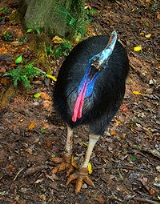
Females are bigger and more brightly coloured. Adult Southern Cassowaries are 1.5 to 1.8 m (4.9 to 5.9 ft) tall, although some females may reach 2 metres (6.6 ft), and weigh 58.5 kilograms (129 lb).

All cassowaries have feathers that consist of a shaft and loose barbules. They do not have retrices (tail feathers) or a preen gland. Cassowaries have small wings with 5-6 large remeges. These are reduced to stiff, keratinous quills, like porcupine quills, with no barbs. A claw is on each second finger. The furcula
Furcula
The ' is a forked bone found in birds, formed by the fusion of the two clavicles. In birds, its function is the strengthening of the thoracic skeleton to withstand the rigors of flight....

 and coracoid are degenerate, and their palatal bones and sphenoid
Sphenoid bone
The sphenoid bone is an unpaired bone situated at the base of the skull in front of the temporal bone and basilar part of the occipital bone.The sphenoid bone is one of the seven bones that articulate to form the orbit...

 bones touch each other. These, along with their wedge-shaped body, are thought to be adaptations to ward off vines, thorns and saw-edged leaves, allowing them to run quickly through the rainforest.

A cassowary's three-toe
Toe
Toes are the digits of the foot of a tetrapod. Animal species such as cats that walk on their toes are described as being digitigrade. Humans, and other animals that walk on the soles of their feet, are described as being plantigrade; unguligrade animals are those that walk on hooves at the tips of...

d feet have sharp claw
Claw
A claw is a curved, pointed appendage, found at the end of a toe or finger in most mammals, birds, and some reptiles. However, the word "claw" is also often used in reference to an invertebrate. Somewhat similar fine hooked structures are found in arthropods such as beetles and spiders, at the end...

s. The second toe, the inner one in the medial position, sports a dagger
Dagger
A dagger is a fighting knife with a sharp point designed or capable of being used as a thrusting or stabbing weapon. The design dates to human prehistory, and daggers have been used throughout human experience to the modern day in close combat confrontations...

-like claw that is 125 millimetres (4.9 in) long. This claw is particularly fearsome since cassowaries sometimes kick humans and animals with their enormously powerful legs (see Cassowary Attacks, below). Cassowaries can run up to 50 km/h (31 mph) through the dense forest. They can jump up to 1.5 metres (4.9 ft) and they are good swimmers, crossing wide rivers and swimming in the sea as well.


All three species have horn-like but soft and spongy crests called casque
Casque
Casque can refer to:* French word for helmet* An enlargement on the upper mandible of the bill of some species of birds, including many hornbills*Hornbill ivory: the casque of the Helmeted Hornbill, collected as a decorative material...

s on their heads, up to 18 cm (7.1 in). These consist of "a keratin
Keratin
Keratin refers to a family of fibrous structural proteins. Keratin is the key of structural material making up the outer layer of human skin. It is also the key structural component of hair and nails...

ous skin over a core of firm, cellular foam-like material". Several purposes for the casques have been proposed. One possibility is that they are secondary sexual characteristics. Other suggestions include that they are used to batter through underbrush, as a weapon for dominance disputes, or as a tool for pushing aside leaf litter during foraging. The latter three are disputed by biologist Andrew Mack, whose personal observation suggests that the casque amplifies deep sounds. However, the earlier article by Crome and Moore says that the birds do lower their heads when they are running "full tilt through the vegetation, brushing saplings aside and occasionally careening into small trees. The casque would help protect the skull from such collisions." From an engineering perspective the wedge shaped casque is also the most efficient way to protect the head by deflecting falling fruit. As cassowaries live on fallen fruit they spend a lot of time under trees where seeds the size of golfballs or larger are dropping from heights of up to 30 metres. Mack and Jones also speculate that the casques play a role in either sound reception or acoustic communication. This is related to their discovery that at least the Dwarf Cassowary and Southern Cassowary produce very-low frequency sounds, which may aid in communication in dense rainforest. This "boom" is the lowest known bird call, and is on the edge of human hearing.

The average lifespan of wild cassowaries is believed to be about 40 to 50 years.

Behaviour


Cassowaries are solitary birds except during courtship, egg-laying, and sometimes around ample food supplies. Male cassowaries defend a territory of about 7 square kilometres (1,729.7 acre) for itself and its mate, while females have overlapping territories of several males.

Reproductive


The breeding season starts in May or June. Females lay three to eight large, dark bright green or pale green-blue egg
Egg (biology)
An egg is an organic vessel in which an embryo first begins to develop. In most birds, reptiles, insects, molluscs, fish, and monotremes, an egg is the zygote, resulting from fertilization of the ovum, which is expelled from the body and permitted to develop outside the body until the developing...

s in each clutch into a prepared heap of leaf litter. These eggs measure about 9 by — only Ostrich and Emu eggs are larger. The female does not care for the eggs or the chicks but moves on to lay eggs in the nests of several other males. The male incubate
Avian incubation
Incubation refers to the process by which certain oviparous animals hatch their eggs, and to the development of the embryo within the egg. The most vital factor of incubation is the constant temperature required for its development over a specific period. Especially in domestic fowl, the act of...

s the eggs for 50–52 days, removing or adding litter to regulate the temperature, then protects the brown-striped chicks who stay in the nest for about nine months, defending them fiercely against all potential predators, including humans. The young males then go off to find a territory of their own.

"Young cassowaries are brown and have buffy stripes. They are often kept as pets in native villages [in New Guinea], where they are permitted to roam like barnyard fowl. Often they are kept until they become nearly grown and someone gets hurt. Mature cassowaries are placed beside native houses in cribs hardly larger than the birds themselves. Garbage and other vegetable food is fed them, and they live for years in such enclosures; for in some areas their plumage is still as valuable as shell money. Caged birds are regularly bereft of their fresh plumes."


Diet


Cassowaries are predominantly frugivorous, but they will take flowers, fungi, snails, insects, frogs, birds, fish, rats, mice, and carrion. Fruit from at least twenty-six plant families have been documented in the diet of cassowaries. Fruits from the laurel, podocarp, palm, wild grape, nightshade, and myrtle families are important items in the diet. The cassowary plum
Cassowary plum
The cassowary plum is a species of Cerbera native to New Guinea and Tropical North Queensland in Australia...

 takes its name from the bird.

Where trees are dropping fruit, cassowaries will come in and feed, with each bird defending a tree from others for a few days. They move on when the fruit is depleted. Fruit is swallowed whole, even items as large as bananas and apples.

Cassowaries are a keystone species
Keystone species
A keystone species is a species that has a disproportionately large effect on its environment relative to its abundance. Such species play a critical role in maintaining the structure of an ecological community, affecting many other organisms in an ecosystem and helping to determine the types and...

 of rain forests because they eat fallen fruit whole and distribute seeds across the jungle floor via excrement.

As for eating the Cassowary, it is supposed to be quite tough. Australian administrative officers stationed in New Guinea were advised that it "should be cooked with a stone in the pot: when the stone is ready to eat so is the Cassowary".

Distribution and habitat


Cassowaries are native to the humid rainforests of New Guinea and nearby smaller islands, and northeastern Australia. They will, however, venture out into palm scrub, grassland
Grassland
Grasslands are areas where the vegetation is dominated by grasses and other herbaceous plants . However, sedge and rush families can also be found. Grasslands occur naturally on all continents except Antarctica...

, savanna
Savanna
A savanna, or savannah, is a grassland ecosystem characterized by the trees being sufficiently small or widely spaced so that the canopy does not close. The open canopy allows sufficient light to reach the ground to support an unbroken herbaceous layer consisting primarily of C4 grasses.Some...

, and swamp forest. It is unclear if some islands' populations are natural or the result of trade in young birds by natives.

Threats


The Southern Cassowary is endangered in Queensland, Australia. Kofron and Chapman (2006) assessed the decline of this species. They found that, of the former cassowary habitat, only 20 - 25% remains. They stated that habitat loss and fragmentation is the primary cause of decline. They then studied 140 cases of cassowary mortality and found that motor vehicle strikes accounted for 55% of them, and dog attacks produced another 18%. Remaining causes of death included hunting (5 cases), entanglement in wire (1 case), the removal of cassowaries that attacked humans (4 cases), and natural causes (18 cases), including tuberculosis (4 cases). 14 cases were for unknown reasons.

Hand feeding of cassowaries poses a big threat to their survival, because it lures them into suburban areas. There, the birds are more susceptible to vehicles and dogs. Contact with humans encourages cassowaries to take food from picnic tables.

Feral pigs are a huge problem. They destroy nests and eggs but their worst effect is as competitors for food, which could be catastrophic for the cassowaries during lean times.

In February 2011 Cyclone Yasi
Cyclone Yasi
Severe Tropical Cyclone Yasi was a tropical cyclone that made landfall in northern Queensland, Australia in the early hours of Thursday, 3 February 2011. Yasi originated from a tropical low near Fiji. The system intensified to a Category 3 cyclone at about 5pm AEST on 31 January 2011...

 destroyed a large area of cassowary habitat, endangering 200 of the birds, around 10% of the total Australian population.

Cassowary attacks


Cassowaries have a reputation for being dangerous to people and domestic animals. During World War II
World War II
World War II, or the Second World War , was a global conflict lasting from 1939 to 1945, involving most of the world's nations—including all of the great powers—eventually forming two opposing military alliances: the Allies and the Axis...

 American and Australian troops stationed in New Guinea were warned to steer clear of them. In his book "Living Birds of the World" from 1958, ornithologist Thomas E. Gilliard wrote:
"The inner or second of the three toes is fitted with a long, straight, murderous nail which can sever an arm or eviscerate an abdomen with ease. There are many records of natives being killed by this bird."


However, Gilliard did not include any such records or any references for them, and although this assessment of the danger posed by cassowaries has been repeated in print by authors including Gregory S. Paul (1988) and Jared Diamond
Jared Diamond
Jared Mason Diamond is an American scientist and author whose work draws from a variety of fields. He is currently Professor of Geography and Physiology at UCLA...

 (1997), recent research on hundreds of cassowary attacks has only been able to find one human death.
A 2003 study of attacks by the Southern Cassowary in Queensland found no wounds larger than punctures about 1.5 cm in diameter. Of 221 attacks studied, 150 were against humans. 75% of these were from cassowaries that had been fed by people. 71% of the time the bird chased or charged the victim. 15% of the time they kicked. Of the attacks, 73% involved the birds expecting or snatching food, 5% involved defending natural food sources, 15% involved defending themselves from attack, 7% involved defending their chicks or eggs. Of all 150 attacks there was only one human death.

The one documented human death caused by a cassowary was on 6 April 1926. 16-year old Phillip McClean and his brother, aged 13, came across a cassowary on their property and decided to kill it by striking it with clubs. The bird kicked the younger boy, who fell and ran away as his older brother struck the bird. The cassowary then charged and knocked the older McClean to the ground and kicked him in the neck, opening a 1.25 cm (0.492125984251969 in) wound. The boy managed to escape, but died shortly afterwards as a result of his injuries.

Cassowary strikes to the abdomen are among the rarest of all, but there is one case of a dog that was kicked in the belly in 1995. The blow left no puncture, but there was severe bruising. The dog later died from an apparent intestinal rupture.

Role in seed dispersal and germination


Cassowaries feed on the fruits of several hundred rainforest species and usually pass viable seeds in large dense scat
Scat
-Education:* School and College Ability Test* Somerset College of Arts and Technology, a community college in Somerset, England* Shrewsbury College of Arts & Technology, a community college in Shropshire, England-Games:* Thirty-one , a card game...

s. They are known to disperse seeds over distances greater than a kilometre, and thus play an important role in the ecosystem. Germination rates for seeds of the rare Australian rainforest tree Ryparosa
Ryparosa
Ryparosa is a genus of plant in family Achariaceae.Species include:* Ryparosa fasciculata, King* Ryparosa scortechinii, King...

were found to be much higher after passing through a cassowary's gut (92% versus 4%).

Cited texts

  • Borrell, Brendan. 2008. Invasion of the Cassowaries. Smithsonian magazine, October 2008
  • Buzzle.com The Cassowary Bird
  • Clark, Philip (ed), (1990) Stay in Touch The Sydney Morning Herald
    The Sydney Morning Herald
    The Sydney Morning Herald is a daily broadsheet newspaper published by Fairfax Media in Sydney, Australia. Founded in 1831 as the Sydney Herald, the SMH is the oldest continuously published newspaper in Australia. The newspaper is published six days a week. The newspaper's Sunday counterpart, The...

    , 5 November 1990. Cites "authorities" for the death claim.
  • Crome, F., and L. Moore. (1988) The cassowary’s casque. Emu 88:123–124.
  • Davies, S. J. J. F. (2002). Ratites and Tinamous. Oxford University Press. ISBN 0-19-854996-2
  • Kofron, Christopher P. (1999) "Attacks to humans and domestic animals by the southern cassowary (Casuarius casuarius johnsonii) in Queensland, Australia
  • Kofron, Christopher P. (2003) "Case histories of attacks by the southern cassowary in Queensland" Memoirs of the Queensland Museum 49(1) 335-338
  • Kofron, Christopher P., Chapman, Angela. (2006) "Causes of mortality to the endangered Southern Cassowary Casuarius casuariusjohnsonii in Queensland, Australia." Pacific Conservation Biology vol. 12: 175-179
  • Mack, A.L. & Jones, J (2003) Low-frequency vocalizations by cassowaries (Casuarius spp.) The Auk 120(4):1062–1068
  • Owen, J. (2003). Does Rain Forest Bird "Boom" Like a Dinosaur?. National Geographic News.
  • Paul, Gregory S. (1988) Predatory Dinosaurs of the World. Simon and Schuster, New York, USA. pg. 364, 464pp.
  • Readers' Digest, June 2006 issue.
  • Underhill, D (1993) Australia's Dangerous Creatures, Reader's Digest, Sydney, New South Wales, ISBN 0-86438-018-6
  • Weber, B.L. & Woodrow, I.E. Functional Plant Biology "Cassowary frugivory, seed dmelindholhauserefleshing and fruit fly infestation influence the transition from seed to seedling in the rare Australian rainforest tree, Ryparosa sp. nov. 1 (Achariaceae)." 31: 505-516

External links