
Home      Discussion      Topics      Dictionary      Almanac
Signup       Login
Emu

Emu

Overview
The Emu is the largest bird
Bird
Birds are feathered, winged, bipedal, endothermic , egg-laying, vertebrate animals. Around 10,000 living species and 188 families makes them the most speciose class of tetrapod vertebrates. They inhabit ecosystems across the globe, from the Arctic to the Antarctic. Extant birds range in size from...

 native to Australia
Australia
Australia , officially the Commonwealth of Australia, is a country in the Southern Hemisphere comprising the mainland of the Australian continent, the island of Tasmania, and numerous smaller islands in the Indian and Pacific Oceans. It is the world's sixth-largest country by total area...

 and the only extant member of the genus
Genus
In biology, a genus is a low-level taxonomic rank used in the biological classification of living and fossil organisms, which is an example of definition by genus and differentia...

 Dromaius
Dromaius
Dromaius is a genus of ratite present in Australia. There is one extant species, Dromaius novaehollandiae commonly known as the Emu.In his original 1816 description of the emu, Louis Jean Pierre Vieillot used two generic names; first Dromiceius, then Dromaius a few pages later...

. It is the second-largest extant bird in the world by height, after its ratite
Ratite
A ratite is any of a diverse group of large, flightless birds of Gondwanan origin, most of them now extinct. Unlike other flightless birds, the ratites have no keel on their sternum—hence the name from the Latin ratis...

 relative, the ostrich
Ostrich
The Ostrich is one or two species of large flightless birds native to Africa, the only living member of the genus Struthio. Some analyses indicate that the Somali Ostrich may be better considered a full species apart from the Common Ostrich, but most taxonomists consider it to be a...

. There are three subspecies of Emus in Australia. The Emu is common over most of mainland Australia, although it avoids heavily populated areas, dense forest, and arid areas.
Discussion
Ask a question about 'Emu'
Start a new discussion about 'Emu'
Answer questions from other users
Full Discussion Forum
 
Recent Discussions
Emu
Encyclopedia
The Emu is the largest bird
Bird
Birds are feathered, winged, bipedal, endothermic , egg-laying, vertebrate animals. Around 10,000 living species and 188 families makes them the most speciose class of tetrapod vertebrates. They inhabit ecosystems across the globe, from the Arctic to the Antarctic. Extant birds range in size from...

 native to Australia
Australia
Australia , officially the Commonwealth of Australia, is a country in the Southern Hemisphere comprising the mainland of the Australian continent, the island of Tasmania, and numerous smaller islands in the Indian and Pacific Oceans. It is the world's sixth-largest country by total area...

 and the only extant member of the genus
Genus
In biology, a genus is a low-level taxonomic rank used in the biological classification of living and fossil organisms, which is an example of definition by genus and differentia...

 Dromaius
Dromaius
Dromaius is a genus of ratite present in Australia. There is one extant species, Dromaius novaehollandiae commonly known as the Emu.In his original 1816 description of the emu, Louis Jean Pierre Vieillot used two generic names; first Dromiceius, then Dromaius a few pages later...

. It is the second-largest extant bird in the world by height, after its ratite
Ratite
A ratite is any of a diverse group of large, flightless birds of Gondwanan origin, most of them now extinct. Unlike other flightless birds, the ratites have no keel on their sternum—hence the name from the Latin ratis...

 relative, the ostrich
Ostrich
The Ostrich is one or two species of large flightless birds native to Africa, the only living member of the genus Struthio. Some analyses indicate that the Somali Ostrich may be better considered a full species apart from the Common Ostrich, but most taxonomists consider it to be a...

. There are three subspecies of Emus in Australia. The Emu is common over most of mainland Australia, although it avoids heavily populated areas, dense forest, and arid areas.

The soft-feathered, brown, flightless bird
Flightless bird
Flightless birds are birds which lack the ability to fly, relying instead on their ability to run or swim. They are thought to have evolved from flying ancestors. There are about forty species in existence today, the best known being the ostrich, emu, cassowary, rhea, kiwi, and penguin...

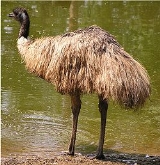
s reach up to 2 metres (6.6 ft) in height. They have long thin necks and legs. Emus can travel great distances at a fast, economical trot and, if necessary, can sprint at 50 km/h (31 mph) for some distance at a time. Their long legs allow them to take strides of up to 275 centimetres (9 ft) They are opportunistically nomadic and may travel long distances to find food; they feed on a variety of plants and insects, but have been known to go weeks without food. Emus ingest stones, glass shards and bits of metal to grind food in the digestive system. They drink infrequently, but take in copious fluids when the opportunity arises. Emus will sit in water and are also able to swim. They are curious birds who are known to follow and watch other animals and humans. Emus do not sleep continuously at night but in several short stints sitting down.

Emus use their strongly clawed feet as a defence mechanism. Their legs are among the strongest of any animals, allowing them to rip metal wire fences. They are endowed with good eyesight and hearing, which allows them to detect predators in the vicinity. The plumage varies regionally, matching the surrounding environment and improving its camouflage. The feather structure prevents heat from flowing into the skin, permitting Emus to be active during the midday heat. They can tolerate a wide range of temperatures and thermoregulate
Thermoregulation
Thermoregulation is the ability of an organism to keep its body temperature within certain boundaries, even when the surrounding temperature is very different...

 effectively. Males and females are hard to distinguish visually, but can be differentiated by the types of loud sounds they emit by manipulating an inflatable neck sac. Emus breed in May and June and are not monogamous; fighting among females for a mate is common. Females can mate several times and lay several batches of eggs in one season. The animals put on weight before the breeding season, and the male does most of the incubation, losing significant weight during this time as he does not eat. The eggs hatch after around eight weeks, and the young are nurtured by their fathers. They reach full size after around six months, but can remain with their family until the next breeding season half a year later. Emus can live between 10 and 20 years in the wild and are predated by dingo
Dingo
The Australian Dingo or Warrigal is a free-roaming wild dog unique to the continent of Australia, mainly found in the outback. Its original ancestors are thought to have arrived with humans from southeast Asia thousands of years ago, when dogs were still relatively undomesticated and closer to...

s, eagles and hawks. They can jump and kick to avoid dingos, but against eagles and hawks, they can only run and swerve.

The Tasmanian Emu
Tasmanian Emu
The Tasmanian Emu is an extinct subspecies of the Emu. It was found on Tasmania where it had become isolated during the Late Pleistocene...

 and King Island Emu
King Island Emu
The King Island Emu or Black Emu is an extinct sub-species of emu which occurred on King Island between mainland Australia and Tasmania. It is known from 19th century descriptions of live birds, as well as subfossil bones and one museum specimen...

 subspecies that previously inhabited Tasmania
Tasmania
Tasmania is an Australian island and state. It is south of the continent, separated by Bass Strait. The state includes the island of Tasmania—the 26th largest island in the world—and the surrounding islands. The state has a population of 507,626 , of whom almost half reside in the greater Hobart...

 and King Island
King Island
King Island, Kings Island or King's Island may refer to:Australia* King Island * King Island ** King Island AirportCanada* King Island * King Island * King Island USA...

 became extinct after the European settlement of Australia in 1788; and the distribution of the mainland subspecies has been influenced by human activities. Once common on the east coast, Emu are now uncommon; by contrast, the development of agriculture and the provision of water for stock in the interior of the continent have increased the range of the Emu in arid regions, and it is of Least Concern
Least Concern
Least Concern is an IUCN category assigned to extant taxon or lower taxa which have been evaluated but do not qualify for any other category. As such they do not qualify as threatened, Near Threatened, or Conservation Dependent...

 for conservation. They were a food and fuel source for indigenous Australians and early European settlers. Emus are farmed for their meat, oil
Emu oil
Emu oil is an oil made from the fat of the emu, Dromaius novaehollandiae, a bird native to Australia.Emu oil and eucalyptus oil have been used historically by the Australian aborigines for the treatment of fevers, coughs, arthritic joints, bruises, cuts and sores.Pure emu oil can vary widely in...

, and leather. Emu is a lean meat and while it is often claimed by marketers that the oil has anti-inflammatory and anti-oxidative effects, this has not been scientifically verified in humans. The Emu is an important cultural icon of Australia. It appears on the coat of arms
Coat of arms of Australia
The coat of arms of Australia is the official symbol of Australia. The initial coat of arms was granted by King Edward VII on 7 May 1908, and the current version was granted by King George V on 19 September 1912, although the 1908 version continued to be used in some contexts, notably appearing on...

, various coins, features prominently in Indigenous Australian mythology, and hundreds of places are named after the bird.

Taxonomy


There are reports the Emu was first sighted by European explorers in 1696 when they made a brief visit to the coast of Western Australia. It was thought to have been spotted on the east coast of Australia before 1788 when the first European settlement occurred. It was first described under the name of the New Holland Cassowary in Arthur Phillip's
Arthur Phillip
Admiral Arthur Phillip RN was a British admiral and colonial administrator. Phillip was appointed Governor of New South Wales, the first European colony on the Australian continent, and was the founder of the settlement which is now the city of Sydney.-Early life and naval career:Arthur Phillip...

 Voyage to Botany Bay, published in 1789. The species was named by ornithologist John Latham
John Latham (ornithologist)
John Latham was an English physician, naturalist and author. He was born at Eltham in Kent, and was the eldest son of John Latham, a surgeon there, and his mother was a descendant of the Sothebys, in Yorkshire....

 on a specimen from the Sydney
Sydney
Sydney is the most populous city in Australia and the state capital of New South Wales. Sydney is located on Australia's south-east coast of the Tasman Sea. As of June 2010, the greater metropolitan area had an approximate population of 4.6 million people...

, Australia
Australia
Australia , officially the Commonwealth of Australia, is a country in the Southern Hemisphere comprising the mainland of the Australian continent, the island of Tasmania, and numerous smaller islands in the Indian and Pacific Oceans. It is the world's sixth-largest country by total area...

 area, which was referred to as New Holland
New Holland (Australia)
New Holland is a historic name for the island continent of Australia. The name was first applied to Australia in 1644 by the Dutch seafarer Abel Tasman as Nova Hollandia, naming it after the Dutch province of Holland, and remained in use for 180 years....

 at the time. He collaborated on Phillip's book and provided the first descriptions of and names for many Australian bird species; its name is Latin for "fast-footed New Hollander
New Holland (Australia)
New Holland is a historic name for the island continent of Australia. The name was first applied to Australia in 1644 by the Dutch seafarer Abel Tasman as Nova Hollandia, naming it after the Dutch province of Holland, and remained in use for 180 years....

". The etymology
Etymology
Etymology is the study of the history of words, their origins, and how their form and meaning have changed over time.For languages with a long written history, etymologists make use of texts in these languages and texts about the languages to gather knowledge about how words were used during...

 of the common name Emu is uncertain, but is thought to have come from an Arabic word for large bird that was later used by Portuguese explorers to describe the related Cassowary
Cassowary
The cassowaries are ratites, very large flightless birds in the genus Casuarius native to the tropical forests of New Guinea, nearby islands and northeastern Australia. There are three extant species recognized today...

 in Australia and New Guinea
New Guinea
New Guinea is the world's second largest island, after Greenland, covering a land area of 786,000 km2. Located in the southwest Pacific Ocean, it lies geographically to the east of the Malay Archipelago, with which it is sometimes included as part of a greater Indo-Australian Archipelago...

. Another theory is that it comes from the word "ema", which is used in Portuguese to denote a large bird akin to an ostrich or crane. In Victoria, some terms for the Emu were Barrimal in the Dja Dja Wurrung
Dja Dja Wurrung
Dja Dja Wurrung, also known as the Jaara people and Loddon River tribe, is a native Aboriginal tribe which occupied the watersheds of the Loddon and Avoca Rivers in the Bendigo region of central Victoria, Australia. They were part of the Kulin alliance of tribes. There were 16 clans, which adhered...

 language, myoure in Gunai
Gunai
The Gunai or Kurnai is an Indigenous Australian nation of south-east Australia whose territory occupied most of present-day Gippsland and much of the southern slopes of the Victorian Alps. The nation was not on friendly terms with the neighbouring Wurundjeri and Bunurong nations...

, and courn in Jardwadjali
Jardwadjali
The Jardwadjali people are Indigenous Australians who occupy the lands in the upper Wimmera River watershed east to Gariwerd and west to Lake Bringalbert. The towns of Horsham, Cavendish, Coleraine, Asply, Minyip and Donald are within their territory...

. It was known as murawung or birabayin to the local Eora
Eora
The Eora are the Aboriginal people of the Sydney area, south to the Georges River, north to the Hawkesbury River, and west to Parramatta. The indigenous people used this word to describe where they came from to the British. "Eora" was then used by the British to refer to those Aboriginal people...

 and Darug
Darug people
The Darug people are a language group of Indigenous Australians, who are traditional custodians of much of what is modern day Sydney. There is some dispute about the extent of the Darug nation. Some historians believe the coastal Eora people were a separate tribe to the Darug...

 inhabitants of the Sydney basin.

In his original 1816 description of the Emu, Vieillot
Louis Jean Pierre Vieillot
Louis Jean Pierre Vieillot was a French ornithologist.Vieillot described a large number of birds for the first time, especially those he encountered during the time he spent in the West Indies and North America, and 26 genera established by him are still in use...

 used two generic
Genus
In biology, a genus is a low-level taxonomic rank used in the biological classification of living and fossil organisms, which is an example of definition by genus and differentia...

 names; first Dromiceius, then Dromaius a few pages later. It has been a point of contention ever since which is correct; the latter is more correctly formed, but the convention in taxonomy
Alpha taxonomy
Alpha taxonomy is the discipline concerned with finding, describing and naming species of living or fossil organisms. This field is supported by institutions holding collections of these organisms, with relevant data, carefully curated: such institutes include natural history museums, herbaria and...

 is that the first name given stands, unless it is clearly a typographical error
Typographical error
A typographical error is a mistake made in, originally, the manual type-setting of printed material, or more recently, the typing process. The term includes errors due to mechanical failure or slips of the hand or finger, but usually excludes errors of ignorance, such as spelling errors...

. Most modern publications, including those of the Australian government, use Dromaius, with Dromiceius mentioned as an alternative spelling.

Classification


Although the Emu was long classified with its closest relatives, the cassowaries
Cassowary
The cassowaries are ratites, very large flightless birds in the genus Casuarius native to the tropical forests of New Guinea, nearby islands and northeastern Australia. There are three extant species recognized today...

, in the family Casuariidae
Casuariidae
The bird family Casuariidae has four surviving members: the three species of cassowary, and the only remaining species of Emu. The emus were formerly classified in their own family, Dromaiidae, but are regarded as sufficiently closely related to the cassowaries to be part of the same family.All...

, part of the ratite
Ratite
A ratite is any of a diverse group of large, flightless birds of Gondwanan origin, most of them now extinct. Unlike other flightless birds, the ratites have no keel on their sternum—hence the name from the Latin ratis...

 order Struthioniformes
Ratite
A ratite is any of a diverse group of large, flightless birds of Gondwanan origin, most of them now extinct. Unlike other flightless birds, the ratites have no keel on their sternum—hence the name from the Latin ratis...

, an alternate classification has been recently adopted which splits the Casuariidae into their own order, Casuariformes. Two different Dromaius
Dromaius
Dromaius is a genus of ratite present in Australia. There is one extant species, Dromaius novaehollandiae commonly known as the Emu.In his original 1816 description of the emu, Louis Jean Pierre Vieillot used two generic names; first Dromiceius, then Dromaius a few pages later...

species were common in Australia before European settlement, and one additional species is known from fossil remains. The small emus—D. baudinianus
Kangaroo Island Emu
Kangaroo Island Emu or Dwarf Emu is an extinct member of the bird family Casuariidae. It was restricted to Kangaroo Island, South Australia, which was known as Ile Decrés by the members of the Baudin expedition. It differed from the mainland Emu mainly in its smaller size...

and D. n. ater
King Island Emu
The King Island Emu or Black Emu is an extinct sub-species of emu which occurred on King Island between mainland Australia and Tasmania. It is known from 19th century descriptions of live birds, as well as subfossil bones and one museum specimen...

—both became extinct
Extinction
In biology and ecology, extinction is the end of an organism or of a group of organisms , normally a species. The moment of extinction is generally considered to be the death of the last individual of the species, although the capacity to breed and recover may have been lost before this point...

 shortly after the arrival of Europeans. D. novaehollandiae diemenensis, a subspecies known as the Tasmanian Emu
Tasmanian Emu
The Tasmanian Emu is an extinct subspecies of the Emu. It was found on Tasmania where it had become isolated during the Late Pleistocene...

, became extinct around 1865. However, the mainland sub-species of D. novaehollandiae, remain common. Their population size vary from decade to decade, largely dependent on rainfall; current estimates range from 625,000 to 725,000 birds, with 100,000–200,000 in Western Australia
Western Australia
Western Australia is a state of Australia, occupying the entire western third of the Australian continent. It is bounded by the Indian Ocean to the north and west, the Great Australian Bight and Indian Ocean to the south, the Northern Territory to the north-east and South Australia to the south-east...

 and the remainder mostly in New South Wales
New South Wales
New South Wales is a state of :Australia, located in the east of the country. It is bordered by Queensland, Victoria and South Australia to the north, south and west respectively. To the east, the state is bordered by the Tasman Sea, which forms part of the Pacific Ocean. New South Wales...

 and Queensland
Queensland
Queensland is a state of Australia, occupying the north-eastern section of the mainland continent. It is bordered by the Northern Territory, South Australia and New South Wales to the west, south-west and south respectively. To the east, Queensland is bordered by the Coral Sea and Pacific Ocean...

. Emus were introduced to Maria Island
Maria Island
Maria Island is a mountainous island off the east coast of Tasmania. The entire island is a national park. Maria Island National Park has a total area of 115.50 km², which includes a marine area of 18.78 km² off the island's northwest coast. The island is about 20 km in length from...

 off Tasmania and Kangaroo Island
Kangaroo Island
Kangaroo Island is Australia's third-largest island after Tasmania and Melville Island. It is southwest of Adelaide at the entrance of Gulf St Vincent. Its closest point to the mainland is off Cape Jervis, on the tip of the Fleurieu Peninsula in the state of South Australia. The island is long...

 near South Australia during the 20th century. While the Maria Island population became extinct in the mid 1990s, the Kangaroo Island birds have established a breeding population.

There are three extant subspecies
Subspecies
Subspecies in biological classification, is either a taxonomic rank subordinate to species, ora taxonomic unit in that rank . A subspecies cannot be recognized in isolation: a species will either be recognized as having no subspecies at all or two or more, never just one...

 in Australia:
  • In the southeast, D. novaehollandiae novaehollandiae, with its whitish ruff when breeding;
  • In the north, D. novaehollandiae woodwardi, slender and paler; and
  • In the southwest, D. novaehollandiae rothschildi, darker, with no ruff during breeding.


Examination of the King island Emu's DNA shows it to be closely related to the mainland Emu and hence best treated as a subspecies.

Description


Emus are large birds. The largest can reach up to 150 to 190 cm (59.1 to 74.8 in) in height, 1 to 1.3 m (3.3 to 4.3 ft) at the shoulder. Emus weigh between 18 and 55 kg (39.7 and 121.3 lb). Females are usually larger than males by a small amount, but substantially wider across the rump.

They have small vestigial wings that are around 20 centimetres (7.9 in) long and have a small claw at the tip of this wing. The Emu flaps its wings when it is running and it is believed that they stabilise the bird when it is moving. It has a long neck and legs. Their ability to run at high speeds, 48 km/h (30 mph), is due to their highly specialised pelvic limb musculature. Their feet have only three toes and a similarly reduced number of bones and associated foot muscles; they are the only birds with gastrocnemius muscle
Gastrocnemius muscle
In humans, the gastrocnemius muscle is a very powerful superficial pennate muscle that is in the back part of the lower leg. It runs from its two heads just above the knee to the heel, and is involved in standing, walking, running and jumping. Along with the soleus muscle it forms the calf muscle...

s in the back of the lower legs. The pelvic limb muscles of emus have a similar contribution to total body mass as the flight muscles of flying birds. When walking, the Emu takes steps of around 100 centimetres (3.3 ft), but at full gallop, a stride can be as long as 275 centimetres (9 ft). Its legs are devoid of feathers and underneath its feet are thick, cushioned pads. Like the Cassowary, the Emu has sharp claws on its toes which are its major defensive attribute. This is used in combat to inflict wounds on opponents by kicking. The toe and claw are a total of 15 centimetres (5.9 in). They have a soft bill, adapted for grazing.

The Emu has good eyesight and hearing, which allows it to detect nearby threats. Its legs are among the strongest of any animals, powerful enough to tear down metal wire fences.

The neck of the Emu is pale blue and shows through its sparse feathers. They have brown to grey-brown plumage of shaggy appearance; the shafts and the tips of the feather
Feather
Feathers are one of the epidermal growths that form the distinctive outer covering, or plumage, on birds and some non-avian theropod dinosaurs. They are considered the most complex integumentary structures found in vertebrates, and indeed a premier example of a complex evolutionary novelty. They...

s are black. Solar radiation is absorbed by the tips, and the loose-packed inner plumage
Plumage
Plumage refers both to the layer of feathers that cover a bird and the pattern, colour, and arrangement of those feathers. The pattern and colours of plumage vary between species and subspecies and can also vary between different age classes, sexes, and season. Within species there can also be a...

 insulates the skin. The resultant heat is prevented from flowing to the skin by the insulation provided by the coat, allowing the bird to be active during the heat of the day. A unique feature of the Emu feather is its double rachis emerging from a single shaft. Both of the rachis have the same length, and the texture is variable; the near the quill it is rather furry, but the external ends resemble grass. The sexes are similar in appearance, although the male's penis can become visible when it defecates. The plumage varies in colour due to environmental factors, giving the bird a natural camouflage. Feathers of Emus in more arid area with red soil have a similarly tinted plumage but are darker in animals residing in damp conditions.

The eyes of an Emu are protected by nictitating membranes. These are translucent, secondary eyelids that move from the end of the eye closest to the beak to cover the other side. This is used by the Emu as a protective visor to protect its eyes from dust that is prevalent in windy and arid deserts. The Emu also has a tracheal pouch, which becomes more prominent during the mating season. It is often used during courting, and it has speculated that it is used for communication on a day-to-day basis. The pouch is more than 30 centimetres (11.8 in), is spacious and the wall in very thin. Its opening's width is only 8 centimetres (3.1 in). The quantity of air that goes through the pouch, as determined by the Emu deciding to open or close it, affects the pitch of an Emu's call. Females typically cry more loudly than males.

On very hot days, emus pant to maintain their body temperature
Thermoregulation
Thermoregulation is the ability of an organism to keep its body temperature within certain boundaries, even when the surrounding temperature is very different...

, their lungs work as evaporative
Evaporation
Evaporation is a type of vaporization of a liquid that occurs only on the surface of a liquid. The other type of vaporization is boiling, which, instead, occurs on the entire mass of the liquid....

 coolers and, unlike some other species, the resulting low levels of carbon dioxide
Carbon dioxide
Carbon dioxide is a naturally occurring chemical compound composed of two oxygen atoms covalently bonded to a single carbon atom...

 in the blood do not appear to cause alkalosis
Alkalosis
Alkalosis refers to a condition reducing hydrogen ion concentration of arterial blood plasma . Generally, alkalosis is said to occur when pH of the blood exceeds 7.45. The opposite condition is acidosis .-Causes:...

. For normal breathing in cooler weather, they have large, multifolded nasal passages. Cool air warms as it passes through into the lungs, extracting heat from the nasal region. On exhalation, the Emu's cold nasal turbinates condense moisture back out of the air and absorb it for reuse. As with other ratites, the Emu has great homeothermic ability, and can maintain this status from -5 to 45 degrees. The thermoneutral zone of Emus lies between 10–15 degrees and 30 degrees.

As with other ratites, the Emu has a relatively low rate of metabolism compared to other types of birds, but the rate depends on activity, especially due to resulting changes to thermodynamics. At -5 degrees, the metabolism rate of an Emu while sitting down is around 60% of the value for one that is standing, as the lack of feathers under its stomach leads to a higher rate of heat loss when it is standing up and exposing the underbelly.
Their calls consist of loud booming, drumming, and grunting sounds that can be heard up to 2 kilometres (1.2 mi) away. The booming sound is created in an inflatable neck sac that is 30 cm (11.8 in) long and thin-walled. The different sounds produced can be used to distinguish males and females. The loud booming caused by inflation of the cervical sac corresponds to females, while loud grunts are limited to male Emus.

Ecology and behaviour


Emus live in most habitats across Australia, although they are most common in areas of sclerophyll
Sclerophyll
Sclerophyll is the term for a type of vegetation that has hard leaves and short internodes . The word comes from the Greek sclero and phyllon ....

 forest and savanna
Savanna
A savanna, or savannah, is a grassland ecosystem characterized by the trees being sufficiently small or widely spaced so that the canopy does not close. The open canopy allows sufficient light to reach the ground to support an unbroken herbaceous layer consisting primarily of C4 grasses.Some...

 woodland, and least common in populated and very arid areas, except during wet periods. Emus predominately travel in pairs, and while they can form enormous flocks, this is an atypical social behaviour that arises from the common need to move towards food sources. Emus have been shown to travel long distances to reach abundant feeding areas. In Western Australia
Western Australia
Western Australia is a state of Australia, occupying the entire western third of the Australian continent. It is bounded by the Indian Ocean to the north and west, the Great Australian Bight and Indian Ocean to the south, the Northern Territory to the north-east and South Australia to the south-east...

, Emu movements follow a distinct seasonal pattern—north in summer and south in winter. On the east coast their wanderings do not appear to follow a pattern. Emus are also able to swim when necessary, although they rarely do so unless the area is flooded or they need to cross a river.

They are also known to be inquisitive animals, and are known to approach humans if they see movement of a limb or a piece of clothing. They may follow and observe humans in the wild. Sometimes they poke other animals and then run away after drawing a reaction, as though they are playing a game. An Emu spends much of its time preening its plumage with its beak.

Emus sleep during the night, and begin to settle down at sunset, although it does not sleep continuously throughout the night. It can awake and arise up to eight times per night in order to feed or defecate. Before going into a deep sleep, the Emu squats on its tarsus and begins to enter a drowsy state. However, it is alert enough to react to visual or aural stimuli and return to an awakened state. During this time, the neck descends closer to the body and the eyelids begin to lower. If there are no aural or visual disturbances, it will go into a deep form of sleep after 20 minutes. During this time the body is lowered until it is touching the ground and its legs are folded. The feathers direct any rain downwards along the mound-like body into the ground, and it has been surmised that the sleeping position is a type of camouflage meant to mimic a small hill. The neck is brought down very low and the beak turned down so that the whole neck becomes S-shaped and folding onto itself. An Emu will typically awake from the deep sleep one every 90–120 minutes and stand in a tarsal position to eat or defecate. This lasts for 10–20 minutes and the cycle is repeated 4–6 times during most nights. Overall, an Emu sleeps for around seven hours every day. Young Emus are known to sleep with their neck flat and stretching forward along the ground surface.

Diet


Emus forage in a diurnal pattern. They eat a variety of native and introduced plant species; the type of plants eaten depends on seasonal availability. They also eat insects, including grasshopper
Grasshopper
The grasshopper is an insect of the suborder Caelifera in the order Orthoptera. To distinguish it from bush crickets or katydids, it is sometimes referred to as the short-horned grasshopper...

s and cricket
Cricket (insect)
Crickets, family Gryllidae , are insects somewhat related to grasshoppers, and more closely related to katydids or bush crickets . They have somewhat flattened bodies and long antennae. There are about 900 species of crickets...

s, lady birds
Coccinellidae
Coccinellidae is a family of beetles, known variously as ladybirds , or ladybugs . Scientists increasingly prefer the names ladybird beetles or lady beetles as these insects are not true bugs...

, soldier and saltbush caterpillars, Bogong
Bogong moth
The Bogong moth is a temperate species of night-flying moth notable for appearing in large numbers around major public buildings in Canberra, the capital city of Australia, during spring as it migrates to the High Plains. The moth's name 'Bogong' is the same as the mountain ranges on the High...

 and cotton-boll
Heliothis
Heliothis is a genus of moths, whose larvae are agricultural pests on crop species such as tobacco, cotton, soybean and pigeon pea. Several of the species formerly placed in this genus are now in the genus Helicoverpa.-Species:...

 moth larvae and ants. This forms a large part of its protein requirements and intake. In Western Australia, food preferences have been observed in travelling Emus: they eat seeds from Acacia aneura until it rains, after which they eat fresh grass shoots and caterpillars; in winter they feed on the leaves and pods of Cassia
Senna obtusifolia
Senna obtusifolia is a legume in the genus Senna, sometimes separated in the monotypic genus Diallobus. It grows wild in North, Central, and South America, Asia, Africa, and Oceania, and is considered a particularly serious weed in many places...

; in spring, they feed on grasshoppers and the fruit of Santalum acuminatum
Santalum acuminatum
Santalum acuminatum, the desert quandong, is a hemiparasitic plant in the Sandalwood family Santalaceae, widely dispersed throughout the central deserts and southern areas of Australia....

: a sort of quandong
Quandong
Quandong, quandang or quondong, is a common name for the species Santalum acuminatum , especially its edible fruit, but may also refer to* Aceratium concinnum...

. They are also known to eat wheat crops, and any fruit or other crops that it can access, easily climbing over high fences if required. Emus serve as an important agent for the dispersal of large viable seeds, which contributes to floral biodiversity. One undesirable effect of this occurred in Queensland in the 1930s and 1940s when Emus ate cactus in the outback there. They defecated the seeds in various places as they moved around, spreading the unwanted plant. This led to constant hunting campaigns to stop the cactus from being spread.

Emus also require pebbles and stones to assist in the digestion of the plant material. Individual stones may weigh 45 g (1.6 oz) and they may have as much as 745 g (1.6 lb) in their gizzard
Gizzard
The gizzard, also referred to as the ventriculus, gastric mill, and gigerium, is an organ found in the digestive tract of some animals, including birds, reptiles, earthworms and some fish. This specialized stomach constructed of thick, muscular walls is used for grinding up food; often rocks are...

 at one time. They also eat charcoal, however scientists still have not ascertained why. Captive Emus are also known to eat shards of glass, marbles, car keys, jewellery and nuts and bolts.

Emus drink at infrequent intervals, but ingest large amounts when they do so. They typically inspect the water body in groups for a period before kneeling down at the edge of the water and drinking. They are observed to prefer kneeling on solid earth while drinking, rather than in rocks or mud, presumably due to a fear of sinking. They often drink continuously for 10 minutes, unless disturbed by danger, in which case they interrupt themselves to deal with the threat before resuming. Due to the arid environment, they often go one or two days without finding a source of water and drinking. They typically drink once per day or night, but can do so several times daily if supply is abundant. In the wild, they often share water sources with kangaroos, birds and wild camels and donkeys that were let loose by European settlers. Emus are suspicious of these other species and tend to wait in bushes and wait for other types of animals to leave; they choose to drink separately to the other animals. If an Emu sense abnormal circumstances or a threat, it drinks while standing.

Breeding


Emus form breeding pairs during the summer months of December and January, and may remain together for about five months. During this time they wander around in an area a few miles in diameter. It is believed they guard or find territory during this time. Both males and females increase in weight during this time and the female is slightly heavier at between 45 and 58 kg. This weight is lost during the incubation period, the males losing around 9 kg. Mating occurs in the cooler months of May and June, and the exact timing is determined by the climate, as the birds nest during the coldest part of the year. During the breeding season, males experience hormonal changes, including an increase in luteinizing hormone
Luteinizing hormone
Luteinizing hormone is a hormone produced by the anterior pituitary gland. In females, an acute rise of LH called the LH surge triggers ovulation and development of the corpus luteum. In males, where LH had also been called interstitial cell-stimulating hormone , it stimulates Leydig cell...

 and testosterone
Testosterone
Testosterone is a steroid hormone from the androgen group and is found in mammals, reptiles, birds, and other vertebrates. In mammals, testosterone is primarily secreted in the testes of males and the ovaries of females, although small amounts are also secreted by the adrenal glands...

 levels, and their testicle
Testicle
The testicle is the male gonad in animals. Like the ovaries to which they are homologous, testes are components of both the reproductive system and the endocrine system...

s double in size.

It is the females that court the males, and during the mating season, they become physically more attractive. The female's plumage darkens slightly and the small patches of bare, hairless skin just below the eyes and near the beaks turn turquoise-blue, although this is a subtle change. The female strides around confidently, often circling the male, and pulls its neck back while puffing out her feathers and crying out a low, monosyllabic sound that has been compared to human drums. This calling can occur when the males are not in view and more than 50 metres (164 ft) away and when the male's attention has been gained, the female can circle in a radius of 10–40 m. As the female circles its prospective mate, it continues to look towards him by turning its neck, while keeping its rump facing him. During this time, the female's cervical air sac may remain inflated as it calls outs. The passive male retains the same colour hair, although the bare patches of skin also turn a light blue. The female has more black hairs on its head but gender differentiation can be difficult for humans. If the male shows interest in the parading female, he will move closer; the female continues to tantalise its target by shuffling further away and continuing to circle him as before.

Females are more aggressive than males during the courting period, often fighting one another for access to mates. Fights among females accounted for more than half of the violent incidents in one mating season study. If a female tried to woo a male that already had a partner, the incumbent female will try and repel the competitor by walking towards her challenger and staring in a stern way. If the male showed interest in the second female by erecting his feathers and swaying from side to side, the incumbent female will attack the challenger, usually resulting in a backdown by the new female. Some female-female competitions can last up to five hours, especially when the target male is single and neither female has the advantage of incumbency. In these cases, the animals typically intensify their mating calls and displays, which increase in extravagance. This is often accompanied by chasing and kicking by the competing females.

Males lose their appetite and construct a rough nest in a semi-sheltered hollow on the ground from bark, grass, sticks, and leaves. The nest almost a flat surface rather than a segment of a sphere, although in cold conditions the nest is taller, up to 7 cm tall, and more spherical to provide more insulation. When other material is lacking, it can also use spinifex grass bushes more than a metre across, despite the prickly nature. The nest can be placed in open ground or near scrubs and rocks, although thick grass is usually present if the emu takes the former option. The nests are usually placed in an area where the emu has a clear view of the surrounds and can detect predators.

If a male is interested, he will stretch his neck and erect his feathers and bend over and peck at the ground. He will then sidle up to the female, swaying his body and neck from side to side, and rubbing his breast against his partner's rump, usually without calling out. The female would accept by sitting down and raising her rump.

The pair mates every day or two, and every second or third day the female lays one of an average of 11 (and as many as 20) very large, thick-shelled, dark-green eggs. The shell is around 1 mm thick although indigenous Australians say that northern eggs are thinner. The number of eggs varies with rainfall. The eggs are on average 134 by 89 mm (5.3 by 3.5 in) and weigh between 700 and 900 g (1.5 and 2 lb), which is roughly equivalent to 10–12 chicken eggs in volume and weight. The first verified occurrence of genetically identical avian twins was demonstrated in the Emu. The egg surface is granulated and pale green. During the incubation period, the egg turns dark green, although if the egg never hatches, it will turn white from the bleaching effect of the sun.

The male becomes broody after his mate starts laying, and begins to incubate
Avian incubation
Incubation refers to the process by which certain oviparous animals hatch their eggs, and to the development of the embryo within the egg. The most vital factor of incubation is the constant temperature required for its development over a specific period. Especially in domestic fowl, the act of...

 the eggs before the laying period is complete. From this time on, he does not eat, drink, or defecate, and stands only to turn the eggs, which he does about 10 times a day. Sometimes he will walk away at night; he chooses such a time as most predators of Emu eggs are not nocturnal. Over eight weeks of incubation, he will lose a third of his weight and will survive only on stored body-fat and on any morning dew that he can reach from the nest. As with many other Australian birds, such as the Superb Fairy-wren
Superb Fairy-wren
The Superb Fairywren , also known as the Superb Blue-wren or colloquially as the Blue Wren, is a passerine bird of the Maluridae family, common and familiar across south-eastern Australia...

, infidelity is the norm for Emus, despite the initial pair-bond: once the male starts brooding, the female mates with other males and may lay in multiple clutches; thus, as many as half the chicks in a brood may be fathered by others, or by neither parent as Emus also exhibit brood parasitism
Brood parasite
Brood parasites are organisms that use the strategy of brood parasitism, a kind of kleptoparasitism found among birds, fish or insects, involving the manipulation and use of host individuals either of the same or different species to raise the young of the brood-parasite...

. Some females stay and defend the nest until the chicks start hatching, but most leave the nesting area completely to nest again; in a good season, a female Emu may nest three times. If the parents stay together during the incubation period, they will take turns standing guard over the eggs while the other drinks and feeds within earshot. If it perceives a threat during this period, it will lie down on top of the nest and try to blend in with the similar-looking surrounds, and suddenly stand up and confront and scare the other party if it comes close.

Incubation takes 56 days, and the male stops incubating the eggs shortly before they hatch. The male also increases the temperature of the nest during the eight-week period. Although the eggs are laid sequentially with days of separation, they tend to hatch within two days within one another, as the eggs that were laid later were subject to higher temperatures and developed more quickly. During the process, the precocial Emu chicks need to develop a capacity for thermoregulation. During incubation, the embryos are ectothermic but need to develop endothermic behaviour by the time it is hatched.

Newly hatched chicks are active and can leave the nest within a few days. They stand about 12 centimetres (5 in) tall, weigh 0.5 kg (17.6 oz), and have distinctive brown and cream stripes for camouflage, which fade after three months or so. The male stays with the growing chicks for up to 7 months, defending them and teaching them how to find food. Chicks grow very quickly and are full-grown in 5–6 months; they may remain with their family group for another six months or so before they split up to breed in their second season. During their early life, the young Emus are defended by their father, who adopts a belligerent and standoffish stance towards other Emus, even including the mother. The father does to by ruffling his feathers, emitting sharp grunts, and kicking his legs to shoo off other animals. He can also bend his knees to shield his smaller children. At night, he envelops his young with his feathers. As the young Emus cannot travel far, the parents must choose an area with plentiful food in which to breed. In the wild, Emus live between 10 to 20 years; captive birds can live longer than those in the wild.

Emus are preyed upon by a few animals, including dingos, eagles and hawks. Foxes try and steal incubating eggs, while the other three also attack adults. Birds of prey and the dingo try to kill the Emu by attacking the head. The Emu tries to repel the dingo by jumping into the air and kicking or stamping the dingo on its way down. The Emu jumps as the dingo barely has a the capacity to jump high enough to threaten its neck, so a correctly timed leap to coincide with the dingo's lunge can keep its head and neck out of danger. Wedge-tailed eagle
Wedge-tailed Eagle
The Wedge-tailed Eagle , sometimes known as the Eaglehawk in its native range, is the largest bird of prey in Australia, but it is also found in southern New Guinea. It has long, fairly broad wings, fully feathered legs, and an unmistakable wedge-shaped tail...

s and hawks attack Emus by swooping downwards rapidly and at high speed and aiming for the head and neck. In this case, the Emu's jumping technique as employed against the dingo is not useful. The birds try to target the Emu in open ground so that it cannot hide behind obstacles. Under such circumstances, the Emu can only run in a chaotic manner and change directions frequently to try and evade its attacker.

Conservation status


Emus were used as a source of food by indigenous Australians
Indigenous Australians
Indigenous Australians are the original inhabitants of the Australian continent and nearby islands. The Aboriginal Indigenous Australians migrated from the Indian continent around 75,000 to 100,000 years ago....

 and early European settlers. Aboriginal Australians used a variety of techniques to catch the bird, including spearing them while they drank at waterholes, poisoning waterholes, catching Emus in nets, and attracting Emus by imitating their calls or with a ball of feathers and rags dangled from a tree. The indigenous Australians used pituri or other poisonous plants to contaminate water supplies and were easily able to catch disoriented Emus that drank the water. They also sometimes disguised themselves using the skins of Emus they had previously killed. Emus were also lured into capture in camouflaged pits using rags or imitation calls. Aboriginal Australians did not kill the animals except to eat them, and frowned on peers who hunted the Emus but then left the meat unused. They also used almost every part of the carcass for some purpose. Aside from the meat, the fat was harvested for oil used for polishing their weapons, and the bones and tendon were used as makeshift knives and tools, and for tying, respectively.

Europeans killed Emus to provide food and to remove them if they interfered with farming or invaded settlements in search of water during drought. An extreme example of this was the Emu War
Emu War
The Emu War, also known as the Great Emu War, was a nuisance wildlife management operation undertaken in Australia over the latter part of 1932 to address public concern over the number of emus said to be running amok in the Campion district of Western Australia...

 in Western Australia in 1932, when Emus that flocked to Campion during a hot summer scared the town’s inhabitants and an unsuccessful attempt to drive them off was mounted, with the army called in to dispatch them in the so-called 'war'. There were two phases, the second of which started on 12 November with mixed results. There have been two documented cases of humans being attacked by Emus.

The early white settlers also used Emu fat for fuelling lamps. In the 1930s, Emu killings in Western Australia peaked at 57,000 per year, and culls were also plentiful in Queensland at the same time due to rampant crop damage. Even in the 1960s, bounties were still paid in Western Australia for killing Emus. In John Gould's
John Gould
John Gould was an English ornithologist and bird artist. The Gould League in Australia was named after him. His identification of the birds now nicknamed "Darwin's finches" played a role in the inception of Darwin's theory of evolution by natural selection...

 Handbook to the Birds of Australia, first published in 1865, he laments the loss of the Emu from Tasmania, where it had become rare and has since become extinct; he notes that Emus were no longer common in the vicinity of Sydney and proposes that the species be given protected status. Wild Emus are formally protected in Australia under the Environment Protection and Biodiversity Conservation Act 1999
Environment Protection and Biodiversity Conservation Act 1999
The Environment Protection and Biodiversity Conservation Act 1999 is an Act of the Parliament of Australia that provides a framework for protection of the Australian environment, including its biodiversity and its natural and culturally significant places...

. The IUCN rates their status as Least Concern
Least Concern
Least Concern is an IUCN category assigned to extant taxon or lower taxa which have been evaluated but do not qualify for any other category. As such they do not qualify as threatened, Near Threatened, or Conservation Dependent...

. Their occurrence range is between 4240000 to 6730000 km² (1,637,073.2 to 2,598,467.5 sqmi), and a 1992 population estimate was between 630,000 and 725,000.
Although the population of Emus on mainland Australia is thought to be higher now than before European settlement, some wild populations are at risk of local extinction due to small population size. Threats to small populations include the clearance and fragmentation of areas of habitat; deliberate slaughter; collisions with vehicles; and predation of the young and eggs by foxes, feral and domestic dogs, and feral pigs. The isolated Emu population of the New South Wales North Coast Bioregion and Port Stephens is listed as endangered by the New South Wales Government.

Economic value


The Emu was an important source of meat to Aboriginal Australians in the areas to which it was endemic. Emu fat was used as bush medicine
Bush medicine
Bush medicine is the term used in Australia by Aboriginal people to describe their traditional medicinal knowledge and practices. The term is often used in conjunction with Bush tucker....

, and was rubbed on the skin. It also served as a valuable lubricant. It was mixed with ochre
Ochre Pits
The Ochre Pits are a popular tourist destination in Australia's Northern Territory, approximately 50 kilometres west of Alice Springs along the Larapinta Trail....

 to make the traditional paint for ceremonial body adornment, as well as to oil wooden tools and utensils such as the coolamon
Coolamon (vessel)
A coolamon is an Indigenous Australian carrying vessel.It is a multi-purpose shallow vessel, or dish with curved sides, ranging in length from 30–70 cm, and similar in shape to a canoe....

.

An example of how the Emu was cooked comes from the Arrernte
Arrernte people
The Arrernte people , known in English as the Aranda or Arunta, are those Indigenous Australians who are the original custodians of Arrernte lands in the central area of Australia around Mparntwe or Alice Springs in the Northern Territory. The Arrernte tribe has lived there for more than 20,000 years...

 of Central Australia
Central Australia
Central Australia/Alice Springs Region is one of the five regions in the Northern Territory. The term Central Australia is used to describe an area centred on Alice Springs in Australia. It is sometimes referred to as Centralia; likewise the people of the area are sometimes called Centralians...

 who call it Kere ankerre:
Commercial Emu farming started in Western Australia
Western Australia
Western Australia is a state of Australia, occupying the entire western third of the Australian continent. It is bounded by the Indian Ocean to the north and west, the Great Australian Bight and Indian Ocean to the south, the Northern Territory to the north-east and South Australia to the south-east...

 in 1987 and the first slaughtering occurred in 1990. In Australia, the commercial industry is based on stock bred in captivity and all states except Tasmania have licensing requirements to protect wild Emus. Outside Australia, Emus are farmed on a large scale in North America
North America
North America is a continent wholly within the Northern Hemisphere and almost wholly within the Western Hemisphere. It is also considered a northern subcontinent of the Americas...

, with about 1 million birds in the US, Peru
Peru
Peru , officially the Republic of Peru , is a country in western South America. It is bordered on the north by Ecuador and Colombia, on the east by Brazil, on the southeast by Bolivia, on the south by Chile, and on the west by the Pacific Ocean....

, and China
People's Republic of China
China , officially the People's Republic of China , is the most populous country in the world, with over 1.3 billion citizens. Located in East Asia, the country covers approximately 9.6 million square kilometres...

, and to a lesser extent in some other countries. Emus breed well in captivity, and are kept in large open pens to avoid leg and digestive problems that arise with inactivity. They are typically fed on grain supplemented by grazing, and are slaughtered at 50–70 weeks of age. They eat two times a day and prefer 2.25 kilograms (5 lb) of leaves each meal.

Emus are farmed primarily for their meat, leather, and oil
Emu oil
Emu oil is an oil made from the fat of the emu, Dromaius novaehollandiae, a bird native to Australia.Emu oil and eucalyptus oil have been used historically by the Australian aborigines for the treatment of fevers, coughs, arthritic joints, bruises, cuts and sores.Pure emu oil can vary widely in...

. Emu meat is a low-fat meat (less than 1.5% fat), and with cholesterol at 85 mg/100 g, it is comparable to other lean meats. Most of the usable portions (the best cuts come from the thigh and the larger muscles of the drum or lower leg) are, like other poultry
Poultry
Poultry are domesticated birds kept by humans for the purpose of producing eggs, meat, and/or feathers. These most typically are members of the superorder Galloanserae , especially the order Galliformes and the family Anatidae , commonly known as "waterfowl"...

, dark meat; Emu meat is considered for cooking purposes by the USDA to be a red meat
Red meat
Red meat in traditional culinary terminology is meat which is red when raw and not white when cooked. In the nutritional sciences, red meat includes all mammal meat. Red meat includes the meat of most adult mammals and some fowl ....

 because its red colour and pH
PH
In chemistry, pH is a measure of the acidity or basicity of an aqueous solution. Pure water is said to be neutral, with a pH close to 7.0 at . Solutions with a pH less than 7 are said to be acidic and solutions with a pH greater than 7 are basic or alkaline...

 value approximate that of beef, but for inspection purposes it is considered poultry.
Emu fat is rendered to produce oil for cosmetics, dietary supplements, and therapeutic products. The oil is harvested from the subcutaneous and retroperitoneal fat from the macerated adipose tissue, and filtering the liquefied fat to get the oil, and has been used by indigenous Australians and the early white settlers for purported healing benefits. The oil consists mainly of fatty acids; oleic acid
Oleic acid
Oleic acid is a monounsaturated omega-9 fatty acid found in various animal and vegetable fats. It has the formula CH37CH=CH7COOH. It is an odorless, colourless oil, although commercial samples may be yellowish. The trans isomer of oleic acid is called elaidic acid...

 (42%), linoleic
Linoleic acid
Linoleic acid is an unsaturated n-6 fatty acid. It is a colorless liquid at room temperature. In physiological literature, it has a lipid number of 18:2...

 and palmitic acid
Palmitic acid
Palmitic acid, or hexadecanoic acid in IUPAC nomenclature, is one of the most common saturated fatty acids found in animals and plants. Its molecular formula is CH314CO2H. As its name indicates, it is a major component of the oil from palm trees . Palmitate is a term for the salts and esters of...

s (21% each) are the most prominent components. It also contains various anti-oxidants, notablly carotenoid
Carotenoid
Carotenoids are tetraterpenoid organic pigments that are naturally occurring in the chloroplasts and chromoplasts of plants and some other photosynthetic organisms like algae, some bacteria, and some types of fungus. Carotenoids can be synthesized fats and other basic organic metabolic building...

s and flavones.

There is some evidence that the oil has anti-inflammatory properties; however, there have not yet been extensive tests, and the US Food and Drug Administration regards pure Emu oil product as an unapproved drug. Nevertheless the oil has been linked to the easing of gastrointestinal inflammation, and tests on rats have shown that it has a significant effect in threating athritis and joint pain, more so than olive or fish oils. It has been scientifically shown to improve the rate of wound healing, but the mechanism responsible for such aforementioned effects is not understood. A 2008 study has claimed that emu oil has a better anti-oxidative and anti-inflammatory potential than other avian and ratite oils, and linked this to emu oil's higher proportion of unsaturated fatty acids, in comparison to the amount of saturated fatty acids. While there are no scientific studies showing that emu oil is effective in humans, it is marketed and promoted as a dietary supplement
Dietary supplement
A dietary supplement, also known as food supplement or nutritional supplement, is a preparation intended to supplement the diet and provide nutrients, such as vitamins, minerals, fiber, fatty acids, or amino acids, that may be missing or may not be consumed in sufficient quantities in a person's diet...

 with a wide variety of claimed health benefits. Commercially marketed emu oil supplements are poorly standardised. Such products are sometimes marketed deceptively; the USFDA highlighted emu oil in a 2009 article on "How to Spot Health Fraud".

Emu leather has a distinctive patterned surface, due to a raised area around the feather follicles in the skin; the leather is used in such small items as wallets and shoes, often in combination with other leathers. The feathers and eggs are used in decorative arts and crafts. In particular, hollowed-out emu eggs have been engraved with portraits, similar to cameos, and scenes of other Australian native animals.

Cultural references


The Emu has a prominent place in Australian Aboriginal mythology
Australian Aboriginal mythology
Australian Aboriginal myths are the stories traditionally performed by Aboriginal peoples within each of the language groups across Australia....

, including a creation myth of the Yuwaalaraay
Gamilaraay language
The Gamilaraay or Kamilaroi language is a Pama–Nyungan language of the Wiradhuric subgroup found mostly in South East Australia. It was the traditional language of the Kamilaroi people, but is now moribund—according to Ethnologue, there were only 3 speakers left in 1997...

 and other groups in NSW who say that the sun was made by throwing an Emu's egg into the sky; the bird features in numerous aetiological
Etiology
Etiology is the study of causation, or origination. The word is derived from the Greek , aitiologia, "giving a reason for" ....

 stories told across a number of Aboriginal groups. One story from Western Australia holds that a man once annoyed a small bird, who responded by throwing a boomerang
Boomerang
A boomerang is a flying tool with a curved shape used as a weapon or for sport.-Description:A boomerang is usually thought of as a wooden device, although historically boomerang-like devices have also been made from bones. Modern boomerangs used for sport are often made from carbon fibre-reinforced...

, severing the arms of the man and transforming him into a flightless Emu. The Kurdaitcha
Kurdaitcha
Kurdaitcha is a ritual "executioner" in Australian Aboriginal culture. The word is from the Arrernte people and specifically refers to the shoes worn by the man, woven of feathers and human hair and treated with blood...

 man of Central Australia
Central Australia
Central Australia/Alice Springs Region is one of the five regions in the Northern Territory. The term Central Australia is used to describe an area centred on Alice Springs in Australia. It is sometimes referred to as Centralia; likewise the people of the area are sometimes called Centralians...

 is said to wear sandals made of Emu feathers to mask his footprints. Many Aboriginal language groups throughout Australia have a tradition that the dark dust lanes in the Milky Way
Milky Way
The Milky Way is the galaxy that contains the Solar System. This name derives from its appearance as a dim un-resolved "milky" glowing band arching across the night sky...

 represent a giant emu. Several of the Sydney rock engravings
Sydney rock engravings
Sydney rock engravings are a form of Australian Aboriginal Rock Art consisting of carefully drawn images of people, animals, or symbols, in the sandstone around Sydney, New South Wales, Australia...

 depict an Emu. The animals are also depicted in indigenous dances.

The Emu is popularly but unofficially considered as a faunal emblem—the national bird of Australia. It appears as a shield bearer on the Coat of arms of Australia
Coat of arms of Australia
The coat of arms of Australia is the official symbol of Australia. The initial coat of arms was granted by King Edward VII on 7 May 1908, and the current version was granted by King George V on 19 September 1912, although the 1908 version continued to be used in some contexts, notably appearing on...

 with the Red Kangaroo
Red Kangaroo
The Red Kangaroo is the largest of all kangaroos, the largest mammal native to Australia, and the largest surviving marsupial. It is found across mainland Australia, avoiding only the more fertile areas in the south, the east coast, and the northern rainforests.-Description:This species is a very...

 and as a part of the Arms also appears on the Australian 50 cent coin
Coins of the Australian dollar
Coins of the Australian dollar were introduced on 14 February 1966, although they did not at that time include a one-dollar coin. The dollar was equivalent in value to 10 shillings in the former currency .- Regular coinage :...

. It has featured on numerous Australian postage stamp
Postage stamp
A postage stamp is a small piece of paper that is purchased and displayed on an item of mail as evidence of payment of postage. Typically, stamps are made from special paper, with a national designation and denomination on the face, and a gum adhesive on the reverse side...

s, including a pre-federation
Federation of Australia
The Federation of Australia was the process by which the six separate British self-governing colonies of New South Wales, Queensland, South Australia, Tasmania, Victoria and Western Australia formed one nation...

 New South Wales 100th Anniversary issue from 1888, which featured a 2 pence
Penny
A penny is a coin or a type of currency used in several English-speaking countries. It is often the smallest denomination within a currency system.-Etymology:...

 blue Emu stamp, a 36 cent stamp released in 1986, and a $1.35 stamp released in 1994. The hats of the Australian Light Horse are decorated with an Emu feather plume.

There are around 600 gazetted
Gazetteer of Australia
The Gazetteer of Australia is a register of the location and spelling of geographical names across Australia. It is compiled by the Intergovernmental Committee on Surveying and Mapping and derived from state, territory, and Australian government agencies....

 places named after the Emu in Australia, including mountains, lakes, creeks, and towns. During the 19th and 20th centuries, many Australian companies and household products were named after the bird; for example, in Western Australia, Emu-branded beer has been produced since the early 20th century. The Swan Brewery
Swan Brewery
The Swan Brewery is a brewery located in Perth, Western Australia. It was founded in central Perth in 1837. From 1879, it occupied riverside premises below Mount Eliza, displacing an official "Aboriginal institution" which recognised traditional use of the land by indigenous people.The brewery...

 continues to produce a range of Emu-branded beers. Emu – Austral Ornithology
Emu (journal)
Emu, subtitled Austral Ornithology, is the peer-reviewed scientific journal of the Royal Australasian Ornithologists Union. The journal was established in 1901 and is the oldest ornithological journal published in Australia...

is the quarterly peer-reviewed publication of the Royal Australasian Ornithologists Union
Royal Australasian Ornithologists Union
The Royal Australasian Ornithologists Union, also known as Birds Australia, was founded in 1901 to promote the study and conservation of the native bird species of Australia and adjacent regions. This makes it Australia's oldest national birding association. It is also Australia's largest...

, also known as Birds Australia.

The late comedian, Rod Hull
Rod Hull
Rodney Stephen Hull , better known as Rod Hull, was a popular entertainer on British television in the 1970s and 1980s. He rarely appeared without Emu, a mute, highly aggressive arm-length puppet of the flightless emu bird...

, featured an emu puppet
Emu (puppet)
Emu is a puppet emu given to Rod Hull in the 1960s while he was presenting a children's breakfast television programme in Australia. Hull adopted the mute puppet for his cabaret act, and took it with him to the United Kingdom when he returned in 1970...

 in his act.

External links