

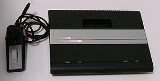
Atari 7800

Encyclopedia
The Atari 7800 ProSystem, or simply the Atari 7800, is a video game console
re-released by Atari Corporation
in January 1986. The original release had occurred two years earlier under Atari Inc
. The 7800 had originally been designed to replace Atari Inc.'s Atari 5200
in 1984, but was temporarily shelved due to the sale of the company after the video game crash. In January 1986, the 7800 was again released and would compete that year with the Nintendo Entertainment System
and the Sega Master System
.
It had simple digital joystick
s; it was almost fully backward-compatible
with the Atari 2600
(and was the first console to have backward compatibility without the use of additional modules); and it was considered affordable at a price of US$140.
In 2009, IGN
chose the 7800 to be their 17th best video game console of all time. They justified this relatively low ranking (though higher than every other Atari console save the 2600) with the summary statement: "Its delayed release, its cancelled peripherals, and a lack of financial backing from the company's new owners all combined to ensure that Atari 7800 would never see any success beyond being a sexier way of playing Atari 2600 titles."
on July 2, 1984. The project was originally called the Atari 3600, though was later renamed the Atari 7800.
Several key factors influenced the design of the 7800. First, Atari had been facing mounting pressure from the ColecoVision
, which boasted graphics that more closely mirrored arcade games of the time than Atari’s reigning 2600 VCS system. Second, the Atari 5200 (the original intended successor to the Atari 2600 VCS) had been widely criticized for not being able to play Atari 2600 VCS games without an adapter. Finally, dropping prices of home computer
s like the Commodore 64
had caused many to believe that buying a home computer was a better investment because it provided more detailed gameplay and could be used for other purposes such as word processing
.
Previous game consoles sometimes had a difficult time replicating the arcade experience in home versions of popular arcade game
s. In particular, home versions of arcade games sometimes had problems with flickering and slow down when more than a few moving objects appeared on the screen at once. GCC, which had a background in creating arcade games, designed their new system with a graphical architecture similar to arcade machines of the time. The 7800 featured the ability to move around a tremendous amount of objects (75-to-100) that far exceeded previous consoles. Powering the system was an Atari SALLY 6502
(Atari's slightly custom 6502, sometimes described as a "6502C") processor running at 1.79 MHz, similar to the processor found in home computers (Atari 8-bit, Apple II
, Commodore 64) and other consoles (Atari 5200 and Nintendo Entertainment System
).
In response to the criticisms of the Atari 5200, the Atari 7800 could play almost all Atari 2600 games out of the box, without the need for an adapter. In addition, it featured a return to a digital controller.
To address the concerns of parents that home computers were a better investment than consoles, the system was designed to be upgraded to a full-fledged home computer. A keyboard was developed, and the keyboard had an expansion port (which was the SIO port from Atari's 8-bit computer line, though the 7800 could not run Atari computer programs) allowed for the addition of peripherals such as disk drives and printers.
To enhance the gaming experience further, GCC had also designed a 'high score cartridge,' a battery-backed RAM
cartridge designed for storing game scores. On the side of the 7800 was an expansion port, reportedly for a planned connection with a laserdisc
player.
in June 1984, following an announcement on May 21, 1984 at the Summer Consumer Electronics Show
. 13 games were announced for the system's launch, including Ms. Pac-Man
, Pole Position II
, Centipede
, Joust, Dig Dug
, Desert Falcon, Robotron: 2084
, Galaga
, Xevious
, Food Fight, Ballblazer
, Rescue on Fractalus!, and Track and Field
. Atari was a sponsor of the 1984 Summer Olympics
and planned to push the 7800 aggressively in time for Christmas that year.
One month later, Warner Communications
sold Atari's Consumer Division to Jack Tramiel
. All projects were halted during an initial evaluation period.
The Atari 7800 languished on warehouse shelves until it was re-introduced in January 1986 after strong 2600 sales the previous Christmas.
Atari's launch of the 7800 under Tramiel was far more subdued than Warner had planned for the system in 1984 with a marketing budget of just $300,000. Additionally, the keyboard and high score cartridge were canceled, the expansion port was removed from later production runs of the system and, in lieu of new titles, the system was launched with titles intended for the 7800's debut in 1984.
.
During the Atari 7800’s life cycle, Atari found themselves struggling to get developers to create 7800 versions of then-popular arcade titles because of a controversial policy employed by Nintendo. When Nintendo revived the industry, they signed up software development companies to create NES games under a strict license agreement which imposed serious restrictions on what they were allowed to do. One of the key clauses was that companies who made Nintendo games were not allowed to make that game on a competing system for a period of two years. Because of the market success of the NES, companies chose to develop for it first and were thus barred from developing the same games on competing systems for two years. The software libraries of the Atari 7800 and Sega Master System suffered tremendously as a result.
Some NES titles were developed by companies who had licensed their title from a different arcade manufacturer. While the creator of the NES version would be restricted from making a competitive version of an NES game, the original arcade copyright holder was not precluded from licensing out rights for a home version of an arcade game to multiple systems. Through this loophole, Atari 7800 conversions of Mario Bros.
, Double Dragon
, Commando, Rampage, Xenophobe
, Ikari Warriors
and Kung Fu Master
were licensed and developed.
Third party development for the 7800 was limited as most game companies were locked into exclusive agreements with Nintendo for the NES. 11 titles were developed and sold by three third-party companies under their own labels for the 7800 (Absolute Entertainment
, Activision
, and Froggo
) with the rest published by Atari themselves. However, most Atari development was contracted out.
Despite trailing the Nintendo Entertainment System in terms of number of units sold, the 7800 was a profitable enterprise for Atari Corp., benefiting largely from Atari’s name and the system's 2600 compatibility. Profits were strong owing to low investment in game development and marketing. Nonetheless, the 7800 failed to help Atari regain its dominance in the videogame industry.
called MARIA which is very different from other second and third generation consoles, and made it more difficult for game programmers to make the transition. Instead of a limited number of hardware sprites, the MARIA allows for a much larger number of sprites described in a list of display lists. Each display list contains sprite entries with pointers to graphics data, color information, and horizontal positioning. The same display list is used for multiple rasters with the pointers being automatically adjusted. However, managing and displaying a large number of sprites required much more CPU time (both directly and indirectly since the MARIA would halt the CPU when drawing sprites) than consoles with hardware sprites and backgrounds.
MARIA has a number of different graphics modes which are either 160 pixels wide or 320 pixels wide. While the 320 pixel modes theoretically enable the 7800 to create games at higher resolution than the 256 pixel wide graphics found in the Nintendo Entertainment System
and Sega Master System
, the intense processing demands of MARIA typically meant that programmers created their games using the lower 160 pixel modes.
The 7800 features a broad (for its time) palette of 256 colors. Depending on various parameters, each individual sprite can use from 1 to 12 colors, with 3 colors (plus a 4th "transparency" color) being the most common. In this format, the sprite is referenced to one of 8 palettes, where each palette holds 3 assignable colors. There is also an assignable background color, which will be visible wherever another object has not covered it up. In total the system can utilize 25 colors on a scanline at one time.
The graphics resolution, color palette assignments, and background color can be adjusted in between scanlines. Although it is a more advanced programming technique, this isn't really a "trick". The designers deliberately included this feature, and documented its use in the original 1983 "Atari 3600 Software Guide". Games often used this feature to render high resolution text in one area of the screen, while displaying more colorful graphics with less resolution in the gameplay area. Demos also exist which use this feature to place all 256 colors on the screen at the same time.
The MARIA’s approach had advantages and disadvantages when it came to generating graphics in software during the lifespan of the 7800. It excelled at moving around large numbers of sprites on a static screen without the screen flickering that plagued other 8-bit systems. Its flexible design enabled it to play games which used display list manipulation to generate a pseudo 3D appearance such as Ballblazer
(1987) and F-18 Hornet (1988). While side-scrolling games in the vein of Super Mario Bros.
are possible on the system (1990's Scrapyard Dog is the best example), it is significantly harder to develop such a title than on a tile-based system such as the Nintendo Entertainment System.
To compensate for this, GCC’s engineers allowed games to include a POKEY audio chip
in the cartridge which substantially improved the audio quality. To ensure software developers had an economical means of producing better sound than TIA, GCC had originally planned to make a low-cost, high performance sound chip, GUMBY, which could also be placed in 7800 cartridges to enhance its sound capabilities further. This project was cancelled when Atari was sold to Jack Tramiel.
Despite having the capability to support sound chips in cartridges, almost no 7800 cartridges feature POKEY hardware for enhanced sound. Ballblazer, released in 1987, uses the POKEY to generate all music and sound effects. Similarly, Commando, released in 1989, uses a POKEY to generate in-game music while the TIA generates the game's sound effects for a total of 6 channels of sound.
, an Atari 2600 VCS title with adult themes, Atari had concerns over similar adult titles finding their way onto the 7800 and displaying adult graphics on the significantly improved graphics of the MARIA chip. To combat this, they included a digital signature protection method which prevented unauthorized 7800 games from being played on the system.
When a cartridge was inserted into the system, the 7800 BIOS included code which would generate a digital signature of the cartridge ROM and compare it to the signature stored on the cartridge. If a correct signature was located on the cartridge, the 7800 would operate in 7800 mode, granting the game access to MARIA and other features. If a signature was not located, the 7800 remained in 2600 mode and MARIA was unavailable. All 7800 games released in North America had to be digitally signed by Atari. This digital signature code is not present in PAL 7800s, which use various heuristics to detect 2600 cartridges, due to export restrictions.
(Random Access Memory) and the ability to access more cartridge data at one time than the 2600. The most substantial difference, however, is a graphics architecture which differs markedly from either the Atari 2600 VCS or Atari’s 8-bit line of computers.
The 7800's compatibility with the Atari 2600 is made possible by including many of the same chips used in the Atari 2600. When operating in “2600” mode to play Atari 2600 titles, the 7800 uses a Television Interface Adapter (TIA) chip to generate graphics and sound. The processor is slowed to 1.19 MHz, enabling the 7800 to mirror the performance of the 2600s stripped-down 6507 processor. RAM is limited to 128 bytes found in the RIOT and game data is accessed in 4K blocks.
When in “7800” mode (signified by the appearance of the full screen Atari logo), the graphics are generated entirely by the MARIA graphics processing unit, all system RAM is available and game data is accessed in larger 48K blocks. The system’s SALLY 6502 runs at its normal 1.79 MHz instead of the reduced speed of 2600 mode. The 2600 chips are used in 7800 mode to generate sound as well as switch and controller interfaces.
Production:
 The Atari 7800 came bundled with the Atari Proline Joystick a two button controller with a joystick for movement. In response to criticism over ergonomic issues in the 7800’s Pro-Line controllers, Atari later released joypad controllers with European 7800s, which were similar in style to controllers found on Nintendo and Sega Systems. The Joypad was not available in the United States.
Unlike the NES or Sega Master System, there were few add-on peripherals for the 7800, though its backwards compatibility feature allowed it to be compatible with most Atari 2600 peripherals.
The most notable exception was the XG-1 lightgun, which came bundled with the Atari XE Game System. The XG-1 was fully compatible with the 7800 and was sold separately for other Atari systems. Atari released four 7800 light gun games: Alien Brigade
, Crossbow
, Meltdown, and Barnyard Blaster.
Nonetheless, some unreleased Atari 7800 games, as well as early versions of released games have been released to the public. A few have been manufactured and sold.
These include
Engineering Notes list Tempest as a game that was between 15–20% completed for the Atari 7800; no code to date has been found. The Atari Museum located and posted unreleased box art and notes for a 7800 version of Crystal Castles. No code to date has been found for that game either. Atari's earlier 7800 games listing showed Millipede as one of the games in the line up; however, it does not appear that it was ever started or worked on.
computer system) were discovered in a dumpster behind the Atari building in Sunnyvale, California. Commented assembly language
source code was made available for Centipede
, Commando, Crossbow, Desert Falcon, Dig Dug
, Food Fight, Galaga
, Hat Trick, Joust, Ms. Pac-Man
, Super Stunt Cycle, Robotron: 2084 and Xevious
game titles.
operating system. It uses the Windows API and DirectX to display what it emulates in both PAL
and NTSC
.
The digital signature long prevented homebrew games from being developed until the original encryption generating software was discovered. When the original digital signature generating software was turned over to the Atari community, development of new Atari 7800 titles began. In addition, the Atari community has slowly uncovered the original 7800 development tools and released them into the public domain. New tools, documentation, source code and utilities for development have since been created which has sponsored additional homebrew development. Several new commercial Atari 7800 titles such as Beef Drop, B*nQ, Pac Man Collection, Combat 1990, Santa Simon, and Space War have been created and released.
System compatible hardware has also been produced for the system. Among these was the Cuttle Cart II, a device that allowed the Atari 7800 to read MMC cards containing binary files of Atari 7800 programs. The Cuttle Cart II has enabled more people to play the entire 2600 and 7800 library on an original system as well as binaries of unreleased games and new homebrew titles. The Cuttle Cart II was a success by homebrew standards, selling out both production runs and commanding high prices on eBay.
A more recent development is the Atari 7800 expansion module developed by Legacy Engineering with a high scores save feature (with compatible games), additional RAM capabilities, as well as vastly improved sound capabilities using the POKEY
and YM2151 sound chips. The Expansion module is designed as a pass-through device that sits on top of the console and requires no system modding.
console. This system resembled a miniature Atari 7800 and joysticks and had 20 built in games (five 7800 and fifteen 2600 titles). While the unit sold well, it was controversial among Atari fans. Atari had given the engineering firm, Legacy Engineering, extremely limited development timelines. The firm was forced to build the Flashback using NES-On-A-Chip
hardware instead of recreating the Atari 7800 hardware. As a result, the Flashback has been criticized for failing to properly replicate the actual Atari gaming experience.
Legacy Engineering was later commissioned to create another 7800 project that was subsequently cancelled after prototypes were made.
Video game console
A video game console is an interactive entertainment computer or customized computer system that produces a video display signal which can be used with a display device to display a video game...
re-released by Atari Corporation
Atari Corporation
Atari Corporation was a manufacturer of computers and video game consoles from 1984 to 1996. Atari Corp. was founded in July of 1984 when Warner Communications sold the home computing and game console divisions of Atari to Jack Tramiel. Its chief products were the Atari ST, Atari XE, Atari 7800,...
in January 1986. The original release had occurred two years earlier under Atari Inc
Atari, Inc
Atari, Inc. was an American video game and home computer company founded in 1972 by Nolan Bushnell and Ted Dabney. Primarily responsible for the formation of the video arcade and modern video game industries, the company was closed and its assets split in 1984 as a direct result of the North...
. The 7800 had originally been designed to replace Atari Inc.'s Atari 5200
Atari 5200
The Atari 5200 SuperSystem, commonly known as the Atari 5200, is a video game console that was introduced in 1982 by Atari Inc. as a higher end complementary console for the popular Atari 2600...
in 1984, but was temporarily shelved due to the sale of the company after the video game crash. In January 1986, the 7800 was again released and would compete that year with the Nintendo Entertainment System
Nintendo Entertainment System
The Nintendo Entertainment System is an 8-bit video game console that was released by Nintendo in North America during 1985, in Europe during 1986 and Australia in 1987...
and the Sega Master System
Sega Master System
The is a third-generation video game console that was manufactured and released by Sega in 1985 in Japan , 1986 in North America and 1987 in Europe....
.
It had simple digital joystick
Joystick
A joystick is an input device consisting of a stick that pivots on a base and reports its angle or direction to the device it is controlling. Joysticks, also known as 'control columns', are the principal control in the cockpit of many civilian and military aircraft, either as a center stick or...
s; it was almost fully backward-compatible
Backward compatibility
In the context of telecommunications and computing, a device or technology is said to be backward or downward compatible if it can work with input generated by an older device...
with the Atari 2600
Atari 2600
The Atari 2600 is a video game console released in October 1977 by Atari, Inc. It is credited with popularizing the use of microprocessor-based hardware and cartridges containing game code, instead of having non-microprocessor dedicated hardware with all games built in...
(and was the first console to have backward compatibility without the use of additional modules); and it was considered affordable at a price of US$140.
In 2009, IGN
IGN
IGN is an entertainment website that focuses on video games, films, music and other media. IGN's main website comprises several specialty sites or "channels", each occupying a subdomain and covering a specific area of entertainment...
chose the 7800 to be their 17th best video game console of all time. They justified this relatively low ranking (though higher than every other Atari console save the 2600) with the summary statement: "Its delayed release, its cancelled peripherals, and a lack of financial backing from the company's new owners all combined to ensure that Atari 7800 would never see any success beyond being a sexier way of playing Atari 2600 titles."
History
The Atari 7800 ProSystem was the first game system from Atari Inc. designed by an outside company, General Computer Corporation (GCC). The system had been designed in 1983 through 1984 with an intended mass market rollout in June 1984, but was canceled shortly thereafter due to the sale of the company to Tramiel Technology LtdJack Tramiel
Jack Tramiel is an American businessman, best known for founding Commodore International - manufacturer of the Commodore PET, Commodore 64, Commodore 128, Commodore Amiga, and other Commodore models of home computers.-Biography:...
on July 2, 1984. The project was originally called the Atari 3600, though was later renamed the Atari 7800.
Several key factors influenced the design of the 7800. First, Atari had been facing mounting pressure from the ColecoVision
ColecoVision
The ColecoVision is Coleco Industries' second generation home video game console which was released in August 1982. The ColecoVision offered arcade-quality graphics and gaming style, and the means to expand the system's basic hardware...
, which boasted graphics that more closely mirrored arcade games of the time than Atari’s reigning 2600 VCS system. Second, the Atari 5200 (the original intended successor to the Atari 2600 VCS) had been widely criticized for not being able to play Atari 2600 VCS games without an adapter. Finally, dropping prices of home computer
Home computer
Home computers were a class of microcomputers entering the market in 1977, and becoming increasingly common during the 1980s. They were marketed to consumers as affordable and accessible computers that, for the first time, were intended for the use of a single nontechnical user...
s like the Commodore 64
Commodore 64
The Commodore 64 is an 8-bit home computer introduced by Commodore International in January 1982.Volume production started in the spring of 1982, with machines being released on to the market in August at a price of US$595...
had caused many to believe that buying a home computer was a better investment because it provided more detailed gameplay and could be used for other purposes such as word processing
Word processing
Word processing is the creation of documents using a word processor. It can also refer to advanced shorthand techniques, sometimes used in specialized contexts with a specially modified typewriter.-External links:...
.
Previous game consoles sometimes had a difficult time replicating the arcade experience in home versions of popular arcade game
Arcade game
An arcade game is a coin-operated entertainment machine, usually installed in public businesses such as restaurants, bars, and amusement arcades. Most arcade games are video games, pinball machines, electro-mechanical games, redemption games, and merchandisers...
s. In particular, home versions of arcade games sometimes had problems with flickering and slow down when more than a few moving objects appeared on the screen at once. GCC, which had a background in creating arcade games, designed their new system with a graphical architecture similar to arcade machines of the time. The 7800 featured the ability to move around a tremendous amount of objects (75-to-100) that far exceeded previous consoles. Powering the system was an Atari SALLY 6502
MOS Technology 6502
The MOS Technology 6502 is an 8-bit microprocessor that was designed by Chuck Peddle and Bill Mensch for MOS Technology in 1975. When it was introduced, it was the least expensive full-featured microprocessor on the market by a considerable margin, costing less than one-sixth the price of...
(Atari's slightly custom 6502, sometimes described as a "6502C") processor running at 1.79 MHz, similar to the processor found in home computers (Atari 8-bit, Apple II
Apple II series
The Apple II series is a set of 8-bit home computers, one of the first highly successful mass-produced microcomputer products, designed primarily by Steve Wozniak, manufactured by Apple Computer and introduced in 1977 with the original Apple II...
, Commodore 64) and other consoles (Atari 5200 and Nintendo Entertainment System
Nintendo Entertainment System
The Nintendo Entertainment System is an 8-bit video game console that was released by Nintendo in North America during 1985, in Europe during 1986 and Australia in 1987...
).
In response to the criticisms of the Atari 5200, the Atari 7800 could play almost all Atari 2600 games out of the box, without the need for an adapter. In addition, it featured a return to a digital controller.
To address the concerns of parents that home computers were a better investment than consoles, the system was designed to be upgraded to a full-fledged home computer. A keyboard was developed, and the keyboard had an expansion port (which was the SIO port from Atari's 8-bit computer line, though the 7800 could not run Atari computer programs) allowed for the addition of peripherals such as disk drives and printers.
To enhance the gaming experience further, GCC had also designed a 'high score cartridge,' a battery-backed RAM
Ram
-Animals:*Ram, an uncastrated male sheep*Ram cichlid, a species of freshwater fish endemic to Colombia and Venezuela-Military:*Battering ram*Ramming, a military tactic in which one vehicle runs into another...
cartridge designed for storing game scores. On the side of the 7800 was an expansion port, reportedly for a planned connection with a laserdisc
Laserdisc
LaserDisc was a home video format and the first commercial optical disc storage medium. Initially licensed, sold, and marketed as MCA DiscoVision in North America in 1978, the technology was previously referred to interally as Optical Videodisc System, Reflective Optical Videodisc, Laser Optical...
player.
Launch
The 7800 was initially released in southern CaliforniaCalifornia
California is a state located on the West Coast of the United States. It is by far the most populous U.S. state, and the third-largest by land area...
in June 1984, following an announcement on May 21, 1984 at the Summer Consumer Electronics Show
Consumer Electronics Show
The International Consumer Electronics Show is a major technology-related trade show held each January in the Las Vegas Convention Center, Las Vegas, Nevada, United States. Not open to the public, the Consumer Electronics Association-sponsored show typically hosts previews of products and new...
. 13 games were announced for the system's launch, including Ms. Pac-Man
Ms. Pac-Man
Ms. Pac-Man is an arcade video game produced by Midway as an unauthorized sequel to Pac-Man. It was released in North America in 1981 and became one of the most popular video games of all time, leading to its adoption by Pac-Man licensor Namco as an official title...
, Pole Position II
Pole Position II
Pole Position II is a racing arcade game that was released by Namco in 1983 as the sequel to Pole Position, which was released the previous year. As with the original, Namco licensed Pole Position II to Atari for US manufacture and distribution...
, Centipede
Centipede (video game)
Centipede is a vertically-oriented shoot 'em up arcade game produced by Atari, Inc. in 1980. The game was designed by Ed Logg along with Dona Bailey, one of the few female game programmers in the industry at this time. It was also the first arcade coin-operated game to have a significant female...
, Joust, Dig Dug
Dig Dug
is an arcade game developed and published by Namco in Japan in 1982 for Namco Galaga hardware. It was later published outside of Japan by Atari. A popular game based on a simple concept, it was also released as a video game on many consoles.-Objective:...
, Desert Falcon, Robotron: 2084
Robotron: 2084
Robotron: 2084 is an arcade video game developed by Vid Kidz and released by Williams Electronics in 1982. It is a shooting game that features two-dimensional graphics. The game is set in the year 2084, in a fictional world where robots have turned against humans...
, Galaga
Galaga
is a fixed shooter arcade game developed and published by Namco in Japan and published by Midway in North America in 1981. It is the sequel to Galaxian, released in 1979. The gameplay of Galaga puts the player in control of a space ship which is situated on the bottom of the screen...
, Xevious
Xevious
is a vertical scrolling shooter arcade game by Namco, released in 1982. It was designed by Masanobu Endō. In the U.S., the game was manufactured and distributed by Atari. Xevious runs on Namco Galaga hardware. In Brazil the arcade cabinet was printed with the name 'COLUMBIA' for the game, while the...
, Food Fight, Ballblazer
Ballblazer
Ballblazer is a 1984 computer game created by Lucasfilm Games . It was originally released for the Atari 8-bit systems, such as the Atari 800 and the Atari 5200. It was also ported to other popular platforms of the day, such as the Apple II, ZX Spectrum , Amstrad CPC, Commodore 64, Atari 7800, and...
, Rescue on Fractalus!, and Track and Field
Track & Field (arcade game)
Track & Field, known in Japan as , is a 1983 Olympic-themed arcade game developed and published by Konami.The arcade version was released in 1983. The simple gameplay, based on quick repeating button presses, set the basics for sequels and similar games in the genre for the next decades...
. Atari was a sponsor of the 1984 Summer Olympics
1984 Summer Olympics
The 1984 Summer Olympics, officially known as the Games of the XXIII Olympiad, was an international multi-sport event held in Los Angeles, California, United States in 1984...
and planned to push the 7800 aggressively in time for Christmas that year.
One month later, Warner Communications
Time Warner
Time Warner is one of the world's largest media companies, headquartered in the Time Warner Center in New York City. Formerly two separate companies, Warner Communications, Inc...
sold Atari's Consumer Division to Jack Tramiel
Jack Tramiel
Jack Tramiel is an American businessman, best known for founding Commodore International - manufacturer of the Commodore PET, Commodore 64, Commodore 128, Commodore Amiga, and other Commodore models of home computers.-Biography:...
. All projects were halted during an initial evaluation period.
The Atari 7800 languished on warehouse shelves until it was re-introduced in January 1986 after strong 2600 sales the previous Christmas.
Atari's launch of the 7800 under Tramiel was far more subdued than Warner had planned for the system in 1984 with a marketing budget of just $300,000. Additionally, the keyboard and high score cartridge were canceled, the expansion port was removed from later production runs of the system and, in lieu of new titles, the system was launched with titles intended for the 7800's debut in 1984.
Marketplace challenges
At the time, a key driver for success with a home console was the number of home conversions it had of popular arcade games. This had been a primary reason for the success of the Atari 2600 VCS against systems like the IntellivisionIntellivision
The Intellivision is a video game console released by Mattel in 1979. Development of the console began in 1978, less than a year after the introduction of its main competitor, the Atari 2600. The word intellivision is a portmanteau of "intelligent television"...
.
During the Atari 7800’s life cycle, Atari found themselves struggling to get developers to create 7800 versions of then-popular arcade titles because of a controversial policy employed by Nintendo. When Nintendo revived the industry, they signed up software development companies to create NES games under a strict license agreement which imposed serious restrictions on what they were allowed to do. One of the key clauses was that companies who made Nintendo games were not allowed to make that game on a competing system for a period of two years. Because of the market success of the NES, companies chose to develop for it first and were thus barred from developing the same games on competing systems for two years. The software libraries of the Atari 7800 and Sega Master System suffered tremendously as a result.
Some NES titles were developed by companies who had licensed their title from a different arcade manufacturer. While the creator of the NES version would be restricted from making a competitive version of an NES game, the original arcade copyright holder was not precluded from licensing out rights for a home version of an arcade game to multiple systems. Through this loophole, Atari 7800 conversions of Mario Bros.
Mario Bros.
is an arcade game published and developed by Nintendo in 1983. It was developed by Shigeru Miyamoto. It has been commonly featured as a minigame in the Super Mario Advance series and other games...
, Double Dragon
Double Dragon
is a classic beat 'em up video game series initially developed by Technos Japan Corporation, who also developed the Kunio-kun series ....
, Commando, Rampage, Xenophobe
Xenophobe (video game)
Xenophobe is a 1987 arcade game published by Bally Midway. Starbases, moons, ships, and space cities are infested with aliens, and the players have to kill the aliens before each is completely overrun.-Description:...
, Ikari Warriors
Ikari Warriors
Ikari Warriors is a 1986 arcade game by SNK, published in the United States and Europe by Tradewest. Known simply as in Japan, this was SNK's first major breakthrough US release and became something of a classic. The game was released at the time when there were many Commando clones on the market...
and Kung Fu Master
Kung Fu Master
Kung-Fu Master, known in Japan as , is a beat 'em up arcade game developed and published in Japan by Irem. It was later published in North America by Data East. The Japanese version was based on the Jackie Chan movie Wheels on Meals, known as Spartan X in Japan, and credited "Paragon Films Ltd.,...
were licensed and developed.
Third party development for the 7800 was limited as most game companies were locked into exclusive agreements with Nintendo for the NES. 11 titles were developed and sold by three third-party companies under their own labels for the 7800 (Absolute Entertainment
Absolute Entertainment
Absolute Entertainment was a video game publisher based in Glen Rock, New Jersey and later in Upper Saddle River, New Jersey. Through its development house Imagineering, Absolute Entertainment produced titles for the Amiga, Atari 2600, Atari 7800, Sega Game Gear, Sega Mega Drive, Mega-CD, Game Boy,...
, Activision
Activision
Activision is an American publisher, majority owned by French conglomerate Vivendi SA. Its current CEO is Robert Kotick. It was founded on October 1, 1979 and was the world's first independent developer and distributor of video games for gaming consoles...
, and Froggo
Froggo
Froggo Games was a video game company that produced several games for the Atari 2600 and Atari 7800 game systems, long after the release of the Nintendo NES and other systems. The games were particularly notable for their poor ratings, and is often considered the worst game company on the 2600...
) with the rest published by Atari themselves. However, most Atari development was contracted out.
Demise
The Atari 7800 remained officially active between 1986 and 1991. On January 1, 1992, Atari Corp. formally announced that production of the Atari 7800, the Atari 2600, the Atari 8-bit computer line, and the Atari XE Game System would cease. By the time of the cancellation, Nintendo's NES dominated the North American market, controlling 80% while Atari Corp. controlled just 12%.Despite trailing the Nintendo Entertainment System in terms of number of units sold, the 7800 was a profitable enterprise for Atari Corp., benefiting largely from Atari’s name and the system's 2600 compatibility. Profits were strong owing to low investment in game development and marketing. Nonetheless, the 7800 failed to help Atari regain its dominance in the videogame industry.
Technical Specifications
- CPU: Atari SALLY 6502MOS Technology 6502The MOS Technology 6502 is an 8-bit microprocessor that was designed by Chuck Peddle and Bill Mensch for MOS Technology in 1975. When it was introduced, it was the least expensive full-featured microprocessor on the market by a considerable margin, costing less than one-sixth the price of...
("6502C")- Speed: 1.79 MHz, drops to 1.19 MHz when the TIA Television Interface Adaptor or RIOT (6532 RAM-I/O-TimerMOS Technology 6532The 6532 RAM-I/O-Timer was an integrated circuit made by MOS Technology, as well as second sources such as Rockwell. It incorporated 128 bytes of static RAM, two bidirectional 8-bit digital I/O ports, and a programmable timer. This high degree of integration made it quite popular in the late 1970s...
) chips are accessed - (note: Unlike a standard 6502, SALLY can be halted to allow other devices to control the bus)
- Speed: 1.79 MHz, drops to 1.19 MHz when the TIA Television Interface Adaptor or RIOT (6532 RAM-I/O-Timer
- RAMRam-Animals:*Ram, an uncastrated male sheep*Ram cichlid, a species of freshwater fish endemic to Colombia and Venezuela-Military:*Battering ram*Ramming, a military tactic in which one vehicle runs into another...
: 4 KB (2 6116 2Kx8 RAM ICs) - ROMRomROM, Rom, or rom is an abbreviation and name that may refer to:-In computers and mathematics:* Read-only memory, a type of storage media which is used in computers and other electronic devices....
: built in 4 KB BIOSBIOSIn IBM PC compatible computers, the basic input/output system , also known as the System BIOS or ROM BIOS , is a de facto standard defining a firmware interface....
ROM, 48 KB Cartridge ROM space without bankswitching - Graphics: MARIA custom graphics controller
- 160×240 (160×288 PALPAL regionThe PAL region is a television publication territory which covers most of Asia, Africa, Australia, New Zealand, and most of Western Europe...
) resolution or 320×240/288 resolution - 25 color palette out of 256 colors (16 hues * 16 luma), different graphics modes restricted the number of usable colors and the number of colors per sprite
- Direct Memory AccessDirect memory accessDirect memory access is a feature of modern computers that allows certain hardware subsystems within the computer to access system memory independently of the central processing unit ....
(DMA) - Graphics clock: 7.16 MHz
- 160×240 (160×288 PAL
- I/O: Joystick and console switch IO handled byte 6532 RIOTMOS Technology 6532The 6532 RAM-I/O-Timer was an integrated circuit made by MOS Technology, as well as second sources such as Rockwell. It incorporated 128 bytes of static RAM, two bidirectional 8-bit digital I/O ports, and a programmable timer. This high degree of integration made it quite popular in the late 1970s...
and TIA - Ports: 2 joystick ports, 1 cartridge port, 1 expansion connector, power in, RF output
- Sound: TIA video and sound chip, same as the 2600. Only the sound is used in 7800 games. Both video and sound are used in 2600 games.
- Optional POKEYAtari POKEYThe Pot Keyboard Integrated Circuit is a digital I/O chip found in the Atari 8-bit family of home computers and many arcade games in the 1980s. It was commonly used to sample potentiometers and scan matrices of switches...
sound chip on cartridge for improved sounds.
- Optional POKEY
Graphics
The graphics are generated by a custom Graphics Processing UnitGraphics processing unit
A graphics processing unit or GPU is a specialized circuit designed to rapidly manipulate and alter memory in such a way so as to accelerate the building of images in a frame buffer intended for output to a display...
called MARIA which is very different from other second and third generation consoles, and made it more difficult for game programmers to make the transition. Instead of a limited number of hardware sprites, the MARIA allows for a much larger number of sprites described in a list of display lists. Each display list contains sprite entries with pointers to graphics data, color information, and horizontal positioning. The same display list is used for multiple rasters with the pointers being automatically adjusted. However, managing and displaying a large number of sprites required much more CPU time (both directly and indirectly since the MARIA would halt the CPU when drawing sprites) than consoles with hardware sprites and backgrounds.
MARIA has a number of different graphics modes which are either 160 pixels wide or 320 pixels wide. While the 320 pixel modes theoretically enable the 7800 to create games at higher resolution than the 256 pixel wide graphics found in the Nintendo Entertainment System
Nintendo Entertainment System
The Nintendo Entertainment System is an 8-bit video game console that was released by Nintendo in North America during 1985, in Europe during 1986 and Australia in 1987...
and Sega Master System
Sega Master System
The is a third-generation video game console that was manufactured and released by Sega in 1985 in Japan , 1986 in North America and 1987 in Europe....
, the intense processing demands of MARIA typically meant that programmers created their games using the lower 160 pixel modes.
The 7800 features a broad (for its time) palette of 256 colors. Depending on various parameters, each individual sprite can use from 1 to 12 colors, with 3 colors (plus a 4th "transparency" color) being the most common. In this format, the sprite is referenced to one of 8 palettes, where each palette holds 3 assignable colors. There is also an assignable background color, which will be visible wherever another object has not covered it up. In total the system can utilize 25 colors on a scanline at one time.
The graphics resolution, color palette assignments, and background color can be adjusted in between scanlines. Although it is a more advanced programming technique, this isn't really a "trick". The designers deliberately included this feature, and documented its use in the original 1983 "Atari 3600 Software Guide". Games often used this feature to render high resolution text in one area of the screen, while displaying more colorful graphics with less resolution in the gameplay area. Demos also exist which use this feature to place all 256 colors on the screen at the same time.
The MARIA’s approach had advantages and disadvantages when it came to generating graphics in software during the lifespan of the 7800. It excelled at moving around large numbers of sprites on a static screen without the screen flickering that plagued other 8-bit systems. Its flexible design enabled it to play games which used display list manipulation to generate a pseudo 3D appearance such as Ballblazer
Ballblazer
Ballblazer is a 1984 computer game created by Lucasfilm Games . It was originally released for the Atari 8-bit systems, such as the Atari 800 and the Atari 5200. It was also ported to other popular platforms of the day, such as the Apple II, ZX Spectrum , Amstrad CPC, Commodore 64, Atari 7800, and...
(1987) and F-18 Hornet (1988). While side-scrolling games in the vein of Super Mario Bros.
Super Mario Bros.
is a 1985 platform video game developed by Nintendo, published for the Nintendo Entertainment System as a sequel to the 1983 game Mario Bros. In Super Mario Bros., the player controls Mario as he travels through the Mushroom Kingdom in order to rescue Princess Toadstool from the antagonist...
are possible on the system (1990's Scrapyard Dog is the best example), it is significantly harder to develop such a title than on a tile-based system such as the Nintendo Entertainment System.
Sound
A common criticism of the 7800 regards its use of the TIA to provide 2-channel sound effects and music, resulting in sound quality that is virtually identical to the Atari 2600 VCS from 1977. While the inclusion of 2600 hardware is required to maintain compatibility with the older system, this drove up production costs and reduced available space on the 7800’s motherboard. As such, the 7800 does not include additional hardware for generating sound as it does with graphics and the sound hardware is considered the weakest part of the system.To compensate for this, GCC’s engineers allowed games to include a POKEY audio chip
Atari POKEY
The Pot Keyboard Integrated Circuit is a digital I/O chip found in the Atari 8-bit family of home computers and many arcade games in the 1980s. It was commonly used to sample potentiometers and scan matrices of switches...
in the cartridge which substantially improved the audio quality. To ensure software developers had an economical means of producing better sound than TIA, GCC had originally planned to make a low-cost, high performance sound chip, GUMBY, which could also be placed in 7800 cartridges to enhance its sound capabilities further. This project was cancelled when Atari was sold to Jack Tramiel.
Despite having the capability to support sound chips in cartridges, almost no 7800 cartridges feature POKEY hardware for enhanced sound. Ballblazer, released in 1987, uses the POKEY to generate all music and sound effects. Similarly, Commando, released in 1989, uses a POKEY to generate in-game music while the TIA generates the game's sound effects for a total of 6 channels of sound.
Lockout features
Following the debate over Custer's RevengeCuster's Revenge
Custer's Revenge is a controversial video game made for the Atari 2600 by Mystique, a company that produced a number of adult video game titles for the system...
, an Atari 2600 VCS title with adult themes, Atari had concerns over similar adult titles finding their way onto the 7800 and displaying adult graphics on the significantly improved graphics of the MARIA chip. To combat this, they included a digital signature protection method which prevented unauthorized 7800 games from being played on the system.
When a cartridge was inserted into the system, the 7800 BIOS included code which would generate a digital signature of the cartridge ROM and compare it to the signature stored on the cartridge. If a correct signature was located on the cartridge, the 7800 would operate in 7800 mode, granting the game access to MARIA and other features. If a signature was not located, the 7800 remained in 2600 mode and MARIA was unavailable. All 7800 games released in North America had to be digitally signed by Atari. This digital signature code is not present in PAL 7800s, which use various heuristics to detect 2600 cartridges, due to export restrictions.
Backward compatibility
The Atari 7800 differs from the 2600 in several key areas. It features a full Atari SALLY 6502 processor whereas the 2600 VCS has a stripped down 6507 processor running at a slower speed. It has additional RAMRam
-Animals:*Ram, an uncastrated male sheep*Ram cichlid, a species of freshwater fish endemic to Colombia and Venezuela-Military:*Battering ram*Ramming, a military tactic in which one vehicle runs into another...
(Random Access Memory) and the ability to access more cartridge data at one time than the 2600. The most substantial difference, however, is a graphics architecture which differs markedly from either the Atari 2600 VCS or Atari’s 8-bit line of computers.
The 7800's compatibility with the Atari 2600 is made possible by including many of the same chips used in the Atari 2600. When operating in “2600” mode to play Atari 2600 titles, the 7800 uses a Television Interface Adapter (TIA) chip to generate graphics and sound. The processor is slowed to 1.19 MHz, enabling the 7800 to mirror the performance of the 2600s stripped-down 6507 processor. RAM is limited to 128 bytes found in the RIOT and game data is accessed in 4K blocks.
When in “7800” mode (signified by the appearance of the full screen Atari logo), the graphics are generated entirely by the MARIA graphics processing unit, all system RAM is available and game data is accessed in larger 48K blocks. The system’s SALLY 6502 runs at its normal 1.79 MHz instead of the reduced speed of 2600 mode. The 2600 chips are used in 7800 mode to generate sound as well as switch and controller interfaces.
System revisions
Prototypes:- Atari 3600, original model number
- Atari CX-9000 Video Computer System
Production:
- Atari CX7800, two joystick ports on lower front panel. Side expansion port for upgrades and add-ons. Bundled accessories included two CX24 Pro-Line joysticks, AC adapter, switchbox, RCA connecting cable, and Pole Position IIPole Position IIPole Position II is a racing arcade game that was released by Namco in 1983 as the sequel to Pole Position, which was released the previous year. As with the original, Namco licensed Pole Position II to Atari for US manufacture and distribution...
cartridge. - Atari CX7800, second revision. Slightly revised motherboard, added an additional timing circuit. Expansion port connector removed from motherboard but is still etched. Shell has indentation of where expansion port was to be.
- Atari CX7800, third revision. Same as above but with only a small blemish on the shell where the expansion port was.
Peripherals
Unlike the NES or Sega Master System, there were few add-on peripherals for the 7800, though its backwards compatibility feature allowed it to be compatible with most Atari 2600 peripherals.
The most notable exception was the XG-1 lightgun, which came bundled with the Atari XE Game System. The XG-1 was fully compatible with the 7800 and was sold separately for other Atari systems. Atari released four 7800 light gun games: Alien Brigade
Alien Brigade
Alien Brigade is a side-scrolling shooting game, released in 1990 for the Atari 7800 Prosystem. Similar in style to Operation Wolf, Alien Brigade tells the story of a soldier that is forced to do battle with aliens that are invading the planet and taking over the bodies of fellow soldiers in the...
, Crossbow
Crossbow (video game)
Crossbow is a video arcade game released by Exidy in 1983. It was later published by Absolute Entertainment for the Commodore 64, DOS and by Atari for the 2600, 7800 and XE Game System starting in 1987.-Description:...
, Meltdown, and Barnyard Blaster.
Canceled peripherals
Due to the acquisition of the Atari Consumer Division by Jack Tramiel in 1984, a number of planned peripherals for the system were canceled.- The High Score Cartridge was designed to save player high scores for up to 65 separate games. The cartridge was intended as a pass-through device (similar to the later Game GenieGame GenieThe Game Genie is a series of cheat systems designed by Codemasters and sold by Camerica and Galoob for the Nintendo Entertainment System, Super Nintendo Entertainment System, Game Boy, Mega Drive/Genesis, and Sega Game Gear that modifies game data, allowing the player to cheat, manipulate various...
). Nine games were programmed with the feature but the cartridge was canceled before it was released. In 1999, a limited run of cartridges were produced by Atari historian Curt Vendel using ROM code from Gary Rubio (the former Atari liaison to GCC on the Atari 7800 project). This feature has been included in many homebrew releases in recent years.
- The 7800 included an expansion port which would have allowed for the addition of a planned computer keyboard, connection to laserdisc players and other peripherals. The expansion port was removed in the second and third revisions of the 7800.
- A dual joystick holder was designed for games like Robotron 2084 and future games like Battlezone and others, but not produced.
Software library
While the 7800 can actually play hundreds of titles due to its compatibility with the Atari 2600, there was limited third party support for the 7800 and less than 100 titles were specifically designed for it.Unreleased games
As with most game consoles, there were many more games in development for the 7800 than were actually released. However, very few prototypes have been located, due to Tramiel Atari’s reluctance to make them in the first place. Atari 7800 prototypes tend to be highly coveted by collectors, often fetching hundreds of dollars when sold. Some collectors are unwilling to share the rare items publicly as doing so risks decreasing the value of their prototypes.Nonetheless, some unreleased Atari 7800 games, as well as early versions of released games have been released to the public. A few have been manufactured and sold.
These include
- Klax (Programmed by Blue Sky Software). The game was nearly completed when canceled. For years, it was traded privately until a ROM was made available to the general public. Later, the developer appeared to create additional levels for the community.
- GatoGato (computer game)GATO was a real-time submarine simulator published by Spectrum HoloByte in the 1980s for use on several platforms, including the Apple IIe and Atari XE Game System. It simulated combat operations aboard the Gato-class submarine in the Pacific Theater of World War II...
(Programmed by Ibid Inc Software). Released on the XE Game System, an Atari 7800 version was started but not completed beyond a simple demo. - Missing in Action (Programmed by Sculptured Software for TNT Games). A side scrolling adventure that was about 85% complete when cancelled. The game is mostly playable with some later collision detection issues requiring cheats to get past.
- Pit-FighterPit-FighterPit-Fighter is a 1990 arcade game by Atari Games, notable for its early use of digitized live actors. The Japanese arcade release was published by Konami. The graphic animation for the player character and opponents were created through a bluescreen process, where the various poses & moves of the...
(Programmed by Imagitec Design). An early demo of the game has been found, with crude graphics, no sound and poor collision detection. - Rescue on Fractalus! (Programmed by GCC). A conversion of the popular computer game was released by GCC in 2004. The game was partially complete with a running engine but no enemies.
- Other 7800 games remain lost, despite indications that development occurred. The most notable of these are SkyfoxSkyfoxSkyfox is a 1984 action computer game developed by Ray Tobey and published by Electronic Arts. Ariolasoft published the game in Europe. Originally developed for the Apple II, it was ported to the ZX Spectrum, Amstrad CPC, Commodore 64 and Macintosh in 1985 and to the Amiga and Atari ST in 1986...
(shown on the back of the original system box) and ElectrocopElectroCopElectrocop is a 1989 video game developed by Epyx and published by Atari.-Summary:This video gamewas one of the first games developed for the Atari Lynx, and was released with the platform's launch....
(artwork has since been uncovered).
Engineering Notes list Tempest as a game that was between 15–20% completed for the Atari 7800; no code to date has been found. The Atari Museum located and posted unreleased box art and notes for a 7800 version of Crystal Castles. No code to date has been found for that game either. Atari's earlier 7800 games listing showed Millipede as one of the games in the line up; however, it does not appear that it was ever started or worked on.
Source Code Release
The source code for 13 games, as well as the OS and development tools (for the Atari STAtari ST
The Atari ST is a home/personal computer that was released by Atari Corporation in 1985 and commercially available from that summer into the early 1990s. The "ST" officially stands for "Sixteen/Thirty-two", which referred to the Motorola 68000's 16-bit external bus and 32-bit internals...
computer system) were discovered in a dumpster behind the Atari building in Sunnyvale, California. Commented assembly language
Assembly language
An assembly language is a low-level programming language for computers, microprocessors, microcontrollers, and other programmable devices. It implements a symbolic representation of the machine codes and other constants needed to program a given CPU architecture...
source code was made available for Centipede
Centipede (video game)
Centipede is a vertically-oriented shoot 'em up arcade game produced by Atari, Inc. in 1980. The game was designed by Ed Logg along with Dona Bailey, one of the few female game programmers in the industry at this time. It was also the first arcade coin-operated game to have a significant female...
, Commando, Crossbow, Desert Falcon, Dig Dug
Dig Dug
is an arcade game developed and published by Namco in Japan in 1982 for Namco Galaga hardware. It was later published outside of Japan by Atari. A popular game based on a simple concept, it was also released as a video game on many consoles.-Objective:...
, Food Fight, Galaga
Galaga
is a fixed shooter arcade game developed and published by Namco in Japan and published by Midway in North America in 1981. It is the sequel to Galaxian, released in 1979. The gameplay of Galaga puts the player in control of a space ship which is situated on the bottom of the screen...
, Hat Trick, Joust, Ms. Pac-Man
Ms. Pac-Man
Ms. Pac-Man is an arcade video game produced by Midway as an unauthorized sequel to Pac-Man. It was released in North America in 1981 and became one of the most popular video games of all time, leading to its adoption by Pac-Man licensor Namco as an official title...
, Super Stunt Cycle, Robotron: 2084 and Xevious
Xevious
is a vertical scrolling shooter arcade game by Namco, released in 1982. It was designed by Masanobu Endō. In the U.S., the game was manufactured and distributed by Atari. Xevious runs on Namco Galaga hardware. In Brazil the arcade cabinet was printed with the name 'COLUMBIA' for the game, while the...
game titles.
Emulation and homebrew
When emulators of 1980s video game consoles began to appear on home computers in the late 1990s, the Atari 7800 was one of the last to be emulated. The lack of awareness of the system, the lack of understanding of the hardware, and fears about the digital signature lockout initially caused concerns. Since that time, however, the 7800 has been emulated successfully and is now common on emulation sites. One such program is ProSystem, written in C/C++ for the Microsoft WindowsMicrosoft Windows
Microsoft Windows is a series of operating systems produced by Microsoft.Microsoft introduced an operating environment named Windows on November 20, 1985 as an add-on to MS-DOS in response to the growing interest in graphical user interfaces . Microsoft Windows came to dominate the world's personal...
operating system. It uses the Windows API and DirectX to display what it emulates in both PAL
PAL
PAL, short for Phase Alternating Line, is an analogue television colour encoding system used in broadcast television systems in many countries. Other common analogue television systems are NTSC and SECAM. This page primarily discusses the PAL colour encoding system...
and NTSC
NTSC
NTSC, named for the National Television System Committee, is the analog television system that is used in most of North America, most of South America , Burma, South Korea, Taiwan, Japan, the Philippines, and some Pacific island nations and territories .Most countries using the NTSC standard, as...
.
The digital signature long prevented homebrew games from being developed until the original encryption generating software was discovered. When the original digital signature generating software was turned over to the Atari community, development of new Atari 7800 titles began. In addition, the Atari community has slowly uncovered the original 7800 development tools and released them into the public domain. New tools, documentation, source code and utilities for development have since been created which has sponsored additional homebrew development. Several new commercial Atari 7800 titles such as Beef Drop, B*nQ, Pac Man Collection, Combat 1990, Santa Simon, and Space War have been created and released.
System compatible hardware has also been produced for the system. Among these was the Cuttle Cart II, a device that allowed the Atari 7800 to read MMC cards containing binary files of Atari 7800 programs. The Cuttle Cart II has enabled more people to play the entire 2600 and 7800 library on an original system as well as binaries of unreleased games and new homebrew titles. The Cuttle Cart II was a success by homebrew standards, selling out both production runs and commanding high prices on eBay.
A more recent development is the Atari 7800 expansion module developed by Legacy Engineering with a high scores save feature (with compatible games), additional RAM capabilities, as well as vastly improved sound capabilities using the POKEY
Pokey
Pokey may refer to:* Pokey the Penguin, a surrealistic online comic strip* Pokey , a character from the Gumby television series...
and YM2151 sound chips. The Expansion module is designed as a pass-through device that sits on top of the console and requires no system modding.
Atari Flashback
In 2004, Atari (now owned by Infogrames) released the first Atari FlashbackAtari Flashback
The Atari Flashback, Atari Flashback 2, Atari Flashback2+ and Atari Flashback 3 are dedicated video game consoles marketed by Atari Inc. in 2004, 2005 and 2010, then AtGames in 2011...
console. This system resembled a miniature Atari 7800 and joysticks and had 20 built in games (five 7800 and fifteen 2600 titles). While the unit sold well, it was controversial among Atari fans. Atari had given the engineering firm, Legacy Engineering, extremely limited development timelines. The firm was forced to build the Flashback using NES-On-A-Chip
Nintendo Entertainment System hardware clone
Owing to the popularity and longevity of the Nintendo Entertainment System , the system has become one of the world's most cloned video game consoles...
hardware instead of recreating the Atari 7800 hardware. As a result, the Flashback has been criticized for failing to properly replicate the actual Atari gaming experience.
Legacy Engineering was later commissioned to create another 7800 project that was subsequently cancelled after prototypes were made.