


Atari 5200

Encyclopedia

Video game console
A video game console is an interactive entertainment computer or customized computer system that produces a video display signal which can be used with a display device to display a video game...
that was introduced in 1982 by Atari Inc. as a higher end complementary console for the popular Atari 2600
Atari 2600
The Atari 2600 is a video game console released in October 1977 by Atari, Inc. It is credited with popularizing the use of microprocessor-based hardware and cartridges containing game code, instead of having non-microprocessor dedicated hardware with all games built in...
. The 5200 was created to compete with the Intellivision
Intellivision
The Intellivision is a video game console released by Mattel in 1979. Development of the console began in 1978, less than a year after the introduction of its main competitor, the Atari 2600. The word intellivision is a portmanteau of "intelligent television"...
, but wound up more directly competing with the ColecoVision
ColecoVision
The ColecoVision is Coleco Industries' second generation home video game console which was released in August 1982. The ColecoVision offered arcade-quality graphics and gaming style, and the means to expand the system's basic hardware...
shortly after its release.
The 5200 was based on Atari Inc.'s existing 400/800
Atari 8-bit family
The Atari 8-bit family is a series of 8-bit home computers manufactured from 1979 to 1992. All are based on the MOS Technology 6502 CPU and were the first home computers designed with custom coprocessor chips...
computers and the internal hardware was almost identical, although software was not directly compatible between the two systems. The 5200's controllers feature an analog joystick and a numeric keypad along with start, pause and reset buttons. The 360-degree non-centering joystick was touted as offering more control than the four-position joystick controller offered with the Atari 2600.
Hardware
Much of the technology in the Atari 8-bit familyAtari 8-bit family
The Atari 8-bit family is a series of 8-bit home computers manufactured from 1979 to 1992. All are based on the MOS Technology 6502 CPU and were the first home computers designed with custom coprocessor chips...
of home computer
Home computer
Home computers were a class of microcomputers entering the market in 1977, and becoming increasingly common during the 1980s. They were marketed to consumers as affordable and accessible computers that, for the first time, were intended for the use of a single nontechnical user...
systems were originally developed as a second-generation games console intended to replace the 2600. However, as the system was reaching completion, the personal computer
Personal computer
A personal computer is any general-purpose computer whose size, capabilities, and original sales price make it useful for individuals, and which is intended to be operated directly by an end-user with no intervening computer operator...
revolution was starting with the release of machines like the Commodore PET
Commodore PET
The Commodore PET was a home/personal computer produced from 1977 by Commodore International...
, TRS-80
TRS-80
TRS-80 was Tandy Corporation's desktop microcomputer model line, sold through Tandy's Radio Shack stores in the late 1970s and early 1980s. The first units, ordered unseen, were delivered in November 1977, and rolled out to the stores the third week of December. The line won popularity with...
and Apple II
Apple II
The Apple II is an 8-bit home computer, one of the first highly successful mass-produced microcomputer products, designed primarily by Steve Wozniak, manufactured by Apple Computer and introduced in 1977...
. These machines were similar in technological terms to the 2600, but sold for much higher prices with associated higher profit margins. Atari's management decided to enter this market, and the new technology was repackaged into the Atari 400 and 800, hitting the market in 1979.
In the early 1980s a second wave of games consoles came to market, notably the Intellivision and numerous other announcements and releases. Being behind the technological curve was not entirely surprising; the chipset used in the 400 and 800 was designed because they were aware the 2600 would be obsolete by the 1980 time frame. What was surprising was the sudden entry into the market of new competition, whose machines quickly cut off the sales of the 2600. Atari decided to re-enter the games market with a design that closely matched their original 1978 specifications. In its prototype stage, the Atari 5200 was originally called the "Atari Video System X - Advanced Video Computer System", and was codenamed "Pam" after a female employee at Atari Inc. It is also rumored that PAM actually stood for "Personal Arcade Machine", as the majority of games for the system ended up being arcade conversions. Actual working Atari Video System X machines, whose hardware is 100% identical to the Atari 5200 do exist, but are extremely rare.
The initial 1982 release of the system featured four controller ports, where nearly all other systems of the day had only two ports. The 5200 also featured a revolutionary new controller with an analog joystick
Joystick
A joystick is an input device consisting of a stick that pivots on a base and reports its angle or direction to the device it is controlling. Joysticks, also known as 'control columns', are the principal control in the cockpit of many civilian and military aircraft, either as a center stick or...
, numeric keypad, two fire buttons on each side of the controller and game function keys for Start, Pause, and Reset. The 5200 also featured the innovation of the first automatic TV switchbox, allowing it to automatically switch from regular TV viewing to the game system signal when the system was activated. Previous RF adapters required the user to slide a switch on the adapter by hand. This unique RF
Radio frequency
Radio frequency is a rate of oscillation in the range of about 3 kHz to 300 GHz, which corresponds to the frequency of radio waves, and the alternating currents which carry radio signals...
box was also where the power supply connected in a unique dual power/television signal setup similar to the RCA Studio II
RCA Studio II
The RCA Studio II is a videogame console made by RCA that debuted in January 1977. The graphics of Studio II games were black and white and resembled those of earlier Pong consoles and their clones. The Studio II also did not have joysticks or similar game controllers but instead used two ten...
's. A single cable coming out of the 5200 plugged into the switch box and was used for both electricity and the television signal.
The 1983 revision of the Atari 5200 has two controller ports instead of four, and a change back to the more conventional separate power supply and standard non-autoswitching RF switch. It also has changes in the cartridge port address lines to allow for the Atari 2600
Atari 2600
The Atari 2600 is a video game console released in October 1977 by Atari, Inc. It is credited with popularizing the use of microprocessor-based hardware and cartridges containing game code, instead of having non-microprocessor dedicated hardware with all games built in...
adapter released that year. While the adapter was only made to work on the two-port version, modifications can be made to the four-port to make it line-compatible. In fact, towards the end of the four-port model's production run, there were a limited number of consoles produced which included these modifications. These consoles can be identified by an asterisk in their serial number.
Controllers
The controller prototypes used in the electrical development lab used a yoke and gimbal mechanism that came from an RC airplane controller kit. This simple design gave very nice smooth linear control and was highly reliable. The production controllers were quite different and a great disappointment to the electrical and software development teams. The design of the analog joystickAnalog stick
An analog stick, sometimes called a control stick or thumbstick, is an input device for a controller that is used for two-dimensional input. An analog stick is a variation of a joystick, consisting of a protrusion from the controller; input is based on the position of this protrusion in relation...
, which used a weak rubber boot rather than springs to provide centering, proved to be ungainly and unreliable. They quickly became the Achilles' heel
Achilles' heel
An Achilles’ heel is a deadly weakness in spite of overall strength, that can actually or potentially lead to downfall. While the mythological origin refers to a physical vulnerability, metaphorical references to other attributes or qualities that can lead to downfall are common.- Origin :In Greek...
of the system because of their combination of an overly complex mechanical design with a very low-cost internal flex circuit system. Another major flaw of the controllers was that the design did not translate into a linear acceleration from the center through the arc of the stick travel. The controllers did, however, include a pause button, a unique feature at the time. Various third party replacement joysticks were also released, including those made by Wico.
Atari Inc. released the Pro-Line Trak-Ball
Trackball
A trackball is a pointing device consisting of a ball held by a socket containing sensors to detect a rotation of the ball about two axes—like an upside-down mouse with an exposed protruding ball. The user rolls the ball with the thumb, fingers, or the palm of the hand to move a cursor...
controller for the system, which was used primarily for gaming titles such as Centipede
Centipede
Centipedes are arthropods belonging to the class Chilopoda of the subphylum Myriapoda. They are elongated metameric animals with one pair of legs per body segment. Despite the name, centipedes can have a varying number of legs from under 20 to over 300. Centipedes have an odd number of pairs of...
or Missile Command
Missile Command
Missile Command is a 1980 arcade game by Atari, Inc. that was also licensed to Sega for European release. It is considered one of the most notable games from the Golden Age of Video Arcade Games...
. A paddle controller and an updated self-centering version of the original controller were also in development, but never made it to market.
The primary controller was ranked the 10th worst video game controller by IGN
IGN
IGN is an entertainment website that focuses on video games, films, music and other media. IGN's main website comprises several specialty sites or "channels", each occupying a subdomain and covering a specific area of entertainment...
editor Craig Harris.
Internal differences between the 5200 and the 400/800
Although the Atari 5200's internal design was extensively based on that of the 400/800 home computers, the differences were sufficient that games designed for one would not run directly on the other.One of the most obvious differences was the 5200's lack of a keyboard
Computer keyboard
In computing, a keyboard is a typewriter-style keyboard, which uses an arrangement of buttons or keys, to act as mechanical levers or electronic switches...
. However, there were several others:
- The 400/800's 10 KB operating system was replaced with a simpler 2 KBKilobyteThe kilobyte is a multiple of the unit byte for digital information. Although the prefix kilo- means 1000, the term kilobyte and symbol KB have historically been used to refer to either 1024 bytes or 1000 bytes, dependent upon context, in the fields of computer science and information...
BIOS, of which 1 KB is the built-in character set. - A number of important registers, such as those of the GTIA and POKEYPokeyPokey may refer to:* Pokey the Penguin, a surrealistic online comic strip* Pokey , a character from the Gumby television series...
chips appear at different memory locations. - The purpose of some registers changed slightly on the 5200.
- The 5200's analog joysticks required different input handling to the traditional digital joystick input on the 400/800. (However, the 5200 reassigned/rewired two of the 400/800's existing analog paddlePaddle (game controller)A paddle is a game controller with a round wheel and one or more fire buttons, where the wheel is typically used to control movement of the player object along one axis of the video screen...
registers for each bi-directional analog joystick input).
Atari Corp.'s later XE Games System revisited the idea of a console based on the 400/800 hardware. However, as this was essentially just a 65XE computer with a detachable keyboard, it was able to run most of the home computer titles directly.
Market Performance
The Atari 5200 did not fare well commercially, compared to its predecessor, the Atari 2600. While it touted superior graphics to the 2600 and Mattel's IntellivisionIntellivision
The Intellivision is a video game console released by Mattel in 1979. Development of the console began in 1978, less than a year after the introduction of its main competitor, the Atari 2600. The word intellivision is a portmanteau of "intelligent television"...
, the system was initially incompatible with the 2600's expansive library of games, and some market analysts have speculated that this hurt its sales especially since an Atari 2600 cartridge adapter had been released for the Intellivision II. (A revised 2-port model was released in 1983, along with a game adapter that allowed gamers to play all 2600 games.) This lack of new games was due in part to a lack of funding, with Atari continuing to develop most of its games for the saturated 2600 market. Many of the 5200's games appeared simply as updated versions of 2600 titles, which failed to excite consumers. Its pack-in game, Super Breakout, was particularly criticized for not doing enough to demonstrate the system's capabilities, and this gave the ColecoVision a significant advantage when its pack-in, Donkey Kong
Donkey Kong
is a fictional gorilla in the Donkey Kong and Mario series. He is roughly twice the size of a normal gorilla, weighing approximately 800 pounds. Donkey Kong first appeared in Nintendo's popular 1981 video game of the same name. Since then he has appeared in over 20 games in his own series, as well...
, delivered a more authentic arcade experience than any previous game cartridge. Likewise, the 5200's non-centering analog controllers received much criticism for their "sloppy" design.
At one point following the 5200's release, Atari had planned a smaller, cost-reduced version of the Atari 5200, which would have removed the controller storage bin. Code-named the "Atari 5100" (a.k.a. "Atari 5200 Jr."), only a few fully working prototype 5100s were made before the project was canceled.
On May 21, 1984, during a press conference at which the Atari 7800
Atari 7800
The Atari 7800 ProSystem, or simply the Atari 7800, is a video game console re-released by Atari Corporation in January 1986. The original release had occurred two years earlier under Atari Inc. The 7800 had originally been designed to replace Atari Inc.'s Atari 5200 in 1984, but was temporarily...
was introduced, company executives revealed that the 5200 had been discontinued after just two years on the market. Total sales of the 5200 were reportedly in excess of 1 million units.
Technical specifications
- CPU: Custom MOS 6502CMOS Technology 6502The MOS Technology 6502 is an 8-bit microprocessor that was designed by Chuck Peddle and Bill Mensch for MOS Technology in 1975. When it was introduced, it was the least expensive full-featured microprocessor on the market by a considerable margin, costing less than one-sixth the price of...
@ 1.79 MHz (not a 65C02). - Support Hardware: 2 custom VLSI chips
- Maximum Screen Resolution: 320×192 resolution, 16 (out of 256) on-screen colors per scan line. Palette can be changed at every scan line using ANTICANTICAlphanumeric Television Interface Controller is an early video system chip used in the Atari 8-bit family of microcomputers as well as the Atari 5200 in the 1980s. The chip was patented by Atari, Inc. in 1981...
display list interrupts, allowing all 256 colors to be displayed at once. - Graphics: ANTICANTICAlphanumeric Television Interface Controller is an early video system chip used in the Atari 8-bit family of microcomputers as well as the Atari 5200 in the 1980s. The chip was patented by Atari, Inc. in 1981...
and GTIA - Sound: 4-channel sound via the POKEYPokeyPokey may refer to:* Pokey the Penguin, a surrealistic online comic strip* Pokey , a character from the Gumby television series...
chip which also handles keyboard scanning, serial I/O, high resolution interrupt capable timers (single cycle accurate), and random number generation. - RAM: 16 KBKilobyteThe kilobyte is a multiple of the unit byte for digital information. Although the prefix kilo- means 1000, the term kilobyte and symbol KB have historically been used to refer to either 1024 bytes or 1000 bytes, dependent upon context, in the fields of computer science and information...
- ROM:
- 2 KB on-board BIOS for system startup and interrupt routing.
- 32 KB ROM window for standard game cartridges, expandable using bank switchingBank switchingBank switching is a technique to increase the amount of usable memory beyond the amount directly addressable by the processor. It can be used to configure a system differently at different times; for example, a ROM required to start a system from diskette could be switched out when no longer...
techniques.
- Dimensions: 13" × 15" × 4.25"
Games
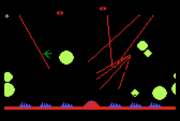
Galaxian
is an arcade game developed by Namco in 1979. It was published by Namco in Japan and was imported to North America by Midway in 1980. A fixed shooter-style game in which the player controls a spaceship at the bottom of the screen and shoots enemies descending in various directions, it was designed...
and Space Invaders
Space Invaders
is an arcade video game designed by Tomohiro Nishikado, and released in 1978. It was originally manufactured and sold by Taito in Japan, and was later licensed for production in the United States by the Midway division of Bally. Space Invaders is one of the earliest shooting games and the aim is to...
were the system's launch titles. A port of Asteroids was advertised as a launch title, but was never released. Gremlins, released in 1986, was the last game officially released for the system.
Reception
The console was frequently criticized for its poorly designed controllers and high asking price. In August 2009, video game website IGNIGN
IGN is an entertainment website that focuses on video games, films, music and other media. IGN's main website comprises several specialty sites or "channels", each occupying a subdomain and covering a specific area of entertainment...
placed the 5200 23rd out of the 25 greatest video game consoles of all time, behind its predecessor (the 2600, ranked 2nd greatest), its successor (the 7800
Atari 7800
The Atari 7800 ProSystem, or simply the Atari 7800, is a video game console re-released by Atari Corporation in January 1986. The original release had occurred two years earlier under Atari Inc. The 7800 had originally been designed to replace Atari Inc.'s Atari 5200 in 1984, but was temporarily...
, 17th), and both its main competitors (the Intellivision and Colecovision, 14th and 12th respectively).