

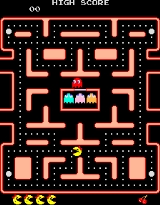
Ms. Pac-Man

Encyclopedia
Ms. Pac-Man is an arcade
video game produced by Midway
as an unauthorized sequel to Pac-Man
. It was released in North America in 1981 and became one of the most popular video games of all time, leading to its adoption by Pac-Man licensor Namco
as an official title. This game introduces a female protagonist, new maze designs and several minor gameplay changes over the original game.
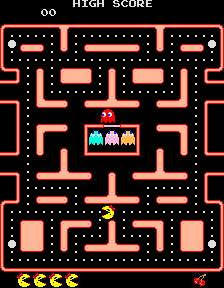 The gameplay of Ms. Pac-Man is largely identical to that of the original Pac-Man. The player gathers points by eating dots and avoiding ghosts (contact with one loses a life). Power-pellets or energizers change the ghosts, which reverse their course and can be eaten for bonus points. Fruit bonuses can be consumed for increasing point values, twice per level. As the levels increase, the speed and difficulty increase as well.
There are, however, some notable differences:
As in Pac-Man, the game has a bug in the subroutine that draws the fruit, which renders the 256th level unplayable. However, the game also has other bugs that cause it to crash or become unplayable much sooner, making it impossible to reach the 256th level without an emulator
.
While Crazy Otto was under development, GCC settled a lawsuit with Atari
over their Missile Command
conversion kit Super Missile Attack. Part of the settlement terms barred GCC from selling future conversion kits without consent from the original game manufacturer. Rather than scrapping Crazy Otto entirely, the programmers decided to show it to Midway, Namco
's American distributor of the original game. Midway had become impatient in waiting for Namco to release its next Pac-Man game (which would be Super Pac-Man
), and were enthusiastic that such a game had come to their attention. They bought the rights to Crazy Otto, changed the sprite
s to fit the Pac-Man universe, renamed the game Ms. Pac-Man, and released it into arcades.
After the game became wildly popular, Midway and GCC undertook a brief legal battle concerning royalties. The Killer List of Videogames
notes that the game was accomplished without Namco's consent, causing both companies to eventually turn over the rights of Ms. Pac-Man to Namco. Ms. Pac-Man was reportedly the first of a series of unauthorized sequels that eventually led to the termination of the licensing agreement between Namco and Midway. GCC co-founder Doug Macrae has disputed stories that the game was manufactured without Namco's blessing, claiming that then-Namco president Masaya Nakamura
had even provided feedback over character artwork during the game's development.
Ms. Pac-Man was later released on the third Namco Museum
game; however, there is no mention of it in Namco's official archives (including the archives on all of the Namco Museum releases).
In 2001, Namco released an arcade board featuring both Ms. Pac-Man and Galaga
in honor of the 20th anniversary of both games with the subtitle "20 Year Reunion / Class of 1981
". It also features Pac-Man
as a hidden bonus game. The later 25th Anniversary Edition allows all three games to be selected at the main menu.
, where she is named Pepper and is Pac-Man's wife.
Arcade cabinets have made appearances in a number of other series: in the episode "My Own Private Practice Guy" of the TV show Scrubs
, The Todd comments "Oh, Ms. Pac-Man I would sex that bow right off your head. Eat those dots you naughty, naughty girl." Dr. Kelso is also an expert at the game, with an impossibly high score of 40,000,000. Similarly, in the Weeds
episode, "A Modest Proposal", the character Andy Botwin buys a Ms. Pac-Man cabinet. He anthropomorphises
the ghosts, and also uses sexual language, though with Sue as the target, saying, "Come here Sue, you filthy little ghost whore!".
Ms. Pac-Man is referenced by a number of Fox
programmes. In The Simpsons
episode "I Married Marge
," Mr. Burns can be seen playing Ms. Pac-Man while he says "That's it... That's it... Come closer... [gobbles a power pellet] Muhahaha! Ironic isn't it. The hunter has become the hunted! Hahahaha!!". In Family Guy
, during the episode "Meet the Quagmires
," Peter is shown playing Menstrual Ms. Pac-Man when he and Brian go back in time to the 80s
. Futurama
s episode "Anthology of Interest II
" has a video game-inspired segment, in which the character of Ms. Pac-Man appears after her husband, "General Colin Pac-Man", is killed by a laser bolt from a Space Invader
. She appears to sob over Colin's dead body. Fry then asks Amy to "tend to the Widow Pac-Man".
Comedian and talk show host Tom Green
owns a Ms. Pac-Man arcade machine which can occasionally be seen during episodes of Tom Green's House Tonight, and was featured in an episode of The Jace Hall Show
.
In the 1992 movie Wayne's World
Wayne Campbell (played by Mike Myers) asks what is the difference between Pac-Man & Ms. Pac-Man is "really". Noah Vanderhof says she had a bow in her hair making Wayne telling him to "get out of town".
In the Drawn Together
episode "Gay Bash", Xandir meets Pac-Man (with whom he is friends) at a gay party. Believing Ms. Pac-Man to be his ex-wife, Xandir tells him to keep his gay secret
between them (as Ms. Pac-Man is best friends with Xandir's girlfriend). However, it is revealed that Ms. Pac-Man is actually Pac-Man in drag.
In the series Friends
, season 8, episode 12, "The one where Joey dates Rachel", Phoebe gives a Ms. Pac-Man arcade machine to Chandler and Monica for their wedding. Then begins a competition between the three of them over the game.
put Ms. Pac-Man 10th on their list of "The Top 200 Games of All Time", saying that it "trumped [the original Pac-Man] in nearly every way".
Arcade game
An arcade game is a coin-operated entertainment machine, usually installed in public businesses such as restaurants, bars, and amusement arcades. Most arcade games are video games, pinball machines, electro-mechanical games, redemption games, and merchandisers...
video game produced by Midway
Midway Games
Midway Games, Inc. is an American company that was formerly a major video game publisher. Following a bankruptcy filing in 2009, it is no longer active and is in the process of liquidating all of its assets. Midway's titles included Mortal Kombat, Ms.Pac-Man, Spy Hunter, Tron, Rampage, the...
as an unauthorized sequel to Pac-Man
Pac-Man
is an arcade game developed by Namco and licensed for distribution in the United States by Midway, first released in Japan on May 22, 1980. Immensely popular from its original release to the present day, Pac-Man is considered one of the classics of the medium, virtually synonymous with video games,...
. It was released in North America in 1981 and became one of the most popular video games of all time, leading to its adoption by Pac-Man licensor Namco
Namco
is a Japanese corporation best known as a former video game developer and publisher. Following a merger with Bandai in September 2005, the two companies' game production assets were spun off into Namco Bandai Games on March 31, 2006. Namco Ltd. was re-established to continue domestic operation of...
as an official title. This game introduces a female protagonist, new maze designs and several minor gameplay changes over the original game.
Gameplay
There are, however, some notable differences:
- The game has four different mazes that appear in different sets of colors.
- Most of the new mazes have two sets of warp tunnels.
- Unlike the original Pac-Man, the spaces in between the walls are filled in, making it easier to see where the path is.
- The ghosts' behavior patterns are different and include semi-random movement, precluding the use of patterns to beat each level.
- Instead of appearing in the center of the maze, fruits bounce around the maze, entering and leaving through the warp tunnelsWraparound (Video Games)Wraparound, in video games, is a gameplay variation on the single-screen in which space is finite but unbounded; objects leaving one side of the screen immediately reappear on the opposite side, maintaining speed and trajectory...
. Once all fruits have been encountered, they appear in random sequence for the rest of the game. - The orange ghost's name is Sue instead of Clyde.
- The three intermissions have changed to follow the developing relationship between Pac-Man and Ms. Pac-Man (from when they first meet to having a stork drop off their baby).
- The sound effects and music of the game are very different from the Pac-Man sounds.
As in Pac-Man, the game has a bug in the subroutine that draws the fruit, which renders the 256th level unplayable. However, the game also has other bugs that cause it to crash or become unplayable much sooner, making it impossible to reach the 256th level without an emulator
Emulator
In computing, an emulator is hardware or software or both that duplicates the functions of a first computer system in a different second computer system, so that the behavior of the second system closely resembles the behavior of the first system...
.
History
Ms. Pac-Man was originally conceived as an enhancement kit for Pac-Man called Crazy Otto, created by programmers employed at the General Computer Corporation (GCC).While Crazy Otto was under development, GCC settled a lawsuit with Atari
Atari
Atari is a corporate and brand name owned by several entities since its inception in 1972. It is currently owned by Atari Interactive, a wholly owned subsidiary of the French publisher Atari, SA . The original Atari, Inc. was founded in 1972 by Nolan Bushnell and Ted Dabney. It was a pioneer in...
over their Missile Command
Missile Command
Missile Command is a 1980 arcade game by Atari, Inc. that was also licensed to Sega for European release. It is considered one of the most notable games from the Golden Age of Video Arcade Games...
conversion kit Super Missile Attack. Part of the settlement terms barred GCC from selling future conversion kits without consent from the original game manufacturer. Rather than scrapping Crazy Otto entirely, the programmers decided to show it to Midway, Namco
Namco
is a Japanese corporation best known as a former video game developer and publisher. Following a merger with Bandai in September 2005, the two companies' game production assets were spun off into Namco Bandai Games on March 31, 2006. Namco Ltd. was re-established to continue domestic operation of...
's American distributor of the original game. Midway had become impatient in waiting for Namco to release its next Pac-Man game (which would be Super Pac-Man
Super Pac-Man
, released in 1982 is the third installment of the Pac-Man series of arcade games and the second starring Pac-Man himself. It is also the second game to be created by series originator Namco, as Ms...
), and were enthusiastic that such a game had come to their attention. They bought the rights to Crazy Otto, changed the sprite
Sprite (computer graphics)
In computer graphics, a sprite is a two-dimensional image or animation that is integrated into a larger scene...
s to fit the Pac-Man universe, renamed the game Ms. Pac-Man, and released it into arcades.
After the game became wildly popular, Midway and GCC undertook a brief legal battle concerning royalties. The Killer List of Videogames
Killer List of Videogames
The Killer List of Videogames is a web site featuring an online encyclopedia devoted to cataloging arcade games past and present. It is the video game department of the International Arcade Museum, and has been referred to as "the IMDb for players."....
notes that the game was accomplished without Namco's consent, causing both companies to eventually turn over the rights of Ms. Pac-Man to Namco. Ms. Pac-Man was reportedly the first of a series of unauthorized sequels that eventually led to the termination of the licensing agreement between Namco and Midway. GCC co-founder Doug Macrae has disputed stories that the game was manufactured without Namco's blessing, claiming that then-Namco president Masaya Nakamura
Masaya Nakamura (Namco)
is the founder of Namco, the third largest video game developing entity in Japan. The Japanese government awarded Nakamura the “Order of the Rising Sun, Gold Rays with Rosette” in their Spring Conferment of Decorations for his contribution to Japanese industry...
had even provided feedback over character artwork during the game's development.
Ms. Pac-Man was later released on the third Namco Museum
Namco Museum
Namco Museum refers to the series of video game compilations released by Namco for various 32-bit and above consoles, containing releases of their games from the 1980s and early 1990s...
game; however, there is no mention of it in Namco's official archives (including the archives on all of the Namco Museum releases).
In 2001, Namco released an arcade board featuring both Ms. Pac-Man and Galaga
Galaga
is a fixed shooter arcade game developed and published by Namco in Japan and published by Midway in North America in 1981. It is the sequel to Galaxian, released in 1979. The gameplay of Galaga puts the player in control of a space ship which is situated on the bottom of the screen...
in honor of the 20th anniversary of both games with the subtitle "20 Year Reunion / Class of 1981
Pac-Man Anniversary Arcade Machines
On special anniversaries for Pac-Man and/or Ms. Pac-Man . Namco has released compilations of their classic arcade games as arcade machines....
". It also features Pac-Man
Pac-Man
is an arcade game developed by Namco and licensed for distribution in the United States by Midway, first released in Japan on May 22, 1980. Immensely popular from its original release to the present day, Pac-Man is considered one of the classics of the medium, virtually synonymous with video games,...
as a hidden bonus game. The later 25th Anniversary Edition allows all three games to be selected at the main menu.
Ports
Like many other games of its era, Ms. Pac-Man has been ported to many platforms.- A tabletop version of Ms. Pac-Man was released in 1983 by Coleco. The unit was shaped like a miniature arcade cabinet, was controlled with a built-in joystick, and used a multicolor vacuum fluorescent displayVacuum fluorescent displayA vacuum fluorescent display is a display device used commonly on consumer-electronics equipment such as video cassette recorders, car radios, and microwave ovens. Invented in Japan in 1967, the displays became common on calculators and other consumer electronics devices...
. - Atari Inc released versions of it for its Atari 2600Atari 2600The Atari 2600 is a video game console released in October 1977 by Atari, Inc. It is credited with popularizing the use of microprocessor-based hardware and cartridges containing game code, instead of having non-microprocessor dedicated hardware with all games built in...
, Atari 5200Atari 5200The Atari 5200 SuperSystem, commonly known as the Atari 5200, is a video game console that was introduced in 1982 by Atari Inc. as a higher end complementary console for the popular Atari 2600...
, Atari 7800Atari 7800The Atari 7800 ProSystem, or simply the Atari 7800, is a video game console re-released by Atari Corporation in January 1986. The original release had occurred two years earlier under Atari Inc. The 7800 had originally been designed to replace Atari Inc.'s Atari 5200 in 1984, but was temporarily...
, and Atari 8-bit computer lineAtari 8-bit familyThe Atari 8-bit family is a series of 8-bit home computers manufactured from 1979 to 1992. All are based on the MOS Technology 6502 CPU and were the first home computers designed with custom coprocessor chips...
. There were also versions for the Commodore VIC-20Commodore VIC-20The VIC-20 is an 8-bit home computer which was sold by Commodore Business Machines. The VIC-20 was announced in 1980, roughly three years after Commodore's first personal computer, the PET...
, Commodore 64Commodore 64The Commodore 64 is an 8-bit home computer introduced by Commodore International in January 1982.Volume production started in the spring of 1982, with machines being released on to the market in August at a price of US$595...
, ZX SpectrumZX SpectrumThe ZX Spectrum is an 8-bit personal home computer released in the United Kingdom in 1982 by Sinclair Research Ltd...
, IBM PCIBM PCThe IBM Personal Computer, commonly known as the IBM PC, is the original version and progenitor of the IBM PC compatible hardware platform. It is IBM model number 5150, and was introduced on August 12, 1981...
, Apple IIApple IIThe Apple II is an 8-bit home computer, one of the first highly successful mass-produced microcomputer products, designed primarily by Steve Wozniak, manufactured by Apple Computer and introduced in 1977...
, and Texas Instruments TI-99/4ATexas Instruments TI-99/4AThe Texas Instruments TI-99/4A was an early home computer, released in June 1981, originally at a price of USD $525. It was an enhanced version of the less-successful—and quite rare—TI-99/4 model, which was released in late 1979 at a price of $1,150...
. A version of Ms. Pac-Man was also created for the Puffer exercise bike controller by Jim Leiterman for the Atari 5200Atari 5200The Atari 5200 SuperSystem, commonly known as the Atari 5200, is a video game console that was introduced in 1982 by Atari Inc. as a higher end complementary console for the popular Atari 2600...
as part of the Puffer project. It was never intended to be published. Atari CorporationAtari CorporationAtari Corporation was a manufacturer of computers and video game consoles from 1984 to 1996. Atari Corp. was founded in July of 1984 when Warner Communications sold the home computing and game console divisions of Atari to Jack Tramiel. Its chief products were the Atari ST, Atari XE, Atari 7800,...
also released a version for the Atari Lynx, introducing new mazes and a power-up that gave the player a temporary speed boost. - The Mega Drive/Genesis, Master SystemSega Master SystemThe is a third-generation video game console that was manufactured and released by Sega in 1985 in Japan , 1986 in North America and 1987 in Europe....
, and NESNintendo Entertainment SystemThe Nintendo Entertainment System is an 8-bit video game console that was released by Nintendo in North America during 1985, in Europe during 1986 and Australia in 1987...
versions, by TengenTengen (company)Tengen was a video game publisher and developer that was created by arcade game manufacturer Atari Games.-History:Atari had been split into two distinct companies. Atari Corporation was responsible for computer and console games and hardware and owned the rights to the Atari brand for these domains...
, and the Super NESSuper Nintendo Entertainment SystemThe Super Nintendo Entertainment System is a 16-bit video game console that was released by Nintendo in North America, Europe, Australasia , and South America between 1990 and 1993. In Japan and Southeast Asia, the system is called the , or SFC for short...
version, by Williams Electronics, took a few liberties. They featured four different sets of mazes: the original arcade mazes, bigger mazes, smaller mazes, and "strange" mazes. There was also a Pac-Booster option that let players make Ms. Pac-Man move much faster. All of these versions also allowed two people to play simultaneously, with player 2 as Pac-Man, either cooperatively or competitively. The game also ended at level 32, at which point an intermission that did not occur in the original game took place, where Pac-Man and Ms. Pac-Man say good bye. Namco also ported Ms. Pac-Man to the Famicom in 1985; this version did not reach North America until 1993. Unlike the Tengen version, it was a straight port of the arcade game without any added features. - Ms. Pac-Man was ported to the CD-iCD-iCD-i, or Compact Disc Interactive, is the name of an interactive multimedia CD player developed and marketed by Royal Philips Electronics N.V. CD-i also refers to the multimedia Compact Disc standard used by the CD-i console, also known as Green Book, which was developed by Philips and Sony...
as part of an Arcade ClassicsArcade Classics (CD-i game)Arcade Classics for the CD-i is a video game compilation containing ports of three Namco arcade games. The compilation was released in Europe but not released in North America.-Summary:...
collection (released in EuropeEuropeEurope is, by convention, one of the world's seven continents. Comprising the westernmost peninsula of Eurasia, Europe is generally 'divided' from Asia to its east by the watershed divides of the Ural and Caucasus Mountains, the Ural River, the Caspian and Black Seas, and the waterways connecting...
, but not in North AmericaNorth AmericaNorth America is a continent wholly within the Northern Hemisphere and almost wholly within the Western Hemisphere. It is also considered a northern subcontinent of the Americas...
). It had all of the extra features of Tengen's ports even though neither Tengen or Williams Electronics had made this version. - It has also been included in Namco's, MicrosoftMicrosoftMicrosoft Corporation is an American public multinational corporation headquartered in Redmond, Washington, USA that develops, manufactures, licenses, and supports a wide range of products and services predominantly related to computing through its various product divisions...
's and Atari's late 1990s series of classic game anthologies, and is an unlockable minigame in Pac-Man 2: The New AdventuresPac-Man 2: The New AdventuresPac-Man 2: The New Adventures, known in Japan as , is a side-scrolling game incorporating both puzzle and action-adventure elements. It was produced and published by Namco for the Super Nintendo Entertainment System and Mega Drive/Genesis systems, and was released on April 6, 1994 by Namco...
and Pac-Man World 2Pac-Man World 2is a video game by Namco for Xbox, GameCube, PlayStation 2, Game Boy Advance, and PC released in . Like the original Pac-Man World, the player controls the character of Pac-Man in a 3D platform game.-Story:...
. - It was ported to the Game Boy ColorGame Boy ColorThe is Nintendo's successor to the 8-bit Game Boy handheld game console, and was released on October 21, 1998 in Japan, November 19, 1998 in North America, November 23, 1998 in Europe and November 27, 1998 in the United Kingdom. It features a color screen and is slightly thicker and taller than...
with two new mazes and a bonus game (Super Pac-Man). - A standalone, battery-powered version of the game released by Jakks PacificJakks PacificJAKKS Pacific, Inc. is a designer and marketer of toys and consumer products, with a range of products that feature numerous children's toy licenses...
can be plugged directly into a television. Ms. Pac-Man and four other games (GalagaGalagais a fixed shooter arcade game developed and published by Namco in Japan and published by Midway in North America in 1981. It is the sequel to Galaxian, released in 1979. The gameplay of Galaga puts the player in control of a space ship which is situated on the bottom of the screen...
, MappyMappyis a 1983 arcade game by Namco. In the United States, it was manufactured and distributed by Bally/Midway. Mappy is a side-scrolling platformer that features cartoon-like characters, primarily cats and mice. The game's main character itself is a mouse. Mappy runs on Namco Super Pac-Man hardware,...
, XeviousXeviousis a vertical scrolling shooter arcade game by Namco, released in 1982. It was designed by Masanobu Endō. In the U.S., the game was manufactured and distributed by Atari. Xevious runs on Namco Galaga hardware. In Brazil the arcade cabinet was printed with the name 'COLUMBIA' for the game, while the...
and Pole PositionPole PositionPole Position is a racing video game released in 1982 by Namco. It was published by Namco in Japan and by Atari, Inc. in the United States...
) are included in a self-contained joystick hand controller. - Ms. Pac Man was also a free game bundled with every Xbox Live ArcadeXbox Live ArcadeXbox Live Arcade is a type of video game download distribution available primarily in a section of the Xbox Live Marketplace, Microsoft's digital distribution network for the Xbox 360, that focuses on smaller downloadable games from both major publishers and independent game developers...
disc for the original Xbox. The Xbox 360Xbox 360The Xbox 360 is the second video game console produced by Microsoft and the successor to the Xbox. The Xbox 360 competes with Sony's PlayStation 3 and Nintendo's Wii as part of the seventh generation of video game consoles...
XBLA version was released on January 9, 2007, featuring an online leaderboard and twelve achievements. - As of July 11, 2008, Ms. Pac Man is available for Apple's iPhoneIPhoneThe iPhone is a line of Internet and multimedia-enabled smartphones marketed by Apple Inc. The first iPhone was unveiled by Steve Jobs, then CEO of Apple, on January 9, 2007, and released on June 29, 2007...
through the App Store, and features all 256 levels. The game was also released in July for Windows Mobile ProfessionalWindows MobileWindows Mobile is a mobile operating system developed by Microsoft that was used in smartphones and Pocket PCs, but by 2011 was rarely supplied on new phones. The last version is "Windows Mobile 6.5.5"; it is superseded by Windows Phone, which does not run Windows Mobile software.Windows Mobile is...
. - As part of Pac-ManPac-Manis an arcade game developed by Namco and licensed for distribution in the United States by Midway, first released in Japan on May 22, 1980. Immensely popular from its original release to the present day, Pac-Man is considered one of the classics of the medium, virtually synonymous with video games,...
's 30th anniversary, Ms. Pac-Man is one of the games included on the home version of Pac-Man's Arcade Party arcade machine.
In film and television
The titular character of Ms. Pac-Man is a central figure in the Pac-Man animated TV seriesPac-Man (TV series)
Pac-Man is an animated television series produced by Hanna-Barbera based on the video game Pac-Man by Namco, which premiered on ABC and ran from 1982 to 1983. During the first airing of the show, the large number of advertisers sponsoring it caused commercial breaks to be double their normal length...
, where she is named Pepper and is Pac-Man's wife.
Arcade cabinets have made appearances in a number of other series: in the episode "My Own Private Practice Guy" of the TV show Scrubs
Scrubs (TV series)
Scrubs is an American medical comedy-drama television series created in 2001 by Bill Lawrence and produced by ABC Studios. The show follows the lives of several employees of the fictional Sacred Heart, a teaching hospital. It features fast-paced screenplay, slapstick, and surreal vignettes...
, The Todd comments "Oh, Ms. Pac-Man I would sex that bow right off your head. Eat those dots you naughty, naughty girl." Dr. Kelso is also an expert at the game, with an impossibly high score of 40,000,000. Similarly, in the Weeds
Weeds (TV series)
Weeds is an American television comedy created by Jenji Kohan and produced by Tilted Productions in association with Lionsgate Television. The central character is Nancy Botwin , a widowed mother of two boys who begins selling marijuana to support her family after her husband dies suddenly of a...
episode, "A Modest Proposal", the character Andy Botwin buys a Ms. Pac-Man cabinet. He anthropomorphises
Anthropomorphism
Anthropomorphism is any attribution of human characteristics to animals, non-living things, phenomena, material states, objects or abstract concepts, such as organizations, governments, spirits or deities. The term was coined in the mid 1700s...
the ghosts, and also uses sexual language, though with Sue as the target, saying, "Come here Sue, you filthy little ghost whore!".
Ms. Pac-Man is referenced by a number of Fox
Fox
Fox is a common name for many species of omnivorous mammals belonging to the Canidae family. Foxes are small to medium-sized canids , characterized by possessing a long narrow snout, and a bushy tail .Members of about 37 species are referred to as foxes, of which only 12 species actually belong to...
programmes. In The Simpsons
The Simpsons
The Simpsons is an American animated sitcom created by Matt Groening for the Fox Broadcasting Company. The series is a satirical parody of a middle class American lifestyle epitomized by its family of the same name, which consists of Homer, Marge, Bart, Lisa and Maggie...
episode "I Married Marge
I Married Marge
"I Married Marge" is the twelfth episode of The Simpsons third season. It originally aired on the Fox network in the United States on December 26, 1991. In the episode, Marge worries that she may yet again be pregnant and drives to Dr. Hibbert's office...
," Mr. Burns can be seen playing Ms. Pac-Man while he says "That's it... That's it... Come closer... [gobbles a power pellet] Muhahaha! Ironic isn't it. The hunter has become the hunted! Hahahaha!!". In Family Guy
Family Guy
Family Guy is an American animated television series created by Seth MacFarlane for the Fox Broadcasting Company. The series centers on the Griffins, a dysfunctional family consisting of parents Peter and Lois; their children Meg, Chris, and Stewie; and their anthropomorphic pet dog Brian...
, during the episode "Meet the Quagmires
Meet the Quagmires
"Meet the Quagmires" is the eighteenth episode of the fifth season of the animated comedy series Family Guy. It originally aired on Fox on May 20, 2007. The episode features Peter after he goes back in time, in order to live the single life a little longer, before he met his wife, Lois...
," Peter is shown playing Menstrual Ms. Pac-Man when he and Brian go back in time to the 80s
1980s
File:1980s decade montage.png|thumb|400px|From left, clockwise: The first Space Shuttle, Columbia, lifted off in 1981; American President Ronald Reagan and Soviet leader Mikhail Gorbachev eased tensions between the two superpowers, leading to the end of the Cold War; The Fall of the Berlin Wall in...
. Futurama
Futurama
Futurama is an American animated science fiction sitcom created by Matt Groening and developed by Groening and David X. Cohen for the Fox Broadcasting Company. The series follows the adventures of a late 20th-century New York City pizza delivery boy, Philip J...
s episode "Anthology of Interest II
Anthology of Interest II
"Anthology of Interest II" is episode eighteen of Futuramas third season. It originally aired in North America on January 6, 2002. This episode, as well as the earlier "Anthology of Interest I", serves to showcase three "imaginary" stories.-Plot:...
" has a video game-inspired segment, in which the character of Ms. Pac-Man appears after her husband, "General Colin Pac-Man", is killed by a laser bolt from a Space Invader
Space Invaders
is an arcade video game designed by Tomohiro Nishikado, and released in 1978. It was originally manufactured and sold by Taito in Japan, and was later licensed for production in the United States by the Midway division of Bally. Space Invaders is one of the earliest shooting games and the aim is to...
. She appears to sob over Colin's dead body. Fry then asks Amy to "tend to the Widow Pac-Man".
Comedian and talk show host Tom Green
Tom Green
Michael Thomas "Tom" Green is a Canadian actor, rapper, writer, comedian, talk show host and media personality. Best known for his shock humour brand of comedy, Green found mainstream prominence via his MTV television show The Tom Green Show...
owns a Ms. Pac-Man arcade machine which can occasionally be seen during episodes of Tom Green's House Tonight, and was featured in an episode of The Jace Hall Show
The Jace Hall Show
The Jace Hall Show is a video game show hosted by Jace Hall consisting of interviews with hollywood celebrities and those involved in the video game industry. The Jace Hall Show is a production of and is distributed by IGN Entertainment. The episodes air on Thursdays, and are available on Crackle,...
.
In the 1992 movie Wayne's World
Wayne's World (film)
Wayne's World is a 1992 American comedy film directed by Penelope Spheeris and starring Mike Myers in his film debut as Wayne Campbell and Dana Carvey as Garth Algar, hosts of the Aurora, Illinois-based Public-access television cable TV show Wayne's World...
Wayne Campbell (played by Mike Myers) asks what is the difference between Pac-Man & Ms. Pac-Man is "really". Noah Vanderhof says she had a bow in her hair making Wayne telling him to "get out of town".
In the Drawn Together
Drawn Together
Drawn Together is an American animated television series, which ran on Comedy Central from October 27, 2004 to November 14, 2007. The series was created by Dave Jeser and Matt Silverstein, and uses a sitcom format with a TV reality show setting...
episode "Gay Bash", Xandir meets Pac-Man (with whom he is friends) at a gay party. Believing Ms. Pac-Man to be his ex-wife, Xandir tells him to keep his gay secret
Coming out
Coming out is a figure of speech for lesbian, gay, bisexual, and transgender people's disclosure of their sexual orientation and/or gender identity....
between them (as Ms. Pac-Man is best friends with Xandir's girlfriend). However, it is revealed that Ms. Pac-Man is actually Pac-Man in drag.
In the series Friends
Friends
Friends is an American sitcom created by David Crane and Marta Kauffman, which aired on NBC from September 22, 1994 to May 6, 2004. The series revolves around a group of friends in Manhattan. The series was produced by Bright/Kauffman/Crane Productions, in association with Warner Bros. Television...
, season 8, episode 12, "The one where Joey dates Rachel", Phoebe gives a Ms. Pac-Man arcade machine to Chandler and Monica for their wedding. Then begins a competition between the three of them over the game.
Reception and legacy
In 2009, Game InformerGame Informer
Game Informer is an American-based monthly magazine featuring articles, news, strategy, and reviews of popular video games and associated consoles. It was formed in August 1991, when FuncoLand started publishing a six-page magazine, free in all its retail locations...
put Ms. Pac-Man 10th on their list of "The Top 200 Games of All Time", saying that it "trumped [the original Pac-Man] in nearly every way".
External links
- GCC 2004 reunion audio Presentation by GCC alumni of their company history, including development of Ms. Pac-Man
- Ms. PAC-MAN for iPod at NamcoGames.com
- Ms. Pac-Man (360) Reviews at MetacriticMetacriticMetacritic.com is a website that collates reviews of music albums, games, movies, TV shows and DVDs. For each product, a numerical score from each review is obtained and the total is averaged. An excerpt of each review is provided along with a hyperlink to the source. Three colour codes of Green,...
- ClassicGaming.com entry on Ms. Pac-Man
- Twin Galaxies has a scoreboard for Ms. Pac-Man high scores (registration required)