

ColecoVision

Encyclopedia
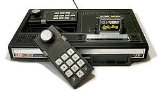
The ColecoVision is Coleco Industries
' second generation
home video game console
which was released in August 1982. The ColecoVision offered arcade-quality
graphics and gaming style, and the means to expand the system's basic hardware. Released with a catalog of 12 launch title
s, with an additional ten games announced for 1982, approximately 145 titles in total were published as ROM cartridge
s for the system between 1982 and 1984. River West Brands currently owns the ColecoVision brand name.
In 2009, IGN
named the ColecoVision their 12th best video game console out of their list of 25, citing "its incredible accuracy in bringing current-generation arcade hits home."
's Donkey Kong
as the official pack-in cartridge for all ColecoVision consoles, and this version of the game was well received as a near-perfect arcade port
, helping to boost the console's popularity. By Christmas of 1982, Coleco had sold more than 500,000 units, in part on the strength of its bundled game. The ColecoVision's main competitor was the arguably more advanced but less commercially successful Atari 5200
.
The ColecoVision was distributed by CBS Electronics outside of the United States
, and was branded the CBS ColecoVision.
Sales quickly passed one million in early 1983, before the video game crash of 1983
. By the beginning of 1984, quarterly sales of the ColecoVision had dramatically decreased.
Over the next 18 months, the Coleco company ramped down its video game division, ultimately withdrawing from the video game market by the end of the summer of 1985. The ColecoVision was officially discontinued by October 1985. Total sales of the ColecoVision are uncertain but were ultimately in excess of 2 million units, as sales had reached that number by the spring of 1984, while the console continued to sell modestly up until its discontinuation the following year.
In 1986, Bit Corporation
produced a ColecoVision clone called the Dina
, which was sold in the United States by Telegames as the Telegames Personal Arcade
.
and RF jack
at the rear. The controller
s connect into plugs in a recessed area on the top of the unit.
The design of the controllers is similar to that of Mattel
's Intellivision
—the controller is rectangular and consists of a numeric keypad and a set of side buttons. In place of the circular control disc below the keypad, the Coleco controller has a short, 1.5-inch joystick
. The keypad is designed to accept a thin plastic overlay that maps the keys for a particular game. Each ColecoVision console shipped with two controllers.
All first-party cartridges and most third-party software titles feature a 12-second pause before presenting the game select screen. This delay results from an intentional loop in the console's BIOS
to enable on-screen display of the ColecoVision brand. Companies like Parker Brothers
, Activision
, and Micro Fun bypassed this loop, which necessitated embedding portions of the BIOS outside the delay loop, further reducing storage available to actual game programming.
 From its introduction, Coleco had touted a hardware add-on called the Expansion Module #1 which made the ColecoVision compatible with the industry-leading Atari 2600
. Functionally, this gave the ColecoVision the largest software library of any console of its day. The expansion module prompted legal action from Atari, but Atari was unable to stop sales of the module because the 2600 could be reproduced with standard parts. Coleco was also able to design and market the Gemini game system
which was an exact clone of the 2600, but with combined joystick/paddle controllers.
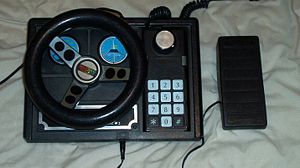
Expansion Module #2 is a driving controller expansion that consists of a steering wheel
, gas pedal and the pack-in game Turbo. The driving controller is also compatible with the games Destructor and Dukes Of Hazzard.
Expansion Module #3, the final hardware expansion module, was released in the summer of 1983. Module #3 converts the ColecoVision into a full-fledged computer known as the Coleco Adam
, complete with keyboard and digital data pack (DDP) cassette drives. Module #3 was originally conceived to be the ColecoVision Super Game Module using game wafers as the storage medium. Although Coleco presented a mock-up of the SGM at the 1983 New York Toy Show, that product was never manufactured. There were also rumors that Expansion Module #3 was to have incorporated an RCA
CED
player to store larger amounts of data.
Coleco prototyped a fourth expansion module intended to provide compatibility with Mattel's Intellivision, but this was never released.
Two controller expansions were also available. First was the Roller Controller, a trackball packaged with a port of the arcade game Slither, a Centipede clone and meant to be used with some dedicated games like Victory or to enhance the gameplay of previously published cartridges which benefitted from its trackball system (like Wargames
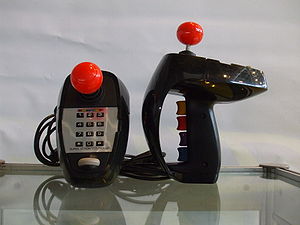
). The second was the Super Action Controller Set, resembling a pair of boxing gloves each with joystick and numeric keypad on top and a series of buttons along the grip. It came with the game Super Action Baseball and saw later release of the Rocky
-inspired Super Action Boxing and a port of Front Line
.
and Sega SG-1000/SC-3000 but the MSX contains a different sound chip, the AY-3-8910. ColecoVision shares the same CPU and a sound chip with Sega Master System
, also a similar but inferior graphics chip. For this reason it is not hard to port games between these systems.
(the creators of Pac-Man
and many other hits), Coleco entered into contracts with companies such as Sega
, Konami
, and Universal. Given that the ColecoVision could produce near arcade-quality ports, industry magazines like Electronic Games
were unanimous in their enthusiasm over the console.
Some of the more popular games include Donkey Kong
(the pack-in), Donkey Kong Junior, Carnival
, Lady Bug
, Mouse Trap, and Zaxxon
. Coleco also popularized lesser known arcade games, such as Venture, Cosmic Avenger
, and Mr. Do!
. In some cases, the console versions were arguably superior to the arcade versions, as seen in Space Panic
. Later Coleco continued adapting newer successful arcade games like Subroc
, Time Pilot
and Frenzy
, the company also made inferior ports of many of these games for the Atari 2600 and Intellivision
, in an effort to broaden its market.
Compared to arcade ports, the ColecoVision did not offer many games original to the console, though a few notable releases are Smurf: Rescue in Gargamel's Castle, War Room
, Illusions
, and Fortune Builder, an early milestone in the style of SimCity
.
Coleco was infamous for its vaporware
offerings. An example of such was to be an adaptation of Tunnels and Trolls
. It is not known whether the game's printed screen shots were from an actual prototype or were merely pre-development illustrations. The ColecoVision's box itself bears several other examples, among them Chess Challenger, Side Trak, Rip Cord, Horse Racing, and Mr. Turtle.
game for the ColecoVision, a Tetris
clone entitled Kevtris.
In 1997, Telegames released Personal Arcade Vol. 1, a collection of ColecoVision games for Microsoft Windows
, and a 1998 follow-up, Colecovision Hits Volume One.
, Family Guy
and Everybody Hates Chris
.
Coleco
Coleco is an American company founded in 1932 by Maurice Greenberg as "Connecticut Leather Company". It became a highly successful toy company in the 1980s, known for its mass-produced version of Cabbage Patch Kids dolls and its video game consoles, the Coleco Telstar and...
' second generation
History of video game consoles (second generation)
In the history of computer and video games, the second generation began in 1976 with the release of the Fairchild Channel F and Radofin 1292 Advanced Programmable Video System....
home video game console
Video game console
A video game console is an interactive entertainment computer or customized computer system that produces a video display signal which can be used with a display device to display a video game...
which was released in August 1982. The ColecoVision offered arcade-quality
Arcade game
An arcade game is a coin-operated entertainment machine, usually installed in public businesses such as restaurants, bars, and amusement arcades. Most arcade games are video games, pinball machines, electro-mechanical games, redemption games, and merchandisers...
graphics and gaming style, and the means to expand the system's basic hardware. Released with a catalog of 12 launch title
Launch title
A launch game, or launch title, is a video game released to consumers synchronously with the release of its respective video game console, meaning they are the only available games at the time of the console's launch. Several of these games are also packaged with the console...
s, with an additional ten games announced for 1982, approximately 145 titles in total were published as ROM cartridge
ROM cartridge
A ROM cartridge, sometimes referred to as a cart, is a removable enclosure containing read-only memory devices designed to be connected to a computer or games console....
s for the system between 1982 and 1984. River West Brands currently owns the ColecoVision brand name.
In 2009, IGN
IGN
IGN is an entertainment website that focuses on video games, films, music and other media. IGN's main website comprises several specialty sites or "channels", each occupying a subdomain and covering a specific area of entertainment...
named the ColecoVision their 12th best video game console out of their list of 25, citing "its incredible accuracy in bringing current-generation arcade hits home."
History
Coleco licensed NintendoNintendo
is a multinational corporation located in Kyoto, Japan. Founded on September 23, 1889 by Fusajiro Yamauchi, it produced handmade hanafuda cards. By 1963, the company had tried several small niche businesses, such as a cab company and a love hotel....
's Donkey Kong
Donkey Kong (video game)
is an arcade game released by Nintendo in 1981. It is an early example of the platform game genre, as the gameplay focuses on maneuvering the main character across a series of platforms while dodging and jumping over obstacles. In the game, Jumpman must rescue a damsel in distress, Lady, from a...
as the official pack-in cartridge for all ColecoVision consoles, and this version of the game was well received as a near-perfect arcade port
Porting
In computer science, porting is the process of adapting software so that an executable program can be created for a computing environment that is different from the one for which it was originally designed...
, helping to boost the console's popularity. By Christmas of 1982, Coleco had sold more than 500,000 units, in part on the strength of its bundled game. The ColecoVision's main competitor was the arguably more advanced but less commercially successful Atari 5200
Atari 5200
The Atari 5200 SuperSystem, commonly known as the Atari 5200, is a video game console that was introduced in 1982 by Atari Inc. as a higher end complementary console for the popular Atari 2600...
.
The ColecoVision was distributed by CBS Electronics outside of the United States
United States
The United States of America is a federal constitutional republic comprising fifty states and a federal district...
, and was branded the CBS ColecoVision.
Sales quickly passed one million in early 1983, before the video game crash of 1983
Video game crash of 1983
The North American video game crash was a serious event that brought an abrupt end to what is considered the second generation of console video gaming in North America. Beginning in 1983, the crash almost destroyed the then-fledgling industry and led to the bankruptcy of several companies producing...
. By the beginning of 1984, quarterly sales of the ColecoVision had dramatically decreased.
Over the next 18 months, the Coleco company ramped down its video game division, ultimately withdrawing from the video game market by the end of the summer of 1985. The ColecoVision was officially discontinued by October 1985. Total sales of the ColecoVision are uncertain but were ultimately in excess of 2 million units, as sales had reached that number by the spring of 1984, while the console continued to sell modestly up until its discontinuation the following year.
In 1986, Bit Corporation
Bit Corporation
Bit Corporation was a Taiwanese game developer and console manufacturer.-Games:Bit Corporation was one of the few Taiwanese companies to produce original software for the Atari 2600 rather than simply pirating the works of others, which it released worldwide under both its own name and the Puzzy...
produced a ColecoVision clone called the Dina
Dina (video game console)
The Dina is a video game console originally manufactured by Bit Corporation, later sold in the United States by Telegames as the Telegames Personal Arcade. It is a clone of the ColecoVision and the Sega SG-1000 consoles, with one cartridge slot for each platform...
, which was sold in the United States by Telegames as the Telegames Personal Arcade
Telegames Personal Arcade
The Telegames Personal Arcade was the US version of Bit Corporation's DINA 2-in-1. This slim console could play both ColecoVision and Sega SG-1000 cartridges. It came equipped with Nintendo NES styled control pads, and even had a built in game called "Meteoric Shower"...
.
Hardware
The main console unit consists of a 14×8×2 inch rectangular plastic case that houses the motherboard, with a cartridge slot on the right side and connectors for the external power supplyPower supply
A power supply is a device that supplies electrical energy to one or more electric loads. The term is most commonly applied to devices that convert one form of electrical energy to another, though it may also refer to devices that convert another form of energy to electrical energy...
and RF jack
RF connector
A coaxial RF connector is an electrical connector designed to work at radio frequencies in the multi-megahertz range.RF connectors are typically used with coaxial cables and are designed to maintain the shielding that the coaxial design offers. Better models also minimize the change in transmission...
at the rear. The controller
Game controller
A game controller is a device used with games or entertainment systems used to control a playable character or object, or otherwise provide input in a computer game. A controller is typically connected to a game console or computer by means of a wire, cord or nowadays, by means of wireless connection...
s connect into plugs in a recessed area on the top of the unit.
The design of the controllers is similar to that of Mattel
Mattel
Mattel, Inc. is the world's largest toy company based on revenue. The products it produces include Fisher Price, Barbie dolls, Hot Wheels and Matchbox toys, Masters of the Universe, American Girl dolls, board games, and, in the early 1980s, video game consoles. The company's name is derived from...
's Intellivision
Intellivision
The Intellivision is a video game console released by Mattel in 1979. Development of the console began in 1978, less than a year after the introduction of its main competitor, the Atari 2600. The word intellivision is a portmanteau of "intelligent television"...
—the controller is rectangular and consists of a numeric keypad and a set of side buttons. In place of the circular control disc below the keypad, the Coleco controller has a short, 1.5-inch joystick
Joystick
A joystick is an input device consisting of a stick that pivots on a base and reports its angle or direction to the device it is controlling. Joysticks, also known as 'control columns', are the principal control in the cockpit of many civilian and military aircraft, either as a center stick or...
. The keypad is designed to accept a thin plastic overlay that maps the keys for a particular game. Each ColecoVision console shipped with two controllers.
All first-party cartridges and most third-party software titles feature a 12-second pause before presenting the game select screen. This delay results from an intentional loop in the console's BIOS
BIOS
In IBM PC compatible computers, the basic input/output system , also known as the System BIOS or ROM BIOS , is a de facto standard defining a firmware interface....
to enable on-screen display of the ColecoVision brand. Companies like Parker Brothers
Parker Brothers
Parker Brothers is a toy and game manufacturer and brand. Since 1883, the company has published more than 1,800 games; among their best known products are Monopoly, Cluedo , Sorry, Risk, Trivial Pursuit, Ouija, Aggravation, and Probe...
, Activision
Activision
Activision is an American publisher, majority owned by French conglomerate Vivendi SA. Its current CEO is Robert Kotick. It was founded on October 1, 1979 and was the world's first independent developer and distributor of video games for gaming consoles...
, and Micro Fun bypassed this loop, which necessitated embedding portions of the BIOS outside the delay loop, further reducing storage available to actual game programming.
Technical specifications
- CPU: NECNEC, a Japanese multinational IT company, has its headquarters in Minato, Tokyo, Japan. NEC, part of the Sumitomo Group, provides information technology and network solutions to business enterprises, communications services providers and government....
version of ZilogZilogZilog, Inc., previously known as ZiLOG , is a manufacturer of 8-bit and 24-bit microcontrollers, and is most famous for its Intel 8080-compatible Z80 series.-History:...
Z80AZilog Z80The Zilog Z80 is an 8-bit microprocessor designed by Zilog and sold from July 1976 onwards. It was widely used both in desktop and embedded computer designs as well as for military purposes...
@ 3.58 MHz (See chip U1, marked NEC D780C-1 in circuit board picture) - Video processorVideo Display ControllerA Video Display Controller or VDC is an integrated circuit which is the main component in a video signal generator, a device responsible for the production of a TV video signal in a computing or game system...
: Texas InstrumentsTexas InstrumentsTexas Instruments Inc. , widely known as TI, is an American company based in Dallas, Texas, United States, which develops and commercializes semiconductor and computer technology...
TMS9928ATexas Instruments TMS9918thumb|VDP TMS9918Athumb|VDP TMS9918Athumb|VDP TMS9928AThe TMS9918 is a Video Display Controller manufactured by Texas Instruments.-General information:...
(40 Pin DIP located under the heat sinkHeat sinkA heat sink is a term for a component or assembly that transfers heat generated within a solid material to a fluid medium, such as air or a liquid. Examples of heat sinks are the heat exchangers used in refrigeration and air conditioning systems and the radiator in a car...
in the circuit board picture)- 256×192 resolution (See Display resolutionDisplay resolutionThe display resolution of a digital television or display device is the number of distinct pixels in each dimension that can be displayed. It can be an ambiguous term especially as the displayed resolution is controlled by all different factors in cathode ray tube , flat panel or projection...
) - 32 Sprites (See Sprite (computer graphics)Sprite (computer graphics)In computer graphics, a sprite is a two-dimensional image or animation that is integrated into a larger scene...
) - 16 colors
- 256×192 resolution (See Display resolution
- Sound: Texas InstrumentsTexas InstrumentsTexas Instruments Inc. , widely known as TI, is an American company based in Dallas, Texas, United States, which develops and commercializes semiconductor and computer technology...
SN76489ATexas Instruments SN76489The SN76489 Digital Complex Sound Generator is a TTL-compatible Programmable Sound Generator chip from Texas Instruments. It contains three square wave tone generators and one white noise generator, each of which can produce sounds at various frequencies and sixteen different volume levels...
(See chip U20 in circuit board picture)- 3 tone generators
- 1 noise generator
- VRAMVRAMVideo RAM, or VRAM, is a dual-ported variant of dynamic RAM , which was once commonly used to store the framebuffer in some graphics adapters....
: 16 KB (Chips marked ITT (See ITT CorporationITT CorporationITT Corporation is a global diversified manufacturing company based in the United States. ITT participates in global markets including water and fluids management, defense and security, and motion and flow control...
) 8244 4116 3N in the circuit board picture - These are 16K by 1 bit chips, thus there are 8 of them) - RAMRam-Animals:*Ram, an uncastrated male sheep*Ram cichlid, a species of freshwater fish endemic to Colombia and Venezuela-Military:*Battering ram*Ramming, a military tactic in which one vehicle runs into another...
: 1 KB (Chips marked UPD2114LC (U3 & U4) in circuit board picture - 1024 X 4-bit SRAM, thus two chips for 1 KB of memory) - ROM (See Read-only memoryRead-only memoryRead-only memory is a class of storage medium used in computers and other electronic devices. Data stored in ROM cannot be modified, or can be modified only slowly or with difficulty, so it is mainly used to distribute firmware .In its strictest sense, ROM refers only...
: 8 KB Texas Instruments TMS4764 Mask ROMMask ROMMask ROM is a type of read-only memory whose contents are programmed by the integrated circuit manufacturer...
(See chip U2, marked TMS4764NL in circuit board picture) - Storage: Cartridge: 8/16/24/32 KB
Expansion modules
Atari 2600
The Atari 2600 is a video game console released in October 1977 by Atari, Inc. It is credited with popularizing the use of microprocessor-based hardware and cartridges containing game code, instead of having non-microprocessor dedicated hardware with all games built in...
. Functionally, this gave the ColecoVision the largest software library of any console of its day. The expansion module prompted legal action from Atari, but Atari was unable to stop sales of the module because the 2600 could be reproduced with standard parts. Coleco was also able to design and market the Gemini game system
Coleco Gemini
The Coleco Gemini was an Atari 2600 clone manufactured by Coleco.-Technical specifications:* Processor: 8-bit 6507* CPU speed: 1.19 MHz* RAM: 128 bytes* Resolution: 160x200, 128 Colors -History:...
which was an exact clone of the 2600, but with combined joystick/paddle controllers.
Expansion Module #2 is a driving controller expansion that consists of a steering wheel
Steering wheel
A steering wheel is a type of steering control in vehicles and vessels ....
, gas pedal and the pack-in game Turbo. The driving controller is also compatible with the games Destructor and Dukes Of Hazzard.
Expansion Module #3, the final hardware expansion module, was released in the summer of 1983. Module #3 converts the ColecoVision into a full-fledged computer known as the Coleco Adam
Coleco Adam
The Coleco Adam is a home computer, an attempt in the early 1980s by American toy manufacturer Coleco to follow on the success of its ColecoVision game console...
, complete with keyboard and digital data pack (DDP) cassette drives. Module #3 was originally conceived to be the ColecoVision Super Game Module using game wafers as the storage medium. Although Coleco presented a mock-up of the SGM at the 1983 New York Toy Show, that product was never manufactured. There were also rumors that Expansion Module #3 was to have incorporated an RCA
RCA
RCA Corporation, founded as the Radio Corporation of America, was an American electronics company in existence from 1919 to 1986. The RCA trademark is currently owned by the French conglomerate Technicolor SA through RCA Trademark Management S.A., a company owned by Technicolor...
CED
SelectaVision
The Capacitance Electronic Disc was an analog video video disc playback system developed by RCA, in which video and audio could be played back on a TV set using a special needle and high-density groove system similar to phonograph records....
player to store larger amounts of data.
Coleco prototyped a fourth expansion module intended to provide compatibility with Mattel's Intellivision, but this was never released.
Two controller expansions were also available. First was the Roller Controller, a trackball packaged with a port of the arcade game Slither, a Centipede clone and meant to be used with some dedicated games like Victory or to enhance the gameplay of previously published cartridges which benefitted from its trackball system (like Wargames
WarGames (game)
WarGames is a 1984 video game developed by Coleco for the ColecoVision, and later ported to theAtari 8-bit family and Commodore 64. The game's goal is to defend the United States against nuclear attack, much in the style of a less frantic Missile Command...
). The second was the Super Action Controller Set, resembling a pair of boxing gloves each with joystick and numeric keypad on top and a series of buttons along the grip. It came with the game Super Action Baseball and saw later release of the Rocky
Rocky
Rocky is a 1976 American sports drama film directed by John G. Avildsen and both written by and starring Sylvester Stallone. It tells the rags to riches American Dream story of Rocky Balboa, an uneducated but kind-hearted debt collector for a loan shark in the city of Philadelphia, Pennsylvania...
-inspired Super Action Boxing and a port of Front Line
Front Line (arcade game)
Front Line is a military combat-themed arcade game released in 1982 by Taito Corporation.The original arcade version consists of a joystick, a single button , and a rotary dial that can be pushed in like a button, which fires the weapon...
.
Similarities to other platforms
The ColecoVision contains the same CPU and graphics chip as the MSXMSX
MSX was the name of a standardized home computer architecture in the 1980s conceived by Kazuhiko Nishi, then Vice-president at Microsoft Japan and Director at ASCII Corporation...
and Sega SG-1000/SC-3000 but the MSX contains a different sound chip, the AY-3-8910. ColecoVision shares the same CPU and a sound chip with Sega Master System
Sega Master System
The is a third-generation video game console that was manufactured and released by Sega in 1985 in Japan , 1986 in North America and 1987 in Europe....
, also a similar but inferior graphics chip. For this reason it is not hard to port games between these systems.
Games
Coleco's software approach was to license arcade games that Atari had not. Realizing that Atari had firm support from NamcoNamco
is a Japanese corporation best known as a former video game developer and publisher. Following a merger with Bandai in September 2005, the two companies' game production assets were spun off into Namco Bandai Games on March 31, 2006. Namco Ltd. was re-established to continue domestic operation of...
(the creators of Pac-Man
Pac-Man
is an arcade game developed by Namco and licensed for distribution in the United States by Midway, first released in Japan on May 22, 1980. Immensely popular from its original release to the present day, Pac-Man is considered one of the classics of the medium, virtually synonymous with video games,...
and many other hits), Coleco entered into contracts with companies such as Sega
Sega
, usually styled as SEGA, is a multinational video game software developer and an arcade software and hardware development company headquartered in Ōta, Tokyo, Japan, with various offices around the world...
, Konami
Konami
is a Japanese leading developer and publisher of numerous popular and strong-selling toys, trading cards, anime, tokusatsu, slot machines, arcade cabinets and video games...
, and Universal. Given that the ColecoVision could produce near arcade-quality ports, industry magazines like Electronic Games
Electronic Games
Electronic Games was the first video game magazine published in the United States and ran from 1981 to 1994. It was co-founded by Arnie Katz and Bill Kunkel, and is unrelated to the subsequent Electronic Gaming Monthly.-External links:* *...
were unanimous in their enthusiasm over the console.
Some of the more popular games include Donkey Kong
Donkey Kong (video game)
is an arcade game released by Nintendo in 1981. It is an early example of the platform game genre, as the gameplay focuses on maneuvering the main character across a series of platforms while dodging and jumping over obstacles. In the game, Jumpman must rescue a damsel in distress, Lady, from a...
(the pack-in), Donkey Kong Junior, Carnival
Carnival (game)
Carnival is a fixed shooter arcade game created by Sega in , and has the distinction of being the first video game with a bonus round.- Gameplay :...
, Lady Bug
Lady Bug (arcade game)
Lady Bug is a Pac-Man-like maze-based insect-themed arcade game produced by Universal Games and released in 1981.-Description:The goal of Lady Bug is to eat all dots, hearts and letters in the maze while avoiding other insects. The player is represented by a red, yellow, and green character...
, Mouse Trap, and Zaxxon
Zaxxon
Zaxxon is a 1982 arcade game developed and released by Sega. Some sources claim that Japanese electronics company Ikegami Tsushinki also worked on the development of Zaxxon...
. Coleco also popularized lesser known arcade games, such as Venture, Cosmic Avenger
Cosmic Avenger
Cosmic Avenger is a 1981 arcade game developed and published by Universal. This game is the first continuous X-axis scrolling video game.Wes Hupp holds the official record for this game with 117,290 points on November 17, 1982...
, and Mr. Do!
Mr. Do!
Mr. Do! is an arcade game created by Universal in 1982. Remotely similar in gameplay to Namco's popular Dig Dug title, Mr. Do! was also popular and saw release on a variety of home video game consoles and systems. It is the first game in the Mr...
. In some cases, the console versions were arguably superior to the arcade versions, as seen in Space Panic
Space Panic
Space Panic is a 1980 arcade game designed by Universal, which Chris Crawford calls the first ever platform game, as it pre-dates Nintendo's Donkey Kong which is often cited as the original platform game. Space Panic lacks Donkey Kongs jump mechanic, disqualifying it as a platformer for some...
. Later Coleco continued adapting newer successful arcade games like Subroc
Subroc-3D
SubRoc-3D is an arcade game released in 1982 by Sega, and the first such game to provide a three-dimensional image to the player, using a display that delivers individual images to each eye...
, Time Pilot
Time Pilot
Time Pilot is a multi-directional scrolling shooter and free-roaming aerial combat arcade game designed by Yoshiki Okamoto, released by Konami in 1982, and distributed in the United States by Centuri...
and Frenzy
Frenzy (video game)
Frenzy was an arcade game published by Stern Electronics in 1982. It was a sequel to the hit 1980 arcade game Berzerk.-Description:Frenzy followed the basic paradigm set by Berzerk: the player must navigate a maze full of hostile robots. The goal of the game is to survive as long as possible and...
, the company also made inferior ports of many of these games for the Atari 2600 and Intellivision
Intellivision
The Intellivision is a video game console released by Mattel in 1979. Development of the console began in 1978, less than a year after the introduction of its main competitor, the Atari 2600. The word intellivision is a portmanteau of "intelligent television"...
, in an effort to broaden its market.
Compared to arcade ports, the ColecoVision did not offer many games original to the console, though a few notable releases are Smurf: Rescue in Gargamel's Castle, War Room
War Room (video game)
War Room is a video game version of a fictional nuclear defense that was programmed by Robert S. Harris in 1983 for the ColecoVision....
, Illusions
Illusions (video game)
Illusions is a surreal ColecoVision video game in which the player maneuvers blobs around the screen, trying to get them to merge, or, alternatively, split apart. At times, lizards may chase the blobs around. The water bucket, when spilled, can cause the lizard to turn into a fish. If the fish...
, and Fortune Builder, an early milestone in the style of SimCity
SimCity
SimCity is a critically acclaimed city-building simulation video game, first released in 1989, and designed by Will Wright. SimCity was Maxis' first product, which has since been ported into various personal computers and game consoles, and spawned several sequels including SimCity 2000 in 1994,...
.
Coleco was infamous for its vaporware
Vaporware
Vaporware is a term in the computer industry that describes a product, typically computer hardware or software, that is announced to the general public but is never actually released nor officially canceled. Vaporware is also a term sometimes used to describe events that are announced or predicted,...
offerings. An example of such was to be an adaptation of Tunnels and Trolls
Tunnels and Trolls
Tunnels & Trolls is a fantasy role-playing game designed by Ken St. Andre and first published in 1975 by Flying Buffalo. The second modern role-playing game published, it was written by Ken St...
. It is not known whether the game's printed screen shots were from an actual prototype or were merely pre-development illustrations. The ColecoVision's box itself bears several other examples, among them Chess Challenger, Side Trak, Rip Cord, Horse Racing, and Mr. Turtle.
Legacy
In 1996, programmer Kevin Horton released the first homebrewHomebrew (video games)
Homebrew is a term frequently applied to video games or other software produced by consumers to target proprietary hardware platforms not typically user-programmable or that use proprietary storage methods...
game for the ColecoVision, a Tetris
Tetris
Tetris is a puzzle video game originally designed and programmed by Alexey Pajitnov in the Soviet Union. It was released on June 6, 1984, while he was working for the Dorodnicyn Computing Centre of the Academy of Science of the USSR in Moscow, Russian Soviet Federative Socialist Republic...
clone entitled Kevtris.
In 1997, Telegames released Personal Arcade Vol. 1, a collection of ColecoVision games for Microsoft Windows
Microsoft Windows
Microsoft Windows is a series of operating systems produced by Microsoft.Microsoft introduced an operating environment named Windows on November 20, 1985 as an add-on to MS-DOS in response to the growing interest in graphical user interfaces . Microsoft Windows came to dominate the world's personal...
, and a 1998 follow-up, Colecovision Hits Volume One.
In popular culture
The value of the ColecoVision as an 1980s pop culture icon was discussed on VH1's I Love The 80's Strikes Back. Several television series have aired episodes that reference or parody the console: South ParkSouth Park
South Park is an American animated television series created by Trey Parker and Matt Stone for the Comedy Central television network. Intended for mature audiences, the show has become famous for its crude language, surreal, satirical, and dark humor that lampoons a wide range of topics...
, Family Guy
Family Guy
Family Guy is an American animated television series created by Seth MacFarlane for the Fox Broadcasting Company. The series centers on the Griffins, a dysfunctional family consisting of parents Peter and Lois; their children Meg, Chris, and Stewie; and their anthropomorphic pet dog Brian...
and Everybody Hates Chris
Everybody Hates Chris
Everybody Hates Chris is an African American television period sitcom inspired by the teenage experiences of comedian Chris Rock , while growing up in the Bedford-Stuyvesant neighborhood of Brooklyn, New York . The show is set from 1982 to 1987; however, Rock himself was a teenager during years...
.