
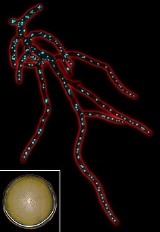
Ashbya gossypii

Encyclopedia
Ashbya gossypii is a filamentous fungus
or mold
closely related to yeast
, but growing exclusively in a filamentous way. It was originally isolated from cotton
as a pathogen
causing stigmatomycosis
by Ashby and Novell in 1926. This disease affects the development of hair cell
s in cotton bolls and can be transmitted to citrus fruits, which thereupon dry out and collapse (dry rot disease). In the first part of the 20th century, A. gossypii and two other fungi causing stigmatomycosis (Eremothecium coryli
, Aureobasidium pullulans
) made it virtually impossible to grow cotton in certain regions of the subtropics, causing severe economical losses. Control of the spore transmitting insects - cotton stainer (Dysdercus suturellus) and Antestia - permitted to fully eradicate infections. It was recognized that A. gossypii is a natural overproducer of riboflavin
, also known as vitamin B2, which protects its spores against ultraviolet light. This made it an interesting organism for industries, where genetically modified strains are still used to produce this vitamin
.
to study the growth of long and multinucleate
fungal cells (hypha
e) because of its small genome
, haploid
nuclei
, and efficient gene targeting
methods. It is generally assumed that a better understanding of filamentous fungal growth will greatly stimulate the development of novel fungicide
s. The use of Ashbya gossypii as a model organism
is particularly promising because of the high level of gene order
conservation (synteny
) between the genome
s of A. gossypii and the yeast Saccharomyces cerevisiae
.
and annotation
of the entire A. gossypii genome
, as published in 2004, was initiated when a significant degree of gene
synteny
was observed in preliminary studies in comparison to the genome of budding yeast, Saccharomyces cerevisiae
. This not only helped to improve gene annotation of S. cerevisiae, but also allowed the reconstruction
of the evolutionary history of both organisms. A. gossypii and S. cerevisiae originate from a common ancestor
which carried about 5000 genes. Divergence
of these two close relatives started some 100 million years ago. One branch of evolution involving up to 100 viable genome rearrangements (translocations
and inversions
), a few million base pair
changes, and a limited number of gene deletions, duplications
and additions lead to modern A. gossypii with its 4718 protein-coding genes and 9.2 million base pairs (smallest genome of a free-living eukaryote yet characterized) spread over seven chromosomes. The genome of S. cerevisiae underwent a more eventful evolution, which includes a whole-genome duplication.
Despite the long evolutionary history and of the two organisms and fundamentally different ways of growth and development, the complete synteny
map of both genomes reveals that 95 % of A. gossypii genes are orthologs
of S. cerevisiae genes and 90 % map within blocks of synteny (syntenic homologs
).
 The A. gossypii life cycle
starts with the only known phase of isotropic
growth in wild type
: germination
of the haploid
spore
to form a germ bubble. This is followed by apical
growth, extending two germ tubes in succession on opposing sites of the germ bubble. More axes of polarity are established with lateral branch formation in young mycelium
. Maturation is characterized by apical branching (tip splitting) and a dramatic increase of growth speed (up to 200 μm/h at 30 °C), which enables it to cover an 8 cm Petri dish
of full medium
in about 7 days. Sporulation is thought to be induced by nutrient
deprivation, leading to contraction at the septa
, cytokinesis
and subsequent abscission of sporangia
which contain up to 8 haploid
spores. Hypha
e are compartmentalized by septa, which in young parts appear as rings that allow transfer of nuclei
and in older parts may appear as closed discs. Compartments typically contain around eight nuclei
.
networks? This work examines alternative modes of transcriptional
control, spatial organization, and post-translational regulation that were adopted for nuclear division to accurately function in the framework of a multinucleated cell.
may contribute to the location of mitoses
. Thus septins seem to provide instructions that direct where a mitosis takes place. This project focuses on understanding how the septins signal to the cell cycle
machinery.
dependent kinase (CDK
) is phosphorylated and inhibited by the action of Swe1p (a wee1-like kinase) in response to low nutrients. This work focuses on understanding how external nutrient status is transmitted through the cell to regulate Swe1p kinase.
including experiments evaluating how Spindle Pole Bodies, Nuclear Pore Complex components and/or the Endoplasmic reticulum may be involved in maintaining nuclear autonomy.
Ashbya gossypii (also known as Eremothecium gossypii) is a filamentous fungus
or mold
closely related to yeast
, but growing exclusively in a filamentous way. It was originally isolated from cotton
as a pathogen
causing stigmatomycosis
by Ashby and Novell in 1926. This disease affects the development of hair cell
s in cotton bolls and can be transmitted to citrus fruits, which thereupon dry out and collapse (dry rot disease). In the first part of the 20th century, A. gossypii and two other fungi causing stigmatomycosis (Eremothecium coryli
, Aureobasidium pullulans
) made it virtually impossible to grow cotton in certain regions of the subtropics, causing severe economical losses. Control of the spore transmitting insects - cotton stainer (Dysdercus suturellus) and Antestia - permitted to fully eradicate infections. It was recognized that A. gossypii is a natural overproducer of riboflavin
, also known as vitamin B2, which protects its spores against ultraviolet light. This made it an interesting organism for industries, where genetically modified strains are still used to produce this vitamin
.
to study the growth of long and multinucleate
fungal cells (hypha
e) because of its small genome
, haploid
nuclei
, and efficient gene targeting
methods. It is generally assumed that a better understanding of filamentous fungal growth will greatly stimulate the development of novel fungicide
s. The use of Ashbya gossypii as a model organism
is particularly promising because of the high level of gene order
conservation (synteny
) between the genome
s of A. gossypii and the yeast Saccharomyces cerevisiae
.
and annotation
of the entire A. gossypii genome
, as published in 2004, was initiated when a significant degree of gene
synteny
was observed in preliminary studies in comparison to the genome of budding yeast, Saccharomyces cerevisiae
. This not only helped to improve gene annotation of S. cerevisiae, but also allowed the reconstruction
of the evolutionary history of both organisms. A. gossypii and S. cerevisiae originate from a common ancestor
which carried about 5000 genes. Divergence
of these two close relatives started some 100 million years ago. One branch of evolution involving up to 100 viable genome rearrangements (translocations
and inversions
), a few million base pair
changes, and a limited number of gene deletions, duplications
and additions lead to modern A. gossypii with its 4718 protein-coding genes and 9.2 million base pairs (smallest genome of a free-living eukaryote yet characterized) spread over seven chromosomes. The genome of S. cerevisiae underwent a more eventful evolution, which includes a whole-genome duplication.
Despite the long evolutionary history and of the two organisms and fundamentally different ways of growth and development, the complete synteny
map of both genomes reveals that 95 % of A. gossypii genes are orthologs
of S. cerevisiae genes and 90 % map within blocks of synteny (syntenic homologs
).
The A. gossypii life cycle
starts with the only known phase of isotropic
growth in wild type
: germination
of the haploid
spore
to form a germ bubble. This is followed by apical
growth, extending two germ tubes in succession on opposing sites of the germ bubble. More axes of polarity are established with lateral branch formation in young mycelium
. Maturation is characterized by apical branching (tip splitting) and a dramatic increase of growth speed (up to 200 μm/h at 30 °C), which enables it to cover an 8 cm Petri dish
of full medium
in about 7 days. Sporulation is thought to be induced by nutrient
deprivation, leading to contraction at the septa
, cytokinesis
and subsequent abscission of sporangia
which contain up to 8 haploid
spores. Hypha
e are compartmentalized by septa, which in young parts appear as rings that allow transfer of nuclei
and in older parts may appear as closed discs. Compartments typically contain around eight nuclei
.
networks? This work examines alternative modes of transcriptional
control, spatial organization, and post-translational regulation that were adopted for nuclear division to accurately function in the framework of a multinucleated cell.
may contribute to the location of mitoses
. Thus septins seem to provide instructions that direct where a mitosis takes place. This project focuses on understanding how the septins signal to the cell cycle
machinery.
dependent kinase (CDK
) is phosphorylated and inhibited by the action of Swe1p (a wee1-like kinase) in response to low nutrients. This work focuses on understanding how external nutrient status is transmitted through the cell to regulate Swe1p kinase.
including experiments evaluating how Spindle Pole Bodies, Nuclear Pore Complex components and/or the Endoplasmic reticulum may be involved in maintaining nuclear autonomy.
Ashbya gossypii (also known as Eremothecium gossypii) is a filamentous fungus
or mold
closely related to yeast
, but growing exclusively in a filamentous way. It was originally isolated from cotton
as a pathogen
causing stigmatomycosis
by Ashby and Novell in 1926. This disease affects the development of hair cell
s in cotton bolls and can be transmitted to citrus fruits, which thereupon dry out and collapse (dry rot disease). In the first part of the 20th century, A. gossypii and two other fungi causing stigmatomycosis (Eremothecium coryli
, Aureobasidium pullulans
) made it virtually impossible to grow cotton in certain regions of the subtropics, causing severe economical losses. Control of the spore transmitting insects - cotton stainer (Dysdercus suturellus) and Antestia - permitted to fully eradicate infections. It was recognized that A. gossypii is a natural overproducer of riboflavin
, also known as vitamin B2, which protects its spores against ultraviolet light. This made it an interesting organism for industries, where genetically modified strains are still used to produce this vitamin
.
to study the growth of long and multinucleate
fungal cells (hypha
e) because of its small genome
, haploid
nuclei
, and efficient gene targeting
methods. It is generally assumed that a better understanding of filamentous fungal growth will greatly stimulate the development of novel fungicide
s. The use of Ashbya gossypii as a model organism
is particularly promising because of the high level of gene order
conservation (synteny
) between the genome
s of A. gossypii and the yeast Saccharomyces cerevisiae
.
and annotation
of the entire A. gossypii genome
, as published in 2004, was initiated when a significant degree of gene
synteny
was observed in preliminary studies in comparison to the genome of budding yeast, Saccharomyces cerevisiae
. This not only helped to improve gene annotation of S. cerevisiae, but also allowed the reconstruction
of the evolutionary history of both organisms. A. gossypii and S. cerevisiae originate from a common ancestor
which carried about 5000 genes. Divergence
of these two close relatives started some 100 million years ago. One branch of evolution involving up to 100 viable genome rearrangements (translocations
and inversions
), a few million base pair
changes, and a limited number of gene deletions, duplications
and additions lead to modern A. gossypii with its 4718 protein-coding genes and 9.2 million base pairs (smallest genome of a free-living eukaryote yet characterized) spread over seven chromosomes. The genome of S. cerevisiae underwent a more eventful evolution, which includes a whole-genome duplication.
Despite the long evolutionary history and of the two organisms and fundamentally different ways of growth and development, the complete synteny
map of both genomes reveals that 95 % of A. gossypii genes are orthologs
of S. cerevisiae genes and 90 % map within blocks of synteny (syntenic homologs
).
The A. gossypii life cycle
starts with the only known phase of isotropic
growth in wild type
: germination
of the haploid
spore
to form a germ bubble. This is followed by apical
growth, extending two germ tubes in succession on opposing sites of the germ bubble. More axes of polarity are established with lateral branch formation in young mycelium
. Maturation is characterized by apical branching (tip splitting) and a dramatic increase of growth speed (up to 200 μm/h at 30 °C), which enables it to cover an 8 cm Petri dish
of full medium
in about 7 days. Sporulation is thought to be induced by nutrient
deprivation, leading to contraction at the septa
, cytokinesis
and subsequent abscission of sporangia
which contain up to 8 haploid
spores. Hypha
e are compartmentalized by septa, which in young parts appear as rings that allow transfer of nuclei
and in older parts may appear as closed discs. Compartments typically contain around eight nuclei
.
networks? This work examines alternative modes of transcriptional
control, spatial organization, and post-translational regulation that were adopted for nuclear division to accurately function in the framework of a multinucleated cell.
may contribute to the location of mitoses
. Thus septins seem to provide instructions that direct where a mitosis takes place. This project focuses on understanding how the septins signal to the cell cycle
machinery.
dependent kinase (CDK
) is phosphorylated and inhibited by the action of Swe1p (a wee1-like kinase) in response to low nutrients. This work focuses on understanding how external nutrient status is transmitted through the cell to regulate Swe1p kinase.
including experiments evaluating how Spindle Pole Bodies, Nuclear Pore Complex components and/or the Endoplasmic reticulum may be involved in maintaining nuclear autonomy.

Fungus
A fungus is a member of a large group of eukaryotic organisms that includes microorganisms such as yeasts and molds , as well as the more familiar mushrooms. These organisms are classified as a kingdom, Fungi, which is separate from plants, animals, and bacteria...
or mold
Mold
Molds are fungi that grow in the form of multicellular filaments called hyphae. Molds are not considered to be microbes but microscopic fungi that grow as single cells called yeasts...
closely related to yeast
Yeast
Yeasts are eukaryotic micro-organisms classified in the kingdom Fungi, with 1,500 species currently described estimated to be only 1% of all fungal species. Most reproduce asexually by mitosis, and many do so by an asymmetric division process called budding...
, but growing exclusively in a filamentous way. It was originally isolated from cotton
Cotton
Cotton is a soft, fluffy staple fiber that grows in a boll, or protective capsule, around the seeds of cotton plants of the genus Gossypium. The fiber is almost pure cellulose. The botanical purpose of cotton fiber is to aid in seed dispersal....
as a pathogen
Pathogen
A pathogen gignomai "I give birth to") or infectious agent — colloquially, a germ — is a microbe or microorganism such as a virus, bacterium, prion, or fungus that causes disease in its animal or plant host...
causing stigmatomycosis
Stigmatomycosis
The term Stigmatomycosis is the general name for a fungal disease that occurs in a number of crops, such as cotton, soybean, pecan, pomegranate, citrus, and pistachio. It has been reported on pistachio in Greece, Iran, Russia, and is frequently a problem in California pistachio orchards severely...
by Ashby and Novell in 1926. This disease affects the development of hair cell
Hair cell
Hair cells are the sensory receptors of both the auditory system and the vestibular system in all vertebrates. In mammals, the auditory hair cells are located within the organ of Corti on a thin basilar membrane in the cochlea of the inner ear...
s in cotton bolls and can be transmitted to citrus fruits, which thereupon dry out and collapse (dry rot disease). In the first part of the 20th century, A. gossypii and two other fungi causing stigmatomycosis (Eremothecium coryli
Nematospora coryli
Nematospora coryli is a plant pathogen that causes stigmatomycosis. It is cultivated on potato dextrose agar and grows as yeast-like oval or spherical budding cells either isolated or in short chains and has few hyphae which are septate at maturity...
, Aureobasidium pullulans
Aureobasidium pullulans
Aureobasidium pullulans is a ubiquitous yeast-like fungus that can be found in different environments . It is well known as a naturally occurring epiphyte or endophyte of a wide range of plant species without causing any symptoms of disease.A...
) made it virtually impossible to grow cotton in certain regions of the subtropics, causing severe economical losses. Control of the spore transmitting insects - cotton stainer (Dysdercus suturellus) and Antestia - permitted to fully eradicate infections. It was recognized that A. gossypii is a natural overproducer of riboflavin
Riboflavin
Riboflavin, also known as vitamin B2 or additive E101, is an easily absorbed micronutrient with a key role in maintaining health in humans and animals. It is the central component of the cofactors FAD and FMN, and is therefore required by all flavoproteins. As such, vitamin B2 is required for a...
, also known as vitamin B2, which protects its spores against ultraviolet light. This made it an interesting organism for industries, where genetically modified strains are still used to produce this vitamin
Vitamin
A vitamin is an organic compound required as a nutrient in tiny amounts by an organism. In other words, an organic chemical compound is called a vitamin when it cannot be synthesized in sufficient quantities by an organism, and must be obtained from the diet. Thus, the term is conditional both on...
.
A. gossypii as a model organism
A few years ago, A. gossypii became recognized as an attractive modelModel organism
A model organism is a non-human species that is extensively studied to understand particular biological phenomena, with the expectation that discoveries made in the organism model will provide insight into the workings of other organisms. Model organisms are in vivo models and are widely used to...
to study the growth of long and multinucleate
Multinucleate
Multinucleate cells have more than one nucleus per cell, which is the result of nuclear division not being followed by cytokinesis. As a consequence, multiple nuclei share one common cytoplasm. This can be the consequence of a disturbed cell cycle control Multinucleate (also multinucleated,...
fungal cells (hypha
Hypha
A hypha is a long, branching filamentous structure of a fungus, and also of unrelated Actinobacteria. In most fungi, hyphae are the main mode of vegetative growth, and are collectively called a mycelium; yeasts are unicellular fungi that do not grow as hyphae.-Structure:A hypha consists of one or...
e) because of its small genome
Genome
In modern molecular biology and genetics, the genome is the entirety of an organism's hereditary information. It is encoded either in DNA or, for many types of virus, in RNA. The genome includes both the genes and the non-coding sequences of the DNA/RNA....
, haploid
Ploidy
Ploidy is the number of sets of chromosomes in a biological cell.Human sex cells have one complete set of chromosomes from the male or female parent. Sex cells, also called gametes, combine to produce somatic cells. Somatic cells, therefore, have twice as many chromosomes. The haploid number is...
nuclei
Cell nucleus
In cell biology, the nucleus is a membrane-enclosed organelle found in eukaryotic cells. It contains most of the cell's genetic material, organized as multiple long linear DNA molecules in complex with a large variety of proteins, such as histones, to form chromosomes. The genes within these...
, and efficient gene targeting
Gene targeting
Gene targeting is a genetic technique that uses homologous recombination to change an endogenous gene. The method can be used to delete a gene, remove exons, add a gene, and introduce point mutations. Gene targeting can be permanent or conditional...
methods. It is generally assumed that a better understanding of filamentous fungal growth will greatly stimulate the development of novel fungicide
Fungicide
Fungicides are chemical compounds or biological organisms used to kill or inhibit fungi or fungal spores. Fungi can cause serious damage in agriculture, resulting in critical losses of yield, quality and profit. Fungicides are used both in agriculture and to fight fungal infections in animals...
s. The use of Ashbya gossypii as a model organism
Model organism
A model organism is a non-human species that is extensively studied to understand particular biological phenomena, with the expectation that discoveries made in the organism model will provide insight into the workings of other organisms. Model organisms are in vivo models and are widely used to...
is particularly promising because of the high level of gene order
Gene orders
Gene orders is the permutation of genome arrangement. So far a fair amount of work trying to describe whether gene orders evolve according to a molecular clock or in jumps ....
conservation (synteny
Synteny
In classical genetics, synteny describes the physical co-localization of genetic loci on the same chromosome within an individual or species. The concept is related to genetic linkage: Linkage between two loci is established by the observation of lower-than-expected recombination frequencies...
) between the genome
Genome
In modern molecular biology and genetics, the genome is the entirety of an organism's hereditary information. It is encoded either in DNA or, for many types of virus, in RNA. The genome includes both the genes and the non-coding sequences of the DNA/RNA....
s of A. gossypii and the yeast Saccharomyces cerevisiae
Saccharomyces cerevisiae
Saccharomyces cerevisiae is a species of yeast. It is perhaps the most useful yeast, having been instrumental to baking and brewing since ancient times. It is believed that it was originally isolated from the skin of grapes...
.
Genome
The complete sequencingSequencing
In genetics and biochemistry, sequencing means to determine the primary structure of an unbranched biopolymer...
and annotation
Annotation
An annotation is a note that is made while reading any form of text. This may be as simple as underlining or highlighting passages.Annotated bibliographies give descriptions about how each source is useful to an author in constructing a paper or argument...
of the entire A. gossypii genome
Genome
In modern molecular biology and genetics, the genome is the entirety of an organism's hereditary information. It is encoded either in DNA or, for many types of virus, in RNA. The genome includes both the genes and the non-coding sequences of the DNA/RNA....
, as published in 2004, was initiated when a significant degree of gene
Gene
A gene is a molecular unit of heredity of a living organism. It is a name given to some stretches of DNA and RNA that code for a type of protein or for an RNA chain that has a function in the organism. Living beings depend on genes, as they specify all proteins and functional RNA chains...
synteny
Synteny
In classical genetics, synteny describes the physical co-localization of genetic loci on the same chromosome within an individual or species. The concept is related to genetic linkage: Linkage between two loci is established by the observation of lower-than-expected recombination frequencies...
was observed in preliminary studies in comparison to the genome of budding yeast, Saccharomyces cerevisiae
Saccharomyces cerevisiae
Saccharomyces cerevisiae is a species of yeast. It is perhaps the most useful yeast, having been instrumental to baking and brewing since ancient times. It is believed that it was originally isolated from the skin of grapes...
. This not only helped to improve gene annotation of S. cerevisiae, but also allowed the reconstruction
Ancestral Reconstruction
- Trait reconstruction :Ancestral reconstruction is widely use to infer the ecological, phenotypic, or biogeographic traits associated with ancestral nodes in a phylogenetic tree...
of the evolutionary history of both organisms. A. gossypii and S. cerevisiae originate from a common ancestor
Ancestor
An ancestor is a parent or the parent of an ancestor ....
which carried about 5000 genes. Divergence
Genetic divergence
Genetic divergence is the process in which two or more populations of an ancestral species accumulate independent genetic changes through time, often after the populations have become reproductively isolated for some period of time...
of these two close relatives started some 100 million years ago. One branch of evolution involving up to 100 viable genome rearrangements (translocations
Chromosomal translocation
In genetics, a chromosome translocation is a chromosome abnormality caused by rearrangement of parts between nonhomologous chromosomes. A gene fusion may be created when the translocation joins two otherwise separated genes, the occurrence of which is common in cancer. It is detected on...
and inversions
Chromosomal inversion
An inversion is a chromosome rearrangement in which a segment of a chromosome is reversed end to end. An inversion occurs when a single chromosome undergoes breakage and rearrangement within itself. Inversions are of two types: paracentric and pericentric.Paracentric inversions do not include the...
), a few million base pair
Base pair
In molecular biology and genetics, the linking between two nitrogenous bases on opposite complementary DNA or certain types of RNA strands that are connected via hydrogen bonds is called a base pair...
changes, and a limited number of gene deletions, duplications
Gene duplication
Gene duplication is any duplication of a region of DNA that contains a gene; it may occur as an error in homologous recombination, a retrotransposition event, or duplication of an entire chromosome.The second copy of the gene is often free from selective pressure — that is, mutations of it have no...
and additions lead to modern A. gossypii with its 4718 protein-coding genes and 9.2 million base pairs (smallest genome of a free-living eukaryote yet characterized) spread over seven chromosomes. The genome of S. cerevisiae underwent a more eventful evolution, which includes a whole-genome duplication.
Despite the long evolutionary history and of the two organisms and fundamentally different ways of growth and development, the complete synteny
Synteny
In classical genetics, synteny describes the physical co-localization of genetic loci on the same chromosome within an individual or species. The concept is related to genetic linkage: Linkage between two loci is established by the observation of lower-than-expected recombination frequencies...
map of both genomes reveals that 95 % of A. gossypii genes are orthologs
Homology (biology)
Homology forms the basis of organization for comparative biology. In 1843, Richard Owen defined homology as "the same organ in different animals under every variety of form and function". Organs as different as a bat's wing, a seal's flipper, a cat's paw and a human hand have a common underlying...
of S. cerevisiae genes and 90 % map within blocks of synteny (syntenic homologs
Homology (biology)
Homology forms the basis of organization for comparative biology. In 1843, Richard Owen defined homology as "the same organ in different animals under every variety of form and function". Organs as different as a bat's wing, a seal's flipper, a cat's paw and a human hand have a common underlying...
).
Growth, Development and Morphology
Biological life cycle
A life cycle is a period involving all different generations of a species succeeding each other through means of reproduction, whether through asexual reproduction or sexual reproduction...
starts with the only known phase of isotropic
Isotropy
Isotropy is uniformity in all orientations; it is derived from the Greek iso and tropos . Precise definitions depend on the subject area. Exceptions, or inequalities, are frequently indicated by the prefix an, hence anisotropy. Anisotropy is also used to describe situations where properties vary...
growth in wild type
Wild type
Wild type refers to the phenotype of the typical form of a species as it occurs in nature. Originally, the wild type was conceptualized as a product of the standard, "normal" allele at a locus, in contrast to that produced by a non-standard, "mutant" allele...
: germination
Germination
Germination is the process in which a plant or fungus emerges from a seed or spore, respectively, and begins growth. The most common example of germination is the sprouting of a seedling from a seed of an angiosperm or gymnosperm. However the growth of a sporeling from a spore, for example the...
of the haploid
Ploidy
Ploidy is the number of sets of chromosomes in a biological cell.Human sex cells have one complete set of chromosomes from the male or female parent. Sex cells, also called gametes, combine to produce somatic cells. Somatic cells, therefore, have twice as many chromosomes. The haploid number is...
spore
Spore
In biology, a spore is a reproductive structure that is adapted for dispersal and surviving for extended periods of time in unfavorable conditions. Spores form part of the life cycles of many bacteria, plants, algae, fungi and some protozoa. According to scientist Dr...
to form a germ bubble. This is followed by apical
Apical
Apical, from the Latin apex meaning to be at the apex or tip, may refer to:*Apical , an anatomical term of location for features associated with the base of an organism or structure...
growth, extending two germ tubes in succession on opposing sites of the germ bubble. More axes of polarity are established with lateral branch formation in young mycelium
Mycelium
thumb|right|Fungal myceliaMycelium is the vegetative part of a fungus, consisting of a mass of branching, thread-like hyphae. The mass of hyphae is sometimes called shiro, especially within the fairy ring fungi. Fungal colonies composed of mycelia are found in soil and on or within many other...
. Maturation is characterized by apical branching (tip splitting) and a dramatic increase of growth speed (up to 200 μm/h at 30 °C), which enables it to cover an 8 cm Petri dish
Petri dish
A Petri dish is a shallow glass or plastic cylindrical lidded dish that biologists use to culture cells or small moss plants. It was named after German bacteriologist Julius Richard Petri, who invented it when working as an assistant to Robert Koch...
of full medium
Growth medium
A growth medium or culture medium is a liquid or gel designed to support the growth of microorganisms or cells, or small plants like the moss Physcomitrella patens.There are different types of media for growing different types of cells....
in about 7 days. Sporulation is thought to be induced by nutrient
Nutrient
A nutrient is a chemical that an organism needs to live and grow or a substance used in an organism's metabolism which must be taken in from its environment. They are used to build and repair tissues, regulate body processes and are converted to and used as energy...
deprivation, leading to contraction at the septa
Septum
In anatomy, a septum is a wall, dividing a cavity or structure into smaller ones.-In human anatomy:...
, cytokinesis
Cytokinesis
Cytokinesis is the process in which the cytoplasm of a single eukaryotic cell is divided to form two daughter cells. It usually initiates during the late stages of mitosis, and sometimes meiosis, splitting a binucleate cell in two, to ensure that chromosome number is maintained from one generation...
and subsequent abscission of sporangia
Sporangium
A sporangium is an enclosure in which spores are formed. It can be composed of a single cell or can be multicellular. All plants, fungi, and many other lineages form sporangia at some point in their life cycle...
which contain up to 8 haploid
Ploidy
Ploidy is the number of sets of chromosomes in a biological cell.Human sex cells have one complete set of chromosomes from the male or female parent. Sex cells, also called gametes, combine to produce somatic cells. Somatic cells, therefore, have twice as many chromosomes. The haploid number is...
spores. Hypha
Hypha
A hypha is a long, branching filamentous structure of a fungus, and also of unrelated Actinobacteria. In most fungi, hyphae are the main mode of vegetative growth, and are collectively called a mycelium; yeasts are unicellular fungi that do not grow as hyphae.-Structure:A hypha consists of one or...
e are compartmentalized by septa, which in young parts appear as rings that allow transfer of nuclei
Cell nucleus
In cell biology, the nucleus is a membrane-enclosed organelle found in eukaryotic cells. It contains most of the cell's genetic material, organized as multiple long linear DNA molecules in complex with a large variety of proteins, such as histones, to form chromosomes. The genes within these...
and in older parts may appear as closed discs. Compartments typically contain around eight nuclei
Cell nucleus
In cell biology, the nucleus is a membrane-enclosed organelle found in eukaryotic cells. It contains most of the cell's genetic material, organized as multiple long linear DNA molecules in complex with a large variety of proteins, such as histones, to form chromosomes. The genes within these...
.
Mechanisms of cell polarity
Polar growth is essential for proper function of many cells. Without cell polarity many transport processes and signal perception of vision and sound would be impossible. Investigating how Ashbya gossypii hyphae maintain polarity and grow constantly into one direction will help to understand the basic processes of cell polarity.Evolution of the cell cycle in multinucleated cells
How do cell shape, size and nuclear organization influence the function of conserved cell cycleCell cycle
The cell cycle, or cell-division cycle, is the series of events that takes place in a cell leading to its division and duplication . In cells without a nucleus , the cell cycle occurs via a process termed binary fission...
networks? This work examines alternative modes of transcriptional
Transcription (genetics)
Transcription is the process of creating a complementary RNA copy of a sequence of DNA. Both RNA and DNA are nucleic acids, which use base pairs of nucleotides as a complementary language that can be converted back and forth from DNA to RNA by the action of the correct enzymes...
control, spatial organization, and post-translational regulation that were adopted for nuclear division to accurately function in the framework of a multinucleated cell.
Spatial control of mitosis
It has been discovered that a conserved family of proteins called the septinsSeptins
Septins are evolutionary conserved proteins with essential functions in cytokinesis, and more subtle roles throughout the cell cycle. Much of our knowledge about septins originates from studies of budding yeast Saccharomyces cerevisiae, where they form a ring-like protein scaffold at the mother-bud...
may contribute to the location of mitoses
Mitosis
Mitosis is the process by which a eukaryotic cell separates the chromosomes in its cell nucleus into two identical sets, in two separate nuclei. It is generally followed immediately by cytokinesis, which divides the nuclei, cytoplasm, organelles and cell membrane into two cells containing roughly...
. Thus septins seem to provide instructions that direct where a mitosis takes place. This project focuses on understanding how the septins signal to the cell cycle
Cell cycle
The cell cycle, or cell-division cycle, is the series of events that takes place in a cell leading to its division and duplication . In cells without a nucleus , the cell cycle occurs via a process termed binary fission...
machinery.
Nutritional control of cyclin dependent kinase activity
It has been shown that the CyclinCyclin
Cyclins are a family of proteins that control the progression of cells through the cell cycle by activating cyclin-dependent kinase enzymes.- Function :...
dependent kinase (CDK
Cyclin-dependent kinase
thumb|350px|Schematic of the cell cycle. outer ring: I=[[Interphase]], M=[[Mitosis]]; inner ring: M=Mitosis; G1=[[G1 phase|Gap phase 1]]; S=[[S phase|Synthesis]]; G2=[[G2 phase|Gap phase 2]]...
) is phosphorylated and inhibited by the action of Swe1p (a wee1-like kinase) in response to low nutrients. This work focuses on understanding how external nutrient status is transmitted through the cell to regulate Swe1p kinase.
Basis for asynchronous mitoses in a common cytoplasm
There is some evidence proteins can be exchanged between neighboring nuclei in Ashbya cells, however, the nuclei still divide independently of their neighbors. This work involves identifying the basis for nuclear independence within a common cytoplasmCytoplasm
The cytoplasm is a small gel-like substance residing between the cell membrane holding all the cell's internal sub-structures , except for the nucleus. All the contents of the cells of prokaryote organisms are contained within the cytoplasm...
including experiments evaluating how Spindle Pole Bodies, Nuclear Pore Complex components and/or the Endoplasmic reticulum may be involved in maintaining nuclear autonomy.
Ashbya gossypii (also known as Eremothecium gossypii) is a filamentous fungus
Fungus
A fungus is a member of a large group of eukaryotic organisms that includes microorganisms such as yeasts and molds , as well as the more familiar mushrooms. These organisms are classified as a kingdom, Fungi, which is separate from plants, animals, and bacteria...
or mold
Mold
Molds are fungi that grow in the form of multicellular filaments called hyphae. Molds are not considered to be microbes but microscopic fungi that grow as single cells called yeasts...
closely related to yeast
Yeast
Yeasts are eukaryotic micro-organisms classified in the kingdom Fungi, with 1,500 species currently described estimated to be only 1% of all fungal species. Most reproduce asexually by mitosis, and many do so by an asymmetric division process called budding...
, but growing exclusively in a filamentous way. It was originally isolated from cotton
Cotton
Cotton is a soft, fluffy staple fiber that grows in a boll, or protective capsule, around the seeds of cotton plants of the genus Gossypium. The fiber is almost pure cellulose. The botanical purpose of cotton fiber is to aid in seed dispersal....
as a pathogen
Pathogen
A pathogen gignomai "I give birth to") or infectious agent — colloquially, a germ — is a microbe or microorganism such as a virus, bacterium, prion, or fungus that causes disease in its animal or plant host...
causing stigmatomycosis
Stigmatomycosis
The term Stigmatomycosis is the general name for a fungal disease that occurs in a number of crops, such as cotton, soybean, pecan, pomegranate, citrus, and pistachio. It has been reported on pistachio in Greece, Iran, Russia, and is frequently a problem in California pistachio orchards severely...
by Ashby and Novell in 1926. This disease affects the development of hair cell
Hair cell
Hair cells are the sensory receptors of both the auditory system and the vestibular system in all vertebrates. In mammals, the auditory hair cells are located within the organ of Corti on a thin basilar membrane in the cochlea of the inner ear...
s in cotton bolls and can be transmitted to citrus fruits, which thereupon dry out and collapse (dry rot disease). In the first part of the 20th century, A. gossypii and two other fungi causing stigmatomycosis (Eremothecium coryli
Nematospora coryli
Nematospora coryli is a plant pathogen that causes stigmatomycosis. It is cultivated on potato dextrose agar and grows as yeast-like oval or spherical budding cells either isolated or in short chains and has few hyphae which are septate at maturity...
, Aureobasidium pullulans
Aureobasidium pullulans
Aureobasidium pullulans is a ubiquitous yeast-like fungus that can be found in different environments . It is well known as a naturally occurring epiphyte or endophyte of a wide range of plant species without causing any symptoms of disease.A...
) made it virtually impossible to grow cotton in certain regions of the subtropics, causing severe economical losses. Control of the spore transmitting insects - cotton stainer (Dysdercus suturellus) and Antestia - permitted to fully eradicate infections. It was recognized that A. gossypii is a natural overproducer of riboflavin
Riboflavin
Riboflavin, also known as vitamin B2 or additive E101, is an easily absorbed micronutrient with a key role in maintaining health in humans and animals. It is the central component of the cofactors FAD and FMN, and is therefore required by all flavoproteins. As such, vitamin B2 is required for a...
, also known as vitamin B2, which protects its spores against ultraviolet light. This made it an interesting organism for industries, where genetically modified strains are still used to produce this vitamin
Vitamin
A vitamin is an organic compound required as a nutrient in tiny amounts by an organism. In other words, an organic chemical compound is called a vitamin when it cannot be synthesized in sufficient quantities by an organism, and must be obtained from the diet. Thus, the term is conditional both on...
.
A. gossypii as a model organism
A few years ago, A. gossypii became recognized as an attractive modelModel organism
A model organism is a non-human species that is extensively studied to understand particular biological phenomena, with the expectation that discoveries made in the organism model will provide insight into the workings of other organisms. Model organisms are in vivo models and are widely used to...
to study the growth of long and multinucleate
Multinucleate
Multinucleate cells have more than one nucleus per cell, which is the result of nuclear division not being followed by cytokinesis. As a consequence, multiple nuclei share one common cytoplasm. This can be the consequence of a disturbed cell cycle control Multinucleate (also multinucleated,...
fungal cells (hypha
Hypha
A hypha is a long, branching filamentous structure of a fungus, and also of unrelated Actinobacteria. In most fungi, hyphae are the main mode of vegetative growth, and are collectively called a mycelium; yeasts are unicellular fungi that do not grow as hyphae.-Structure:A hypha consists of one or...
e) because of its small genome
Genome
In modern molecular biology and genetics, the genome is the entirety of an organism's hereditary information. It is encoded either in DNA or, for many types of virus, in RNA. The genome includes both the genes and the non-coding sequences of the DNA/RNA....
, haploid
Ploidy
Ploidy is the number of sets of chromosomes in a biological cell.Human sex cells have one complete set of chromosomes from the male or female parent. Sex cells, also called gametes, combine to produce somatic cells. Somatic cells, therefore, have twice as many chromosomes. The haploid number is...
nuclei
Cell nucleus
In cell biology, the nucleus is a membrane-enclosed organelle found in eukaryotic cells. It contains most of the cell's genetic material, organized as multiple long linear DNA molecules in complex with a large variety of proteins, such as histones, to form chromosomes. The genes within these...
, and efficient gene targeting
Gene targeting
Gene targeting is a genetic technique that uses homologous recombination to change an endogenous gene. The method can be used to delete a gene, remove exons, add a gene, and introduce point mutations. Gene targeting can be permanent or conditional...
methods. It is generally assumed that a better understanding of filamentous fungal growth will greatly stimulate the development of novel fungicide
Fungicide
Fungicides are chemical compounds or biological organisms used to kill or inhibit fungi or fungal spores. Fungi can cause serious damage in agriculture, resulting in critical losses of yield, quality and profit. Fungicides are used both in agriculture and to fight fungal infections in animals...
s. The use of Ashbya gossypii as a model organism
Model organism
A model organism is a non-human species that is extensively studied to understand particular biological phenomena, with the expectation that discoveries made in the organism model will provide insight into the workings of other organisms. Model organisms are in vivo models and are widely used to...
is particularly promising because of the high level of gene order
Gene orders
Gene orders is the permutation of genome arrangement. So far a fair amount of work trying to describe whether gene orders evolve according to a molecular clock or in jumps ....
conservation (synteny
Synteny
In classical genetics, synteny describes the physical co-localization of genetic loci on the same chromosome within an individual or species. The concept is related to genetic linkage: Linkage between two loci is established by the observation of lower-than-expected recombination frequencies...
) between the genome
Genome
In modern molecular biology and genetics, the genome is the entirety of an organism's hereditary information. It is encoded either in DNA or, for many types of virus, in RNA. The genome includes both the genes and the non-coding sequences of the DNA/RNA....
s of A. gossypii and the yeast Saccharomyces cerevisiae
Saccharomyces cerevisiae
Saccharomyces cerevisiae is a species of yeast. It is perhaps the most useful yeast, having been instrumental to baking and brewing since ancient times. It is believed that it was originally isolated from the skin of grapes...
.
Genome
The complete sequencingSequencing
In genetics and biochemistry, sequencing means to determine the primary structure of an unbranched biopolymer...
and annotation
Annotation
An annotation is a note that is made while reading any form of text. This may be as simple as underlining or highlighting passages.Annotated bibliographies give descriptions about how each source is useful to an author in constructing a paper or argument...
of the entire A. gossypii genome
Genome
In modern molecular biology and genetics, the genome is the entirety of an organism's hereditary information. It is encoded either in DNA or, for many types of virus, in RNA. The genome includes both the genes and the non-coding sequences of the DNA/RNA....
, as published in 2004, was initiated when a significant degree of gene
Gene
A gene is a molecular unit of heredity of a living organism. It is a name given to some stretches of DNA and RNA that code for a type of protein or for an RNA chain that has a function in the organism. Living beings depend on genes, as they specify all proteins and functional RNA chains...
synteny
Synteny
In classical genetics, synteny describes the physical co-localization of genetic loci on the same chromosome within an individual or species. The concept is related to genetic linkage: Linkage between two loci is established by the observation of lower-than-expected recombination frequencies...
was observed in preliminary studies in comparison to the genome of budding yeast, Saccharomyces cerevisiae
Saccharomyces cerevisiae
Saccharomyces cerevisiae is a species of yeast. It is perhaps the most useful yeast, having been instrumental to baking and brewing since ancient times. It is believed that it was originally isolated from the skin of grapes...
. This not only helped to improve gene annotation of S. cerevisiae, but also allowed the reconstruction
Ancestral Reconstruction
- Trait reconstruction :Ancestral reconstruction is widely use to infer the ecological, phenotypic, or biogeographic traits associated with ancestral nodes in a phylogenetic tree...
of the evolutionary history of both organisms. A. gossypii and S. cerevisiae originate from a common ancestor
Ancestor
An ancestor is a parent or the parent of an ancestor ....
which carried about 5000 genes. Divergence
Genetic divergence
Genetic divergence is the process in which two or more populations of an ancestral species accumulate independent genetic changes through time, often after the populations have become reproductively isolated for some period of time...
of these two close relatives started some 100 million years ago. One branch of evolution involving up to 100 viable genome rearrangements (translocations
Chromosomal translocation
In genetics, a chromosome translocation is a chromosome abnormality caused by rearrangement of parts between nonhomologous chromosomes. A gene fusion may be created when the translocation joins two otherwise separated genes, the occurrence of which is common in cancer. It is detected on...
and inversions
Chromosomal inversion
An inversion is a chromosome rearrangement in which a segment of a chromosome is reversed end to end. An inversion occurs when a single chromosome undergoes breakage and rearrangement within itself. Inversions are of two types: paracentric and pericentric.Paracentric inversions do not include the...
), a few million base pair
Base pair
In molecular biology and genetics, the linking between two nitrogenous bases on opposite complementary DNA or certain types of RNA strands that are connected via hydrogen bonds is called a base pair...
changes, and a limited number of gene deletions, duplications
Gene duplication
Gene duplication is any duplication of a region of DNA that contains a gene; it may occur as an error in homologous recombination, a retrotransposition event, or duplication of an entire chromosome.The second copy of the gene is often free from selective pressure — that is, mutations of it have no...
and additions lead to modern A. gossypii with its 4718 protein-coding genes and 9.2 million base pairs (smallest genome of a free-living eukaryote yet characterized) spread over seven chromosomes. The genome of S. cerevisiae underwent a more eventful evolution, which includes a whole-genome duplication.
Despite the long evolutionary history and of the two organisms and fundamentally different ways of growth and development, the complete synteny
Synteny
In classical genetics, synteny describes the physical co-localization of genetic loci on the same chromosome within an individual or species. The concept is related to genetic linkage: Linkage between two loci is established by the observation of lower-than-expected recombination frequencies...
map of both genomes reveals that 95 % of A. gossypii genes are orthologs
Homology (biology)
Homology forms the basis of organization for comparative biology. In 1843, Richard Owen defined homology as "the same organ in different animals under every variety of form and function". Organs as different as a bat's wing, a seal's flipper, a cat's paw and a human hand have a common underlying...
of S. cerevisiae genes and 90 % map within blocks of synteny (syntenic homologs
Homology (biology)
Homology forms the basis of organization for comparative biology. In 1843, Richard Owen defined homology as "the same organ in different animals under every variety of form and function". Organs as different as a bat's wing, a seal's flipper, a cat's paw and a human hand have a common underlying...
).
Growth, Development and Morphology
Biological life cycle
A life cycle is a period involving all different generations of a species succeeding each other through means of reproduction, whether through asexual reproduction or sexual reproduction...
starts with the only known phase of isotropic
Isotropy
Isotropy is uniformity in all orientations; it is derived from the Greek iso and tropos . Precise definitions depend on the subject area. Exceptions, or inequalities, are frequently indicated by the prefix an, hence anisotropy. Anisotropy is also used to describe situations where properties vary...
growth in wild type
Wild type
Wild type refers to the phenotype of the typical form of a species as it occurs in nature. Originally, the wild type was conceptualized as a product of the standard, "normal" allele at a locus, in contrast to that produced by a non-standard, "mutant" allele...
: germination
Germination
Germination is the process in which a plant or fungus emerges from a seed or spore, respectively, and begins growth. The most common example of germination is the sprouting of a seedling from a seed of an angiosperm or gymnosperm. However the growth of a sporeling from a spore, for example the...
of the haploid
Ploidy
Ploidy is the number of sets of chromosomes in a biological cell.Human sex cells have one complete set of chromosomes from the male or female parent. Sex cells, also called gametes, combine to produce somatic cells. Somatic cells, therefore, have twice as many chromosomes. The haploid number is...
spore
Spore
In biology, a spore is a reproductive structure that is adapted for dispersal and surviving for extended periods of time in unfavorable conditions. Spores form part of the life cycles of many bacteria, plants, algae, fungi and some protozoa. According to scientist Dr...
to form a germ bubble. This is followed by apical
Apical
Apical, from the Latin apex meaning to be at the apex or tip, may refer to:*Apical , an anatomical term of location for features associated with the base of an organism or structure...
growth, extending two germ tubes in succession on opposing sites of the germ bubble. More axes of polarity are established with lateral branch formation in young mycelium
Mycelium
thumb|right|Fungal myceliaMycelium is the vegetative part of a fungus, consisting of a mass of branching, thread-like hyphae. The mass of hyphae is sometimes called shiro, especially within the fairy ring fungi. Fungal colonies composed of mycelia are found in soil and on or within many other...
. Maturation is characterized by apical branching (tip splitting) and a dramatic increase of growth speed (up to 200 μm/h at 30 °C), which enables it to cover an 8 cm Petri dish
Petri dish
A Petri dish is a shallow glass or plastic cylindrical lidded dish that biologists use to culture cells or small moss plants. It was named after German bacteriologist Julius Richard Petri, who invented it when working as an assistant to Robert Koch...
of full medium
Growth medium
A growth medium or culture medium is a liquid or gel designed to support the growth of microorganisms or cells, or small plants like the moss Physcomitrella patens.There are different types of media for growing different types of cells....
in about 7 days. Sporulation is thought to be induced by nutrient
Nutrient
A nutrient is a chemical that an organism needs to live and grow or a substance used in an organism's metabolism which must be taken in from its environment. They are used to build and repair tissues, regulate body processes and are converted to and used as energy...
deprivation, leading to contraction at the septa
Septum
In anatomy, a septum is a wall, dividing a cavity or structure into smaller ones.-In human anatomy:...
, cytokinesis
Cytokinesis
Cytokinesis is the process in which the cytoplasm of a single eukaryotic cell is divided to form two daughter cells. It usually initiates during the late stages of mitosis, and sometimes meiosis, splitting a binucleate cell in two, to ensure that chromosome number is maintained from one generation...
and subsequent abscission of sporangia
Sporangium
A sporangium is an enclosure in which spores are formed. It can be composed of a single cell or can be multicellular. All plants, fungi, and many other lineages form sporangia at some point in their life cycle...
which contain up to 8 haploid
Ploidy
Ploidy is the number of sets of chromosomes in a biological cell.Human sex cells have one complete set of chromosomes from the male or female parent. Sex cells, also called gametes, combine to produce somatic cells. Somatic cells, therefore, have twice as many chromosomes. The haploid number is...
spores. Hypha
Hypha
A hypha is a long, branching filamentous structure of a fungus, and also of unrelated Actinobacteria. In most fungi, hyphae are the main mode of vegetative growth, and are collectively called a mycelium; yeasts are unicellular fungi that do not grow as hyphae.-Structure:A hypha consists of one or...
e are compartmentalized by septa, which in young parts appear as rings that allow transfer of nuclei
Cell nucleus
In cell biology, the nucleus is a membrane-enclosed organelle found in eukaryotic cells. It contains most of the cell's genetic material, organized as multiple long linear DNA molecules in complex with a large variety of proteins, such as histones, to form chromosomes. The genes within these...
and in older parts may appear as closed discs. Compartments typically contain around eight nuclei
Cell nucleus
In cell biology, the nucleus is a membrane-enclosed organelle found in eukaryotic cells. It contains most of the cell's genetic material, organized as multiple long linear DNA molecules in complex with a large variety of proteins, such as histones, to form chromosomes. The genes within these...
.
Mechanisms of cell polarity
Polar growth is essential for proper function of many cells. Without cell polarity many transport processes and signal perception of vision and sound would be impossible. Investigating how Ashbya gossypii hyphae maintain polarity and grow constantly into one direction will help to understand the basic processes of cell polarity.Evolution of the cell cycle in multinucleated cells
How do cell shape, size and nuclear organization influence the function of conserved cell cycleCell cycle
The cell cycle, or cell-division cycle, is the series of events that takes place in a cell leading to its division and duplication . In cells without a nucleus , the cell cycle occurs via a process termed binary fission...
networks? This work examines alternative modes of transcriptional
Transcription (genetics)
Transcription is the process of creating a complementary RNA copy of a sequence of DNA. Both RNA and DNA are nucleic acids, which use base pairs of nucleotides as a complementary language that can be converted back and forth from DNA to RNA by the action of the correct enzymes...
control, spatial organization, and post-translational regulation that were adopted for nuclear division to accurately function in the framework of a multinucleated cell.
Spatial control of mitosis
It has been discovered that a conserved family of proteins called the septinsSeptins
Septins are evolutionary conserved proteins with essential functions in cytokinesis, and more subtle roles throughout the cell cycle. Much of our knowledge about septins originates from studies of budding yeast Saccharomyces cerevisiae, where they form a ring-like protein scaffold at the mother-bud...
may contribute to the location of mitoses
Mitosis
Mitosis is the process by which a eukaryotic cell separates the chromosomes in its cell nucleus into two identical sets, in two separate nuclei. It is generally followed immediately by cytokinesis, which divides the nuclei, cytoplasm, organelles and cell membrane into two cells containing roughly...
. Thus septins seem to provide instructions that direct where a mitosis takes place. This project focuses on understanding how the septins signal to the cell cycle
Cell cycle
The cell cycle, or cell-division cycle, is the series of events that takes place in a cell leading to its division and duplication . In cells without a nucleus , the cell cycle occurs via a process termed binary fission...
machinery.
Nutritional control of cyclin dependent kinase activity
It has been shown that the CyclinCyclin
Cyclins are a family of proteins that control the progression of cells through the cell cycle by activating cyclin-dependent kinase enzymes.- Function :...
dependent kinase (CDK
Cyclin-dependent kinase
thumb|350px|Schematic of the cell cycle. outer ring: I=[[Interphase]], M=[[Mitosis]]; inner ring: M=Mitosis; G1=[[G1 phase|Gap phase 1]]; S=[[S phase|Synthesis]]; G2=[[G2 phase|Gap phase 2]]...
) is phosphorylated and inhibited by the action of Swe1p (a wee1-like kinase) in response to low nutrients. This work focuses on understanding how external nutrient status is transmitted through the cell to regulate Swe1p kinase.
Basis for asynchronous mitoses in a common cytoplasm
There is some evidence proteins can be exchanged between neighboring nuclei in Ashbya cells, however, the nuclei still divide independently of their neighbors. This work involves identifying the basis for nuclear independence within a common cytoplasmCytoplasm
The cytoplasm is a small gel-like substance residing between the cell membrane holding all the cell's internal sub-structures , except for the nucleus. All the contents of the cells of prokaryote organisms are contained within the cytoplasm...
including experiments evaluating how Spindle Pole Bodies, Nuclear Pore Complex components and/or the Endoplasmic reticulum may be involved in maintaining nuclear autonomy.
Ashbya gossypii (also known as Eremothecium gossypii) is a filamentous fungus
Fungus
A fungus is a member of a large group of eukaryotic organisms that includes microorganisms such as yeasts and molds , as well as the more familiar mushrooms. These organisms are classified as a kingdom, Fungi, which is separate from plants, animals, and bacteria...
or mold
Mold
Molds are fungi that grow in the form of multicellular filaments called hyphae. Molds are not considered to be microbes but microscopic fungi that grow as single cells called yeasts...
closely related to yeast
Yeast
Yeasts are eukaryotic micro-organisms classified in the kingdom Fungi, with 1,500 species currently described estimated to be only 1% of all fungal species. Most reproduce asexually by mitosis, and many do so by an asymmetric division process called budding...
, but growing exclusively in a filamentous way. It was originally isolated from cotton
Cotton
Cotton is a soft, fluffy staple fiber that grows in a boll, or protective capsule, around the seeds of cotton plants of the genus Gossypium. The fiber is almost pure cellulose. The botanical purpose of cotton fiber is to aid in seed dispersal....
as a pathogen
Pathogen
A pathogen gignomai "I give birth to") or infectious agent — colloquially, a germ — is a microbe or microorganism such as a virus, bacterium, prion, or fungus that causes disease in its animal or plant host...
causing stigmatomycosis
Stigmatomycosis
The term Stigmatomycosis is the general name for a fungal disease that occurs in a number of crops, such as cotton, soybean, pecan, pomegranate, citrus, and pistachio. It has been reported on pistachio in Greece, Iran, Russia, and is frequently a problem in California pistachio orchards severely...
by Ashby and Novell in 1926. This disease affects the development of hair cell
Hair cell
Hair cells are the sensory receptors of both the auditory system and the vestibular system in all vertebrates. In mammals, the auditory hair cells are located within the organ of Corti on a thin basilar membrane in the cochlea of the inner ear...
s in cotton bolls and can be transmitted to citrus fruits, which thereupon dry out and collapse (dry rot disease). In the first part of the 20th century, A. gossypii and two other fungi causing stigmatomycosis (Eremothecium coryli
Nematospora coryli
Nematospora coryli is a plant pathogen that causes stigmatomycosis. It is cultivated on potato dextrose agar and grows as yeast-like oval or spherical budding cells either isolated or in short chains and has few hyphae which are septate at maturity...
, Aureobasidium pullulans
Aureobasidium pullulans
Aureobasidium pullulans is a ubiquitous yeast-like fungus that can be found in different environments . It is well known as a naturally occurring epiphyte or endophyte of a wide range of plant species without causing any symptoms of disease.A...
) made it virtually impossible to grow cotton in certain regions of the subtropics, causing severe economical losses. Control of the spore transmitting insects - cotton stainer (Dysdercus suturellus) and Antestia - permitted to fully eradicate infections. It was recognized that A. gossypii is a natural overproducer of riboflavin
Riboflavin
Riboflavin, also known as vitamin B2 or additive E101, is an easily absorbed micronutrient with a key role in maintaining health in humans and animals. It is the central component of the cofactors FAD and FMN, and is therefore required by all flavoproteins. As such, vitamin B2 is required for a...
, also known as vitamin B2, which protects its spores against ultraviolet light. This made it an interesting organism for industries, where genetically modified strains are still used to produce this vitamin
Vitamin
A vitamin is an organic compound required as a nutrient in tiny amounts by an organism. In other words, an organic chemical compound is called a vitamin when it cannot be synthesized in sufficient quantities by an organism, and must be obtained from the diet. Thus, the term is conditional both on...
.
A. gossypii as a model organism
A few years ago, A. gossypii became recognized as an attractive modelModel organism
A model organism is a non-human species that is extensively studied to understand particular biological phenomena, with the expectation that discoveries made in the organism model will provide insight into the workings of other organisms. Model organisms are in vivo models and are widely used to...
to study the growth of long and multinucleate
Multinucleate
Multinucleate cells have more than one nucleus per cell, which is the result of nuclear division not being followed by cytokinesis. As a consequence, multiple nuclei share one common cytoplasm. This can be the consequence of a disturbed cell cycle control Multinucleate (also multinucleated,...
fungal cells (hypha
Hypha
A hypha is a long, branching filamentous structure of a fungus, and also of unrelated Actinobacteria. In most fungi, hyphae are the main mode of vegetative growth, and are collectively called a mycelium; yeasts are unicellular fungi that do not grow as hyphae.-Structure:A hypha consists of one or...
e) because of its small genome
Genome
In modern molecular biology and genetics, the genome is the entirety of an organism's hereditary information. It is encoded either in DNA or, for many types of virus, in RNA. The genome includes both the genes and the non-coding sequences of the DNA/RNA....
, haploid
Ploidy
Ploidy is the number of sets of chromosomes in a biological cell.Human sex cells have one complete set of chromosomes from the male or female parent. Sex cells, also called gametes, combine to produce somatic cells. Somatic cells, therefore, have twice as many chromosomes. The haploid number is...
nuclei
Cell nucleus
In cell biology, the nucleus is a membrane-enclosed organelle found in eukaryotic cells. It contains most of the cell's genetic material, organized as multiple long linear DNA molecules in complex with a large variety of proteins, such as histones, to form chromosomes. The genes within these...
, and efficient gene targeting
Gene targeting
Gene targeting is a genetic technique that uses homologous recombination to change an endogenous gene. The method can be used to delete a gene, remove exons, add a gene, and introduce point mutations. Gene targeting can be permanent or conditional...
methods. It is generally assumed that a better understanding of filamentous fungal growth will greatly stimulate the development of novel fungicide
Fungicide
Fungicides are chemical compounds or biological organisms used to kill or inhibit fungi or fungal spores. Fungi can cause serious damage in agriculture, resulting in critical losses of yield, quality and profit. Fungicides are used both in agriculture and to fight fungal infections in animals...
s. The use of Ashbya gossypii as a model organism
Model organism
A model organism is a non-human species that is extensively studied to understand particular biological phenomena, with the expectation that discoveries made in the organism model will provide insight into the workings of other organisms. Model organisms are in vivo models and are widely used to...
is particularly promising because of the high level of gene order
Gene orders
Gene orders is the permutation of genome arrangement. So far a fair amount of work trying to describe whether gene orders evolve according to a molecular clock or in jumps ....
conservation (synteny
Synteny
In classical genetics, synteny describes the physical co-localization of genetic loci on the same chromosome within an individual or species. The concept is related to genetic linkage: Linkage between two loci is established by the observation of lower-than-expected recombination frequencies...
) between the genome
Genome
In modern molecular biology and genetics, the genome is the entirety of an organism's hereditary information. It is encoded either in DNA or, for many types of virus, in RNA. The genome includes both the genes and the non-coding sequences of the DNA/RNA....
s of A. gossypii and the yeast Saccharomyces cerevisiae
Saccharomyces cerevisiae
Saccharomyces cerevisiae is a species of yeast. It is perhaps the most useful yeast, having been instrumental to baking and brewing since ancient times. It is believed that it was originally isolated from the skin of grapes...
.
Genome
The complete sequencingSequencing
In genetics and biochemistry, sequencing means to determine the primary structure of an unbranched biopolymer...
and annotation
Annotation
An annotation is a note that is made while reading any form of text. This may be as simple as underlining or highlighting passages.Annotated bibliographies give descriptions about how each source is useful to an author in constructing a paper or argument...
of the entire A. gossypii genome
Genome
In modern molecular biology and genetics, the genome is the entirety of an organism's hereditary information. It is encoded either in DNA or, for many types of virus, in RNA. The genome includes both the genes and the non-coding sequences of the DNA/RNA....
, as published in 2004, was initiated when a significant degree of gene
Gene
A gene is a molecular unit of heredity of a living organism. It is a name given to some stretches of DNA and RNA that code for a type of protein or for an RNA chain that has a function in the organism. Living beings depend on genes, as they specify all proteins and functional RNA chains...
synteny
Synteny
In classical genetics, synteny describes the physical co-localization of genetic loci on the same chromosome within an individual or species. The concept is related to genetic linkage: Linkage between two loci is established by the observation of lower-than-expected recombination frequencies...
was observed in preliminary studies in comparison to the genome of budding yeast, Saccharomyces cerevisiae
Saccharomyces cerevisiae
Saccharomyces cerevisiae is a species of yeast. It is perhaps the most useful yeast, having been instrumental to baking and brewing since ancient times. It is believed that it was originally isolated from the skin of grapes...
. This not only helped to improve gene annotation of S. cerevisiae, but also allowed the reconstruction
Ancestral Reconstruction
- Trait reconstruction :Ancestral reconstruction is widely use to infer the ecological, phenotypic, or biogeographic traits associated with ancestral nodes in a phylogenetic tree...
of the evolutionary history of both organisms. A. gossypii and S. cerevisiae originate from a common ancestor
Ancestor
An ancestor is a parent or the parent of an ancestor ....
which carried about 5000 genes. Divergence
Genetic divergence
Genetic divergence is the process in which two or more populations of an ancestral species accumulate independent genetic changes through time, often after the populations have become reproductively isolated for some period of time...
of these two close relatives started some 100 million years ago. One branch of evolution involving up to 100 viable genome rearrangements (translocations
Chromosomal translocation
In genetics, a chromosome translocation is a chromosome abnormality caused by rearrangement of parts between nonhomologous chromosomes. A gene fusion may be created when the translocation joins two otherwise separated genes, the occurrence of which is common in cancer. It is detected on...
and inversions
Chromosomal inversion
An inversion is a chromosome rearrangement in which a segment of a chromosome is reversed end to end. An inversion occurs when a single chromosome undergoes breakage and rearrangement within itself. Inversions are of two types: paracentric and pericentric.Paracentric inversions do not include the...
), a few million base pair
Base pair
In molecular biology and genetics, the linking between two nitrogenous bases on opposite complementary DNA or certain types of RNA strands that are connected via hydrogen bonds is called a base pair...
changes, and a limited number of gene deletions, duplications
Gene duplication
Gene duplication is any duplication of a region of DNA that contains a gene; it may occur as an error in homologous recombination, a retrotransposition event, or duplication of an entire chromosome.The second copy of the gene is often free from selective pressure — that is, mutations of it have no...
and additions lead to modern A. gossypii with its 4718 protein-coding genes and 9.2 million base pairs (smallest genome of a free-living eukaryote yet characterized) spread over seven chromosomes. The genome of S. cerevisiae underwent a more eventful evolution, which includes a whole-genome duplication.
Despite the long evolutionary history and of the two organisms and fundamentally different ways of growth and development, the complete synteny
Synteny
In classical genetics, synteny describes the physical co-localization of genetic loci on the same chromosome within an individual or species. The concept is related to genetic linkage: Linkage between two loci is established by the observation of lower-than-expected recombination frequencies...
map of both genomes reveals that 95 % of A. gossypii genes are orthologs
Homology (biology)
Homology forms the basis of organization for comparative biology. In 1843, Richard Owen defined homology as "the same organ in different animals under every variety of form and function". Organs as different as a bat's wing, a seal's flipper, a cat's paw and a human hand have a common underlying...
of S. cerevisiae genes and 90 % map within blocks of synteny (syntenic homologs
Homology (biology)
Homology forms the basis of organization for comparative biology. In 1843, Richard Owen defined homology as "the same organ in different animals under every variety of form and function". Organs as different as a bat's wing, a seal's flipper, a cat's paw and a human hand have a common underlying...
).
Growth, Development and Morphology
Biological life cycle
A life cycle is a period involving all different generations of a species succeeding each other through means of reproduction, whether through asexual reproduction or sexual reproduction...
starts with the only known phase of isotropic
Isotropy
Isotropy is uniformity in all orientations; it is derived from the Greek iso and tropos . Precise definitions depend on the subject area. Exceptions, or inequalities, are frequently indicated by the prefix an, hence anisotropy. Anisotropy is also used to describe situations where properties vary...
growth in wild type
Wild type
Wild type refers to the phenotype of the typical form of a species as it occurs in nature. Originally, the wild type was conceptualized as a product of the standard, "normal" allele at a locus, in contrast to that produced by a non-standard, "mutant" allele...
: germination
Germination
Germination is the process in which a plant or fungus emerges from a seed or spore, respectively, and begins growth. The most common example of germination is the sprouting of a seedling from a seed of an angiosperm or gymnosperm. However the growth of a sporeling from a spore, for example the...
of the haploid
Ploidy
Ploidy is the number of sets of chromosomes in a biological cell.Human sex cells have one complete set of chromosomes from the male or female parent. Sex cells, also called gametes, combine to produce somatic cells. Somatic cells, therefore, have twice as many chromosomes. The haploid number is...
spore
Spore
In biology, a spore is a reproductive structure that is adapted for dispersal and surviving for extended periods of time in unfavorable conditions. Spores form part of the life cycles of many bacteria, plants, algae, fungi and some protozoa. According to scientist Dr...
to form a germ bubble. This is followed by apical
Apical
Apical, from the Latin apex meaning to be at the apex or tip, may refer to:*Apical , an anatomical term of location for features associated with the base of an organism or structure...
growth, extending two germ tubes in succession on opposing sites of the germ bubble. More axes of polarity are established with lateral branch formation in young mycelium
Mycelium
thumb|right|Fungal myceliaMycelium is the vegetative part of a fungus, consisting of a mass of branching, thread-like hyphae. The mass of hyphae is sometimes called shiro, especially within the fairy ring fungi. Fungal colonies composed of mycelia are found in soil and on or within many other...
. Maturation is characterized by apical branching (tip splitting) and a dramatic increase of growth speed (up to 200 μm/h at 30 °C), which enables it to cover an 8 cm Petri dish
Petri dish
A Petri dish is a shallow glass or plastic cylindrical lidded dish that biologists use to culture cells or small moss plants. It was named after German bacteriologist Julius Richard Petri, who invented it when working as an assistant to Robert Koch...
of full medium
Growth medium
A growth medium or culture medium is a liquid or gel designed to support the growth of microorganisms or cells, or small plants like the moss Physcomitrella patens.There are different types of media for growing different types of cells....
in about 7 days. Sporulation is thought to be induced by nutrient
Nutrient
A nutrient is a chemical that an organism needs to live and grow or a substance used in an organism's metabolism which must be taken in from its environment. They are used to build and repair tissues, regulate body processes and are converted to and used as energy...
deprivation, leading to contraction at the septa
Septum
In anatomy, a septum is a wall, dividing a cavity or structure into smaller ones.-In human anatomy:...
, cytokinesis
Cytokinesis
Cytokinesis is the process in which the cytoplasm of a single eukaryotic cell is divided to form two daughter cells. It usually initiates during the late stages of mitosis, and sometimes meiosis, splitting a binucleate cell in two, to ensure that chromosome number is maintained from one generation...
and subsequent abscission of sporangia
Sporangium
A sporangium is an enclosure in which spores are formed. It can be composed of a single cell or can be multicellular. All plants, fungi, and many other lineages form sporangia at some point in their life cycle...
which contain up to 8 haploid
Ploidy
Ploidy is the number of sets of chromosomes in a biological cell.Human sex cells have one complete set of chromosomes from the male or female parent. Sex cells, also called gametes, combine to produce somatic cells. Somatic cells, therefore, have twice as many chromosomes. The haploid number is...
spores. Hypha
Hypha
A hypha is a long, branching filamentous structure of a fungus, and also of unrelated Actinobacteria. In most fungi, hyphae are the main mode of vegetative growth, and are collectively called a mycelium; yeasts are unicellular fungi that do not grow as hyphae.-Structure:A hypha consists of one or...
e are compartmentalized by septa, which in young parts appear as rings that allow transfer of nuclei
Cell nucleus
In cell biology, the nucleus is a membrane-enclosed organelle found in eukaryotic cells. It contains most of the cell's genetic material, organized as multiple long linear DNA molecules in complex with a large variety of proteins, such as histones, to form chromosomes. The genes within these...
and in older parts may appear as closed discs. Compartments typically contain around eight nuclei
Cell nucleus
In cell biology, the nucleus is a membrane-enclosed organelle found in eukaryotic cells. It contains most of the cell's genetic material, organized as multiple long linear DNA molecules in complex with a large variety of proteins, such as histones, to form chromosomes. The genes within these...
.
Mechanisms of cell polarity
Polar growth is essential for proper function of many cells. Without cell polarity many transport processes and signal perception of vision and sound would be impossible. Investigating how Ashbya gossypii hyphae maintain polarity and grow constantly into one direction will help to understand the basic processes of cell polarity.Evolution of the cell cycle in multinucleated cells
How do cell shape, size and nuclear organization influence the function of conserved cell cycleCell cycle
The cell cycle, or cell-division cycle, is the series of events that takes place in a cell leading to its division and duplication . In cells without a nucleus , the cell cycle occurs via a process termed binary fission...
networks? This work examines alternative modes of transcriptional
Transcription (genetics)
Transcription is the process of creating a complementary RNA copy of a sequence of DNA. Both RNA and DNA are nucleic acids, which use base pairs of nucleotides as a complementary language that can be converted back and forth from DNA to RNA by the action of the correct enzymes...
control, spatial organization, and post-translational regulation that were adopted for nuclear division to accurately function in the framework of a multinucleated cell.
Spatial control of mitosis
It has been discovered that a conserved family of proteins called the septinsSeptins
Septins are evolutionary conserved proteins with essential functions in cytokinesis, and more subtle roles throughout the cell cycle. Much of our knowledge about septins originates from studies of budding yeast Saccharomyces cerevisiae, where they form a ring-like protein scaffold at the mother-bud...
may contribute to the location of mitoses
Mitosis
Mitosis is the process by which a eukaryotic cell separates the chromosomes in its cell nucleus into two identical sets, in two separate nuclei. It is generally followed immediately by cytokinesis, which divides the nuclei, cytoplasm, organelles and cell membrane into two cells containing roughly...
. Thus septins seem to provide instructions that direct where a mitosis takes place. This project focuses on understanding how the septins signal to the cell cycle
Cell cycle
The cell cycle, or cell-division cycle, is the series of events that takes place in a cell leading to its division and duplication . In cells without a nucleus , the cell cycle occurs via a process termed binary fission...
machinery.
Nutritional control of cyclin dependent kinase activity
It has been shown that the CyclinCyclin
Cyclins are a family of proteins that control the progression of cells through the cell cycle by activating cyclin-dependent kinase enzymes.- Function :...
dependent kinase (CDK
Cyclin-dependent kinase
thumb|350px|Schematic of the cell cycle. outer ring: I=[[Interphase]], M=[[Mitosis]]; inner ring: M=Mitosis; G1=[[G1 phase|Gap phase 1]]; S=[[S phase|Synthesis]]; G2=[[G2 phase|Gap phase 2]]...
) is phosphorylated and inhibited by the action of Swe1p (a wee1-like kinase) in response to low nutrients. This work focuses on understanding how external nutrient status is transmitted through the cell to regulate Swe1p kinase.
Basis for asynchronous mitoses in a common cytoplasm
There is some evidence proteins can be exchanged between neighboring nuclei in Ashbya cells, however, the nuclei still divide independently of their neighbors. This work involves identifying the basis for nuclear independence within a common cytoplasmCytoplasm
The cytoplasm is a small gel-like substance residing between the cell membrane holding all the cell's internal sub-structures , except for the nucleus. All the contents of the cells of prokaryote organisms are contained within the cytoplasm...
including experiments evaluating how Spindle Pole Bodies, Nuclear Pore Complex components and/or the Endoplasmic reticulum may be involved in maintaining nuclear autonomy.