

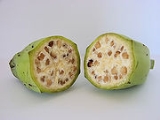
Wild type

Encyclopedia
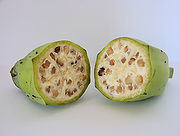
Phenotype
A phenotype is an organism's observable characteristics or traits: such as its morphology, development, biochemical or physiological properties, behavior, and products of behavior...
of the typical form of a species
Species
In biology, a species is one of the basic units of biological classification and a taxonomic rank. A species is often defined as a group of organisms capable of interbreeding and producing fertile offspring. While in many cases this definition is adequate, more precise or differing measures are...
as it occurs in nature. Originally, the wild type was conceptualized as a product of the standard, "normal" allele
Allele
An allele is one of two or more forms of a gene or a genetic locus . "Allel" is an abbreviation of allelomorph. Sometimes, different alleles can result in different observable phenotypic traits, such as different pigmentation...
at a locus, in contrast to that produced by a non-standard, "mutant" allele. It is now appreciated that most or all gene loci exist in a variety of allelic forms, which vary in frequency
Frequency
Frequency is the number of occurrences of a repeating event per unit time. It is also referred to as temporal frequency.The period is the duration of one cycle in a repeating event, so the period is the reciprocal of the frequency...
throughout the geographic range of a species, and that a uniform wild type does not exist. In general; however, the most prevalent allele – e.g., the one with the highest gene frequency is the one deemed as wild-type.
The concept of wild type is useful in some experimental organisms such as fruit flies Drosophila melanogaster
Drosophila melanogaster
Drosophila melanogaster is a species of Diptera, or the order of flies, in the family Drosophilidae. The species is known generally as the common fruit fly or vinegar fly. Starting from Charles W...
, in which the standard phenotypes for features such as eye color or shape and wing form are known to be altered by particular gene
Gene
A gene is a molecular unit of heredity of a living organism. It is a name given to some stretches of DNA and RNA that code for a type of protein or for an RNA chain that has a function in the organism. Living beings depend on genes, as they specify all proteins and functional RNA chains...
mutations that produce distinctive phenotypes, such as "apricot" "bar eyes" or "vestigial wings." "Wild type" alleles are indicated with a "+" superscript, for example B+ and vg+ for round eyes and full-size wings, respectively.
External links
- "Absence of the wild-type allele" - Pediatrics
- "Genetically-spliced bacteria may benefit agriculture" - Sarasota Herald-Tribune
- "Reading of DNA allows creation of synthetic vaccines" - Star News
- http://pqasb.pqarchiver.com/newsday/access/103999001.html?dids=103999001:103999001&FMT=ABS&FMTS=ABS:FT&type=current&date=Jun+28%2C+1988&author=By+Robert+Cooke&pub=Newsday+(Combined+editions)&desc=A+Curious+Clue+in+Cats+Cats+infected+by+the+feline+leukemia+virus+can+get+a+strange+variety+of+diseases%2C+a+new+finding+that+may+help+in+human+AIDS+and+cancer+research&pqatl=google"A Curious Clue in Cats" - Newsday]
- "A Genetically Engineered Agriculture Revolution?" - The Telegraph