

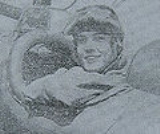
Arthur Rhys Davids

Encyclopedia
Arthur Percival Foley Rhys-Davids DSO
, MC
& Bar
(26 September 1897 – 27 October 1917) was a British
flying ace during the First World War. He was credited with 25 victories, including those over leading German flying aces Oberleutnant Karl Menckhoff
and Leutnant Werner Voss
in the same fight.
) - the son of a Welsh father and an English mother - served in the British civil service in Ceylon in the 1860s and went on to become the Professor of Pali
at the University of London and holder of the Chair in Comparative Religion at the University of Manchester
. Rhys-Davids' mother, an Englishwoman by the name of Caroline Augusta Foley Rhys Davids
was also a Pali scholar.
, London
, where the family lived until 1904 when his father was appointed a Professor
of Comparative Religion at Manchester University. Rhys-Davids struggled to overcome a stammer, but was a successful student throughout his academic career, due to a drive that pushed him to the brink of collapse.
In 1911, he was enrolled at Eton College
as a King's Scholar
. Because of a limit, he had to wait for one of the 70 King's Scholars leave before he could fill the vacancy. Despite poor health—he was asthmatic and had other unspecified maladies—he took part in Football, Cricket
, the Eton Wall Game
and the Eton Field Game
. He was also an accomplished Rugby
player, usually as a half back. He joined the Officer Training Corps, and a visiting coach and his Classics
tutor helped him overcome his stuttering.
Academically, Rhys-Davids was a specialist in Classics; his interests included music and English Literature, especially poetry. When he left Eton in 1916, he was the top student, and as such the captain of the school. He was also a member of "Pop", the Eton Society. He won the Newcastle Scholarship and intended to take up his place at Balliol College, Oxford
as an Exhibitioner when he returned from the war.
Rhys-Davids joined the Royal Flying Corps
on 28 August 1916 as a Second Lieutenant in the Special Reserve to study aeronautics, still in Oxford. His courses included the theory of flight, rigging, artillery observation, photography, and Gnome (brand name) engines and instruments. He then reported to the Central Flying School, Upavon
, Wiltshire
for flight training. Major Richard Blomfield was recruiting promising pilots with a musical interest for 56 Squadron
. Blomfield selected Rhys-Davids, who moved with the squadron to France in April 1917.
Rhys-Davids' beginning as a fighter pilot was inauspicious. He misjudged a landing and totally wrecked his plane, badly wrenching his back. Injured and minus an airplane, he was grounded for a month.
His first aerial combat on 7 May 1917 was harrowing and disastrous. Eleven Royal Aircraft Factory SE5s
of 56 Squadron ran into the experienced German airmen of Jasta 11
of the Flying Circus. One of the Squadron 56 flight commanders, famous ace Albert Ball
, was killed in action. Five other British pilots were shot down, including Rhys-Davids. He found himself with jammed guns in a shotup plane whose damaged engine suddenly quit. He was doubly fortunate. Kurt Wolff
, the German pilot on his tail, pulled away from a sure kill and let him live. Rhys-Davids then managed a powerless dead stick landing safely behind British lines.
On the 23rd of May, Rhys-Davids shot an Albatros D.III
fighter down out of control. The next day, he scored three victories in an hour. One day later, he got his fifth victory and became an ace.
On 5 June 1917, after his sixth triumph, he received a telegram informing him that along with Capt. Cyril M. Crowe and 2nd Lt. R.T.C. Hoidge
he had been awarded the Military Cross
(MC).
The next month, a famed ace transferred into 56 Squadron and became B Flight's commander. James Thomas Byford McCudden, subsequently a Victoria Cross
holder and most decorated ace in British aviation, had risen from the enlisted ranks and survived three years of increasingly deadly aerial warfare. McCudden lectured Rhys-Davids about unnecessary risks and their consequences. Rhys-Davids would confess to his mother that once in the air he became a different man; by his own admission he could be too daring for safety's sake.
By the end of July, Rhys-Davids had 13 victories and a Bar to his Military Cross. On 3 September, he destroyed an Albatros D.V
. On the 5th, he shot down two more D.Vs and drove another one out of battle, all within 45 minutes. On 9 September, he scored again.
On 23 September, Rhys-Davids was the victor in one of the most famous dogfights of aviation. Werner Voss
, considered by many to be as skillful an ace as Manfred von Richthofen
, single-handedly engaged Rhys-Davids, James McCudden
, Gerald Bowman, Reginald Hoidge
, Richard Maybery
, Keith Muspratt
, and Verschoyle Cronyn. Another German ace, Karl Menckhoff
of Jasta 3 saw the encounter and tried to assist Voss but Rhys-Davids shot up his Albatross D.V, Menckhoff crash-landing unharmed.
Voss used the superior maneuverability and tighter turning radius of his Fokker F.I to stand off the seven British aces and put bullets into every one of their aircraft. However, the battle ended after a near midair collision between Voss and Rhys-Davids, who briefly found himself behind Voss and fired. The German plane unaccountably stopped evading fire, presumably because the pilot was hit. Voss's Fokker F.I plunged to the earth and was smashed to bits. Along with Menckhoff's plane, that brought Rhys-Davids' score to 20. McCudden recalled him saying of the remarkable Voss, "If only I could have brought him down alive."
During the next three weeks, Rhys-Davids would gain five more victories, his last on 17 October 1917. His final tally was 25 enemy aircraft ; 2 captured, 4 and 2 shared destroyed, and 14 and 3 shared 'out of control'.
. The German Air Service credited Karl Gallwitz
, an ace pilot of Jasta Boelcke
, with shooting him down.
Rhys-Davids' family anxiously hoped he had survived and been captured. However, a plane from Jasta Boelke flew over his aerodrome and dropped a message giving the details of his death and of his burial with military honours. The Royal Flying Corps declared Rhys-Davids killed in action
on the date he disappeared. His mother received official confirmation on 18 March 1918, when her son was awarded the Distinguished Service Order
. In 1920, German authorities returned Rhys-Davids' notecase to his family.
World War I aviation scholars established the site of Rhys-Davids' death by comparing Karl Gallwitz's combat report with other documents. Rhys-Davids crashed about five miles from the impact point of Werner Voss
's Fokker just one month earlier.
Rhys-Davids' name appears on the Arras Flying Services Memorial.
on having first met Arthur Rhys Davids. Rhys Davids was chosen by Marshal of the Royal Air Force
Hugh Trenchard
and his assistant Maurice Baring
as one of two airmen to have their portraits taken by Orpen.
reminiscence of Captain Duncan Grinnell-Milne
, Commanding officer of 56th squadron RFC, upon hearing news of the death of Captain Richard Maybery
2nd Lt. Arthur Percival Foley Rhys-Davids, Spec Res. For conspicuous gallantry and devotion. On many occasions he has shot down hostile machines and put others out of action, frequently pursuing to low altitudes. On all occasions his fearlessness and dash have been most marked.
2nd Lt. Arthur Percival Foley Rhys-Davids, M.C., R.F.C., Spec Res.
For conspicuous gallantry and devotion to duty whilst on offensive patrols. He has in all destroyed four enemy aircraft, and driven down many others out of control. In all his combats his gallantry and skill have been most marked, and on one occasion he shot down an enemy pilot who had accounted for twenty-nine Allied machines. His offensive spirit and initiative have set a magnificent example to all.
2nd Lt. Arthur Percival Foley Rhys-Davids, M.C., R.F.C., Spec Res. For conspicuous gallantry and devotion to duty in bringing down nine enemy aircraft in nine weeks. He is a magnificent fighter, never failing to locate enemy aircraft and invariably attacking regardless of the numbers against him.
Cecil Lewis. Sagittarius Rising.
Distinguished Service Order
The Distinguished Service Order is a military decoration of the United Kingdom, and formerly of other parts of the British Commonwealth and Empire, awarded for meritorious or distinguished service by officers of the armed forces during wartime, typically in actual combat.Instituted on 6 September...
, MC
Military Cross
The Military Cross is the third-level military decoration awarded to officers and other ranks of the British Armed Forces; and formerly also to officers of other Commonwealth countries....
& Bar
Medal bar
A medal bar or medal clasp is a thin metal bar attached to the ribbon of a military decoration, civil decoration, or other medal. It is most commonly used to indicate the campaign or operation the recipient received the award for, and multiple bars on the same medal are used to indicate that the...
(26 September 1897 – 27 October 1917) was a British
United Kingdom
The United Kingdom of Great Britain and Northern IrelandIn the United Kingdom and Dependencies, other languages have been officially recognised as legitimate autochthonous languages under the European Charter for Regional or Minority Languages...
flying ace during the First World War. He was credited with 25 victories, including those over leading German flying aces Oberleutnant Karl Menckhoff
Karl Menckhoff
Karl Menckhoff was a German First World War fighter ace, credited with 39 confirmed victories. Already in his 30s when he learned to fly, he was one of the oldest pilots in the Imperial German Aviation Service....
and Leutnant Werner Voss
Werner Voss
Werner Voss was a World War I German flying ace, a friend and rival of the famous Red Baron, Manfred von Richthofen....
in the same fight.
Family background
Rhys-Davids' father (Thomas William Rhys DavidsThomas William Rhys Davids
Thomas William Rhys Davids was a British scholar of the Pāli language and founder of the Pali Text Society.-Life:...
) - the son of a Welsh father and an English mother - served in the British civil service in Ceylon in the 1860s and went on to become the Professor of Pali
Páli
- External links :* *...
at the University of London and holder of the Chair in Comparative Religion at the University of Manchester
University of Manchester
The University of Manchester is a public research university located in Manchester, United Kingdom. It is a "red brick" university and a member of the Russell Group of research-intensive British universities and the N8 Group...
. Rhys-Davids' mother, an Englishwoman by the name of Caroline Augusta Foley Rhys Davids
Caroline Augusta Foley Rhys Davids
Caroline Augusta Foley Rhys Davids was an English Pāli language scholar and translator, and from 1923-1942 president of the Pali Text Society which was founded by her husband T. W. Rhys Davids whom she married in 1894.-Early life and education:...
was also a Pali scholar.
Early life
Arthur Rhys-Davids was an only son, though with two sisters. He was born in Forest HillForest Hill, London
Forest Hill is a district of south London, England, located in the London Borough of Lewisham. It situated between Dulwich and Sydenham. The area has enjoyed extensive investment since plans to extend the East London Line to Forest Hill were unveiled in 2004....
, London
London
London is the capital city of :England and the :United Kingdom, the largest metropolitan area in the United Kingdom, and the largest urban zone in the European Union by most measures. Located on the River Thames, London has been a major settlement for two millennia, its history going back to its...
, where the family lived until 1904 when his father was appointed a Professor
Professor
A professor is a scholarly teacher; the precise meaning of the term varies by country. Literally, professor derives from Latin as a "person who professes" being usually an expert in arts or sciences; a teacher of high rank...
of Comparative Religion at Manchester University. Rhys-Davids struggled to overcome a stammer, but was a successful student throughout his academic career, due to a drive that pushed him to the brink of collapse.
In 1911, he was enrolled at Eton College
Eton College
Eton College, often referred to simply as Eton, is a British independent school for boys aged 13 to 18. It was founded in 1440 by King Henry VI as "The King's College of Our Lady of Eton besides Wyndsor"....
as a King's Scholar
King's Scholar
A King's Scholar is a foundation scholar of one of certain public schools...
. Because of a limit, he had to wait for one of the 70 King's Scholars leave before he could fill the vacancy. Despite poor health—he was asthmatic and had other unspecified maladies—he took part in Football, Cricket
Cricket
Cricket is a bat-and-ball game played between two teams of 11 players on an oval-shaped field, at the centre of which is a rectangular 22-yard long pitch. One team bats, trying to score as many runs as possible while the other team bowls and fields, trying to dismiss the batsmen and thus limit the...
, the Eton Wall Game
Eton Wall Game
The Eton wall game is a game similar to football and Rugby Union, that originated from and is still played at Eton College. It is played on a strip of ground 5 metres wide and 110 metres long next to a slightly curved brick wall, erected in 1717....
and the Eton Field Game
Eton Field Game
The Field Game is one of two codes of football devised and played at Eton College. The other is the Eton Wall Game. The game is like football in some ways — the ball is round, but one size smaller than a standard football, and may not be handled — but the off-side rules — known as 'sneaking' — are...
. He was also an accomplished Rugby
Rugby union
Rugby union, often simply referred to as rugby, is a full contact team sport which originated in England in the early 19th century. One of the two codes of rugby football, it is based on running with the ball in hand...
player, usually as a half back. He joined the Officer Training Corps, and a visiting coach and his Classics
Classics
Classics is the branch of the Humanities comprising the languages, literature, philosophy, history, art, archaeology and other culture of the ancient Mediterranean world ; especially Ancient Greece and Ancient Rome during Classical Antiquity Classics (sometimes encompassing Classical Studies or...
tutor helped him overcome his stuttering.
Academically, Rhys-Davids was a specialist in Classics; his interests included music and English Literature, especially poetry. When he left Eton in 1916, he was the top student, and as such the captain of the school. He was also a member of "Pop", the Eton Society. He won the Newcastle Scholarship and intended to take up his place at Balliol College, Oxford
Balliol College, Oxford
Balliol College , founded in 1263, is one of the constituent colleges of the University of Oxford in England but founded by a family with strong Scottish connections....
as an Exhibitioner when he returned from the war.
War service
As a member of the Eton College Officer Training Corps, Rhys-Davids had been spared from the Conscription Act that had taken effect at the beginning of 1916. However, the Royal Flying Corps was then recruiting, with an especial interest in athletes.Rhys-Davids joined the Royal Flying Corps
Royal Flying Corps
The Royal Flying Corps was the over-land air arm of the British military during most of the First World War. During the early part of the war, the RFC's responsibilities were centred on support of the British Army, via artillery co-operation and photographic reconnaissance...
on 28 August 1916 as a Second Lieutenant in the Special Reserve to study aeronautics, still in Oxford. His courses included the theory of flight, rigging, artillery observation, photography, and Gnome (brand name) engines and instruments. He then reported to the Central Flying School, Upavon
Upavon
Upavon is a rural village in the English County of Wiltshire, England. As its name suggests, it is on the upper portions of the River Avon which runs from the north to the south through the village. It is situated about south of Pewsey, about southeast of the market town of Devizes, and about ...
, Wiltshire
Wiltshire
Wiltshire is a ceremonial county in South West England. It is landlocked and borders the counties of Dorset, Somerset, Hampshire, Gloucestershire, Oxfordshire and Berkshire. It contains the unitary authority of Swindon and covers...
for flight training. Major Richard Blomfield was recruiting promising pilots with a musical interest for 56 Squadron
No. 56 Squadron RAF
Number 56 Squadron is one of the oldest and most successful squadrons of the Royal Air Force, with battle honours from many of the significant air campaigns of both World War I and World War II...
. Blomfield selected Rhys-Davids, who moved with the squadron to France in April 1917.
Rhys-Davids' beginning as a fighter pilot was inauspicious. He misjudged a landing and totally wrecked his plane, badly wrenching his back. Injured and minus an airplane, he was grounded for a month.
His first aerial combat on 7 May 1917 was harrowing and disastrous. Eleven Royal Aircraft Factory SE5s
Royal Aircraft Factory S.E.5
The Royal Aircraft Factory S.E.5 was a British biplane fighter aircraft of the First World War. Although the first examples reached the Western Front before the Sopwith Camel and it had a much better overall performance, problems with its Hispano-Suiza engine, particularly the geared-output H-S...
of 56 Squadron ran into the experienced German airmen of Jasta 11
Jasta 11
Royal Prussian Jagdstaffel 11 was founded on 28 September 1916 from elements of 4 armee's Keks 1, 2 and 3 and mobilized on 11 October as part of the German Air Service's expansion program, forming permanent specialised fighter squadrons, or "Jastas"...
of the Flying Circus. One of the Squadron 56 flight commanders, famous ace Albert Ball
Albert Ball
Albert Ball VC, DSO & Two Bars, MC was an English fighter pilot of the First World War and a recipient of the Victoria Cross, the highest decoration for gallantry "in the face of the enemy" that can be awarded to members of the British or Commonwealth armed forces...
, was killed in action. Five other British pilots were shot down, including Rhys-Davids. He found himself with jammed guns in a shotup plane whose damaged engine suddenly quit. He was doubly fortunate. Kurt Wolff
Kurt Wolff (aviator)
Oberleutnant Kurt Wolff was one of Imperial Germany's highest scoring fighter aces during World War I. After achieving 33 confirmed victories, he was killed in action at the age of 22.-Early life:...
, the German pilot on his tail, pulled away from a sure kill and let him live. Rhys-Davids then managed a powerless dead stick landing safely behind British lines.
On the 23rd of May, Rhys-Davids shot an Albatros D.III
Albatros D.III
The Albatros D.III was a biplane fighter aircraft used by the Imperial German Army Air Service and the Austro-Hungarian Air Service during World War I. The D.III was flown by many top German aces, including Manfred von Richthofen, Ernst Udet, Erich Löwenhardt, Kurt Wolff, and Karl Emil Schäfer...
fighter down out of control. The next day, he scored three victories in an hour. One day later, he got his fifth victory and became an ace.
On 5 June 1917, after his sixth triumph, he received a telegram informing him that along with Capt. Cyril M. Crowe and 2nd Lt. R.T.C. Hoidge
Reginald Hoidge
Reginald Theodore Carlos Hoidge MC & Bar was a Canadian First World War flying ace, officially credited with 28 victories...
he had been awarded the Military Cross
Military Cross
The Military Cross is the third-level military decoration awarded to officers and other ranks of the British Armed Forces; and formerly also to officers of other Commonwealth countries....
(MC).
The next month, a famed ace transferred into 56 Squadron and became B Flight's commander. James Thomas Byford McCudden, subsequently a Victoria Cross
Victoria Cross
The Victoria Cross is the highest military decoration awarded for valour "in the face of the enemy" to members of the armed forces of various Commonwealth countries, and previous British Empire territories....
holder and most decorated ace in British aviation, had risen from the enlisted ranks and survived three years of increasingly deadly aerial warfare. McCudden lectured Rhys-Davids about unnecessary risks and their consequences. Rhys-Davids would confess to his mother that once in the air he became a different man; by his own admission he could be too daring for safety's sake.
By the end of July, Rhys-Davids had 13 victories and a Bar to his Military Cross. On 3 September, he destroyed an Albatros D.V
Albatros D.V
|-See also:-Bibliography:*Bennett, Leon. Gunning for the Red Baron. College Station, TX: Texas A&M University Press, 2006. ISBN 1-58544-507-X....
. On the 5th, he shot down two more D.Vs and drove another one out of battle, all within 45 minutes. On 9 September, he scored again.
On 23 September, Rhys-Davids was the victor in one of the most famous dogfights of aviation. Werner Voss
Werner Voss
Werner Voss was a World War I German flying ace, a friend and rival of the famous Red Baron, Manfred von Richthofen....
, considered by many to be as skillful an ace as Manfred von Richthofen
Manfred von Richthofen
Manfred Albrecht Freiherr von Richthofen , also widely known as the Red Baron, was a German fighter pilot with the Imperial German Army Air Service during World War I...
, single-handedly engaged Rhys-Davids, James McCudden
James McCudden
James Thomas Byford McCudden VC, DSO & Bar, MC & Bar, MM was an English recipient of the Victoria Cross, the highest award for valour in the face of the enemy that can be awarded to British and Commonwealth forces...
, Gerald Bowman, Reginald Hoidge
Reginald Hoidge
Reginald Theodore Carlos Hoidge MC & Bar was a Canadian First World War flying ace, officially credited with 28 victories...
, Richard Maybery
Richard Maybery
Captain Richard Aveline Maybery MC and Bar was a Welsh World War I flying ace.Maybery was born in Brecon, Powys, Wales in January 1895, the only son of Aveline Maybery, a solicitor, and his wife Lucy...
, Keith Muspratt
Keith Muspratt
Keith Knox Muspratt MC, born 22 December 1897 in Bournemouth, England and educated at Sherborne School, was a First World War flying ace in the Royal Flying Corps with eight victories to his name.Keith Muspratt was a doctor's son from Bournemouth, Hampshire....
, and Verschoyle Cronyn. Another German ace, Karl Menckhoff
Karl Menckhoff
Karl Menckhoff was a German First World War fighter ace, credited with 39 confirmed victories. Already in his 30s when he learned to fly, he was one of the oldest pilots in the Imperial German Aviation Service....
of Jasta 3 saw the encounter and tried to assist Voss but Rhys-Davids shot up his Albatross D.V, Menckhoff crash-landing unharmed.
Voss used the superior maneuverability and tighter turning radius of his Fokker F.I to stand off the seven British aces and put bullets into every one of their aircraft. However, the battle ended after a near midair collision between Voss and Rhys-Davids, who briefly found himself behind Voss and fired. The German plane unaccountably stopped evading fire, presumably because the pilot was hit. Voss's Fokker F.I plunged to the earth and was smashed to bits. Along with Menckhoff's plane, that brought Rhys-Davids' score to 20. McCudden recalled him saying of the remarkable Voss, "If only I could have brought him down alive."
During the next three weeks, Rhys-Davids would gain five more victories, his last on 17 October 1917. His final tally was 25 enemy aircraft ; 2 captured, 4 and 2 shared destroyed, and 14 and 3 shared 'out of control'.
Final flight
On 27 October 1917 Rhys-Davids was promoted to lieutenant, backdated to the 1 September 1917. That same day he took off on a routine patrol and was last seen flying east of RoeselareRoeselare
Roeselare is a Belgian city and municipality in the Flemish province of West Flanders. The municipality comprises the city of Roeselare proper and the towns of Beveren, Oekene and Rumbeke....
. The German Air Service credited Karl Gallwitz
Karl Gallwitz
Leutnant Karl Gallwitz was a World War I flying ace credited with ten aerial victories.Gallwitz originally flew a Roland D.III for artillery cooperation units on the Russian Front, shooting down two observation balloons with FA 37, before a brief assignment to Jasta 29. On 24 August 1917, he joined...
, an ace pilot of Jasta Boelcke
Oswald Boelcke
Oswald Boelcke was a German flying ace of the First World War and one of the most influential patrol leaders and tacticians of the early years of air combat. Boelcke is considered the father of the German fighter air force, as well as the "Father of Air Fighting Tactics"; he was the first to...
, with shooting him down.
Rhys-Davids' family anxiously hoped he had survived and been captured. However, a plane from Jasta Boelke flew over his aerodrome and dropped a message giving the details of his death and of his burial with military honours. The Royal Flying Corps declared Rhys-Davids killed in action
Killed in action
Killed in action is a casualty classification generally used by militaries to describe the deaths of their own forces at the hands of hostile forces. The United States Department of Defense, for example, says that those declared KIA need not have fired their weapons but have been killed due to...
on the date he disappeared. His mother received official confirmation on 18 March 1918, when her son was awarded the Distinguished Service Order
Distinguished Service Order
The Distinguished Service Order is a military decoration of the United Kingdom, and formerly of other parts of the British Commonwealth and Empire, awarded for meritorious or distinguished service by officers of the armed forces during wartime, typically in actual combat.Instituted on 6 September...
. In 1920, German authorities returned Rhys-Davids' notecase to his family.
World War I aviation scholars established the site of Rhys-Davids' death by comparing Karl Gallwitz's combat report with other documents. Rhys-Davids crashed about five miles from the impact point of Werner Voss
Werner Voss
Werner Voss was a World War I German flying ace, a friend and rival of the famous Red Baron, Manfred von Richthofen....
's Fokker just one month earlier.
Rhys-Davids' name appears on the Arras Flying Services Memorial.
Quotes
Sir William OrpenWilliam Orpen
Major Sir William Newenham Montague Orpen, KBE, RA, RHA was an Irish portrait painter, who worked mainly in London...
on having first met Arthur Rhys Davids. Rhys Davids was chosen by Marshal of the Royal Air Force
Marshal of the Royal Air Force
Marshal of the Royal Air Force is the highest rank in the Royal Air Force. In peacetime it was granted to RAF officers in the appointment of Chief of the Defence Staff, and to retired Chiefs of the Air Staff, who were promoted to it on their last day of service. Promotions to the rank have ceased...
Hugh Trenchard
Hugh Trenchard, 1st Viscount Trenchard
Marshal of the Royal Air Force Hugh Montague Trenchard, 1st Viscount Trenchard GCB OM GCVO DSO was a British officer who was instrumental in establishing the Royal Air Force...
and his assistant Maurice Baring
Maurice Baring
Maurice Baring was an English man of letters, known as a dramatist, poet, novelist, translator and essayist, and also as a travel writer and war correspondent...
as one of two airmen to have their portraits taken by Orpen.
reminiscence of Captain Duncan Grinnell-Milne
Duncan Grinnell-Milne
Captain Duncan William Grinnell-Milne MC, DFC & Bar was an English First World War pilot credited with six confirmed aerial victories, a prisoner of war, a flying ace and an author who successfully escaped from German captivity...
, Commanding officer of 56th squadron RFC, upon hearing news of the death of Captain Richard Maybery
Honours and awards
- 18 July 1917 Rhys-Davids was awarded the Military CrossMilitary CrossThe Military Cross is the third-level military decoration awarded to officers and other ranks of the British Armed Forces; and formerly also to officers of other Commonwealth countries....
-
2nd Lt. Arthur Percival Foley Rhys-Davids, Spec Res. For conspicuous gallantry and devotion. On many occasions he has shot down hostile machines and put others out of action, frequently pursuing to low altitudes. On all occasions his fearlessness and dash have been most marked.
- 17 September 1917 Rhys-Davids was awarded a Bar to his Military Cross -
2nd Lt. Arthur Percival Foley Rhys-Davids, M.C., R.F.C., Spec Res.
For conspicuous gallantry and devotion to duty whilst on offensive patrols. He has in all destroyed four enemy aircraft, and driven down many others out of control. In all his combats his gallantry and skill have been most marked, and on one occasion he shot down an enemy pilot who had accounted for twenty-nine Allied machines. His offensive spirit and initiative have set a magnificent example to all.
- 18 March 1918 was awarded the Distinguished Service OrderDistinguished Service OrderThe Distinguished Service Order is a military decoration of the United Kingdom, and formerly of other parts of the British Commonwealth and Empire, awarded for meritorious or distinguished service by officers of the armed forces during wartime, typically in actual combat.Instituted on 6 September...
-
2nd Lt. Arthur Percival Foley Rhys-Davids, M.C., R.F.C., Spec Res. For conspicuous gallantry and devotion to duty in bringing down nine enemy aircraft in nine weeks. He is a magnificent fighter, never failing to locate enemy aircraft and invariably attacking regardless of the numbers against him.
Further reading
Alex Revell. Brief Glory: The Life of Arthur Rhys Davids, DSO, MC and Bar. William Kimber, 1984.Cecil Lewis. Sagittarius Rising.
External links
- http://www.spiritus-temporis.com/arthur-rhys-davids/ Accessed 8 September 2008.
- http://www.firstworldwar.com/bio/rhysdavids.htm Accessed 8 September 2008.
- http://www.theaerodrome.com/aces/england/rhys_davids.php Accessed 8 September 2008.
- http://1914-1918.invisionzone.com/forums/index.php?showtopic=104930 Accessed 21 October 2008.