

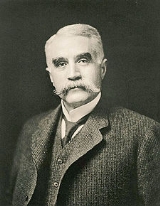
Charles F. Brush

Encyclopedia
Charles Francis Brush was a U.S. inventor, entrepreneur
and philanthropist
.
, Brush was raised on a farm about 10 miles from downtown Cleveland
. He had a great interest in science, particularly with Humphry Davy
's experiments with the arc light
; he tinkered with and built simple electrical devices such as a static electricity machine at age 12, experimenting in a workshop on his parents farm. Brush attended Central High School in Cleveland where he built his first arc light, and graduated there with honors in 1867. He received his college education from the University of Michigan
, where he studied mining engineering (there were no majors—as there are today—in electrical engineering). At Michigan, Brush was a member of Delta Kappa Epsilon
fraternity (Omicron chapter).
In 1876 he secured the backing of the Wetting Supply Company in Cleveland to design his "dynamo" (an electrical generator
) for powering arc light
s. Brush began with the dynamo design of Zénobe Gramme
but his final design was a marked divergence, retaining the ring armature idea that originated with Antonio Pacinotti
. Brush remarked on his motivation for improving the generator in his : "The best forms of magneto-electric apparatus at present before the public are unnecessarily bulky, heavy, and expensive, and are more or less wasteful of mechanical power." After comparing it to the Gramme dynamo
and other European entrants, the Franklin Institute
of Philadelphia judged Brush's dynamo superior due to its simpler design and maintainability after completing tests in 1878.
Brush produced additional patents refining the design of his arc lights in the coming years and sold systems to several cities for public lighting, and even equipped Philadelphia's Wanamaker's
Grand Depot with a system. His lights were easier to maintain, had automatic functions and burned twice as long as Yablochkov candle
s. His generators were reliable and automatically increased voltage with greater load while keeping current constant. By 1881, New York, Boston, Philadelphia, Baltimore, Montreal, Buffalo, San Francisco, Cleveland and other cities had Brush arc light systems, producing public light well into the 20th century.
The San Francisco system was the first case of a utility
selling electricity from a central plant to multiple customers via transmission
lines. The California Electric Light Company
(now PG&E) purchased two generators from Charles Brush's company in 1879 and soon opened a second plant with 4 additional generators. Service charges for light from sundown to midnight was $10 per lamp per day/week. Brush's system was lighting Broadway 2 years before Edison's Pearl Street Station
began lighting New York. By 1893 there were 1500 arc lights illuminating New York streets.
In 1879 Brush formed the Anglo-American Brush Electric Light Corporation in Lambeth, London, England. This company eventually moved to Loughborough England and became Brush Electrical Engineering Co. Ltd.
In 1880, he established the Brush Electric Company, and though successful, faced stiff competition from Thomson-Houston Electric Company, whose arc lights could be independently turned off, and by Edison, whose incandescent lights had a softer warm glow, didn't flicker and were less costly to maintain than arc lights. In 1882 the Brush Electric Company supplied generating equipment for a hydroelectric power plant at St. Anthony Falls in Minneapolis, among the first to generate electricity from water power in the United States
. Thomson-Houston bought out Brush in 1889 and eventually merged to become part of General Electric
in 1891. After selling his interests in Brush Electric, Brush never returned to the electric industry.
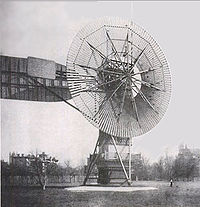 In 1884, Brush built a mansion on Euclid Avenue in Cleveland that showcased many of his inventions. There he raised his family and lived the remainder of his life. The basement housed Brush's private laboratory. In 1888, he powered the mansion with the world's first automatically operated wind turbine
generator which charged the home's 12 batteries. It was the first home in Cleveland to have electricity. Over its 20 year life, the turbine never failed to keep the home continuously powered. In 1926, Brush pioneered the first piezo-electric featherweight stylus.
Between 1910 and 1929 he wrote several papers on his version of a kinetic theory of gravitation
, based on some sort of electromagnetic waves. He died on June 15, 1929.
Entrepreneur
An entrepreneur is an owner or manager of a business enterprise who makes money through risk and initiative.The term was originally a loanword from French and was first defined by the Irish-French economist Richard Cantillon. Entrepreneur in English is a term applied to a person who is willing to...
and philanthropist
Philanthropist
A philanthropist is someone who engages in philanthropy; that is, someone who donates his or her time, money, and/or reputation to charitable causes...
.
Biography
Born in Euclid Township, OhioCleveland, Ohio
Cleveland is a city in the U.S. state of Ohio and is the county seat of Cuyahoga County, the most populous county in the state. The city is located in northeastern Ohio on the southern shore of Lake Erie, approximately west of the Pennsylvania border...
, Brush was raised on a farm about 10 miles from downtown Cleveland
Cleveland, Ohio
Cleveland is a city in the U.S. state of Ohio and is the county seat of Cuyahoga County, the most populous county in the state. The city is located in northeastern Ohio on the southern shore of Lake Erie, approximately west of the Pennsylvania border...
. He had a great interest in science, particularly with Humphry Davy
Humphry Davy
Sir Humphry Davy, 1st Baronet FRS MRIA was a British chemist and inventor. He is probably best remembered today for his discoveries of several alkali and alkaline earth metals, as well as contributions to the discoveries of the elemental nature of chlorine and iodine...
's experiments with the arc light
Arc Light
Arc Light is the debut novel by Eric L. Harry, a techno-thriller about limited nuclear war published in 1994 and written in 1991-2.As China and Russia clash in Siberia in June 1999, nuclear missiles strike the United States. The U.S. retaliates against Russia, and World War III begins...
; he tinkered with and built simple electrical devices such as a static electricity machine at age 12, experimenting in a workshop on his parents farm. Brush attended Central High School in Cleveland where he built his first arc light, and graduated there with honors in 1867. He received his college education from the University of Michigan
University of Michigan
The University of Michigan is a public research university located in Ann Arbor, Michigan in the United States. It is the state's oldest university and the flagship campus of the University of Michigan...
, where he studied mining engineering (there were no majors—as there are today—in electrical engineering). At Michigan, Brush was a member of Delta Kappa Epsilon
Delta Kappa Epsilon
Delta Kappa Epsilon is a fraternity founded at Yale College in 1844 by 15 men of the sophomore class who had not been invited to join the two existing societies...
fraternity (Omicron chapter).
In 1876 he secured the backing of the Wetting Supply Company in Cleveland to design his "dynamo" (an electrical generator
Electrical generator
In electricity generation, an electric generator is a device that converts mechanical energy to electrical energy. A generator forces electric charge to flow through an external electrical circuit. It is analogous to a water pump, which causes water to flow...
) for powering arc light
Arc Light
Arc Light is the debut novel by Eric L. Harry, a techno-thriller about limited nuclear war published in 1994 and written in 1991-2.As China and Russia clash in Siberia in June 1999, nuclear missiles strike the United States. The U.S. retaliates against Russia, and World War III begins...
s. Brush began with the dynamo design of Zénobe Gramme
Zénobe Gramme
Zénobe Théophile Gramme was a Belgian electrical engineer. He invented the Gramme machine, a type of direct current dynamo capable of generating smoother and much higher voltages than the dynamos known to that point.In 1873 he and Hippolyte Fontaine accidentally discovered that the device was...
but his final design was a marked divergence, retaining the ring armature idea that originated with Antonio Pacinotti
Antonio Pacinotti
Antonio Pacinotti was an Italian physicist, who was Professor of Physics at the University of Pisa.-Biography:Pacinotti was born in Pisa, where he also died...
. Brush remarked on his motivation for improving the generator in his : "The best forms of magneto-electric apparatus at present before the public are unnecessarily bulky, heavy, and expensive, and are more or less wasteful of mechanical power." After comparing it to the Gramme dynamo
Gramme machine
A Gramme machine, Gramme ring, Gramme magneto, or Gramme dynamo is an electrical generator which produces direct current, named for its Belgian inventor, Zénobe Gramme, and was built as either a dynamo or a magneto. It was the first generator to produce power on a commercial scale for industry...
and other European entrants, the Franklin Institute
Franklin Institute
The Franklin Institute is a museum in Philadelphia, Pennsylvania, and one of the oldest centers of science education and development in the United States, dating to 1824. The Institute also houses the Benjamin Franklin National Memorial.-History:On February 5, 1824, Samuel Vaughn Merrick and...
of Philadelphia judged Brush's dynamo superior due to its simpler design and maintainability after completing tests in 1878.
Brush produced additional patents refining the design of his arc lights in the coming years and sold systems to several cities for public lighting, and even equipped Philadelphia's Wanamaker's
Wanamaker's
Wanamaker's department store was the first department store in Philadelphia, Pennsylvania, and one of the first department stores in the United States. At its zenith in the early 20th century, there were two major Wanamaker department stores, one in Philadelphia and one in New York City at Broadway...
Grand Depot with a system. His lights were easier to maintain, had automatic functions and burned twice as long as Yablochkov candle
Yablochkov candle
A Yablochkov candle is a type of electric carbon arc lamp, invented in 1876 by Pavel Yablochkov.-Design:A Yablochkov candle consists of a sandwich of two long carbon blocks, approximately 6 by 12 millimetres in cross-section, separated by a block of inert material such as plaster of paris or kaolin...
s. His generators were reliable and automatically increased voltage with greater load while keeping current constant. By 1881, New York, Boston, Philadelphia, Baltimore, Montreal, Buffalo, San Francisco, Cleveland and other cities had Brush arc light systems, producing public light well into the 20th century.
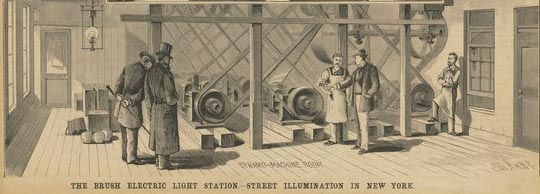 |
| New York central power plant dynamos powered arc lamps for public lighting. Beginning operation in December 1880 at 133 West Twenty-Fifth Street, it powered a 2 mile long circuit. |
The San Francisco system was the first case of a utility
Electric utility
An electric utility is a company that engages in the generation, transmission, and distribution of electricity for sale generally in a regulated market. The electrical utility industry is a major provider of energy in most countries. It is indispensable to factories, commercial establishments,...
selling electricity from a central plant to multiple customers via transmission
Electric power transmission
Electric-power transmission is the bulk transfer of electrical energy, from generating power plants to Electrical substations located near demand centers...
lines. The California Electric Light Company
Pacific Gas and Electric Company
The Pacific Gas and Electric Company , commonly known as PG&E, is the utility that provides natural gas and electricity to most of the northern two-thirds of California, from Bakersfield almost to the Oregon border...
(now PG&E) purchased two generators from Charles Brush's company in 1879 and soon opened a second plant with 4 additional generators. Service charges for light from sundown to midnight was $10 per lamp per day/week. Brush's system was lighting Broadway 2 years before Edison's Pearl Street Station
Pearl Street Station
Pearl Street Station was the first central power plant in the United States. It was located at 255-257 Pearl Street in Manhattan on a site measuring 50 by 100 feet, just south of Fulton Street. It began with one direct current generator, and it started generating electricity on September 4, 1882,...
began lighting New York. By 1893 there were 1500 arc lights illuminating New York streets.
In 1879 Brush formed the Anglo-American Brush Electric Light Corporation in Lambeth, London, England. This company eventually moved to Loughborough England and became Brush Electrical Engineering Co. Ltd.
In 1880, he established the Brush Electric Company, and though successful, faced stiff competition from Thomson-Houston Electric Company, whose arc lights could be independently turned off, and by Edison, whose incandescent lights had a softer warm glow, didn't flicker and were less costly to maintain than arc lights. In 1882 the Brush Electric Company supplied generating equipment for a hydroelectric power plant at St. Anthony Falls in Minneapolis, among the first to generate electricity from water power in the United States
United States
The United States of America is a federal constitutional republic comprising fifty states and a federal district...
. Thomson-Houston bought out Brush in 1889 and eventually merged to become part of General Electric
General Electric
General Electric Company , or GE, is an American multinational conglomerate corporation incorporated in Schenectady, New York and headquartered in Fairfield, Connecticut, United States...
in 1891. After selling his interests in Brush Electric, Brush never returned to the electric industry.
Wind turbine
A wind turbine is a device that converts kinetic energy from the wind into mechanical energy. If the mechanical energy is used to produce electricity, the device may be called a wind generator or wind charger. If the mechanical energy is used to drive machinery, such as for grinding grain or...
generator which charged the home's 12 batteries. It was the first home in Cleveland to have electricity. Over its 20 year life, the turbine never failed to keep the home continuously powered. In 1926, Brush pioneered the first piezo-electric featherweight stylus.
Between 1910 and 1929 he wrote several papers on his version of a kinetic theory of gravitation
Le Sage's theory of gravitation
Le Sage's theory of gravitation is a kinetic theory of gravity originally proposed by Nicolas Fatio de Duillier in 1690 and later by Georges-Louis Le Sage in 1748. The theory proposed a mechanical explanation for Newton's gravitational force in terms of streams of tiny unseen particles impacting...
, based on some sort of electromagnetic waves. He died on June 15, 1929.
Legacy
- Charles F. Brush High SchoolCharles F. Brush High SchoolCharles F. Brush High School is a public high school in Lyndhurst, Ohio. The school is named for Charles F. Brush, the Ohio-born inventor of the arc light, an invention which, until recently, the school's student newspaper was named after....
in LyndhurstLyndhurst, OhioAs of the census of 2000, there were 15,279 people, 6,642 households, and 4,397 families residing in the city. The population density was 3,480.1 people per square mile . There were 6,855 housing units at an average density of 1,561.4 per square mile...
, Ohio is named after Brush, whose sports teams and other groups are named the "Arcs," after Brush's lamp. - Metro Parks, Serving Summit CountyMetro Parks, Serving Summit County' is a Metroparks system serving the citizens of Summit County, Ohio by managing in 14 developed parks, six conservation areas and more than of trails.The park district is fully supported by a levy, which voters are periodically asked to approve...
's Furnace Run Metro Park in RichfieldRichfield, OhioRichfield is a village in Summit County, Ohio, United States. The population was 3,286 at the 2000 census. The village and the adjacent Richfield Township are approximately equidistant between the downtown areas of Akron and Cleveland...
, Ohio, received a donation of land from the Family of Charles F. Brush. The donated tract is known as Brushwood. - USS Brush (DD-745)USS Brush (DD-745)USS Brush , an Allen M. Sumner-class destroyer, is the only ship of the United States Navy to be named for Charles Brush.Brush was launched 28 December 1943 by Bethlehem Steel Co., Staten Island, New York; sponsored by Miss Virginia Perkins, great-granddaughter of Charles Brush; and commissioned...
1943-1969 (then Taiwan's Hsiang Yang until scrapped in 1993) was named after Brush, sponsored by his great-granddaughter.
Honors
- Rumford PrizeRumford PrizeFounded in 1796, the Rumford Prize, awarded by the American Academy of Arts and Sciences, is one of the oldest scientific prizes in the United States. The prize recognizes contributions by scientists to the fields of heat and light...
of the American Academy of Arts and SciencesAmerican Academy of Arts and SciencesThe American Academy of Arts and Sciences is an independent policy research center that conducts multidisciplinary studies of complex and emerging problems. The Academy’s elected members are leaders in the academic disciplines, the arts, business, and public affairs.James Bowdoin, John Adams, and...
(1899). - French Legion of HonorLégion d'honneurThe Legion of Honour, or in full the National Order of the Legion of Honour is a French order established by Napoleon Bonaparte, First Consul of the Consulat which succeeded to the First Republic, on 19 May 1802...
(1881) - Edison MedalIEEE Edison MedalThe Edison Medal is presented by the IEEE "for a career of meritorious achievement in electrical science, electrical engineering or the electrical arts." It is the oldest and most coveted medal in this field of engineering in the United States. The award consists of a gold medal, bronze replica,...
(1913) - Franklin MedalFranklin MedalThe Franklin Medal was a science and engineering award presented by the Franklin Institute, of Philadelphia, PA, USA.-Laureates:*1915 - Thomas Alva Edison *1915 - Heike Kamerlingh Onnes *1916 - John J...
- Fellow of the North British Academy of ArtsNorth British Academy of ArtsThe North British Academy of Arts was an art institution of Newcastle upon Tyne in northern England.-Overview:The Academy, sometimes known as the North British Academy of Arts, Science, Literature, and Music, was located in the Claremount Buildings on the western side of Barras Bridge on the...
Patents
- Generator:
- Arc light (automatic control of spark gap) 1878
- Arc light (double-carbon lamp regulation system) 1879
- Arc light (Automatic shut off for Electric Lights or Motors) 1880
- Arc light (improved regulator for the carbon arc) 1885