
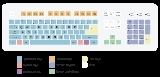
QWERTY is the most common modern-day
keyboard layoutA keyboard layout is any specific mechanical, visual, or functional arrangement of the keys, legends, or key–meaning associations of a computer, typewriter, or other typographic keyboard....
. The name comes from the first six letters (keys) appearing in the topleft letter row of the keyboard, read left to right: Q-W-E-R-T-Y. The QWERTY design is based on a layout created for the
Sholes and Glidden typewriterThe Sholes and Glidden typewriter was the first commercially successful typewriter. Principally designed by the American inventor Christopher Latham Sholes, it was developed with the assistance of fellow printer Samuel W. Soule and amateur mechanic Carlos S. Glidden...
and sold to
RemingtonE. Remington and Sons was a manufacturer of firearms and typewriters. Founded in 1816 by Eliphalet Remington in Ilion, New York, on March 1, 1873 it started manufacturing the first commercial typewriter.-Becoming "E. Remington & Sons":...
in the same year, when it first appeared in
typewriterA typewriter is a mechanical or electromechanical device with keys that, when pressed, cause characters to be printed on a medium, usually paper. Typically one character is printed per keypress, and the machine prints the characters by making ink impressions of type elements similar to the pieces...
s. It became popular with the success of the Remington No. 2 of 1878, and remains in use on electronic keyboards due to the
network effectIn economics and business, a network effect is the effect that one user of a good or service has on the value of that product to other people. When network effect is present, the value of a product or service is dependent on the number of others using it.The classic example is the telephone...
of a standard layout and a belief that alternatives fail to provide very significant advantages. The use and adoption of the QWERTY keyboard is often viewed as one of the most important case studies in open standards because of the widespread, collective adoption and use of the product, particularly in the United States.
History and purposes
This layout was devised and created in the early 1870s by Christopher Latham Sholes, a
newspaperA newspaper is a scheduled publication containing news of current events, informative articles, diverse features and advertising. It usually is printed on relatively inexpensive, low-grade paper such as newsprint. By 2007, there were 6580 daily newspapers in the world selling 395 million copies a...
editor and printer who lived in Milwaukee. With the assistance of his friends
Carlos GliddenCarlos Glidden , along with Christopher Sholes and Samuel W. Soule, invented the first practical typewriter at a machine shop located in Milwaukee, Wisconsin.-References:...
and
Samuel W. SouleSamuel W. Soule along with Christopher Sholes and Carlos Glidden invented the first practical typewriter at a machine shop located in Milwaukee, Wisconsin, in 1869.- References :Samuel W...
he built an early writing machine for which a patent application was filed in October 1867.
The first model constructed by Sholes used a piano-like keyboard with two rows of characters arranged alphabetically as follows:
His "Type Writer" had two features which made jams a serious issue.
Firstly, characters were mounted on metal arms or typebars, which would clash and jam if neighboring arms were depressed at the same time or in rapid succession. Secondly, its printing point was located beneath the paper carriage, invisible to the operator, a so-called "up-stroke" design. Consequently, jams were especially serious, because the typist could only discover the mishap by raising the carriage to inspect what he had typed. The solution was to place commonly used letter-pairs (like "th" or "st") so that their typebars were not neighboring, avoiding jams.
While it is often said that QWERTY was designed to "slow down" typists, this is incorrect – it was designed to prevent jams
while typing at speed, yet some of the layout decisions, such as placing only one vowel on the home row, did have the effect of hobbling more modern keyboards.
Sholes struggled for the next five years to perfect his invention, making many trial-and-error rearrangements of the original machine's alphabetical key arrangement. His study of letter-pair frequency by educator Amos Densmore, brother of the financial backer
James DensmoreJames Densmore was a business associate of Christopher Sholes, who along with Carlos Glidden and Samuel W. Soule helped contribute to inventing one of the first practical typewriters at a machine shop located in Milwaukee, Wisconsin....
, is believed to have influenced the arrangement of letters, but called in question.
In November 1868 he changed the arrangement of the latter half of the alphabet, O to Z, right-to-left. In April 1870 he arrived at a four-row, upper case keyboard approaching the modern QWERTY standard, moving six vowels, A, E, I, O, U, and Y, to the upper row as follows:
In 1873 Sholes's backer, James Densmore, succeeded in selling manufacturing rights for the Sholes & Glidden Type-Writer to
E. Remington and SonsE. Remington and Sons was a manufacturer of firearms and typewriters. Founded in 1816 by Eliphalet Remington in Ilion, New York, on March 1, 1873 it started manufacturing the first commercial typewriter.-Becoming "E. Remington & Sons":...
, and within a few months the keyboard layout was finalized by Remington's mechanics. The keyboard ultimately presented to Remington was arranged as follows:
After it purchased the device, Remington made several adjustments which created a keyboard with what is essentially the modern QWERTY layout. Their adjustments included placing the "R" key in the place previously allotted to the period key (this has been claimed to be done with the purpose of enabling salesmen to impress customers by pecking out the brand name "TYPE WRITER" from one keyboard row but this claim is unsubstantiated). Vestiges of the original alphabetical layout remained in the "home row" sequence DFGHJKL.
The QWERTY layout became popular with the success of the Remington No. 2 of 1878, the first typewriter to include both upper and lower case letters, via a
shift keyThe shift key is a modifier key on a keyboard, used to type capital letters and other alternate "upper" characters. There are typically two shift keys, on the left and right sides of the row below the home row...
.
Much less commented-on than the order of the keys is that the keys are not on a grid, but rather that each column slants diagonally; this is because of the mechanical linkages – each key being attached to a lever, and hence the offset prevents the levers from running into each other – and has been retained in most electronic keyboards. Some keyboards, such as the
KinesisThe Kinesis line of ergonomic computer keyboards is an alternative to the traditional keyboard design. Most widely known among these are the contoured Advantage line, which feature recessed keys in two bucket-like hollows which allow the fingers to reach keys with less effort as well as a central...
, retain the QWERTY layout but arrange the keys in vertical columns, to reduce unnecessary lateral finger motion.
Substituting characters
The QWERTY layout depicted in Sholes's 1878 patent includes a few differences from the modern layout, most notably in the absence of the numerals 0 and 1, with each of the remaining numerals shifted one position to the left of their modern counterparts. The letter M is located at the end of the third row to the right of the letter L rather than on the fourth row to the right of the N, the letters X and C are reversed, and most
punctuation marksPunctuation marks are symbols that indicate the structure and organization of written language, as well as intonation and pauses to be observed when reading aloud.In written English, punctuation is vital to disambiguate the meaning of sentences...
are in different positions or are missing entirely. 0 and 1 were omitted to simplify the design and reduce the manufacturing and maintenance costs; they were chosen specifically because they were "redundant" and could be recreated using other keys. Typists who learned on these machines learned the habit of using the uppercase letter
II is the ninth letter and a vowel in the basic modern Latin alphabet.-History:In Semitic, the letter may have originated in a hieroglyph for an arm that represented a voiced pharyngeal fricative in Egyptian, but was reassigned to by Semites, because their word for "arm" began with that sound...
(or lowercase letter
LŁ or ł, described in English as L with stroke, is a letter of the Polish, Kashubian, Sorbian, Łacinka , Łatynka , Wilamowicean, Navajo, Dene Suline, Inupiaq, Zuni, Hupa, and Dogrib alphabets, several proposed alphabets for the Venetian language, and the ISO 11940 romanization of the Thai alphabet...
) for the digit one, and the uppercase
OO is the fifteenth letter and a vowel in the basic modern Latin alphabet.The letter was derived from the Semitic `Ayin , which represented a consonant, probably , the sound represented by the Arabic letter ع called `Ayn. This Semitic letter in its original form seems to have been inspired by a...
for the zero.
Combined characters
In early designs, some characters were produced by printing two symbols with the carriage in the same position. For instance, the
exclamation pointThe exclamation mark, exclamation point, or bang, or "dembanger" is a punctuation mark usually used after an interjection or exclamation to indicate strong feelings or high volume , and often marks the end of a sentence. Example: “Watch out!” The character is encoded in Unicode at...
, which shares a key with the numeral 1 on modern keyboards, could be reproduced by using a three-stroke combination of an apostrophe, a backspace, and a period. A semicolon was produced by printing a comma over a colon (:). As the backspace key is slow in simple mechanical typewriters (the carriage was heavy and optimized to move in the opposite direction), a more professional approach was to block the carriage by pressing and holding the space bar while printing all characters that needed to be in a shared position. To make this possible, the carriage was designed to advance forward only after releasing the space bar.
The 0 key was added and standardized in its modern position early in the history of the typewriter, but the 1 and exclamation point were left off some typewriter keyboards into the 1970s.
Contemporary alternatives
There was no particular technological requirement for the QWERTY layout, since at the time there were ways to make a typewriter without the "up-stroke" typebar mechanism that had required it to be devised. Not only were there rival machines with "down-stroke" and "frontstroke" positions that gave a visible printing point, the problem of typebar clashes could be circumvented completely: examples include
Thomas EdisonThomas Alva Edison was an American inventor and businessman. He developed many devices that greatly influenced life around the world, including the phonograph, the motion picture camera, and a long-lasting, practical electric light bulb. In addition, he created the world’s first industrial...
's 1872 electric print-wheel device which later became the basis for
TeletypeA teleprinter is a electromechanical typewriter that can be used to communicate typed messages from point to point and point to multipoint over a variety of communication channels that range from a simple electrical connection, such as a pair of wires, to the use of radio and microwave as the...
machines;
Lucien Stephen CrandallLucien Stephen Crandall was an American inventor of typewriters, adding machines and electrical devices. Crandall gave his name to several typewriters, and he was also involved in the development of various machines, such as the project to produce the Hammond design at the Remington factory, or...
's typewriter (the second to come onto the American market) whose type was arranged on a cylindrical sleeve; the Hammond typewriter of 1887 which used a semi-circular "type-shuttle" of hardened rubber (later light metal); and the
Blickensderfer typewriterThe Blickensderfer Typewriter was designed by George C Blickensderfer in 1893. It was originally intended to compete with Remington desk typewriters, but ended up being known for its portability. Blickensderfer's typewriter contained only 250 parts compared to the 2,500 parts of a standard...
of 1893 which used a type wheel. The early Blickensderfer's "Ideal" keyboard was also non-QWERTY, instead having the sequence "DHIATENSOR" in the home row, these 10 letters being capable of composing 70% of the words in the English language.
Properties
Alternating hands while typing is a desirable trait in a keyboard design, since while one hand is typing a letter, the other hand can get in position to type the next letter. Thus, a typist may fall into a steady rhythm and type quickly. However, when a string of letters is done with the same hand, the chances of stuttering are increased and a rhythm can be broken, thus decreasing speed and increasing errors and fatigue. In the QWERTY layout many more words can be spelled using only the left hand than the right hand. In fact, thousands of English words can be spelled using only the left hand, while only a couple of hundred words can be typed using only the right hand. In addition, most typing strokes are done with the left hand in the QWERTY layout. This is helpful for
left-handedLeft-handedness is the preference for the left hand over the right for everyday activities such as writing. In ancient times it was seen as a sign of the devil, and was abhorred in many cultures...
people but to the disadvantage of right-handed people.
Computer keyboards
The first computer terminals such as the Teletype were typewriters that could produce and be controlled by various computer codes. These used the QWERTY layouts, and added keys such as
escapeOn computer keyboards, the Esc key is a key labeled Esc or Escape that is used to generate the ASCII Escape character , the character code traditionally used to initiate an escape sequence...
(ESC) which had special meanings to computers. Later keyboards added
function keyA function key is a key on a computer or terminal keyboard which can be programmed so as to cause an operating system command interpreter or application program to perform certain actions...
s and
arrow keysCursor movement keys or arrow keys are buttons on a computer keyboard that are either programmed or designated to move the cursor in a specified direction....
. Since the standardization of PC-compatible computers and Windows after the 1980s, most full-sized computer keyboards have followed this standard (see drawing at right). This layout has a separate
numeric keypadA numeric keypad, numpad or tenkey for short, is the small, palm-sized, seventeen key section of a computer keyboard, usually on the very far right. The numeric keypad features digits 0 to 9, addition , subtraction , multiplication and division symbols, a decimal point and Num Lock and Enter keys...
for data entry at the right, 12 function keys across the top, and a cursor section to the right and center with keys for
InsertThe Insert key is a key commonly found on computer keyboards.It is primarily used to switch between the two text-entering modes on a personal computer or word processor. The first is overtype mode, in which the cursor, when typing, overwrites any text that is present on and after its current...
,
DeleteThe delete key , known less ambiguously as forward delete, performs a function when struck on a computer keyboard during text or command editing, which is to discard the character ahead of the cursor's position, moving all following characters one position "back" towards the freed letterspace. The...
,
HomeThe home key is a key commonly found on computer keyboards. The key has the opposite effect of the end key. In limited-size keyboards where the home key is missing the same functionality can be reached via the key combination of -Microsoft Windows:...
,
EndThe end key is a key commonly found on computer keyboards. The key has the opposite effect of the home key. In limited-size keyboards where the end key is missing the same functionality can be reached via the key combination of -Microsoft Windows:...
,
Page Up, and Page DownThe Page Up and Page Down keys are two keys commonly found on computer keyboards.The two keys are primarily used to scroll up or down in documents, but the scrolling distance varies between different applications...
with cursor arrows in an inverted-T shape.
Diacritical marks and international variants
Different computer operating systems have methods of support for input of different languages such as Chinese, Hebrew or Arabic. QWERTY is designed for
EnglishEnglish is a West Germanic language that arose in the Anglo-Saxon kingdoms of England and spread into what was to become south-east Scotland under the influence of the Anglian medieval kingdom of Northumbria...
, a language without any
diacriticA diacritic is a glyph added to a letter, or basic glyph. The term derives from the Greek διακριτικός . Diacritic is both an adjective and a noun, whereas diacritical is only an adjective. Some diacritical marks, such as the acute and grave are often called accents...
al marks. QWERTY
keyboardsIn computing, a keyboard is a typewriter-style keyboard, which uses an arrangement of buttons or keys, to act as mechanical levers or electronic switches...
meet issues when having to type an accent. Until recently, no norm was defined for a standard QWERTY keyboard layout allowing the typing of accented characters, apart from the US-International layout.
Depending on the
operating systemAn operating system is a set of programs that manage computer hardware resources and provide common services for application software. The operating system is the most important type of system software in a computer system...
and sometimes the application program being used, there are many ways to generate Latin characters with accents.
UK-Extended Layout
Microsoft Windows XP SP2 and above provide the UK-Extended layout that behaves exactly the same as the standard UK layout for all the characters it can generate, but can additionally generate a number of
diacritical marksA diacritic is a glyph added to a letter, or basic glyph. The term derives from the Greek διακριτικός . Diacritic is both an adjective and a noun, whereas diacritical is only an adjective. Some diacritical marks, such as the acute and grave are often called accents...
, useful when working with text in other languages (including
WelshWelsh is a member of the Brythonic branch of the Celtic languages spoken natively in Wales, by some along the Welsh border in England, and in Y Wladfa...
- a UK language). Not all combinations work on all keyboards.
- acute accent
The acute accent is a diacritic used in many modern written languages with alphabets based on the Latin, Cyrillic, and Greek scripts.-Apex:An early precursor of the acute accent was the apex, used in Latin inscriptions to mark long vowels.-Greek:...
s (e.g. á) on a,e,i,o,u,w,y,A,E,I,O,U,W,Y are generated by pressing the AltGr keyAltGr is a modifier key found on many computer keyboards and primarily used to type characters that are unusual for the locale of the keyboard layout, such as currency symbols and accented letters...
together with the letter, or AltGr and apostrophe, followed by the letter (see note below);
- grave accent
The grave accent is a diacritical mark used in written Breton, Catalan, Corsican, Dutch, French, Greek , Italian, Mohawk, Norwegian, Occitan, Portuguese, Scottish Gaelic, Vietnamese, Welsh, Romansh, and other languages.-Greek:The grave accent was first used in the polytonic orthography of Ancient...
s (e.g. è) on a,e,i,o,u,w,y,A,E,I,O,U,W,Y are generated by pressing the backquote (`) [which is now a dead keyA dead key is a special kind of a modifier key on a typewriter or computer keyboard that is typically used to attach a specific diacritic to a base letter. The dead key does not generate a character by itself but modifies the character generated by the key struck immediately after...
], then the letter;
- circumflex
The circumflex is a diacritic used in the written forms of many languages, and is also commonly used in various romanization and transcription schemes. It received its English name from Latin circumflexus —a translation of the Greek περισπωμένη...
(e.g. â) on a,e,i,o,u,w,y,A,E,I,O,U,W,Y is generated by AltGr and 6, followed by the letter;
- diaeresis or umlaut (e.g. ö) on a,e,i,o,u,w,y,A,E,I,O,U,W,Y is generated by AltGr and 2, then the letter;
- tilde
The tilde is a grapheme with several uses. The name of the character comes from Portuguese and Spanish, from the Latin titulus meaning "title" or "superscription", though the term "tilde" has evolved and now has a different meaning in linguistics....
(e.g. ã) on a,n,o,A,N,O is generated by AltGr and #, then the letter;
- cedilla
A cedilla , also known as cedilha or cédille, is a hook added under certain letters as a diacritical mark to modify their pronunciation.-Origin:...
(e.g. ç) under c,C is generated by AltGr and the letter.
These combinations are designed to be easy to remember, as the circumflex accent (e.g. â) is similar to a caret (^), printed above the 6 key; the diaeresis (e.g. ö) is similar to the double-quote (") above 2 on the UK keyboard; the tilde (~) is printed on the same key as the #.
Like US-International, UK-Extended does not cater for many languages written with Latin characters, including Romanian and Turkish, or any using different
character setsA character encoding system consists of a code that pairs each character from a given repertoire with something else, such as a sequence of natural numbers, octets or electrical pulses, in order to facilitate the transmission of data through telecommunication networks or storage of text in...
such as Greek and Russian.
Notes:
- The AltGr and letter method used for acutes and cedillas does not work for applications which assign shortcut menu functions to these key combinations. For acute accents the AltGr and apostrophe method should be used.
International variants
Minor changes to the arrangement are made for other languages.
Alternatives to QWERTY
Several alternatives to QWERTY have been developed over the years, claimed by their designers and users to be more efficient, intuitive and ergonomic. Nevertheless, none has seen widespread adoption, due partly to the sheer dominance of available keyboards and training. Although studies have shown the superiority in typing speed afforded by alternative keyboard layouts economists Stan Liebowitz and Stephen E Margolis have claimed that these studies are flawed and more rigorous studies are inconclusive as to whether they actually offer any real benefits. The most widely used such alternative is the
Dvorak Simplified KeyboardThe Dvorak Simplified Keyboard is a keyboard layout patented in 1936 by Dr. August Dvorak and his brother-in-law, Dr. William Dealey. Over the years several slight variations were designed by the team led by Dvorak or by ANSI...
; another increasingly popular alternative is Colemak, which is based partly on QWERTY and is therefore easier for an existing QWERTY typist to learn while offering several optimisations. Most modern computer operating systems support this and other alternative mappings with appropriate special mode settings, but few keyboards are manufactured with keys labeled according to this standard.
Half QWERTY
A half QWERTY keyboard is a combination of an alpha-numeric keypad and a QWERTY keypad, designed for mobile phones. In a half QWERTY keyboard, two characters share the same key, which reduces the number of keys and increases the
surface areaSurface area is the measure of how much exposed area a solid object has, expressed in square units. Mathematical description of the surface area is considerably more involved than the definition of arc length of a curve. For polyhedra the surface area is the sum of the areas of its faces...
of each key, useful for mobile phones that have little space for keys. It means that 'Q' and 'W' will share the same key and the user has to press the key once to type 'Q' and twice to type 'W'.
Displaced QWERTY
Also designed for mobile devices, the displaced QWERTY layout allows for the increase of button area by over 40% while keeping the same candybar form factor. Entering, spacing and deleting are handled by gestures over the text area, reducing the keyboard's screen footprint. The layout is essentially a rearrangement of keys on the right half of the keyboard under those on the left and, as such, should present a gentler learning curve to touch typists. It was first seen on the iPhone application "LittlePad".
See also
- AZERTY
AZERTY is a specific layout for the characters of the Latin alphabet on typewriter keys and computer keyboards. The layout takes its name from the first six letters to appear on the first row of alphabetical keys...
- QWERTZ
thumb|175px|A computer QWERTZ keyboardThe QWERTZ or QWERTZU keyboard is a widely used computer and typewriter keyboard layout that is mostly used in Central Europe...
- HCESAR
HCESAR is an obsolete typewriter keyboard layout. It was created by decree on July 21, 1937, by Portuguese prime-minister António de Oliveira Salazar....
- Dvorak Simplified Keyboard
The Dvorak Simplified Keyboard is a keyboard layout patented in 1936 by Dr. August Dvorak and his brother-in-law, Dr. William Dealey. Over the years several slight variations were designed by the team led by Dvorak or by ANSI...
- Maltron keyboard
PCD Maltron Ltd., d.b.a. Maltron, is a manufacturer of ergonomic special-needs keyboards, founded by South African-born inventor Lilian Malt, the namesake of the company, and manufacturer Stephen Hobday...
- Path dependence
Path dependence explains how the set of decisions one faces for any given circumstance is limited by the decisions one has made in the past, even though past circumstances may no longer be relevant....
- Repetitive strain injury
Repetitive strain injury is an injury of the musculoskeletal and nervous systems that may be caused by...
- Text entry interface
A text entry interface is an interface that is used to put text information into an electronic device. For example, the QWERTY keyboard layout.-Background:...
- Touch typing
Touch typing is typing without using the sense of sight to find the keys. Specifically, a touch typist will know their location on the keyboard through muscle memory. Touch typing typically involves placing the eight fingers in a horizontal row along the middle of the keyboard and having them...
- Velotype
Velotype is the old trademark for a type of keyboard for typing text known as a syllabic chord keyboard, an invention of the Dutchmen Nico Berkelmans and Marius den Outer. The current tradename is Veyboard...
- WASD
- Keyboard monument
Keyboard monument is an outdoor sculpture featuring the QWERTY keyboard. It is located in the Russian city of Yekaterinburg and is popular among tourists...
External links