

Syrian Wars

Encyclopedia

Diadochi
The Diadochi were the rival generals, family and friends of Alexander the Great who fought for the control of Alexander's empire after his death in 323 BC...
of the Seleucid Empire
Seleucid Empire
The Seleucid Empire was a Greek-Macedonian state that was created out of the eastern conquests of Alexander the Great. At the height of its power, it included central Anatolia, the Levant, Mesopotamia, Persia, today's Turkmenistan, Pamir and parts of Pakistan.The Seleucid Empire was a major centre...
and the Ptolemaic Kingdom of Egypt
Ptolemaic Egypt
Ptolemaic Egypt began when Ptolemy I Soter invaded Egypt and declared himself Pharaoh of Egypt in 305 BC and ended with the death of queen Cleopatra VII of Egypt and the Roman conquest in 30 BC. The Ptolemaic Kingdom was a powerful Hellenistic state, extending from southern Syria in the east, to...
during the 3rd and 2nd centuries BC over the region then called Coele-Syria
Coele-Syria
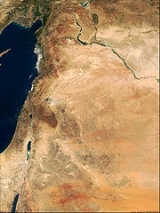
Coele-Syria , or Cœle-Syria or Celesyria, traditionally given the meaning 'hollow' Syria, was the region of southern Syria disputed between the Seleucid dynasty and the Ptolemaic dynasty. Rather than limiting the Greek term to the Beqaa Valley of Lebanon, it is often used to cover the entire area...
, one of the few avenues into Egypt. These conflicts drained the material and manpower of both parties and led to their eventual destruction and conquest by Rome
Roman Republic
The Roman Republic was the period of the ancient Roman civilization where the government operated as a republic. It began with the overthrow of the Roman monarchy, traditionally dated around 508 BC, and its replacement by a government headed by two consuls, elected annually by the citizens and...
and Parthia
Parthia
Parthia is a region of north-eastern Iran, best known for having been the political and cultural base of the Arsacid dynasty, rulers of the Parthian Empire....
.
First Syrian War (274274 BCYear 274 BC was a year of the pre-Julian Roman calendar. At the time it was known as the Year of the Consulship of Dentatus and Merenda...
-271 BC271 BCYear 271 BC was a year of the pre-Julian Roman calendar. At the time it was known as the Year of the Consulship of Claudus and Clepsina...
)
A decade into his rule, Ptolemy IIPtolemy II Philadelphus
Ptolemy II Philadelphus was the king of Ptolemaic Egypt from 283 BCE to 246 BCE. He was the son of the founder of the Ptolemaic kingdom Ptolemy I Soter and Berenice, and was educated by Philitas of Cos...
faced Antiochus I
Antiochus I Soter
Antiochus I Soter , was a king of the Hellenistic Seleucid Empire. He reigned from 281 BC - 261 BC....
, the Seleucid king who was trying to expand his empire's holdings in Syria
Syria
Syria , officially the Syrian Arab Republic , is a country in Western Asia, bordering Lebanon and the Mediterranean Sea to the West, Turkey to the north, Iraq to the east, Jordan to the south, and Israel to the southwest....
and Anatolia
Anatolia
Anatolia is a geographic and historical term denoting the westernmost protrusion of Asia, comprising the majority of the Republic of Turkey...
. Ptolemy proved to be a forceful ruler and skilled general. In addition, his recent marriage to his court-wise sister Arsinoe II of Egypt
Arsinoe II of Egypt
For other uses see, ArsinoeArsinoë II was a Ptolemaic Greek Princess of Ancient Egypt and through marriage was of Queen Thrace, Asia Minor and Macedonia as wife of King Lysimachus and later co-ruler of Egypt with her brother-husband Ptolemy II Philadelphus For other uses see, ArsinoeArsinoë II...
had stabilized the volatile Egyptian court, allowing Ptolemy to successfully carry out the campaign.
The First Syrian War was a major victory for the Ptolemies. Antiochus took the Ptolemaic controlled areas in coastal Syria and southern Anatolia in his initial rush. Ptolemy reconquered these territories by 271 BC
271 BC
Year 271 BC was a year of the pre-Julian Roman calendar. At the time it was known as the Year of the Consulship of Claudus and Clepsina...
, extending Ptolemaic rule as far as Caria
Caria
Caria was a region of western Anatolia extending along the coast from mid-Ionia south to Lycia and east to Phrygia. The Ionian and Dorian Greeks colonized the west of it and joined the Carian population in forming Greek-dominated states there...
and into most of Cilicia
Cilicia
In antiquity, Cilicia was the south coastal region of Asia Minor, south of the central Anatolian plateau. It existed as a political entity from Hittite times into the Byzantine empire...
. With Ptolemy's eye focused eastward, his half-brother Magas
Magas of Cyrene
Magas of Cyrene was a Greek Macedonian nobleman. Through his mother’s second marriage he was a member of the Ptolemaic dynasty. He became King of Cyrenaica and he managed to wrestle independence for Cyrenaica from the Greek Ptolemaic dynasty of Ancient Egypt.-Family Background & Early Life:Magas...
declared his province of Cyrenaica
Cyrenaica
Cyrenaica is the eastern coastal region of Libya.Also known as Pentapolis in antiquity, it was part of the Creta et Cyrenaica province during the Roman period, later divided in Libia Pentapolis and Libia Sicca...
to be independent. It would remain independent until 250 BC
250 BC
Year 250 BC was a year of the pre-Julian Roman calendar. At the time it was known as the Year of the Consulship of Regulus and Longus...
, when it was reabsorbed into the Ptolemaic Kingdom.
Second Syrian War (260260 BCYear 260 BC was a year of the pre-Julian Roman calendar. At the time it was known as the Year of the Consulship of Asina and Duilius...
-253 BC253 BCYear 253 BC was a year of the pre-Julian Roman calendar. At the time it was known as the Year of the Consulship of Caepio and Blaesus...
)
Antiochus IIAntiochus II Theos
Antiochus II Theos was a king of the Hellenistic Seleucid Kingdom who reigned 261 BC – 246 BC). He succeeded his father Antiochus I Soter in the winter of 262–61 BC...
succeeded his father in 261 BC
261 BC
Year 261 BC was a year of the pre-Julian Roman calendar. At the time it was known as the Year of the Consulship of Flaccus and Crassus...
, and thus began a new war for Syria. He reached an agreement with the current Antigonid king
Antigonid dynasty
The Antigonid dynasty was a dynasty of Hellenistic kings descended from Alexander the Great's general Antigonus I Monophthalmus .-History:...
in Macedon
Macedon
Macedonia or Macedon was an ancient kingdom, centered in the northeastern part of the Greek peninsula, bordered by Epirus to the west, Paeonia to the north, the region of Thrace to the east and Thessaly to the south....
, Antigonus Gonatas, who was also interested in pushing Ptolemy II out of the Aegean. With Macedon's support, Antiochus II launched an attack on Ptolemaic outposts in Asia.
Most of the information about the Second Syrian War has been lost. It is clear that Antigonus' fleet defeated Ptolemy's at the Battle of Cos
Battle of Cos
The Battle of Cos was fought ca 258 BC between an Antigonid fleet and a Ptolemaic fleet. Antigonus II Gonatas led his forces to victory over Patroclus, admiral of Ptolemy II. It has been widely assumed that the battle severely damaged Ptolemaic control of the Aegean...
in 258
258 BC
Year 258 BC was a year of the pre-Julian Roman calendar. At the time it was known as the Year of the Consulship of Calatinus and Peterculus...
, diminishing Ptolemaic naval power. Ptolemy appears to have lost ground in Cilicia, Pamphylia
Pamphylia
In ancient geography, Pamphylia was the region in the south of Asia Minor, between Lycia and Cilicia, extending from the Mediterranean to Mount Taurus . It was bounded on the north by Pisidia and was therefore a country of small extent, having a coast-line of only about 75 miles with a breadth of...
, and Ionia
Ionia
Ionia is an ancient region of central coastal Anatolia in present-day Turkey, the region nearest İzmir, which was historically Smyrna. It consisted of the northernmost territories of the Ionian League of Greek settlements...
, while Antiochus regained Miletus
Miletus
Miletus was an ancient Greek city on the western coast of Anatolia , near the mouth of the Maeander River in ancient Caria...
and Ephesus
Ephesus
Ephesus was an ancient Greek city, and later a major Roman city, on the west coast of Asia Minor, near present-day Selçuk, Izmir Province, Turkey. It was one of the twelve cities of the Ionian League during the Classical Greek era...
. Macedon's involvement in the war ceased when Antigonus became preoccupied by the rebellion of Corinth
Corinth
Corinth is a city and former municipality in Corinthia, Peloponnese, Greece. Since the 2011 local government reform it is part of the municipality Corinth, of which it is the seat and a municipal unit...
and Chalcis
Chalcis
Chalcis or Chalkida , the chief town of the island of Euboea in Greece, is situated on the strait of the Evripos at its narrowest point. The name is preserved from antiquity and is derived from the Greek χαλκός , though there is no trace of any mines in the area...
in 253 BC
253 BC
Year 253 BC was a year of the pre-Julian Roman calendar. At the time it was known as the Year of the Consulship of Caepio and Blaesus...
, possibly instigated by Ptolemy, as well as an increase in enemy activity along Macedon's northern frontier.
The war was concluded around 253 BC
253 BC
Year 253 BC was a year of the pre-Julian Roman calendar. At the time it was known as the Year of the Consulship of Caepio and Blaesus...
with the marriage of Antiochus to Ptolemy's daughter, Berenice Syra
Berenice (Seleucid queen)
Berenice, also called Berenice Syra, was the daughter of Ptolemy II Philadelphus and his first wife Arsinoe I of Egypt.In 261 BC she married the Seleucid monarch Antiochus II Theos, who, following an agreement with Ptolemy , had divorced his wife Laodice I and transferred the succession to...
. Antiochus repudiated his previous wife, Laodice
Laodice I
Laodice I was an Anatolian noblewoman who was a close relative of the early Seleucid Dynasty and was the first wife of the Seleucid Greek King Antiochus II Theos. -Family Background:...
, and turned over substantial domain to her. He died in Ephesus in 246
246 BC
Year 246 BC was a year of the pre-Julian Roman calendar. At the time it was known as the Year of the Consulship of Crassus and Licinus...
, poisoned by Laodice according to some sources. Ptolemy II died in the same year.
Third Syrian War (246246 BCYear 246 BC was a year of the pre-Julian Roman calendar. At the time it was known as the Year of the Consulship of Crassus and Licinus...
-241 BC241 BCYear 241 BC was a year of the pre-Julian Roman calendar. At the time it was known as the Year of the Consulship of Atticus and Cerco...
)
Also known as the Laodicean War, the Third Syrian War began with one of the many succession crises that plagued the Hellenistic states. Antiochus II left two ambitious mothers, his repudiated wife LaodiceLaodice I
Laodice I was an Anatolian noblewoman who was a close relative of the early Seleucid Dynasty and was the first wife of the Seleucid Greek King Antiochus II Theos. -Family Background:...
and Ptolemy II's daughter Berenice Syra, in a competition to put their respective sons on the throne. Laodice claimed that Antiochus had named her son heir while on his deathbed, but Berenice argued that her newly born son was the legitimate heir. Berenice asked her brother Ptolemy III
Ptolemy III Euergetes
-Family:Euergetes was the eldest son of Ptolemy II Philadelphus and his first wife, Arsinoe I, and came to power in 246 BC upon the death of his father.He married Berenice of Cyrene in the year corresponding to 244/243 BC; and their children were:...
, the new Ptolemaic king, to come to Antioch
Antioch
Antioch on the Orontes was an ancient city on the eastern side of the Orontes River. It is near the modern city of Antakya, Turkey.Founded near the end of the 4th century BC by Seleucus I Nicator, one of Alexander the Great's generals, Antioch eventually rivaled Alexandria as the chief city of the...
and help place her son on the throne. When Ptolemy arrived, Berenice and her child had been assassinated.
Ptolemy declared war on Laodice's newly crowned son, Seleucus II
Seleucus II Callinicus
Seleucus II Callinicus or Pogon , was a ruler of the Hellenistic Seleucid Empire, who reigned from 246 to 225 BC...
, in 246 BC
246 BC
Year 246 BC was a year of the pre-Julian Roman calendar. At the time it was known as the Year of the Consulship of Crassus and Licinus...
, and campaigned with great success (his forces possibly being commanded by Xanthippus of Sparta, aka Xanthippus of Carthage, the mercenary general responsible for defeating a Roman army at Tunis/Bagrades in 255). He won major victories over Seleucus in Syria and Anatolia, briefly occupied Antioch and, as a recent cuneiform discovery proves, even reached Babylon
Babylon
Babylon was an Akkadian city-state of ancient Mesopotamia, the remains of which are found in present-day Al Hillah, Babil Province, Iraq, about 85 kilometers south of Baghdad...
. These victories were marred by the loss of the Cyclades
Cyclades
The Cyclades is a Greek island group in the Aegean Sea, south-east of the mainland of Greece; and a former administrative prefecture of Greece. They are one of the island groups which constitute the Aegean archipelago. The name refers to the islands around the sacred island of Delos...
to Antigonus Gonatas in the Battle of Andros
Battle of Andros
The Battle of Andros was an obscure naval battle during the Third Syrian War.In 246 BC, Ptolemy III Euergetes lost the Cyclades to Antigonus II Gonatas.-See also:*Syrian Wars*Seleucid Empire*Ptolemaic Egypt...
. Seleucus had his own difficulties. His domineering mother asked him to grant co-regency to his younger brother, Antiochus Hierax
Antiochus Hierax
Antiochus Hierax , or Antiochus III, , so called from his grasping and ambitious character, was the younger son of Antiochus II and Laodice I and separatist leader in the Hellenistic Seleucid kingdom, who ruled as king of Syria during his brother's reign.On the death of his father, in 246 BCE,...
, as well as rule over Seleucid territories in Anatolia. Antiochus promptly declared independence, undermining Seleucus' efforts to defend against Ptolemy.
In exchange for a peace in 241
241 BC
Year 241 BC was a year of the pre-Julian Roman calendar. At the time it was known as the Year of the Consulship of Atticus and Cerco...
, Ptolemy was awarded new territories on the northern coast of Syria, including Seleucia Pieria, the port of Antioch. The Ptolemaic kingdom was at the height of its power.
Fourth Syrian War (219219 BCYear 219 BC was a year of the pre-Julian Roman calendar. At the time it was known as the Year of the Consulship of Paullus and Salinator...
-217 BC217 BCYear 217 BC was a year of the pre-Julian Roman calendar. At the time it was known as the Year of the Consulship of Geminus and Flaminius/Regulus...
)
Upon taking the Seleucid throne in 223 BC223 BC
Year 223 BC was a year of the pre-Julian Roman calendar. At the time it was known as the Year of the Consulship of Flaminus and Philus...
, Antiochus III (241
241 BC
Year 241 BC was a year of the pre-Julian Roman calendar. At the time it was known as the Year of the Consulship of Atticus and Cerco...
–187 BC
187 BC
Year 187 BC was a year of the pre-Julian Roman calendar. At the time it was known as the Year of the Consulship of Lepidus and Flaminius...
) set himself the task of restoring the lost imperial possessions of Seleucus I Nicator
Seleucus I Nicator
Seleucus I was a Macedonian officer of Alexander the Great and one of the Diadochi. In the Wars of the Diadochi that took place after Alexander's death, Seleucus established the Seleucid dynasty and the Seleucid Empire...
, which extended from Greco-Bactrian Kingdom
Greco-Bactrian Kingdom
The Greco-Bactrian Kingdom was the easternmost part of the Hellenistic world, covering Bactria and Sogdiana in Central Asia from 250 to 125 BC...
in the east, the Hellespont in the north, and Syria in the south. By 221 BC
221 BC
Year 221 BC was a year of the pre-Julian Roman calendar. At the time it was known as the Year of the Consulship of Asina and Rufus/Lepidus...
, he had re-established Seleucid control over Media and Persia, which had been in rebellion. The ambitious king turned his eyes toward Syria and Egypt.
Egypt had been significantly weakened by court intrigue and public unrest. The rule of the newly inaugurated Ptolemy IV Philopator
Ptolemy IV Philopator
Ptolemy IV Philopator , son of Ptolemy III and Berenice II of Egypt was the fourth Pharaoh of Ptolemaic Egypt...
(reigned 221
221 BC
Year 221 BC was a year of the pre-Julian Roman calendar. At the time it was known as the Year of the Consulship of Asina and Rufus/Lepidus...
-204 BC
204 BC
Year 204 BC was a year of the pre-Julian Roman calendar. At the time it was known as the Year of the Consulship of Cethegus and Tuditanus...
) began with the murder of queen-mother Berenice II. The young king quickly fell under the absolute influence of imperial courtiers. His ministers used their absolute power in their own self-interest, to the people's great chagrin.
Antiochus sought to take advantage of this chaotic situation. After an invasion in 221 BC
221 BC
Year 221 BC was a year of the pre-Julian Roman calendar. At the time it was known as the Year of the Consulship of Asina and Rufus/Lepidus...
failed to launch, he finally began the Fourth Syrian War in 219
219 BC
Year 219 BC was a year of the pre-Julian Roman calendar. At the time it was known as the Year of the Consulship of Paullus and Salinator...
. He recaptured Seleucia Pieria as well as cities in Phoenicia
Phoenicia
Phoenicia , was an ancient civilization in Canaan which covered most of the western, coastal part of the Fertile Crescent. Several major Phoenician cities were built on the coastline of the Mediterranean. It was an enterprising maritime trading culture that spread across the Mediterranean from 1550...
, amongst them Tyre. Rather than promptly invading Egypt, Antiochus waited in Phoenicia for over a year, consolidating his new territories and listening to diplomatic proposals from the Ptolemaic kingdom.
Meanwhile, Ptolemy's minister Sosibius
Sosibius
Sosibius was the chief minister of Ptolemy Philopator , king of Egypt. Nothing is known of his origin or parentage, though he may have been a son of Sosibius of Tarentum; nor have we any account of the means by which he rose to power; but we find him immediately after the accession of Ptolemy ,...
began recruiting and training an army. He recruited not only from the local Greek population, as Hellenistic armies generally were, but also from the native Egyptians, enrolling at least thirty thousand natives as phalangite
Phalangite
Phalangite is the Greek name for*an infantryman deployed in a phalanx of Classical and Hellenistic antiquity. The Macedonian so-called Sarissaphoros had a tactical advantage over other phalangites because of their extremely long pikes known as a sarissa...
s. This innovation paid off, but it would eventually have dire consequences for Ptolemaic stability. In the summer of 217
217 BC
Year 217 BC was a year of the pre-Julian Roman calendar. At the time it was known as the Year of the Consulship of Geminus and Flaminius/Regulus...
, Ptolemy engaged and defeated the long-delayed Antiochus in the Battle of Raphia
Battle of Raphia
The Battle of Raphia, also known as the Battle of Gaza, was a battle fought on 22 June 217 BC near modern Rafah between the forces of Ptolemy IV Philopator, king of Egypt and Antiochus III the Great of the Seleucid kingdom during the Syrian Wars...
, the largest battle since the Battle of Ipsus
Battle of Ipsus
The Battle of Ipsus was fought between some of the Diadochi in 301 BC near the village of that name in Phrygia...
over eighty years earlier.
Ptolemy's victory preserved his control over Coele-Syria, and the weak king declined to advance further into Antiochus' empire, even to retake Seleucia Pieria. The Ptolemaic kingdom would continue to weaken over the following years, suffering from economic problems and rebellion. Nationalist sentiment had developed among the native Egyptians who had fought at Raphia. Confident and well-trained, they broke from Ptolemy in what is known as the Egyptian Revolt, establishing their own kingdom in Upper Egypt
Upper Egypt
Upper Egypt is the strip of land, on both sides of the Nile valley, that extends from the cataract boundaries of modern-day Aswan north to the area between El-Ayait and Zawyet Dahshur . The northern section of Upper Egypt, between El-Ayait and Sohag is sometimes known as Middle Egypt...
which the Ptolemies finally reconquered around 185 BC
185 BC
Year 185 BC was a year of the pre-Julian Roman calendar. At the time it was known as the Year of the Consulship of Pulcher and Puditanus...
.
Fifth Syrian War (202202 BCYear 202 BC was a year of the pre-Julian Roman calendar. At the time it was known as the Year of the Consulship of Geminus and Nero...
-195 BC195 BCYear 195 BC was a year of the pre-Julian Roman calendar. At the time it was known as the Year of the Consulship of Flaccus and Cato...
)
The death of Ptolemy IV in 204204 BC
Year 204 BC was a year of the pre-Julian Roman calendar. At the time it was known as the Year of the Consulship of Cethegus and Tuditanus...
was followed by a bloody conflict over the regency as his heir, Ptolemy V
Ptolemy V Epiphanes
Ptolemy V Epiphanes , son of Ptolemy IV Philopator and Arsinoe III of Egypt, was the fifth ruler of the Ptolemaic dynasty. He became ruler at the age of five, and under a series of regents the kingdom was paralyzed.-Regency infighting:Ptolemy Epiphanes was only a small boy when his father, Ptolemy...
, was just a child. The conflict began with the murder of the dead king's wife and sister Arsinoë
Arsinoe III of Egypt
Arsinoe III was Queen of Egypt . She was a daughter of Ptolemy III and Berenice II.Between late October and early November 220 BC she was married to her brother, Ptolemy IV. She took active part in the government of the country, at least in the measure that it was tolerated by the all-powerful...
by the ministers Agothocles
Agathocles of Egypt
Agathocles was a Ptolemaic minister and together with his sister Agathoclea were very close to Egyptian Greek Pharaoh Ptolemy IV Philopator who reigned 221 BC–205 BC....
and Sosibius. The fate of Sosibius is unclear, but Agothocles seems to have held the regency for some time until he was lynched by the volatile Alexandrian mob. The regency was passed from one adviser to another, and the kingdom was in a state of near anarchy.
Seeking to take advantage of this turmoil, Antiochus III staged a second invasion of Coele-Syria. He made an agreement with Philip V of Macedon
Philip V of Macedon
Philip V was King of Macedon from 221 BC to 179 BC. Philip's reign was principally marked by an unsuccessful struggle with the emerging power of Rome. Philip was attractive and charismatic as a young man...
to conquer and share the Ptolemies' overseas territories, although this greedy alliance did not last long. Antiochus quickly swept through the region. After a brief setback at Gaza
Gaza
Gaza , also referred to as Gaza City, is a Palestinian city in the Gaza Strip, with a population of about 450,000, making it the largest city in the Palestinian territories.Inhabited since at least the 15th century BC,...
, he delivered a crushing blow to the Ptolemies near the head of the River Jordan which earned him the important port of Sidon
Sidon
Sidon or Saïda is the third-largest city in Lebanon. It is located in the South Governorate of Lebanon, on the Mediterranean coast, about 40 km north of Tyre and 40 km south of the capital Beirut. In Genesis, Sidon is the son of Canaan the grandson of Noah...
.
In 200 BC
200 BC
Year 200 BC was a year of the pre-Julian Roman calendar. At the time it was known as the Year of the Consulship of Maximus and Cotta...
, Roman emissaries came to Philip and Antiochus demanding that they refrain from invading Egypt. The Romans would suffer no disruption of the import of grain from Egypt, key to supporting the massive population in Italy. As neither monarch had planned to invade Egypt itself, they willingly complied to Rome's demands. Antiochus completed the subjugation of Coele-Syria in 198
198 BC
Year 198 BC was a year of the pre-Julian Roman calendar. At the time it was known as the Year of the Consulship of Catus and Flamininus...
and went on to raid Ptolemy's remaining coastal strongholds in Caria and Cilicia.
Problems at home led Ptolemy to seek a quick and disadvantageous conclusion. The nativist movement, which began before the war with the Egyptian Revolt and expanded with the support of Egyptian priests, created turmoil and sedition throughout the kingdom. Economic troubles led the Ptolemaic government to increase taxation, which in turn fed the nationalist fire. In order to focus on the home front, Ptolemy signed a conciliatory treaty with Antiochus in 195
195 BC
Year 195 BC was a year of the pre-Julian Roman calendar. At the time it was known as the Year of the Consulship of Flaccus and Cato...
, leaving the Seleucid king in possession of Coele-Syria and agreeing to marry Antiochus' daughter Cleopatra I
Cleopatra I of Egypt
Cleopatra I Syra , c. 204–176 BC was a princess of the Seleucid Empire and by marriage, Queen of Ptolemaic Egypt.-Family:...
.
Sixth Syrian War (170170 BCYear 170 BC was a year of the pre-Julian Roman calendar. At the time it was known as the Year of the Consulship of Mancinus and Serranus...
-168 BC168 BCYear 168 BC was a year of the pre-Julian Roman calendar. At the time it was known as the Year of the Consulship of Macedonicus and Crassus...
)
The causes of this conflict are obscure. In 170, Eulaeus and Lenaeus, the two regents of the young king of Egypt Ptolemy VI PhilometorPtolemy VI Philometor
Ptolemy VI Philometor was a king of Egypt from the Ptolemaic period. He reigned from 180 to 145 BC....
, declared war on the Seleucid ruler Antiochus IV Epiphanes
Antiochus IV Epiphanes
Antiochus IV Epiphanes ruled the Seleucid Empire from 175 BC until his death in 164 BC. He was a son of King Antiochus III the Great. His original name was Mithridates; he assumed the name Antiochus after he ascended the throne....
. In the same year, Ptolemy's younger siblings Ptolemy VIII Physcon
Ptolemy VIII Physcon
Ptolemy VIII Euergetes II , nicknamed , Phúskōn, Physcon for his obesity, was a king of the Ptolemaic dynasty in Egypt. His complicated career started in 170 BC, when Antiochus IV Epiphanes invaded Egypt, captured his brother Ptolemy VI Philometor and let him continue as a puppet monarch...
and Cleopatra II were declared co-rulers in order to bolster the unity of Egypt. Military operations did not begin until 169 when Antiochus quickly gained the upper hand, seizing the important strategic town of Pelusium
Pelusium
Pelusium was a city in the eastern extremes of Egypt's Nile Delta, 30 km to the southeast of the modern Port Said. Alternative names include Sena and Per-Amun , Pelousion , Sin , Seyân , and Tell el-Farama...
. The Egyptians realised their folly in starting the war, Eulaeus and Lenaeus were overthrown and replaced by two new regents, Comanus and Cineas, and envoys were sent to negotiate a peace treaty with Antiochus. Antiochus took Ptolemy VI (who was his nephew) under his guardianship, giving him effective control of Egypt. However, this was unacceptable to the people of Alexandria who responded by proclaiming Ptolemy Physcon as sole king. Antiochus besieged Alexandria but he was unable to cut communications to the city and he also needed to deal with a revolt of Maccabees
Maccabees
The Maccabees were a Jewish rebel army who took control of Judea, which had been a client state of the Seleucid Empire. They founded the Hasmonean dynasty, which ruled from 164 BCE to 63 BCE, reasserting the Jewish religion, expanding the boundaries of the Land of Israel and reducing the influence...
in Judaea
Judea
Judea or Judæa was the name of the mountainous southern part of the historic Land of Israel from the 8th century BCE to the 2nd century CE, when Roman Judea was renamed Syria Palaestina following the Jewish Bar Kokhba revolt.-Etymology:The...
so, at the end of 169, he withdrew his army. In his absence, Ptolemy VI and his brother were reconciled. Antiochus, angered at his loss of control over the king, invaded again. The Egyptians sent to Rome asking for help and the Senate despatched Gaius Popilius Laenas
Gaius Popillius Laenas
Gaius Popillius Laenas twice served as one of the two consuls of the Roman Republic, in 172 and 158 BC. His name indicates he was of the gens of the Popilii, a name of Etruscan origin...
to Alexandria. Meanwhile, Antiochus had seized Cyprus
Cyprus
Cyprus , officially the Republic of Cyprus , is a Eurasian island country, member of the European Union, in the Eastern Mediterranean, east of Greece, south of Turkey, west of Syria and north of Egypt. It is the third largest island in the Mediterranean Sea.The earliest known human activity on the...
and Memphis
Memphis, Egypt
Memphis was the ancient capital of Aneb-Hetch, the first nome of Lower Egypt. Its ruins are located near the town of Helwan, south of Cairo.According to legend related by Manetho, the city was founded by the pharaoh Menes around 3000 BC. Capital of Egypt during the Old Kingdom, it remained an...
and was marching on Alexandria. At Eleusis, on the outskirts of the capital, he met Popilius Laenas, with whom he had been friends during his stay in Rome. But instead of a friendly welcome, Popilius offered the king an ultimatum from the Senate: he must evacuate Egypt and Cyprus immediately. Antiochus begged to have time to consider but Popilius drew a circle round him in the sand with his cane and told him to decide before he stepped outside it. Antiochus chose to obey the Roman ultimatum. The "Day of Eleusis" ended the Sixth Syrian War and Antiochus' hopes of conquering Egyptian territory.
See also
- Hellenistic civilizationHellenistic civilizationHellenistic civilization represents the zenith of Greek influence in the ancient world from 323 BCE to about 146 BCE...
- Seleucid EmpireSeleucid EmpireThe Seleucid Empire was a Greek-Macedonian state that was created out of the eastern conquests of Alexander the Great. At the height of its power, it included central Anatolia, the Levant, Mesopotamia, Persia, today's Turkmenistan, Pamir and parts of Pakistan.The Seleucid Empire was a major centre...
- Ptolemaic EgyptPtolemaic EgyptPtolemaic Egypt began when Ptolemy I Soter invaded Egypt and declared himself Pharaoh of Egypt in 305 BC and ended with the death of queen Cleopatra VII of Egypt and the Roman conquest in 30 BC. The Ptolemaic Kingdom was a powerful Hellenistic state, extending from southern Syria in the east, to...
- Antiochus III
Sources and further reading
- Green, Peter. Alexander to Actium: The Historical Evolution of the Hellenistic Age. Berkeley: University of California Press, 1990. ISBN 0-500-01485-X