

Airport Core Programme

Encyclopedia
Infrastructure
Infrastructure is basic physical and organizational structures needed for the operation of a society or enterprise, or the services and facilities necessary for an economy to function...
centred around the new Hong Kong International Airport
Hong Kong International Airport
Hong Kong International Airport is the main airport in Hong Kong. It is colloquially known as Chek Lap Kok Airport , being built on the island of Chek Lap Kok by land reclamation, and also to distinguish it from its predecessor, the closed Kai Tak Airport.The airport opened for commercial...
during the early 1990s. The programme was part of the Port and Airport Development Strategy
Port and Airport Development Strategy
The Port and Airport Development Strategy is an infrastructure project in Hong Kong. It is better known as the Rose Garden Project .-Background:...
, commonly known as the Rose Garden Project.
The cost for the whole project was estimated at over HK$200 billion, and the Chinese Government
Government of the People's Republic of China
All power within the government of the People's Republic of China is divided among three bodies: the People's Republic of China, State Council, and the People's Liberation Army . This article is concerned with the formal structure of the state, its departments and their responsibilities...
was concerned about its impact on the financial reserve of the future Hong Kong SAR Government. Several changes were made to the plan, including the shortening of the Tsing Ma Bridge
Tsing Ma Bridge
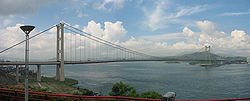
The Tsing Ma Bridge is a bridge in Hong Kong. It is the world's seventh-longest span suspension bridge, and was the second longest at time of completion. The bridge was named after two of the islands at its ends, namely Tsing Yi and Ma Wan . It has two decks and carries both road and rail...
and the constructing of the Airport Railway as a double-track railway. The project ended up costing HK$160.2 billion (160,200,000,000).
The Programme formally commenced after the signing of a memorandum of understanding between British Prime Minister
Prime Minister of the United Kingdom
The Prime Minister of the United Kingdom of Great Britain and Northern Ireland is the Head of Her Majesty's Government in the United Kingdom. The Prime Minister and Cabinet are collectively accountable for their policies and actions to the Sovereign, to Parliament, to their political party and...
John Major
John Major
Sir John Major, is a British Conservative politician, who served as Prime Minister of the United Kingdom and Leader of the Conservative Party from 1990–1997...
and Chinese Premier Li Peng
Li Peng
Li Peng served as the fourth Premier of the People's Republic of China, between 1987 and 1998, and the Chairman of the Standing Committee of the National People's Congress, China's top legislative body, from 1998 to 2003. For much of the 1990s Li was ranked second in the Communist Party of China ...
in Beijing on 3 September 1991, and lasted 8 years in total. It was the biggest infrastructure programme in Hong Kong's history.
History
There were plans to replace the old Kai Tak AirportKai Tak Airport
Kai Tak Airport was the international airport of Hong Kong from 1925 until 1998. It was officially known as the Hong Kong International Airport from 1954 to 6 July 1998, when it was closed and replaced by the new Hong Kong International Airport at Chek Lap Kok, 30 km to the west...
after the Second World War. However due to financial and political reasons, the plan was abandoned in 1951 and the Hong Kong Government decided to expand the original airport instead.
With the growth of the economy of Hong Kong
Economy of Hong Kong
As one of the world's leading international financial centres, Hong Kong has a major capitalist service economy characterised by low taxation and free trade, and the currency, Hong Kong dollar, is the ninth most traded currency in the world. Hong Kong has remained as the world's freest economy,...
during the 1970s, the project was mentioned again. The Government earmarked Chek Lap Kok
Chek Lap Kok
Chek Lap Kok was an island in the western waters of Hong Kong. Together with the smaller Lam Chau, it was leveled and merged via land reclamation into the platform for the current Hong Kong International Airport, which opened for commercial operations in 1998...
, just off the north coast of Lantau Island
Lantau Island
Lantau Island , based on the old local name of Lantau Peak , is the largest island in Hong Kong, located at the mouth of the Pearl River. Administratively, most of Lantau Island is part of the Islands District of Hong Kong...
near Tung Chung
Tung Chung
Tung Chung, meaning 'eastern stream', is an area situated on the north-western coast of Lantau Island in Hong Kong. Tung Chung, currently one of the latest generation of new towns, was formerly a rural village around Tung Chung Wan, and along the delta and lower courses of Tung Chung River and Ma...
, as the new airport's site. However, the plan was shelved in 1983 for economic reasons, as well as the question of Hong Kong's sovereignty and the impending signing of the Sino-British Joint Declaration
Sino-British Joint Declaration
The Sino-British Joint Declaration, formally known as the Joint Declaration of the Government of the United Kingdom of Great Britain and Northern Ireland and the Government of the People's Republic of China on the Question of Hong Kong, was signed by the Prime Ministers, Zhao Ziyang and Margaret...
.
The plan was announced on 11 October 1989 by the then Governor
Governor of Hong Kong
The Governor of Hong Kong was the head of the government of Hong Kong during British rule from 1843 to 1997. The governor's roles were defined in the Hong Kong Letters Patent and Royal Instructions...
Wilson
David Wilson, Baron Wilson of Tillyorn
David Clive Wilson, Baron Wilson of Tillyorn, is a retired British administrator, diplomat and Sinologist. Lord Wilson of Tillyorn was the penultimate Commander-in-Chief and 27th Governor of Hong Kong...
, and it was perceived to be part of the government's effort to reinstate confidence in Hong Kong after the Tiananmen Square protests of 1989
Tiananmen Square protests of 1989
The Tiananmen Square protests of 1989, also known as the June Fourth Incident in Chinese , were a series of demonstrations in and near Tiananmen Square in Beijing in the People's Republic of China beginning on 15 April 1989...
. The public was initially surprised by the huge budget and there were concerns that it would drain much of the public revenue. The programme was completed with the opening of the new Hong Kong International Airport
Hong Kong International Airport
Hong Kong International Airport is the main airport in Hong Kong. It is colloquially known as Chek Lap Kok Airport , being built on the island of Chek Lap Kok by land reclamation, and also to distinguish it from its predecessor, the closed Kai Tak Airport.The airport opened for commercial...
at Chek Lap Kok in July 1998.
Hong Kong International Airport
The Hong Kong International Airport is the centrepiece of this massive project; it provided the foundation for the other 9 core projects of the Airport Core Programme.Chek Lap Kok
Chek Lap Kok
Chek Lap Kok was an island in the western waters of Hong Kong. Together with the smaller Lam Chau, it was leveled and merged via land reclamation into the platform for the current Hong Kong International Airport, which opened for commercial operations in 1998...
was selected as an optimal site due to its development potential. Construction finally started in 1992 and was planned to finish in mid-1997. Chris Patten
Chris Patten
Christopher Francis Patten, Baron Patten of Barnes, CH, PC , is the last Governor of British Hong Kong, a former British Conservative politician, and the current chairman of the BBC Trust....
, the last Governor of Hong Kong, expressed his hope of leaving Hong Kong via the new airport after the transfer of sovereignty of Hong Kong. Sadly, this did not materialise. The airport finally come into operation on 6 July 1998, at a cost of around USD$20 billion.
Airport Railway
The Airport Railway was built to connect Kowloon PeninsulaKowloon Peninsula
The Kowloon Peninsula is a peninsula that forms the southern part of the main landmass in the territory of Hong Kong. The Kowloon Peninsula and the area of New Kowloon are collectively known as Kowloon....
and Hong Kong Island
Hong Kong Island
Hong Kong Island is an island in the southern part of the Hong Kong Special Administrative Region. It has a population of 1,289,500 and its population density is 16,390/km², as of 2008...
to the Airport and the planned new towns
North Lantau New Town
The North Lantau New Town , built on reclaimed land from the northern coast of the Lantau Island in the New Territories, is the newest among the nine new towns in Hong Kong. It was planned to span Tung Chung and Tai Ho. Nevertheless, as of 2006, only Tung Chung was developed, and a railway depot at...
of Northern Lantau. The railway is operated by the MTR Corporation
MTR Corporation
MTR Corporation Limited is a company listed on the Hong Kong Exchange and included in the Hang Seng Index. MTR owns and runs the Hong Kong MTR metro system, and is also a major property developer and landlord in Hong Kong...
and has two routes: the Airport Express
Airport Express
Airport Express can refer to the following:*AirPort Express, a wireless product by Apple Inc.*Several airport rail links are named Airport Express:**Airport Express , the airport transit service in Beijing, China...
and the Tung Chung Line which provides a commuter service linking the new town of Tung Chung to the city. These two lines share the same double-tracks for most of their routes, however, the railway was initially planned to have 4 tracks along its length. The commuter service offered by the Tung Chung Line also provided relief to the overcrowded Tsuen Wan Line of the MTR
MTR
Mass Transit Railway is the rapid transit railway system in Hong Kong. Originally opened in 1979, the system now includes 211.6 km of rail with 155 stations, including 86 railway stations and 69 light rail stops...
.
Lantau Link
Comprising Kap Shui Mun BridgeKap Shui Mun Bridge
The Kap Shui Mun Bridge in Hong Kong is one of the longest cable-stayed bridges in the world that transports both road and railway traffic, with the upper deck for motor vehicles, and the lower deck for both vehicles and the MTR. It has a main span of 430 metres and an overall length of 750 metres...
and Tsing Ma Bridge
Tsing Ma Bridge
The Tsing Ma Bridge is a bridge in Hong Kong. It is the world's seventh-longest span suspension bridge, and was the second longest at time of completion. The bridge was named after two of the islands at its ends, namely Tsing Yi and Ma Wan . It has two decks and carries both road and rail...
, the Lantau Link connects Lantau with Tsing Yi
Tsing Yi
Tsing Yi , or Tsing Yi Island is an island in the urban area of Hong Kong, to the northwest of Hong Kong Island and south of Tsuen Wan. With an area of 10.69 km², the island has extended drastically by reclamation along almost all its natural shore and the annexation of Nga Ying Chau and Chau...
, via Ma Wan
Ma Wan
Ma Wan is an island of Hong Kong, located between Lantau Island and Tsing Yi Island, with an area of 0.97 km². Administratively, it is part of Tsuen Wan District....
. It carries both road and railway traffic between the islands.
Western Harbour Crossing
This is the third cross-harbour tunnel for Victoria HarbourVictoria Harbour
Victoria Harbour is a natural landform harbour situated between Hong Kong Island and the Kowloon Peninsula in Hong Kong. The harbour's deep, sheltered waters and strategic location on the South China Sea were instrumental in Hong Kong's establishment as a British colony and its subsequent...
. Built under a BOT
Build-Operate-Transfer
Build-own-operate-transfer or build-operate-transfer is a form of project financing, wherein a private entity receives a concession from the private or public sector to finance, design, construct, and operate a facility stated in the concession contract...
agreement with the Western Harbour Tunnel Company
Western Harbour Tunnel Company
The Western Habour Tunnel Company Limited 香港西區隧道有限公司 is a jointly owned entity engaged principally in the construction, maintenance and operation of the Western Harbour Crossing in Hong Kong....
, the tunnel was intended to relieve congestion at the Cross Harbour Tunnel and is part of expressway Route 3
Route 3 (Hong Kong)
Route 3 is a series of expressways in Hong Kong from Sai Ying Pun on the Hong Kong Island to Yuen Long in the New Territories, via Yau Ma Tei, Kwai Chung and Tsing Yi Island.From south to north, Route 3 can be divided into four parts...
.
North Lantau Expressway
With the highest posted speed limitSpeed limit
Road speed limits are used in most countries to regulate the speed of road vehicles. Speed limits may define maximum , minimum or no speed limit and are normally indicated using a traffic sign...
in Hong Kong, this 6-lane motorway links Tung Chung
Tung Chung
Tung Chung, meaning 'eastern stream', is an area situated on the north-western coast of Lantau Island in Hong Kong. Tung Chung, currently one of the latest generation of new towns, was formerly a rural village around Tung Chung Wan, and along the delta and lower courses of Tung Chung River and Ma...
in the west to the Lantau Link
Lantau Link
The Lantau Link, formerly known as the Lantau Fixed Crossing, is a series of infrastructures linking Hong Kong International Airport to the urban areas in Hong Kong. It was officially opened on 27 April 1997, and it opened to traffic on 22 May the same year.-Infrastructure:The Lantau Link is 3.5 km...
in the east, via the north coast of Lantau.
Route 3 – Kwai Chung and Tsing Yi SectionsRoute 3 (Hong Kong)Route 3 is a series of expressways in Hong Kong from Sai Ying Pun on the Hong Kong Island to Yuen Long in the New Territories, via Yau Ma Tei, Kwai Chung and Tsing Yi Island.From south to north, Route 3 can be divided into four parts...
Route 3Route 3 (Hong Kong)
Route 3 is a series of expressways in Hong Kong from Sai Ying Pun on the Hong Kong Island to Yuen Long in the New Territories, via Yau Ma Tei, Kwai Chung and Tsing Yi Island.From south to north, Route 3 can be divided into four parts...
is one of the 9 strategic expressway routes
Hong Kong Strategic Route and Exit Number System
The Hong Kong Strategic Route and Exit Number System is a system adopted by the Transport Department of the Hong Kong Government to organise the major roads in the territory into Routes 1 to 10 for the convenience of drivers. When the system was first implemented in 2004, the government launched a...
of Hong Kong, linking Sai Ying Pun
Sai Ying Pun
Sai Ying Pun is an area in Western District on the Hong Kong Island in Hong Kong. It is part of Central and Western District in district administration....
on Hong Kong Island and Yuen Long
Yuen Long
Yuen Long , formerly Un Long, is an area and town located in the northwest of Hong Kong, on the Yuen Long Plain. To its west lie Hung Shui Kiu and Ha Tsuen, to the south Shap Pat Heung and Tai Tong, to the east Au Tau and Kam Tin, and to the north Nam Sang Wai.-Name:The Cantonese name Yuen Long 元朗...
in the New Territories
New Territories
New Territories is one of the three main regions of Hong Kong, alongside Hong Kong Island and the Kowloon Peninsula. It makes up 86.2% of Hong Kong's territory. Historically, it is the region described in The Convention for the Extension of Hong Kong Territory...
. The Kwai Chung and Tsing Yi sections were built to link the Lantau Link
Lantau Link
The Lantau Link, formerly known as the Lantau Fixed Crossing, is a series of infrastructures linking Hong Kong International Airport to the urban areas in Hong Kong. It was officially opened on 27 April 1997, and it opened to traffic on 22 May the same year.-Infrastructure:The Lantau Link is 3.5 km...
and West Kowloon Expressway
West Kowloon Highway
West Kowloon Highway is a section of Route 3 in Hong Kong. This dual-3 lane highway runs for 4.2 km, connecting Western Harbour Crossing in the south with Tsing Kwai Highway in the north. While the southern section of the road is at grade, the northern part is on a viaduct in order to accommodate...
.
The Kwai Chung section is 3 km in length. The route connects with the West Kowloon Expressway near Lai Chi Kok
Lai Chi Kok
Lai Chi Kok is a neighborhood in New Kowloon, Hong Kong, east of Kwai Chung and west of Cheung Sha Wan. Mei Foo Sun Chuen is the largest housing estate in the area. Administratively, it belongs to the Sham Shui Po District.-History:...
, then bypasses the Kwai Tsing Container Terminals
Kwai Tsing Container Terminals
Kwai Tsing Container Terminals is the main port facilities in the reclamation along Rambler Channel between Kwai Chung and Tsing Yi Island, Hong Kong. It evolves from 4 berths of Kwai Chung Container Port completed in 1970s. It later expanded with two berths in 1980s...
, finally connecting with the Cheung Tsing Bridge of the Tsing Yi section. It is an 8-lane elevated motorway. This section is now known as Tsing Kwai Highway
Tsing Kwai Highway
Tsing Kwai Highway is a section of Route 3 in Hong Kong, previously known as Route 3 - Kwai Chung Section. From its junction with West Kowloon Highway at Mei Foo Roundabout, the expressway runs in the form of a 3 km dual-4 lane viaduct atop Kwai Chung Road and Kwai Tai Road, circumscribing the...
.
The Tsing Yi section comprises the 500 m long Cheung Tsing Bridge, which crosses over Rambler Channel
Rambler Channel
Rambler Channel is a body of water in Hong Kong that separates Tsing Yi Island from mainland Kowloon Peninsula, namely Tsuen Wan and Kwai Chung in the New Territories...
, and the 1.6 km Cheung Tsing Tunnel
Cheung Tsing Tunnel
Cheung Tsing Tunnel, also spelt Cheung Ching Tunnel, is a dual tube 3-lane tunnel on Tsing Yi Island, Hong Kong. It is part of Tsing Kwai Highway of Route 3. Its east end connects to Rambler Channel Bridge and west Cheung Tsing Highway. The tunnel was opened on 1997-05-22 and is the second...
, which cuts through the high ground on Tsing Yi Island. This section is now known as the Cheung Tsing Highway
Cheung Tsing Highway
Cheung Tsing Highway is a highway of Route 3 between Cheung Tsing Tunnel and North West Tsing Yi Interchange on Tsing Yi Island, Hong Kong. It was built as part of the Airport Core Programme together with the rest of Route 3 to provide a new highway link from North Western New Territories...
.
West Kowloon Expressway
This is a 6-lane motorway 4.2 km in length with the northern 2 km elevated for the Airport Railway running underneath. It links the KowloonKowloon
Kowloon is an urban area in Hong Kong comprising the Kowloon Peninsula and New Kowloon. It is bordered by the Lei Yue Mun strait in the east, Mei Foo Sun Chuen and Stonecutter's Island in the west, Tate's Cairn and Lion Rock in the north, and Victoria Harbour in the south. It had a population of...
portal of the Western Harbour Crossing
Western Harbour Crossing
The Western Harbour Crossing is a dual 3-lane immersed tube tunnel in Hong Kong. It is the third tunnel to cross Victoria Harbour, linking the newly reclaimed land in West Kowloon with Sai Ying Pun on Hong Kong Island...
in the south to the Tsing Kwai Highway
Tsing Kwai Highway
Tsing Kwai Highway is a section of Route 3 in Hong Kong, previously known as Route 3 - Kwai Chung Section. From its junction with West Kowloon Highway at Mei Foo Roundabout, the expressway runs in the form of a 3 km dual-4 lane viaduct atop Kwai Chung Road and Kwai Tai Road, circumscribing the...
in the north and is built entirely on newly reclaimed land.
Land Reclamation in West KowloonWest KowloonWest Kowloon is a part of Kowloon, Hong Kong situated within the Yau Tsim Mong District. It is bounded by Canton Road to the east, Victoria Harbour to the west and the south, and Jordan Road to the north. Further to the north, the area extends to Tai Kok Tsui to the west of the West Kowloon...
Reclamation work was needed along the west coast of Kowloon PeninsulaKowloon Peninsula
The Kowloon Peninsula is a peninsula that forms the southern part of the main landmass in the territory of Hong Kong. The Kowloon Peninsula and the area of New Kowloon are collectively known as Kowloon....
to provide land for the expressway, Route 3
Route 3 (Hong Kong)
Route 3 is a series of expressways in Hong Kong from Sai Ying Pun on the Hong Kong Island to Yuen Long in the New Territories, via Yau Ma Tei, Kwai Chung and Tsing Yi Island.From south to north, Route 3 can be divided into four parts...
, as well as supporting infrastructure. The Airport Railway also runs through the reclaimed land of West Kowloon. The reclamation work has increased the area of Kowloon Peninsula by 30%.
Central Reclamation Phase I
This phase required the reclamation of an area of 20 hectares along the waterfront of Central to provide land for the Airport Railway's Hong Kong Station. Two ferry piersOutlying Islands Ferry Pier
Outlying Islands Ferry Pier means the ferry piers which provide ferry service outside Victoria Harbour in Central, Hong Kong. It now refers to Central Piers No.2 to No.6, near International Finance Center...
serving outlying islands as well as a government dockyard had to be relocated to facilitate the work.
Phase I of North Lantau New Town
The first phase of the new town in Northern Lantau is centred around Tung ChungTung Chung
Tung Chung, meaning 'eastern stream', is an area situated on the north-western coast of Lantau Island in Hong Kong. Tung Chung, currently one of the latest generation of new towns, was formerly a rural village around Tung Chung Wan, and along the delta and lower courses of Tung Chung River and Ma...
and was planned to provide housing to 18,000 people. The new town was meant to be a supporting community for the new Hong Kong International Airport
Airport
An airport is a location where aircraft such as fixed-wing aircraft, helicopters, and blimps take off and land. Aircraft may be stored or maintained at an airport...
, as well as to act as a "gateway" to Hong Kong for visitors. At present, phases I, II and IIIA of the new town have been completed, all around Tung Chung
Tung Chung
Tung Chung, meaning 'eastern stream', is an area situated on the north-western coast of Lantau Island in Hong Kong. Tung Chung, currently one of the latest generation of new towns, was formerly a rural village around Tung Chung Wan, and along the delta and lower courses of Tung Chung River and Ma...
. When all 4 phases are completed, the new town will be home to 320,000 people, covering an area of 830 hectares between Tung Chung
Tung Chung
Tung Chung, meaning 'eastern stream', is an area situated on the north-western coast of Lantau Island in Hong Kong. Tung Chung, currently one of the latest generation of new towns, was formerly a rural village around Tung Chung Wan, and along the delta and lower courses of Tung Chung River and Ma...
and the neighbouring area of Tai Ho
Tai Ho
Tai Ho may refer to:*Tai Ho , also known as Tai Ho Bay , a place on Lantau Island, Hong Kong*Tai Ho, a recurring character in Suikoden...
.
Exhibition Centre
- The Airport Core Programme Exhibition CentreAirport Core Programme Exhibition CentreThe Airport Core Programme Exhibition Centre, is housed in a single-storey distinctive white structure situated at 401 Castle Peak Road, Ting Kau, New Territories in Hong Kong. The exhibition centre is run by the Home Affairs Department for the Airport Core Programme often referred to as the Rose...
introducing the programme is located in Ting KauTing KauTing Kau is an area in west Tsuen Wan District, New Territories, Hong Kong. Ting Kau Village is a village near the shore. The beach nearby, Ting Kau Beach was once a popular beach in Hong Kong. The water quality affected by the treated water injected into Victoria Harbour.Ting Kau is also famous...
near Sham TsengSham TsengSham Tseng is a coastal area in Tsuen Wan District, Hong Kong, between Ting Kau and Tsing Lung Tau.In 1982, the Government launched a new town project for the area. There were proposals for a massive housing scheme, where the population of the village, then estimated at 6,000, was set to increase...
in Hong Kong.