

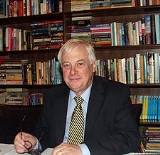
Chris Patten

Encyclopedia
Christopher Francis Patten, Baron Patten of Barnes, CH
, PC (born 12 May 1944), is the last Governor
of British Hong Kong
, a former British
Conservative
politician, and the current chairman of the BBC Trust
.
He was Member of Parliament for Bath
, eventually rising to a cabinet minister and party chairman. In the latter capacity, he orchestrated the Conservatives' unexpected fourth consecutive electoral victory in 1992, but lost his own seat in the House of Commons.
He then accepted the post of Governor and Commander-in-Chief
of Hong Kong, and oversaw its handover to the People's Republic of China in July 1997. As Governor and Commander-in-Chief
, Patten presided over a steady rise in the living standards of ordinary Hong Kongers while encouraging a signficant expansion of Hong Kong's social welfare system.
From 2000 to 2004 he served as one of the United Kingdom's two members of the European Commission
. After leaving that post, he returned to the UK and became the Chancellor of the University of Oxford in 2003, and he was made a Life Peer
in 2005.
Patten is a Roman Catholic and oversaw Pope Benedict XVI's visit to the United Kingdom
in September 2010.
On 7 April 2011 the Queen approved Patten's appointment as the Chairman of the BBC Trust
, the governing body of the British Broadcasting Corporation.
in Ealing
, west London, and at Balliol College, Oxford
. He was the first member of his family to attend university. In 1965, Patten worked for the campaign of New York Mayor John Lindsay
, where he reported on the television performance of rival William F. Buckley, Jr.
. He worked for the Conservative Party
from 1966, first as desk officer and then director (from 1974 to 1979) of the Conservative Research Department
.
at the Foreign and Commonwealth Office
from 1986 to 1989.
In 1989 he was appointed to the Cabinet as Secretary of State for the Environment
and became responsible for the unpopular Poll Tax
. Though he robustly defended the policy at the time, in his 2006 book Not Quite the Diplomat (published in the United States as Cousins and Strangers: America, Britain and Europe in the New Century) he claims to have thought it was a mistake on Margaret Thatcher
's part. He also introduced, and steered through Parliament, the major legislation that became the Environmental Protection Act 1990.
In 1990, John Major
made Patten Chancellor of the Duchy of Lancaster
and Chairman of the Conservative Party
, with responsibility for organising the coming general election campaign. As party chairman, he was widely considered to be the main architect of the somewhat unexpected Conservative
victory in the 1992 election. However, he lost his marginal seat for Bath
to the Liberal Democrat candidate, Don Foster, in 1992. Patten's defeat was attributed to several factors: the Poll Tax that he implemented, which was especially unpopular in his constituency, and his duties as party chairman that prevented him from much local campaigning.
said that he would have made Patten Chancellor of the Exchequer
. However, in the three weeks leading up to the election, many party insiders sensed that Patten would lose his seat, and Major was considering a patronage appointment.
In any event, in July 1992, he became the 28th and the last Governor
of Hong Kong until its handover to the People's Republic of China on 30 June 1997. He was given an official Chinese name
, Pang Ding-hong , a name with an etymology based on the words "stability" and "health". Unlike most previous Hong Kong Governors, he was not a career diplomat from the UK Foreign Office but a politician. However, he was not the first former MP to become a Governor of Hong Kong: that was John Bowring
(Governor of Hong Kong 1854–1859). Also, John Pope Hennessy
(Governor of Hong Kong 1877–1882), was a Conservative MP before he entered Colonial Service.
Patten's tenure faced several different challenges, as many in Hong Kong were still reeling from the Tiananmen Square Massacre a few years earlier, while others were suspicious of whether or not the British would act in their best interest. However the general opinion regarded him positively. He took steps to get in touch with the people of the colony, and was known for his penchant for taking public strolls around Hong Kong as well as in the media limelight. Hong Kong affectionately nicknamed him Fat Pang , making him the only governor to have a widely recognised Chinese nickname.
Patten's most controversial actions are related to the election of the Hong Kong Legislative Council. Legco members returned in 1995 were originally to serve beyond the handover, thereby providing institutional continuity across the reversion of Hong Kong to the PRC. Beijing had expected that the use of functional constituencies with limited electorates would be used to elect this council, however Patten extended the definition of functional constituencies
and thus virtually every Hong Kong subject was able to vote for the so-called indirectly elected members (see Politics of Hong Kong
) of the Legislative Council.
His measure was strongly criticised by the pro-Beijing
political parties of Hong Kong, which would suffer from the electoral changes. Patten was also denounced by the PRC government as the 'whore of the East,' a 'serpent' and a 'wrongdoer who would be condemned for a thousand generations' . The legislative council which was elected under Patten's governorship was dissolved upon the handover of Hong Kong to the PRC and replaced by a Provisional Legislative Council
which functioned until elections were held under the previous rules in 1998.
However, Patten's institutional reform gained unprecedented support in Hong Kong and the criticism from the PRC government raised his popularity to a level he had not previously enjoyed in the UK; he was widely seen as standing up for the colony's rights. Notwithstanding the electoral controversy, even some of his critics admired his eloquence and praised his efforts to raise the level of debate in the colony. Ending up, the PRC did bow to pressure and after the handover, an increasing portion of seats in the Legco would be directly elected.
At 00:00 HKT 1 July 1997 (16:00 GMT, 30 June 1997), he sent the following telegram:
he left the city, together with Prince Charles
, on board the British royal yacht, HMY Britannia
. Patten was noted to be in tears after his speech at the Transfer of sovereignty over Hong Kong in 1997.
appointed him a Companion of Honour. From 1998 to 1999, he chaired the Independent Commission on Policing for Northern Ireland
, better known as the Patten Commission, which had been established in 1998 as part of the Belfast Agreement
. On 9 September 1999, the Commission produced its report, entitled A New Beginning: Policing in Northern Ireland but popularly known as the Patten Report, which contained 175 symbolic and practical recommendations. This report led to the re-naming of the Royal Ulster Constabulary
as the Police Service of Northern Ireland
. He is the co-chair of International Crisis Group
, overseeing many international operations. He is also a member of the Global Leadership Foundation
, an organisation which works to promote good governance around the world. On 23 May 2005 he was appointed by Cadbury (formerly Cadbury's) as a non-executive director. In 2011 Patten took seat in the advisory council of The Hague Institute for Global Justice
.
as Commissioner for External Relations
where he was responsible for the Union's development and co-operation programmes, as well as liaison with Javier Solana
, the High Representative of the Common Foreign and Security Policy. He held this position within the Prodi Commission
from 23 January 2000 until 22 November 2004. Patten oversaw many crises in the area of European foreign policy
, most notably the failure of the European Union to come up with a common unified policy before the Iraq war in 2003. Although nominated for the post of President
in the next Commission in 2004, he was unable to gain support from France and Germany.
According to information from wikileaks
(http://46.59.1.2/cable/2004/04/04BRUSSELS1868.html) Mr Patten was in Moscow in April 2004, and had concluded EU-Russia ministerial consultations in Brussels. He considered that the EU had become overly dependent on Russian energy supplies, and should become more engaged with the countries of the Caucasus and Central Asia in order to diversify supplies.
According to information from the US Embassy in Brussels (published by Wikileaks in November 2010): Mr Patten said in April 2004 that Russian President Vladimir Putin
has done a good job for Russia mainly due to high world energy prices, but he had serious doubts about the man’s character. Cautioning that “I’m not saying that genes are determinant,” Patten then reviewed Mr Putin family history: grandfather part of Lenin’s special protection team, father a communist party apparatchik, and Putin himself decided at a young age to pursue a career in the KGB. “He seems a completely reasonable man when discussing the Middle East or energy policy, but when the conversation shifts to Chechnya or Islamic extremism, Putin’s eyes turn to those of a killer.”
 Patten was Chancellor of Newcastle University from 1999 to 2009, and elected Chancellor of the University of Oxford in 2003. In 2005 he was raised to the Peerage
as Baron Patten of Barnes, of Barnes in the London Borough of Richmond
. In September 2005 he was elected a Distinguished Honorary Fellow of Massey College
in the University of Toronto
(the only person so elected except for the Chancellor of the University of Cambridge and the University of Edinburgh
, the Duke of Edinburgh
) as well as receiving an honorary Doctorate of Sacred Letters from the University of Trinity College
, Toronto
and an honorary Doctorate of Letters from the University of Ulster
. In March 2009, Patten received the title Doctor Honoris Causa by South East European University
.
.
. They have three daughters, Kate, Laura (married to Elton Charles), and Alice Patten
(actress); and two Norfolk terrier
s, Whisky and Soda.
On 29 September 2005, he published his memoirs, Not Quite the Diplomat: Home Truths About World Affairs
.
In October 2009, Lord Patten was Chief Guest at The Doon School
, Dehradun
a boarding school in India
which is a member of the United Kingdom's Headmasters’ and Headmistresses’ Conference
and Robert Merton
:
"... it is surely laughable when the highest awards are showered on those who promote the most gimcrack schemes to make themselves rich, at least for a while. The geniuses who invented the pyramid of derivatives at Long-Term Capital Management
were awarded the Nobel Prize for their cleverness, not long before the whole edifice came crashing down with the financial community digging deep into its pockets to prevent too much collateral damage. To every excess, there comes a reaction." (pls. ref. to "Not Quite the DIPLOMAT – Home Truths about World Affairs", Nov. 2005, p. 218)
Patten was interviewed about the rise of Thatcherism
for the 2006 BBC
TV documentary series Tory! Tory! Tory!
.
".....After all, both General Fonseka and Mr. Rajapaksa executed the 30-year conflict to its bloody conclusion at the expense of huge numbers of Tamil civilian casualties.
By early May, when the war was ending, the United Nations estimated that some 7,000 civilians had died and more than 10,000 had been wounded in 2009 as the army’s noose was being drawn tight around the remaining rebels and hundreds of thousands of noncombatants, who could not escape government shelling. The final two weeks likely saw thousands more civilians killed, at the hands of both the army and the rebels."
|-
|-
|-
|-
|-
|-
|-
|-
|-
|-
|-
|-
Order of the Companions of Honour
The Order of the Companions of Honour is an order of the Commonwealth realms. It was founded by King George V in June 1917, as a reward for outstanding achievements in the arts, literature, music, science, politics, industry or religion....
, PC (born 12 May 1944), is the last Governor
Governor
A governor is a governing official, usually the executive of a non-sovereign level of government, ranking under the head of state...
of British Hong Kong
British Hong Kong
British Hong Kong refers to Hong Kong as a Crown colony and later, a British dependent territory under British administration from 1841 to 1997.- Colonial establishment :...
, a former British
United Kingdom
The United Kingdom of Great Britain and Northern IrelandIn the United Kingdom and Dependencies, other languages have been officially recognised as legitimate autochthonous languages under the European Charter for Regional or Minority Languages...
Conservative
Conservative Party (UK)
The Conservative Party, formally the Conservative and Unionist Party, is a centre-right political party in the United Kingdom that adheres to the philosophies of conservatism and British unionism. It is the largest political party in the UK, and is currently the largest single party in the House...
politician, and the current chairman of the BBC Trust
BBC Trust
The BBC Trust is the governing body of the British Broadcasting Corporation. It is operationally independent of BBC management and external bodies, and aims to act in the best interests of licence fee payers....
.
He was Member of Parliament for Bath
Bath (UK Parliament constituency)
Bath is a constituency in the House of Commons of the Parliament of the United Kingdom, previously of the House of Commons of England. It is an ancient constituency which has been constantly represented in Parliament since boroughs were first summoned to send members in the 13th century...
, eventually rising to a cabinet minister and party chairman. In the latter capacity, he orchestrated the Conservatives' unexpected fourth consecutive electoral victory in 1992, but lost his own seat in the House of Commons.
He then accepted the post of Governor and Commander-in-Chief
Governor of Hong Kong
The Governor of Hong Kong was the head of the government of Hong Kong during British rule from 1843 to 1997. The governor's roles were defined in the Hong Kong Letters Patent and Royal Instructions...
of Hong Kong, and oversaw its handover to the People's Republic of China in July 1997. As Governor and Commander-in-Chief
Governor of Hong Kong
The Governor of Hong Kong was the head of the government of Hong Kong during British rule from 1843 to 1997. The governor's roles were defined in the Hong Kong Letters Patent and Royal Instructions...
, Patten presided over a steady rise in the living standards of ordinary Hong Kongers while encouraging a signficant expansion of Hong Kong's social welfare system.
From 2000 to 2004 he served as one of the United Kingdom's two members of the European Commission
European Commission
The European Commission is the executive body of the European Union. The body is responsible for proposing legislation, implementing decisions, upholding the Union's treaties and the general day-to-day running of the Union....
. After leaving that post, he returned to the UK and became the Chancellor of the University of Oxford in 2003, and he was made a Life Peer
Life peer
In the United Kingdom, life peers are appointed members of the Peerage whose titles cannot be inherited. Nowadays life peerages, always of baronial rank, are created under the Life Peerages Act 1958 and entitle the holders to seats in the House of Lords, presuming they meet qualifications such as...
in 2005.
Patten is a Roman Catholic and oversaw Pope Benedict XVI's visit to the United Kingdom
Pope Benedict XVI's visit to the United Kingdom
Pope Benedict XVI's visit to the United Kingdom from 16 to 19 September 2010 was the first state visit by a pope to the United Kingdom...
in September 2010.
On 7 April 2011 the Queen approved Patten's appointment as the Chairman of the BBC Trust
BBC Trust
The BBC Trust is the governing body of the British Broadcasting Corporation. It is operationally independent of BBC management and external bodies, and aims to act in the best interests of licence fee payers....
, the governing body of the British Broadcasting Corporation.
Early life
Chris Patten was educated at the independent St Benedict's SchoolSt Benedict's School
St Benedict's School is a co-educational independent Roman Catholic school situated in Ealing, West London. The school is part of Ealing Abbey and is governed by the Abbot and monks of Ealing. As the only day school of the English Houses of the English Benedictine Congregation, the school does not...
in Ealing
Ealing
Ealing is a suburban area of west London, England and the administrative centre of the London Borough of Ealing. It is located west of Charing Cross and around from the City of London. It is one of the major metropolitan centres identified in the London Plan. It was historically a rural village...
, west London, and at Balliol College, Oxford
Balliol College, Oxford
Balliol College , founded in 1263, is one of the constituent colleges of the University of Oxford in England but founded by a family with strong Scottish connections....
. He was the first member of his family to attend university. In 1965, Patten worked for the campaign of New York Mayor John Lindsay
John Lindsay
John Vliet Lindsay was an American politician, lawyer and broadcaster who was a U.S. Congressman, Mayor of New York City, candidate for U.S...
, where he reported on the television performance of rival William F. Buckley, Jr.
William F. Buckley, Jr.
William Frank Buckley, Jr. was an American conservative author and commentator. He founded the political magazine National Review in 1955, hosted 1,429 episodes of the television show Firing Line from 1966 until 1999, and was a nationally syndicated newspaper columnist. His writing was noted for...
. He worked for the Conservative Party
Conservative Party (UK)
The Conservative Party, formally the Conservative and Unionist Party, is a centre-right political party in the United Kingdom that adheres to the philosophies of conservatism and British unionism. It is the largest political party in the UK, and is currently the largest single party in the House...
from 1966, first as desk officer and then director (from 1974 to 1979) of the Conservative Research Department
Conservative Research Department
The Conservative Research Department is part of the central organisation of the Conservative Party of the United Kingdom. It operates alongside other departments of Conservative Campaign Headquarters at 30 Millbank, London SW1....
.
In government
Patten was a Member of Parliament for Bath from 1979 to 1992, serving as Minister for Overseas DevelopmentSecretary of State for International Development
In the United Kingdom, the Secretary of State for International Development is a Cabinet minister responsible for the Department for International Development and for promoting development overseas, particularly in the third world...
at the Foreign and Commonwealth Office
Foreign and Commonwealth Office
The Foreign and Commonwealth Office, commonly called the Foreign Office or the FCO is a British government department responsible for promoting the interests of the United Kingdom overseas, created in 1968 by merging the Foreign Office and the Commonwealth Office.The head of the FCO is the...
from 1986 to 1989.
In 1989 he was appointed to the Cabinet as Secretary of State for the Environment
Secretary of State for the Environment
The Secretary of State for the Environment was a UK cabinet position, responsible for the Department of the Environment . This was created by Edward Heath as a combination of the Ministry of Housing and Local Government, the Ministry of Transport and the Ministry of Public Building and Works on 15...
and became responsible for the unpopular Poll Tax
Community Charge
The Community Charge, popularly known as the "poll tax", was a system of taxation introduced in replacement of the rates to part fund local government in Scotland from 1989, and England and Wales from 1990. It provided for a single flat-rate per-capita tax on every adult, at a rate set by the...
. Though he robustly defended the policy at the time, in his 2006 book Not Quite the Diplomat (published in the United States as Cousins and Strangers: America, Britain and Europe in the New Century) he claims to have thought it was a mistake on Margaret Thatcher
Margaret Thatcher
Margaret Hilda Thatcher, Baroness Thatcher, was Prime Minister of the United Kingdom from 1979 to 1990...
's part. He also introduced, and steered through Parliament, the major legislation that became the Environmental Protection Act 1990.
In 1990, John Major
John Major
Sir John Major, is a British Conservative politician, who served as Prime Minister of the United Kingdom and Leader of the Conservative Party from 1990–1997...
made Patten Chancellor of the Duchy of Lancaster
Chancellor of the Duchy of Lancaster
The Chancellor of the Duchy of Lancaster is, in modern times, a ministerial office in the government of the United Kingdom that includes as part of its duties, the administration of the estates and rents of the Duchy of Lancaster...
and Chairman of the Conservative Party
Chairman of the Conservative Party
In the United Kingdom, the Chairman of the Conservative Party is responsible for running the party machine, overseeing Conservative Central Office. When the Conservatives are in power, the Chairman is usually a member of the Cabinet being given a sinecure position such as Minister without Portfolio...
, with responsibility for organising the coming general election campaign. As party chairman, he was widely considered to be the main architect of the somewhat unexpected Conservative
Conservative Party (UK)
The Conservative Party, formally the Conservative and Unionist Party, is a centre-right political party in the United Kingdom that adheres to the philosophies of conservatism and British unionism. It is the largest political party in the UK, and is currently the largest single party in the House...
victory in the 1992 election. However, he lost his marginal seat for Bath
Bath (UK Parliament constituency)
Bath is a constituency in the House of Commons of the Parliament of the United Kingdom, previously of the House of Commons of England. It is an ancient constituency which has been constantly represented in Parliament since boroughs were first summoned to send members in the 13th century...
to the Liberal Democrat candidate, Don Foster, in 1992. Patten's defeat was attributed to several factors: the Poll Tax that he implemented, which was especially unpopular in his constituency, and his duties as party chairman that prevented him from much local campaigning.
Governor of Hong Kong
If Patten had been re-elected in 1992, sections of the media thought he would have been rewarded by appointment as Foreign Secretary, although in his autobiography John MajorJohn Major
Sir John Major, is a British Conservative politician, who served as Prime Minister of the United Kingdom and Leader of the Conservative Party from 1990–1997...
said that he would have made Patten Chancellor of the Exchequer
Chancellor of the Exchequer
The Chancellor of the Exchequer is the title held by the British Cabinet minister who is responsible for all economic and financial matters. Often simply called the Chancellor, the office-holder controls HM Treasury and plays a role akin to the posts of Minister of Finance or Secretary of the...
. However, in the three weeks leading up to the election, many party insiders sensed that Patten would lose his seat, and Major was considering a patronage appointment.
In any event, in July 1992, he became the 28th and the last Governor
Governor of Hong Kong
The Governor of Hong Kong was the head of the government of Hong Kong during British rule from 1843 to 1997. The governor's roles were defined in the Hong Kong Letters Patent and Royal Instructions...
of Hong Kong until its handover to the People's Republic of China on 30 June 1997. He was given an official Chinese name
Chinese name
Personal names in Chinese culture follow a number of conventions different from those of personal names in Western cultures. Most noticeably, a Chinese name is written with the family name first and the given name next, therefore "John-Paul Smith" as a Chinese name would be "Smith John-Paul"...
, Pang Ding-hong , a name with an etymology based on the words "stability" and "health". Unlike most previous Hong Kong Governors, he was not a career diplomat from the UK Foreign Office but a politician. However, he was not the first former MP to become a Governor of Hong Kong: that was John Bowring
John Bowring
Sir John Bowring, KCB was an English political economist, traveller, miscellaneous writer, polyglot, and the 4th Governor of Hong Kong.- Early life :...
(Governor of Hong Kong 1854–1859). Also, John Pope Hennessy
John Pope Hennessy
Sir John Pope Hennessy, KCMG , was an Irish and British politician and colonial administrator who served as the eighth Governor of Hong Kong.-Early life:...
(Governor of Hong Kong 1877–1882), was a Conservative MP before he entered Colonial Service.
Patten's tenure faced several different challenges, as many in Hong Kong were still reeling from the Tiananmen Square Massacre a few years earlier, while others were suspicious of whether or not the British would act in their best interest. However the general opinion regarded him positively. He took steps to get in touch with the people of the colony, and was known for his penchant for taking public strolls around Hong Kong as well as in the media limelight. Hong Kong affectionately nicknamed him Fat Pang , making him the only governor to have a widely recognised Chinese nickname.
Patten's most controversial actions are related to the election of the Hong Kong Legislative Council. Legco members returned in 1995 were originally to serve beyond the handover, thereby providing institutional continuity across the reversion of Hong Kong to the PRC. Beijing had expected that the use of functional constituencies with limited electorates would be used to elect this council, however Patten extended the definition of functional constituencies
Functional constituency
In the political systems of Hong Kong and Macau, a functional constituency is a professional or special interest group involved in the electoral process...
and thus virtually every Hong Kong subject was able to vote for the so-called indirectly elected members (see Politics of Hong Kong
Politics of Hong Kong
Politics of Hong Kong takes place in a framework of a political system dominated by its constitutional document, the Basic Law of Hong Kong, its own legislature, the Chief Executive as the head of government, and of a multi-party system...
) of the Legislative Council.
His measure was strongly criticised by the pro-Beijing
Communist Party of China
The Communist Party of China , also known as the Chinese Communist Party , is the founding and ruling political party of the People's Republic of China...
political parties of Hong Kong, which would suffer from the electoral changes. Patten was also denounced by the PRC government as the 'whore of the East,' a 'serpent' and a 'wrongdoer who would be condemned for a thousand generations' . The legislative council which was elected under Patten's governorship was dissolved upon the handover of Hong Kong to the PRC and replaced by a Provisional Legislative Council
Provisional Legislative Council
The Provisional Legislative Council or the PLC was the interim legislature of Hong Kong from 1997 to 1998. The legislature was founded in Guangzhou and sat in Shenzhen from 1996 until the handover in 1997 and moved to Hong Kong to serves as the temporary replacement of Legislative Council of Hong...
which functioned until elections were held under the previous rules in 1998.
However, Patten's institutional reform gained unprecedented support in Hong Kong and the criticism from the PRC government raised his popularity to a level he had not previously enjoyed in the UK; he was widely seen as standing up for the colony's rights. Notwithstanding the electoral controversy, even some of his critics admired his eloquence and praised his efforts to raise the level of debate in the colony. Ending up, the PRC did bow to pressure and after the handover, an increasing portion of seats in the Legco would be directly elected.
At 00:00 HKT 1 July 1997 (16:00 GMT, 30 June 1997), he sent the following telegram:
I have relinquished the administration of this government. God Save The Queen. Patten.This marked the end of British rule in Hong Kong and after the handover ceremony
Handover ceremony of Hong Kong in 1997
The handover ceremony of Hong Kong in 1997 officially marked the transfer of sovereignty over Hong Kong from the United Kingdom to the People's Republic of China...
he left the city, together with Prince Charles
Charles, Prince of Wales
Prince Charles, Prince of Wales is the heir apparent and eldest son of Queen Elizabeth II and Prince Philip, Duke of Edinburgh. Since 1958 his major title has been His Royal Highness The Prince of Wales. In Scotland he is additionally known as The Duke of Rothesay...
, on board the British royal yacht, HMY Britannia
HMY Britannia
Her Majesty's Yacht Britannia is the former Royal Yacht of the British monarch, Queen Elizabeth II. She was the 83rd such vessel since the restoration of King Charles II in 1660. She is the second Royal yacht to bear the name, the first being the famous racing cutter built for The Prince of Wales...
. Patten was noted to be in tears after his speech at the Transfer of sovereignty over Hong Kong in 1997.
Post governorship
In 1998, Queen Elizabeth IIElizabeth II of the United Kingdom
Elizabeth II is the constitutional monarch of 16 sovereign states known as the Commonwealth realms: the United Kingdom, Canada, Australia, New Zealand, Jamaica, Barbados, the Bahamas, Grenada, Papua New Guinea, the Solomon Islands, Tuvalu, Saint Lucia, Saint Vincent and the Grenadines, Belize,...
appointed him a Companion of Honour. From 1998 to 1999, he chaired the Independent Commission on Policing for Northern Ireland
Independent Commission on Policing for Northern Ireland
The Independent Commission on Policing for Northern Ireland was established in 1998 as part of the Belfast Agreement, intended as a major step in the Northern Ireland peace process. Chaired by Conservative politician Chris Patten, it was better known as the Patten Commission. The other members of...
, better known as the Patten Commission, which had been established in 1998 as part of the Belfast Agreement
Belfast Agreement
The Good Friday Agreement or Belfast Agreement , sometimes called the Stormont Agreement, was a major political development in the Northern Ireland peace process...
. On 9 September 1999, the Commission produced its report, entitled A New Beginning: Policing in Northern Ireland but popularly known as the Patten Report, which contained 175 symbolic and practical recommendations. This report led to the re-naming of the Royal Ulster Constabulary
Royal Ulster Constabulary
The Royal Ulster Constabulary was the name of the police force in Northern Ireland from 1922 to 2000. Following the awarding of the George Cross in 2000, it was subsequently known as the Royal Ulster Constabulary GC. It was founded on 1 June 1922 out of the Royal Irish Constabulary...
as the Police Service of Northern Ireland
Police Service of Northern Ireland
The Police Service of Northern Ireland is the police force that serves Northern Ireland. It is the successor to the Royal Ulster Constabulary which, in turn, was the successor to the Royal Irish Constabulary in Northern Ireland....
. He is the co-chair of International Crisis Group
International Crisis Group
The International Crisis Group is an international, non-profit, non-governmental organization whose mission is to prevent and resolve deadly conflicts around the world through field-based analyses and high-level advocacy.-History:...
, overseeing many international operations. He is also a member of the Global Leadership Foundation
Global Leadership Foundation
The Global Leadership Foundation is a not-for-profit, non-governmental organisation founded in 2004 by former State President of South Africa and Nobel Prize laureate F.W. de Klerk....
, an organisation which works to promote good governance around the world. On 23 May 2005 he was appointed by Cadbury (formerly Cadbury's) as a non-executive director. In 2011 Patten took seat in the advisory council of The Hague Institute for Global Justice
The Hague Institute for Global Justice
is founded in 2011 in The Hague, The Netherlands . Former US Secretary of State Madeleine Albright is chair of the advisory council of the institute. THIGJ was founded as an independent centre of expertise, dedicated to the promotion of knowledge of law and justice as the basis of and in relation...
.
European Commissioner
In 1999, he was appointed as one of the United Kingdom's two members to the European CommissionEuropean Commission
The European Commission is the executive body of the European Union. The body is responsible for proposing legislation, implementing decisions, upholding the Union's treaties and the general day-to-day running of the Union....
as Commissioner for External Relations
European Commissioner for External Relations and European Neighbourhood Policy
The European Commissioner for External Relations was a member of the European Commission with responsibility over the Commissions external representation in the world and the European Union's Neighbourhood Policy...
where he was responsible for the Union's development and co-operation programmes, as well as liaison with Javier Solana
Javier Solana
Francisco Javier Solana de Madariaga, KOGF is a Spanish physicist and Socialist politician. After serving in the Spanish government under Felipe González and Secretary General of NATO , he was appointed the European Union's High Representative for Common Foreign and Security Policy, Secretary...
, the High Representative of the Common Foreign and Security Policy. He held this position within the Prodi Commission
Prodi Commission
The Prodi Commission was the European Commission in office between 1999 and 2004. The administration was led by former Italian Prime Minister Romano Prodi.-History:...
from 23 January 2000 until 22 November 2004. Patten oversaw many crises in the area of European foreign policy
Foreign relations of the European Union
Although there has been a large degree of integration between European Union member states, foreign relations is still a largely inter-governmental matter, with the 27 members controlling their own relations to a large degree. However with the Union holding more weight as a single bloc, there are...
, most notably the failure of the European Union to come up with a common unified policy before the Iraq war in 2003. Although nominated for the post of President
President of the European Commission
The President of the European Commission is the head of the European Commission ― the executive branch of the :European Union ― the most powerful officeholder in the EU. The President is responsible for allocating portfolios to members of the Commission and can reshuffle or dismiss them if needed...
in the next Commission in 2004, he was unable to gain support from France and Germany.
According to information from wikileaks
Wikileaks
WikiLeaks is an international self-described not-for-profit organisation that publishes submissions of private, secret, and classified media from anonymous news sources, news leaks, and whistleblowers. Its website, launched in 2006 under The Sunshine Press organisation, claimed a database of more...
(http://46.59.1.2/cable/2004/04/04BRUSSELS1868.html) Mr Patten was in Moscow in April 2004, and had concluded EU-Russia ministerial consultations in Brussels. He considered that the EU had become overly dependent on Russian energy supplies, and should become more engaged with the countries of the Caucasus and Central Asia in order to diversify supplies.
According to information from the US Embassy in Brussels (published by Wikileaks in November 2010): Mr Patten said in April 2004 that Russian President Vladimir Putin
Vladimir Putin
Vladimir Vladimirovich Putin served as the second President of the Russian Federation and is the current Prime Minister of Russia, as well as chairman of United Russia and Chairman of the Council of Ministers of the Union of Russia and Belarus. He became acting President on 31 December 1999, when...
has done a good job for Russia mainly due to high world energy prices, but he had serious doubts about the man’s character. Cautioning that “I’m not saying that genes are determinant,” Patten then reviewed Mr Putin family history: grandfather part of Lenin’s special protection team, father a communist party apparatchik, and Putin himself decided at a young age to pursue a career in the KGB. “He seems a completely reasonable man when discussing the Middle East or energy policy, but when the conversation shifts to Chechnya or Islamic extremism, Putin’s eyes turn to those of a killer.”
University roles and elevation to the Peerage
Peerage
The Peerage is a legal system of largely hereditary titles in the United Kingdom, which constitute the ranks of British nobility and is part of the British honours system...
as Baron Patten of Barnes, of Barnes in the London Borough of Richmond
London Borough of Richmond upon Thames
The London Borough of Richmond upon Thames is a London borough in South West London, UK, which forms part of Outer London. It is unique because it is the only London borough situated both north and south of the River Thames.-Settlement:...
. In September 2005 he was elected a Distinguished Honorary Fellow of Massey College
Massey College
Massey College is a postgraduate residential college at the University of Toronto, established in 1963 with an endowment by the Massey Foundation. Similar to All Souls College, Oxford, members of Massey College are nominated from the university community, and are elected by and as fellows of the...
in the University of Toronto
University of Toronto
The University of Toronto is a public research university in Toronto, Ontario, Canada, situated on the grounds that surround Queen's Park. It was founded by royal charter in 1827 as King's College, the first institution of higher learning in Upper Canada...
(the only person so elected except for the Chancellor of the University of Cambridge and the University of Edinburgh
University of Edinburgh
The University of Edinburgh, founded in 1583, is a public research university located in Edinburgh, the capital of Scotland, and a UNESCO World Heritage Site. The university is deeply embedded in the fabric of the city, with many of the buildings in the historic Old Town belonging to the university...
, the Duke of Edinburgh
Prince Philip, Duke of Edinburgh
Prince Philip, Duke of Edinburgh is the husband of Elizabeth II. He is the United Kingdom's longest-serving consort and the oldest serving spouse of a reigning British monarch....
) as well as receiving an honorary Doctorate of Sacred Letters from the University of Trinity College
University of Trinity College
The University of Trinity College, informally referred to as Trin, is a college of the University of Toronto, founded in 1851 by Bishop John Strachan. Trinity was intended by Strachan as a college of strong Anglican alignment, after the University of Toronto severed its ties with the Church of...
, Toronto
Toronto
Toronto is the provincial capital of Ontario and the largest city in Canada. It is located in Southern Ontario on the northwestern shore of Lake Ontario. A relatively modern city, Toronto's history dates back to the late-18th century, when its land was first purchased by the British monarchy from...
and an honorary Doctorate of Letters from the University of Ulster
University of Ulster
The University of Ulster is a multi-campus, co-educational university located in Northern Ireland. It is the largest single university in Ireland, discounting the federal National University of Ireland...
. In March 2009, Patten received the title Doctor Honoris Causa by South East European University
South East European University
South East European University , is a university located in Tetovo, Republic of Macedonia with a branch campus in Skopje. It is the first private-public not for profit university in Macedonia. It was founded in October 2001 and is a member of the Balkan Universities Network and an associate member...
.
Charity
In 2010 Lord Patten of Barnes was appointed President of Medical Aid for PalestiniansMedical Aid for Palestinians
Medical Aid for Palestinians is a British charity that offers medical services in the West Bank, Gaza Strip and Lebanon and, advocates for the universal right to health.-Aim and history:...
.
Personal life
Lord Patten of Barnes is married to Lavender, who is a barristerBarrister
A barrister is a member of one of the two classes of lawyer found in many common law jurisdictions with split legal professions. Barristers specialise in courtroom advocacy, drafting legal pleadings and giving expert legal opinions...
. They have three daughters, Kate, Laura (married to Elton Charles), and Alice Patten
Alice Patten
Alice Patten is an English actress, and the daughter of Chris Patten, a prominent British Conservative politician and the last governor of Hong Kong. She has played a key role in the Hindi film Rang De Basanti...
(actress); and two Norfolk terrier
Norfolk Terrier
The Norfolk Terrier is a British breed of dog. Prior to gaining recognition as an independent breed in 1960, it was a variety of the Norwich Terrier, distinguished from the "prick eared" Norwich by its "drop ears"...
s, Whisky and Soda.
On 29 September 2005, he published his memoirs, Not Quite the Diplomat: Home Truths About World Affairs
Chris Patten, Not Quite the Diplomat
Not Quite the Diplomat: Home Truths About World Affairs is a book by Chris Patten, published by Allen Lane in September 2005. Patten was the last Governor of Hong Kong and afterwards became Europe's Commissioner for External Relations...
.
In October 2009, Lord Patten was Chief Guest at The Doon School
The Doon School
The Doon School is an independent school located in Dehradun in the state of Uttarakhand in India. Established in 1935, it was founded by Satish Ranjan Das. Its first Headmaster was Arthur E...
, Dehradun
Dehradun
- Geography :The Dehradun district has various types of physical geography from Himalayan mountains to Plains. Raiwala is the lowest point at 315 meters above sea level, and the highest points are within the Tiuni hills, rising to 3700 m above sea level...
a boarding school in India
India
India , officially the Republic of India , is a country in South Asia. It is the seventh-largest country by geographical area, the second-most populous country with over 1.2 billion people, and the most populous democracy in the world...
which is a member of the United Kingdom's Headmasters’ and Headmistresses’ Conference
In the media
Patten made as a politician as well as chancellor of the University of Oxford a remarkable comment on Myron ScholesMyron Scholes
Myron Samuel Scholes is a Canadian-born American financial economist who is best known as one of the authors of the Black–Scholes equation. In 1997 he was awarded the Nobel Memorial Prize in Economic Sciences for a method to determine the value of derivatives...
and Robert Merton
Robert Merton
Robert Merton may refer to:*Robert K. Merton , American sociologist*Robert C. Merton , American economist, Nobel Laureate, MIT professor, son of Robert K. Merton...
:
"... it is surely laughable when the highest awards are showered on those who promote the most gimcrack schemes to make themselves rich, at least for a while. The geniuses who invented the pyramid of derivatives at Long-Term Capital Management
Long-Term Capital Management
Long-Term Capital Management L.P. was a speculative hedge fund based in Greenwich, Connecticut that utilized absolute-return trading strategies combined with high leverage...
were awarded the Nobel Prize for their cleverness, not long before the whole edifice came crashing down with the financial community digging deep into its pockets to prevent too much collateral damage. To every excess, there comes a reaction." (pls. ref. to "Not Quite the DIPLOMAT – Home Truths about World Affairs", Nov. 2005, p. 218)
Patten was interviewed about the rise of Thatcherism
Thatcherism
Thatcherism describes the conviction politics, economic and social policy, and political style of the British Conservative politician Margaret Thatcher, who was leader of her party from 1975 to 1990...
for the 2006 BBC
BBC
The British Broadcasting Corporation is a British public service broadcaster. Its headquarters is at Broadcasting House in the City of Westminster, London. It is the largest broadcaster in the world, with about 23,000 staff...
TV documentary series Tory! Tory! Tory!
Tory! Tory! Tory!
Tory! Tory! Tory! is a 2006 BBC television documentary series on the history of the people and ideas that formed Thatcherism told through the eyes of those on the New Right.-Production:...
.
Criticism of Sri Lanka
In an Op-Ed contribution in The New York Times (January 12, 2010), Patten made the comment,".....After all, both General Fonseka and Mr. Rajapaksa executed the 30-year conflict to its bloody conclusion at the expense of huge numbers of Tamil civilian casualties.
By early May, when the war was ending, the United Nations estimated that some 7,000 civilians had died and more than 10,000 had been wounded in 2009 as the army’s noose was being drawn tight around the remaining rebels and hundreds of thousands of noncombatants, who could not escape government shelling. The final two weeks likely saw thousands more civilians killed, at the hands of both the army and the rebels."
Books
- Chris Patten (1997). Letters to Hong Kong. Hong Kong: Information Services Department.
- Reviewed by Jonathan SumptionJonathan SumptionJonathan Philip Chadwick Sumption, OBE, QC is a UK barrister and medieval historian. On 4 May 2011 it was announced that he had been appointed to the United Kingdom Supreme Court, to be sworn in at a date agreed between him and Lord Phillips, President of the Supreme Court.He is known for his...
in The Spectator
- Reviewed by Jonathan Sumption
Honours
- Sir William Robinson, Mark Aitchison YoungMark Aitchison YoungSir Mark Aitchison Young, GCMG was a British administrator who became the Governor of Hong Kong during the years immediately before and after the Japanese occupation of the territory.-Early life, service in war:...
and Patten are the only Governors not to be bestowed any honours in Hong Kong after their term was completed.
External links
- The Chris Patten Archive – This website aims to archive all articles, speeches and material by or about Chris Patten.
- Chris Patten's profile on BBC News website
- "History in Motion" Chris Patten's monthly op/ed commentary series for Project SyndicateProject SyndicateProject Syndicate is an international not-for-profit newspaper syndicate and association of newspapers. It distributes commentaries and analysis by experts, activists, Nobel laureates, statesmen, economists, political thinkers, business leaders and academics to its member publications, and...
. - European Commissioner
- Patten Gets Peerage (BBC News Article)
- Still looking for trouble at (nearly) 60 – Jackie AshleyJackie AshleyJacqueline Ashley is a British journalist and broadcaster.Ashley is the daughter of Jack Ashley, Baron Ashley of Stoke, the life peer and former Labour MP. Her mother was Pauline Kay Ashley née Crispin...
talks to Chris Patten - His thought patterns (Biswadip Mitra talks to Chris Patten)
- Audio: Chris Patten in conversation on the BBC World Service discussion show The ForumThe Forum (BBC World Service)The Forum is the BBC World Service's flagship discussion programme. It brings together prominent thinkers from different disciplines and different parts of the world to try and create stimulating discussion, informed by highly distinct academic, artistic and cultural backgrounds.-Format:Each...
Offices held
|-|-
|-
|-
|-
|-
|-
|-
|-
|-
|-
|-
|-