

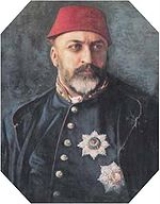
Abdülâziz

Encyclopedia
Abdülaziz I or Abd Al-Aziz, His Imperial Majesty (Ottoman Turkish
: `Abdü´l-Âzīz-i evvel عبد العزيز) (February 9/18 1830 – 4 June 1876) was the 32nd Sultan
of the Ottoman Empire
and reigned between 25 June 1861 and 30 May 1876. He was the son of Sultan Mahmud II
and succeeded his brother Abdülmecid I
in 1861.
Born at the Eyüp Palace
, Constantinople/(Istanbul
), on 9/18 February 1830, Abdülaziz received an Ottoman education but was nevertheless an ardent admirer of the material progress that was made in the West. He was interested in literature and was also a classical music composer. Some of his compositions have been collected in the album "European Music at the Ottoman Court" by the London Academy of Ottoman Court Music.
and Valide Sultan
Pertevniyal ("Partav-Nihal"). (1812–1883), originally named Bezime, a Vlach. He was a quarter French. In 1868 Pertevniyal was living in the Dolmabahçe Palace
. That year Abdülaziz led the visiting Eugénie de Montijo
, Empress of France, to see his mother. Pertevniyal perceived the presence of a foreign woman within her quarters of the seraglio
as an insult. She reportedly slap
ped Eugénie across the face, almost resulting in an international incident. The Pertevniyal Valide Sultan Mosque
was built under the patronage of his mother. The construction work began in November 1869 and the mosque was finished in 1871.
His paternal grandparents were Sultan Abdul Hamid I and Sultana Naksh-i-Dil Haseki
. Several accounts identify his paternal grandmother with Aimée du Buc de Rivéry
, a cousin of Joséphine de Beauharnais
. Pertevniyal was a sister of Hoshiar (Khushiyar), third wife of Ibrahim Pasha of Egypt
. Hoshiar and Ibrahim were the parents of Isma'il Pasha
.
 Between 1861 and 1871, the Tanzimat
reforms which began during the reign of his brother Abdülmecid I
were continued under the leadership of his chief ministers, Keçecizade Mehmet Fuat Pasha
and Mehmed Emin Aali Pasha
. New administrative districts (vilayets) were set up in 1864 and a Council of State
was established in 1868. Public education was organized on the French model
and Istanbul University
was reorganized as a modern institution in 1861.
Abdülaziz cultivated good relations with the Second French Empire
and the British
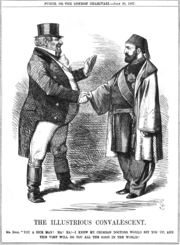
. In 1867 he was the first Ottoman sultan to visit Western Europe
; his trip included a visit to the United Kingdom, where he was made a Knight of the Garter by Queen Victoria
and shown a Royal Navy Fleet Review with Ismail of Egypt. He travelled by a private rail car, which today can be found in the Rahmi M. Koç Museum in Istanbul. His fellow Knights of the Garter created in 1867 were Charles Gordon-Lennox, 6th Duke of Richmond
, Charles Manners, 6th Duke of Rutland
, Henry Somerset, 8th Duke of Beaufort
, Prince Arthur, Duke of Connaught and Strathearn
, Franz Joseph I of Austria
and Alexander II of Russia
.
In 1869, Abdülaziz received visits from Eugénie de Montijo
, Empress consort of Napoleon III of France
and other foreign monarchs on their way to the opening of the Suez Canal
. The Prince of Wales
, the future Edward VII of the United Kingdom
, twice visited Constantinople.
By 1871 both ʿAlī Pasha and Fuʿād Pasha were dead. The Second French Empire, his Western European model, had been defeated in the Franco-Prussian War
by the North German Confederation
under the leadership of the Kingdom of Prussia
. In foreign policy, Abdülaziz turned to the Russian Empire
for friendship, as turmoil in the Balkan provinces continued. In 1875, the Herzegovinian rebellion
was the beginning of further unrest in the Balkan provinces. In 1876, the April Uprising
saw insurrection spreading among the Bulgarians
. Ill feeling mounted against Russia for its encouragement of the rebellions.
The crop failure of 1873, the sultan's lavish expenditures for the Ottoman Navy
and the new palaces which he built, and the mounting public debt heightened public discontent. Abdülaziz was deposed by his ministers on 30 May 1876; his death at Feriye Palace
in Constantinople a few days later was attributed to suicide at the time, although in Sultan Abdulhamid II
's recently surfaced memoirs, the event is described as an assassination by the order of Hussein Avni Pasha
and Midhat Pasha. When Sultan Murad V
began to show signs of paranoia, madness and continuous fainting and vomiting even on the day of his coronation and threw himself to a pool yelling at his guards to protect his life, they were afraid the public would become outraged and revolt to bring the former Sultan back, so in a few days, on 4 June 1876, they arranged for Sultan Abdülaziz to kill himself with a scissors, cutting his two wrists at the same time. It was unclear how the Sultan got hold of a scissors in the tower prison cell he was imprisoned in, how he managed to cut two wrists at once since no autopsy was allowed afterwards. The event was recorded as suicide officially and he was buried in Istanbul.
He established the first Ottoman railroad network and Sirkeci Train Station in Constantinople, terminus of the Orient Express
.
Impressed by the museums in London, Paris and Vienna, he established the Istanbul Archaeology Museum
.
Under Abdülaziz's reign, Turkey's first postage stamps were issued in 1863, and Turkey joined the Universal Postal Union
in 1875 as a founding member.
He was made the 756th Knight
of the Order of the Garter
in 1867 and the 127th Grand Cross
of the Order of the Tower and Sword
.
 Ten children survived him.
He married firstly at the Dolmabahçe Palace
in Constantinople in 1856 to Georgian
HH Dürrünev Kadın Efendi (Batumi
, 15 March 1835 - Constantinople, Üsküdar
, Çamlıca Palace, 3 December 1892), and had three children.
He married secondly at the Dolmabahçe Palace in 1861 to HH Edâdil Kadın Efendi (1845 - Dolmabahçe Palace, 12 December 1875), and had one child.
He married thirdly in 1872 to Circassian HH Gevherin Nedaxe Kadın Efendi (Caucasus
, 8 July 1856 - Ortaköy Palace, Ortaköy
, Constantinople, 20 September 1894), and had one child.
He married fourthly at the Dolmabahçe Palace
, Constantinople, on 21 September 1866 to Georgian HH Hayranidil Kadın Efendi (Kars
, 2 November 1846 - Ortaköy Palace, Constantinople, 26 November 1898), and had two children.
He married fifthly at the Dolmabahçe Palace, in 1868 to Georgian HH Nesherek (Nesrin) Haseki Kadın Efendi (Tbilisi
, (1848 - 11 June 1876)Ortaköy Palace, Istanbul), and had three children.
He married sixthly to Yıldız (Gözde), sister of HH Safinaz Kadın Efendi, a wife of Sultan
Abdul Hamid II
, and had two children.
Ottoman Turkish language
The Ottoman Turkish language or Ottoman language is the variety of the Turkish language that was used for administrative and literary purposes in the Ottoman Empire. It borrows extensively from Arabic and Persian, and was written in a variant of the Perso-Arabic script...
: `Abdü´l-Âzīz-i evvel عبد العزيز) (February 9/18 1830 – 4 June 1876) was the 32nd Sultan
Sultan
Sultan is a title with several historical meanings. Originally, it was an Arabic language abstract noun meaning "strength", "authority", "rulership", and "dictatorship", derived from the masdar سلطة , meaning "authority" or "power". Later, it came to be used as the title of certain rulers who...
of the Ottoman Empire
Ottoman Empire
The Ottoman EmpireIt was usually referred to as the "Ottoman Empire", the "Turkish Empire", the "Ottoman Caliphate" or more commonly "Turkey" by its contemporaries...
and reigned between 25 June 1861 and 30 May 1876. He was the son of Sultan Mahmud II
Mahmud II
Mahmud II was the 30th Sultan of the Ottoman Empire from 1808 until his death in 1839. He was born in the Topkapi Palace, Istanbul, the son of Sultan Abdulhamid I...
and succeeded his brother Abdülmecid I
Abdülmecid I
Sultan Abdülmecid I, Abdul Mejid I, Abd-ul-Mejid I or Abd Al-Majid I Ghazi was the 31st Sultan of the Ottoman Empire and succeeded his father Mahmud II on July 2, 1839. His reign was notable for the rise of nationalist movements within the empire's territories...
in 1861.
Born at the Eyüp Palace
Eyüp
-External links:* * * * *...
, Constantinople/(Istanbul
Istanbul
Istanbul , historically known as Byzantium and Constantinople , is the largest city of Turkey. Istanbul metropolitan province had 13.26 million people living in it as of December, 2010, which is 18% of Turkey's population and the 3rd largest metropolitan area in Europe after London and...
), on 9/18 February 1830, Abdülaziz received an Ottoman education but was nevertheless an ardent admirer of the material progress that was made in the West. He was interested in literature and was also a classical music composer. Some of his compositions have been collected in the album "European Music at the Ottoman Court" by the London Academy of Ottoman Court Music.
Family
His parents were Mahmud IIMahmud II
Mahmud II was the 30th Sultan of the Ottoman Empire from 1808 until his death in 1839. He was born in the Topkapi Palace, Istanbul, the son of Sultan Abdulhamid I...
and Valide Sultan
Valide Sultan
Valide Sultan was the title held by the mother of a ruling Sultan in the Ottoman Empire. The Turkish pronunciation of the word Valide is . The title is sometimes translated as Queen Mother, although the position of Valide Sultan was quite different.The position was perhaps the most important...
Pertevniyal ("Partav-Nihal"). (1812–1883), originally named Bezime, a Vlach. He was a quarter French. In 1868 Pertevniyal was living in the Dolmabahçe Palace
Dolmabahçe Palace
Dolmabahçe Palace located in the Beşiktaş district of Istanbul, Turkey, on the European coastline of the Bosphorus strait, served as the main administrative center of the Ottoman Empire from 1856 to 1922, apart from a 22-year interval in which Yıldız Palace was used.- History :Dolmabahçe Palace...
. That year Abdülaziz led the visiting Eugénie de Montijo
Eugénie de Montijo
Doña María Eugenia Ignacia Augustina de Palafox-Portocarrero de Guzmán y Kirkpatrick, 16th Countess of Teba and 15th Marquise of Ardales; 5 May 1826 – 11 July 1920), known as Eugénie de Montijo , was the last Empress consort of the French from 1853 to 1871 as the wife of Napoleon III, Emperor of...
, Empress of France, to see his mother. Pertevniyal perceived the presence of a foreign woman within her quarters of the seraglio
Seraglio
A seraglio or serail is the sequestered living quarters used by wives and concubines in a Turkish household. The word comes from an Italian variant of Turkish saray, from Persian sarai , meaning palace, or the enclosed courts for the wives and concubines of the harem of a house or palace...
as an insult. She reportedly slap
Slap
A slap or "smack" is a broad stroke made with the open hand or the back of the hand, as opposed to a punch that is made with a closed fist. Slaps are frequently made across the face, but can be also made across hands or any other body part, and can use either the palm of the hand or the back of the...
ped Eugénie across the face, almost resulting in an international incident. The Pertevniyal Valide Sultan Mosque
Pertevniyal Valide Sultan Mosque
-External links:*...
was built under the patronage of his mother. The construction work began in November 1869 and the mosque was finished in 1871.
His paternal grandparents were Sultan Abdul Hamid I and Sultana Naksh-i-Dil Haseki
Aimée du Buc de Rivéry
Aimée du Buc de Rivéry was a French heiress, a cousin of Empress Josephine, who went missing at sea at the age of eleven...
. Several accounts identify his paternal grandmother with Aimée du Buc de Rivéry
Aimée du Buc de Rivéry
Aimée du Buc de Rivéry was a French heiress, a cousin of Empress Josephine, who went missing at sea at the age of eleven...
, a cousin of Joséphine de Beauharnais
Joséphine de Beauharnais
Joséphine de Beauharnais was the first wife of Napoléon Bonaparte, and thus the first Empress of the French. Her first husband Alexandre de Beauharnais had been guillotined during the Reign of Terror, and she had been imprisoned in the Carmes prison until her release five days after Alexandre's...
. Pertevniyal was a sister of Hoshiar (Khushiyar), third wife of Ibrahim Pasha of Egypt
Ibrahim Pasha of Egypt
Ibrahim Pasha was the eldest son of Muhammad Ali, the Wāli and unrecognised Khedive of Egypt and Sudan. He served as a general in the Egyptian army that his father established during his reign, taking his first command of Egyptian forces was when he was merely a teenager...
. Hoshiar and Ibrahim were the parents of Isma'il Pasha
Isma'il Pasha
Isma'il Pasha , known as Ismail the Magnificent , was the Khedive of Egypt and Sudan from 1863 to 1879, when he was removed at the behest of the United Kingdom...
.
Reign
Tanzimat
The Tanzimât , meaning reorganization of the Ottoman Empire, was a period of reformation that began in 1839 and ended with the First Constitutional Era in 1876. The Tanzimât reform era was characterized by various attempts to modernize the Ottoman Empire, to secure its territorial integrity against...
reforms which began during the reign of his brother Abdülmecid I
Abdülmecid I
Sultan Abdülmecid I, Abdul Mejid I, Abd-ul-Mejid I or Abd Al-Majid I Ghazi was the 31st Sultan of the Ottoman Empire and succeeded his father Mahmud II on July 2, 1839. His reign was notable for the rise of nationalist movements within the empire's territories...
were continued under the leadership of his chief ministers, Keçecizade Mehmet Fuat Pasha
Keçecizade Mehmet Fuat Pasha
Mehmed Fuad Pasha was an Ottoman statesman known for his leadership during the Crimean War and in the Tanzimat reforms within the Ottoman Empire. He was also a noted Freemason.- Career :...
and Mehmed Emin Aali Pasha
Mehmed Emin Aali Pasha
Mehmed Emin Âli Paşa , , was an Ottoman statesman....
. New administrative districts (vilayets) were set up in 1864 and a Council of State
Council of State
The Council of State is a unique governmental body in a country or subdivision thereoff, though its nature may range from the formal name for the cabinet to a non-executive advisory body surrounding a head of state. It is sometimes regarded as the equivalent of a privy council.-Modern:*Belgian...
was established in 1868. Public education was organized on the French model
Education in France
The French educational system is highly centralized, organized, and ramified. It is divided into three different stages:* the primary education ;* secondary education ;...
and Istanbul University
Istanbul University
Istanbul University is a Turkish university located in Istanbul. The main campus is adjacent to Beyazıt Square.- Synopsis :A madrasa, a religious school, was established sometime in the 15th century after the Ottoman conquest of Constantinople. An institution of higher education named the...
was reorganized as a modern institution in 1861.
Abdülaziz cultivated good relations with the Second French Empire
Second French Empire
The Second French Empire or French Empire was the Imperial Bonapartist regime of Napoleon III from 1852 to 1870, between the Second Republic and the Third Republic, in France.-Rule of Napoleon III:...
and the British
United Kingdom of Great Britain and Ireland
The United Kingdom of Great Britain and Ireland was the formal name of the United Kingdom during the period when what is now the Republic of Ireland formed a part of it....
. In 1867 he was the first Ottoman sultan to visit Western Europe
Western Europe
Western Europe is a loose term for the collection of countries in the western most region of the European continents, though this definition is context-dependent and carries cultural and political connotations. One definition describes Western Europe as a geographic entity—the region lying in the...
; his trip included a visit to the United Kingdom, where he was made a Knight of the Garter by Queen Victoria
Victoria of the United Kingdom
Victoria was the monarch of the United Kingdom of Great Britain and Ireland from 20 June 1837 until her death. From 1 May 1876, she used the additional title of Empress of India....
and shown a Royal Navy Fleet Review with Ismail of Egypt. He travelled by a private rail car, which today can be found in the Rahmi M. Koç Museum in Istanbul. His fellow Knights of the Garter created in 1867 were Charles Gordon-Lennox, 6th Duke of Richmond
Charles Gordon-Lennox, 6th Duke of Richmond
Charles Henry Gordon-Lennox, 6th Duke of Richmond, 6th Duke of Lennox, and 1st Duke of Gordon KG PC , styled Lord Settrington until 1819 and Earl of March between 1819 and 1860, was a British Conservative politician.-Background and education:Born at Richmond House, London, he was the son of Charles...
, Charles Manners, 6th Duke of Rutland
Charles Manners, 6th Duke of Rutland
Charles Manners, 6th Duke of Rutland KG , styled Marquess of Granby before 1857, was an English Conservative politician.-Background and education:...
, Henry Somerset, 8th Duke of Beaufort
Henry Somerset, 8th Duke of Beaufort
Captain Henry Charles FitzRoy Somerset, 8th Duke of Beaufort KG, PC, DL , styled Earl of Glamorgan until 1835 and Marquess of Worcester from 1835 to 1853, was a British peer, soldier and Conservative politician...
, Prince Arthur, Duke of Connaught and Strathearn
Prince Arthur, Duke of Connaught and Strathearn
Prince Arthur, Duke of Connaught and Strathearn was a member of the shared British and Saxe-Coburg and Gotha royal family who served as the Governor General of Canada, the 10th since Canadian Confederation.Born the seventh child and third son of Queen Victoria and Prince Albert of Saxe-Coburg and...
, Franz Joseph I of Austria
Franz Joseph I of Austria
Franz Joseph I or Francis Joseph I was Emperor of Austria, King of Bohemia, King of Croatia, Apostolic King of Hungary, King of Galicia and Lodomeria and Grand Duke of Cracow from 1848 until his death in 1916.In the December of 1848, Emperor Ferdinand I of Austria abdicated the throne as part of...
and Alexander II of Russia
Alexander II of Russia
Alexander II , also known as Alexander the Liberator was the Emperor of the Russian Empire from 3 March 1855 until his assassination in 1881...
.
In 1869, Abdülaziz received visits from Eugénie de Montijo
Eugénie de Montijo
Doña María Eugenia Ignacia Augustina de Palafox-Portocarrero de Guzmán y Kirkpatrick, 16th Countess of Teba and 15th Marquise of Ardales; 5 May 1826 – 11 July 1920), known as Eugénie de Montijo , was the last Empress consort of the French from 1853 to 1871 as the wife of Napoleon III, Emperor of...
, Empress consort of Napoleon III of France
Napoleon III of France
Louis-Napoléon Bonaparte was the President of the French Second Republic and as Napoleon III, the ruler of the Second French Empire. He was the nephew and heir of Napoleon I, christened as Charles Louis Napoléon Bonaparte...
and other foreign monarchs on their way to the opening of the Suez Canal
Suez Canal
The Suez Canal , also known by the nickname "The Highway to India", is an artificial sea-level waterway in Egypt, connecting the Mediterranean Sea and the Red Sea. Opened in November 1869 after 10 years of construction work, it allows water transportation between Europe and Asia without navigation...
. The Prince of Wales
Prince of Wales
Prince of Wales is a title traditionally granted to the heir apparent to the reigning monarch of the United Kingdom of Great Britain and Northern Ireland and the 15 other independent Commonwealth realms...
, the future Edward VII of the United Kingdom
Edward VII of the United Kingdom
Edward VII was King of the United Kingdom and the British Dominions and Emperor of India from 22 January 1901 until his death in 1910...
, twice visited Constantinople.
By 1871 both ʿAlī Pasha and Fuʿād Pasha were dead. The Second French Empire, his Western European model, had been defeated in the Franco-Prussian War
Franco-Prussian War
The Franco-Prussian War or Franco-German War, often referred to in France as the 1870 War was a conflict between the Second French Empire and the Kingdom of Prussia. Prussia was aided by the North German Confederation, of which it was a member, and the South German states of Baden, Württemberg and...
by the North German Confederation
North German Confederation
The North German Confederation 1866–71, was a federation of 22 independent states of northern Germany. It was formed by a constitution accepted by the member states in 1867 and controlled military and foreign policy. It included the new Reichstag, a parliament elected by universal manhood...
under the leadership of the Kingdom of Prussia
Kingdom of Prussia
The Kingdom of Prussia was a German kingdom from 1701 to 1918. Until the defeat of Germany in World War I, it comprised almost two-thirds of the area of the German Empire...
. In foreign policy, Abdülaziz turned to the Russian Empire
Russian Empire
The Russian Empire was a state that existed from 1721 until the Russian Revolution of 1917. It was the successor to the Tsardom of Russia and the predecessor of the Soviet Union...
for friendship, as turmoil in the Balkan provinces continued. In 1875, the Herzegovinian rebellion
Herzegovinian rebellion
The Herzegovina Uprising of 1875-1878 was an uprising led by Christians, firstly in Herzegovina and then in Bosnia. It is the most significant of the rebellions against Ottoman rule in Herzegovina...
was the beginning of further unrest in the Balkan provinces. In 1876, the April Uprising
April Uprising
The April Uprising was an insurrection organised by the Bulgarians in the Ottoman Empire from April to May 1876, which indirectly resulted in the re-establishment of Bulgaria as an autonomous nation in 1878...
saw insurrection spreading among the Bulgarians
Bulgarians
The Bulgarians are a South Slavic nation and ethnic group native to Bulgaria and neighbouring regions. Emigration has resulted in immigrant communities in a number of other countries.-History and ethnogenesis:...
. Ill feeling mounted against Russia for its encouragement of the rebellions.
The crop failure of 1873, the sultan's lavish expenditures for the Ottoman Navy
Ottoman Navy
The Ottoman Navy was established in the early 14th century. During its long existence it was involved in many conflicts; refer to list of Ottoman sieges and landings and list of Admirals in the Ottoman Empire for a brief chronology.- Pre-Ottoman:...
and the new palaces which he built, and the mounting public debt heightened public discontent. Abdülaziz was deposed by his ministers on 30 May 1876; his death at Feriye Palace
Galatasaray University
Galatasaray University or Université Galatasaray is a Turkish university established in İstanbul, Turkey in 1992, following an agreement signed with the presence of President François Mitterrand of France and President Turgut Özal of Turkey during a ceremony at Galatasaray High School, the mother...
in Constantinople a few days later was attributed to suicide at the time, although in Sultan Abdulhamid II
Abdul Hamid II
His Imperial Majesty, The Sultan Abdülhamid II, Emperor of the Ottomans, Caliph of the Faithful was the 34th sultan of the Ottoman Empire...
's recently surfaced memoirs, the event is described as an assassination by the order of Hussein Avni Pasha
Hussein Avni Pasha
Hussein Avni Pasha was an Ottoman statesman. He was Grand Vizier of the Ottoman Empire from 15 February 1874 until 26 April 1875.- References :...
and Midhat Pasha. When Sultan Murad V
Murad V
Murad V was the 33rd Sultan of the Ottoman Empire who reigned from 30 May to 31 August 1876.He was born at Istanbul , Topkapı Palace. His father was Abdülmecid I...
began to show signs of paranoia, madness and continuous fainting and vomiting even on the day of his coronation and threw himself to a pool yelling at his guards to protect his life, they were afraid the public would become outraged and revolt to bring the former Sultan back, so in a few days, on 4 June 1876, they arranged for Sultan Abdülaziz to kill himself with a scissors, cutting his two wrists at the same time. It was unclear how the Sultan got hold of a scissors in the tower prison cell he was imprisoned in, how he managed to cut two wrists at once since no autopsy was allowed afterwards. The event was recorded as suicide officially and he was buried in Istanbul.
Achievements
The biggest achievement of Abdülaziz was to modernize the Ottoman Navy. In 1875, the Navy had 21 battleships and 173 warships of other types, ranking as the third largest navy in the world after the British and French navies.He established the first Ottoman railroad network and Sirkeci Train Station in Constantinople, terminus of the Orient Express
Orient Express
The Orient Express is the name of a long-distance passenger train service originally operated by the Compagnie Internationale des Wagons-Lits. It ran from 1883 to 2009 and is not to be confused with the Venice-Simplon Orient Express train service, which continues to run.The route and rolling stock...
.
Impressed by the museums in London, Paris and Vienna, he established the Istanbul Archaeology Museum
Istanbul Archaeology Museum
The Istanbul Archaeology Museums is a group of three archeological museums located in the Eminönü district of Istanbul, Turkey, near Gülhane Park and Topkapı Palace.The Istanbul Archaeology Museums consists of three museums....
.
Under Abdülaziz's reign, Turkey's first postage stamps were issued in 1863, and Turkey joined the Universal Postal Union
Universal Postal Union
The Universal Postal Union is an international organization that coordinates postal policies among member nations, in addition to the worldwide postal system. The UPU contains four bodies consisting of the Congress, the Council of Administration , the Postal Operations Council and the...
in 1875 as a founding member.
He was made the 756th Knight
Knight
A knight was a member of a class of lower nobility in the High Middle Ages.By the Late Middle Ages, the rank had become associated with the ideals of chivalry, a code of conduct for the perfect courtly Christian warrior....
of the Order of the Garter
Order of the Garter
The Most Noble Order of the Garter, founded in 1348, is the highest order of chivalry, or knighthood, existing in England. The order is dedicated to the image and arms of St...
in 1867 and the 127th Grand Cross
Grand Cross
The phrase Grand Cross is used to denote the highest grade in many orders of knighthood. Sometimes the holders of the highest grade are referred to "knights grand cross" or just "grand crosses"; in other cases the actual insignia itself is called "the grand cross".Alternatively, in some other...
of the Order of the Tower and Sword
Order of the Tower and Sword
The Military Order of the Tower and of the Sword, of Valour, Loyalty and Merit is a Portuguese order of knighthood and the pinnacle of the Portuguese honours system. It was created by King Afonso V in 1459....
.
Marriages and issue
He married firstly at the Dolmabahçe Palace
Dolmabahçe Palace
Dolmabahçe Palace located in the Beşiktaş district of Istanbul, Turkey, on the European coastline of the Bosphorus strait, served as the main administrative center of the Ottoman Empire from 1856 to 1922, apart from a 22-year interval in which Yıldız Palace was used.- History :Dolmabahçe Palace...
in Constantinople in 1856 to Georgian
Georgians
The Georgians are an ethnic group that have originated in Georgia, where they constitute a majority of the population. Large Georgian communities are also present throughout Russia, European Union, United States, and South America....
HH Dürrünev Kadın Efendi (Batumi
Batumi
Batumi is a seaside city on the Black Sea coast and capital of Adjara, an autonomous republic in southwest Georgia. Sometimes considered Georgia's second capital, with a population of 121,806 , Batumi serves as an important port and a commercial center. It is situated in a subtropical zone, rich in...
, 15 March 1835 - Constantinople, Üsküdar
Üsküdar
Üsküdar is a large and densely populated municipality of Istanbul, Turkey, on the Anatolian shore of the Bosphorus. It is bordered on the north by Beykoz, on the east by Ümraniye, on the southeast by Ataşehir, on the south by Kadıköy, and on the west by the Bosphorus, with the areas of Beşiktaş,...
, Çamlıca Palace, 3 December 1892), and had three children.
He married secondly at the Dolmabahçe Palace in 1861 to HH Edâdil Kadın Efendi (1845 - Dolmabahçe Palace, 12 December 1875), and had one child.
He married thirdly in 1872 to Circassian HH Gevherin Nedaxe Kadın Efendi (Caucasus
Caucasus
The Caucasus, also Caucas or Caucasia , is a geopolitical region at the border of Europe and Asia, and situated between the Black and the Caspian sea...
, 8 July 1856 - Ortaköy Palace, Ortaköy
Ortaköy
Ortaköy is a neighbourhood, formerly a small village, within the Beşiktaş district of Istanbul, Turkey, located in the middle of the European bank of the Bosphorus....
, Constantinople, 20 September 1894), and had one child.
He married fourthly at the Dolmabahçe Palace
Dolmabahçe Palace
Dolmabahçe Palace located in the Beşiktaş district of Istanbul, Turkey, on the European coastline of the Bosphorus strait, served as the main administrative center of the Ottoman Empire from 1856 to 1922, apart from a 22-year interval in which Yıldız Palace was used.- History :Dolmabahçe Palace...
, Constantinople, on 21 September 1866 to Georgian HH Hayranidil Kadın Efendi (Kars
Kars
Kars is a city in northeast Turkey and the capital of Kars Province. The population of the city is 73,826 as of 2010.-Etymology:As Chorzene, the town appears in Roman historiography as part of ancient Armenia...
, 2 November 1846 - Ortaköy Palace, Constantinople, 26 November 1898), and had two children.
He married fifthly at the Dolmabahçe Palace, in 1868 to Georgian HH Nesherek (Nesrin) Haseki Kadın Efendi (Tbilisi
Tbilisi
Tbilisi is the capital and the largest city of Georgia, lying on the banks of the Mt'k'vari River. The name is derived from an early Georgian form T'pilisi and it was officially known as Tiflis until 1936...
, (1848 - 11 June 1876)Ortaköy Palace, Istanbul), and had three children.
He married sixthly to Yıldız (Gözde), sister of HH Safinaz Kadın Efendi, a wife of Sultan
Sultan
Sultan is a title with several historical meanings. Originally, it was an Arabic language abstract noun meaning "strength", "authority", "rulership", and "dictatorship", derived from the masdar سلطة , meaning "authority" or "power". Later, it came to be used as the title of certain rulers who...
Abdul Hamid II
Abdul Hamid II
His Imperial Majesty, The Sultan Abdülhamid II, Emperor of the Ottomans, Caliph of the Faithful was the 34th sultan of the Ottoman Empire...
, and had two children.