


2008 United States salmonellosis outbreak

Encyclopedia
United States
The United States of America is a federal constitutional republic comprising fifty states and a federal district...
fell ill after consuming contaminated food. The U.S. Food and Drug Administration currently believes that the contaminated food products responsible are fresh jalapeño
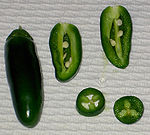
Jalapeño
The jalapeño is a medium-sized chili pepper that has a warm, burning sensation when eaten. A mature jalapeño fruit is 2–3½ inches long and is commonly picked and consumed while still green, but occasionally it is allowed to fully ripen and turn crimson red...
and serrano
Serrano pepper
The serrano pepper is a type of chili pepper that originated in the mountainous regions of the Mexican states of Puebla and Hidalgo. The name of the pepper is a reference to the mountains of these regions....
peppers from Mexico
Mexico
The United Mexican States , commonly known as Mexico , is a federal constitutional republic in North America. It is bordered on the north by the United States; on the south and west by the Pacific Ocean; on the southeast by Guatemala, Belize, and the Caribbean Sea; and on the east by the Gulf of...
, and perhaps raw tomato
Tomato
The word "tomato" may refer to the plant or the edible, typically red, fruit which it bears. Originating in South America, the tomato was spread around the world following the Spanish colonization of the Americas, and its many varieties are now widely grown, often in greenhouses in cooler...
es. Fresh cilantro
Coriander
Coriander is an annual herb in the family Apiaceae. Coriander is native to southern Europe and North Africa to southwestern Asia. It is a soft, hairless plant growing to tall. The leaves are variable in shape, broadly lobed at the base of the plant, and slender and feathery higher on the...
is also under investigation. The FDA and the Centers for Disease Control and Prevention
Centers for Disease Control and Prevention
The Centers for Disease Control and Prevention are a United States federal agency under the Department of Health and Human Services headquartered in Druid Hills, unincorporated DeKalb County, Georgia, in Greater Atlanta...
narrowed their investigation to certain farms in Mexico that they believed were responsible for the contaminated produce.
Salmonellosis
From April 10 to July 31, 2008, the rare Saintpaul serotype of Salmonella entericaSalmonella enterica
Salmonella enterica is a rod-shaped flagellated, facultative anaerobic, Gram-negative bacterium, and a member of the genus Salmonella.- Epidemiology :...
caused at least 1329 cases of salmonellosis
Salmonellosis
Salmonellosis is an infection with Salmonella bacteria. Most people infected with Salmonella develop diarrhea, fever, vomiting, and abdominal cramps 12 to 72 hours after infection. In most cases, the illness lasts four to seven days, and most people recover without treatment...
food poisoning in 43 states throughout the United States and in the District of Columbia. It was the largest reported salmonellosis outbreak in the United States since 1985. New Mexico
New Mexico
New Mexico is a state located in the southwest and western regions of the United States. New Mexico is also usually considered one of the Mountain States. With a population density of 16 per square mile, New Mexico is the sixth-most sparsely inhabited U.S...
and Texas
Texas
Texas is the second largest U.S. state by both area and population, and the largest state by area in the contiguous United States.The name, based on the Caddo word "Tejas" meaning "friends" or "allies", was applied by the Spanish to the Caddo themselves and to the region of their settlement in...
were proportionally the hardest hit, with 56.9 and 21.3 reported cases per million, respectively. The greatest number of reported cases have occurred in Texas (508 reported cases), New Mexico (112), Illinois
Illinois
Illinois is the fifth-most populous state of the United States of America, and is often noted for being a microcosm of the entire country. With Chicago in the northeast, small industrial cities and great agricultural productivity in central and northern Illinois, and natural resources like coal,...
(116), and Arizona
Arizona
Arizona ; is a state located in the southwestern region of the United States. It is also part of the western United States and the mountain west. The capital and largest city is Phoenix...
(57). Some other significantly impacted states include Maryland
Maryland
Maryland is a U.S. state located in the Mid Atlantic region of the United States, bordering Virginia, West Virginia, and the District of Columbia to its south and west; Pennsylvania to its north; and Delaware to its east...
, Oklahoma
Oklahoma
Oklahoma is a state located in the South Central region of the United States of America. With an estimated 3,751,351 residents as of the 2010 census and a land area of 68,667 square miles , Oklahoma is the 28th most populous and 20th-largest state...
, Kansas
Kansas
Kansas is a US state located in the Midwestern United States. It is named after the Kansas River which flows through it, which in turn was named after the Kansa Native American tribe, which inhabited the area. The tribe's name is often said to mean "people of the wind" or "people of the south...
, Arkansas
Arkansas
Arkansas is a state located in the southern region of the United States. Its name is an Algonquian name of the Quapaw Indians. Arkansas shares borders with six states , and its eastern border is largely defined by the Mississippi River...
, and Nevada
Nevada
Nevada is a state in the western, mountain west, and southwestern regions of the United States. With an area of and a population of about 2.7 million, it is the 7th-largest and 35th-most populous state. Over two-thirds of Nevada's people live in the Las Vegas metropolitan area, which contains its...
which have been collectively affected by 118 reported cases. All of the above-mentioned states suffered more than five reported cases per million. Additionally, five cases were reported in residents of Canada
Canada
Canada is a North American country consisting of ten provinces and three territories. Located in the northern part of the continent, it extends from the Atlantic Ocean in the east to the Pacific Ocean in the west, and northward into the Arctic Ocean...
, four of whom appeared to have been infected after traveling to the United States.
There were at least 257 reported hospitalizations linked to the outbreak, leading to at least one death, and the outbreak may have been a contributing factor in at least one additional death. The CDC
Centers for Disease Control and Prevention
The Centers for Disease Control and Prevention are a United States federal agency under the Department of Health and Human Services headquartered in Druid Hills, unincorporated DeKalb County, Georgia, in Greater Atlanta...
maintains that "it is likely many more illnesses have occurred than those reported." If applying a previous CDC estimated ratio of non-reported salmonellosis cases to reported cases (38.6:1), one would arrive at an estimated 52,826 illnesses from this outbreak, and 173 estimated cases per million throughout the United States.
Type of contaminated food
Food Safety Network
The International Food Safety Network at Kansas State University imparts the opportunity of improving the overall safety of the food supply by connecting all those in the agriculture and food industry....
, possible suspects aside from tomatoes include salsa, jalapeño peppers, green onions
Scallion
Scallions , are the edible plants of various Allium species, all of which are "onion-like", having hollow green leaves and lacking a fully developed root bulb.-Etymology:The words...
, and cilantro.
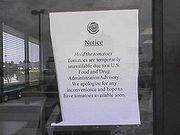
Throughout the end of June and beginning of July, the FDA has been changing its position regarding the source or sources of the Salmonella. It first admitted the possibility that foods "commonly consumed with tomatoes" might be possible suspects in the outbreak, though it declined to elaborate with specifics. Days later, it commented on specific suspects aside from fresh tomatoes: fresh serrano peppers, fresh cilantro, fresh bulb onions, fresh scallions, and fresh jalapeño peppers. The FDA still maintained, however, that tomatoes were the prime suspect. A couple of days later, the FDA began to focus on jalapeño peppers above other non-tomato suspects. Most recently, the FDA has disclosed that jalapeño peppers are now the main suspects in the outbreak, and that "the accumulated data from all investigations indicate that jalapeño peppers caused some illnesses but that they do not explain all illnesses." It has narrowed its list of suspects to fresh jalapeño peppers, raw tomatoes, fresh serrano peppers, and fresh cilantro. The FDA now maintains with confidence that tomatoes are not responsible for at least some of the illnesses. The CDC has stated that some illness clusters involved people who were certain that they ate foods with jalapeño peppers but not tomatoes, and other clusters were vice-versa. The CDC considers it most likely that contaminated tomatoes, jalapeños, and serrano peppers have all been responsible for the outbreak.
According to the FDA, types of tomatoes likely affected with Salmonella include red plum
Plum tomato
A plum tomato, also known as a processing tomato or paste tomato, is a type of tomato bred for sauce and packing purposes. They are generally oval or cylindrical in shape, with significantly fewer seed compartments than standard round tomatoes and a generally higher solid content, making them more...
, red Roma
Roma Tomato
Roma tomato or Roma is a plum tomato which is commonly found in supermarkets. The tomato is a meaty, egg- or pear-shaped tomato that is available in red and yellow. It has few seeds and is a good canning and sauce tomato...
, and round red tomatoes. The FDA writes that "types of tomatoes not linked to any illnesses are cherry tomato
Cherry tomato
A cherry tomato is a small variety of tomato that has been cultivated since at least the early 1800s and thought to have originated in Peru and Northern Chile. Cherry tomatoes range in size from a thumbtip up to the size of a golf ball, and can range from being spherical to slightly oblong in shape...
es, grape tomato
Grape tomato
A grape tomato is a class of tomatoes believed to be of southeast Asian origin, shaped similarly to the oval plum tomatoes but having the small size and sweetness of cherry tomatoes. Grape tomatoes produce small and typically oblong fruits...
es, and tomatoes with the vine still attached," and the CDC agrees that these types of tomatoes are "not the likely source of this outbreak." The FDA website provides a list of areas from which it has deemed tomato farms not to be the source of the outbreak.
On July 18, 2008, the FDA lifted its warnings regarding tomato consumption, given that hardly any tomatoes from winter crops are still in circulation. On July 21, after discovering a single contaminated pepper in a load imported from Mexico, the FDA recommended that consumers throughout the United States avoid eating any fresh jalapeño peppers, regardless of the source. On July 25, the FDA announced that American grown peppers are not considered a risk to consumers. On July 30, the after tracing the outbreak strain to a Mexican farm, the FDA revised its recommendations again and warned all consumers to avoid jalapeño and serrano peppers from Mexico. People who would be in the most danger if infected with Salmonella (infants, the elderly, and those with compromised immune systems), should be especially careful to avoid eating fresh jalapeño and serrano peppers from Mexico.
Source of the contamination
As of July 31, 2008, the CDC has sent 39 people into the field to work with other health officials in investigating the outbreak. The exact sources of the contaminated food are not yet known. The time frame of the outbreak had led the FDA to suspect that a source or sources of the outbreak may be among tomato farms producing winter crops in either of the following areas:- Parts of Mexico, such as the State of SinaloaSinaloaSinaloa officially Estado Libre y Soberano de Sinaloa is one of the 31 states which, with the Federal District, comprise the 32 Federal Entities of Mexico. It is divided in 18 municipalities and its capital city is Culiacán Rosales....
, which exports over 300 million pounds of winter tomatoes to the U.S. via the Arizona border. Tomatoes from Sinaloa enter the U.S. through the hardest hit region of the southwest, which has suffered over half of the total reported cases in the outbreak. By contrast, tomatoes from Baja CaliforniaBaja CaliforniaBaja California officially Estado Libre y Soberano de Baja California is one of the 31 states which, with the Federal District, comprise the 32 Federal Entities of Mexico. It is both the northernmost and westernmost state of Mexico. Before becoming a state in 1953, the area was known as the North...
, which have been listed by the FDA as "not associated with the outbreak," are exported to the relatively unaffected California.
- The southern and east-central regions of Florida. Southern and central Florida produce the majority of domestically consumed winter tomatoes, though only two cases of food poisoning have actually been reported in Florida - and one of those involved a Florida man who had eaten a raw tomato in New YorkNew YorkNew York is a state in the Northeastern region of the United States. It is the nation's third most populous state. New York is bordered by New Jersey and Pennsylvania to the south, and by Connecticut, Massachusetts and Vermont to the east...
.
As of July 31, the latest reported illness onset occurred on July 12, and the latest estimated illness onset occurred on July 25. Illness onsets well into July suggest that fresh winter tomatoes are not the only source of the outbreak. In response to the continuing progression of illness onset dates, the CDC has proposed that a contaminated farm might have switched from tomato production to jalapeño production in the middle of the outbreak, causing crops of both types of foods to become contaminated. Jalapeño peppers, a food strongly suspected in the outbreak by the FDA, are primarily grown throughout Mexico, Texas, and New Mexico.
Contaminated pepper samples
On July 21, 2008, the FDA released a notice that the outbreak strain of Salmonella Saintpaul was found on a sample of jalapeño pepper from the McAllen, Texas produce importer/distributor Agricola Zaragoza, Inc. Agricola Zaragoza is a small distributor with only $600,000 in annual sales and three employees. It distributes only jalapeños and tomatilloTomatillo
The tomatillo is a plant of the nightshade family, related to the cape gooseberry, bearing small, spherical and green or green-purple fruit of the same name. Tomatillos are a staple in Mexican cuisine. Tomatillos are grown as annuals throughout the Western Hemisphere...
s, the latter of which is not a suspect in the outbreak. No other samples, swabs, or tests taken at the facility have tested positive for Salmonella.
The contaminated pepper sample in question was imported from Mexico, and it is from a load that had been distributed to Texas and Georgia beginning on June 30. No other peppers from the same load have yet been found to be contaminated. The means by which the pepper became contaminated is unknown. Between June 30 and July 12, there have been approximately 40 reported new illness onsets, representing three percent of total reported illness onsets. The number of illnesses thought to be associated with Mexican peppers from Agricola Zaragoza is undisclosed. Peppers from that distributor are the main suspects in an illness cluster involving a restaurant in Minnesota
Minnesota
Minnesota is a U.S. state located in the Midwestern United States. The twelfth largest state of the U.S., it is the twenty-first most populous, with 5.3 million residents. Minnesota was carved out of the eastern half of the Minnesota Territory and admitted to the Union as the thirty-second state...
.
On July 29, a jalapeño pepper bought at a Wal-Mart
Wal-Mart
Wal-Mart Stores, Inc. , branded as Walmart since 2008 and Wal-Mart before then, is an American public multinational corporation that runs chains of large discount department stores and warehouse stores. The company is the world's 18th largest public corporation, according to the Forbes Global 2000...
in Montezuma County
Montezuma County, Colorado
Montezuma County is the southwesternmost of the 64 counties of the state of Colorado of the United States. The county population was 23,830 at U.S. Census 2000...
, Colorado
Colorado
Colorado is a U.S. state that encompasses much of the Rocky Mountains as well as the northeastern portion of the Colorado Plateau and the western edge of the Great Plains...
, tested positive for the outbreak strain of Salmonella. Brian Grubbs, a Colorado man who was hospitalized for salmonellosis, is suing Wal-Mart for allegedly selling him contaminated peppers that got him sick in early July.
On July 30, the FDA announced that it found samples of the outbreak strain of Salmonella in samples of serrano peppers and groundwater at a Mexican farm in Nuevo León
Nuevo León
Nuevo León It is located in Northeastern Mexico. It is bordered by the states of Tamaulipas to the north and east, San Luis Potosí to the south, and Coahuila to the west. To the north, Nuevo León has a 15 kilometer stretch of the U.S.-Mexico border adjacent to the U.S...
. That same farm also supplied jalapeños to a packing facility in Mexico that did business with Agricola Zaragoza. Mexico's Agriculture Ministry is protesting the findings of the FDA, claiming that a soil sample was taken after the harvest and was not "scientifically valid."
A different farm in Tamaulipas
Tamaulipas
Tamaulipas officially Estado Libre y Soberano de Tamaulipas is one of the 31 states which, with the Federal District, comprise the 32 Federal Entities of Mexico. It is divided in 43 municipalities and its capital city is Ciudad Victoria. The capital city was named after Guadalupe Victoria, the...
actually supplied the contaminated peppers found at Agricola Zaragoza. Results from FDA samples taken at that farm are pending, and Mexican investigators have already found Salmonella on samples taken in Tamaulipas.
Health officials have not yet indicated any positive Salmonella cultures from other samples (aside from a load of basil from Mexico and loads of jalapeño and serrano peppers imported from Mexico, none of which were found to be contaminated with the particular strain of Salmonella responsible for the outbreak).
Tracebacks
The FDA has posted on its website that "the agency has been able to trace the pathway of some tomatoes from the point of purchase (e.g. supermarket) or consumption (e.g. restaurant) to each point on the distribution chain down to certain farms in Mexico and Florida." In a press conference on June 20, the FDA elaborated: "What the traceback has done is take us back to a number of different farms in FloridaFlorida
Florida is a state in the southeastern United States, located on the nation's Atlantic and Gulf coasts. It is bordered to the west by the Gulf of Mexico, to the north by Alabama and Georgia and to the east by the Atlantic Ocean. With a population of 18,801,310 as measured by the 2010 census, it...
and in Mexico.... [W]e've got several farms in both Florida and Mexico and those are the places along with their associated distribution chain that we are going to be getting into as quickly as possible." At the very same press conference, however, the FDA also stated: "Right now all of the traceback data that we have point to this being Mexico or Florida. Currently we do not believe it's both."
Notably, the FDA states that "there's no clear indication that there's any obvious crossover point" where tomatoes from both Mexico and Florida could have been contaminated at the same place. Dismissing the possibility of coincidence of outbreaks from two independent distribution chains as "very unlikely from a natural perspective," the FDA also insists that there is "nothing to suggest that this [food poisoning outbreak] is deliberate." The FDA expects to find that the contaminated tomatoes have been coming from only one area. This expectation is based in part on the FDA's consultations with the United States Department of Agriculture
United States Department of Agriculture
The United States Department of Agriculture is the United States federal executive department responsible for developing and executing U.S. federal government policy on farming, agriculture, and food...
and the United States Department of Homeland Security
United States Department of Homeland Security
The United States Department of Homeland Security is a cabinet department of the United States federal government, created in response to the September 11 attacks, and with the primary responsibilities of protecting the territory of the United States and protectorates from and responding to...
, neither of which support the conclusion that tomatoes were deliberately poisoned.
The FDA now thinks that tomatoes are responsible for only part of the outbreak, at most. The agency is no longer advising caution regarding tomato consumption, given that winter tomatoes are generally no longer in circulation.
Criticism of the FDA
James Prevor, Editor of Produce Business, has criticized the FDA for maintaining a list of areas where crops "have not been associated with the outbreak," because if tomatoes have in fact been contaminated elsewhere along the supply line, the FDA's list of safe farm areas would be inappropriate and misleading to consumers. Charles H. BronsonCharles H. Bronson
Charles H. Bronson is the former Commissioner of Agriculture and Consumer Services for the U.S. State of Florida. He was appointed to the position in 2001 by Governor Jeb Bush, then reelected to the position in 2002 and 2006....
, Agriculture Commissioner of the State of Florida, also indicated that repacking could be responsible for Salmonella contamination. Bronson said that there is a "99.99 percent" chance that the Florida tomato farms are not the source of the Salmonella outbreak.
Prevor has also criticized the FDA for refusing to disclose data on whether subjects generally recalled eating suspected foods from restaurants or from retail stores: "Retail and restaurants often have completely different products with a completely different supply chain." For example, mature green winter tomatoes, which are primarily distributed to the foodservice market, are dominated by Florida producers. Vine ripe winter tomatoes, which are distributed to both the foodservice and retail markets, usually come from Mexican producers. "All this information is not confidential," Prevor writes concerning data on the origins of purchase. "There is no reason not to release it." At least three Mexican restaurants (two Adobo Grills and one Los Tres Amigos) in Illinois have been publicly identified by the Chicago Department of Public Health and the Madison County Health Department as responsible for clusters of the outbreak, despite the FDA's nondisclosure stance. According to unnamed sources close to the investigation, most illness clusters in the outbreak involve Mexican restaurants
Mexican cuisine
Mexican cuisine, a style of food that originates in Mexico, is known for its varied flavors, colourful decoration and variety of spices and ingredients, most of which are native to the country. The cuisine of Mexico has evolved through thousands of years of blending indigenous cultures, with later...
.
Earlier in the investigation, some produce industry insiders expressed doubt that fresh produce is to blame for the outbreak. They pointed to the absence of Salmonella on all of the tested produce samples to date, as well as divergent results from produce tracebacks. They also said that the extended time frame of new sicknesses made it unlikely that either raw tomatoes or fresh jalapeños, the government's two main suspects, could be solely responsible. Some have looked to cross-contamination at restaurants as a more probable cause of the outbreak. Contaminated foods such as raw chicken could have spread the Salmonella to fresh salsa at restaurants. Customers would not have become ill from contaminated chicken once it was cooked, but they might have become ill from the raw produce that had contacted raw chicken.
Others suggested that processed foods such as canned tomatoes and canned jalapeños might have been responsible for the outbreak. Health officials generally do not consider processed foods high-risk suspects in food outbreaks, as the canning and bottling processes are supposed to kill any bacteria. Nevertheless, the FDA and the CDC were surprised in 2007 by outbreaks from Salmonella contamination in pasteurized peanut butter and from Clostridium botulinum
Clostridium botulinum
Clostridium botulinum is a Gram-positive, rod-shaped bacterium that produces several toxins. The best known are its neurotoxins, subdivided in types A-G, that cause the flaccid muscular paralysis seen in botulism. It is also the main paralytic agent in botox. C. botulinum is an anaerobic...
contamination in improperly pasteurized canned chili. Will Steele, President and CEO of Frontera Produce, said that "the outbreak is probably related to processed goods and [the FDA is] looking in the wrong closets."
The FDA's recommendation that consumers stop eating any fresh jalapeños, regardless of their origin, has elicited more disapproval from the produce industry. Criticism of the FDA's decision comes on the grounds that there was only a solitary positive sample among numerous negative samples both at the distribution facility and at many other farms and facilities. Additionally, Agricola Zaragoza is a small distributor that imports from a known source in Mexico and distributes peppers to limited parts of the country. Four days after making the recommendation not to eat any fresh jalapeños, the FDA announced that peppers grown in the United States are indeed safe to eat.
See also
- SalmonellosisSalmonellosisSalmonellosis is an infection with Salmonella bacteria. Most people infected with Salmonella develop diarrhea, fever, vomiting, and abdominal cramps 12 to 72 hours after infection. In most cases, the illness lasts four to seven days, and most people recover without treatment...
- 1985 United States salmonellosis outbreak1985 United States salmonellosis outbreakThe 1985 United States salmonellosis outbreak was Salmonella typhimurium in milk from the Hillfarm Dairy in Melrose Park, Illinois. It was the worst outbreak of salmonellosis food poisoning in United States history at the time. At least 16,284 people were infected, all but 1,059 of them from...
- List of foodborne illness outbreaks