


1830s and 1840s in fashion

Encyclopedia
Clothing
Clothing refers to any covering for the human body that is worn. The wearing of clothing is exclusively a human characteristic and is a feature of nearly all human societies...
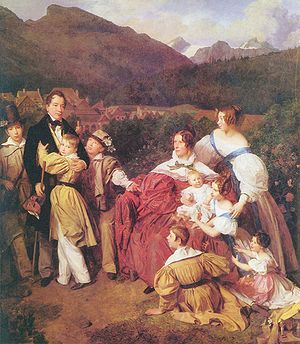
is characterized by an emphasis on breadth, initially at the shoulder and later in the hips, in contrast to the narrower silhouettes that had predominated between 1800 and the 1820s.
Women's costume featured larger sleeves than were worn in any period before or since, which were accompanied by elaborate hairstyles and large hats.
The final months of the 1830s saw the proliferation of a revolutionary new technology
Technology
Technology is the making, usage, and knowledge of tools, machines, techniques, crafts, systems or methods of organization in order to solve a problem or perform a specific function. It can also refer to the collection of such tools, machinery, and procedures. The word technology comes ;...
—photography
Photography
Photography is the art, science and practice of creating durable images by recording light or other electromagnetic radiation, either electronically by means of an image sensor or chemically by means of a light-sensitive material such as photographic film...
. Hence, the infant industry of photographic portraiture
Portrait photography
Portrait photography or portraiture is the capture by means of photography of the likeness of a person or a small group of people , in which the face and expression is predominant. The objective is to display the likeness, personality, and even the mood of the subject...
preserved for history a few rare, but invaluable, first images of human beings—and therefore also preserved our earliest, live peek into "fashion in action"—and its impact on everyday life and society as a whole.
General trends
The prevalent trend of RomanticismRomanticism
Romanticism was an artistic, literary and intellectual movement that originated in the second half of the 18th century in Europe, and gained strength in reaction to the Industrial Revolution...
from the 1820s through the mid-1840s, with its emphasis on strong emotion as a source of aesthetic experience and its recognition of the picturesque
Picturesque
Picturesque is an aesthetic ideal introduced into English cultural debate in 1782 by William Gilpin in Observations on the River Wye, and Several Parts of South Wales, etc. Relative Chiefly to Picturesque Beauty; made in the Summer of the Year 1770, a practical book which instructed England's...
, was reflected in fashion as in other arts. Items of historical dress including neck ruff
Ruff
The Ruff is a medium-sized wading bird that breeds in marshes and wet meadows across northern Eurasia. This highly gregarious sandpiper is migratory and sometimes forms huge flocks in its winter grounds, which include southern and western Europe, Africa, southern Asia and Australia...
s, ferronieres (jeweled headbands worn across the forehead), and sleeves based on styles of earlier periods were popular.
Innovations in roller printing on textiles
Roller printing on textiles
Roller printing, also called cylinder printing or machine printing, on fabrics is a textile printing process patented by Thomas Bell of Scotland in 1783 in an attempt to reduce the cost of the earlier copperplate printing...
introduced new dress fabrics. Rich colors such as the Turkey red
Rubiá
aRubiá is a municipality in the Spanish province of Ourense. It has a population of 1734 and an area of 101 km²....
of the 1820s were still found, but delicate floral prints on light backgrounds were increasingly popular. More precise printing eliminated the need for dark outlines on printed designs, and new green dyes appeared in patterns of grasses, ferns, and unusual florals. Combinations of florals and stripes were fashionable.
Overall, both men's and women's fashion showed width at the shoulder above a tiny waist. Men's coats were padded in the shoulders and across the chest, while women's shoulders sloped to huge sleeves.
Women's fashions
Overview
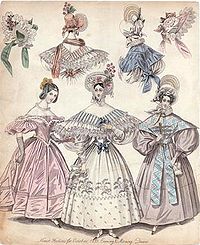
In the 1830s, fashionable women's clothing styles had distinctive large "leg of mutton" or "gigot" sleeveSleeve
Sleeve is that part of a garment which covers the arm, or through which the arm passes or slips. The pattern of the sleeve is one of the characteristics of fashion in dress, varying in every country and period...
s, above large full conical skirts, ideally with a narrow, low waist between (achieved through corset
Corset
A corset is a garment worn to hold and shape the torso into a desired shape for aesthetic or medical purposes...
ing). The bulkiness of women's garments both above and below the waist was intended to make the waist look smaller than it was — this was the final repudiation of any last lingering aesthetic influences of the Empire silhouette
Empire silhouette
An Empire silhouette is created by a woman wearing a high-waisted dress, gathered near or just under the bust with a long, loose skirt, which skims the body. The outline is especially flattering to pear shapes wishing to disguise the stomach area or emphasise the bust. The shape of the dress also...
of ca. 1795–1825. Heavy stiff fabrics such as brocade
Brocade
Brocade is a class of richly decorative shuttle-woven fabrics, often made in colored silks and with or without gold and silver threads. The name, related to the same root as the word "broccoli," comes from Italian broccato meaning "embossed cloth," originally past participle of the verb broccare...
s came back into style, and many 18th-century gowns were brought down from attics and cut up into new garments. The combination of sloping shoulders and sleeves which were very large over most of the arm (but narrowing to a small cuff at the wrist) is quite distinctive to the day dresses of the 1830s.
Pelerines
Tippet
A tippet is a stole or scarf-like narrow piece of clothing, worn over the shoulders. They evolved in the fourteenth century from long sleeves and typically had one end hanging down to the knees...
, or lace coverings draped over the shoulders, were popular (one of several devices, along with full upper-arm sleeves and wide necklines, to emphasize the shoulders and their width).
Gowns
The fashionable feminine figure, with its sloping shoulders, rounded bust, narrow waist and full hips, was emphasized in various ways with the cut and trim of gowns. To about 1835, the small waist was accentuated with a wide belt (a fashion continuing from the 1820s). Later the waist and midriff were unbelted but cut close to the body, and the bodice began to taper to a small point at the front waist. The fashionable corset now had goresGore (segment)
A gore is a segment of a three-dimensional shape fabricated from a two-dimensional material. The term was originally used to describe triangular shapes, but is now extended to any shape that can be used to create the third dimension.-Examples:...
to individually cup the breasts, and the bodice
Bodice
A bodice, historically, is an article of clothing for women, covering the body from the neck to the waist. In modern usage it typically refers to a specific type of upper garment common in Europe during the 16th to the 18th century, or to the upper portion of a modern dress to distinguish it from...
was styled to emphasize this shape.
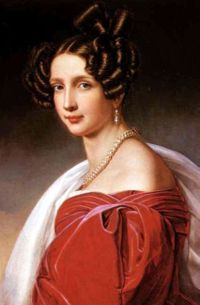
Evening gowns had very wide necklines and short, puffed sleeves reaching to the elbow from a dropped shoulder, and were worn with mid-length glove
Glove
A glove is a garment covering the hand. Gloves have separate sheaths or openings for each finger and the thumb; if there is an opening but no covering sheath for each finger they are called "fingerless gloves". Fingerless gloves with one large opening rather than individual openings for each...
s. The width at the shoulder was often emphasized by gathered or pleated panels of fabric arranged horizontally over the bust and around the shoulders.
Day dresses generally had high necklines, and shoulder width was emphasized with tippets or wide collars that rested on the gigot sleeves. Summer afternoon dresses might have wide, low necklines similar to evening gowns, but with long sleeves. Skirts were pleated into the waistband of the bodice, and held out with starched petticoat
Petticoat
A petticoat or underskirt is an article of clothing for women; specifically an undergarment to be worn under a skirt or a dress. The petticoat is a separate garment hanging from the waist ....
s of linen or cotton.
Around 1835, the fashionable skirt-length for middle- and upper-class women's clothes dropped from ankle-length to floor-length.
Hairstyles and Headgear
Bonnets with wide semicircular brims framed the face for street wear, and were heavily decorated with trim, ribbons, and feathers.
Married women wore a linen or cotton cap for daywear, trimmed with lace, ribbon, and frills, and tied under the chin. The cap was worn alone indoors and under the bonnet for street wear.
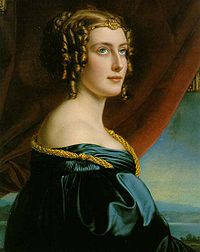
For evening wear, hair ornaments including combs, ribbons, flowers, and jewels were worn; other options included beret
Beret
A beret is a soft, round, flat-crowned hat, designated a "cap", usually of woven, hand-knitted wool, crocheted cotton, or wool felt, or acrylic fiber....
s and turban
Turban
In English, Turban refers to several types of headwear popularly worn in the Middle East, North Africa, Punjab, Jamaica and Southwest Asia. A commonly used synonym is Pagri, the Indian word for turban.-Styles:...
s.
Undergarments
Women's undergarments consisted of a knee-length linenLinen
Linen is a textile made from the fibers of the flax plant, Linum usitatissimum. Linen is labor-intensive to manufacture, but when it is made into garments, it is valued for its exceptional coolness and freshness in hot weather....
chemise
Chemise
The term chemise or shift can refer to the classic smock, or else can refer to certain modern types of women's undergarments and dresses...
with straight, elbow length sleeves. Corset
Corset
A corset is a garment worn to hold and shape the torso into a desired shape for aesthetic or medical purposes...
s compressed the waist and skirts were held in shape by layers of starch
Starch
Starch or amylum is a carbohydrate consisting of a large number of glucose units joined together by glycosidic bonds. This polysaccharide is produced by all green plants as an energy store...
ed petticoats, stiffened with tucks and cording. The full sleeves were supported by down-filled sleeve plumpers.
Outerwear
Riding habitRiding habit
A riding habit is women's clothing for horseback riding.Since the mid-17th century, a formal habit for riding sidesaddle usually consisted of:* A tailored jacket with a long skirt to match* A tailored shirt or chemisette...
s consisted of a high-necked, tight-waisted jacket with the fashionable dropped shoulder and huge gigot sleeves, worn over a tall-collared shirt or chemisette
Chemisette
A Chemisette is an article of women's clothing worn to fill in the front and neckline of any garment. Chemisettes give the appearance of a blouse or shirt worn under the outer garment without adding bulk at the waist or upper arm.Chemisettes of linen or cotton were often worn with day dresses in...
, with a long matching petticoat or skirt. Tall top hats with veils were worn.
Shawl
Shawl
A shawl is a simple item of clothing, loosely worn over the shoulders, upper body and arms, and sometimes also over the head. It is usually a rectangular or square piece of cloth, that is often folded to make a triangle but can also be triangular in shape...
s were worn with short-sleeved evening gowns early in the decade, but they were not suited to the wide gigot sleeves of the mid 1830s.
Full-length mantles
Mantle (clothing)
A mantle is a type of loose garment usually worn over indoor clothing to serve the same purpose as an overcoat...
were worn to about 1836, when mantles became shorter. A mantlet or shawl-mantlet was a shaped garment like a cross between a shawl and a mantle, with points hanging down in front. The burnous
Burnous
A burnous is a long cloak of coarse woollen fabric with a hood, usually white in color, worn by Berbers and the Arabs throughout North Africa....
was a three-quarter length mantle with a hood, named after the similar garment of Arabia. The paletot was knee-length, with three cape-collars and slits for the arms, and the pardessus was half or three-quarter length coat with a defined waist and sleeves.
For evening, voluminous mantles of velvet or satin, with fur trim or fur linings in cold climates, were worn with the evening gown.
Footwear
Low, square-toed slippers were made of fabric or leather for daytime and of satin for evening wear. Low boots with elasticElastomer
An elastomer is a polymer with the property of viscoelasticity , generally having notably low Young's modulus and high yield strain compared with other materials. The term, which is derived from elastic polymer, is often used interchangeably with the term rubber, although the latter is preferred...
insets appeared in this decade.
Style gallery 1830–1835
- Fashion plate from Mercure des Salons
- Sophie Guillemette, Grand Duchess of Baden wears a white evening gown that just skims her ankles and a tawny-colored shawl. Her flat shoes have ribbon laces and square toes. 1831.
- Therese von Schenk wears long sheer oversleeves over short puffed sleeves and an elaborate fabric-covered hat with plumes, 1831.
- Sarah Josepha Hale with curls and a center part in her hair. She wears a low-cut black dress with plain sleeves and a showy white chemise. 1831.
- Mrs. Edward Kellogg wears the frilled indoor day cap of a married woman with a wide ribbon bow tied under her chin. Her simple dark gown has gigot sleeves and a modestly broad neckline, filled in with a ruffed chemisetteChemisetteA Chemisette is an article of women's clothing worn to fill in the front and neckline of any garment. Chemisettes give the appearance of a blouse or shirt worn under the outer garment without adding bulk at the waist or upper arm.Chemisettes of linen or cotton were often worn with day dresses in...
. - Fashion plate from Wiener Moden, in which anatomical accuracy gives way to the desire to present a trendy fashion silhouette. The day dress has a wide, low neckline and long sleeves.
- German fashion of 1834 with echoes of the RenaissanceRenaissanceThe Renaissance was a cultural movement that spanned roughly the 14th to the 17th century, beginning in Italy in the Late Middle Ages and later spreading to the rest of Europe. The term is also used more loosely to refer to the historical era, but since the changes of the Renaissance were not...
: a wide-necked black gown features a tight belt at the raised waistline. Hair is worn in elaborate curls and knots. - Caroline, Countess of Holnstein wears her hair severely parted in the center front and across the top of her head. Her long hair is braided, and the braids are looped over either ear and wound into a knot at the crown of her head. She wears a white gown with a wide belt and gathers at the front to emphasise the bust under a pink satin coat with a fur collar and fur trim. German, 1834.
- Fashion plate from Wiener Zeitschrift shows the fashion for fabrics printed with combinations of stripes and floral designs.
Style gallery 1835–1839
- 1830s Riding habitRiding habitA riding habit is women's clothing for horseback riding.Since the mid-17th century, a formal habit for riding sidesaddle usually consisted of:* A tailored jacket with a long skirt to match* A tailored shirt or chemisette...
s have fashionable full sleeves. - Marie Lafont-Porcher's hair is styled in a high knot with wide side-curls; her gauzy gown has a neck ruff and a wide collar, and she wears a fur piece similar to that in the Gazette des Salons fashion plate above, 1835.
- Conservative, middle-class fashion: Eliza Clarke Cory Clench wears a white cap with a large striped ribbon bow that contrasts with her bright green dress. Canada, 1834–36.
- Portrait of Ada LovelaceAda LovelaceAugusta Ada King, Countess of Lovelace , born Augusta Ada Byron, was an English writer chiefly known for her work on Charles Babbage's early mechanical general-purpose computer, the analytical engine...
in British court dressCourt uniform and dress- Court dress :On formal royal occasions in monarchies the dress worn by those present is prescribed by official regulations.Court dress is worn by all men not entitled to court uniform or military uniform on all occasions of state where such are customarily worn...
. She wears a red trainTrain (clothing)A train in clothing is the long back portion of a skirt or dress that writes a trail on the ground behind the wearer in ruler , or a separate trailing overskirt. It is a common part of a court dress or a wedding dress....
over a white satin evening gown. Note her square-toed satin slippers, 1836. - Viennese fashion plate for February 1837 shows front and back views of the newly fashionable dangling clusters of curls on the sides worn with an ornate knot of hair at the crown. A headband is worn for evening. The waist is still defined by a wide belt, but it sits lower on the body.
- By 1837, fullness was dropping from just off the shoulder to the middle of the arm. The bonnet is smaller than those worn earlier in the decade, and black lace mitts (fingerless gloves) are worn with the white day dress. Hair is worn in wide clusters of short sausage curls. French.
- Mathilde, Gräfin Lynar wears a brown velvet gown with snug shoulders and lower sleeves, and fullness at the middle of the arm. The waist is darted to fit and comes to a small point in front. Hair is smoothed above the ears and wound into a braided crown. German, 1837.
- Adélaide d'Orléans wears a heavily decorated straw bonnet over a frilled cap, 1838.
Caricature gallery
- "Waist and Extravagance", ca. 1830 fashion satire
Men's fashion
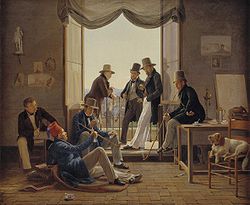
Overview
In this period, men's fashion plates continue to show an ideal silhouette with broad shoulders, and a narrow, tightly cinched waist.Shirts and cravats
ShirtShirt
A shirt is a cloth garment for the upper body. Originally an undergarment worn exclusively by men, it has become, in American English, a catch-all term for almost any garment other than outerwear such as sweaters, coats, jackets, or undergarments such as bras, vests or base layers...
s of linen or cotton featured tall standing collars
Collar (clothing)
In clothing, a collar is the part of a shirt, dress, coat or blouse that fastens around or frames the neck. Among clothing construction professionals, a collar is differentiated from other necklines such as revers and lapels, by being made from a separate piece of fabric, rather than a folded or...
, increasing worn "spread" and later turned down rather than turned up over the chin, and were worn with wide cravats tied in a soft bow; dark cravats were popular for day wear. Shirts for daywear had tucked
Tuck (sewing)
In sewing, a tuck is a fold or pleat in fabric that is sewn in place.Small tucks, especially multiple parallel tucks, may be used to decorate clothing or household linens...
insets over the chest, while evening shirts had frills.
Coats and waistcoats
Frock coatFrock coat
A frock coat is a man's coat characterised by knee-length skirts all around the base, popular during the Victorian and Edwardian periods. The double-breasted style is sometimes called a Prince Albert . The frock coat is a fitted, long-sleeved coat with a centre vent at the back, and some features...
s (in French redingote
Redingote
The redingote is a type of coat that has had several forms over time. The name is derived from a French alteration of the English "riding coat", an example of reborrowing.-Women's redingote:...
s) increasingly replaced tail coats for informal day wear. They were calf length, and might be double-breasted. Shoulder emphasis fell lower on the arm; shoulders were sloped and puffed sleeve heads gradually shrank and then disappeared. Waistcoat
Waistcoat
A waistcoat or vest is a sleeveless upper-body garment worn over a dress shirt and necktie and below a coat as a part of most men's formal wear, and as the third piece of the three-piece male business suit.-Characteristics and use:...
s or vests were single- or double-breasted, with rolled shawl or (later) notched collars, and extremely tight through the waist. Waistcoast were sometimes worn two at time, in contrasting colors. Corsets or corset-like garments were worn by many men to draw in the waistline. The most fashionable coats had padded shoulders and chests, a feature that disappeared after about 1837.
Trousers
Full-length trousersTrousers
Trousers are an item of clothing worn on the lower part of the body from the waist to the ankles, covering both legs separately...
began to have the modern fly-front closure, replacing the earlier fall-front. Breeches remained a requirement for formal functions at the British court (as they would be throughout the century). Breeches continued to be worn for horseback riding and other country pursuits, especially in Britain, with tall fitted boots.
Outerwear
CloakCloak
A cloak is a type of loose garment that is worn over indoor clothing and serves the same purpose as an overcoat; it protects the wearer from the cold, rain or wind for example, or it may form part of a fashionable outfit or uniform. Cloaks are as old as human history; there has nearly always been...
s were worn with evening wear. Overcoat
Overcoat
An overcoat is a type of long coat intended to be worn as the outermost garment. Overcoats usually extend below the knee, but are sometimes mistakenly referred to as topcoats, which are short coats that end at or above the knees. Topcoats and overcoats together are known as outercoats...
s with wide sleeves were worn with day wear; these were often called greatcoats.
Hats and hairstyles
The crowns of tall hatsTop hat
A top hat, beaver hat, high hat silk hat, cylinder hat, chimney pot hat or stove pipe hat is a tall, flat-crowned, broad-brimmed hat, predominantly worn from the latter part of the 18th to the middle of the 20th century...
were less curvy than in the previous period. Hair was generally parted to one side. Curled hair and sideburns remained fashionable, along with moustaches.
Style gallery
- 1830s fashion plate shows the small, high waist that was the ideal of French fashion in the 1830s. Frock coat (left) and morning coat (right).
- Frederik Hansen Sødring wears a brocade waistcoat with a high black velvet shawl collar. The front flap of his fall-front trousers can be seen clearly in this 1832 portrait. Note the taper of the waistcoat toward the tight waist.
- Antoine Julien Meffre-Rouzan of New Orleans painted in ParisParisParis is the capital and largest city in France, situated on the river Seine, in northern France, at the heart of the Île-de-France region...
, 1833, in evening wear. The puffs at the shoulder of his coat are smaller than those worn in the 1820s, and his waistcoat has a slight point at the front waist. - 1834 portrait of Davy CrockettDavy CrockettDavid "Davy" Crockett was a celebrated 19th century American folk hero, frontiersman, soldier and politician. He is commonly referred to in popular culture by the epithet "King of the Wild Frontier". He represented Tennessee in the U.S...
shows the fashionable dark cravat worn with a wide turn-over collar. - Portrait of John C. CalhounJohn C. CalhounJohn Caldwell Calhoun was a leading politician and political theorist from South Carolina during the first half of the 19th century. Calhoun eloquently spoke out on every issue of his day, but often changed positions. Calhoun began his political career as a nationalist, modernizer, and proponent...
in a sheer white formal cravat, dark coat, and fur-collared or lined overcoat, 1834. - Portrait of Hans Christian AndersenHans Christian AndersenHans Christian Andersen was a Danish author, fairy tale writer, and poet noted for his children's stories. These include "The Steadfast Tin Soldier," "The Snow Queen," "The Little Mermaid," "Thumbelina," "The Little Match Girl," and "The Ugly Duckling."...
shows the depth and breadth of fashionable coat collars, 1836. - A gentleman of the Wilkes Family, 1838–40, wears a dark cravat. His tall coat collar is notched and spreads onto his shoulders. The sleeve has just a hint of fullness at the sleeve head.
- Zoo proprietor Edward Cross wears a red and black patterned waistcoat with brown trousers and a black tailcoat, cravat, and top hat, 1838.
Children's fashion
In this period, small boys wore sashed tunics over trousers, sometimes with a round-collared shirt underneath. (In Sketches by BozSketches by Boz
Sketches by "Boz," Illustrative of Every-day Life and Every-day People is a collection of short pieces published by Charles Dickens in 1836 accompanied by illustrations by George Cruikshank. The 56 sketches concern London scenes and people and are divided into four sections: "Our Parish",...
, 1836, Charles Dickens
Charles Dickens
Charles John Huffam Dickens was an English novelist, generally considered the greatest of the Victorian period. Dickens enjoyed a wider popularity and fame than had any previous author during his lifetime, and he remains popular, having been responsible for some of English literature's most iconic...
described the earlier skeleton suit
Skeleton suit
A skeleton suit is an outfit of clothing for small boys, popular from about 1790 to 1830, consisting of a tight short- or long-sleeved coat or jacket buttoned to a pair of high-waisted trousers. Skeleton suits are often described as one of the earliest fashions to be specifically tailored for...
as "...one of those straight blue cloth cases in which small boys used to be confined, before belts and tunics had come in...." [emphasis added]). Older boys wore short jackets and trousers with round-collared shirts.
Girls wore simplified versions of women's fashion.
External links
- The Romantic Era: Fashions 1825-1845
- 1840s Men's Fashions – circa 1840 Men's Fashion Photos (Daguerreotypes) with Annotations
- Men's fashion plates of the 1830s at Victoriana.com