

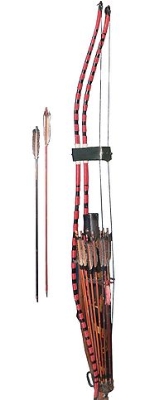
Yumi

Overview
is the Japanese term
for bow
s, and includes the longer and the shorter used in the practice of kyūdō
, or Japanese archery
. The yumi was an important weapon of the samurai
warrior during the feudal period of Japan.
Early Japanese used bows of various sizes but the majority were short with a center grip. By the 3rd century B.C. the bow length had grown to nearly 2 meters. This bow was called the maruki yumi and was constructed from a small sapling or tree limb.
Japanese language
is a language spoken by over 130 million people in Japan and in Japanese emigrant communities. It is a member of the Japonic language family, which has a number of proposed relationships with other languages, none of which has gained wide acceptance among historical linguists .Japanese is an...
for bow
Bow (weapon)
The bow and arrow is a projectile weapon system that predates recorded history and is common to most cultures.-Description:A bow is a flexible arc that shoots aerodynamic projectiles by means of elastic energy. Essentially, the bow is a form of spring powered by a string or cord...
s, and includes the longer and the shorter used in the practice of kyūdō
Kyudo
, literally meaning "way of the bow", is the Japanese art of archery. It is a modern Japanese martial art and practitioners are known as .It is estimated that there are approximately half a million practitioners of kyudo today....
, or Japanese archery
Archery
Archery is the art, practice, or skill of propelling arrows with the use of a bow, from Latin arcus. Archery has historically been used for hunting and combat; in modern times, however, its main use is that of a recreational activity...
. The yumi was an important weapon of the samurai
Samurai
is the term for the military nobility of pre-industrial Japan. According to translator William Scott Wilson: "In Chinese, the character 侍 was originally a verb meaning to wait upon or accompany a person in the upper ranks of society, and this is also true of the original term in Japanese, saburau...
warrior during the feudal period of Japan.
Early Japanese used bows of various sizes but the majority were short with a center grip. By the 3rd century B.C. the bow length had grown to nearly 2 meters. This bow was called the maruki yumi and was constructed from a small sapling or tree limb.
