

Yamasee War

Encyclopedia
The Yamasee War (1715–1717) was a conflict between British settlers of colonial South Carolina
and various Native American Indian
tribes, including the Yamasee
, Muscogee, Cherokee
, Chickasaw
, Catawba, Apalachee
, Apalachicola, Yuchi
, Savannah River Shawnee
, Congaree, Waxhaw
, Pee Dee, Cape Fear
, Cheraw, and others. Some of the Native American Indian groups played a minor role while others launched attacks throughout South Carolina in an attempt to destroy the colony.
They killed hundreds of colonists and destroyed many settlements. Traders "in the field" were killed throughout what is now southeastern United States
. Abandoning settled frontiers, people fled to Charles Town
, where starvation set in as supplies ran low. The survival of the South Carolina colony was in question during 1715. The tide turned in early 1716 when the Cherokee sided with the colonists against the Creek, their traditional enemy. The last of South Carolina's major Native American foes withdrew from the conflict in 1717, bringing a fragile peace to the colony.
The Yamasee War was one of the most disruptive and transformational conflicts of colonial America. It was one of the American Indians' most serious challenges to European dominance. For over a year the colony faced the possibility of annihilation. About 7% of South Carolina's white citizenry was killed, making the war bloodier than King Philip's War
, which is often cited as North America's bloodiest war involving Native Americans. The geopolitical situation for British, Spanish, and French colonies, as well as the Indian groups of the southeast, was radically altered. The war marks the end of the early colonial era of the American South
. The Yamasee War and its aftermath contributed to the emergence of new Indian confederated nations, such as the Muscogee Creek and Catawba.
The origin of the war was complex. Reasons for fighting differed among the many Indian groups who participated. Commitment differed as well. Factors included land encroachment by Europeans, the trading system, trader abuses, the Indian slave trade, the depletion of deer, increasing Indian debts in contrast to increasing wealth among some colonists, the spread of rice
plantation
agriculture, French power in Louisiana
offering an alternative to British trade, long-established Indian links to Spanish Florida
, the vying for power among Indian groups, as well as an increasingly large-scale and robust inter-tribal communication network, and recent experiences in military collaboration among previously distant tribes.
 The Tuscarora War
and its lengthy aftermath played a major role in the outbreak of the Yamasee War. The Tuscarora began attacking colonial settlements of North Carolina
in 1711. South Carolina settlers mustered armies and campaigned twice against the Tuscarora, in 1712 and 1713. These armies were made up mainly of Indian troops. The Yamasee had been strong military allies of South Carolina colonists for many years. Yamasee warriors made up the core of both armies. Other Indians were recruited over a large area from diverse tribes that in some cases were traditional enemies of one another. Tribes that sent warriors to South Carolina's armies included the Yamasee, Catawba, Yuchi, Apalachee, Cusabo
, Wateree
, Sugaree
, Waxhaw, Congraree, Pee Dee, Cape Fear, Cheraw, Saxapahaw
, Cherokee, and various proto-Creek groups.
This military collaboration brought Indians of the entire region into closer contact with one another. The Indians saw the disagreements and weaknesses of the British colonies, as South Carolina, North Carolina, and Virginia bickered over various aspects of the Tuscarora War. Essentially all of the tribes that helped South Carolina during the Tuscarora War joined in attacking settlers in the colony during the Yamasee War, just two or three years later.
The Yamasee, while often described as a tribe
, were an amalgamation of the remnants of earlier tribes and chiefdom
s, such as the Guale
and groups originating in the provinces of Tama and Ocute in interior Georgia (Worth 1993:40–45). The Yamasee emerged during the 17th century in the contested frontier between South Carolina and Spanish Florida. At first allied with the Spanish, the Yamasee moved north in the late 17th century and soon became South Carolina's most important Indian ally. They lived near the mouth of the Savannah River
and around Port Royal Sound
.
For years, the Yamasee profited from their relation with the British. By 1715 they found it difficult to obtain the two trade items most desired by the British— deerskins and Indian slaves. With the deerskin trade booming over an ever-larger region, deer had become rare in Yamasee territory. After the Tuscarora War, slave-raiding opportunities were limited. The Yamasee became increasingly indebted to the British traders, who supplied them with trade goods on credit. By 1715 rice plantations had begun to thrive in South Carolina, and much of the accessible land good for rice had been taken up. The Yamasee had been granted a large land reserve on the southern borders of South Carolina, and settlers began to covet their land, which they deemed ideal for rice plantations.
Historians have not determined if the Yamasee were leaders in fomenting Indian unrest and plans for war. The Ochese Creeks (later known as the Lower Creeks) may have been more instrumental in gaining support for war. Each of the Indian tribes that joined in the war had its own reasons, as complicated and deeply rooted in the past as the Yamasee's. Although the tribes did not act in carefully planned coordination, the unrest increased, and inter-tribal communication began about the possibility of war. By early 1715 rumors of growing Indian support for war was troubling enough that some friendly Indians warned colonists of the danger. They suggested the Ochese Creek were the instigators.
). They hoped to obtain Yamasee assistance in arranging an emergency summit with the Ochese Creek leaders. The delegation's visit to Pocotaligo triggered the start of the war.
The delegation that visited Pocotaligo consisted of Samuel Warner and William Bray, sent by the Board of Commissioners. They were joined by Thomas Nairne
and John Wright, two of the most important people of South Carolina's Indian trading system. Two others, Seymour Burroughs and an unknown South Carolinian, also joined. On the evening of April 14, 1715, the day before Good Friday
, the men spoke to an assembly of Yamasee. They promised to make special efforts to redress Yamasee grievances. They also said that Governor Craven
was on the way to the village.
During the night, as the South Carolinians slept, the Yamasee debated over what to do. There were some who were not fully pledged to a war, but in the end the choice was made. After applying war paint, the Yamasee woke the Carolinians and attacked them. Two of the six men escaped. Seymour Burroughs fled and, although shot twice, raised an alarm in the Port Royal
settlements. The Yamasee killed Nairne, Wright, Warner, and Bray. The unknown South Carolinian hid in a nearby swamp, from which he witnessed the ritual death-by-torture of Nairne. The events of the early hours of Good Friday, April 15, 1715, marked the beginning of the Yamasee War.
and a general alarm had been raised. By chance, a captured smuggler's ship was docked at Port Royal. By the time the Yamasee arrived, several hundred settlers had found refuge on the ship, while many others had fled in canoes.
The second war party invaded Saint Bartholomew's Parish, plundering and burning plantations, taking captives, and killing over a hundred settlers and slaves. Within the week, a large Yamasee army was preparing to engage a rapidly assembled South Carolinian militia. Other Yamasee went south to find refuge in makeshift forts.
The Yamasee War was the first major test of South Carolina's militia
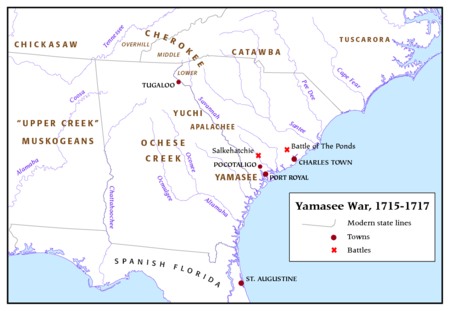
. Governor Craven led a force of about 240 militia against the Yamasee. The Yamasee war parties had little choice but to join together to engage Craven's militia. Near the Indian town of Salkehatchie (or "Saltcatchers" in English), on the Salkehatchie River
, a pitched battle was fought on open terrain. I t was the kind of battle conditions which Craven and the militia officers desired and the Indians were poorly suited for.
Several hundred Yamasee warriors attacked the 240 or so members of the militia. The Yamasee tried to outflank the South Carolinians but found it difficult. After several head warrior
s were killed, the Yamasee abandoned the battle and dispersed into nearby swamps. Although the casualties were about equal, 24 or so on each side, the practical result was a decisive victory for South Carolina. Other smaller militia forces pressed the Yamasee and won a series of further victories.
Alexander MacKay, experienced with Indian war, led a force south. They found and attacked a group of about 200 Yamasee who had taken refuge in a palisade-fortified encampment. After a relatively small Carolinian party made two sorties over the walls of the fort, the Yamasee decided to retreat. Outside the fort, the Yamasee were ambushed and decimated by MacKay and about 100 men.
A smaller battle took place in the summer of 1715, becoming known as the Daufuskie Fight. A Carolinian boat scout crew managed to ambush a group of Yamasee, killing 35 while suffering only one casualty. Before long, the surviving Yamasee decided to move farther south to the vicinity of the Altamaha River
.
By May of 1715 the Catawba sent war parties against South Carolina settlers. About 400 Catawba warriors, joined by about 70 Cherokee, terrorized the northern parts of the colony. In June a South Carolinian force of 90 cavalry under Captain Thomas Barker went north in response. The Catawba-Cherokee war party managed to ambush Barker's troops, and killed them all. Another Catawba-Cherokee force attacked a makeshift fort on Benjamin Schenkingh's plantation, where they killed about 20 people. After this, South Carolina had no defenses for the wealthy Goose Creek district, just north of Charles Town.
Before the northern forces attacked Charles Town, most of the Cherokee left, as they had heard about their own towns being threatened. The remaining Catawba then faced a rapidly assembled militia under the command of George Chicken. On June 13, 1715, Chicken's militia ambushed a Catawba party and launched a direct assault upon the main Catawba force. In the Battle of the Ponds, the militia routed the Catawba. The warriors were not used to such direct confrontation. After returning to their villages, the Catawba decided on peace. By July of 1715, Catawba diplomats arrived in Virginia to inform the British of their willingness to not only make peace, but to assist South Carolina militarily.
The Ochese Creek were buffered from South Carolina by several smaller Indian groups, such as the Yuchi, Savannah River Shawnee, Apalachee, and Apalachicola. In the summer of 1715, these Indians made several successful attacks on South Carolina settlements. Generally the Ochese Creek were cautious after South Carolina's counterattacks proved effective. The smaller Indian groups fled the Savannah River area.
Many found refuge among the Ochese Creeks, where plans were being made for the next stage of the war. The Upper Creek were not as determined to wage war had strong respect for the Ochese Creek. They might have joined in an invasion if conditions were favorable. An issue at stake was trade goods. The Creek people had come to depend on English trade goods from South Carolina. Facing possible war with the British, the Creek looked to the French and Spanish as possible market sources. The French and Spanish were more than willing to supply the Creek, but they were unable to provide the same quantity or quality of goods which the British had been providing. Muskets, gunpowder, and bullets were especially needed if the Creek were to invade South Carolina. The Upper Creek remained reluctant to go to war. Nevertheless, the Creek formed closer ties to the French and Spanish during the Yamasee War.
The Ochese Creeks had other connections, such as the Chickasaw and Cherokee. But the Chickasaw, after killing their English traders, had been quick to make peace with South Carolina. They blamed the deaths of the traders in their towns on the Creeks—a lame excuse that was gladly accepted by South Carolina. The Cherokee's position became strategically important.
The Cherokee were divided. In general the Lower Cherokee, who lived closest to South Carolina, tended to support the war. Some participated in Catawba attacks on South Carolina's Santee River
settlements. The Overhill Cherokee
, who lived farthest from South Carolina, tended to support an alliance with South Carolina and war against the Creek. One of the Cherokee leaders most in favor of an alliance with South Carolina was Caesar, a chief of a Middle Cherokee town.
In late 1715, two South Carolinian traders visited the Cherokee and returned to Charles Town with a large Cherokee delegation. An alliance was made, and plans for war against the Creek developed. But in the following month the Cherokee failed to meet up with South Carolinians at Savannah Town
as planned. South Carolina then sent an expedition of over 300 soldiers to the Cherokee, arriving in December, 1715. They split up and visited the key Lower, Middle, and Overhill towns, and quickly saw how divided the Cherokee were. During the winter the Cherokee leader Caesar traveled throughout the Cherokee towns, drumming up support for war against the Creek. Other prestigious and respected Cherokee leaders urged caution and patience, including Charitey Hagey the Conjurer of Tugaloo
, one of the Lower Towns closest to South Carolina. Many of the Lower Town Cherokee were open to peace with South Carolina, but reluctant to fight anyone other than the Yuchi and Savannah River Shawnee.
The South Carolinians were told that a "flag of truce" had been sent from the Lower Towns to the Creek, and that a delegation of Creek headmen had promised to come. Charitey Hagey and his supporters seemed to be offering to broker peace talks between the Creek and South Carolinians. They convinced the South Carolinians to alter their plans of war. Instead, the South Carolinians spent the winter trying to dissuade Caesar and the pro-war Cherokee.
The Cherokee alliance with South Carolina doomed the possibility of a major Creek invasion of South Carolina. At the same time, South Carolina was eager to regain peaceful relations with the Creek and did not want to fight a war with them. While South Carolina did supply the Cherokee with weapons and trade goods, they did not provide the military support that the pro-war Cherokee had hoped for. There were Cherokee victories in 1716 and 1717, but Creek counterattacks undermined the Cherokee's will to fight, which had been divided from the start. Nevertheless, the Creek and Cherokee continued to launch small-scale raids against each other for generations.
In response to The Tugaloo massacre and the Cherokee attacks, the Ochese Creek made a strategic defensive adjustment in early 1716. They relocated all their towns from the Ocmulgee River
basin to the Chattahoochee River
. The Ochese Creek had originally lived along the Chattahoochee, but had moved their towns to the Ocmulgee River and its tributary, Ochese Creek (from which the name "Creek" came), around 1690, in order to be closer to South Carolina. Their return to the Chattahoochee River in 1716 was thus not so much a retreat as a return to previous conditions. The distance between the Chattahoochee and Charles Town protected them from a possible South Carolina attack.
In 1716 and 1717, as no major Cherokee-British attack materialized, the Lower Creek found themselves in a position of increased power and resumed raiding their enemies—British, Cherokee, and Catawba. But, cut off from British trade, they began to experience problems in the supply of ammunition, gunpowder, and firearms. The Cherokee, on the other hand, were well-supplied with British weaponry. The lure of British trade undermined anti-British elements among the Creek. In early 1717 a few emissaries from Charles Town went to the Lower Creek territory, and a few Creek went to Charles Town, tentatively starting the process that would lead to peace. At the same time other Lower Creeks were looking for ways to continue to fight. In late 1716 a group representing many Muskogean Creek nations traveled all the way to the Iroquois Six Nations in New York. Impressed by the Creek's diplomacy, the Iroquois sent 20 of their own ambassadors to accompany the Creek back home. The Iroquois and Creek were mainly interested in planning attacks on their mutual Indian enemies, like the Catawba and Cherokee. But to South Carolina, a Creek-Iroquois alliance was something to be avoided at all costs. In response, South Carolina sent a group of emissaries to the Lower Creek towns, along with a large cargo of trade good presents.
In response to the militia's failure, Governor Craven replaced it with a professional army (that is, an army whose soldiers were paid). By August of 1715 South Carolina's new army contained about 600 South Carolinian citizens, 400 black slaves, 170 friendly Indians, and 300 troops from North Carolina and Virginia. This was the first time the South Carolina militia had been disbanded and a professional army assembled. It is also notable for the high number of black slaves armed (and their masters paid) to wage war.
But even this army was not able to secure the colony. The hostile Indians simply refused to engage in pitched battles, using unpredictable raids and ambushes instead. In addition, the Indians occupied such a large territory that it was effectively impossible to send an army against them. The army was disbanded after the Cherokee alliance was established in early 1716.
s of the colony believed the colony was no longer in mortal danger after the first few weeks. For others it was the Cherokee alliance of early 1716 that marked the end of the war. Peace treaties were established with various Creek and other Muskogean peoples in late 1717. But some tribes never agreed to peace, and all remained armed. The Yamasee and Apalachicola had moved south, but continued to raid South Carolina's settlements well into the 1720s. Frontier insecurity remained a problem.
to a crown colony
had begun. It took nine years, but in 1729 South Carolina and North Carolina officially became crown colonies. South Carolinians had been discontented with the proprietary system before the Yamasee War, but the call for change became shrill in 1715, after the first phase of the war, and only grew louder in the following years.
The Yamasee War also led to the establishment of the colony of Georgia. While there were other factors involved in Georgia's founding, it would not have been possible without the withdrawal of the Yamasee. The few Yamasee that remained became known as the Yamacraw
. James Oglethorpe
negotiated with the Yamacraw in order to obtain the site where he founded his capital city of Savannah
.
, a region that had been their homeland in the 17th century. But they were unable to find security there and soon became refugees. As a people, the Yamasee had always been ethnically mixed, and in the aftermath of the Yamasee War they split apart. About a third of the survivors chose to settle among the Lower Creek, eventually becoming part of the emerging Creek confederacy. Most of the rest, joined by Apalachicola refugees moved to the vicinity of St. Augustine
in the summer of 1715. Despite several attempts to make peace, by both South Carolinians and Yamasee individuals, conflict between the two continued for decades. The Yamasee of Spanish Florida were in time weakened by disease and other factors. The survivors became part of the Seminole
Indians.
The various proto-Creek Muskogean tribes grew closer after the Yamasee War. The reoccupation of the Chattahoochee River by the Ochese Creek, along with remnants of the Apalachicola, Apalachee, Yamasee, and others, seemed to Europeans to represent a new Indian identity, and needed a new name. To the Spanish it seemed like a reincarnation of the Apalachicola Province of the 17th century. To the English, the term Lower Creek became common.
The Catawba absorbed many of the remnants of northern or Piedmont tribes like the Cheraw, Congaree, Santee, Pee Dee, Waxhaw, Wateree, Waccamaw, and Winyah—although these tribes remained relatively independent for years. The Catawba confederacy emerged from the Yamasee War as the most powerful Indian force of the Piedmont region
, especially as the Tuscarora migrated away to join the Iroquois in the north. In 1716, a year after the Catawba had made peace with South Carolina, some Santee and Waxhaw Indians killed several colonists. In response the South Carolina government asked the Catawba to "fall upon them and cut them off", which the Catawba did. Surviving Santee and Waxhaw were absorbed into the Catawba society as slaves or "adoptees". The Cheraw remained generally hostile for years to come.
Province of Carolina
The Province of Carolina, originally chartered in 1629, was an English and later British colony of North America. Because the original Heath charter was unrealized and was ruled invalid, a new charter was issued to a group of eight English noblemen, the Lords Proprietors, in 1663...
and various Native American Indian
Native Americans in the United States
Native Americans in the United States are the indigenous peoples in North America within the boundaries of the present-day continental United States, parts of Alaska, and the island state of Hawaii. They are composed of numerous, distinct tribes, states, and ethnic groups, many of which survive as...
tribes, including the Yamasee
Yamasee
The Yamasee were a multiethnic confederation of Native Americans that lived in the coastal region of present-day northern coastal Georgia near the Savannah River and later in northeastern Florida.-History:...
, Muscogee, Cherokee
Cherokee
The Cherokee are a Native American people historically settled in the Southeastern United States . Linguistically, they are part of the Iroquoian language family...
, Chickasaw
Chickasaw
The Chickasaw are Native American people originally from the region that would become the Southeastern United States...
, Catawba, Apalachee
Apalachee
The Apalachee are a Native American people who historically lived in the Florida Panhandle, and now live primarily in the U.S. state of Louisiana. Their historical territory was known to the Spanish colonists as the Apalachee Province...
, Apalachicola, Yuchi
Yuchi
For the Chinese surname 尉迟, see Yuchi.The Yuchi, also spelled Euchee and Uchee, are a Native American Indian tribe who traditionally lived in the eastern Tennessee River valley in Tennessee in the 16th century. During the 17th century, they moved south to Alabama, Georgia and South Carolina...
, Savannah River Shawnee
Shawnee
The Shawnee, Shaawanwaki, Shaawanooki and Shaawanowi lenaweeki, are an Algonquian-speaking people native to North America. Historically they inhabited the areas of Ohio, Virginia, West Virginia, Western Maryland, Kentucky, Indiana, and Pennsylvania...
, Congaree, Waxhaw
Waxhaw Tribe
The Waxhaw Tribe was a tribe native to what are now the counties of Lancaster, in South Carolina; and Union and Mecklenburg in North Carolina, around the area of Charlotte...
, Pee Dee, Cape Fear
Cape Fear Indians
The Cape Fear Indians were a small tribe of Carolina Algonquian Native Americans who lived on the Cape Fear River in North Carolina ....
, Cheraw, and others. Some of the Native American Indian groups played a minor role while others launched attacks throughout South Carolina in an attempt to destroy the colony.
They killed hundreds of colonists and destroyed many settlements. Traders "in the field" were killed throughout what is now southeastern United States
Southeastern United States
The Southeastern United States, colloquially referred to as the Southeast, is the eastern portion of the Southern United States. It is one of the most populous regions in the United States of America....
. Abandoning settled frontiers, people fled to Charles Town
Charleston, South Carolina
Charleston is the second largest city in the U.S. state of South Carolina. It was made the county seat of Charleston County in 1901 when Charleston County was founded. The city's original name was Charles Towne in 1670, and it moved to its present location from a location on the west bank of the...
, where starvation set in as supplies ran low. The survival of the South Carolina colony was in question during 1715. The tide turned in early 1716 when the Cherokee sided with the colonists against the Creek, their traditional enemy. The last of South Carolina's major Native American foes withdrew from the conflict in 1717, bringing a fragile peace to the colony.
The Yamasee War was one of the most disruptive and transformational conflicts of colonial America. It was one of the American Indians' most serious challenges to European dominance. For over a year the colony faced the possibility of annihilation. About 7% of South Carolina's white citizenry was killed, making the war bloodier than King Philip's War
King Philip's War
King Philip's War, sometimes called Metacom's War, Metacomet's War, or Metacom's Rebellion, was an armed conflict between Native American inhabitants of present-day southern New England and English colonists and their Native American allies in 1675–76. The war is named after the main leader of the...
, which is often cited as North America's bloodiest war involving Native Americans. The geopolitical situation for British, Spanish, and French colonies, as well as the Indian groups of the southeast, was radically altered. The war marks the end of the early colonial era of the American South
Southern United States
The Southern United States—commonly referred to as the American South, Dixie, or simply the South—constitutes a large distinctive area in the southeastern and south-central United States...
. The Yamasee War and its aftermath contributed to the emergence of new Indian confederated nations, such as the Muscogee Creek and Catawba.
The origin of the war was complex. Reasons for fighting differed among the many Indian groups who participated. Commitment differed as well. Factors included land encroachment by Europeans, the trading system, trader abuses, the Indian slave trade, the depletion of deer, increasing Indian debts in contrast to increasing wealth among some colonists, the spread of rice
Rice
Rice is the seed of the monocot plants Oryza sativa or Oryza glaberrima . As a cereal grain, it is the most important staple food for a large part of the world's human population, especially in East Asia, Southeast Asia, South Asia, the Middle East, and the West Indies...
plantation
Plantation
A plantation is a long artificially established forest, farm or estate, where crops are grown for sale, often in distant markets rather than for local on-site consumption...
agriculture, French power in Louisiana
Louisiana (New France)
Louisiana or French Louisiana was an administrative district of New France. Under French control from 1682–1763 and 1800–03, the area was named in honor of Louis XIV, by French explorer René-Robert Cavelier, Sieur de la Salle...
offering an alternative to British trade, long-established Indian links to Spanish Florida
Spanish Florida
Spanish Florida refers to the Spanish territory of Florida, which formed part of the Captaincy General of Cuba, the Viceroyalty of New Spain, and the Spanish Empire. Originally extending over what is now the southeastern United States, but with no defined boundaries, la Florida was a component of...
, the vying for power among Indian groups, as well as an increasingly large-scale and robust inter-tribal communication network, and recent experiences in military collaboration among previously distant tribes.
Background
Tuscarora War
The Tuscarora War was fought in North Carolina during the autumn of 1711 until 11 February 1715 between the British, Dutch, and German settlers and the Tuscarora Native Americans. A treaty was signed in 1715....
and its lengthy aftermath played a major role in the outbreak of the Yamasee War. The Tuscarora began attacking colonial settlements of North Carolina
Province of North Carolina
The Province of North Carolina was originally part of the Province of Carolina in British America, which was chartered by eight Lords Proprietor. The province later became the U.S. states of North Carolina and Tennessee....
in 1711. South Carolina settlers mustered armies and campaigned twice against the Tuscarora, in 1712 and 1713. These armies were made up mainly of Indian troops. The Yamasee had been strong military allies of South Carolina colonists for many years. Yamasee warriors made up the core of both armies. Other Indians were recruited over a large area from diverse tribes that in some cases were traditional enemies of one another. Tribes that sent warriors to South Carolina's armies included the Yamasee, Catawba, Yuchi, Apalachee, Cusabo
Cusabo
The Cusabo were a group of historic Native American tribes who lived along the coast of the Atlantic Ocean in what is now South Carolina, approximately between present-day Charleston and south to the Savannah River, at the time of European encounter. English colonists often referred to them as the...
, Wateree
Wateree
The Wateree were one of the first groups of Native Americans in the interior of the East Coast to encounter Europeans. They were recorded in 1567, by Spanish captain Juan Pardo's scribe Bandera for his expeditions through the interior of the Carolinas. They were named the Guatari in Bandera's...
, Sugaree
Sugaree
"Sugaree" is a song written by long-time Grateful Dead lyricist Robert Hunter and composed by guitarist Jerry Garcia. It was written for Jerry Garcia's first solo album Garcia, which was released in January 1972...
, Waxhaw, Congraree, Pee Dee, Cape Fear, Cheraw, Saxapahaw
Saura
The Saura were a tribe of Native Americans who lived in the Piedmont area of North Carolina near the Sauratown Mountains, east of Pilot Mountain and north of the Yadkin River. They were believed to have spoken a Siouan language....
, Cherokee, and various proto-Creek groups.
This military collaboration brought Indians of the entire region into closer contact with one another. The Indians saw the disagreements and weaknesses of the British colonies, as South Carolina, North Carolina, and Virginia bickered over various aspects of the Tuscarora War. Essentially all of the tribes that helped South Carolina during the Tuscarora War joined in attacking settlers in the colony during the Yamasee War, just two or three years later.
The Yamasee, while often described as a tribe
Tribe
A tribe, viewed historically or developmentally, consists of a social group existing before the development of, or outside of, states.Many anthropologists use the term tribal society to refer to societies organized largely on the basis of kinship, especially corporate descent groups .Some theorists...
, were an amalgamation of the remnants of earlier tribes and chiefdom
Chiefdom
A chiefdom is a political economy that organizes regional populations through a hierarchy of the chief.In anthropological theory, one model of human social development rooted in ideas of cultural evolution describes a chiefdom as a form of social organization more complex than a tribe or a band...
s, such as the Guale
Guale
Guale was an historic Native American chiefdom along the coast of present-day Georgia and the Sea Islands. Spanish Florida established its Roman Catholic missionary system in the chiefdom in the late 16th century. During the late 17th century and early 18th century, Guale society was shattered...
and groups originating in the provinces of Tama and Ocute in interior Georgia (Worth 1993:40–45). The Yamasee emerged during the 17th century in the contested frontier between South Carolina and Spanish Florida. At first allied with the Spanish, the Yamasee moved north in the late 17th century and soon became South Carolina's most important Indian ally. They lived near the mouth of the Savannah River
Savannah River
The Savannah River is a major river in the southeastern United States, forming most of the border between the states of South Carolina and Georgia. Two tributaries of the Savannah, the Tugaloo River and the Chattooga River, form the northernmost part of the border...
and around Port Royal Sound
Port Royal Sound
Port Royal Sound is a coastal sound, or inlet of the Atlantic Ocean, located in the Sea Islands region, in Beaufort County in the U.S. state of South Carolina...
.
For years, the Yamasee profited from their relation with the British. By 1715 they found it difficult to obtain the two trade items most desired by the British— deerskins and Indian slaves. With the deerskin trade booming over an ever-larger region, deer had become rare in Yamasee territory. After the Tuscarora War, slave-raiding opportunities were limited. The Yamasee became increasingly indebted to the British traders, who supplied them with trade goods on credit. By 1715 rice plantations had begun to thrive in South Carolina, and much of the accessible land good for rice had been taken up. The Yamasee had been granted a large land reserve on the southern borders of South Carolina, and settlers began to covet their land, which they deemed ideal for rice plantations.
Historians have not determined if the Yamasee were leaders in fomenting Indian unrest and plans for war. The Ochese Creeks (later known as the Lower Creeks) may have been more instrumental in gaining support for war. Each of the Indian tribes that joined in the war had its own reasons, as complicated and deeply rooted in the past as the Yamasee's. Although the tribes did not act in carefully planned coordination, the unrest increased, and inter-tribal communication began about the possibility of war. By early 1715 rumors of growing Indian support for war was troubling enough that some friendly Indians warned colonists of the danger. They suggested the Ochese Creek were the instigators.
Pocotaligo massacre
When the warnings about a possible Ochese Creek uprising reached the South Carolina government, they listened and acted. The government sent a party to the main Upper Yamasee town of Pocotaligo (near present-day Yemassee, South CarolinaYemassee, South Carolina
Yemassee is a town in Beaufort and Hampton counties in the U.S. state of South Carolina. The population was 1,027 at the 2010 census. Yemassee is also very near the borders of Colleton and Jasper counties and is often considered to be the geographical center or heart of the Lowcountry region...
). They hoped to obtain Yamasee assistance in arranging an emergency summit with the Ochese Creek leaders. The delegation's visit to Pocotaligo triggered the start of the war.
The delegation that visited Pocotaligo consisted of Samuel Warner and William Bray, sent by the Board of Commissioners. They were joined by Thomas Nairne
Thomas Nairne
Thomas Nairne was a Scots trader and the first Indian agent of the Province of Carolina. He is best known for recording Native American customs and practices in the 1690s and 1700s, and for articulating visions and policies that guided colonial policy toward Indians...
and John Wright, two of the most important people of South Carolina's Indian trading system. Two others, Seymour Burroughs and an unknown South Carolinian, also joined. On the evening of April 14, 1715, the day before Good Friday
Good Friday
Good Friday , is a religious holiday observed primarily by Christians commemorating the crucifixion of Jesus Christ and his death at Calvary. The holiday is observed during Holy Week as part of the Paschal Triduum on the Friday preceding Easter Sunday, and may coincide with the Jewish observance of...
, the men spoke to an assembly of Yamasee. They promised to make special efforts to redress Yamasee grievances. They also said that Governor Craven
Charles Craven
Charles Craven was governor of colonial South Carolina from 19 March 1712 to 23 April 1716. He held the office during the end of the Tuscarora War and the beginning of the Yamasee War...
was on the way to the village.
During the night, as the South Carolinians slept, the Yamasee debated over what to do. There were some who were not fully pledged to a war, but in the end the choice was made. After applying war paint, the Yamasee woke the Carolinians and attacked them. Two of the six men escaped. Seymour Burroughs fled and, although shot twice, raised an alarm in the Port Royal
Port Royal Sound
Port Royal Sound is a coastal sound, or inlet of the Atlantic Ocean, located in the Sea Islands region, in Beaufort County in the U.S. state of South Carolina...
settlements. The Yamasee killed Nairne, Wright, Warner, and Bray. The unknown South Carolinian hid in a nearby swamp, from which he witnessed the ritual death-by-torture of Nairne. The events of the early hours of Good Friday, April 15, 1715, marked the beginning of the Yamasee War.
Yamasee attacks and South Carolina counterattacks
The Yamasee quickly organized two war parties of several hundred men, which set out later in the day. One war party attacked the settlements of Port Royal, but Seymour Burrough had managed to reach the plantation of John BarnwellJohn Barnwell (colonist)
John Barnwell was a native of Ireland who emigrated to the Province of South Carolina in 1701. He led an army against the Tuscarora in 1711–1712. Later he served the colony as an official in talks with England in forming the government...
and a general alarm had been raised. By chance, a captured smuggler's ship was docked at Port Royal. By the time the Yamasee arrived, several hundred settlers had found refuge on the ship, while many others had fled in canoes.
The second war party invaded Saint Bartholomew's Parish, plundering and burning plantations, taking captives, and killing over a hundred settlers and slaves. Within the week, a large Yamasee army was preparing to engage a rapidly assembled South Carolinian militia. Other Yamasee went south to find refuge in makeshift forts.
The Yamasee War was the first major test of South Carolina's militia
Militia
The term militia is commonly used today to refer to a military force composed of ordinary citizens to provide defense, emergency law enforcement, or paramilitary service, in times of emergency without being paid a regular salary or committed to a fixed term of service. It is a polyseme with...
. Governor Craven led a force of about 240 militia against the Yamasee. The Yamasee war parties had little choice but to join together to engage Craven's militia. Near the Indian town of Salkehatchie (or "Saltcatchers" in English), on the Salkehatchie River
Salkehatchie River
The Salkehatchie River originates near the City of Barnwell, South Carolina and accepts drainage from Turkey Creek and Whippy Swamp before merging with the Little Salkehatchie River to form the Combahee River Basin, which empties into Saint Helena Sound and the Atlantic Ocean...
, a pitched battle was fought on open terrain. I t was the kind of battle conditions which Craven and the militia officers desired and the Indians were poorly suited for.
Several hundred Yamasee warriors attacked the 240 or so members of the militia. The Yamasee tried to outflank the South Carolinians but found it difficult. After several head warrior
Warrior
A warrior is a person skilled in combat or warfare, especially within the context of a tribal or clan-based society that recognizes a separate warrior class.-Warrior classes in tribal culture:...
s were killed, the Yamasee abandoned the battle and dispersed into nearby swamps. Although the casualties were about equal, 24 or so on each side, the practical result was a decisive victory for South Carolina. Other smaller militia forces pressed the Yamasee and won a series of further victories.
Alexander MacKay, experienced with Indian war, led a force south. They found and attacked a group of about 200 Yamasee who had taken refuge in a palisade-fortified encampment. After a relatively small Carolinian party made two sorties over the walls of the fort, the Yamasee decided to retreat. Outside the fort, the Yamasee were ambushed and decimated by MacKay and about 100 men.
A smaller battle took place in the summer of 1715, becoming known as the Daufuskie Fight. A Carolinian boat scout crew managed to ambush a group of Yamasee, killing 35 while suffering only one casualty. Before long, the surviving Yamasee decided to move farther south to the vicinity of the Altamaha River
Altamaha River
The Altamaha River is a major river of the American state of Georgia. It flows generally eastward for 137 miles from its origin at the confluence of the Oconee River and Ocmulgee River towards the Atlantic Ocean, where it empties into the ocean near Brunswick, Georgia. There are no dams...
.
Traders killed
While the Yamasee were the main concern within the colony's settlements, British traders operating throughout the southeast found they were caught up in the conflict. Most were killed. Of about 100 traders in the field when the war broke out, 90 were killed in the first few weeks. Attackers included warriors of the Creek (the Ochese, Tallapoosa, Abeika, and Alabama peoples), the Apalachee, Chickasaw, Choctaw, Catawba, Cherokee, and others.Northern Front
During the first month of the war, South Carolina hoped to receive assistance from the northern Indians, such as the Catawba. But the first news from the north was that the Catawba and Cheroke had murdered British traders among them. The Catawba and Cherokee had not attacked traders as quickly as did the southern Indians. Both tribes were divided over what course to take. Some Virginian traders were accused of goading the Catawba into making war on South Carolina. Although the Catawba killed traders from South Carolina, they spared those from Virginia.By May of 1715 the Catawba sent war parties against South Carolina settlers. About 400 Catawba warriors, joined by about 70 Cherokee, terrorized the northern parts of the colony. In June a South Carolinian force of 90 cavalry under Captain Thomas Barker went north in response. The Catawba-Cherokee war party managed to ambush Barker's troops, and killed them all. Another Catawba-Cherokee force attacked a makeshift fort on Benjamin Schenkingh's plantation, where they killed about 20 people. After this, South Carolina had no defenses for the wealthy Goose Creek district, just north of Charles Town.
Before the northern forces attacked Charles Town, most of the Cherokee left, as they had heard about their own towns being threatened. The remaining Catawba then faced a rapidly assembled militia under the command of George Chicken. On June 13, 1715, Chicken's militia ambushed a Catawba party and launched a direct assault upon the main Catawba force. In the Battle of the Ponds, the militia routed the Catawba. The warriors were not used to such direct confrontation. After returning to their villages, the Catawba decided on peace. By July of 1715, Catawba diplomats arrived in Virginia to inform the British of their willingness to not only make peace, but to assist South Carolina militarily.
Creek and Cherokee
The Ochese Indians had probably been instigators of the war at least as much as the Yamasee. When the war broke out, they promptly killed all the South Carolinian traders in their territory, as did the other Creek, the Choctaw, Chickasaw, and Cherokee.The Ochese Creek were buffered from South Carolina by several smaller Indian groups, such as the Yuchi, Savannah River Shawnee, Apalachee, and Apalachicola. In the summer of 1715, these Indians made several successful attacks on South Carolina settlements. Generally the Ochese Creek were cautious after South Carolina's counterattacks proved effective. The smaller Indian groups fled the Savannah River area.
Many found refuge among the Ochese Creeks, where plans were being made for the next stage of the war. The Upper Creek were not as determined to wage war had strong respect for the Ochese Creek. They might have joined in an invasion if conditions were favorable. An issue at stake was trade goods. The Creek people had come to depend on English trade goods from South Carolina. Facing possible war with the British, the Creek looked to the French and Spanish as possible market sources. The French and Spanish were more than willing to supply the Creek, but they were unable to provide the same quantity or quality of goods which the British had been providing. Muskets, gunpowder, and bullets were especially needed if the Creek were to invade South Carolina. The Upper Creek remained reluctant to go to war. Nevertheless, the Creek formed closer ties to the French and Spanish during the Yamasee War.
The Ochese Creeks had other connections, such as the Chickasaw and Cherokee. But the Chickasaw, after killing their English traders, had been quick to make peace with South Carolina. They blamed the deaths of the traders in their towns on the Creeks—a lame excuse that was gladly accepted by South Carolina. The Cherokee's position became strategically important.
The Cherokee were divided. In general the Lower Cherokee, who lived closest to South Carolina, tended to support the war. Some participated in Catawba attacks on South Carolina's Santee River
Santee River
The Santee River is a river in South Carolina in the United States, long. The Santee and its tributaries provide the principal drainage and navigation for the central coastal plain of South Carolina, emptying into the Atlantic Ocean approximately from its farthest headwater on the Catawba River...
settlements. The Overhill Cherokee
Overhill Cherokee
The term Overhill Cherokee refers to the former Cherokee settlements located in what is now Tennessee in the southeastern United States. The name was given by 18th century European traders and explorers who had to cross the Appalachian Mountains to reach these settlements when traveling from...
, who lived farthest from South Carolina, tended to support an alliance with South Carolina and war against the Creek. One of the Cherokee leaders most in favor of an alliance with South Carolina was Caesar, a chief of a Middle Cherokee town.
In late 1715, two South Carolinian traders visited the Cherokee and returned to Charles Town with a large Cherokee delegation. An alliance was made, and plans for war against the Creek developed. But in the following month the Cherokee failed to meet up with South Carolinians at Savannah Town
Savannah Town, South Carolina
Savannah Town, South Carolina was first observed in the 1670s as a Westo village, located on the Savannah River below the fall line in present day Aiken County. The Savannah displaced the Westos in a 1679-1680 trade war, and the town bore their name on a 1685 Joel Gascoyne Plat of the Province of...
as planned. South Carolina then sent an expedition of over 300 soldiers to the Cherokee, arriving in December, 1715. They split up and visited the key Lower, Middle, and Overhill towns, and quickly saw how divided the Cherokee were. During the winter the Cherokee leader Caesar traveled throughout the Cherokee towns, drumming up support for war against the Creek. Other prestigious and respected Cherokee leaders urged caution and patience, including Charitey Hagey the Conjurer of Tugaloo
Tugaloo (Cherokee town)
Tugaloo was a Cherokee town on the Tugaloo River, at the mouth of Toccoa Creek, near present-day Toccoa, Georgia and very near the historic tavern called Travelers Rest....
, one of the Lower Towns closest to South Carolina. Many of the Lower Town Cherokee were open to peace with South Carolina, but reluctant to fight anyone other than the Yuchi and Savannah River Shawnee.
The South Carolinians were told that a "flag of truce" had been sent from the Lower Towns to the Creek, and that a delegation of Creek headmen had promised to come. Charitey Hagey and his supporters seemed to be offering to broker peace talks between the Creek and South Carolinians. They convinced the South Carolinians to alter their plans of war. Instead, the South Carolinians spent the winter trying to dissuade Caesar and the pro-war Cherokee.
Tugaloo Massacre
On January 27, 1716, the South Carolinians were summoned to Tugaloo, where they discovered that the Creek delegation had arrived and that the Cherokee had killed 11 or 12 of them. The Cherokee claimed that the Creek delegation was in fact a war party of hundreds of Creek and Yamasee, and that they had nearly succeeded in ambushing the South Carolinian forces. It remains unknown exactly what happened at Tugaloo. That the Cherokee and Creek met in private without the South Carolinians presents suggests that the Cherokee were still divided on whether to join the Creek and attack South Carolina or join the South Carolinian's and attack the Creek. It is possible that the Cherokee, who were relatively new to trade with the British, hoped to replace the Creek as South Carolina's main trading partner. Whatever the underlying factors, the murders at Tugaloo probably resulted from an unpredictable and heated debate which, like the Pocotaligo massacre, ended in an impasse resolved through murder. After the Tugaloo massacre the only possible solution was war between the Cherokee and Creek and an alliance between the Cherokee and South Carolina.The Cherokee alliance with South Carolina doomed the possibility of a major Creek invasion of South Carolina. At the same time, South Carolina was eager to regain peaceful relations with the Creek and did not want to fight a war with them. While South Carolina did supply the Cherokee with weapons and trade goods, they did not provide the military support that the pro-war Cherokee had hoped for. There were Cherokee victories in 1716 and 1717, but Creek counterattacks undermined the Cherokee's will to fight, which had been divided from the start. Nevertheless, the Creek and Cherokee continued to launch small-scale raids against each other for generations.
In response to The Tugaloo massacre and the Cherokee attacks, the Ochese Creek made a strategic defensive adjustment in early 1716. They relocated all their towns from the Ocmulgee River
Ocmulgee River
The Ocmulgee River is a tributary of the Altamaha River, approximately 255 mi long, in the U.S. state of Georgia...
basin to the Chattahoochee River
Chattahoochee River
The Chattahoochee River flows through or along the borders of the U.S. states of Georgia, Alabama, and Florida. It is a tributary of the Apalachicola River, a relatively short river formed by the confluence of the Chattahoochee and Flint Rivers and emptying into Apalachicola Bay in the Gulf of...
. The Ochese Creek had originally lived along the Chattahoochee, but had moved their towns to the Ocmulgee River and its tributary, Ochese Creek (from which the name "Creek" came), around 1690, in order to be closer to South Carolina. Their return to the Chattahoochee River in 1716 was thus not so much a retreat as a return to previous conditions. The distance between the Chattahoochee and Charles Town protected them from a possible South Carolina attack.
In 1716 and 1717, as no major Cherokee-British attack materialized, the Lower Creek found themselves in a position of increased power and resumed raiding their enemies—British, Cherokee, and Catawba. But, cut off from British trade, they began to experience problems in the supply of ammunition, gunpowder, and firearms. The Cherokee, on the other hand, were well-supplied with British weaponry. The lure of British trade undermined anti-British elements among the Creek. In early 1717 a few emissaries from Charles Town went to the Lower Creek territory, and a few Creek went to Charles Town, tentatively starting the process that would lead to peace. At the same time other Lower Creeks were looking for ways to continue to fight. In late 1716 a group representing many Muskogean Creek nations traveled all the way to the Iroquois Six Nations in New York. Impressed by the Creek's diplomacy, the Iroquois sent 20 of their own ambassadors to accompany the Creek back home. The Iroquois and Creek were mainly interested in planning attacks on their mutual Indian enemies, like the Catawba and Cherokee. But to South Carolina, a Creek-Iroquois alliance was something to be avoided at all costs. In response, South Carolina sent a group of emissaries to the Lower Creek towns, along with a large cargo of trade good presents.
Frontier insecurity
After the Yamasee and Catawba had pulled back, South Carolina's militia reoccupied abandoned settlements and tried to secure the frontier, turning a number of plantation houses into makeshift forts. The militia had done well in preemptive offensive fighting, but was unable to defend the colony against raiding parties. Members of the militia began to desert in large numbers during the summer of 1715. Some were concerned for their own property and families, while others simply left South Carolina altogether.In response to the militia's failure, Governor Craven replaced it with a professional army (that is, an army whose soldiers were paid). By August of 1715 South Carolina's new army contained about 600 South Carolinian citizens, 400 black slaves, 170 friendly Indians, and 300 troops from North Carolina and Virginia. This was the first time the South Carolina militia had been disbanded and a professional army assembled. It is also notable for the high number of black slaves armed (and their masters paid) to wage war.
But even this army was not able to secure the colony. The hostile Indians simply refused to engage in pitched battles, using unpredictable raids and ambushes instead. In addition, the Indians occupied such a large territory that it was effectively impossible to send an army against them. The army was disbanded after the Cherokee alliance was established in early 1716.
Resolution
Since so many different tribes were involved in the war, with varying and changing participation, there was no single definitive end to the conflict. In some respects the main crisis was over within a month or two. The Lords ProprietorLords Proprietor
Lords Proprietor was the name for the chief or highest owners or proprietors of certain English proprietary colonies in America, such as Carolina, New Jersey and Barbados....
s of the colony believed the colony was no longer in mortal danger after the first few weeks. For others it was the Cherokee alliance of early 1716 that marked the end of the war. Peace treaties were established with various Creek and other Muskogean peoples in late 1717. But some tribes never agreed to peace, and all remained armed. The Yamasee and Apalachicola had moved south, but continued to raid South Carolina's settlements well into the 1720s. Frontier insecurity remained a problem.
Political change
Although it took several years to accomplish, the Yamasee War led directly to South Carolina's overthrow of the Lords Proprietors. By 1720 the process of transition from a proprietary colonyProprietary colony
A proprietary colony was a colony in which one or more individuals, usually land owners, remaining subject to their parent state's sanctions, retained rights that are today regarded as the privilege of the state, and in all cases eventually became so....
to a crown colony
Crown colony
A Crown colony, also known in the 17th century as royal colony, was a type of colonial administration of the English and later British Empire....
had begun. It took nine years, but in 1729 South Carolina and North Carolina officially became crown colonies. South Carolinians had been discontented with the proprietary system before the Yamasee War, but the call for change became shrill in 1715, after the first phase of the war, and only grew louder in the following years.
The Yamasee War also led to the establishment of the colony of Georgia. While there were other factors involved in Georgia's founding, it would not have been possible without the withdrawal of the Yamasee. The few Yamasee that remained became known as the Yamacraw
Yamacraw
The Yamacraw were a Native American tribe which settled parts of Georgia, specifically around the future site of the city of Savannah.- History :...
. James Oglethorpe
James Oglethorpe
James Edward Oglethorpe was a British general, member of Parliament, philanthropist, and founder of the colony of Georgia...
negotiated with the Yamacraw in order to obtain the site where he founded his capital city of Savannah
Savannah, Georgia
Savannah is the largest city and the county seat of Chatham County, in the U.S. state of Georgia. Established in 1733, the city of Savannah was the colonial capital of the Province of Georgia and later the first state capital of Georgia. Today Savannah is an industrial center and an important...
.
Indian aftermath
In the first year of the war the Yamasee lost about a quarter of their population, either killed or enslaved. The survivors moved south to the Altamaha RiverAltamaha River
The Altamaha River is a major river of the American state of Georgia. It flows generally eastward for 137 miles from its origin at the confluence of the Oconee River and Ocmulgee River towards the Atlantic Ocean, where it empties into the ocean near Brunswick, Georgia. There are no dams...
, a region that had been their homeland in the 17th century. But they were unable to find security there and soon became refugees. As a people, the Yamasee had always been ethnically mixed, and in the aftermath of the Yamasee War they split apart. About a third of the survivors chose to settle among the Lower Creek, eventually becoming part of the emerging Creek confederacy. Most of the rest, joined by Apalachicola refugees moved to the vicinity of St. Augustine
St. Augustine, Florida
St. Augustine is a city in the northeast section of Florida and the county seat of St. Johns County, Florida, United States. Founded in 1565 by Spanish explorer and admiral Pedro Menéndez de Avilés, it is the oldest continuously occupied European-established city and port in the continental United...
in the summer of 1715. Despite several attempts to make peace, by both South Carolinians and Yamasee individuals, conflict between the two continued for decades. The Yamasee of Spanish Florida were in time weakened by disease and other factors. The survivors became part of the Seminole
Seminole
The Seminole are a Native American people originally of Florida, who now reside primarily in that state and Oklahoma. The Seminole nation emerged in a process of ethnogenesis out of groups of Native Americans, most significantly Creeks from what is now Georgia and Alabama, who settled in Florida in...
Indians.
The various proto-Creek Muskogean tribes grew closer after the Yamasee War. The reoccupation of the Chattahoochee River by the Ochese Creek, along with remnants of the Apalachicola, Apalachee, Yamasee, and others, seemed to Europeans to represent a new Indian identity, and needed a new name. To the Spanish it seemed like a reincarnation of the Apalachicola Province of the 17th century. To the English, the term Lower Creek became common.
The Catawba absorbed many of the remnants of northern or Piedmont tribes like the Cheraw, Congaree, Santee, Pee Dee, Waxhaw, Wateree, Waccamaw, and Winyah—although these tribes remained relatively independent for years. The Catawba confederacy emerged from the Yamasee War as the most powerful Indian force of the Piedmont region
Piedmont (United States)
The Piedmont is a plateau region located in the eastern United States between the Atlantic Coastal Plain and the main Appalachian Mountains, stretching from New Jersey in the north to central Alabama in the south. The Piedmont province is a physiographic province of the larger Appalachian division...
, especially as the Tuscarora migrated away to join the Iroquois in the north. In 1716, a year after the Catawba had made peace with South Carolina, some Santee and Waxhaw Indians killed several colonists. In response the South Carolina government asked the Catawba to "fall upon them and cut them off", which the Catawba did. Surviving Santee and Waxhaw were absorbed into the Catawba society as slaves or "adoptees". The Cheraw remained generally hostile for years to come.
See also
- American Indian Wars
- Colonial period of South CarolinaColonial period of South CarolinaThe history of the colonial period of South Carolina focuses on the English colonization that created one of the original Thirteen Colonies. Major settlement began after 1712 as the northern half of the British colony of Carolina attracted frontiersmen from Pennsylvania and Virginia, while the...
- Fort Frederick Heritage PreserveFort Frederick Heritage PreserveFort Frederick Heritage Preserve is a property located in Port Royal, South Carolina. Situated along the Beaufort River, the Preserve contains the remains of Fort Frederick. Also known as "Fort Prince Frederick", the tabby fort was built by the British between 1730 and 1734 to defend against a...
, Port Royal - List of conflicts in British America and North America prior to 1783
- List of conflicts in the United States
- Timeline of United States pre-history (1700-1759)
- Tuscarora WarTuscarora WarThe Tuscarora War was fought in North Carolina during the autumn of 1711 until 11 February 1715 between the British, Dutch, and German settlers and the Tuscarora Native Americans. A treaty was signed in 1715....
- Wars of the indigenous peoples of North America
Further reading
- Crane, Verner (1928). The Southern Frontier, 1670-1732. Duke University PressDuke University PressDuke University Press is an academic publisher of books and journals, and a unit of Duke University. It publishes approximately 120 books annually and more than 40 journals, as well as offering five electronic collections...
.
External links
- History Cooperative, William L. Ramsey, "Something Cloudy in Their Looks": The Origins of the Yamasee War Reconsidered The Journal of American History.
- Yamassee War of 1715, Our Georgia History.
- South Carolina Forts; Yamasee War era forts include Willtown Fort, Passage Fort, Saltcatchers Fort, Fort Moore, and Benjamin Schenckingh's Fort.
- Appalachian Summit, Chapter 4: Dear Skins Furrs and Younge Indian Slaves, transcriptions of primary source letters regarding the Cherokee during the Yamasee War era.