


Wurundjeri

Encyclopedia
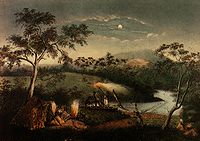
Indigenous Australians
Indigenous Australians are the original inhabitants of the Australian continent and nearby islands. The Aboriginal Indigenous Australians migrated from the Indian continent around 75,000 to 100,000 years ago....
nation of the Woiwurrung language group, in the Kulin
Kulin
The Kulin nation, was an alliance of five Indigenous Australian nations in Central Victoria, Australia, prior to European settlement. Their collective territory extended to around Port Phillip and Western Port, up into the Great Dividing Range and the Loddon and Goulburn River valleys. To their...
alliance, who occupy the Birrarung
Yarra River
The Yarra River, originally Birrarung, is a river in east-central Victoria, Australia. The lower stretches of the river is where the city of Melbourne was established in 1835 and today Greater Melbourne dominates and influences the landscape of its lower reaches...
Valley, its tributaries and the present location of Melbourne
Melbourne
Melbourne is the capital and most populous city in the state of Victoria, and the second most populous city in Australia. The Melbourne City Centre is the hub of the greater metropolitan area and the Census statistical division—of which "Melbourne" is the common name. As of June 2009, the greater...
, Australia
Australia
Australia , officially the Commonwealth of Australia, is a country in the Southern Hemisphere comprising the mainland of the Australian continent, the island of Tasmania, and numerous smaller islands in the Indian and Pacific Oceans. It is the world's sixth-largest country by total area...
. Prior to European settlement, they lived as all people of the Kulin nation lived, sustainably
Sustainability
Sustainability is the capacity to endure. For humans, sustainability is the long-term maintenance of well being, which has environmental, economic, and social dimensions, and encompasses the concept of union, an interdependent relationship and mutual responsible position with all living and non...
on the land, predominantly as hunters and gatherers, for tens of thousands of years. Seasonal changes in the weather, availability of foods and other factors would determine where campsites were located, many near the Birrarung and its tributaries.
Wurundjeri people spoke the Woiwurrung language. The term Wurundjeri is paired with the term Woiwurrung in that both refer to the same region. Wurundjeri refers to the people who occupy the territory, while Woiwurrung refers to the language group shared by the clans within the territory. The Wurundjeri peoples territory extended from north of the Great Dividing Range
Great Dividing Range
The Great Dividing Range, or the Eastern Highlands, is Australia's most substantial mountain range and the third longest in the world. The range stretches more than 3,500 km from Dauan Island off the northeastern tip of Queensland, running the entire length of the eastern coastline through...
, east to Mount Baw Baw
Mount Baw Baw
Mount Baw Baw is a mountain in Victoria, Australia. Mount Baw Baw Alpine Resort is an Unincorporated area of Victoria surrounded by the Shire of Baw Baw.-Location:...
, south to Mordialloc Creek and west to Werribee River
Werribee River
The Werribee River is located on the plain west of Melbourne, Victoria, Australia. The headwaters of a tributary, the Lerderderg River, are north of Ballan near Daylesford and it flows across the basalt plain, through the suburb of Werribee to enter Port Phillip. A linear park follows the Werribee...
. Their lands bordered the Gunai
Gunai
The Gunai or Kurnai is an Indigenous Australian nation of south-east Australia whose territory occupied most of present-day Gippsland and much of the southern slopes of the Victorian Alps. The nation was not on friendly terms with the neighbouring Wurundjeri and Bunurong nations...
/Kurnai people to the east in Gippsland
Gippsland
Gippsland is a large rural region in Victoria, Australia. It begins immediately east of the suburbs of Melbourne and stretches to the New South Wales border, lying between the Great Dividing Range to the north and Bass Strait to the south...
, the Bunurong
Bunurong
The Bunurong are Indigenous Australians of the Kulin nation, who occupy South-Central Victoria, Australia. Prior to European settlement, they lived as all people of the Kulin nation lived, sustainably on the land, predominantly as hunters and gatherers, for tens of thousands of years...
people to the south on the Mornington Peninsula
Mornington Peninsula
The Mornington Peninsula is a peninsula located south-east of Melbourne in Victoria, Australia. It is surrounded by Port Phillip to the west, Western Port to the east and Bass Strait to the south, and is connected to the mainland in the north. Geographically, the peninsula begins its protrusion...
, and the Dja Dja Wurrung
Dja Dja Wurrung
Dja Dja Wurrung, also known as the Jaara people and Loddon River tribe, is a native Aboriginal tribe which occupied the watersheds of the Loddon and Avoca Rivers in the Bendigo region of central Victoria, Australia. They were part of the Kulin alliance of tribes. There were 16 clans, which adhered...
and Taungurong
Taungurong
The Taungurong people, also known as the Daung Wurrung, were nine clans who spoke the Daungwurrung language and were part of the Kulin alliance of indigenous Australians. They lived to the north of and were closely associated with the Woiwurrung speaking Wurundjeri people...
to the north. Wurundjeri people take their name from the word wurun meaning Manna Gum (Eucalyptus viminalis) which is common along Birrarung
Yarra River
The Yarra River, originally Birrarung, is a river in east-central Victoria, Australia. The lower stretches of the river is where the city of Melbourne was established in 1835 and today Greater Melbourne dominates and influences the landscape of its lower reaches...
, and djeri, a grub found in the tree.
Pre-history
The Wurundjeri have lived in the area for up to 40,000 years, according to Gary PreslandGary Presland
Gary Presland is an Australian archaeologist and writer who studied history at La Trobe University 1973-76, and archaeology at the University of London, 1977-79. He was a staff member of the Victoria Archaeological Survey from 1983 to April 1988; his research interests are in the Aboriginal and...
. They lived by fishing, hunting and gathering, and made a good living from the rich food sources of Port Phillip
Port Phillip
Port Phillip Port Phillip Port Phillip (also commonly referred to as Port Phillip Bay or (locally) just The Bay, is a large bay in southern Victoria, Australia; it is the location of Melbourne. Geographically, the bay covers and the shore stretches roughly . Although it is extremely shallow for...
both before and after its flooding about 7,000-10,000 years ago, and the surrounding grasslands.
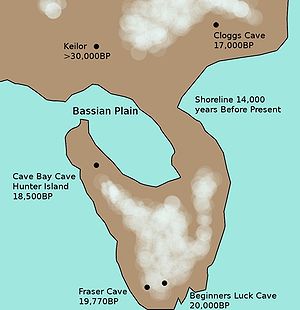
Keilor archaeological site
The Keilor archaeological site was among the first places to demonstrate the antiquity of Aboriginal occupation of Australia when a cranium, unearthed in 1940, was found to be nearly 15,000 years old. Subsequent investigations of Pleistocene alluvial terraces revealed hearths about 31,000 years BP,...
a human hearth excavated in 1971 was radiocarbon-dated to about 31,000 years BP
Before Present
Before Present years is a time scale used in archaeology, geology, and other scientific disciplines to specify when events in the past occurred. Because the "present" time changes, standard practice is to use AD 1950 as the origin of the age scale, reflecting the fact that radiocarbon...
, making Keilor one of the earliest sites of human habitation in Australia. A cranium found at the site has been dated at between 12,000 and 14,700 years BP
Before Present
Before Present years is a time scale used in archaeology, geology, and other scientific disciplines to specify when events in the past occurred. Because the "present" time changes, standard practice is to use AD 1950 as the origin of the age scale, reflecting the fact that radiocarbon...
.
Archaeological sites in Tasmania
Tasmania
Tasmania is an Australian island and state. It is south of the continent, separated by Bass Strait. The state includes the island of Tasmania—the 26th largest island in the world—and the surrounding islands. The state has a population of 507,626 , of whom almost half reside in the greater Hobart...
and on the Bass Strait
Bass Strait
Bass Strait is a sea strait separating Tasmania from the south of the Australian mainland, specifically the state of Victoria.-Extent:The International Hydrographic Organization defines the limits of the Bass Strait as follows:...
Islands have been dated to between 20,000 – 35,000 years ago, when sea levels were 130 metres below present level allowing Aboriginal people to move across the region of southern Victoria
Victoria (Australia)
Victoria is the second most populous state in Australia. Geographically the smallest mainland state, Victoria is bordered by New South Wales, South Australia, and Tasmania on Boundary Islet to the north, west and south respectively....
and on to the land bridge of the Bassian plain to Tasmania
Tasmania
Tasmania is an Australian island and state. It is south of the continent, separated by Bass Strait. The state includes the island of Tasmania—the 26th largest island in the world—and the surrounding islands. The state has a population of 507,626 , of whom almost half reside in the greater Hobart...
by at least 35,000 years ago.
During the Ice Age about 20,000 years BP
Before Present
Before Present years is a time scale used in archaeology, geology, and other scientific disciplines to specify when events in the past occurred. Because the "present" time changes, standard practice is to use AD 1950 as the origin of the age scale, reflecting the fact that radiocarbon...
, the area now known as Port Phillip would have been dry land, and the Yarra and Werribee river would have joined to flow through the heads then south and south west through the Bassian plain before meeting the ocean to the west. Tasmania and the Bass Strait islands became separated from mainland Australia around 12,000 BP
Before Present
Before Present years is a time scale used in archaeology, geology, and other scientific disciplines to specify when events in the past occurred. Because the "present" time changes, standard practice is to use AD 1950 as the origin of the age scale, reflecting the fact that radiocarbon...
, when the sea level was approximately 50m below present levels. Port Phillip was flooded by post-glacial rising sea levels between 8,000 and 6,000 years ago.
Oral history and creation stories from the Wada wurrung, Woiwurrung
Woiwurrung
Woiwurrung is an Indigenous Australian language spoken by some of the Kulin Nation clans, the Wurundjeri people, of Central Victoria, from Mount Baw Baw in the east to Mount Macedon, Sunbury and Gisborne in the west.The Woiwurrung clans inhabited the Yarra River, called Birrarung in Woiwurrung,...
and Bun wurrung
Bunurong
The Bunurong are Indigenous Australians of the Kulin nation, who occupy South-Central Victoria, Australia. Prior to European settlement, they lived as all people of the Kulin nation lived, sustainably on the land, predominantly as hunters and gatherers, for tens of thousands of years...
languages describe the flooding of the bay. Hobsons Bay was once a kangaroo hunting ground. Creation stories describe how Bunjil
Bunjil
In Australian Aboriginal mythology, Bunjil the eagle is a creator deity, culture hero and ancestral being. In the Kulin nation in central Victoria he was regarded as one of two moiety ancestors, the other being the trickster Crow. Bunjil has two wives and a son, Binbeal the rainbow. His brother...
was responsible for the formation of the bay, or the bay was flooded when the Yarra river
Yarra River
The Yarra River, originally Birrarung, is a river in east-central Victoria, Australia. The lower stretches of the river is where the city of Melbourne was established in 1835 and today Greater Melbourne dominates and influences the landscape of its lower reaches...
was created (Yarra Creation Story).
The Wurundjeri mined diorite
Diorite
Diorite is a grey to dark grey intermediate intrusive igneous rock composed principally of plagioclase feldspar , biotite, hornblende, and/or pyroxene. It may contain small amounts of quartz, microcline and olivine. Zircon, apatite, sphene, magnetite, ilmenite and sulfides occur as accessory...
at Mount William stone axe quarry
Mount William stone axe quarry
The Mount William stone axe quarry is a prehistoric aboriginal site located 9km north east of Lancefield, off Powells Track, 10 km north of Romsey and 78 km from Melbourne, Australia, in Central Victoria, at...
which was a source of the highly valued greenstone hatchet heads, which were highly prized and traded across a wide area as far as New South Wales and Adelaide. The mine provided a complex network of trading for economic and social exchange among the different aboriginal nations in Victoria. The Quarry had been in use for more than 1,500 years and covered 18 hectares including underground pits of several metres. In February 2008 the site was placed on the Australian National Heritage List
Australian National Heritage List
The Australian National Heritage List is a list of places deemed to be of outstanding heritage significance to Australia. The list includes natural, historic and indigenous places...
for its cultural importance and archeological value.
First contact
The Wurundjeri tribes would have been aware of the Europeans, through the close relationship to the Bunwurrung people of the coast who came into contact with the Baudin expeditionBaudin expedition of 1800 to 1802
The Baudin expedition of 1800 to 1803 was a French expedition to map the coast of Australia. Nicolas Baudin was selected as leader in October 1800...
on the French ship Le Naturaliste during 1801, and then the British settlement at Sullivan Bay
Sullivan Bay, Victoria
Sullivan Bay lies 60 km due south of Melbourne on Port Phillip, one kilometre east of Sorrento, Victoria. It was established as a short-lived convict settlement in 1803 by Lieutenant Colonel David Collins. The site was chosen because of its strategic location near the entrance of the Bay...
in 1803, near modern day Sorrento, Victoria
Sorrento, Victoria
Sorrento is a township in Victoria, Australia, located on the shores of Port Phillip on the Mornington Peninsula, about one and a half hours south of Melbourne...
. William Buckley
William Buckley (convict)
William Buckley was an English convict who was transported to Australia, escaped, was given up for dead and lived in an Aboriginal community for many years....
, a convict, escaped from this abortive settlement and lived for more than 30 years with the Wada wurrung people before approaching John Batman's party in 1835. He told George Langhorne in 1836:
I frequently entertained them (the Wada wurrung), when sitting around the campfires, with accounts of the English People, Houses, Ships – great guns etc. to which accounts they would listen with great attention – and express much astonishment.
The Bunwurrung people, living primarily along the Port Philip and Western Port coast, were also subjected to raids on their camps by sealers from at least 1809 to as late as 1833, which were frequently violent with men being killed and the women being abducted and enslaved by sealers for sexual partners and taken to the Islands in Bass Strait
Bass Strait
Bass Strait is a sea strait separating Tasmania from the south of the Australian mainland, specifically the state of Victoria.-Extent:The International Hydrographic Organization defines the limits of the Bass Strait as follows:...
where the sealers had their camps. This would have impacted the economic and social ties binding the Wurundjeri and Bunwurrung peoples.
James Fleming, one of the party of Charles Grimes
Charles Grimes
Charles Grimes was an English-born surveyor who did some valuable work in colonial Australia. He served as surveyor-general of New South Wales and discovered the Yarra River in what is now the state of Victoria. He is perhaps best known for being the surveyor who mapped the route of the Hobart...
in the Cumberland who explored the Maryribynong River and the Yarra River as far as Dights Falls in February 1803 reported small pox scars on several aboriginal people he met, indicating that a small pox epidemic had swept through the tribes around Port Philip before 1803 reducing the population. Broome puts forward that two epidemics of smallpox decimated the population of the Kulin
Kulin
The Kulin nation, was an alliance of five Indigenous Australian nations in Central Victoria, Australia, prior to European settlement. Their collective territory extended to around Port Phillip and Western Port, up into the Great Dividing Range and the Loddon and Goulburn River valleys. To their...
tribes by perhaps killing half each time in the 1790s and again around 1830. The Wurundjeri incorporated these epidemics in their oral tradition as the Mindye, a rainbow serpent from the Northwest sent to destroy or afflict any people for bad deeds, hissing and spreading white particles from its mouth from which disease could be inhaled.
Any plague is supposed to be brought on by the Mindye or some of its little ones. I have no doubt that, in generations gone by, there has been an awful plague of cholera or black fever, and that the wind at the time, or some other appearance from the north-west has given rise to this strange being.
Treaty
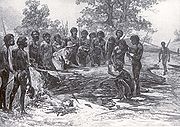
John Batman
John Batman was an Australian grazier, businessman and explorer who is best known for his role in the founding of a settlement which became Melbourne and the colony of Victoria.-Life:...
met with eight elders of the Wurundjeri people including Bebejan
Bebejan
Bebejan also known as Bebejern or Jerum Jerum, was a Ngurungaeta of the Wurundjeri people of the present day Australian state of Victoria. He was at the signing of Batman's Treaty in 1835 and signed it along with seven other tribal leaders...
and Billibellary
Billibellary
Billibellary was a song maker and influential ngurungaeta of the Wurundjeri-willam clan during the early years of European settlement of Melbourne. He was known by various names including Billi-billeri, Billibellary, Jika Jika, Jacky Jacky and Jaga Jaga...
, the traditional owners of the lands around the Yarra River. The meeting took place on the bank of a small stream, likely to be the Merri Creek
Merri Creek
The Merri Creek is a waterway in southern parts of Victoria, Australia which flows through the northern suburbs of Melbourne. It begins in Wallan north of Melbourne and flows south for 70km until it joins the Yarra River at Dights Falls...
and treaty documents were signed along with exchanges of goods by both sides. For a purchase price including tomahawks, knives, scissors, flannel jackets, red shirts and a yearly tribute
Tribute
A tribute is wealth, often in kind, that one party gives to another as a sign of respect or, as was often the case in historical contexts, of submission or allegiance. Various ancient states, which could be called suzerains, exacted tribute from areas they had conquered or threatened to conquer...
of similar items, Batman obtained about 200,000 hectares (2,000 square km) around the Yarra River and Corio Bay. The total value of the goods has been estimated at about GBP100 in the value of the day. In return the Woiwurrung offered woven baskets of examples of their weaponry and two Possum-skin cloak
Possum-skin cloak
Possum-skin cloaks were a form of clothing worn by Aborigines in the south-east of Australia – present-day Victoria and New South Wales.The cloaks were made from numerous possum pelts sewn together with kangaroo sinew, and often decorated with significant incisions on the inside such as clan...
s, a highly treasured item. After the treaty signing, a celebration took place with the Parramatta aborigines with Batman's party dancing a corroboree
Corroboree
A corroboree is a ceremonial meeting of Australian Aborigines. The word was coined by the European settlers of Australia in imitation of the Aboriginal word caribberie. At a corroboree Aborigines interact with the Dreamtime through dance, music and costume. Many ceremonies act out events from the...
.
The treaty was significant as it was the first and only documented time when European settlers negotiated their presence and occupation of aboriginal lands. The Treaty was immediately repudiated by the colonial government in Sydney. The 1835 proclamation by Governor Richard Bourke
Richard Bourke
General Sir Richard Bourke, KCB was Governor of the Colony of New South Wales, Australia between 1831 and 1837.-Early life and career:...
implemented the doctrine of "terra nullius
Terra nullius
Terra nullius is a Latin expression deriving from Roman law meaning "land belonging to no one" , which is used in international law to describe territory which has never been subject to the sovereignty of any state, or over which any prior sovereign has expressly or implicitly relinquished...
" upon which British settlement was based, reinforcing the concept that there was no land owner prior to British possession and that Aboriginal people could not sell or assign the land, and individuals could only acquire it through distribution by the Crown.
Dispossession and conflict
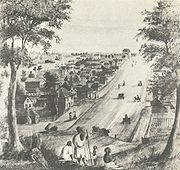
Arweet
Arweet is an important tribal position in the Boon wurrung and Wathaurong tribal peoples of the Indigenous Australian Kulin alliance who live from Western Port, Port Phillip, Geelong to Ballarat.An Arweet is a leader or headman and held a similar tribal standing as a ngurungaeta of the Wurundjeri...
of the Bunurong
Bunurong
The Bunurong are Indigenous Australians of the Kulin nation, who occupy South-Central Victoria, Australia. Prior to European settlement, they lived as all people of the Kulin nation lived, sustainably on the land, predominantly as hunters and gatherers, for tens of thousands of years...
informed the early European settlers in October 1835 of an impending attack by "up-country people". The colonists armed themselves, and the attack was averted. Benbow from the Bunurong and Billibellary
Billibellary
Billibellary was a song maker and influential ngurungaeta of the Wurundjeri-willam clan during the early years of European settlement of Melbourne. He was known by various names including Billi-billeri, Billibellary, Jika Jika, Jacky Jacky and Jaga Jaga...
, from the Wurundjeri, also acted to protect the colonists in what is perceived as part of their duty of hospitality.
In 1840, conflict erupted at the Battle of Yering
Battle of Yering
The Battle of Yering was a conflict between Indigenous Australians of the Wurundjeri nation and the Border Police which occurred on 13 January 1840, on the outskirts of Melbourne-Frontier Conflict:...
, near present day Warrandyte, in which Border Police under the direction of Commissioner of Lands Captain Henry Gisborne
Henry Fyshe Gisborne
Henry Fyshe Gisborne was the first Commissioner for Crown Lands of the Port Phillip District, founder of Flemington Racecourse and petitioner for Victoria's separation from New South Wales.-Early career:...
captured Wurundjeri leader Jaga Jaga, eliciting a violent confrontation involving 50 Wurundjeri clansmen where shots were exchanged.
As early as 1843 Billibellary requested land for the Wurundjeri to settle. In August 1850 it is likely that the Woiwurrung requested land at Bulleen, but Thomas rejected their request as being too close to white settlement. In 1852 the Woiworrung gained 782 hectares along the Yarra at Warrandyte, while the Boonwurrung were allocated 340 hectares at Mordialloc Creek. These reserves were never staffed by whites and were not permanent camps, but acted as distribution depots where rations and blankets were distributed, with the intention being to keep the tribes away from the growing settlement of Melbourne. The Aboriginal Protection Board revoked these two reserves in 1862 and 1863, considering them now too close to Melbourne.
Social impact
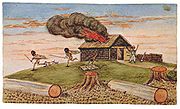
Foundation of Melbourne
The city of Melbourne was founded in 1835. The exact circumstances of the foundation of Melbourne, and the question of who should take credit, have long been matters of dispute.-Exploration:...
from 1835 onwards, with the population declining rapidly. In the 27 years following the foundation of Melbourne, the population of Woiworung and Bunurong language groups was reduced from 207 to 28 people. Many people were killed by diseases, including venereal disease, introduced by the Europeans. The birth rate also drastically declined for Wurundjeri and Bunurong with only five births between 1838 and 1848, while there were 52 deaths for the same period. Infanticide was probably happening to some degree. William Thomas remarked in 1844 that "Infanticide I am persuaded is most awfully on the increase though it cannot be detected—their argument has some reason 'No good pickaninnys now no country".
Native Police Corps
On the instructions of Charles La TrobeCharles La Trobe
Charles Joseph La Trobe was the first lieutenant-governor of the colony of Victoria .-Early life:La Trobe was born in London, the son of Christian Ignatius Latrobe, a family of Huguenot origin...
a Native Police Corps
Native Police Corps
An Australian Native Police Corps was first established in 1842 in the Port Phillip District of the Australian colony of New South Wales...
was established and underwritten by the government in 1842 in the hope of civilising the aboriginal men. It was based at Narre Warren
Narre Warren, Victoria
Narre Warren is a suburb of Melbourne, Victoria, Australia, 42 km south east from Melbourne's central business district. Its Local Government Area is the City of Casey. At the 2006 Census, Narre Warren had a population of 25,667. Narre Warren has a population density of over 2000 people per square...
, but later moved to Merri Creek
Merri Creek
The Merri Creek is a waterway in southern parts of Victoria, Australia which flows through the northern suburbs of Melbourne. It begins in Wallan north of Melbourne and flows south for 70km until it joins the Yarra River at Dights Falls...
and continued in operation until disbanded in January 1853. As senior Wurundjeri elder, Billibellary
Billibellary
Billibellary was a song maker and influential ngurungaeta of the Wurundjeri-willam clan during the early years of European settlement of Melbourne. He was known by various names including Billi-billeri, Billibellary, Jika Jika, Jacky Jacky and Jaga Jaga...
's cooperation for the proposal was important for its success, and after deliberation he backed the initiative and even proposed himself for enlistment, but resigned after about a year when he found that it was to be used to capture and even kill other natives. He did his best from then to undermine the Corps and as a result many native troopers deserted and few remained longer than three or four years. Participation in the police corps failed to stop troopers participating in tribal ceremonies, gatherings and rituals.
Coranderrk
In 1863 the surviving members of the Wurundjeri and other Woiwurrung speakers were given 'permissive occupancy' of CoranderrkCoranderrk
Coranderrk was an Indigenous Australian mission station set up in 1863 to provide land under the policy of concentration, for Aboriginal people who had been dispossessed by the arrival of Europeans to the state of Victoria 30 years prior. The mission was formally closed in 1924 with most residents...
Station, near Healesville
Healesville, Victoria
Healesville is a town in Victoria, Australia, 52 km north-east from Melbourne's central business district. Its Local Government Area is the Shire of Yarra Ranges...
and forcibly resettled. Despite numerous petitions, letters, and delegations to the Colonial and Federal Government, the grant of this land in compensation for the country lost was refused. Coranderrk was closed in 1924 and its occupants again moved to Lake Tyers
Gippsland Lakes
The Gippsland Lakes are a network of lakes, marshes and lagoons in east Gippsland, Victoria, Australia covering an area of about 600 km2. The largest of the lakes are Lake Wellington , Lake King and Lake Victoria. They are fed by the Avon, Thomson, Latrobe, Mitchell, Nicholson and Tambo...
in Gippsland
Gippsland
Gippsland is a large rural region in Victoria, Australia. It begins immediately east of the suburbs of Melbourne and stretches to the New South Wales border, lying between the Great Dividing Range to the north and Bass Strait to the south...
.
Wurundjeri today
All remaining Woiwurrung / Wurundjeri people are descendants of Bebejan, through his daughter Annie Borate (Boorat), and in turn, her son Robert Wandin (Wandoon). Bebejan was a NgurungaetaNgurungaeta
Ngurungaeta is a Wurundjeri word meaning 'head man' or 'tribal leader'. Ngurungaeta held the same tribal standing as an Arweet of the Bunurong and Wathaurong people...
of the Wurundjeri people and was present at John Batman
John Batman
John Batman was an Australian grazier, businessman and explorer who is best known for his role in the founding of a settlement which became Melbourne and the colony of Victoria.-Life:...
’s ‘treaty’ signing in 1835. Joy Murphy Wandin, a Wurundjeri Elder, explains the importance of preserving Wurundjeri culture:
In the recent past, Wurundjeri culture was undermined by people being forbidden to "talk culture" and language. Another loss was the loss of children taken from families. Now, some knowledge of the past must be found and collected from documents. By finding and doing this, Wurundjeri will bring their past to the present and recreate a place of belonging. A "keeping place" should be to keep things for future generations of our people, not a showcase for all, not a resource to earn dollars. I work towards maintaining the Wurundjeri culture for Wurundjeri people into the future.
In 1985, The Wurundjeri Tribe Land Compensation and Cultural Heritage Council
Wurundjeri Tribe Land Compensation and Cultural Heritage Council
The Wurundjeri Tribe Land and Compensation Cultural Heritage Council was established in 1985 by descendants of the Wurundjeri people who are the traditional owners of the country around Melbourne...
was established to fulfill statutory roles under Commonwealth and Victorian legislation and to assist in raising awareness of Wurundjeri culture and history within the wider community.
Wurundjeri elders often attend events with visitors present where they give the traditional welcome to country greeting in the Woiwurrung language:
- Wominjeka yearmenn koondee-bik Wurundjeri-Ballak, which simply means, Welcome to the land of the Wurundjeri people
Structure, borders and land use
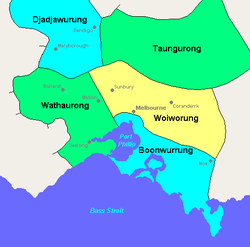
Clans
It is generally considered that prior to European settlement, six separate clans existed:- Wurundjeri-balluk & Wurundjeri-willam: Yarra Valley, Yarra River catchment area to Heidelberg
- Balluk-willam: south of the Yarra Valley extending down to Dandenong, Cranbourne, Koo-wee-rup Swamp
- Gunnung-willam-balluk: east of the Great Dividing Ranges and north to Lancefield
- Kurung-jang-balluk: Werribee River to Sunbury
- Marin-balluk (Boi-berrit): land west of the Maribyrnong River and Sunbury
- Kurnaje-berreing: the land between the Maribyrnong and Yarra Rivers
Diplomacy
When foreign people passed through or were invited onto Wurundjeri lands, the ceremony of TanderrumTanderrum
A tanderrum is a ceremony enacted by the nations of the Kulin people and other Victorian aboriginal nations allowing safe passage and temporary access and use of land and resources by foreign people...
- freedom of the bush - would be performed. This allowed safe passage and temporary access and use of land and resources by foreign people. It was a diplomatic rite involving the landholder's hospitality and a ritual exchange of gifts.
Language
The Wurundjeri people were part of the WoiwurrungWoiwurrung
Woiwurrung is an Indigenous Australian language spoken by some of the Kulin Nation clans, the Wurundjeri people, of Central Victoria, from Mount Baw Baw in the east to Mount Macedon, Sunbury and Gisborne in the west.The Woiwurrung clans inhabited the Yarra River, called Birrarung in Woiwurrung,...
language group; each clan spoke a slight variation of the Woiwurrung language. Some basic terms include;
- bulluk, balluk: swamp
- Nira: cave
- willam, wilam, Illam, yilam: hut, camp, bark
- gunung, gunnung: river
- ngamudji: red colours during sunset, white man
- The Jindyworobak MovementJindyworobak MovementThe Jindyworobak Movement was a nationalistic Australian literary movement whose white members sought to promote indigenous Australian ideas and customs, particularly in poetry. They were active from the 1930s to around the 1950s...
claim to have taken their name from a WoiwurrungWoiwurrungWoiwurrung is an Indigenous Australian language spoken by some of the Kulin Nation clans, the Wurundjeri people, of Central Victoria, from Mount Baw Baw in the east to Mount Macedon, Sunbury and Gisborne in the west.The Woiwurrung clans inhabited the Yarra River, called Birrarung in Woiwurrung,...
phrase jindi worobak meaning to annex or join.
Religion
The Wurundjeri people shared the same belief system as other KulinKulin
The Kulin nation, was an alliance of five Indigenous Australian nations in Central Victoria, Australia, prior to European settlement. Their collective territory extended to around Port Phillip and Western Port, up into the Great Dividing Range and the Loddon and Goulburn River valleys. To their...
nation territories, based on a creative epoch known as the Dreamtime
Dreamtime
In the animist framework of Australian Aboriginal mythology, The Dreaming is a sacred era in which ancestral Totemic Spirit Beings formed The Creation.-The Dreaming of the Aboriginal times:...
which stretches back into a remote era in history when the creator ancestors known as the First Peoples travelled across the land, creating and naming as they went. Indigenous Australia's oral tradition and religious values are based upon reverence for the land and a belief in this Dreamtime. The Dreaming is at once both the ancient time of creation and the present day reality of Dreaming. There were a great many different groups, each with their own individual culture, belief structure, and language. These cultures overlapped to a greater or lesser extent, and evolved over time. The two moiety totems of the Wurundjeri people are Bunjil
Bunjil
In Australian Aboriginal mythology, Bunjil the eagle is a creator deity, culture hero and ancestral being. In the Kulin nation in central Victoria he was regarded as one of two moiety ancestors, the other being the trickster Crow. Bunjil has two wives and a son, Binbeal the rainbow. His brother...
the Eaglehawk and Waang the Crow.
Dreamtime stories
- BunjilBunjilIn Australian Aboriginal mythology, Bunjil the eagle is a creator deity, culture hero and ancestral being. In the Kulin nation in central Victoria he was regarded as one of two moiety ancestors, the other being the trickster Crow. Bunjil has two wives and a son, Binbeal the rainbow. His brother...
& Pallian Creation Story: Bunjil is the Creator spirit of the Kulin People. - BirrarungYarra RiverThe Yarra River, originally Birrarung, is a river in east-central Victoria, Australia. The lower stretches of the river is where the city of Melbourne was established in 1835 and today Greater Melbourne dominates and influences the landscape of its lower reaches...
Creation Story: formation of the Birrarung River. - Mindi: Mindi is a rainbow serpent from the northwest who spreads disease to those who have been bad, but cannot act without Bunjil's permission.
Recreation
William ThomasWilliam Thomas (Australian settler)
William Thomas represented Aboriginal people in various roles in the Port Phillip district during his lifetime.-Various official roles:...
, a Protector of Aborigines
Protector of Aborigines
The role of Protectors of Aborigines resulted from a recommendation of the report of the Select Committee of the House of Commons on Aborigines . On 31 January 1838, Lord Glenelg, Secretary of State for War and the Colonies sent Governor Gipps the report.The report recommended that Protectors of...
in Victoria witnessed Wurundjeri people playing the game of Marn grook
Marn Grook
Marn Grook , literally meaning "Game ball", is a collective name given to a number of traditional Indigenous Australian recreational pastimes believed to have been played at gatherings and celebrations of up to 50 players. It is often confused with a separate indigenous game resembling Association...
in 1841, according to Robert Brough-Smyth, in The Aborigines of Victoria, (1878):
The men and boys joyfully assemble when this game is to be played. One makes a ball of possumPossumA possum is any of about 70 small to medium-sized arboreal marsupial species native to Australia, New Guinea, and Sulawesi .Possums are quadrupedal diprotodont marsupials with long tails...
skin, somewhat elastic, but firm and strong. The players of this game do not throw the ball as a white man might do, but drop it and at the same time kicks it with his foot. The tallest men have the best chances in this game. Some of them will leap as high as five feet from the ground to catch the ball. The person who secures the ball kicks it. This continues for hours and the natives never seem to tire of the exercise.
The game was a favourite of the Wurundjeri-william clan and the two teams were sometimes based on the traditional totemic moeties of Bunjil
Bunjil
In Australian Aboriginal mythology, Bunjil the eagle is a creator deity, culture hero and ancestral being. In the Kulin nation in central Victoria he was regarded as one of two moiety ancestors, the other being the trickster Crow. Bunjil has two wives and a son, Binbeal the rainbow. His brother...
(eagle) and Waang (crow). Robert Brough-Smyth saw the game played at Coranderrk
Coranderrk
Coranderrk was an Indigenous Australian mission station set up in 1863 to provide land under the policy of concentration, for Aboriginal people who had been dispossessed by the arrival of Europeans to the state of Victoria 30 years prior. The mission was formally closed in 1924 with most residents...
Mission Station, where ngurungaeta
Ngurungaeta
Ngurungaeta is a Wurundjeri word meaning 'head man' or 'tribal leader'. Ngurungaeta held the same tribal standing as an Arweet of the Bunurong and Wathaurong people...
William Barak
William Barak
William Barak , was the last traditional ngurungaeta of the Wurundjeri-willam clan, based around the area of present-day Melbourne, Australia...
discouraged the playing of imported games like cricket and encouraged the traditional native game of marn grook. There is some debate about whether the game influenced or was the origin of Australian Rules Football
Australian rules football
Australian rules football, officially known as Australian football, also called football, Aussie rules or footy is a sport played between two teams of 22 players on either...
.
As late as 1862 the Wurundjeri were "often seen in their possum skin coats, armed with spears, and retreating mainly to the unsold hill north of Collingwood where they camped with their dogs, played football with a possum-skin ball and fought with other Aborigines", according to researchers McFarlane and Roberts, reported on in the Herald Sun.
Places of significance
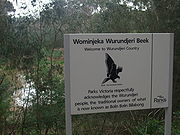
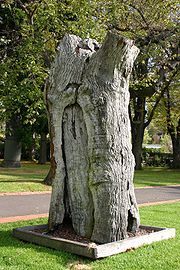
Corroboree
A corroboree is a ceremonial meeting of Australian Aborigines. The word was coined by the European settlers of Australia in imitation of the Aboriginal word caribberie. At a corroboree Aborigines interact with the Dreamtime through dance, music and costume. Many ceremonies act out events from the...
s were held between clans and perhaps neighbouring territories to share in music and dance, exchange news and trade. Other places of significance for the Wurundjeri people include:
- Kings domain Resting Place: In 1985 the remains of 38 Victorian aboriginal people held by the Museum VictoriaMuseum VictoriaMuseum Victoria is an organisation which operates three major state-owned museums in Melbourne, Victoria, Australia; these are: the Melbourne Museum, the Immigration Museum and Scienceworks. It also manages the Royal Exhibition Building and a storage facility in Melbourne's City of Moreland.Museum...
, including Wurundjeri people, were reburied here. - Queen Victoria MarketQueen Victoria MarketThe Queen Victoria Market is a major landmark in Melbourne, Australia, and at around seven hectares is the largest open air market in the Southern Hemisphere. The Market is significant to Melbourne's culture and heritage and has been listed on the Victorian Heritage Register...
: burial site for many aboriginal people as well as European settlers - Corner Franklin and Bowen streets: First public executions took place in Melbourne on 20 January 1842, of two Tasmanian aborigines: Tunnerminnerwait and Maulboyheenner, who had conducted a successful guerilla style resistance campaign around Western Port.
- Jolimont: gatherings of KulinKulinThe Kulin nation, was an alliance of five Indigenous Australian nations in Central Victoria, Australia, prior to European settlement. Their collective territory extended to around Port Phillip and Western Port, up into the Great Dividing Range and the Loddon and Goulburn River valleys. To their...
territories around the site of the MCGMcGJoseph McGinty Nichol , better known as McG, is an American director and producer of film and television, as well as a former record producer....
and Yarra ParkYarra Park, MelbourneYarra Park is part of the Melbourne Sports and Entertainment Precinct - the premier sporting precinct of Victoria, Australia. Located in Yarra Park is the Melbourne Cricket Ground and numerous sporting fields and ovals, including the associated sporting complexes of Melbourne & Olympic Parks...
. See also Fitzroy GardensFitzroy Gardens, MelbourneThe Fitzroy Gardens are 26 hectares located on the southeastern edge of the Melbourne Central Business District in East Melbourne, Victoria, Australia...
Scarred tree - Bundoora ParkBundoora, VictoriaBundoora is a suburb in Melbourne, Victoria, Australia, 16 km north from the Melbourne central business district. Its Local Government Area are the cities of Banyule, Darebin and Whittlesea. At the 2006 Census, Bundoora had a population of 24,018....
: extensively used for bark and quarrying silcrete, fifteen archeological sites in the area. - Burnley ParkBurnley, VictoriaBurnley is a suburb in Melbourne, Victoria, Australia, 4 km east from Melbourne's central business district. Its Local Government Area is the City of Yarra. At the 2006 Census, Burnley had a population of 708....
Corroboree Tree - Fawkner ParkFawkner Park, MelbourneFawkner Park is a popular park in Melbourne's South Yarra and part of the City of Melbourne. It provides recreational areas for teams playing Cricket, Softball, Soccer, Australian Rules Football, Tennis and Rugby.-History and Layout:...
: favourite camping ground - Bolin Bolin Billabong in Bulleen: location of sacred and social interaction between clans
- Gellibrand Hill and Moonee Ponds Creek Valley. A 1991 archeological survey located 31 sites, including camping grounds, silcrete outcrops and scarred trees.
- BirrarungYarra RiverThe Yarra River, originally Birrarung, is a river in east-central Victoria, Australia. The lower stretches of the river is where the city of Melbourne was established in 1835 and today Greater Melbourne dominates and influences the landscape of its lower reaches...
: the primary river flowing through the territory, a major food source and meeting place. - Warrandyte: a gorge in the middle reaches of the Birrarung, named for the actions of the dreamtimeDreamtimeIn the animist framework of Australian Aboriginal mythology, The Dreaming is a sacred era in which ancestral Totemic Spirit Beings formed The Creation.-The Dreaming of the Aboriginal times:...
figure "Bunjil" - Pound Bend, Warrandyte
- Mount William stone axe quarryMount William stone axe quarryThe Mount William stone axe quarry is a prehistoric aboriginal site located 9km north east of Lancefield, off Powells Track, 10 km north of Romsey and 78 km from Melbourne, Australia, in Central Victoria, at...
near LancefieldLancefield, VictoriaLancefield is a town in the Shire of Macedon Ranges Local government area in Victoria, Australia. The town is located north of the state capital, Melbourne and had a population of 1,184 at the 2006 census.-History:...
: tool making - Dights FallsDights FallsDights Falls is located in Melbourne, Victoria just downstream of the junction of the Yarra River with Merri Creek. At this point the river narrows and is constricted between 800,000 year old volcanic, basaltic lava flow and a much older steep, silurian, sedimentary spur...
area: meeting place for corroboreeCorroboreeA corroboree is a ceremonial meeting of Australian Aborigines. The word was coined by the European settlers of Australia in imitation of the Aboriginal word caribberie. At a corroboree Aborigines interact with the Dreamtime through dance, music and costume. Many ceremonies act out events from the...
s, Mission School location, Native Police CorpsNative Police CorpsAn Australian Native Police Corps was first established in 1842 in the Port Phillip District of the Australian colony of New South Wales... - Heide Scarred Tree, TemplestoweTemplestowe, Victoria"Templestowe" redirects here. For the Victorian Legislative Council Province, please see Templestowe Province.Templestowe is a suburb in Melbourne, Victoria, Australia, 17 km north-east from Melbourne's central business district. Its Local Government Area is the City of Manningham...
- Merri CreekMerri CreekThe Merri Creek is a waterway in southern parts of Victoria, Australia which flows through the northern suburbs of Melbourne. It begins in Wallan north of Melbourne and flows south for 70km until it joins the Yarra River at Dights Falls...
including the Treaty Site with John Batman - Solomons Ford on the Maribyrnong RiverMaribyrnong riverThe Maribyrnong River rises about 50 km north of Melbourne, Victoria , near Mount Macedon. It flows generally southward and combines with the Yarra River to flow into Port Phillip....
: location of fish and eel traps. - Lily Street Lookout, Avondale HeightsAvondale Heights, VictoriaAvondale Heights is a suburb 12 km north-west of Melbourne, Victoria, Australia. Its Local Government Area is the City of Moonee Valley. At the 2006 Census, Avondale Heights had a population of 11,074....
: location of a silcrete quarry for stoneworking - Brimbank Park, Keilor. Over 25 archeological sites.
- Taylors Creek Quarry, Keilor.
- The Sunbury earth ringsSunbury earth ringsThe Sunbury earth rings are prehistoric aboriginal sites located on hills to the west of Jacksons Creek near Sunbury, Victoria.-Description and identification:...
, SunburySunbury, VictoriaSunbury is a regional city, located north-west of Melbourne's central business district, in the state of Victoria, Australia. Its Local Government Area is the City of Hume. At the 2006 Census, Sunbury had a population of 31,000... - CoranderrkCoranderrkCoranderrk was an Indigenous Australian mission station set up in 1863 to provide land under the policy of concentration, for Aboriginal people who had been dispossessed by the arrival of Europeans to the state of Victoria 30 years prior. The mission was formally closed in 1924 with most residents...
Mission Station, Healesville
Notable Wurundjeri people
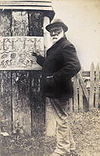
- BillibellaryBillibellaryBillibellary was a song maker and influential ngurungaeta of the Wurundjeri-willam clan during the early years of European settlement of Melbourne. He was known by various names including Billi-billeri, Billibellary, Jika Jika, Jacky Jacky and Jaga Jaga...
, (1799–1846): ngurungaetaNgurungaetaNgurungaeta is a Wurundjeri word meaning 'head man' or 'tribal leader'. Ngurungaeta held the same tribal standing as an Arweet of the Bunurong and Wathaurong people...
of the Wurundjeri-willam clan - Simon WongaSimon WongaSimon Wonga ngurungaeta and son of Billibellary, was an elder of the Wurundjeri indigenous people who lived in the Melbourne area of Australia.In 1840 Simon Wonga injured his foot in the Dandenongs...
(1824–1874): ngurungaetaNgurungaetaNgurungaeta is a Wurundjeri word meaning 'head man' or 'tribal leader'. Ngurungaeta held the same tribal standing as an Arweet of the Bunurong and Wathaurong people...
and son of Billibellary - William BarakWilliam BarakWilliam Barak , was the last traditional ngurungaeta of the Wurundjeri-willam clan, based around the area of present-day Melbourne, Australia...
(1824–1903): last traditional ngurungaetaNgurungaetaNgurungaeta is a Wurundjeri word meaning 'head man' or 'tribal leader'. Ngurungaeta held the same tribal standing as an Arweet of the Bunurong and Wathaurong people...
of the Wurundjeri-willam clan - TullamareenaTullamareenaTullamareena was a senior man of the Wurundjeri, a Koori, people of the Melbourne area, at the time of the British settlement in Victoria, Australia, in 1835. He is believed to be present at the signing of John Batman's land deal in 1835. He was known to be a resistor to British occupation of...
: present during the founding of MelbourneMelbourneMelbourne is the capital and most populous city in the state of Victoria, and the second most populous city in Australia. The Melbourne City Centre is the hub of the greater metropolitan area and the Census statistical division—of which "Melbourne" is the common name. As of June 2009, the greater... - DerrimutDerrimut (Indigenous Australian)Derrimut , was a headman or arweet of the Boonwurrung people from the Melbourne area of Australia....
(1810–1864): a BunurongBunurongThe Bunurong are Indigenous Australians of the Kulin nation, who occupy South-Central Victoria, Australia. Prior to European settlement, they lived as all people of the Kulin nation lived, sustainably on the land, predominantly as hunters and gatherers, for tens of thousands of years...
elder associated with the Woiwurrung
Other notable Wurundjeri people include:
- Joy Murphy WandinJoy Murphy WandinJoy Murphy Wandin is an Indigenous Australian, Senior Wurundjeri elder of the Kulin alliance in Victoria, Australia. She has given the traditional welcome to country greeting at many Melbourne events and to many distinguished visitors where she says in the Woiwurrung language "Wominjeka Wurundjeri...
: senior elder - James WandinJames WandinJames Wandin , also known as Jim, Jimmy, or Juby, was the ngurungaeta of the Wurundjeri till his death in February 2006...
(1933–2006): ngurungaeta and Australian Rules Footballer - MurrundindiMurrundindiMurrundindi is the ngurungaeta of the Wurundjeri people, a descendant of William Barak. He succeeded James Wandin in this position in February 2006....
: ngurungaeta from 2006
See also
- Wurundjeri Tribe Land Compensation and Cultural Heritage CouncilWurundjeri Tribe Land Compensation and Cultural Heritage CouncilThe Wurundjeri Tribe Land and Compensation Cultural Heritage Council was established in 1985 by descendants of the Wurundjeri people who are the traditional owners of the country around Melbourne...
- Batman's TreatyBatman's TreatyBatman's Treaty was a document signed on 6 June 1835 by John Batman, an Australian grazier, businessman and explorer, and a group of Wurundjeri elders, for the purchase of land around Port Phillip, near the present site of the city of Melbourne...
- Indigenous AustraliansIndigenous AustraliansIndigenous Australians are the original inhabitants of the Australian continent and nearby islands. The Aboriginal Indigenous Australians migrated from the Indian continent around 75,000 to 100,000 years ago....
- Australian Aboriginal enumerationAustralian Aboriginal enumerationA common misconception among non-Aboriginals is that Aboriginals did not have a way to count beyond two or three. However, Alfred Howitt, who studied the peoples of southeastern Australia, disproved this in the late nineteenth century, although the myth continues in circulation today.The...
- Battle of YeringBattle of YeringThe Battle of Yering was a conflict between Indigenous Australians of the Wurundjeri nation and the Border Police which occurred on 13 January 1840, on the outskirts of Melbourne-Frontier Conflict:...
- Possum-skin cloakPossum-skin cloakPossum-skin cloaks were a form of clothing worn by Aborigines in the south-east of Australia – present-day Victoria and New South Wales.The cloaks were made from numerous possum pelts sewn together with kangaroo sinew, and often decorated with significant incisions on the inside such as clan...
- BunurongBunurongThe Bunurong are Indigenous Australians of the Kulin nation, who occupy South-Central Victoria, Australia. Prior to European settlement, they lived as all people of the Kulin nation lived, sustainably on the land, predominantly as hunters and gatherers, for tens of thousands of years...
- GunaiGunaiThe Gunai or Kurnai is an Indigenous Australian nation of south-east Australia whose territory occupied most of present-day Gippsland and much of the southern slopes of the Victorian Alps. The nation was not on friendly terms with the neighbouring Wurundjeri and Bunurong nations...