
All Topics  
Batman


   Email Print
   Bookmark   Link


Batman


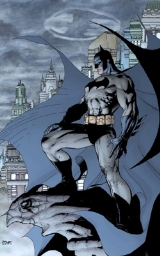
Batman (originally referred to as the Bat-Man and still referred to at times as the Batman) is a fictionalFictional character Summary

A fictional character is any person who appears in a work of fiction....
 comic bookComic book

A comic book or comicbook is a magazine or book containing sequential art in the form of a narrative....
 superheroSuperhero

A superhero is a fictional character who is noted for feats of courage and nobility, who usually possesses abilities beyond ...
 co-created by artist Bob KaneBob Kane

Bob Kane is an American comic book artist and writer credited as the creator of Batman. ...
 and writer Bill FingerBill Finger

Bill Finger was an American writer who is best remembered as the co-creator of the character Batman with Bob Kane as well a...
 (although only Kane receives official credit) and published by DC ComicsDC Comics

DC Comics is one of the largest American companies in comic book and related media publishing....
. The character first appeared in Detective ComicsDetective Comics

Detective Comics is a comic book published by DC Comics since 1937....
#27 (May 1939). Batman's secret identitySecret identity

A secret identity is the practice of hiding a person's identity so the actual identity of the person is not known or suspect...
 is Bruce Wayne, a wealthy industrialistBusiness magnate Summary

A business magnate, sometimes referred to as a mogul, tycoon, or industrialist is a person who controls a ...
, , and philanthropistPhilanthropy

Philanthropy is the act of donating money or goods, or volunteering one's time and effort, to support a charitable cause, us...
. Witnessing the murder of his parents as a child leads him to train himself to physical and intellectual perfection and don a bat-themed costume in order to fight crime. Batman operates in the fictional Gotham CityGotham City

Gotham City is a fictional city appearing in DC Comics, and is best known as the home of Batman....
, assisted by various supporting characters including his sidekick RobinRobin (comics)

Robin is a fictional character published by DC Comics....
 and his butler Alfred PennyworthAlfred Pennyworth

Alfred Pennyworth is a fictional supporting character in the DC Comics' Batman series....
, and fights an assortment of villains influenced by the characters' roots in film and pulp magazinePulp magazine

Pulp magazines were inexpensive fiction magazines....
s.


Discussion
Ask a question about 'Batman'
Start a new discussion about 'Batman'
Answer questions from other users
Full Discussion Forum


Timeline

1937   The first issue of the comic book ''Detective Comics'' is published in the United States. Twenty-seven issues later, ''Detective Comics'' would introduce Batman. The comic would go on to become the longest continually-published comic magazine in American history; it is still published as of 2006.

1939   Batman created by Bob Kane (and, unofficially, Bill Finger).


Quotations


The Joel Schumacher films.

The Tim Burton films.

Batman (1989), Batman Returns (1992)

Early cinema.

Batman (1943)

The camp years, featuring Adam West and Burt Ward.

Batman (1966–1968 TV series), Batman (1966 film)

Animated revival.

(aka The Adventures of Batman and Robin) (1992–1995), Batman Beyond (1999–2001), The Batman (2004–)


Encyclopedia


Batman (originally referred to as the Bat-Man and still referred to at times as the Batman) is a fictionalFictional character Summary

A fictional character is any person who appears in a work of fiction....
 comic bookComic book

A comic book or comicbook is a magazine or book containing sequential art in the form of a narrative....
 superheroSuperhero

A superhero is a fictional character who is noted for feats of courage and nobility, who usually possesses abilities beyond ...
 co-created by artist Bob KaneBob Kane

Bob Kane is an American comic book artist and writer credited as the creator of Batman. ...
 and writer Bill FingerBill Finger

Bill Finger was an American writer who is best remembered as the co-creator of the character Batman with Bob Kane as well a...
 (although only Kane receives official credit) and published by DC ComicsDC Comics

DC Comics is one of the largest American companies in comic book and related media publishing....
. The character first appeared in Detective ComicsDetective Comics

Detective Comics is a comic book published by DC Comics since 1937....
#27 (May 1939). Batman's secret identitySecret identity

A secret identity is the practice of hiding a person's identity so the actual identity of the person is not known or suspect...
 is Bruce Wayne, a wealthy industrialistBusiness magnate Summary

A business magnate, sometimes referred to as a mogul, tycoon, or industrialist is a person who controls a ...
, , and philanthropistPhilanthropy

Philanthropy is the act of donating money or goods, or volunteering one's time and effort, to support a charitable cause, us...
. Witnessing the murder of his parents as a child leads him to train himself to physical and intellectual perfection and don a bat-themed costume in order to fight crime. Batman operates in the fictional Gotham CityGotham City

Gotham City is a fictional city appearing in DC Comics, and is best known as the home of Batman....
, assisted by various supporting characters including his sidekick RobinRobin (comics)

Robin is a fictional character published by DC Comics....
 and his butler Alfred PennyworthAlfred Pennyworth

Alfred Pennyworth is a fictional supporting character in the DC Comics' Batman series....
, and fights an assortment of villains influenced by the characters' roots in film and pulp magazinePulp magazine

Pulp magazines were inexpensive fiction magazines....
s. Unlike most superheroes, he does not possess any superpowersSuperpower (ability)

Superpowers is another term for superhuman abilities, that is, any abilities that a human does not possess in real life....
; he makes use of intellect, detective skills, science and technology, wealth, physical prowess, and torture in his war on crime.

Batman became a popular character soon after his introduction, and eventually gained his own title, BatmanBatman (comic book)

The DC Comics superhero Batman first appeared in Detective Comics #27 in May 1939....
. As the decades wore on, differing takes on the character emerged. The late 1960s BatmanBatman (TV series)

Batman was the title of an exceptionally popular 1960s American television series which replaced the long-running "Adven...
 television seriesTelevision program

A television program, television programme or simply television show is a segment of programming in television b...
 utilized a campCamp (style)

Camp is an aesthetic in which something has appeal not because of its originality, but because of its unoriginality, bad...
 aesthetic associated with the character for years after the show ended. Various creators worked to return the character to his dark roots, culminating in the 1986 miniseries , by writer-artist Frank MillerFrank Miller (comics)

Frank Miller is an American writer, artist and film director best known for his film noir-style comic book stories....
. The successes of directorFilm director

A film director is a person who directs the making of a film....
 Tim BurtonTim Burton

Timothy William Burton is an American film director, writer and designer known for his off-beat and quirky style....
's 1989 Batman motion pictureBatman (1989 film)

Batman is a 1989 Academy Award-winning superhero film based on the Batman character created by Bob Kane and Bill Finger ...
 and Christopher NolanChristopher Nolan

Christopher Nolan is an English film director, writer and producer....
's films Batman BeginsBatman Begins

Batman Begins is a 2005 Academy Award-nominated superhero film based on the Batman character created by Bob Kane and Bil...
and The Dark KnightThe Dark Knight (film)

The Dark Knight is a 2008 superhero film based on the fictional DC Comics character Batman....
also helped to reignite popular interest in the character. A cultural icon, Batman has been licensed and adapted into a variety of media, from radio to television and film, and appears on a variety of merchandise sold all over the world.

Publication history

Creation

In early 1938, the success of SupermanSuperman

Superman is a fictional character regarded as one of the most famous and popular comic book superheroes of all time, and one...
 in Action ComicsAction Comics

Action Comics is the comic book series that introduced Superman, the first major superhero character as the term is popu...
prompted editors at the comic book division of National PublicationsNational Publications

National Publications was one of the companies that would later become DC Comics....
 (the future DC Comics) to request more superheroes for its titles. In response, Bob KaneBob Kane

Bob Kane is an American comic book artist and writer credited as the creator of Batman. ...
 created "the Bat-Man". Collaborator Bill FingerBill Finger Overview

Bill Finger was an American writer who is best remembered as the co-creator of the character Batman with Bob Kane as well a...
 recalled Kane
Finger offered such suggestions as giving the character a cowl instead of a simple domino maskDomino mask

A domino mask is a small, rounded mask covering only the eyes and the space between them....
, a cape instead of wings, and gloves, and removing the red sections from the original costume.. Finger said he devised the name Bruce Wayne for the character's secret identity: "Bruce Wayne's first name came from Robert BruceRobert I of Scotland

Robert I, , usually known in modern English today as Robert the Bruce , was King of Scotland ....
, the ScottishScotland

Scotland is a nation in northwest Europe and one of the constituent countries of the United Kingdom....
 patriot. Wayne, being a playboy, was a man of gentry. I searched for a name that would suggest colonialism. I tried Adams, Hancock ... then I thought of Mad Anthony WayneAnthony Wayne Overview

Anthony Wayne, was a United States Army general and statesman....
". Various aspects of Batman's personality, character history, visual design and equipment were inspired by contemporary popular culture of the 1930s, including movies, pulp magazines, comic strips, newspaper headlines, and even aspects of Kane himself. Kane noted especially the influence of the films The Mark of ZorroThe Mark of Zorro (1920 film)

The Mark of Zorro is a silent motion picture released in 1920 starring Douglas Fairbanks....
(1920) and The Bat WhispersThe Bat Whispers Overview

The Bat Whispers is a 1930 film directed by Roland West....
(1930) in the creation of the iconography associated with the character, while Finger drew inspiration from literary characters Doc SavageDoc Savage

Doc Savage is a fictional character, one of the most enduring pulp heroes of the 1930s and 1940s, created by Lester Dent. ...
, The ShadowThe Shadow Overview

The Shadow is a fictional crime fighter created by Walter B....
, and Sherlock HolmesSherlock Holmes

Sherlock Holmes is a fictional detective of the late 19th and early 20th centuries, who made his first published appearance in 188...
 in his depiction of Batman as a master sleuth and scientist.

Kane himself, in his 1989 autobiographyAutobiography

An autobiography, from the Greek auton, 'self', bios, 'life' and graphein, 'write', is a biography written by th...
, detailed Finger's contributions to Batman creation:

Kane signed away ownership in the character in exchange for, among other compensation, a mandatory byline on all Batman comics. This byline did not, originally, say "Batman created by Bob Kane"; his name was simply written on the title page of each story. The name disappeared from the comic book in the mid-1960s, replaced by credits for each story's actual writer and artists. In the late 1970s, when Jerry SiegelJerry Siegel

Jerome Siegel a.k.a. Joe Carter was the co-creator of Superman, the first of the great comic book superheroes and one ...
 and Joe ShusterJoe Shuster

Joseph "Joe" Shuster was a Canadian-born artist best known for co-creating Superman with Jerry Siegel....
 began receiving a "created by" credit on the Superman titles, along with William Moulton MarstonWilliam Moulton Marston

Dr. William Moulton Marston was a psychologist, feminist theorist, and comic book writer / co-creator of the "Wonder Woman" ...
 being given the byline for creating Wonder WomanWonder Woman

Wonder Woman is a fictional DC Comics superheroine co-created by William Moulton Marston and wife Elizabeth Holloway Marston...
, Batman stories began saying "Created by Bob Kane" in addition to the other credits.

Finger did not receive the same recognition. While he had received credit for other DC work since the 1940s, he began, in the 1960s, to receive limited acknowledgment for his Batman writing; in the letters page of Batman #169 (Feb. 1965) for example, editor Julius SchwartzJulius Schwartz

Julius "Julie" Schwartz was a comic book and pulp magazine editor, and a science fiction agent and prominent fan....
 names him as the creator of the RiddlerFacts About Riddler

The Riddler,, is a DC Comics supervillain and an enemy of Batman....
, one of Batman's recurring villains. However, Finger's contract left him only with his writing page rate and no byline. Kane wrote, "Bill was disheartened by the lack of major accomplishments in his career. He felt that he had not used his creative potential to its fullest and that success had passed him by". At the time of Finger's death in 1974, DC had not officially credited Finger as Batman co-creator.

Jerry RobinsonJerry Robinson

Jerome "Jerry" Robinson , is an American comic book artist best known for his work on the Batman line of books during the G...
, who also worked with Finger and Kane on the strip at this time, has criticized Kane for failing to share the credit. He recalled Finger resenting his position, stating in a 2005 interview with The Comics JournalThe Comics Journal

The Comics Journal, often abbreviated TCJ, is a US magazine of news and criticism pertaining to comic books an...
,

Although Kane initially rebutted Finger's claims at having created the character, writing in a 1965 open letter to fans that "it seemed to me that Bill Finger has given out the impression that he and not myself created the Batman, t' [sicSIC

SIC, SiC, or Sic may mean:...
] as well as Robin and all the other leading villains and characters. This statement is fraudulent and entirely untrue." Kane himself also commented on Finger's lack of credit. "The trouble with being a 'ghost' writer or artist is that you must remain rather anonymously without 'credit'. However, if one wants the 'credit', then one has to cease being a 'ghost' or follower and become a leader or innovator". In 1989, Kane revisited Finger's situation, recalling in an interview,

Early years

The first Batman story, "The Case of the Chemical Syndicate," was published in Detective Comics #27 (May 1939). Finger said, "Batman was originally written in the style of the pulps", and this influence was evident with Batman showing little remorse over killing or maiming criminals and was not above using firearms. Batman proved a hit character, and he received his own solo title in 1940, while continuing to star in Detective Comics. By that time, National was the top-selling and most influential publisher in the industry; Batman and the company's other major hero, Superman, were the cornerstones of the company's success. The two characters were featured side-by-side as the stars of World's Finest ComicsWorld's Finest Comics

World's Finest Comics was a comic book series published by DC Comics from 1941 to 1986....
, which was originally titled World's Best Comics when it debuted in fall 1940. Creators including Jerry RobinsonJerry Robinson

Jerome "Jerry" Robinson , is an American comic book artist best known for his work on the Batman line of books during the G...
 and Dick SprangDick Sprang

Richard W. "Dick" Sprang , was an American comic book artist and penciller, most known for his work on the Batman line o...
 also worked on the strips during this period.

Over the course of the first few Batman strips elements were added to the character and the artistic depiction of Batman evolved. Kane noted that within six issues he drew the character's jawline more pronounced, and lengthened the ears on the costume. "About a year later he was almost the full figure, my mature Batman," Kane said. Batman's characteristic utility belt was introduced in Detective Comics #29 (July 1939), followed by the boomerangBoomerang

A boomerang is a simple wooden implement used for various purposes....
-like batarang and the first bat-themed vehicle in #31 (Sept. 1939).

The character's origin was revealed in #33 (Nov. 1939), unfolding in a two-page story that establishes the brooding persona of Batman, a character driven by the loss of his parents. Written by Finger, it depicts a young Bruce Wayne witnessing the death of his parents as part of a street robbery. Days later, at their grave, the child vows that "by the spirits of my parents [I will] avenge their deaths by spending the rest of my life warring on all criminals". The early, pulp-inflected portrayal of Batman started to soften in Detective Comics #38 (April 1940) with the introduction of Robin, Batman's kid sidekick. Robin was introduced based on Finger's suggestion Batman needed a "WatsonDoctor Watson

Dr. John H. Watson is a fictional character, the friend and confidante of Sherlock Holmes, the fictional 19th century detect...
" with whom Batman could talk. Sales nearly doubled, despite Kane's preference for a solo Batman, and it sparked a proliferation of "kid sidekicks". The first issue of the solo spin-off series BatmanBatman (comic book)

The DC Comics superhero Batman first appeared in Detective Comics #27 in May 1939....
was notable not only for introducing two of his most persistent antagonists, the JokerJoker (comics)

The Joker is a fictional character, a DC Comics supervillain widely considered to be Batman's archenemy....
 and CatwomanCatwoman

Catwoman is a DC Comics character, associated with the Batman franchise and created by Bill Finger and Bob Kane....
, but for a story in which Batman shoots some monstrous giants to death. That story prompted editor Whitney EllsworthWhitney Ellsworth

Fredric Whitney Ellsworth was an American comic book editor, and sometime writer and artist for DC Comics during the period ...
 to decree that the character could no longer kill or use a gun.

By 1942, the writers and artists behind the Batman comics had established most of the basic elements of the Batman mythos. In the years following World War IIWorld War II

World War II, or the Second World War, was a worldwide conflict fought between the Allied Powers and the Axis Powers ,...
, DC Comics "adopted a postwar editorial direction that increasingly de-emphasized social commentary in favor of lighthearted juvenile fantasy". The impact of this editorial approach was evident in Batman comics of the postwar period; removed from the "bleak and menacing world" of the strips of the early 1940s, Batman was instead portrayed as a respectable citizen and paternal figure that inhabited a "bright and colorful" environment.

1950-1963

Batman was one of the few superhero characters to be continuously published as interest in the genre waned during the 1950s. In the story "The Mightiest Team In the World" in SupermanSuperman (comic book)

Superman began as a feature in the National Periodical Publications comic book Action Comics #1....
#76 (June 1952), Batman teams up with Superman for the first time and the pair discovers each other's secret identity. Following the success of this story, World's Finest Comics was revamped so it featured stories starring both heroes together, instead of the separate Batman and Superman features that had been running before. The team-up of the characters was "a financial success in an era when those were few and far between;" this series of stories ran until the book's cancellation in 1986.

Batman comics were among those criticized when the comic book industry came under scrutiny with the publication of psychologist Fredric WerthamFredric Wertham

...
's book Seduction of the InnocentSeduction of the Innocent

Seduction of the Innocent was a book by Dr....
in 1954. Wertham's thesis was that children imitated crimes committed in comic books, and that these works corrupt the morals of the youth. Wertham criticized Batman comics for their supposed homosexual overtones and argued that Batman and Robin were portrayed as lovers. Wertham's criticisms raised a public outcry during the 1950s, eventually leading to the establishment of the Comics Code AuthorityComics Code Authority

The Comics Code Authority is part of the Comics Magazine Association of America, and was created to regulate the content of ...
. The tendency towards a "sunnier Batman" in the postwar years intensified after the introduction of the Comics Code. It has also been suggested by scholars that the characters of BatwomanBatwoman

Batwoman is a fictional character, the female counterpart to DC Comics' popular superhero Batman....
 (in 1956) and Bat-GirlBette Kane

Bette Kane is a fictional character in DC comics....
 (in 1961) were introduced in part to refute the allegation that Batman and Robin were gay, and the stories took on a campier, lighter feel.

In the late 1950s Batman stories gradually become more science fictionScience fiction

Science fiction is a popular genre of fiction in which the narrative world differs from our own present or historical reali...
-oriented, an attempt at mimicking the success of other DC characters that had dabbled in the genre. New characters such as Batwoman, Ace the Bat-HoundAce the Bat-Hound

The comic book character Ace the Bat-Hound was the canine crime-fighting partner of Batman and Robin in DC Comics of the 195...
, and Bat-MiteBat-Mite

Bat-Mite is a fictional character appearing in comic book stories published by DC Comics....
 were introduced. Batman's adventures often involved odd transformations or bizarre space aliens.

In 1960, Batman debuted as a member of the Justice League of AmericaJustice League

The Justice League, sometimes called the Justice League of America or JLA for short, is a fictional DC Universe ...
 in The Brave and the BoldThe Brave and the Bold

The Brave and the Bold was a DC Comics comic book which was published from August 1955 to July 1983....
#28 (February 1960), and went on to appear in several Justice League comic series starting later that same year.

The Dark Knight Returns and modern Batman (1986–present)

Frank MillerFrank Miller (comics)

Frank Miller is an American writer, artist and film director best known for his film noir-style comic book stories....
's 1986 limited seriesLimited series

The limited series is a term referring to a comic book series with a set finite number of issues....
 , which tells the story of a 50-year-old Batman coming out of retirement in a possible future, reinvigorated the character. The Dark Knight Returns was a financial success and has since become one of the medium's most noted touchstones. The series also sparked a major resurgence in the character's popularity. That year Dennis O'Neil took over as editor of the Batman titles and set the template for the portrayal of Batman following DC's status quo-altering miniseries Crisis on Infinite EarthsCrisis on Infinite Earths Overview

Crisis on Infinite Earths was a 12-issue comic book limited series and crossover event, produced by DC Comics in 1985 i...
. O'Neil operated under the assumption that he was hired to revamp the character and as a result tried to instill a different tone in the books than had gone before. One outcome of this new approach was the "" storyline in Batman #404-407 (Feb.-May 1987), in which Frank Miller and artist David MazzucchelliDavid Mazzucchelli

David Mazzucchelli is an American comic book artist and illustrator....
 redefined the character's origins. Writer Alan MooreAlan Moore Overview

Alan Moore is an English writer most famous for his work in comics, including the acclaimed graphic novels, Watchmen, '...
 and artist Brian BollandBrian Bolland

Brian Bolland is a British comics artist, famous for his confident linework and eye catching compositions....
 continued this dark trend with 1988's 48-page one-shot , in which the Joker, attempting to drive Commissioner Gordon insane, cripples Gordon's daughter BarbaraBarbara Gordon

Barbara Gordon is a fictional character appearing in DC Comics and related media....
, and then kidnaps and tortures the commissioner, physically and psychologically.

The Batman comics garnered major attention in 1988 when DC Comics created a 900 numberPremium-rate telephone number

Premium-rate telephone numbers are telephone numbers for telephone calls during which certain services are provided, and for...
 for readers to call to vote on whether Jason ToddJason Todd

Jason Todd is a fictional character in the DC Comics Universe....
, the second Robin, lived or died. Voters decided in favor of Jason's death by a narrow margin of 28 votes (see ). The following year saw the release of Tim BurtonTim Burton

Timothy William Burton is an American film director, writer and designer known for his off-beat and quirky style....
's Batman feature film, which firmly brought the character back to the public's attention, grossing millions of dollars at the box office, and millions more in merchandising. In the same year, the first issue of Legends of the Dark KnightLegends of the Dark Knight

Batman: Legends of the Dark Knight, commonly referred to as simply Legends of the Dark Knight is a DC comic bo...
, the first new solo Batman title in nearly fifty years, sold close to a million copies. 1993's "Knightfall" arc introduced a new villain, BaneBane (comics)

Bane is the DC Comics supervillain best known for having broken Batman's back....
, who critically injures Batman. Jean-Paul Valley, known as AzraelAzrael (comics)

Azrael is a fictional character from DC Comics....
, is called upon to wear the Batsuit during Bruce Wayne's convalescence. Writers Doug MoenchDoug Moench

Doug Moench is an American comic book writer....
, Chuck DixonChuck Dixon

Chuck Dixon is an American comic book writer, perhaps best-known for long runs on Batman titles in the 1990s....
, and Alan Grant worked on the Batman titles during "Knightfall", and would also contribute to other Batman crossovers throughout the 1990s. 1998's "Cataclysm" storyline served as the precursor to 1999's "No Man's Land", a year-long storyline that ran through all the Batman-related titles dealing with the effects of an earthquakeFacts About Earthquake

An earthquake is a phenomenon that results from and is powered by the sudden release of stored energy that radiates seismic ...
-ravaged Gotham City. At the conclusion of "No Man's Land", O'Neil stepped down as editor and was replaced by Bob Schreck. In 2003, writer Jeph LoebJeph Loeb

Joseph "Jeph" Loeb III is an American comic book writer, screen and television writer as well as television and motion pictu...
 and artist Jim LeeJim Lee

Jim Lee is a Korean American comic book artist, writer, creator and publisher....
 began a "", a 12-issue run on Batman that introduced a new villain, Hush, guest-starred every major supporting character and Batman villain, and laid the groundwork for the return of Jason Todd. Lee's first regular comic book work in nearly a decade, the series became #1 on the Diamond Comic DistributorsDiamond Comic Distributors

Diamond Comic Distributors, Inc. is the largest comic book distributor serving North America....
 sales chart for the first time since Batman #500 (Oct. 1993). Lee then teamed with Frank Miller on All-Star Batman and Robin, which debuted with the best-selling issue in 2005, as well as the highest sales in the industry since 2003. Batman was featured in major roles in DC's 2005 company-wide crossover Identity CrisisIdentity Crisis (comics) Summary

Identity Crisis is a seven-issue comic book limited series published by DC Comics in 2004, written by Brad Meltzer and p...
and 2006's Infinite CrisisInfinite Crisis Overview

Infinite Crisis was a seven-issue comic book limited series published by DC Comics....
. Starting in 2006, the regular writers on Batman and Detective Comics were Grant MorrisonGrant Morrison

Grant Morrison is a Scottish comic book writer and artist....
 and Paul DiniPaul Dini

Paul Dini is an American television producer of animated cartoons....
, respectively.

Fictional character history

Batman's history has undergone various revisions, both minor and major. Few elements of the character's history have remained constant. Scholars William Uricchio and Roberta E. Pearson noted in the early 1990s, "Unlike some fictional characters, the Batman has no primary urtext set in a specific period, but has rather existed in a plethora of equally valid texts constantly appearing over more than five decades."

The central fixed event in the Batman stories is the character's origin storyOrigin story

In comic book terminology, the phrase origin story refers to a story or backstory revealing how a character or team gained s...
. As a little boy, Bruce Wayne is horrified and traumatized to see his parents, the physician Dr. Thomas WayneThomas Wayne

Thomas Wayne is a fictional character of the Batman series of comic books....
 and his wife MarthaMartha Wayne

Martha Wayne is a fictional DC Comics' character of the Batman series of comic books....
, being murdered by a muggerMugging

Mugging is a type of robbery, in which the perpetrator accosts the victim in a public place, such as a street or parking lot...
 in front of his very eyes. This drives him to fight crime in Gotham CityGotham City

Gotham City is a fictional city appearing in DC Comics, and is best known as the home of Batman....
 as Batman. In later years, June 26th becomes the established date (Batman Confidential #14) that the murder occurred, and the Batman annually visits the spot in Crime Alley where his parents died.

Pearson and Uricchio also noted beyond the origin story and such events as the introduction of Robin, "Until recently, the fixed and accuring and hence, canonized, events have been few in number," a situation altered by an increased effort by later Batman editors such as Dennis O'Neil to ensure consistency and continuity between stories.

Golden Age

In Batman's first appearance in Detective Comics #27, he is already operating as a crime fighter. Batman's origin is first presented in Detective Comics #33 in November 1939, and is later fleshed out in Batman #47. As these comics state, Bruce Wayne is born to Dr. Thomas Wayne and his wife Martha, two very wealthy and charitable Gotham CityGotham City

Gotham City is a fictional city appearing in DC Comics, and is best known as the home of Batman....
 socialites. Bruce is brought up in Wayne Manor, with its wealthy splendor, and leads a happy and privileged existence until the age of eight, when his parents are killed by a small-time criminal named Joe ChillJoe Chill

Joe Chill is a fictional character in the DC Comics Batman series....
 whilst on their way home from a movie theater. Bruce Wayne swears an oath to rid the city of the evil that had taken his parents' lives. He engages in intense intellectual and physical training; however, he realizes that these skills alone would not be enough. "Criminals are a superstitious and cowardly lot", Wayne remarks, "so my disguise must be able to strike terror into their hearts. I must be a creature of the night, black, terrible..." As if responding to his desires, a bat suddenly flies through the window, inspiring Bruce to assume the persona of Batman.

In early strips, Batman's career as a vigilante initially earns him the ire of the police. During this period Wayne has a fiancée named Julie MadisonJulie Madison Summary

Julie Madison is a DC Comics fictional character who appeared in early issues of Detective Comics featuring Batman....
. Wayne takes in an orphaned circus acrobat, Dick Grayson, who becomes his sidekick, Robin. Batman also becomes a founding member of the Justice Society of AmericaJustice Society of America

The Justice Society of America, or JSA, is a DC Comics superhero group, the first team of superheroes in comic book hi...
, although he, like Superman, is an honorary member, and thus only participates occasionally. Batman's relationship with the law thaws quickly, and he is made an honorary member of Gotham City's police departmentGotham City Police Department

The Gotham City Police Department is a fictional police department servicing the city of Gotham City in the DC Universe....
. During this time, butler Alfred arrives at Wayne Manor, and after deducing the Dynamic Duo's secret identities joins their service.

Modern Batman

After the 12-issue limited seriesLimited series Summary

The limited series is a term referring to a comic book series with a set finite number of issues....
 Crisis on Infinite Earths, DC Comics rebootedRetcon

Retroactive continuity commonly contracted to the portmanteau retcon is the adding of new information to "historical...
 the histories of some major characters in an attempt at updating them for contemporary audiences. Frank Miller retold Batman's origin in the storyline from Batman #404-407, which emphasizes a grittier tone in the character. Though the Earth-Two Batman is erased from history, many stories of Batman's Silver Age/Earth-One career (along with an amount of Golden Age ones) remain canonical in the post-Crisis universe, with his origins remaining the same in essence, despite alteration. For example, Gotham's police are mostly corrupt, setting up further need for Batman's existence. While Dick Grayson's past remains much the same, the history of Jason ToddJason Todd

Jason Todd is a fictional character in the DC Comics Universe....
, the second Robin, is altered, turning the boy into the orphan son of a petty crook, who tries to steal the tires from the Batmobile. Also removed is the guardian Phillip Wayne, leaving young Bruce to be raised by Alfred. Additionally, Batman is no longer a founding member of the Justice League of America, although he becomes leader for a short time of a new incarnation of the team launched in 1987. To help fill in the revised backstory for Batman following Crisis, DC launched a new Batman title called Legends of the Dark KnightLegends of the Dark Knight Overview

Batman: Legends of the Dark Knight, commonly referred to as simply Legends of the Dark Knight is a DC comic bo...
in 1989 and has published various miniseries and one-shot stories since then that largely take place during the "Year One" period. Various stories from Jeph LoebJeph Loeb

Joseph "Jeph" Loeb III is an American comic book writer, screen and television writer as well as television and motion pictu...
 and Matt WagnerMatt Wagner

Matt Wagner is an American comic book writer and artist best known as the creator of two irregular series, Mage and Gr...
 also touch upon this era.

In 1988's "" storyline from Batman #426-429 Jason Todd, the second Robin, is killed by the Joker. Subsequently Batman begins exhibiting an excessive, reckless approach to his crime fighting, a result of the pain of losing Jason Todd. Batman works solo until the decade's close, when Tim Drake becomes the new Robin. In 2005 writers resurrected the Jason Todd character and have pitted him against his former mentor.

Many of the major Batman storylines since the 1990s have been inter-title crossovers that run for a number of issues. In 1993, the same year that DC published the "Death of Superman" storyline, the publisher released the "Knightfall" storyline. In the storyline's first phase, the new villain Bane paralyzes Batman, leading Wayne to ask Azrael to take on the role. After the end of "Knightfall", the storylines split in two directions, following both the Azrael-Batman's adventures, and Bruce Wayne's quest to become Batman once more. The story arcs realign in "KnightsEnd", as Azrael becomes increasingly violent and is defeated by a healed Bruce Wayne. Wayne hands the Batman mantle to Dick Grayson (then Nightwing) for an interim period, while Wayne trains to return to his role as Batman.

1994's company-wide crossover Zero HourZero Hour (comics)

Zero Hour was a 1994 comic book miniseries and crossover storyline that ran in DC Comics....
changes aspects of DC continuity again, including those of Batman. Noteworthy among these changes is that the general populace and the criminal element now considers Batman an urban legend rather than a known force. Similarly, the Waynes' killer is never caught or identified, effectively removing Joe ChillJoe Chill

Joe Chill is a fictional character in the DC Comics Batman series....
 from the new continuity, rendering stories such as "Year Two" non-canon.

Batman once again becomes a member of the Justice League during Grant Morrison's 1996 relaunch of the series, titled JLA. While Batman contributes greatly to many of the team's successes, the Justice League is largely uninvolved as Batman and Gotham City face catastrophe in the decade's closing crossover arc. In 1998's "" storyline, Gotham City is devastated by an earthquake. Deprived of many of his technological resources, Batman fights to reclaim the city from legions of gangs during 1999's "No Man's Land." While Lex LuthorLex Luthor

Lex Luthor is a fictional character, a DC Comics supervillain and Superman's nemesis....
 rebuilds Gotham at the end of the "No Man's Land" storyline, he then frames Bruce Wayne for murder in the "Bruce Wayne: Murderer?" and "" story arcs; Wayne is eventually acquitted.

DC's 2005 limited seriesLimited series

The limited series is a term referring to a comic book series with a set finite number of issues....
 Identity CrisisIdentity Crisis (comics)

Identity Crisis is a seven-issue comic book limited series published by DC Comics in 2004, written by Brad Meltzer and p...
, reveals that JLA member ZatannaZatanna

Zatanna Zatara is a fictional wizard and a superheroine in the DC universe....
 had edited Batman's memories, leading to his deep loss of trust in the rest of the superhero community. Batman later creates the Brother IOMACs

OMACs are an organization of powerful cyborgs that exist in the DC Universe....
 satellite surveillance system to watch over the other heroes. Its eventual co-opting by Maxwell LordMaxwell Lord

Maxwell Lord is a fictional character in the DC Comics Universe....
 is one of the main events that leads to the Infinite CrisisInfinite Crisis

Infinite Crisis was a seven-issue comic book limited series published by DC Comics....
miniseries, which again restructures DC continuity. In Infinite Crisis #7, Alexander Luthor, Jr.Alexander Luthor, Jr.

Alexander Luthor, Jr. is a DC Comics character....
 mentions that in the newly rewritten history of the "New Earth", created in the previous issue, the murderer of Martha and Thomas Wayne – again, Joe Chill – was captured, thus undoing the retconRetcon

Retroactive continuity commonly contracted to the portmanteau retcon is the adding of new information to "historical...
 created after Zero Hour. Batman and a team of superheroes destroy Brother Eye and the OMACs. Following Infinite Crisis, Bruce Wayne, Dick Grayson, and Tim Drake retrace the steps Bruce had taken when he originally left Gotham City, to "rebuild Batman". In the "" storyline, Batman and Robin return to Gotham City after their year-long absence. At the end of the story arc, Bruce adopts Tim as his son. The follow-up story arc in Batman, "Batman & SonBatman & Son Overview

Batman & Son is a comic book story arc from DC Comics by Grant Morrison and Andy Kubert, featuring Batman in the monthly...
", introduces Damian WayneDamian Wayne Summary

Damian Wayne is a fictional comic book character in the DC Universe....
, who is Batman's son with Talia al GhulTalia al Ghul

Talia al Ghul is a fictional character in the DC Comics universe, the now-estranged daughter of the supervillain Ra's al Ghu...
. Batman, along with Superman and Wonder Woman, reforms the Justice League in the new Justice League of America series, and is leading the newest incarnation of the OutsidersOutsiders (comics)

The Outsiders are a DC Comics superhero group....
.

Bruce Wayne

In his secret identity, Batman is Bruce Wayne, a billionaire businessman who lives in Gotham City. To the world at large, Bruce Wayne is often seen as an irresponsible, superficial playboy who lives off his family's personal fortune (amassed when Bruce's family invested in Gotham real estate before the city was a bustling metropolis) and the profits of Wayne EnterprisesWayne Enterprises Overview

Wayne Enterprises is the fictitious company owned by billionaire Bruce Wayne and run by his business manager, Lucius Fox, in...
, a major private technology firm that he inherits. However, Wayne is also known for his contributions to charity, notably through his Wayne Foundation charity. Bruce creates the playboy public persona to aid in throwing off suspicion of his secret identity, often acting dim-witted and self-absorbed to further the act.

Writers of both Batman and Superman stories have often compared the two within the context of various stories, to varying conclusions. Like Superman, the prominent persona of Batman's dual identities varies with time. Modern-age comics have tended to portray "Bruce Wayne" as the facade, with "Batman" as the truer representation of his personality (in counterpoint to the post-Crisis Superman, whose "Clark Kent" persona is the 'real' personality, and "Superman" is the 'mask'). In the film Batman BeginsBatman Begins

Batman Begins is a 2005 Academy Award-nominated superhero film based on the Batman character created by Bob Kane and Bil...
Rachel Dawes describes Bruce Wayne being Batman's mask. However, some stories have portrayed the division between the two as less clear-cut than that; when the alien race known as the CathexisThe Cathexis

The Cathexis are a race of sixth-dimensional beings from the DC Universe....
 divided Batman, along with five other heroes, into their superhuman and civilian identities, the Batman identity grew increasingly withdrawn, unable to fight crime with the same strength as before. This was explained as being due to the fact that, while Batman was driven by the memories of his parents' deaths, the original memory belonged to Bruce, not Batman, leaving Wayne constantly angry at the world and unable to vent his frustrations.

Skills, abilities, and resources

Unlike many superheroes, Batman has no superpowers and instead relies on "his own scientific knowledge, detective skills, and athletic prowess." Batman is physically at the peak of human ability in dozens of areas, notably martial artsMartial arts Overview

Martial arts are systems of codified practices and traditions of training for combat....
, acrobatics, strength, escape artistry, and occasionally, in some media portrayals, torture techniquesTorture

Torture is any act by which severe pain, whether physical or psychological, is intentionally inflicted on a person as a mean...
. Intellectually, he is just as peerless; Batman is one of the world's greatest scientists, engineers, criminologists, and tacticians, as well as a master of disguise, often gathering information under the identity of Matches MaloneMatches Malone

"Matches" Malone is an alter ego sometimes used by the DC Comics character Batman....
. He is regarded as one of the DC Universe's greatest detectives. Rather than simply outfighting his opponents, Batman often uses cunning and planning to outwit them. In Grant Morrison's first storyline in JLA, Superman describes Batman as "the most dangerous man on Earth," able to defeat a team of superpowered aliens all by himself in order to rescue his imprisoned teammates.

Costume

Batman's costume incorporates the imagery of a bat in order to frighten criminals. The details of the Batman costume change repeatedly through various stories and media, but the most distinctive elements remain consistent: a scallop-hem cape, a cowlCowl

The cowl is a long, outer garment, with wide sleeves, worn by Catholic monks when participating in the liturgy....
 covering most of the face featuring a pair of batlike ears, and a stylized bat emblem on the chest, plus the ever-present utility beltBatman's utility belt

Batman's utility belt is the most characteristic portion of Batman's costume, much like Wonder Woman's Lasso of Truth, or Gr...
. The costumes' colors are traditionally thought of as blue and grey, although this colorization arose due to the way comic book art is colored. Batman was conceptualized by Bill FingerBill Finger

Bill Finger was an American writer who is best remembered as the co-creator of the character Batman with Bob Kane as well a...
 and Bob KaneBob Kane

Bob Kane is an American comic book artist and writer credited as the creator of Batman. ...
 as having a black cape and cowl and grey suit, but conventions in coloring call for black to be highlighted with blue. Batman has been presented as wearing a black cape and cowl, as seen in the Tim BurtonTim Burton

Timothy William Burton is an American film director, writer and designer known for his off-beat and quirky style....
 Batman movie series, whilst the 1960s television showed Batman in blue and grey, as have prose adventures. This coloring has been claimed by Larry Ford, in Place, Power, Situation, and Spectacle: A Geography of Film, to be a reversion of conventional color-coding symbolism, which sees "bad guys" wearing dark colors. Batman's gloves typically feature three scallops that protrude from the sides. A yellow ellipse around the bat logo on the character's chest was added in 1964, and became the hero's trademark symbol, akin to the red and yellow "S" symbol of Superman. The overall look of the character, particularly the length of the cowl's ears and of the cape, varies greatly depending on the artist. Dennis O'Neil said, "We now say that Batman has two hundred suits hanging in the Batcave so they don't have to look the same . . . Everybody loves to draw Batman, and everybody wants to put their own spin on it."

Equipment

Batman utilizes a large arsenal of specialized gadgets in his war against crime, the designs of which usually share a bat motif. Batman historian Les DanielsLes Daniels

Les Daniels is an American writer of literary criticism, cultural studies and historical horror fiction....
 credits Gardner FoxGardner Fox

Gardner Francis Fox is an American writer best known for creating numerous comic book characters for DC Comics....
 with creating the concept of Batman's arsenal with the introduction of the utility belt in Detective Comics #29 (July 1939) and the first bat-themed weapons the batarangBatarang Summary

A batarang is a roughly bat-shaped throwing weapon used by the DC Comics superhero Batman as a non-lethal ranged attac...
 and the "Batgyro" in Detective Comics #31 and #32 (September; October, 1939). Batman's primary vehicle is the BatmobileBatmobile

The Batmobile is the fictional personal automobile of comic book superhero Batman....
, which is usually depicted as an imposing black car with large tailfinTailfin

The tailfin era of automobile styling encompassed the 1950s and 1960s, peaking between 1958 and 1960....
s that suggest a bat's wings. Batman's other vehicles include the BatplaneBatplane

The Batplane is the fictional aircraft for the comic book superhero Batman....
 (aka the Batwing), BatboatBatboat

The Batboat is the fictional personal boat of comic book superhero Batman....
, Bat-Sub, and BatcycleBatcycle

The Batcycle is the fictional personal motorcycle of comic book superhero Batman....
.

In proper practice, the "bat" prefix (as in batmobile or batarang) is rarely used by Batman himself when referring to his equipment, particularly after some portrayals (primarily the 1960s Batman live-action television showBatman (TV series)

Batman was the title of an exceptionally popular 1960s American television series which replaced the long-running "Adven...
 and the Super FriendsSuper Friends

Super Friends is an American animated television series about a team of superheroes which ran from 1973 to 1986....
animated series) stretched the practice to campyCamp (style)

Camp is an aesthetic in which something has appeal not because of its originality, but because of its unoriginality, bad...
 proportions. The 1960s television series Batman has an arsenal that includes such ridiculous, satirical "bat-" names as the bat-computer, bat-scanner, bat-radar, bat-cuffs, bat-pontoons, bat-drinking water dispenser, bat-camera with polarized bat-filter, bat-sharkShark

Sharks are fish with a full cartilaginous skeleton and a streamlined body....
 repellent bat-spray, and bat-rope. The storyline "A Death in the Family" suggests that given Batman's grim nature, he is unlikely to have adopted the "bat" prefix on his own.

Batman keeps most of his field equipment in a utility belt. Over the years it is shown to contain a virtually limitless variety of crime fighting tools. Different versions of the belt have these items stored in either pouches or hard cylinders attached evenly around it.

In some of his early appearances, Batman uses guns (see especially Detective Comics #32, September 1939). However, this soon changed. In Batman #1 Batman is depicted as using a gun, stating "Much as I hate to take human life, I'm afraid this time it's necessary." The editor of Batman at this time, Whitney EllsworthWhitney Ellsworth

Fredric Whitney Ellsworth was an American comic book editor, and sometime writer and artist for DC Comics during the period ...
, found this distasteful and decreed that Batman would no longer be shown using a gun or taking human life. Later Batman editor Julius SchwartzJulius Schwartz

Julius "Julie" Schwartz was a comic book and pulp magazine editor, and a science fiction agent and prominent fan....
, unaware of this rule, inadvertently allowed Batman to use a gun. "The first story I did, I made two terrible mistakes. One was that the story took place during the day, and the second was that when Batman caught the villain, he pulled a gun on him." Some stories relax this rule, allowing Batman to arm his vehicles for the purpose of disabling other vehicles or removing inanimate obstacles. In two stories, The Dark Knight Returns and The Cult, Batman uses machine guns loaded with rubber bullets rather than live ammunition. In the 1989 BatmanBatman (1989 film)

Batman is a 1989 Academy Award-winning superhero film based on the Batman character created by Bob Kane and Bill Finger ...
film, firearms figure more prominently in the Dark Knight's arsenal; machine guns and grenades are mounted on the Batmobile, and missiles and machine cannons on the Batwing.

Bat-Signal

When Batman is needed, the Gotham City police activate a searchlightFacts About Searchlight

A searchlight is an apparatus with reflectors for projecting a powerful beam of light of approximately parallel rays in a p...
 with a bat-shaped insignia over the lens called the Bat-signal which shines into the night sky, creating a bat-symbol on a passing cloud which can be seen from any point in Gotham. The origin of the signal varies, depending on the continuity and medium.

In various incarnations, most notably the 1960s Batman TV seriesBatman (TV series)

Batman was the title of an exceptionally popular 1960s American television series which replaced the long-running "Adven...
, Commissioner Gordon also has a dedicated phone line, dubbed the Bat-Phone, connected to a bright red telephone (in the TV series) which sits on a wooden base and has a transparent cake cover on top. The line connects directly to Wayne Manor, specifically to a similar phone sitting on the desk in Bruce Wayne's study.

Batcave

The Batcave is Batman's secret headquarters, consisting of a series of subterranean caves beneath his residence, Wayne ManorWayne Manor

In DC Comics, Wayne Manor is the personal residence of Bruce Wayne, who is also Batman....
. It serves as his command center for both local and global surveillance, as well as housing his vehicles and equipment for his war on crime. It also is a storeroom for Batman's memorabilia. In both the comic Batman: Shadow of the Bat (issue #45) and the 2005 film Batman BeginsBatman Begins Overview

Batman Begins is a 2005 Academy Award-nominated superhero film based on the Batman character created by Bob Kane and Bil...
, the cave is said to have been part of the Underground RailroadUnderground Railroad

The Underground Railroad was a network of clandestine routes by which African slaves in the 19th century United States atte...
. Of the heroes and villains who see the Batcave, few know where it is located. The cave is also home to a large colony of bats which Batman can summon to a scene with a sonic device. Batman also has several little caches throughout the city, linked together through his computer, where he stores extra equipment.

Supporting characters

Batman's interactions with the characters around him, both heroes and villains, help to define the character. CommissionerChief of police

Chief of Police is the title typically given to the head of a police department, particularly in the United States and Canad...
 James "Jim" GordonJames Gordon (comics)

James Worthington "Jim" Gordon is a supporting character in DC Comics' Batman series....
, Batman's ally in the Gotham City police, debuted along with Batman in Detective Comics #27 and has been a consistent presence since then. Later on, Batman gained Alfred Pennyworth as his butler and Lucius FoxLucius Fox

Lucius Fox is a fictional character appearing in Batman comic books by DC Comics....
 as his business manager and apparently unwitting armorerArmorer

An armorer or armourer was in former times a smith who specialized in manufacturing and repairing arms and armor....
. However, the most important supporting role in the Batman mythos is filled by the hero's young sidekick Robin. The first Robin, Dick Grayson, eventually leaves his mentor and becomes the hero Nightwing. The second Robin, Jason ToddJason Todd

Jason Todd is a fictional character in the DC Comics Universe....
, is beaten to death by the Joker but later returns as an adversary. Tim Drake, the third Robin, first appears in 1989 and has gone on to star in his own comic series. Alfred, Bruce Wayne's loyal butler, father figure, and one of the few to know his secret identity, "[lends] a homey touch to Batman's environs and [is] ever ready to provide a steadying and reassuring hand" to the hero and his sidekick.

Batman is at times a member of superhero teams such as the Justice League of America and the Outsiders. Batman has often been paired in adventure with his Justice League teammate Superman, notably as the co-stars of World's Finest and Superman/BatmanSuperman/Batman

Superman/Batman is a monthly comic book series published by DC Comics that features the publisher's two most popular cha...
series. In pre-Crisis continuity, the two are depicted as close friends; however, in current continuity, they have a mutually respectful but uneasy relationship, with an emphasis on their differing views on crime fighting and justice.

Batman is involved romantically with many women throughout his various incarnations. These range from society women such as Vicki ValeVicki Vale

Vicki Vale is a fictional character in the DC Comics universe, a reporter who was once a love interest of Bruce Wayne and hi...
 and Silver St. CloudSilver St. Cloud Overview

Silver St. Cloud is a fictional character from the Batman universe, Silver St....
, to allies like Sasha BordeauxSasha Bordeaux

Sasha Bordeaux is a comicbook character in the DC Universe, who was at first primarily associated with Batman, and has...
, to even villainesses such as CatwomanCatwoman

Catwoman is a DC Comics character, associated with the Batman franchise and created by Bill Finger and Bob Kane....
 and Talia al GhulTalia al Ghul

Talia al Ghul is a fictional character in the DC Comics universe, the now-estranged daughter of the supervillain Ra's al Ghu...
, the latter of whom he sired a son, Damien. While these relationships tend to be short, Batman's attraction to Catwoman is present in nearly every version and medium in which the characters appear. Authors have gone back and forth over the years as to how Batman manages the 'playboy' aspect of Bruce Wayne's personality; at different times he embraces or flees from the women interested in attracting "Gotham's most eligible bachelor".

Other supporting characters in Batman's world include former Batgirl Barbara GordonBarbara Gordon

Barbara Gordon is a fictional character appearing in DC Comics and related media....
, Commissioner Gordon's daughter who, now confined to a wheelchair due to a gunshot wound inflicted by the Joker, serves the superhero community at large as the computer hackerHacker (computer security)

Hacker in a security context refers to a type of computer hacker who is involved in computer security/insecurity and is able...
 Oracle; Azrael, a would-be assassin who replaces Bruce Wayne as Batman for a time; Cassandra CainCassandra Cain

Cassandra Cain, is a fictional character in the DC Universe, and was the most recent Batgirl....
, an assassin's daughter who became the new Batgirl, HuntressHuntress

A huntress is a female who engages in the act of hunting....
, the sole surviving member of a mob family turned Gotham vigilante who has worked with Batman on occasion, Ace the Bat-Hound, Batman's pet dog; and Bat-Mite, an extra-dimensional imp who idolizes Batman.

Enemies

Batman faces a variety of foes ranging from common criminals to outlandish super-villains. Many Batman villains mirror aspects of the hero's character and development, often having tragic origin stories that lead them to a life of crime. Many of Batman's foes seam to be suffering from mental disorders, from multiple personality disorder to complete insanity|the Joker]]). Batman's "most implacable foe" is the JokerJoker (comics)

The Joker is a fictional character, a DC Comics supervillain widely considered to be Batman's archenemy....
, a clown-like criminal who as a "personification of the irrational" represents "everything Batman [opposes]." Other recurring antagonists include CatwomanCatwoman

Catwoman is a DC Comics character, associated with the Batman franchise and created by Bill Finger and Bob Kane....
, the PenguinPenguin (comics)

The Penguin, is a DC Comics supervillain and an enemy of Batman....
, Two-FaceTwo-Face

Two-Face is a DC Comics supervillain, an enemy of Batman....
, the RiddlerRiddler Overview

The Riddler,, is a DC Comics supervillain and an enemy of Batman....
, ScarecrowScarecrow (comics)

The Scarecrow is a DC Comics supervillain, an enemy of Batman....
, Mister Freeze, Poison Ivy, Ra's Al GhulRa's al Ghul Overview

Ra's al Ghul, sometimes written Ra's al Ghul, is a DC Comics supervillain, and an enemy of Batman....
, and BaneBane (comics)

Bane is the DC Comics supervillain best known for having broken Batman's back....
, among many others.

Cultural impact

Batman has become a pop culture icon, recognized around the world. The character's presence has extended beyond his comic book origins; events such as the release of the 1989 Batman film and its accompanying merchandising "brought the Batman to the forefront of public consciousness." In an article commemorating the sixtieth anniversary of the character, The GuardianThe Guardian

The Guardian is a British newspaper owned by the Guardian Media Group....
wrote, "Batman is a figure blurred by the endless reinvention that is modern mass culture. He is at once an icon and a commodity: the perfect cultural artefact for the 21st century." In addition, media outlets have often used the character in trivial and comprehensive surveys- Forbes Magazine estimated Bruce Wayne to be the 7th-richest fictional character with his $6.8 billion fortune while BusinessWeekBusinessWeek

BusinessWeek is a business magazine published by McGraw-Hill....
listed the character as one of the ten most intelligent superheroes appearing in American comics.

Homosexual interpretations

There has been some controversy over various sexual interpretations made regarding the content of Batman comics. Homosexual interpretations have been part of the academic study of Batman since psychologist Fredric Wertham asserted in Seduction of the InnocentSeduction of the Innocent

Seduction of the Innocent was a book by Dr....
that "Batman stories are psychologically homosexual". He claimed, "The Batman type of story may stimulate children to homosexual fantasies, of the nature of which they may be unconscious". Wertham wrote, "Only someone ignorant of the fundamentals of psychiatry and of the psychopathology of sex can fail to realize a subtle atmosphere of homoeroticism which pervades the adventures of the mature 'Batman' and his young friend 'Robin'".

Andy Medhurst wrote in his essay "Batman, Deviance, and Camp" that Batman is interesting to gay audiences because "he was one of the first fictional characters to be attacked on the grounds of his presumed homosexuality," "the 1960s TV series remains a touchstone of camp," and "[he] merits analysis as a notably successful construction of masculinity."

Creators associated with the character have expressed their own opinions. Writer Alan Grant has stated, "The Batman I wrote for 13 years isn't gay. Denny O'Neil's Batman, Marv Wolfman's Batman, everybody's Batman all the way back to Bob Kane... none of them wrote him as a gay character. Only Joel SchumacherJoel Schumacher

Joel Schumacher is an American film director, writer and producer....
 might have had an opposing view". Writer Devin Grayson has commented, "It depends who you ask, doesn't it? Since you're asking me, I'll say no, I don't think he is ... I certainly understand the gay readings, though". While Frank Miller has described the relationship between Batman and the Joker as a "homophobic nightmare", he views the character as sublimating his sexual urges into crime fighting, concluding, "He'd be much healthier if he were gay". Burt WardBurt Ward

Burt Ward is best known for his work as Robin, the "Boy Wonder", in the 1960s television series, Batman. He starred alon...
 has also remarked upon this interpretation in his autobiography Boy Wonder: My Life in Tights, noting the relationship could be interpreted as a sexual one, with the show's double entendres and lavish camp also possibly offering ambiguous interpretation.

Some continue to play off the homosexual interpretations of Batman. One notable example occurred in 2000, when DC Comics refused to allow permission for the reprinting of four panels (from Batman #79, 92, 105 and 139) to illustrate Christopher York's paper All in the Family: Homophobia and Batman Comics in the 1950s. Another happened in the summer of 2005, when painter Mark Chamberlain displayed a number of watercolors depicting both Batman and Robin in suggestive and sexually explicit poses. DC threatened both artist and the Kathleen Cullen Fine Arts gallery with legal action if they did not cease selling the works and demanded all remaining art, as well as any profits derived from them.

External links