
All Topics  
Morris Oxford

 
Morris Oxford

   Email Print
   Bookmark   Link


Morris Oxford


Morris Oxford is a series of motor car
Automobile

An automobile or motor car is a wheeled motor vehicle for transportation passengers, which also carries its own car engine or motor. Most definitions of the term specify that automobiles are designed to run primarily on roads, to have seating for one to eight people, to typically have four wheels, and to be constructed principally f...
 models by the Morris Motor Company
Morris Motor Company

The Morris Motor Company was a United Kingdom automobile manufacturing company. After the incorporation of the company into larger corporations, the Morris name remained in use as a marque until 1984 when British Leyland's Austin Rover Group decided to concentrate on the more popular Austin Motor Company marque....
 of the United Kingdom
United Kingdom

The United Kingdom of Great Britain and Northern Ireland, commonly known as the United Kingdom , the UK or Britain,is a sovereign state located off the northwestern coast of continental Europe....
, from the 1913 "Bullnose" Oxford to the 1961–1971 Oxford VI.

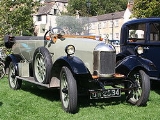
Oxford (Bullnose) (1913–14)
William Morris' first car was called the Oxford in recognition of its home city. To keep costs down virtually all components were bought-in and assembled by Morris. It was a small car with 1018 cc four cylinder side valve engine with fixed cylinder head from White and Poppe
White and Poppe

White and Poppe were Coventry based proprietary engine and gearbox manufacturers. Prior to WWI they served the booming motor industry but in 1919 during the post WWI recession they were bought by Dennis Brothers of Guildford and became a subsidiary....
.


Discussion
Ask a question about 'Morris Oxford'
Start a new discussion about 'Morris Oxford'
Answer questions from other users
Full Discussion Forum


Encyclopedia


Morris Oxford is a series of motor car
Automobile

An automobile or motor car is a wheeled motor vehicle for transportation passengers, which also carries its own car engine or motor. Most definitions of the term specify that automobiles are designed to run primarily on roads, to have seating for one to eight people, to typically have four wheels, and to be constructed principally f...
 models by the Morris Motor Company
Morris Motor Company

The Morris Motor Company was a United Kingdom automobile manufacturing company. After the incorporation of the company into larger corporations, the Morris name remained in use as a marque until 1984 when British Leyland's Austin Rover Group decided to concentrate on the more popular Austin Motor Company marque....
 of the United Kingdom
United Kingdom

The United Kingdom of Great Britain and Northern Ireland, commonly known as the United Kingdom , the UK or Britain,is a sovereign state located off the northwestern coast of continental Europe....
, from the 1913 "Bullnose" Oxford to the 1961–1971 Oxford VI.

Oxford (Bullnose) (1913–14)


William Morris' first car was called the Oxford in recognition of its home city. To keep costs down virtually all components were bought-in and assembled by Morris. It was a small car with 1018 cc four cylinder side valve engine with fixed cylinder head from White and Poppe
White and Poppe

White and Poppe were Coventry based proprietary engine and gearbox manufacturers. Prior to WWI they served the booming motor industry but in 1919 during the post WWI recession they were bought by Dennis Brothers of Guildford and became a subsidiary....
. Ignition was by a Bosch magneto.

The chassis was of pressed steel construction and suspension at the front was by semi-elliptic leaf springs at the front and three-quarter ones at the rear. The brakes, on the rear wheels only, were external contracting type using metal shoes. A three forward and reverse gearbox was fitted. The headlights were acetylene
Acetylene

Acetylene is the chemical compound with the symbol carbonhydrogen. It is the simplest alkyne.As an alkyne, acetylene is Saturation because its two carbon atoms are Chemical bond together in a triple bond....
 and the side and tail lamps oil.

The car got its name from its distinctive round topped radiator at first called the bullet nose. Most bodies, made by Raworth of Oxford, were of the two seat open tourer type, there was also a van version, but the chassis was too short to allow four seat bodies to be fitted.

Oxford (1919–26)


The 1919 Oxford was an upmarket version of the Cowley
Morris Cowley

Morris Cowley was a name given to various cars produced by the Morris Motor Company from 1915 to 1958. It also gained some fame after being mentioned on the 70's "police" series "The Professionals" after it was revealed that Cowley's nickname in the Army was "Morris", which mystified Bodie and Doyle until Cowley's friend, the Major informed...
 model. It retained the pre-war Bullnose radiator style but in a larger version. The 1548 cc engine was of Continental design made by the British branch of the French Hotchkiss
Hotchkiss

Hotchkiss may refer to:* Benjamin B. Hotchkiss - a 19th century American engineer** Hotchkiss et Cie - Hotchkiss Company, a French arms and car manufacturer set up by Benjamin Hotchkiss; full name: Soci?t? Anonyme des Anciens Etablissements Hotchkiss et Cie...
 company in Coventry for Morris at prices well undercutting White and Poppe. (Morris bought the British factory in 1923 and changed the name to Morris engines.) In 1923 the engine was enlarged to 1802 cc.

It was differentiated from the Cowley by having a better electrical system and leather upholstery. In 1925 it got a longer wheelbase chassis to move it further from the Cowley, and four wheel brakes. This model of the Oxford would be the basis of the first MG
MG (car)

MG is a United Kingdom sports car brand founded in 1924.MG is best known for two-seat open sports cars, but MG also produced Sedan and coup?s....
, the 14/28 Super Sports.

A short lived six cylinder variant, The F-Type Oxford Six was announced in 1920 and was in theory available until 1926. The 2320 cc engine proved unreliable and few were sold. Although the car was longer than the four by 9 inches (230 mm)all the extra space was given over to the engine.

Oxford (Flatnose) (1926–30) & Six (1929–33)


The distinctive Bullnose radiator was dropped in 1926 in a new updated version of the car. The engines remained the same but a new range of bodies was offered including all steel saloons.

A 1938 cc six cylinder version, the LA series Oxford Six, was made between 1929 and 1933 and was much more successful than the 1920 version. Alongside the tourer and steel saloon a fabric bodied car was offered until 1932 when it and the tourer were dropped but a coupι introduced.

In 1932 the gearbox gained a fourth speed and the engine grew to 2062 cc with the Q series unit.

Oxford Sixteen & Twenty (1934–35)


A completely new car was announced for 1934 with a longer and stronger chassis with flexible mounting for the 2002 cc engine. The gearbox gained synchromesh. Initially it kept the Six name but this changed to Sixteen in 1935 when it was joined by the 2561 cc Twenty model.

It was replaced by the Fourteen/Sixteen/Eighteen range in 1935 and the Oxford name disappeared until 1948.

Oxford MO (1948–54)


After World War II
World War II

World War II, or the Second World War , was a global military conflict which involved a Participants in World War II, including all of the great powers, organised into two opposing military alliances: the Allies of World War II and the Axis powers....
, the Oxford MO took the place of the Morris 10HP
Morris Ten

The Morris Ten was a medium sized car introduced in 1933 as the company's offering in the important 10 hp sector of the British market. It continued through a series of variants until 1948 when it was replaced by the MO Series Morris Oxford....
. It was introduced in 1948 and was produced through to 1954. The design was shared with Nuffield Organisation
Nuffield Organisation

The Nuffield Organisation was a vehicle manufacturing company in the United Kingdom. Named after its founder, William Morris, 1st Viscount Nuffield, it was formed in 1938 as the merger of Nuffield's Morris Motor Company , another of Nuffield's companies the MG and Riley ....
 stable-mate Wolseley
Wolseley Motor Company

The Wolseley Motor Company was a United Kingdom automobile manufacturer founded in 1901. After 1935 it was incorporated into larger companies but the Wolseley name remained as an upmarket marque until 1975....
 as the Wolseley 4/50
Wolseley 4/50

The Wolseley 4/50 and similar 6/80 were Wolseley Motor Company's first post-war automobiles. They were rushed into production in 1948 and were based on the Morris Oxford and the Morris Six MS respectively....
.

Designed by Alec Issigonis
Alec Issigonis

Sir Alexander Arnold Constantine Issigonis, Order of the British Empire, Fellow of the Royal Society was a Greece-United Kingdom designer of cars, now remembered chiefly for the groundbreaking and influential development of the Mini, launched by the British Motor Corporation in 1959....
, the Oxford, with the Morris Minor
Morris Minor

The Morris Minor was a popular British motor car aimed at the family market. It was the work of a team led by Alec Issigonis, who would go on to design the successful Mini....
, introduced unit construction techniques, though it is not widely recognized as a true unibody car. Torsion bar front suspension was another novelty, and 8 inch (200 mm) drum brake
Drum brake

A drum brake is a brake in which the friction is caused by a set of Brake shoe or Brake pad that press against the Brake lining of a rotating drum....
s hydraulically operated were fitted all around. Under the bonnet, the MO was a step back in technology from the pre-war Ten. It used a side valve
Side valve

Articles on Side valve engines include:* Flathead engine* Ford Flathead engineSee also* Cam-in-block...
 straight-4
Straight-4

The straight-4 or inline-4 engine is a four cylinder internal combustion engine with all four cylinder mounted in a straight line along the crankcase....
 rather than the older overhead valve
Overhead valve

An overhead valve engine, also called pushrod engine or I-head engine is a type of piston engine that places the camshaft in the cylinder block and uses pushrods or rods to actuate rocker arm above the cylinder head to actuate the poppet valve....
 unit. The single SU carburettor engine displaced 1.5 L (1476 cc/90 in³) and with its output of at 4200 rpm could propel the car to 72 mph (116 km/h). The four speed gearbox had a column change and steering was by rack and pinion.

The MO was sold as a 4-door saloon and 2-door Traveller estate
Station wagon

A station wagon in American English, Australian English, Canadian English and New Zealand English usage and an estate car in British English usage, is a passenger automobile with a car body style similar to a sedan but with the roofline following the full, sometimes extended rear cargo area, i.e. ending with a more vertical door...
 with exposed wood, both with four seats. It was replaced by the Series II Oxford in 1954.

The Motor
The Motor (magazine)

The Motor - not to be confused with an Australian magazine with the same name - was a United Kingdom weekly automobile magazine founded on 28 January 1903....
 magazine tested a Traveller in 1952 and found it to have a top speed of and acceleration from 0- in 26.2 seconds. A fuel consumption of was recorded. The test car cost £825 including taxes.

A six cylinder version was sold as the Morris Six MS
Morris Six MS

The Morris Six MS was a six-cylinder midsize car from the Morris Motor Company made from 1948 to 1953. It was the company's first post war six cylinder car....
.

A Commercial Vehicle version of the Morris Oxford MO was produced from 1950-56 as a Van, pickup, chassis cab and used some of the bodywork of the Oxford MO but with a chassis underneath. This was marketed as the Morris Cowley
Morris Cowley

Morris Cowley was a name given to various cars produced by the Morris Motor Company from 1915 to 1958. It also gained some fame after being mentioned on the 70's "police" series "The Professionals" after it was revealed that Cowley's nickname in the Army was "Morris", which mystified Bodie and Doyle until Cowley's friend, the Major informed...
 MCV (see photo, below).

Oxford II (1954–56)


The Oxford was redesigned for 1954 after the formation of BMC
British Motor Corporation

The British Motor Corporation was a United Kingdom vehicle company, formed by the merger of the Austin Motor Company and the Nuffield Organisation in 1952....
, notably getting the Austin
Austin Motor Company

The Austin Motor Company was a United Kingdom manufacturer of automobiles that rose to be a major motorcar brand, the dominant partner after merger with Morris in 1952 but declining after absorption into the British Leyland Motor Corporation, and its subsequent troubles....
-designed B-Series
BMC B-Series engine

The BMC B-series was a straight-4 internal combustion engine family, mostly used in automobile, created by United Kingdom company Austin Motor Company....
 OHV
Overhead valve

An overhead valve engine, also called pushrod engine or I-head engine is a type of piston engine that places the camshaft in the cylinder block and uses pushrods or rods to actuate rocker arm above the cylinder head to actuate the poppet valve....
 straight-4
Straight-4

The straight-4 or inline-4 engine is a four cylinder internal combustion engine with all four cylinder mounted in a straight line along the crankcase....
. This modern 1.5 L (1489 cc/90 in³) engine produced a respectable 50 hp (37 kW) and allowed the Oxford to reach 74 mph (119 km/h). Hydraulic drum brakes all round were still used but increased to diameter.

Styling was revised with perhaps less of a Morris Minor look, though the rounded body still had a family resemblance. Again, a pair of four-seat configurations, 4-door saloon and 2-door Traveller, were offered. The column gear change and front bench seat allowed the saloon to be advertised as a full six seater. The handbrake lever was located between the side of the seat and the driver's side door. Unusually for a British car of its class at the time, the heater was a standard fitting but the radio remained an extra. Sales remained strong when the Series III arrived in 1956.

The British Motor magazine tested a Series II saloon in 1954 recording a top speed of and acceleration from 0- in 28.9 seconds and a fuel consumption of . The test car cost £744 including taxes.

A six cylinder version was sold as the Morris Isis
Morris Isis

The Morris Isis name was first briefly used by the Morris Motor Company on a six cylinder car made from 1929 to 1931. It was resurrected on a new six-cylinder midsize car from the British Motor Corporation in the 1950s to replace the Morris Six MS....
.

Oxford III (1956–59)


The Oxford was updated for 1956 with a new optional two-tone paint scheme, fluted bonnet and small rear fins. Inside the bench seats trimmed in leather remained but the instrument cluster was revised and a new dished steering wheel fitted. The engine now produced 55 hp (41 kW) following an increase in compression ratio though the top speed and acceleration remained the same. A semi-automatic, two pedal, "Manumatic" transmission with centrifugal clutch with vacuum operation coupled to gear changes was optional. The woody Series III Traveller was replaced by the Series IV in 1957, though the saloon remained in production until the Pininfarina
Pininfarina

Pininfarina S.p.A. is an Italian automobile design firm and coachbuilder in Cambiano, Italy, founded as Societ? anonima Carrozzeria Pinin Farina in 1930 by automobile designer and builder Battista Farina ....
-styled Series V was introduced in 1959. 58,117 Series III and Series IV Oxfords were built.

Motor magazine tested a Series III manumatic equipped saloon in 1957 recording a top speed of , virtually unchanged from the Series II and acceleration from 0- in 30.5 seconds, adversely affected by the Manumatic option. Fuel consumption of was found. The test car cost £898 including taxes of £300.

This car was the basis for the Hindustan Ambassador
Hindustan Ambassador

The Hindustan Ambassador is a automobile manufactured by Hindustan Motors of India. It has been in production since 1957 and is based on the Morris Oxford model first made by the Morris Motor Company at Cowley, Oxford in the United Kingdom....
, which continues to be built in India
India

India, officially the Republic of India , is a country in South Asia. It is the List of countries and outlying territories by total area country by geographical area, the List of countries by population country, and the most populous liberal democracy in the world....
 some 50 years after the Oxford's demise.

Oxford IV (1957–60)


The Oxford IV was only made in an estate
Station wagon

A station wagon in American English, Australian English, Canadian English and New Zealand English usage and an estate car in British English usage, is a passenger automobile with a car body style similar to a sedan but with the roofline following the full, sometimes extended rear cargo area, i.e. ending with a more vertical door...
 version. A steel-bodied replacement for the "woody" Series III Traveller, it was similar to the Series III saloon in most respects. The IV was introduced in 1957 and produced alongside the Series V until 1960.

Oxford V (1959–61)


For 1959, the Oxford was merged into the mid-sized Pininfarina
Pininfarina

Pininfarina S.p.A. is an Italian automobile design firm and coachbuilder in Cambiano, Italy, founded as Societ? anonima Carrozzeria Pinin Farina in 1930 by automobile designer and builder Battista Farina ....
-designed BMC Farina range
British Motor Corporation

The British Motor Corporation was a United Kingdom vehicle company, formed by the merger of the Austin Motor Company and the Nuffield Organisation in 1952....
 along with a half-dozen other models, including the 1958 Wolseley 15/60
Wolseley 15/60

The Wolseley Motor Company 15/60 was the first of the mid-sized Pinin Farina-styled automobiles from the British Motor Corporation . Launched in December 1958, the design would eventually be shared with seven other marques....
 and 1959 Riley 4/68
Riley 4

-|The Riley 4/68 and 4/72 are cars produced by British Motor Corporation from April 1959 through the 1960s. They are related to the Pinin Farina-designed Austin Cambridge, MG Magnette, Morris Oxford, and Wolseley 15/60, sharing the MG's rear styling and engine ....
, Austin A55 Cambridge Mark II
Austin Cambridge

The Austin Cambridge is an automobile range sold by the Austin Motor Company from September 1954 through to 1969. It replaced the Austin A40 Somerset but was entirely new with modern unibody construction....
, and MG Magnette Mark III
MG Magnette

The automobile manufacturer MG used the Magnette name on the MG K-type and MG N-type cars in the 1930s, but the Magnette models of the 1950s and 1960s are probably best-remembered....
. The Austin and Morris cars were nearly identical but were produced in separate factories. Differences in the Morris included some of the chrome and interior trim, and the rear lights. Inside, a front bench seat and special dashboard fitted with speedometer, oil pressure gauge, coolant temperature gauge, fuel gauge and clock (optional) were used. A choice of floor or column gear change was available. The handbrake was floor mounted to the side of the seat. The 1.5 L B-Series engine continued. Drum brakes of diameter were fitted front and rear and the steering used a cam and peg system. The suspension was independent at the front using coil springs and had a live axle and semi-elliptic leaf springs at the rear.

The Series IV Traveller was still sold for the first year after which a Series V Traveller was made.

When tested by The Motor magazine the car had a top speed of and could accelerate from 0- in 25.4 seconds. A "touring" fuel consumption of 29.8 miles per gallon(imperial) was recorded.

Both Standard and De-Luxe versions were offered. The de-luxe package included a heater, manual screen washer, twin sun visors, twin horns, bumper over-riders , a clock and leather covered seat. A two tone paint scheme and a radio were available as an option.

On the home market the Standard version cost £815 and the de-luxe £844 including taxes.

In all, 87,432 Series V Oxfords were built.

Oxford VI (1961–71)


All five Farina cars were updated in 1961 with a new 1.6 L (1622 cc/98 in³) version of the B-Series engine and a new revised look. The tail fins had been trimmed and there were still detail changes between the marques. The Morris retained the Series V dash, while the Austin had an all-new fake woodgrain design.

The Morris Oxford Traveller (estate) Mark V was replaced by a Mark VI, although little changed apart from the front grille.

A diesel-engined
Diesel engine

A diesel engine is an internal combustion engine which operates using the diesel cycle . Diesel engines have the highest thermal efficiency compared to any internal combustion or external combustion engine....
 Oxford Mark VI, introduced shortly after the 1961 update, was popular as a taxi
Taxicab

A taxicab, also taxi or cab, is a type of public transport for a single passenger, or small group of passengers, typically for a non-shared ride....
. Variants of the same diesel engine enjoyed a long life in marine applications.

The Oxford VI remained in production until 1971 with 208,823 produced. The Oxford range was to have been replaced by the 1967 Morris 1800 (a badge-engineered 1964 ADO17 Austin 1800), but in the event both were built in parallel until 1971 because in terms both of pricing and of interior space the 1800 fell into the market segment of a slightly larger car. The ADO17 1800 continued until 1975, when it was succeeded by the ADO71 Morris 1800. The car which took the Oxford's place at the smaller end of the market segment was the Morris Marina
Morris Marina

The Morris Marina was a car manufactured by the Morris division of British Leyland Motor Corporation throughout the 1970s, a period of great turbulence and difficulty for the United Kingdom car industry....
, which also succeeded the yet smaller Minor
Morris Minor

The Morris Minor was a popular British motor car aimed at the family market. It was the work of a team led by Alec Issigonis, who would go on to design the successful Mini....
.