

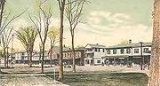
Winchester, New Hampshire

Encyclopedia
Winchester is a town
in Cheshire County
, New Hampshire
, United States
. The population was 4,341 at the 2010 census. The primary settlement in the town, where 1,733 people resided at the 2010 census, is defined by the U.S. Census Bureau as the Winchester census-designated place
(CDP). The town also includes the village of Ashuelot
and part of Pisgah State Park
.
, Earl of Arlington, this town was one of those established in 1733 by Colonial
Governor Jonathan Belcher
as protection for the Massachusetts
border at the Connecticut River
. After becoming a part of New Hampshire province in 1741, the town was granted to Colonel Josiah Willard, commander of Fort Dummer
. In 1753, it was incorporated by Governor Benning Wentworth
as Winchester, for Charles Paulet, 3rd Duke of Bolton, 8th Marquess of Winchester
, and constable of the Tower of London
.
Pioneers who came to the town as early as 1732 were attacked many times by Indians
. Several settlers were taken captive, and the town was burned in 1747. Its church, founded in 1736, is the oldest religious body in Cheshire County. The town has two covered bridge
s.
The Winchester Profession, an influential statement of the principles of Universalism
, was adopted at a Universalist congress in Winchester in 1803.
Although it has been an agricultural
town, many small industries have been established in Winchester. In the 1830s, Graves & Company was among the nation's first manufacturers of musical instruments. The coming of the Ashuelot Railroad in 1850 fostered the growth of textile
mills and wooden-ware factories, especially box manufacture and leather tanning
.
, the town has a total area of 55.5 square miles (143.7 km²), of which 54.9 square miles (142.2 km²) is land and 0.6 square miles (1.6 km²) is water, comprising 1.06% of the town. Winchester is drained by the Ashuelot River
and Roaring Brook. Pisgah Reservoir and Kilburn Pond are in the northwest. The highest point in Winchester is 1424 feet (434 m) Franklin Mountain, near the town's northeast corner.
The town center, defined as a census-designated place
(CDP), covers an area of 3 square miles (7.8 km²), about 5.4% of the area of the town.
Winchester is served by state routes 10
, 78
and 119
.
of 2000, there were 4,144 people, 1,557 households, and 1,094 families residing in the town. The population density
was 75.4 people per square mile (29.1/km²). There were 1,741 housing units at an average density of 12.2 persons/km² (31.7 persons/sq mi). The racial makeup of the town was 97.37% White, 0.31% African American
, 0.56% Native American, 0.31% Asia
n, 0.00% Pacific Islander
, 0.22% from other races, and 1.23% from two or more races. 0.82% of the population were Hispanic
or Latino
of any race.
There were 1,557 households out of which 33.5% had children under the age of 18 living with them, 52.9% were married couples
living together, 11.9% have a woman whose husband does not live with her, and 29.7% were non-families. 23.3% of all households were made up of individuals and 10.3% had someone living alone who was 65 years of age or older. The average household size was 2.61 and the average family size was 3.03.
In the town the population was spread out with 25.5% under the age of 18, 7.6% from 18 to 24, 29.2% from 25 to 44, 23.5% from 45 to 64, and 14.2% who were 65 years of age or older. The median age was 37 years. For every 100 females there were 96.8 males. For every 100 females age 18 and over, there were 95.4 males.
The median income for a household in the town was $37,364, and the median income for a family was $43,393. Males had a median income of $30,399 versus $20,682 for females. The per capita income
for the town was $16,012. 12.0% of the population and 10.0% of families were below the poverty line. Out of the total people living in poverty, 17.6% are under the age of 18 and 5.8% are 65 or older.
of 2000, there were 1,832 people, 690 households, and 467 families residing in the CDP (census-designated place
) at the town center. The population density
was 615.7 people per square mile (237.4/km²). There were 727 housing units at an average density of 94.2 persons/km² (244.3 persons/sq mi). The racial makeup of the town was 96.94% White, 0.49% African American
, 0.66% Native American, 0.38% Asia
n, 0.22% from other races, and 1.31% from two or more races. 1.20% of the population were Hispanic
or Latino
of any race.
There were 690 households out of which 36.2% had children under the age of 18 living with them, 47.4% were married couples
living together, 15.1% have a woman whose husband does not live with her, and 32.3% were non-families. 26.1% of all households were made up of individuals and 13.0% had someone living alone who was 65 years of age or older. The average household size was 2.63 and the average family size was 3.12.
In the CDP the population was spread out with 28.8% under the age of 18, 9.0% from 18 to 24, 29.9% from 25 to 44, 20.2% from 45 to 64, and 12.2% who were 65 years of age or older. The median age was 34 years. For every 100 females there were 94.9 males. For every 100 females age 18 and over, there were 93.3 males.
The median income for a household is $31,281, and the median income for a family was $39,828. Males had a median income of $29,909 versus $19,976 for females. The per capita income
for the town was $13,646. 17.8% of the population and 17.3% of families were below the poverty line. Out of the total people living in poverty, 25.1% are under the age of 18 and 9.5% are 65 or older.
Festival each September on its Main Street.
New England town
The New England town is the basic unit of local government in each of the six New England states. Without a direct counterpart in most other U.S. states, New England towns are conceptually similar to civil townships in other states, but are incorporated, possessing powers like cities in other...
in Cheshire County
Cheshire County, New Hampshire
-Demographics:As of the census of 2000, there were 73,825 people, 28,299 households, and 18,790 families residing in the county. The population density was 104 people per square mile . There were 31,876 housing units at an average density of 45 per square mile...
, New Hampshire
New Hampshire
New Hampshire is a state in the New England region of the northeastern United States of America. The state was named after the southern English county of Hampshire. It is bordered by Massachusetts to the south, Vermont to the west, Maine and the Atlantic Ocean to the east, and the Canadian...
, United States
United States
The United States of America is a federal constitutional republic comprising fifty states and a federal district...
. The population was 4,341 at the 2010 census. The primary settlement in the town, where 1,733 people resided at the 2010 census, is defined by the U.S. Census Bureau as the Winchester census-designated place
Census-designated place
A census-designated place is a concentration of population identified by the United States Census Bureau for statistical purposes. CDPs are delineated for each decennial census as the statistical counterparts of incorporated places such as cities, towns and villages...
(CDP). The town also includes the village of Ashuelot
Ashuelot, New Hampshire
Ashuelot is an unincorporated village in the town of Winchester near the southwestern corner of New Hampshire. The village is named after the Ashuelot River, which flows through it....
and part of Pisgah State Park
Pisgah State Park
Pisgah State Park is a woodland located in Cheshire County in New Hampshire. It is the largest state park in New Hampshire and contains a complete watershed north of the Ashuelot River, seven ponds, four highland ridges, numerous wetlands, and a parcel of old-growth forest.-Geography:The park...
.
History
Originally named Arlington in honor of Charles FitzroyCharles FitzRoy
Charles FitzRoy may refer to:*Charles FitzRoy, 2nd Duke of Cleveland , 18th century nobleman*Charles FitzRoy, 2nd Duke of Grafton , nobleman who was Lord Lieutenant of Ireland...
, Earl of Arlington, this town was one of those established in 1733 by Colonial
Colony
In politics and history, a colony is a territory under the immediate political control of a state. For colonies in antiquity, city-states would often found their own colonies. Some colonies were historically countries, while others were territories without definite statehood from their inception....
Governor Jonathan Belcher
Jonathan Belcher
Jonathan Belcher was colonial governor of the British provinces of Massachusetts Bay, New Hampshire, and New Jersey.-Early life:Jonathan Belcher was born in Cambridge, Province of Massachusetts Bay, in 1682...
as protection for the Massachusetts
Massachusetts
The Commonwealth of Massachusetts is a state in the New England region of the northeastern United States of America. It is bordered by Rhode Island and Connecticut to the south, New York to the west, and Vermont and New Hampshire to the north; at its east lies the Atlantic Ocean. As of the 2010...
border at the Connecticut River
Connecticut River
The Connecticut River is the largest and longest river in New England, and also an American Heritage River. It flows roughly south, starting from the Fourth Connecticut Lake in New Hampshire. After flowing through the remaining Connecticut Lakes and Lake Francis, it defines the border between the...
. After becoming a part of New Hampshire province in 1741, the town was granted to Colonel Josiah Willard, commander of Fort Dummer
Fort Dummer
Fort Dummer was a British fort built in 1724 by the colonial militia of the Province of Massachusetts Bay under the command of Lieutenant Timothy Dwight in what is now the Town of Brattleboro in southeastern Vermont. The fort was the first permanent European settlement in Vermont...
. In 1753, it was incorporated by Governor Benning Wentworth
Benning Wentworth
Benning Wentworth was the colonial governor of New Hampshire from 1741 to 1766.-Biography:The eldest child of the John Wentworth who had been Lieutenant Governor, he was born and died in Portsmouth, New Hampshire. Wentworth graduated from Harvard College in 1715...
as Winchester, for Charles Paulet, 3rd Duke of Bolton, 8th Marquess of Winchester
Marquess of Winchester
Marquess of Winchester is a title in the Peerage of England. It was created in 1551 for the prominent statesman William Paulet, 1st Earl of Wiltshire. He had already been created Baron St John in 1539 and Earl of Wiltshire in 1550, also in the Peerage of England...
, and constable of the Tower of London
Tower of London
Her Majesty's Royal Palace and Fortress, more commonly known as the Tower of London, is a historic castle on the north bank of the River Thames in central London, England. It lies within the London Borough of Tower Hamlets, separated from the eastern edge of the City of London by the open space...
.
Pioneers who came to the town as early as 1732 were attacked many times by Indians
Indigenous peoples of the Americas
The indigenous peoples of the Americas are the pre-Columbian inhabitants of North and South America, their descendants and other ethnic groups who are identified with those peoples. Indigenous peoples are known in Canada as Aboriginal peoples, and in the United States as Native Americans...
. Several settlers were taken captive, and the town was burned in 1747. Its church, founded in 1736, is the oldest religious body in Cheshire County. The town has two covered bridge
Covered bridge
A covered bridge is a bridge with enclosed sides and a roof, often accommodating only a single lane of traffic. Most covered bridges are wooden; some newer ones are concrete or metal with glass sides...
s.
The Winchester Profession, an influential statement of the principles of Universalism
Universalist Church of America
The Universalist Church of America was a Christian Universalist religious denomination in the United States . Known from 1866 as the Universalist General Convention, the name was changed to the Universalist Church of America in 1942...
, was adopted at a Universalist congress in Winchester in 1803.
Although it has been an agricultural
Agriculture
Agriculture is the cultivation of animals, plants, fungi and other life forms for food, fiber, and other products used to sustain life. Agriculture was the key implement in the rise of sedentary human civilization, whereby farming of domesticated species created food surpluses that nurtured the...
town, many small industries have been established in Winchester. In the 1830s, Graves & Company was among the nation's first manufacturers of musical instruments. The coming of the Ashuelot Railroad in 1850 fostered the growth of textile
Textile
A textile or cloth is a flexible woven material consisting of a network of natural or artificial fibres often referred to as thread or yarn. Yarn is produced by spinning raw fibres of wool, flax, cotton, or other material to produce long strands...
mills and wooden-ware factories, especially box manufacture and leather tanning
Tanning
Tanning is the making of leather from the skins of animals which does not easily decompose. Traditionally, tanning used tannin, an acidic chemical compound from which the tanning process draws its name . Coloring may occur during tanning...
.
Geography
According to the United States Census BureauUnited States Census Bureau
The United States Census Bureau is the government agency that is responsible for the United States Census. It also gathers other national demographic and economic data...
, the town has a total area of 55.5 square miles (143.7 km²), of which 54.9 square miles (142.2 km²) is land and 0.6 square miles (1.6 km²) is water, comprising 1.06% of the town. Winchester is drained by the Ashuelot River
Ashuelot River
The Ashuelot River is a tributary of the Connecticut River, approximately long, in southwestern New Hampshire in the United States. It drains a mountainous area of , including much of the area known as the Monadnock Region...
and Roaring Brook. Pisgah Reservoir and Kilburn Pond are in the northwest. The highest point in Winchester is 1424 feet (434 m) Franklin Mountain, near the town's northeast corner.
The town center, defined as a census-designated place
Census-designated place
A census-designated place is a concentration of population identified by the United States Census Bureau for statistical purposes. CDPs are delineated for each decennial census as the statistical counterparts of incorporated places such as cities, towns and villages...
(CDP), covers an area of 3 square miles (7.8 km²), about 5.4% of the area of the town.
Winchester is served by state routes 10
New Hampshire Route 10
New Hampshire Route 10 is a north–south state highway in the U.S. state of New Hampshire. Its southern terminus is at the Massachusetts state line in the town of Winchester. In Massachusetts the highway becomes Massachusetts Route 10. Total length of the highway is .-Route description:NH 10...
, 78
New Hampshire Route 78
New Hampshire Route 78 is a long secondary north–south state highway in Cheshire County in the southern part of the U.S. state of New Hampshire. It runs from the Massachusetts border to Winchester....
and 119
New Hampshire Route 119
New Hampshire Route 119 is a long east–west state highway in Cheshire County in southwestern New Hampshire. The highway runs from the Massachusetts border in New Ipswich to Hinsdale on the Vermont border....
.
Demographics
As of the censusCensus
A census is the procedure of systematically acquiring and recording information about the members of a given population. It is a regularly occurring and official count of a particular population. The term is used mostly in connection with national population and housing censuses; other common...
of 2000, there were 4,144 people, 1,557 households, and 1,094 families residing in the town. The population density
Population density
Population density is a measurement of population per unit area or unit volume. It is frequently applied to living organisms, and particularly to humans...
was 75.4 people per square mile (29.1/km²). There were 1,741 housing units at an average density of 12.2 persons/km² (31.7 persons/sq mi). The racial makeup of the town was 97.37% White, 0.31% African American
African American
African Americans are citizens or residents of the United States who have at least partial ancestry from any of the native populations of Sub-Saharan Africa and are the direct descendants of enslaved Africans within the boundaries of the present United States...
, 0.56% Native American, 0.31% Asia
Asia
Asia is the world's largest and most populous continent, located primarily in the eastern and northern hemispheres. It covers 8.7% of the Earth's total surface area and with approximately 3.879 billion people, it hosts 60% of the world's current human population...
n, 0.00% Pacific Islander
Pacific Islander
Pacific Islander , is a geographic term to describe the indigenous inhabitants of any of the three major sub-regions of Oceania: Polynesia, Melanesia and Micronesia.According to the Encyclopædia Britannica, these three regions, together with their islands consist of:Polynesia:...
, 0.22% from other races, and 1.23% from two or more races. 0.82% of the population were Hispanic
Hispanic
Hispanic is a term that originally denoted a relationship to Hispania, which is to say the Iberian Peninsula: Andorra, Gibraltar, Portugal and Spain. During the Modern Era, Hispanic sometimes takes on a more limited meaning, particularly in the United States, where the term means a person of ...
or Latino
Latino
The demonyms Latino and Latina , are defined in English language dictionaries as:* "a person of Latin-American descent."* "A Latin American."* "A person of Hispanic, especially Latin-American, descent, often one living in the United States."...
of any race.
There were 1,557 households out of which 33.5% had children under the age of 18 living with them, 52.9% were married couples
Marriage
Marriage is a social union or legal contract between people that creates kinship. It is an institution in which interpersonal relationships, usually intimate and sexual, are acknowledged in a variety of ways, depending on the culture or subculture in which it is found...
living together, 11.9% have a woman whose husband does not live with her, and 29.7% were non-families. 23.3% of all households were made up of individuals and 10.3% had someone living alone who was 65 years of age or older. The average household size was 2.61 and the average family size was 3.03.
In the town the population was spread out with 25.5% under the age of 18, 7.6% from 18 to 24, 29.2% from 25 to 44, 23.5% from 45 to 64, and 14.2% who were 65 years of age or older. The median age was 37 years. For every 100 females there were 96.8 males. For every 100 females age 18 and over, there were 95.4 males.
The median income for a household in the town was $37,364, and the median income for a family was $43,393. Males had a median income of $30,399 versus $20,682 for females. The per capita income
Per capita income
Per capita income or income per person is a measure of mean income within an economic aggregate, such as a country or city. It is calculated by taking a measure of all sources of income in the aggregate and dividing it by the total population...
for the town was $16,012. 12.0% of the population and 10.0% of families were below the poverty line. Out of the total people living in poverty, 17.6% are under the age of 18 and 5.8% are 65 or older.
Town center
As of the censusCensus
A census is the procedure of systematically acquiring and recording information about the members of a given population. It is a regularly occurring and official count of a particular population. The term is used mostly in connection with national population and housing censuses; other common...
of 2000, there were 1,832 people, 690 households, and 467 families residing in the CDP (census-designated place
Census-designated place
A census-designated place is a concentration of population identified by the United States Census Bureau for statistical purposes. CDPs are delineated for each decennial census as the statistical counterparts of incorporated places such as cities, towns and villages...
) at the town center. The population density
Population density
Population density is a measurement of population per unit area or unit volume. It is frequently applied to living organisms, and particularly to humans...
was 615.7 people per square mile (237.4/km²). There were 727 housing units at an average density of 94.2 persons/km² (244.3 persons/sq mi). The racial makeup of the town was 96.94% White, 0.49% African American
African American
African Americans are citizens or residents of the United States who have at least partial ancestry from any of the native populations of Sub-Saharan Africa and are the direct descendants of enslaved Africans within the boundaries of the present United States...
, 0.66% Native American, 0.38% Asia
Asia
Asia is the world's largest and most populous continent, located primarily in the eastern and northern hemispheres. It covers 8.7% of the Earth's total surface area and with approximately 3.879 billion people, it hosts 60% of the world's current human population...
n, 0.22% from other races, and 1.31% from two or more races. 1.20% of the population were Hispanic
Hispanic
Hispanic is a term that originally denoted a relationship to Hispania, which is to say the Iberian Peninsula: Andorra, Gibraltar, Portugal and Spain. During the Modern Era, Hispanic sometimes takes on a more limited meaning, particularly in the United States, where the term means a person of ...
or Latino
Latino
The demonyms Latino and Latina , are defined in English language dictionaries as:* "a person of Latin-American descent."* "A Latin American."* "A person of Hispanic, especially Latin-American, descent, often one living in the United States."...
of any race.
There were 690 households out of which 36.2% had children under the age of 18 living with them, 47.4% were married couples
Marriage
Marriage is a social union or legal contract between people that creates kinship. It is an institution in which interpersonal relationships, usually intimate and sexual, are acknowledged in a variety of ways, depending on the culture or subculture in which it is found...
living together, 15.1% have a woman whose husband does not live with her, and 32.3% were non-families. 26.1% of all households were made up of individuals and 13.0% had someone living alone who was 65 years of age or older. The average household size was 2.63 and the average family size was 3.12.
In the CDP the population was spread out with 28.8% under the age of 18, 9.0% from 18 to 24, 29.9% from 25 to 44, 20.2% from 45 to 64, and 12.2% who were 65 years of age or older. The median age was 34 years. For every 100 females there were 94.9 males. For every 100 females age 18 and over, there were 93.3 males.
The median income for a household is $31,281, and the median income for a family was $39,828. Males had a median income of $29,909 versus $19,976 for females. The per capita income
Per capita income
Per capita income or income per person is a measure of mean income within an economic aggregate, such as a country or city. It is calculated by taking a measure of all sources of income in the aggregate and dividing it by the total population...
for the town was $13,646. 17.8% of the population and 17.3% of families were below the poverty line. Out of the total people living in poverty, 25.1% are under the age of 18 and 9.5% are 65 or older.
Culture
Since 1998, Winchester has held its annual PicklePickled cucumber
A pickled cucumber is a cucumber that has been pickled in a brine, vinegar, or other solution and left to ferment for a period of time, by either immersing the cucumbers in an acidic solution or through souring by lacto-fermentation.-Gherkin:A gherkin is not only...
Festival each September on its Main Street.
Sites of interest
- Ashuelot Covered BridgeAshuelot Covered BridgeAshuelot Covered Bridge is a historic wooden covered bridge over the Ashuelot River on Bolton Road, just south of its intersection with NH 119 in Ashuelot, New Hampshire.It was built in 1864 and added to the National Register of Historic Places in 1981....
- Conant Library Museum
- Sheridan House (1870), the Winchester Historical Society Museum
- Monadnock Speedway
Notable inhabitants
- Henry AshleyHenry AshleyHenry Ashley was an American politician from New York.-Life:...
, congressman - Michael DubruielMichael DubruielMichael Dubruiel was a Roman Catholic author and speaker. Born in Keene, New Hampshire, Dubruiel served for four years in the U.S. Army before studying for a BA in philosophy from the now-closed St. Meinrad College and an MA in Christian Spirituality from Creighton University...
, religious author - Louis B. GoodallLouis B. GoodallLouis Bertrand Goodall was a United States Representative from Maine. He was born in Winchester, New Hampshire on September 23, 1851. He moved to Troy, New Hampshire with his parents in 1852...
, industrialist, banker and congressman - Marshall JewellMarshall JewellMarshall Jewell was a U.S. political figure. He served as the 44th and 46th Governor of Connecticut between 1869 and 1870, and again from 1871 until 1873. Born in 1825 in Winchester, New Hampshire, he was first appointed by President Ulysses S. Grant as Minister to Russia from 1873 to 1874, but...
, governor of Connecticut - Addison PrattAddison PrattAddison Pratt was an early Latter-day Saint convert and missionary. Pratt preached in French Polynesia from 1844 to 1848 and from 1850 to 1852, and is recognized by The Church of Jesus Christ of Latter-day Saints as the first Mormon missionary to preach in a language other than English.-Life:Pratt...
, missionary - Leonard WoodLeonard WoodLeonard Wood was a physician who served as the Chief of Staff of the United States Army, Military Governor of Cuba and Governor General of the Philippines. Early in his military career, he received the Medal of Honor. Wood also holds officer service #2 in the Regular Army...
, army chief of staffChief of Staff of the United States ArmyThe Chief of Staff of the Army is a statutory office held by a four-star general in the United States Army, and is the most senior uniformed officer assigned to serve in the Department of the Army, and as such is the principal military advisor and a deputy to the Secretary of the Army; and is in...