
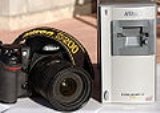
Digital photography is a form of
photographyPhotography is the art, science and practice of creating durable images by recording light or other electromagnetic radiation, either electronically by means of an image sensor or chemically by means of a light-sensitive material such as photographic film...
that uses an array of light sensitive sensors to capture the image focused by the lens, as opposed to an exposure on light sensitive film. The captured image is then stored as a digital file ready for digital processing (colour correction, sizing, cropping, etc.), viewing or printing.
Until the advent of such technology, photographs were made by exposing light sensitive
photographic filmPhotographic film is a sheet of plastic coated with an emulsion containing light-sensitive silver halide salts with variable crystal sizes that determine the sensitivity, contrast and resolution of the film...
, and used chemical
photographic processingPhotographic processing is the chemical means by which photographic film and paper is treated after photographic exposure to produce a negative or positive image...
to develop and stabilize the image. By contrast,
digital photographsA digital image is a numeric representation of a two-dimensional image. Depending on whether or not the image resolution is fixed, it may be of vector or raster type...
can be displayed, printed, stored, manipulated, transmitted, and archived using digital and
computerA computer is a programmable machine designed to sequentially and automatically carry out a sequence of arithmetic or logical operations. The particular sequence of operations can be changed readily, allowing the computer to solve more than one kind of problem...
techniques, without chemical processing.
Digital photography is one of several forms of
digital imagingDigital imaging or digital image acquisition is the creation of digital images, typically from a physical scene. The term is often assumed to imply or include the processing, compression, storage, printing, and display of such images...
. Digital images are also created by non-photographic equipment such as computer tomography scanners and
radio telescopeA radio telescope is a form of directional radio antenna used in radio astronomy. The same types of antennas are also used in tracking and collecting data from satellites and space probes...
s. Digital images can also be made by
scanningIn computing, an image scanner—often abbreviated to just scanner—is a device that optically scans images, printed text, handwriting, or an object, and converts it to a digital image. Common examples found in offices are variations of the desktop scanner where the document is placed on a glass...
conventional photographic images.
Sensors and storage
Image sensorAn image sensor is a device that converts an optical image into an electronic signal. It is used mostly in digital cameras and other imaging devices...
s read the
intensityIn physics, intensity is a measure of the energy flux, averaged over the period of the wave. The word "intensity" here is not synonymous with "strength", "amplitude", or "level", as it sometimes is in colloquial speech...
of light, and digital memory devices store the digital image information as
RGB color spaceAn RGB color space is any additive color space based on the RGB color model. A particular RGB color space is defined by the three chromaticities of the red, green, and blue additive primaries, and can produce any chromaticity that is the triangle defined by those primary colors...
or as
raw dataA camera raw image file contains minimally processed data from the image sensor of either a digital camera, image scanner, or motion picture film scanner. Raw files are so named because they are not yet processed and therefore are not ready to be printed or edited with a bitmap graphics editor...
.
There are two main types of sensors:
- charge-coupled device
A charge-coupled device is a device for the movement of electrical charge, usually from within the device to an area where the charge can be manipulated, for example conversion into a digital value. This is achieved by "shifting" the signals between stages within the device one at a time...
(CCD) – photocharge is shifted to a central charge-to-voltage converter
- CMOS
Complementary metal–oxide–semiconductor is a technology for constructing integrated circuits. CMOS technology is used in microprocessors, microcontrollers, static RAM, and other digital logic circuits...
sensors ("Active pixel sensorAn active-pixel sensor is an image sensor consisting of an integrated circuit containing an array of pixel sensors, each pixel containing a photodetector and an active amplifier. There are many types of active pixel sensors including the CMOS APS used most commonly in cell phone cameras, web...
")
Nearly all digital cameras use built-in and/or removable solid state
flash memoryFlash memory is a non-volatile computer storage chip that can be electrically erased and reprogrammed. It was developed from EEPROM and must be erased in fairly large blocks before these can be rewritten with new data...
. Digital
tapeless camcorderA tapeless camcorder is a camcorder that does not use video tape for the digital recording of video productions as 20th century ones did. Tapeless camcorders record video as digital computer files onto random access data storage devices such as optical discs, hard disk drives and solid-state flash...
s that double as a digital still camera use flash memory, discs and internal hard drives. Certain 20th century digital cameras such as the
Sony MavicaMavica was a brand of Sony cameras which used removable disks as the main recording media. In August, 1981, Sony announced the Sony Mavica electronic still camera, the first commercial electronic still camera. It was not a digital camera, as its CCD sensor produced an analog video signal in the...
range used
floppy diskA floppy disk is a disk storage medium composed of a disk of thin and flexible magnetic storage medium, sealed in a rectangular plastic carrier lined with fabric that removes dust particles...
s and mini-CDs.
Multifunctionality and connectivity
Except for some
linear arrayA charge-coupled device is a device for the movement of electrical charge, usually from within the device to an area where the charge can be manipulated, for example conversion into a digital value. This is achieved by "shifting" the signals between stages within the device one at a time...
type of cameras at the highest-end and simple web cams at the lowest-end, a digital memory device (usually a
memory cardA memory card or flash card is an electronic flash memory data storage device used for storing digital information. They are commonly used in many electronic devices, including digital cameras, mobile phones, laptop computers, MP3 players, and video game consoles...
;
floppy diskA floppy disk is a disk storage medium composed of a disk of thin and flexible magnetic storage medium, sealed in a rectangular plastic carrier lined with fabric that removes dust particles...
s and
CD-RWA CD-RW is a rewritable optical disc. It was introduced in 1997, and was known as "CD-Writable" during development. It was preceded by the CD-MO, which was never commercially released....
s are less common) is used for storing images, which may be transferred to a
computerA computer is a programmable machine designed to sequentially and automatically carry out a sequence of arithmetic or logical operations. The particular sequence of operations can be changed readily, allowing the computer to solve more than one kind of problem...
later.
Digital cameras can take pictures, and may also record sound and video. Some can be used as
webcamA webcam is a video camera that feeds its images in real time to a computer or computer network, often via USB, ethernet, or Wi-Fi.Their most popular use is the establishment of video links, permitting computers to act as videophones or videoconference stations. This common use as a video camera...
s, some can use the
PictBridgePictBridge is an industry standard introduced in 2003 from the Camera & Imaging Products Association for direct printing. It allows images to be printed directly from digital cameras to a printer, without having to connect the camera to a computer. Its formal name is . CIPA DC-001-2003 Rev...
standard to connect to a printer without using a computer, and some can display pictures directly on a television set. Similarly, many
camcorderA camcorder is an electronic device that combines a video camera and a video recorder into one unit. Equipment manufacturers do not seem to have strict guidelines for the term usage...
s can take still photographs, and store them on
videotapeA videotape is a recording of images and sounds on to magnetic tape as opposed to film stock or random access digital media. Videotapes are also used for storing scientific or medical data, such as the data produced by an electrocardiogram...
or on
flash memoryFlash memory is a non-volatile computer storage chip that can be electrically erased and reprogrammed. It was developed from EEPROM and must be erased in fairly large blocks before these can be rewritten with new data...
cards with the same functionality as
digital cameraA digital camera is a camera that takes video or still photographs, or both, digitally by recording images via an electronic image sensor. It is the main device used in the field of digital photography...
s.
Performance metrics
The quality of a digital image is a composite of various factors, many of which are similar to those of film cameras.
PixelIn digital imaging, a pixel, or pel, is a single point in a raster image, or the smallest addressable screen element in a display device; it is the smallest unit of picture that can be represented or controlled....
count (typically listed in megapixels, millions of pixels) is only one of the major factors, though it is the most heavily marketed
figure of meritA figure of merit is a quantity used to characterize the performance of a device, system or method, relative to its alternatives. In engineering, figures of merit are often defined for particular materials or devices in order to determine their relative utility for an application...
. Digital camera manufacturers advertise this figure because consumers can use it to easily compare camera capabilities. It is not, however, the major factor in evaluating a digital camera for most applications. The processing system inside the camera that turns the raw data into a color-balanced and pleasing photograph is usually more critical, which is why some 4+ megapixel cameras perform better than higher-end cameras.
Resolution in pixels is not the only measure of image quality. A larger sensor with the same number of pixels generally produces a better image than a smaller one. One of the most important differences is an improvement in
image noiseImage noise is random variation of brightness or color information in images, and is usually an aspect of electronic noise. It can be produced by the sensor and circuitry of a scanner or digital camera...
. This is one of the advantages of digital SLR cameras, which have larger sensors than simpler cameras of the same resolution.
- Lens quality: resolution, distortion, dispersion
In optics, dispersion is the phenomenon in which the phase velocity of a wave depends on its frequency, or alternatively when the group velocity depends on the frequency.Media having such a property are termed dispersive media...
(see Lens (optics)A lens is an optical device with perfect or approximate axial symmetry which transmits and refracts light, converging or diverging the beam. A simple lens consists of a single optical element...
)
- Capture medium: CMOS, CCD, negative film, reversal film etc.
- Capture format: pixel count, digital file type (RAW
A camera raw image file contains minimally processed data from the image sensor of either a digital camera, image scanner, or motion picture film scanner. Raw files are so named because they are not yet processed and therefore are not ready to be printed or edited with a bitmap graphics editor...
, TIFF, JPEGIn computing, JPEG . The degree of compression can be adjusted, allowing a selectable tradeoff between storage size and image quality. JPEG typically achieves 10:1 compression with little perceptible loss in image quality....
), film formatA film format is a technical definition of a set of standard characteristics regarding image capture on photographic film, for either stills or movies. It can also apply to projected film, either slides or movies. The primary characteristic of a film format is its size and shape.In the case of...
(135 filmThe term 135 was introduced by Kodak in 1934 as a designation for cartridge film wide, specifically for still photography. It quickly grew in popularity, surpassing 120 film by the late 1960s to become the most popular photographic film format...
, 120 film120 is a film format for still photography introduced by Kodak for their Brownie No. 2 in 1901. It was originally intended for amateur photography but was later superseded in this role by 135 film...
, 5x4, 10x8).
- Processing: digital and / or chemical processing of 'negative' and 'print'.
Pixel counts
The number of
pixelIn digital imaging, a pixel, or pel, is a single point in a raster image, or the smallest addressable screen element in a display device; it is the smallest unit of picture that can be represented or controlled....
s
n for a given maximum
resolutionImage resolution is an umbrella term that describes the detail an image holds. The term applies to raster digital images, film images, and other types of images. Higher resolution means more image detail....
(
w horizontal pixels by
h vertical pixels) is the product
n =
w × h. This yields e. g. 1.92 megapixels (1,920,000 pixels) for an image of 1600 × 1200. The majority of compact as well as some
DSLRMost digital single-lens reflex cameras are digital cameras that use a mechanical mirror system and pentaprism to direct light from the lens to an optical viewfinder on the back of the camera....
digital cameras have a 4:3
aspect ratioThe aspect ratio of an image is the ratio of the width of the image to its height, expressed as two numbers separated by a colon. That is, for an x:y aspect ratio, no matter how big or small the image is, if the width is divided into x units of equal length and the height is measured using this...
, i.e.
w/h = 4/3. According to
Digital Photography Review, the 4:3 ratio is because "computer monitors are 4:3 ratio, old CCD's always had a 4:3 ratio, and thus digital cameras inherited this aspect ratio."
The pixel count quoted by manufacturers can be misleading as it may not be the number of full-color pixels. For cameras using single-chip
image sensorAn image sensor is a device that converts an optical image into an electronic signal. It is used mostly in digital cameras and other imaging devices...
s the number claimed is the total number of single-color-sensitive photosensors, whether they have different locations in the plane, as with the Bayer sensor, or in stacks of three co-located photosensors as in the
Foveon X3 sensorThe Foveon X3 sensor is a CMOSimage sensor for digital cameras, designed by Foveon, Inc. and manufactured by National Semiconductorand Dongbu Electronics....
. However, the images have different numbers of RGB pixels: Bayer-sensor cameras produce as many RGB pixels as photosensors via
demosaicingA demosaicing algorithm is a digital image process used to reconstruct a full color image from the incomplete color samples output from an image sensor overlaid with a color filter array...
(interpolation), while Foveon sensors produce uninterpolated image files with one-third as many RGB pixels as photosensors. It is difficult to compare the resolutions based on the megapixel ratings of these two types of sensors, and therefore sometimes a subject of dispute.
The relative increase in detail resulting from an increase in resolution is better compared by looking at the number of pixels across (or down) the picture, rather than the total number of pixels in the picture area. For example, a sensor of 2560 × 1600 sensor elements is described as "4 megapixels" (2560 × 1600 = 4,096,000). Increasing to 3200 × 2048 increases the pixels in the picture to 6,553,600 (6.5 megapixels), a factor of 1.6, but the pixels per cm in the picture (at the same image size) increases by only 1.25 times. A measure of the comparative increase in linear resolution is the square root of the increase in area resolution, i.e., megapixels in the entire image.
Dynamic range
Practical imaging systems, digital and film, have a limited "
dynamic rangeDynamic range, abbreviated DR or DNR, is the ratio between the largest and smallest possible values of a changeable quantity, such as in sound and light. It is measured as a ratio, or as a base-10 or base-2 logarithmic value.-Dynamic range and human perception:The human senses of sight and...
": the range of
luminosityLuminosity is a measurement of brightness.-In photometry and color imaging:In photometry, luminosity is sometimes incorrectly used to refer to luminance, which is the density of luminous intensity in a given direction. The SI unit for luminance is candela per square metre.The luminosity function...
that can be reproduced accurately.
HighlightsIn digital photography and digital video, clipping is a result of capturing or processing an image where the intensity in a certain area falls outside the minimum and maximum intensity which can be represented. It is an instance of signal clipping in the image domain...
of the subject that are too bright are rendered as white, with no detail;
shadowA shadow is an area where direct light from a light source cannot reach due to obstruction by an object. It occupies all of the space behind an opaque object with light in front of it. The cross section of a shadow is a two-dimensional silhouette, or reverse projection of the object blocking the...
s that are too dark are rendered as black. The loss of detail is not abrupt with film, or in dark shadows with digital sensors: some detail is retained as brightness moves out of the dynamic range. "Highlight burn-out" of digital sensors, however, can be abrupt, and highlight detail may be lost. And as the sensor elements for different colors saturate in turn, there can be gross hue or saturation shift in burnt-out highlights.
Some digital cameras can show these blown highlights in the image review, allowing the photographer to re-shoot the picture with a modified exposure. Others compensate for the total contrast of a scene by selectively exposing darker pixels longer. A third technique is used by Fujifilm in its
FinePix S3 ProThe Fujifilm FinePix S3 Pro is an interchangeable lens digital single-lens reflex camera introduced in February 2004. Its successor, the Finepix S5 Pro, was released on 25 September 2006...
digital SLR. The image sensor contains additional
photodiodeA photodiode is a type of photodetector capable of converting light into either current or voltage, depending upon the mode of operation.The common, traditional solar cell used to generateelectric solar power is a large area photodiode....
s of lower sensitivity than the main ones; these retain detail in parts of the image too bright for the main sensor.
High dynamic range imagingIn image processing, computer graphics, and photography, high dynamic range imaging is a set of techniques that allows a greater dynamic range between the lightest and darkest areas of an image than current standard digital imaging techniques or photographic methods...
(HDR) addresses this problem by increasing the dynamic range of images by either
- increasing the dynamic range of the image sensor or
- by using exposure bracketing and post-processing the separate images to create a single image with a higher dynamic range.
HDR images curtail burn-outs and black-outs.
Storage
Storage for digital cameras has increased in size and technology with time, from magnetic tape (
Steven SassonSteven J. Sasson , is an American electrical engineer and the inventor of the digital camera. Sasson is a 1972 and 1973 graduate of Rensselaer Polytechnic Institute in electrical engineering.-Biography:...
's 1975 prototype) to
floppy diskA floppy disk is a disk storage medium composed of a disk of thin and flexible magnetic storage medium, sealed in a rectangular plastic carrier lined with fabric that removes dust particles...
s to
flash memoryFlash memory is a non-volatile computer storage chip that can be electrically erased and reprogrammed. It was developed from EEPROM and must be erased in fairly large blocks before these can be rewritten with new data...
.
Applications and considerations
With the acceptable image quality and the other advantages of digital photography (particularly the time pressures of daily newspapers) the majority of professional news photographers capture their images with digital cameras.
Digital photography has also been adopted by many amateur
snapshotA snapshot is popularly defined as a photograph that is "shot" spontaneously and quickly, most often without artistic or journalistic intent. Snapshots are commonly considered to be technically "imperfect" or amateurish—out of focus or poorly framed or composed...
photographers, who take advantage of the convenience of sending images by
emailElectronic mail, commonly known as email or e-mail, is a method of exchanging digital messages from an author to one or more recipients. Modern email operates across the Internet or other computer networks. Some early email systems required that the author and the recipient both be online at the...
, placing them on the
World Wide WebThe World Wide Web is a system of interlinked hypertext documents accessed via the Internet...
, or displaying them in digital picture frames. The majority of cameras are
camera phoneA camera phone is a mobile phone which is able to capture still photographs . Since early in the 21st century the majority of mobile phones in use are camera phones....
s integrated into cell phones but their usual small, poor quality lenses and sensors render most of them unsuitable for making even moderate size prints.
Some commercial
photographers, and some amateurs interested in artistic photography, have been resistant to using digital rather than film cameras because they believe that the image quality available from a digital camera is still inferior to that available from a film camera, and the quality of images taken on medium format film was thought to be impossible to match with a digital camera. Some have expressed a concern that changing computer technology may make digital photographs inaccessible in the future. A related concern in a specialized application is the use of digital photographs
in court proceedingsPhotography tends to be protected by the law through copyright and moral rights. Photography tends to be restricted by the law through miscellaneous criminal offences. Publishing certain photographs can be restricted by privacy law...
, with the added difficulty of demonstrating an image's authenticity. Some high-end film can also still be projected for viewing at a much higher optical resolution than even the best digital projectors. Some professional photographers resist the use of digital cameras because they are poor performers when it comes to speed for multiple shots. Storing an 8MP image takes a lot of time and therefore, in some applications digital cameras are not currently appropriate.
Other commercial photographers, and many amateurs, have enthusiastically embraced digital photography because they believe that its flexibility and lower long-term costs outweigh its initial price disadvantages. Almost all of the cost of digital photography is
capital cost, meaning that the cost is for the equipment needed to store and copy the images, and once purchased requires virtually no further expense outlay. Film photography requires continuous expenditure of funds for supplies and developing, although the equipment itself does not outdate so quickly and has a longer service life.
Some commercial photographers have also begun moving to digital technology because of the tremendous editing capabilities now offered on computers. The photographer is able to color-balance and otherwise manipulate the image in ways that traditional
darkroomA darkroom is a room that can be made completely dark to allow the processing of light sensitive photographic materials, including photographic film and photographic paper. Darkrooms have been created and used since the inception of photography in the early 19th century...
techniques cannot offer, or are far more laborious in the darkroom. With fully color-balanced systems from the camera to the monitor to the printer, the photographer can now supply, either as a print or as a computer display, what is actually seen on the photographer's screen. Film users can use a
film scannerA film scanner is a device made for scanning photographic film directly into a computer without the use of any intermediate printmaking. It provides several benefits over using a flatbed scanner to scan in a print of any size: the photographer has direct control over cropping and aspect ratio from...
, thus mixing the two technologies. Rapid advances in the technologies have resulted in many specialised
abbreviations and initialisms being freely used in publications and internet discussions.
However, digital cameras require batteries that need to be recharged or replaced frequently, and this means that a photographer needs access to electrical outlets. Digital cameras also tend to be much more sensitive to moisture and extreme cold. For this reason, photographers who work in remote areas may favour film SLR cameras, though many higher-end DSLRs are now equipped with weather-resistant bodies. Medium and large-format film cameras are also still preferred by publications insisting on the very highest detail and resolution.
Digital photography was used in
astrophotographyAstrophotography is a specialized type of photography that entails recording images of astronomical objects and large areas of the night sky. The first photographs of an astronomical object were taken in the 1840s, but it was not until the late 19th century that advances in technology allowed for...
long before its use by the general public and had almost completely displaced photographic plates by the early 1980s. CCDs are more sensitive to light than plates, and have a much more uniform and predictable response. The CCDs used in astronomy are similar to those used by the general public, but are generally monochrome. Many of those used in
infrared astronomyInfrared astronomy is the branch of astronomy and astrophysics that studies astronomical objects visible in infrared radiation. The wavelength of infrared light ranges from 0.75 to 300 micrometers...
are cooled with
liquid nitrogenLiquid nitrogen is nitrogen in a liquid state at a very low temperature. It is produced industrially by fractional distillation of liquid air. Liquid nitrogen is a colourless clear liquid with density of 0.807 g/mL at its boiling point and a dielectric constant of 1.4...
so as to reduce the
image noiseImage noise is random variation of brightness or color information in images, and is usually an aspect of electronic noise. It can be produced by the sensor and circuitry of a scanner or digital camera...
caused by heat. Many astronomical instruments have arrays of many CCDs, sometimes totaling almost a billion pixels. Amateur astronomers also commonly use digital cameras, including the use of
webcamA webcam is a video camera that feeds its images in real time to a computer or computer network, often via USB, ethernet, or Wi-Fi.Their most popular use is the establishment of video links, permitting computers to act as videophones or videoconference stations. This common use as a video camera...
s for
speckle imagingSpeckle imaging describes a range of high-resolution astronomical imaging techniques based either on the shift-and-add method or on speckle interferometry methods...
or "video astronomy".
Advantages of professional digital cameras
- Immediate image review and deletion is possible; lighting and composition can be assessed immediately, which ultimately conserves storage space.
- Faster workflow: Management (colour and file), manipulation and printing tools are more versatile than conventional film processes. However, batch processing of RAW files can be time consuming, even on a fast computer.
- Digital manipulation: A digital image can be modified and manipulated much easier and faster than with traditional negative and print methods. The digital image to the right was captured in RAW format, processed and output in 3 different ways from the source RAW file, then merged and further processed for color saturation and other special effects to produce a more dramatic result than was originally captured with the RAW image.
Recent manufacturers such as
Nikon , also known as just Nikon, is a multinational corporation headquartered in Tokyo, Japan, specializing in optics and imaging. Its products include cameras, binoculars, microscopes, measurement instruments, and the steppers used in the photolithography steps of semiconductor fabrication, of which...
and
Canonis a Japanese multinational corporation that specialises in the manufacture of imaging and optical products, including cameras, camcorders, photocopiers, steppers and computer printers. Its headquarters are located in Ōta, Tokyo, Japan.-Origins:...
have promoted the adoption of
digital single-lens reflex cameraMost digital single-lens reflex cameras are digital cameras that use a mechanical mirror system and pentaprism to direct light from the lens to an optical viewfinder on the back of the camera....
s (DSLRs) by
photojournalistsPhotojournalism is a particular form of journalism that creates images in order to tell a news story. It is now usually understood to refer only to still images, but in some cases the term also refers to video used in broadcast journalism...
. Images captured at 2+ megapixels are deemed of sufficient quality for small images in newspaper or magazine reproduction. Eight to 24 megapixel images, found in modern digital SLRs, when combined with high-end lenses, can approximate the detail of film prints from
35 mm film35 mm film is the film gauge most commonly used for chemical still photography and motion pictures. The name of the gauge refers to the width of the photographic film, which consists of strips 35 millimeters in width...
based SLRs, and the latest 16 megapixel models can produce detailed images that are thought better than 35mm film images and the majority of medium format cameras.
Disadvantages of digital cameras
- Whereas film cameras can have manual backups for electronic and electrical features, digital cameras are entirely dependent on an electrical supply (usually batteries but sometimes power cord when in 'tethered' mode).
- Many digital sensors have less dynamic range than color print film. However, some newer CCDs such as Fuji's Super CCD
Super CCD is a proprietary charge-coupled device that has been developed by Fujifilm since 1999. The Super CCD uses octagonal, rather than rectangular, pixels...
, which combines diodes of different sensitivity, have improved upon this issue.
- When highlights burn out, they burn to white without details, while film cameras retain a reduced level of detail, as discussed above.
- High ISO image noise
Image noise is random variation of brightness or color information in images, and is usually an aspect of electronic noise. It can be produced by the sensor and circuitry of a scanner or digital camera...
may manifest as multicolored speckles in digital images, rather than the less-objectionable "grain" of high-ISO film. While this speckling can be removed by noise-reduction software, either in-camera or on a computer, this can have a detrimental effect on image quality as fine detail may be lost in the process.
- Aliasing
In signal processing and related disciplines, aliasing refers to an effect that causes different signals to become indistinguishable when sampled...
may add patterns to images that do not exist and would not appear in film.
- The possibility that in the future certain digital file formats (for example, JPEG) may become obsolete/replaced.
- Dust particles can adhere to the cover glass of the image sensor in digital cameras, resulting in persisting dust spots in images. Film cameras use a fresh piece of film for each shot, so dust does not build up on the film. Digital image sensors may be cleaned with a simple cleaning kit or professionally, and some digital cameras have built-in sensor cleaning mechanisms, mitigating this problem.
For most consumers in prosperous countries such as the United States and Western Europe, the advantages of digital cameras outweigh their disadvantages. However, some professional photographers still prefer film. Much of the post-shooting work done by a photo lab for film is done by the photographer himself for digital images. Concerns that have been raised by professional photographers include: editing and post-processing of RAW files can take longer than 35mm film, downloading a large number of images to a computer can be time-consuming, shooting in remote sites requires the photographer to carry a number of batteries and add to the load to carry, equipment failure—while all cameras may fail, some film camera problems (e.g., meter or rangefinder problems, failure of only some shutter speeds) can be worked around. As time passes, it is expected that more professional photographers will switch to digital.
In some cases where very high-resolution digital images of good quality are needed it may be advantageous to take large-format film photographs and digitise them. This allows the creation of very large
computer fileA computer file is a block of arbitrary information, or resource for storing information, which is available to a computer program and is usually based on some kind of durable storage. A file is durable in the sense that it remains available for programs to use after the current program has finished...
s without speed or capacity disadvantages at picture-taking time.
Equivalent features
Image noise / grain
Noise in a digital camera's image is remarkably similar to
film grainFilm grain or granularity is the random optical texture of processed photographic film due to the presence of small particles of a metallic silver, or dye clouds, developed from silver halide that have received enough photons. While film grain is a function of such particles it is not the same...
in a film camera. At high
ISOFilm speed is the measure of a photographic film's sensitivity to light, determined by sensitometry and measured on various numerical scales, the most recent being the ISO system....
levels (film speed) the grain/noise becomes more apparent in the final image. Although film ISO levels can be lower than digital ISO levels (25 and 50 respectively), digital settings can be changed quickly according to requirements, while film must be physically replaced and protected from all light during such replacement. Additionally, image
noise reductionNoise reduction is the process of removing noise from a signal.All recording devices, both analogue or digital, have traits which make them susceptible to noise...
techniques can be used to remove noise from digital images and film grain is fixed. From an artistic point of view, film grain and image noise may be desirable when creating a specific
mood for an image. Modern digital cameras have comparable noise/grain at the same ISO as film cameras. Some digital cameras though, do exhibit a pattern in the
digital noiseImage noise is random variation of brightness or color information in images, and is usually an aspect of electronic noise. It can be produced by the sensor and circuitry of a scanner or digital camera...
that is not found on film.
Speed of use
Previously digital cameras had a longer start-up delay compared to film cameras, i.e., the delay from when they are turned on until they are ready to take the first shot, but this is no longer the case for modern digital cameras with start-up times under 1/4 second (0.15 seconds for the Nikon D90). Similarly, the amount of time needed to write the data for a digital picture to the memory card is now comparable to the amount of time it takes to wind the film on a film camera, at least with modern digital cameras and modern fast memory cards. Both digital cameras and film cameras have
a small delayIn photography, shutter lag is the delay between triggering the shutter and when the photograph is actually recorded. This is a common problem in the photography of fast-moving objects or people in motion...
between when the shutter button is pressed and when the picture is taken – this is the time necessary to autofocus the lens and compute and set the exposure. (This shutter delay is practically zero for SLR and the best DSLR cameras.)
Frame rate
The Nikon D3 can take still photographs at 11 frames per second; the fastest film SLR could shoot 14 frames per second (Canon F1-n with a super high speed motor, but fewer than 100 were constructed for the 1984 Summer Olympics). The Nikon F5 is limited to 36 continuous frames (the length of the film) while the Canon EOS-1D Mark III is able to take about 110 high definition
JPEGIn computing, JPEG . The degree of compression can be adjusted, allowing a selectable tradeoff between storage size and image quality. JPEG typically achieves 10:1 compression with little perceptible loss in image quality....
images before its
bufferIn computer science, a buffer is a region of a physical memory storage used to temporarily hold data while it is being moved from one place to another. Typically, the data is stored in a buffer as it is retrieved from an input device or just before it is sent to an output device...
must be cleared and the remaining space on the storage media can be used. Even Bridge camera such as Fujifilm FinePix HS10 has burst mode 10 frame/s and Panasonic Lumix DMC-FZ100 has 11 frame/s. Moreover FinePix HS10 can take movies at 1000 frame/s at 224x64 pixels with no sound.
Image longevity
Film and prints can fade, but digital images can potentially last unchanged forever. However, the media on which the digital images are stored can decay or become corrupt, leading to a loss of image integrity. Film and digital media should be stored under archival conditions for maximum longevity. Without backup it is easier to lose huge amounts of digital data, for example by accidental deletion of folders, or by failure of a mass storage device. In comparison, each generation of copies of film negatives and transparencies is degraded compared to its parent. Film images can easily be converted to digital (by using a digital film scanner for example) with some possible loss of quality.
Colour reproduction
Colour reproduction (
gamutIn color reproduction, including computer graphics and photography, the gamut, or color gamut , is a certain complete subset of colors. The most common usage refers to the subset of colors which can be accurately represented in a given circumstance, such as within a given color space or by a...
) is dependent on the type and quality of film or sensor used and the quality of the optical system and film processing. Different films and sensors have different color sensitivity; the photographer needs to understand his equipment, the light conditions, and the media used to ensure accurate colour reproduction. Many digital cameras offer RAW format (sensor data), which makes it possible to choose color space in the development stage regardless of camera settings; in effect, the scene itself is stored as far as the sensor allows, and can to some extent be "rephotographed" with different color balance, exposure, etc. Although RAW format can be used, the sensor and the camera's dynamics can only capture in the GAMUT that the system will allow, and when that image is transferred for reproduction on any device, the best possible gamut that the person viewing the image will see is the gamut of the end device. For a monitor, it would be the screen's gamut. For a photographic print, it will be the gamut of the device that printed the image on the paper. Color Gamut or Color Space is an abstract term for describing an area where points of color fit in a three dimensional space. You might more easily picture this as different shaped/sized boxes whereby one box may not fit into another and therefore, what does not fit gets clipped off.
A comparison of frame aspect ratios
A typical digital camera's aspect ratio is 1.33 (4:3), the same as today's
NTSCNTSC, named for the National Television System Committee, is the analog television system that is used in most of North America, most of South America , Burma, South Korea, Taiwan, Japan, the Philippines, and some Pacific island nations and territories .Most countries using the NTSC standard, as...
or
PALPAL, short for Phase Alternating Line, is an analogue television colour encoding system used in broadcast television systems in many countries. Other common analogue television systems are NTSC and SECAM. This page primarily discusses the PAL colour encoding system...
/
SECAMSECAM, also written SÉCAM , is an analog color television system first used in France....
TVs or earliest movies. However, a
35 mmThe term 135 was introduced by Kodak in 1934 as a designation for cartridge film wide, specifically for still photography. It quickly grew in popularity, surpassing 120 film by the late 1960s to become the most popular photographic film format...
picture's aspect ratio is 1.5 (3:2). Several new digital cameras take photos in either ratio, and nearly all digital SLRs take pictures in a 3:2 ratio as they usually use lenses designed for 35 mm film (Olympus and
PanasonicPanasonic is an international brand name for Japanese electric products manufacturer Panasonic Corporation, which was formerly known as Matsushita Electric Industrial Co., Ltd...
digital SLRs are notable exceptions). Some photo labs print photos on 4:3 ratio paper, as well as the existing 3:2. In 2005 Panasonic launched the first consumer camera with a native aspect ratio of 16:9, matching HDTV. This is similar to a 7:4 aspect ratio, which was a common size for APS film. Different aspect ratios is one of the reasons consumers have cropping issues when printing digital photos, or film photos. Moreover, the majority of digital cameras take an aspect ratio of 4:3, which translates to a size of 4.5" x 6.0". This translates into losing a half an inch when printing on the "standard" size of 4" x 6", an aspect ratio of 3:2. Similar cropping occurs when printing on other sizes, i.e., 5"x7", 8"x10", or 11"x14". The easy way to see if the aspect ratio you want fits is to divide the length and width. If these match, there is no cropping of the original image. For example, an 8"x12" has the same aspect ratio as a 4"x6" or a 12"x18", because 12 divided by 8 is 1.5, the same aspect ratio as a 4"x6", which is also 1.5.
Market impact
In late 2002, 2 megapixel cameras were available in the United States for less than $100, with some 1 megapixel cameras for under $60. At the same time, many discount stores with photo labs introduced a "digital front end", allowing consumers to obtain true chemical prints (as opposed to ink-jet prints) in an hour. These prices were similar to those of prints made from film negatives. However, because digital images have a different aspect ratio than 35 mm film images, people have started to realize that 4x6 inch prints crop some of the image off the print. Some photofinishers have started offering prints with the same aspect ratio as the digital cameras record.
In July 2003, digital cameras entered the
disposable cameraThe disposable or single-use camera is a simple box camera sold with a roll of film installed, meant to be used once. Most use fixed-focus lenses. Some are equipped with an integrated flash unit, and there are even waterproof versions for underwater photography...
market with the release of the
Ritz Dakota DigitalThe Ritz Dakota Digital is a type of point-and-shoot digital camera, introduced in July of 2003, and sold by the Ritz Camera Centers. It has a digital photo resolution of 1.2 megapixels and a storage capacity of 25 pictures....
, a 1.2 megapixel (1280 x 960) CMOS-based digital camera costing only $11 (USD). Following the familiar single-use concept long in use with film cameras, the Dakota Digital was intended to be used by a consumer one time only. When the pre-programmed 25 picture limit is reached, the camera is returned to the store, and the consumer receives back prints and a CD-ROM with their photos. The camera is then refurbished and resold. Since the introduction of the Dakota Digital, a number of similar single-use digital cameras have appeared. Most of the various single-use digital cameras are nearly identical to the original Dakota Digital regarding specifications and functionality, although a few include superior specifications and more advanced functions (such as higher image resolutions and LCD screens). Most, if not all, of these single-use digital cameras cost less than $20 (USD), not including processing fees. However, the huge demand for complex digital cameras at competitive prices has often resulted in manufacturing shortcuts, evidenced by a large increase in customer complaints over camera malfunctions, high parts prices, and short service life. Some digital cameras offer only a 90-day warranty.
Prices of 35mm compact cameras have dropped with manufacturers further
outsourcingOutsourcing is the process of contracting a business function to someone else.-Overview:The term outsourcing is used inconsistently but usually involves the contracting out of a business function - commonly one previously performed in-house - to an external provider...
to countries such as China. Kodak announced in January 2004 that they would no longer sell Kodak-branded film cameras in the developed world. In January 2006, Nikon followed suit and announced they would stop production of all but two models of their film cameras. They will continue to produce the low-end
Nikon FM10The Nikon FM10 is a manual focus 35 mm film camera sold by Nikon Corporation. It is of SLR design and was first available in 1995. It is normally sold in a kit that includes a Zoom Nikkor 35–70 mm f/3.5-4.8 zoom lens, although a Zoom Nikkor 70–210 mm f/4.5-5.6 zoom lens is also available...
, and the high-end
Nikon F6The Nikon F6 is a 35mm single-lens reflex camera body that became commercially available during 2004, and is the sixth top-of-the-line professional film camera in Nikon's line since the introduction of the Nikon F in 1959...
. In the same month, Konica Minolta announced it was pulling out of the camera business altogether. The price of 35mm and APS compact cameras have dropped, probably due to direct competition from digital and the resulting growth of the offer of second-hand film cameras. Pentax have reduced production of film cameras but not halted it. The technology has improved so rapidly that one of Kodak's film cameras was discontinued before it was awarded a "camera of the year" award later in the year.
Since 2002, digital cameras have outsold film cameras. However, the use of 35mm cameras is greater in developing countries. In Guatemala, for example, extremely high import duties on all digital products serves to encourage sales and use of film cameras.
The decline in film camera sales has also led to a decline in purchases of film for such cameras. In November 2004, a German division of
Agfa-GevaertAgfa-Gevaert N.V. is a European multinational corporation that develops, manufactures, and distributes analogue and digital imaging products and systems, as well as IT solutions. The company has three divisions. Agfa Graphics offers integrated prepress and industrial inkjet systems to the...
, AgfaPhoto, split off. Within six months it filed for bankruptcy . Konica Minolta Photo Imaging, Inc. ended production of Color film and paper worldwide by March 31, 2007. In addition, by 2005, Kodak employed less than a third of the employees it had twenty years earlier. It is not known if these job losses in the film industry have been offset in the digital image industry.
In addition, digital photography has resulted in some positive market impacts as well. The increasing popularity of products such as
digital photo frameA digital photo frame is a picture frame that displays digital photos without the need to print them or use a computer.- Features :...
s and
canvas printA canvas print, also known as a stretched canvas or canvas art, is the result of an image printed onto canvas which is stretched, or gallery-wrapped, onto a frame and displayed...
s is a direct result of the increasing popularity of digital photography.
Social Use- Film VS Digital
The digitalization of photography has had an incredible impact on how photographs are created, but what kind of effect does the digitalization of photography have on the ways we use photography in our society? Documentary photography was the very first way that photography was used. During its beginnings, the “fathers” of photography such as
Nicephore NiepceNicéphore Niépce March 7, 1765 – July 5, 1833) was a French inventor, most noted as one of the inventors of photography and a pioneer in the field.He is most noted for producing the world's first known photograph in 1825...
, William Henry Fox Talbot, and Louis-Jacques-Mande Daguerre would photograph the world around them in order to perfect their processes. As technology improved cameras got smaller and were able to capture more detailed images with shorter shutter speeds. This ability to accurately represent the world quickly made photography the perfect documentary medium. Of course, the images that both film and digital photography produce can be manipulated.
NegativesA negative repetition is the repetition of a technique in weight lifting in which the lifter performs the eccentric phase of a lift. Instead of pressing the weight up slowly, in proper form, a spotter generally aids in the concentric, or lifting, portion of the repetition while the lifter slowly...
can be cut and placed on other negatives to create a collage, and Photoshop allows anyone to manipulate an image more easily then ever before. However, it is not possible in either practise to just create something from nothing. In photography the object in the image had to exist at one point: “…in photography I can never deny that the thing has been there.” (Barthes 76) Although a camera can be biased in many ways, society has accepted a photograph as ultimate proof that something exists. “The picture may distort; but there is always a presumption that something exists, or did exist, which is like what’s in the picture.” (Sontag, On Photography 5).
During the early years, due to the complexity and cost of photography the main practitioners were professionals. Everyday events were not photographed, but rather only important events or subjects that were judged valuable enough by society to be photographed. Society believed that if an object or person was photographed they must be incredibly important as "common" people, event, and objects were never photographed. As new technology was introduced cameras became simpler to operate and more affordable putting them into homes all over North America. “Until 1888 photography was reserved for the elite. Due to costs and the education needed to operate a camera.” (Lemagny and Rouille 80). The most influential camera release of this time was in 1888 when
George EastmanGeorge Eastman was an American innovator and entrepreneur who founded the Eastman Kodak Company and invented roll film, helping to bring photography to the mainstream...
released his first box shaped camera, the Kodak, which could be loaded with film that had room for 100 exposures. The Kodak entered the market with the slogan “You press the button, we do the rest.” This was the first time camera were put into the hands of the middle class and allowed them to start documenting their own lives. These images were initially taken by the family to create a memory for the family but they are also a historical record o the time period. The have a great historical value to us today since they provided us with a record of the customs, clothes and framework of early 1900 life.
In the modern age of analogue photography (late 1900s) personal photography was primarily a form of autobiographical remembering or documentation. It is in the digital age that we start to see a shift away from classic documentation, although it still is a part of photograph is it by no means it’s primary use. Today digital photography is being primarily used as a means of communication and identity formation (Van Dijck 58). Digital photography has made cameras more mobile and faster then ever and this allows us to take camera into almost all aspects of our social lives.
Due to the cost and difficulty of producing photographs in the early years of the practise, photographing a subject gave great value to the event or object being photographed (Lemagny and Rouille, Sontag). This idea of when something was photographed it was of significant value is a concept that is still predominant today. With the digitalization of photography however, the objects that are being photographed are more ordinary then ever before. The value comes from another source, whether it is personal value to the photographer, entrainment value, cultural value, etc. This shift is why digital photography can now be seen as primarily a communication medium. Today we take a photo with a digital camera to communicate that the subject of the photograph is of value to us, the photographer. It may not have the same importance that an image of a family reunion may have, but there is some kind of value. Digital cameras allow us to better create records of our personal lives and create a personal identity of ourselves. Social media sites such as
FacebookFacebook is a social networking service and website launched in February 2004, operated and privately owned by Facebook, Inc. , Facebook has more than 800 million active users. Users must register before using the site, after which they may create a personal profile, add other users as...
,
TwitterTwitter is an online social networking and microblogging service that enables its users to send and read text-based posts of up to 140 characters, informally known as "tweets".Twitter was created in March 2006 by Jack Dorsey and launched that July...
, and
FlickrFlickr is an image hosting and video hosting website, web services suite, and online community that was created by Ludicorp in 2004 and acquired by Yahoo! in 2005. In addition to being a popular website for users to share and embed personal photographs, the service is widely used by bloggers to...
allow us to communicate that message to our friends and family. Using photography as a means of social communication is a relatively new idea. In the past it was used as a communication tool in the form of newspapers, advertisements, magazines. This kind of communication was always from a larger entity downward toward the public in order to get their message across. Using photography as a means of social communication involves using images to communicate with peers, showing images as a part of communication, or to confirm social bonds and group dynamics (Van Dijck).
Photography has gone from a medium primary used to document special events, to a medium primary used to communicate a message. Photography has always been used to create an identity for its user, but the way in which it does this has changed since it has become a digital medium. Today we use the medium not only just for the special moments but also to share those ordinary moments as well; we use it to communicate with the world around us, and to show the world who we are as individuals.
Social impact
Throughout the history of photography, technological advances in
opticsOptics is the branch of physics which involves the behavior and properties of light, including its interactions with matter and the construction of instruments that use or detect it. Optics usually describes the behavior of visible, ultraviolet, and infrared light...
, camera production, developing, and imaging have had an effect on the way people view images. Up until 1960, most printed photographs were black and white. Cameras that could print colour film began to be popular in the 1960s, particularly with the introduction of the Polaroid camera invented by Edwin Land, which could print out a colour film print directly from the camera, within a few minutes of taking the picture. Up until the advent of the digital camera, amateur photographers could either buy print film for their camera, or slide film. If they purchased slide film, the resulting slides could be viewed using a slide projector. Digital photography began to be available in the early 2000s. The simultaneous increased use of the
InternetThe Internet is a global system of interconnected computer networks that use the standard Internet protocol suite to serve billions of users worldwide...
and
emailElectronic mail, commonly known as email or e-mail, is a method of exchanging digital messages from an author to one or more recipients. Modern email operates across the Internet or other computer networks. Some early email systems required that the author and the recipient both be online at the...
, relatively cheap computers and digital cameras led to a tremendous increase in the number of photographic images in digital formats.
In the early part of the 21st century, the dominant method of viewing still images has been on computers and, to a lesser extent, on cellular phones (although people still make and look at prints). These factors have led to a decrease in film and film camera sales and film processing, and has had a dramatic effect on companies such as
Fujiis a multinational photography and imaging company headquartered in Tokyo, Japan.Fujifilm's principal activities are the development, production, sale and servicing of color photographic film, digital cameras, photofinishing equipment, color paper, photofinishing chemicals, medical imaging...
, Kodak, and Agfa. In addition, many stores that used to offer photofinishing services or sell film no longer do, and those that do have seen a tremendous decline.
Photographic images have always been prone to fading and loss of image quality due to sun exposure or improper storage of film negatives, slides, and prints. Since digital images are stored as data on a computer, the image never loses visual quality, detail, or fidelity as long as the digital media remains intact. The only way to ruin a digital image is to delete the image file, corrupt or re-write some of the image file's data, or damage or destroy the electronic storage media (hard drive,
diskDisk storage or disc storage is a general category of storage mechanisms, in which data are digitally recorded by various electronic, magnetic, optical, or mechanical methods on a surface layer deposited of one or more planar, round and rotating disks...
,
CD-ROMA CD-ROM is a pre-pressed compact disc that contains data accessible to, but not writable by, a computer for data storage and music playback. The 1985 “Yellow Book” standard developed by Sony and Philips adapted the format to hold any form of binary data....
, flash card, etc.) that contains the file. As with all computer files, making backups is the most effective way of ensuring a digital image can be recovered.
Of growing concern for both archivists and historians is the relative non-permanence or transitory nature of digital media. Unlike film and print, which are tangible and immediately accessible to a person, storage of digital images is ever-changing with old media and decoding software becoming obsoleted or inaccessible by new technologies. Historians are concerned that we are creating a historical void where information and details about an era will have been lost within either failed or inaccessible digital media. It is recommended that both professional and amateur users develop strategies for migrating stored digital images from old technologies to new. Scrapbookers who may have used film for creating artistic and personal memoirs may need to modify their approach to digital photobooks to personalise them and retain the special qualities of traditional photo albums.
It is likely that film will never again be purchased and used on the scale it was for most of the 20th century. However, it probably will not disappear altogether. At its advent in the early 19th century, many believed photography would supplant the painting of portraits and
landscapeLandscape comprises the visible features of an area of land, including the physical elements of landforms such as mountains, hills, water bodies such as rivers, lakes, ponds and the sea, living elements of land cover including indigenous vegetation, human elements including different forms of...
s. In the same way that
acrylicAcrylic paint is fast drying paint containing pigment suspension in acrylic polymer emulsion. Acrylic paints can be diluted with water, but become water-resistant when dry...
and
oil paintOil paint is a type of slow-drying paint that consists of particles of pigment suspended in a drying oil, commonly linseed oil. The viscosity of the paint may be modified by the addition of a solvent such as turpentine or white spirit, and varnish may be added to increase the glossiness of the...
are still dominant media in use by artists and hobbyists, it is likely that photographic film and equipment will remain an option for enthusiasts. It is also important to note that the differences between film and digital photography are far less significant than the differences between painting and film photography.
The
webThe World Wide Web is a system of interlinked hypertext documents accessed via the Internet...
has been a popular medium for storing and sharing photos ever since the first photograph was published on the web by
Tim Berners-LeeSir Timothy John "Tim" Berners-Lee, , also known as "TimBL", is a British computer scientist, MIT professor and the inventor of the World Wide Web...
in 1992 (an image of the
CERNThe European Organization for Nuclear Research , known as CERN , is an international organization whose purpose is to operate the world's largest particle physics laboratory, which is situated in the northwest suburbs of Geneva on the Franco–Swiss border...
house band
Les Horribles CernettesLes Horribles Cernettes is an all-female parody pop group, self-labelled "the one and only High Energy Rock Band", founded by employees of CERN which performs at CERN and other HEP related events. Their musical style is often described as doo-wop...
). Today popular sites such as
FlickrFlickr is an image hosting and video hosting website, web services suite, and online community that was created by Ludicorp in 2004 and acquired by Yahoo! in 2005. In addition to being a popular website for users to share and embed personal photographs, the service is widely used by bloggers to...
,
PicasaPicasa is an image organizer and image viewer for organizing and editing digital photos, plus an integrated photo-sharing website, originally created by Idealab in 2002 and owned by Google since 2004. "Picasa" is a blend of the name of Spanish painter Pablo Picasso, the phrase mi casa for "my...
and
PhotoBucketPhotobucket is an image hosting, video hosting, slideshow creation and photo sharing website. It was founded in 2003 by Alex Welch and Darren Crystal and received funding from Trinity Ventures. It was acquired by Fox Interactive Media in 2007....
are used by millions of people to share their pictures.
Recent research and innovation
Research and development continues to refine the lighting, optics, sensors, processing, storage, display, and software used in digital photography. Here are a few examples.
- 3D models can be created from collections of normal images. The resulting scene can be viewed from novel viewpoints, but creating the model is very computationally intensive. An example is Microsoft's Photosynth, which provides some models of famous places as examples.
- High dynamic range
In image processing, computer graphics, and photography, high dynamic range imaging is a set of techniques that allows a greater dynamic range between the lightest and darkest areas of an image than current standard digital imaging techniques or photographic methods...
cameras and displays are commercially available. Sensors with dynamic range in excess of 1,000,000:1 are in development, and software is also available to combine multiple non-HDR images (shot with different exposuresIn photography, exposure is the total amount of light allowed to fall on the photographic medium during the process of taking a photograph. Exposure is measured in lux seconds, and can be computed from exposure value and scene luminance over a specified area.In photographic jargon, an exposure...
) into an HDR image.
- Motion blur
Motion blur is the apparent streaking of rapidly moving objects in a still image or a sequence of images such as a movie or animation. It results when the image being recorded changes during the recording of a single frame, either due to rapid movement or long exposure.- Photography :When a camera...
can be dramatically removed by a flutter shutter (a flickering shutter that adds a signature to the blur, which postprocessing recognizes). It is not yet commercially available.
- An object's specular reflection
Specular reflection is the mirror-like reflection of light from a surface, in which light from a single incoming direction is reflected into a single outgoing direction...
can be captured using computer controlled lights and sensors. This is needed to create attractive images of oil paintings, for instance. It is not yet commercially available, but is starting to be used by museums.
- Dust reduction system
A dust reduction system, or dust removal system, is a technology employed by several manufacturers of digital system cameras to solve the problem of dust particles adhering to the image sensor. Some systems remove or clean the sensor by vibrating at a very high frequency—between 100hertz and...
s to help keep dust off of image sensors, originally introduced only by a few cameras like Olympus DSLRs, have now become standard in most models and brands.
Other areas of progress include improved sensors, more powerful software, enlarged-
gamutIn color reproduction, including computer graphics and photography, the gamut, or color gamut , is a certain complete subset of colors. The most common usage refers to the subset of colors which can be accurately represented in a given circumstance, such as within a given color space or by a...
displays, and computer controlled lighting.
See also
- Analog photography
Analog photography is a commonly used term for photography that uses a progressively changing recording medium, which may be either chemical process based or electronic ....
- Automatic image annotation
Automatic image annotation is the process by which a computer system automatically assigns metadata in the form of captioning or keywords to a digital image...
- Camcorder
A camcorder is an electronic device that combines a video camera and a video recorder into one unit. Equipment manufacturers do not seem to have strict guidelines for the term usage...
- Chimping
Chimping is a colloquial term used in digital photography to describe the habit of checking every photo on the camera display immediately after capture....
- Design rule for Camera File system
Design rule for Camera File system is a JEITA specification which defines a file system for digital cameras, including the directory structure, file naming method, character set, file format, and metadata format. It is currently the de facto industry standard for digital still cameras...
- Digital camera
A digital camera is a camera that takes video or still photographs, or both, digitally by recording images via an electronic image sensor. It is the main device used in the field of digital photography...
- Digital image editing
- Digital imaging
Digital imaging or digital image acquisition is the creation of digital images, typically from a physical scene. The term is often assumed to imply or include the processing, compression, storage, printing, and display of such images...
- Digital photo frame
A digital photo frame is a picture frame that displays digital photos without the need to print them or use a computer.- Features :...
- Digital Print Order format (DPOF)
DPOF is a format which allows the user of a digital camera or other device such as a mobile phone or PDA to define which captured images on the storage card are to be printed, together with information on the number of copies or other image information such as paper size, image title text, image...
- Digital revolution
The Digital Revolution is the change from analog mechanical and electronic technology to digital technology that has taken place since c. 1980 and continues to the present day. Implicitly, the term also refers to the sweeping changes brought about by digital computing and communication technology...
- Digital single-lens reflex camera
Most digital single-lens reflex cameras are digital cameras that use a mechanical mirror system and pentaprism to direct light from the lens to an optical viewfinder on the back of the camera....
- Digital watermarking
Digital watermarking is the process of embedding information into a digital signal which may be used to verify its authenticity or the identity of its owners, in the same manner as paper bearing a watermark for visible identification. In digital watermarking, the signal may be audio, pictures, or...
- Exif Exchangeable image file format
- Geocoded photo
A geotagged photograph is a photograph which is associated with a geographical location by geotagging. Usually this is done by assigning at least a latitude and longitude to the image, and optionally altitude, compass bearing and other fields may also be included.In theory, every part of a picture...
- High dynamic range imaging
In image processing, computer graphics, and photography, high dynamic range imaging is a set of techniques that allows a greater dynamic range between the lightest and darkest areas of an image than current standard digital imaging techniques or photographic methods...
- Lenses for SLR and DSLR cameras
This article is about photographic lenses for single-lens reflex film cameras and digital single-lens reflex cameras .Furthermore, the emphasis is on modern lenses for 35 mm film SLRs and for DSLRs with sensor sizes less than or equal to 35 mm .-Interchangeable lenses:The major advantage...
- List of digital camera brands
- Mini-USB 4 pin port
USB is an industry standard developed in the mid-1990s that defines the cables, connectors and protocols used in a bus for connection, communication and power supply between computers and electronic devices....
- Online proofing
Online proofing is the process undertaken by web designers, photographers, marketing agencies and video production companies, among others, to automate the review and approval of work online...
- Personal storage device
A portable storage device is a small hard drive designed to hold any kind of digital data. This is slightly different from a portable media player, which stores and plays music and movies.Some are fixed size hard drives of 256GB, 320GB, etc...
(PSD)
- Photo sharing
Photo sharing is the publishing or transfer of a user's digital photos online, thus enabling the user to share them with others . This function is provided through both websites and applications that facilitate the upload and display of images...
- PictBridge
PictBridge is an industry standard introduced in 2003 from the Camera & Imaging Products Association for direct printing. It allows images to be printed directly from digital cameras to a printer, without having to connect the camera to a computer. Its formal name is . CIPA DC-001-2003 Rev...
- POTD
A POTD is an acronym for "Photo of the Day", "Picture of the Day, or "Poll of the Day". It is a term most commonly used by online digital photography communities as an honor to outstanding photos that are selected daily from among that community's membership...
- Raw image format
A camera raw image file contains minimally processed data from the image sensor of either a digital camera, image scanner, or motion picture film scanner. Raw files are so named because they are not yet processed and therefore are not ready to be printed or edited with a bitmap graphics editor...
- Society for Imaging Science and Technology, IS&T
External links