


White boar

Encyclopedia
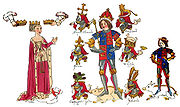
Richard III of England
Richard III was King of England for two years, from 1483 until his death in 1485 during the Battle of Bosworth Field. He was the last king of the House of York and the last of the Plantagenet dynasty...
(1452—1485, reigned from 1483), and is an early instance of the use of boars in heraldry
Boars in heraldry
The wild boar and a boar's head are common charges in heraldry. A complete beast may represent what are seen as the positive qualities of the boar, namely courage and fierceness in battle; a boar's head may represent hospitality , or it may symbolize that the bearer of the arms is a noted...
.
Livery badges were important symbols of political affiliation in the Wars of the Roses
Wars of the Roses
The Wars of the Roses were a series of dynastic civil wars for the throne of England fought between supporters of two rival branches of the royal House of Plantagenet: the houses of Lancaster and York...
, and Richard distributed very large numbers at his coronation and the installation of his son Edward
Edward of Middleham, Prince of Wales
Edward of Middleham, 1st Earl of Salisbury , was the only son of King Richard III of England and his wife Anne Neville. He was Richard's only legitimate child and died aged 11....
as Prince of Wales
Prince of Wales
Prince of Wales is a title traditionally granted to the heir apparent to the reigning monarch of the United Kingdom of Great Britain and Northern Ireland and the 15 other independent Commonwealth realms...
, for which an order of 13,000 badges in fustian
Fustian
Fustian is a term for a variety of heavy woven, mostly cotton fabrics, chiefly prepared for menswear. It is also used to refer to pompous, inflated or pretentious writing or speech, from at least the time of Shakespeare...
cloth is recorded. Edward appears to have shared use of the badge, either from Richard's accession to the throne, or his own appointment as Prince of Wales, both in 1483, to his death the next year. Richard choice of the badge was no doubt personal, but according to a slightly later document the boar had been a badge of the royal possession the "Honour of Windsor
Windsor Castle
Windsor Castle is a medieval castle and royal residence in Windsor in the English county of Berkshire, notable for its long association with the British royal family and its architecture. The original castle was built after the Norman invasion by William the Conqueror. Since the time of Henry I it...
" (an "honour
Honour (land)
In medieval England, an honour could consist of a great lordship, comprising dozens or hundreds of manors. Holders of honours often attempted to preserve the integrity of an honour over time, administering its properties as a unit, maintaining inheritances together, etc.The typical honour had...
" was a large estate, not necessarily all located around the place from which it took its name). Another suggestion is that the boar was a pun on "Ebor", a contraction of Eboracum
Eboracum
Eboracum was a fort and city in Roman Britain. The settlement evolved into York, located in North Yorkshire, England.-Etymology:The first known recorded mention of Eboracum by name is dated circa 95-104 AD and is an address containing the Latin form of the settlement's name, "Eburaci", on a wooden...
, the Latin name for York
York
York is a walled city, situated at the confluence of the Rivers Ouse and Foss in North Yorkshire, England. The city has a rich heritage and has provided the backdrop to major political events throughout much of its two millennia of existence...
; Richard was known as "Richard of York" before being created Duke of Gloucester
Duke of Gloucester
Duke of Gloucester is a British royal title , often conferred on one of the sons of the reigning monarch. The first four creations were in the Peerage of England, the next in the Peerage of Great Britain, and the last in the Peerage of the United Kingdom; this current creation carries with it the...
.
Tudor dynasty
The Tudor dynasty or House of Tudor was a European royal house of Welsh origin that ruled the Kingdom of England and its realms, including the Lordship of Ireland, later the Kingdom of Ireland, from 1485 until 1603. Its first monarch was Henry Tudor, a descendant through his mother of a legitimised...
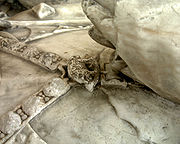
that followed his brief reign, and most of his badges would no doubt have been hurriedly discarded after his death. Only two examples survived on tomb monuments, one of which was destroyed in the 20th century. The sole remaining example is a pendant white boar on a Yorkist livery collar
Livery collar
A livery collar or chain of office is a collar or heavy chain, usually of gold, worn as insignia of office or a mark of fealty or other association in Europe from the Middle Ages onwards....
carved in the alabaster
Alabaster
Alabaster is a name applied to varieties of two distinct minerals, when used as a material: gypsum and calcite . The former is the alabaster of the present day; generally, the latter is the alabaster of the ancients...
effigy of Sir Ralph Fitzherbert
Ralph Fitzherbert
Ralph Fitzherbert was Lord of the manor of Norbury, Derbyshire. His effigy in his suit of armour at Norbury church are reproduced in the Victoria and Albert Museum, in contemporary armour. -Biography:...
, who died in Richard's reign in 1483. A number of metal badges, for pinning to the chest or a hat, have survived in lead, silver, and gilded copper high relief, the last found at Richard's home of Middleham Castle
Middleham Castle
Middleham Castle in Wensleydale, in the county of North Yorkshire, was built by Robert Fitzrandolph, 3rd Lord of Middleham and Spennithorne, commencing in 1190. It was built near the site of an earlier motte and bailey castle...
in Yorkshire, and very likely worn by one of his household when he was Duke of Gloucester.
A new example in silver-gilt
Silver-gilt
Silver-gilt or gilded/gilt silver, sometimes known in American English by the French term vermeil, is silver gilded with gold. Most large objects made in goldsmithing that appear to be gold are actually silver-gilt; for example most sporting trophies, medals , and many crown jewels...
was found in 2009 on or near the battlefield of the Battle of Bosworth Field
Battle of Bosworth Field
The Battle of Bosworth Field was the penultimate battle of the Wars of the Roses, the civil war between the House of Lancaster and the House of York that raged across England in the latter half of the 15th century. Fought on 22 August 1485, the battle was won by the Lancastrians...
, where Richard was killed in 1485, which with other finds is leading to historians rethinking the precise location of the battle. The archaeologist responsible for the site, Dr Glenn Foard, said:"... several of the objects are amazing. The most important by far is the silver-gilt boar, which was Richard III’s own badge, given in large numbers to his supporters. But this one is special, because it is silver-gilt. It was almost certainly worn by a knight in King Richard’s own retinue who rode with the King to his death in his last desperate cavalry charge. It was found right next to the site of a small medieval marsh - and the King was killed when his horse became stuck in a mire." This badge was similar, but not identical, to the Chiddingly Boar found in Chiddingly
Chiddingly
Chiddingly is a village and civil parish in the Wealden District of East Sussex, some five miles northwest of Hailsham. The parish is rural in character: it includes the village of Chiddingly and a collection of hamlets: the largest of these being Muddles Green and Thunder's Hill; others...
, East Sussex
East Sussex
East Sussex is a county in South East England. It is bordered by the counties of Kent, Surrey and West Sussex, and to the south by the English Channel.-History:...
in 1999, and now in the British Museum
British Museum
The British Museum is a museum of human history and culture in London. Its collections, which number more than seven million objects, are amongst the largest and most comprehensive in the world and originate from all continents, illustrating and documenting the story of human culture from its...
. This is, or was, also in silver-gilt, though much of the gilding
Gilding
The term gilding covers a number of decorative techniques for applying fine gold leaf or powder to solid surfaces such as wood, stone, or metal to give a thin coating of gold. A gilded object is described as "gilt"...
has worn off. Badges in precious metals would have been given to the more important, or perhaps intimate, of Richard's supporters. No doubt there were once badges in gold, enamel
Vitreous enamel
Vitreous enamel, also porcelain enamel in U.S. English, is a material made by fusing powdered glass to a substrate by firing, usually between 750 and 850 °C...
and gems for still more important supporters, like the Lancastrian
House of Lancaster
The House of Lancaster was a branch of the royal House of Plantagenet. It was one of the opposing factions involved in the Wars of the Roses, an intermittent civil war which affected England and Wales during the 15th century...
Dunstable Swan Jewel
Dunstable Swan Jewel
The Dunstable Swan Jewel is a gold and enamel brooch in the form of a swan made in England or France in about 1400 and now in the British Museum...
.
The Richard III Society, dedicated to defending his reputation, makes extensive use of white boars in its various forms of heraldry
Heraldry
Heraldry is the profession, study, or art of creating, granting, and blazoning arms and ruling on questions of rank or protocol, as exercised by an officer of arms. Heraldry comes from Anglo-Norman herald, from the Germanic compound harja-waldaz, "army commander"...
. It was originally called the Fellowship of the White Boar.
External links
- http://www.r3.org/rnt1991/deadlyboar.html List of examples of Richard's boar, based on an exhibition at the Royal National TheatreRoyal National TheatreThe Royal National Theatre in London is one of the United Kingdom's two most prominent publicly funded theatre companies, alongside the Royal Shakespeare Company...