

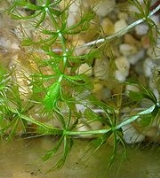
Waterwheel plant

Encyclopedia
Flowering plant
The flowering plants , also known as Angiospermae or Magnoliophyta, are the most diverse group of land plants. Angiosperms are seed-producing plants like the gymnosperms and can be distinguished from the gymnosperms by a series of synapomorphies...
genus Aldrovanda
Aldrovanda
Aldrovanda is a genus of carnivorous plants encompassing one extant species and numerous extinct taxa. The genus is named in honor of the Italian naturalist Ulisse Aldrovandi, the founder of the Botanical Garden of Bologna, Orto Botanico dell'Università di Bologna.The extinct species are known...
of the family Droseraceae
Droseraceae
Droseraceae is the botanical name for a family of flowering plants. The family is also known under its common name, the sundew family.It consists of carnivorous plants: besides the sundews, the genus Drosera, it also contains the even more-famous Venus fly trap Dionaea muscipula...
. This plant feeds on small aquatic invertebrate
Invertebrate
An invertebrate is an animal without a backbone. The group includes 97% of all animal species – all animals except those in the chordate subphylum Vertebrata .Invertebrates form a paraphyletic group...
s using traps very similar to those of the Venus Flytrap
Venus Flytrap
The Venus Flytrap , Dionaea muscipula, is a carnivorous plant that catches and digests animal prey—mostly insects and arachnids. Its trapping structure is formed by the terminal portion of each of the plant's leaves and is triggered by tiny hairs on their inner surfaces...
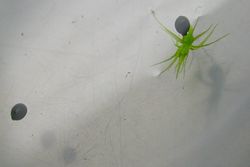
. The traps are arranged in whorls around a central, free-floating stem, hence the common name. This plant is one of few plants capable of rapid plant movement
Rapid plant movement
Rapid plant movement encompasses movement in plant structures occurring over a very short period of time, usually under one second. For example, the Venus Flytrap closes its trap in about 100 milliseconds. The Dogwood Bunchberry's flower opens its petals and fires pollen in less than 0.5 milliseconds...
.
While the genus Aldrovanda
Aldrovanda
Aldrovanda is a genus of carnivorous plants encompassing one extant species and numerous extinct taxa. The genus is named in honor of the Italian naturalist Ulisse Aldrovandi, the founder of the Botanical Garden of Bologna, Orto Botanico dell'Università di Bologna.The extinct species are known...
is monotypic, extinct species are known to have existed. There is also wide variability among populations of significantly different geographic locations, as the species is found natively on four continents.
Morphology
A. vesiculosa is a rootless aquatic plantAquatic plant
Aquatic plants are plants that have adapted to living in aquatic environments. They are also referred to as hydrophytes or aquatic macrophytes. These plants require special adaptations for living submerged in water, or at the water's surface. Aquatic plants can only grow in water or in soil that is...
; seedlings possess rudimentary roots, however these quickly necrotize and fall off. The plant consists of floating stems
Plant stem
A stem is one of two main structural axes of a vascular plant. The stem is normally divided into nodes and internodes, the nodes hold buds which grow into one or more leaves, inflorescence , conifer cones, roots, other stems etc. The internodes distance one node from another...
reaching a length of 6–11 cm. The 2–3 mm trap leaves grow in whorls
Whorl (botany)
In botany, a whorl is an arrangement of sepals, petals, leaves, or branches in which all the parts are attached at the same point and surround or wrap around the stem.There are four whorls in a general flower...
of 5-9 in close succession along the plant's central stem. The actual traps are held by petioles which hold air sacks that aid in flotation. One end of the stem continually grows while the other end dies off. Growth is quite rapid (4–9 mm/day in Japanese populations ), so that in optimal conditions a new whorl is produced once or more each day.
Trap
The actual traps consist of two lobes which fold together to form a snap-trap similar to that of the Venus fly trap, except that they are smaller and underwater. These traps, which are twisted so that the trap openings point outward, are lined on the inside by a fine coating of trigger hairs, snapping shut in response to contact with aquatic invertebrates and trapping them. The closing of this trap takes a mere 10-20 milliseconds, making it one of the fastest examples of plant movementRapid plant movement
Rapid plant movement encompasses movement in plant structures occurring over a very short period of time, usually under one second. For example, the Venus Flytrap closes its trap in about 100 milliseconds. The Dogwood Bunchberry's flower opens its petals and fires pollen in less than 0.5 milliseconds...
in the kingdom
Plant
Plants are living organisms belonging to the kingdom Plantae. Precise definitions of the kingdom vary, but as the term is used here, plants include familiar organisms such as trees, flowers, herbs, bushes, grasses, vines, ferns, mosses, and green algae. The group is also called green plants or...
. This trapping is only possible in warm conditions (20 °C). Each trap is surrounded by between four and six 6–8 mm long bristle
Bristle
A bristle is a stiff hair or feather. Also used are synthetic materials such as nylon in items such as brooms and sweepers. Bristles are often used to make brushes for cleaning uses, as they are strongly abrasive; common examples include the toothbrush and toilet brush...
s which prevent triggering of traps by debris in the water.
Flowers
The small, solitary white flowers of A. vesiculosa are supported above the water level by short peduncles which arise from whorl axes. The flower only opens for a few hours, after which the structure is brought back beneath the water level for seedSeed
A seed is a small embryonic plant enclosed in a covering called the seed coat, usually with some stored food. It is the product of the ripened ovule of gymnosperm and angiosperm plants which occurs after fertilization and some growth within the mother plant...
production. The seeds are cryptocotylar, meaning that the cotyledon
Cotyledon
A cotyledon , is a significant part of the embryo within the seed of a plant. Upon germination, the cotyledon may become the embryonic first leaves of a seedling. The number of cotyledons present is one characteristic used by botanists to classify the flowering plants...
s remain hidden within the seed coat and serve as energy storage for the seedlings. The waterwheel plant, however, seems to bloom seldom, at least in temperate regions.
Divisions
A. vesiculosa reproduces most often through vegetative reproductionVegetative reproduction
Vegetative reproduction is a form of asexual reproduction in plants. It is a process by which new individuals arise without production of seeds or spores...
. In favourable conditions, adult plants will produce an offshoot every 3–4 cm, resulting in new plants as the tips continue to grow and the old ends die off and separate. Due to the rapid growth rate of this species, countless new plants can be produced in a short period of time in this fashion.
Turions
Winter-hardy Aldrovanda form so-called "turions" as a frost survival strategy. At the onset of winter, the growth tip starts producing highly reduced non-carnivorous leaves on a severely shortened stem. This results in a tight bud of protective leaves which, being heavier and having released flotational gases, breaks off of the mother plant and sinks to the water bottom, where temperatures are stable and warmer. Here it can withstand temperatures as low as -15 °C. In the wild, Aldrovanda turions have been observed to have a relatively low rate of successful sinking. Those nutritious turions that fail to sink are then grazed by waterfowl or are killed by the onset of frost. In spring when water temperatures rise above 12-15°C, turions reduce their density and float to the top of the water, where they germinate and resume growth. Non-dormant turion-like organs can also form in response to summer drought.Distribution
A. vesiculosa is the most widely distributed carnivorous plant species, native to EuropeEurope
Europe is, by convention, one of the world's seven continents. Comprising the westernmost peninsula of Eurasia, Europe is generally 'divided' from Asia to its east by the watershed divides of the Ural and Caucasus Mountains, the Ural River, the Caspian and Black Seas, and the waterways connecting...
, Asia
Asia
Asia is the world's largest and most populous continent, located primarily in the eastern and northern hemispheres. It covers 8.7% of the Earth's total surface area and with approximately 3.879 billion people, it hosts 60% of the world's current human population...
, Africa
Africa
Africa is the world's second largest and second most populous continent, after Asia. At about 30.2 million km² including adjacent islands, it covers 6% of the Earth's total surface area and 20.4% of the total land area...
, and Australia
Australia
Australia , officially the Commonwealth of Australia, is a country in the Southern Hemisphere comprising the mainland of the Australian continent, the island of Tasmania, and numerous smaller islands in the Indian and Pacific Oceans. It is the world's sixth-largest country by total area...
. It is, however, rare in all of its range. Aldrovanda is spread mainly through the movement of waterfowl - plants sticking to the feet of a bird are transported to the next aquatic destination on the bird's route. As a result, most Aldrovanda populations are located along avian migratory routes.
Habitat
A. vesiculosa prefers clean, shallow, warm standing water with bright light, low nutrient levels and a slightly acidic pHPH
In chemistry, pH is a measure of the acidity or basicity of an aqueous solution. Pure water is said to be neutral, with a pH close to 7.0 at . Solutions with a pH less than 7 are said to be acidic and solutions with a pH greater than 7 are basic or alkaline...
(around 6). It can be found floating amongst Juncus
Juncus
Juncus is a genus in the plant family Juncaceae. It consists of some 200 to 300 or more species of grassy plants commonly called rushes...
, reeds
Phragmites
Phragmites, the Common reed, is a large perennial grass found in wetlands throughout temperate and tropical regions of the world. Phragmites australis is sometimes regarded as the sole species of the genus Phragmites, though some botanists divide Phragmites australis into three or four species...
, and even rice
Rice
Rice is the seed of the monocot plants Oryza sativa or Oryza glaberrima . As a cereal grain, it is the most important staple food for a large part of the world's human population, especially in East Asia, Southeast Asia, South Asia, the Middle East, and the West Indies...
.
Botanical history
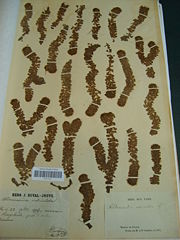
India
India , officially the Republic of India , is a country in South Asia. It is the seventh-largest country by geographical area, the second-most populous country with over 1.2 billion people, and the most populous democracy in the world...
in 1699 by Leonard Plukenet
Leonard Plukenet
Leonard Plukenet was an English botanist, Royal Professor of Botany and gardener to Queen Mary. Plukenet published Phytographia in four parts in which he described and illustrated rare exotic plants. It is a copiously illustrated work of more than 2 700 figures and is frequently cited in books...
, who named the plant Lenticula pulustris Indica. The modern botanical name originates from Giuseppe Monti, who described Italian specimens in 1747 and named them Aldrovandia vesiculosa in honor of the Italian naturalist Ulisse Aldrovandi
Ulisse Aldrovandi
Ulisse Aldrovandi was an Italian naturalist, the moving force behind Bologna's botanical garden, one of the first in Europe. Carolus Linnaeus and the comte de Buffon reckoned him the father of natural history studies...
. When Carl Linnaeus published his Species Plantarum
Species Plantarum
Species Plantarum was first published in 1753, as a two-volume work by Carl Linnaeus. Its prime importance is perhaps that it is the primary starting point of plant nomenclature as it exists today. This means that the first names to be considered validly published in botany are those that appear...
in 1753, the "i" was dropped from the name (an apparent orthographic error) to form the modern binomial.
Infraspecific taxa
- Aldrovanda vesiculosa var. aquitanica Durieu ex Diels (1906) nom.illeg.
- Aldrovanda vesiculosa var. australis Darwin (1876)
- Aldrovanda vesiculosa var. duriaei Caspary (1859)
- Aldrovanda vesiculosa var. verticillata (Roxb.) Darwin (1876)