
Home      Discussion      Topics      Dictionary      Almanac
Signup       Login
Venus Flytrap

Venus Flytrap

Overview
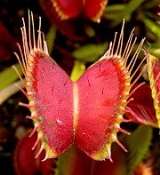
The Venus Flytrap Dionaea muscipula, is a carnivorous plant
Carnivorous plant
Carnivorous plants are plants that derive some or most of their nutrients from trapping and consuming animals or protozoans, typically insects and other arthropods. Carnivorous plants appear adapted to grow in places where the soil is thin or poor in nutrients, especially nitrogen, such as acidic...

 that catches and digests animal prey—mostly insect
Insect
Insects are a class of living creatures within the arthropods that have a chitinous exoskeleton, a three-part body , three pairs of jointed legs, compound eyes, and two antennae...

s and arachnid
Arachnid
Arachnids are a class of joint-legged invertebrate animals in the subphylum Chelicerata. All arachnids have eight legs, although in some species the front pair may convert to a sensory function. The term is derived from the Greek words , meaning "spider".Almost all extant arachnids are terrestrial...

s. Its trapping structure is formed by the terminal portion of each of the plant's leaves and is triggered by tiny hairs on their inner surfaces. When an insect or spider crawling along the leaves contacts a hair, the trap closes if a different hair is contacted within twenty seconds of the first strike. The requirement of redundant triggering in this mechanism serves as a safeguard against a waste of energy in trapping objects with no nutritional value.
Discussion
Ask a question about 'Venus Flytrap'
Start a new discussion about 'Venus Flytrap'
Answer questions from other users
Full Discussion Forum
 
Unanswered Questions
Encyclopedia
The Venus Flytrap Dionaea muscipula, is a carnivorous plant
Carnivorous plant
Carnivorous plants are plants that derive some or most of their nutrients from trapping and consuming animals or protozoans, typically insects and other arthropods. Carnivorous plants appear adapted to grow in places where the soil is thin or poor in nutrients, especially nitrogen, such as acidic...

 that catches and digests animal prey—mostly insect
Insect
Insects are a class of living creatures within the arthropods that have a chitinous exoskeleton, a three-part body , three pairs of jointed legs, compound eyes, and two antennae...

s and arachnid
Arachnid
Arachnids are a class of joint-legged invertebrate animals in the subphylum Chelicerata. All arachnids have eight legs, although in some species the front pair may convert to a sensory function. The term is derived from the Greek words , meaning "spider".Almost all extant arachnids are terrestrial...

s. Its trapping structure is formed by the terminal portion of each of the plant's leaves and is triggered by tiny hairs on their inner surfaces. When an insect or spider crawling along the leaves contacts a hair, the trap closes if a different hair is contacted within twenty seconds of the first strike. The requirement of redundant triggering in this mechanism serves as a safeguard against a waste of energy in trapping objects with no nutritional value.

Dionaea is a monotypic
Monotypic
In biology, a monotypic taxon is a taxonomic group with only one biological type. The term's usage differs slightly between botany and zoology. The term monotypic has a separate use in conservation biology, monotypic habitat, regarding species habitat conversion eliminating biodiversity and...

 genus
Genus
In biology, a genus is a low-level taxonomic rank used in the biological classification of living and fossil organisms, which is an example of definition by genus and differentia...

 closely related to the waterwheel plant and sundew
Sundew
Drosera, commonly known as the sundews, comprise one of the largest genera of carnivorous plants, with at least 194 species. These members of the family Droseraceae lure, capture, and digest insects using stalked mucilaginous glands covering their leaf surface. The insects are used to supplement...

s.

Description


The Venus Flytrap is a small plant whose structure can be described as a rosette of four to seven leaves, which arise from a short subterranean stem that is actually a bulb-like object. Each stem reaches a maximum size of about three to ten centimeters, depending on the time of year; longer leaves with robust traps are usually formed after flowering. Flytraps that have more than 7 leaves are colonies
Colony (biology)
In biology, a colony reference to several individual organisms of the same species living closely together, usually for mutual benefit, such as stronger defense or the ability to attack bigger prey. Some insects live only in colonies...

 formed by rosettes that have divided beneath the ground.

The leaf blade is divided into two regions: a flat, heart-shaped photosynthesis
Photosynthesis
Photosynthesis is a chemical process that converts carbon dioxide into organic compounds, especially sugars, using the energy from sunlight. Photosynthesis occurs in plants, algae, and many species of bacteria, but not in archaea. Photosynthetic organisms are called photoautotrophs, since they can...

-capable petiole
Petiole (botany)
In botany, the petiole is the stalk attaching the leaf blade to the stem. The petiole usually has the same internal structure as the stem. Outgrowths appearing on each side of the petiole are called stipules. Leaves lacking a petiole are called sessile, or clasping when they partly surround the...

, and a pair of terminal lobes hinged at the midrib, forming the trap which is the true leaf. The upper surface of these lobes contains red anthocyanin
Anthocyanin
Anthocyanins are water-soluble vacuolar pigments that may appear red, purple, or blue according to pH...

 pigments and its edges secrete mucilage
Mucilage
Mucilage is a thick, gluey substance produced by most plants and some microorganisms. It is a polar glycoprotein and an exopolysaccharide.It occurs in various parts of nearly all classes of plant, usually in relatively small percentages, and is frequently associated with other substances, such as...

. The lobes exhibit rapid plant movement
Rapid plant movement
Rapid plant movement encompasses movement in plant structures occurring over a very short period of time, usually under one second. For example, the Venus Flytrap closes its trap in about 100 milliseconds. The Dogwood Bunchberry's flower opens its petals and fires pollen in less than 0.5 milliseconds...

s, snapping shut when stimulated by prey. The trapping mechanism is tripped when prey contacts one of the three hair-like trichome
Trichome
Trichomes are fine outgrowths or appendages on plants and certain protists. These are of diverse structure and function. Examples are hairs, glandular hairs, scales, and papillae.- Algal trichomes :...

s that are found on the upper surface of each of the lobes. The trapping mechanism is so specialized that it can distinguish between living prey and non-prey stimuli such as falling raindrops; two trigger hairs must be touched in succession within 20 seconds of each other or one hair touched twice in rapid succession, whereupon the lobes of the trap will snap shut in about 0.1 seconds. The edges of the lobes are fringed by stiff hair-like protrusions or cilia, which mesh together and prevent large prey from escaping. (These protrusions, and the trigger hairs, also known as sensitive hairs, are probably homologous
Homology (biology)
Homology forms the basis of organization for comparative biology. In 1843, Richard Owen defined homology as "the same organ in different animals under every variety of form and function". Organs as different as a bat's wing, a seal's flipper, a cat's paw and a human hand have a common underlying...

 with the tentacles found in this plant’s close relatives, the sundew
Sundew
Drosera, commonly known as the sundews, comprise one of the largest genera of carnivorous plants, with at least 194 species. These members of the family Droseraceae lure, capture, and digest insects using stalked mucilaginous glands covering their leaf surface. The insects are used to supplement...

s.) Scientists are currently unsure about the evolutionary history of the Venus flytrap; however scientists have made hypotheses that the flytrap evolved from Drosera (sundews).

The holes in the meshwork allow small prey to escape, presumably because the benefit that would be obtained from them would be less than the cost of digesting them. If the prey is too small and escapes, the trap will reopen within 12 hours. If the prey moves around in the trap, it tightens and digestion begins more quickly.

Speed of closing can vary depending on the amount of humidity, light, size of prey, and general growing conditions. The speed with which traps close can be used as an indicator of a plant's general health. Venus Flytraps are not as humidity-dependent as are some other carnivorous plants, such as Nepenthes
Nepenthes
The Nepenthes , popularly known as tropical pitcher plants or monkey cups, are a genus of carnivorous plants in the monotypic family Nepenthaceae. The genus comprises roughly 130 species, numerous natural and many cultivated hybrids...

, Cephalotus
Cephalotus
Cephalotus is a genus which contains one species, Cephalotus follicularis, a small carnivorous pitcher plant. The pit-fall traps of the modified leaves have inspired the common names for this plant, which include Albany Pitcher Plant, Western Australian Pitcher Plant, fly-catcher plant or...

, most Heliamphora
Heliamphora
The genus Heliamphora contains 23 species of pitcher plants endemic to South America. The species are collectively known as sun pitchers, based on the mistaken notion that the heli of Heliamphora is from the Greek helios, meaning "sun"...

, and some Drosera.

The Venus Flytrap exhibits variations in petiole shape and length and whether the leaf lies flat on the ground or extends up at an angle of about 40–60 degrees. The four major forms are: 'typica', the most common, with broad decumbent petioles; 'erecta', with leaves at a 45-degree angle; 'linearis', with narrow petioles and leaves at 45 degrees; and 'filiformis', with extremely narrow or linear petioles. Except for 'filiformis', all of these can be stages in leaf production of any plant depending on season (decumbent in summer versus short versus semi-erect in spring), length of photoperiod (long petioles in spring versus short in summer), and intensity of light (wide petioles in low light intensity versus narrow in brighter light).

When grown from seed, plants take around four to five years to reach maturity and will live for 20 to 30 years if cultivated in the right conditions.

Etymology


The plant's common name refers to Venus
Venus (mythology)
Venus is a Roman goddess principally associated with love, beauty, sex,sexual seduction and fertility, who played a key role in many Roman religious festivals and myths...

, the Roman goddess of love. The genus name, Dionaea ("daughter of Dione
Dione (mythology)
Dione was a Greek goddess primarily known as the mother of Aphrodite in Book V of Homer's Iliad. Aphrodite journeys to Dione's side after she has been wounded in battle protecting her favorite son Aeneas. In this episode, Dione seems to be the equivalent of the earth goddess Gaia, whom Homer also...

"), refers to the Greek goddess Aphrodite
Aphrodite
Aphrodite is the Greek goddess of love, beauty, pleasure, and procreation.Her Roman equivalent is the goddess .Historically, her cult in Greece was imported from, or influenced by, the cult of Astarte in Phoenicia....

, while the species name, muscipula is Latin for "mousetrap".

Historically, the plant was also known by the slang term "tipitiwitchet" or "tippity twitchet", possibly an oblique reference to the plant's resemblance to human female genitalia.

Carnivory


Prey selectivity


Most carnivorous plants selectively feed on specific prey. This selection is due to the available prey and the type of trap used by the organism. With the Venus Flytrap, prey is limited to beetles, spiders and arthropods. In fact, the Dionaea diet is 33% ants, 30% spiders, 10% beetles, and 10% grasshoppers, with fewer than 5% flying insects. Given that Dionaea evolved from an ancestral form of Drosera (carnivorous plants that use a sticky trap instead of a snap trap) the reason for this evolutionary branching becomes clear. Whilst Drosera consume smaller, aerial insects, Dionaea consume larger terrestrial bugs. From these larger bugs, Dionaea are able to extract more nutrients. This gives Dionaea an evolutionary advantage over their ancestral sticky trap form.

Mechanism of trapping


The Venus Flytrap is one of a very small group of plants capable of rapid movement
Rapid plant movement
Rapid plant movement encompasses movement in plant structures occurring over a very short period of time, usually under one second. For example, the Venus Flytrap closes its trap in about 100 milliseconds. The Dogwood Bunchberry's flower opens its petals and fires pollen in less than 0.5 milliseconds...

, such as Mimosa
Mimosa
Mimosa is a genus of about 400 species of herbs and shrubs, in the subfamily Mimosoideae of the legume family Fabaceae. The generic name is derived from the Greek word μιμος , meaning "mimic."...

, the Telegraph plant, sundew
Sundew
Drosera, commonly known as the sundews, comprise one of the largest genera of carnivorous plants, with at least 194 species. These members of the family Droseraceae lure, capture, and digest insects using stalked mucilaginous glands covering their leaf surface. The insects are used to supplement...

s and bladderwort
Bladderwort
Utricularia, commonly and collectively called the bladderworts, is a genus of carnivorous plants consisting of approximately 233 species . They occur in fresh water and wet soil as terrestrial or aquatic species across every continent except Antarctica...

s.

The mechanism by which the trap snaps shut involves a complex interaction between elasticity
Elasticity (physics)
In physics, elasticity is the physical property of a material that returns to its original shape after the stress that made it deform or distort is removed. The relative amount of deformation is called the strain....

, turgor and growth. In the open, untripped state, the lobes are convex (bent outwards), but in the closed state, the lobes are concave (forming a cavity). It is the rapid flipping of this bistable
Bistability
Bistability is a fundamental phenomenon in nature. Something that is bistable can be resting in either of two states. These rest states need not be symmetric with respect to stored energy...

 state that closes the trap, but the mechanism by which this occurs is still poorly understood. When the trigger hairs are stimulated, an action potential
Action potential
In physiology, an action potential is a short-lasting event in which the electrical membrane potential of a cell rapidly rises and falls, following a consistent trajectory. Action potentials occur in several types of animal cells, called excitable cells, which include neurons, muscle cells, and...

 (mostly involving calcium ions—see calcium in biology
Calcium in biology
Calcium plays a pivotal role in the physiology and biochemistry of organisms and the cell. It plays an important role in signal transduction pathways, where it acts as a second messenger, in neurotransmitter release from neurons, contraction of all muscle cell types, and fertilization...

) is generated, which propagates across the lobes and stimulates cells in the lobes and in the midrib between them. Exactly what this stimulation does is still debated. The acid growth
Acid growth
Acid growth refers to the ability of plant cells and plant cell walls to elongate or expand quickly at low pH. This form of growth does not involve an increase in cell number. During acid growth, plant cells enlarge rapidly because the cell walls are made more extensible by expansin, a...

 theory states that individual cells in the outer layers of the lobes and midrib rapidly move 1H+
Proton
The proton is a subatomic particle with the symbol or and a positive electric charge of 1 elementary charge. One or more protons are present in the nucleus of each atom, along with neutrons. The number of protons in each atom is its atomic number....

 (hydrogen ion
Hydrogen ion
Hydrogen ion is recommended by IUPAC as a general term for all ions of hydrogen and its isotopes.Depending on the charge of the ion, two different classes can be distinguished: positively charged ions and negatively charged ions....

s) into their cell walls, lowering the pH
PH
In chemistry, pH is a measure of the acidity or basicity of an aqueous solution. Pure water is said to be neutral, with a pH close to 7.0 at . Solutions with a pH less than 7 are said to be acidic and solutions with a pH greater than 7 are basic or alkaline...

 and loosening the extracellular components, which allows them to swell rapidly by osmosis
Osmosis
Osmosis is the movement of solvent molecules through a selectively permeable membrane into a region of higher solute concentration, aiming to equalize the solute concentrations on the two sides...

, thus elongating and changing the shape of the trap lobe. Alternatively, cells in the inner layers of the lobes and midrib may rapidly secrete other ion
Ion
An ion is an atom or molecule in which the total number of electrons is not equal to the total number of protons, giving it a net positive or negative electrical charge. The name was given by physicist Michael Faraday for the substances that allow a current to pass between electrodes in a...

s, allowing water to follow by osmosis, and the cells to collapse. Both of these mechanisms may play a role and have some experimental evidence to support them.

Digestion


If the prey is unable to escape, it will continue to stimulate the inner surface of the lobes, and this causes a further growth response that forces the edges of the lobes together, eventually sealing the trap hermetically and forming a 'stomach' in which digestion
Digestion
Digestion is the mechanical and chemical breakdown of food into smaller components that are more easily absorbed into a blood stream, for instance. Digestion is a form of catabolism: a breakdown of large food molecules to smaller ones....

 occurs. Digestion is catalysed
Catalysis
Catalysis is the change in rate of a chemical reaction due to the participation of a substance called a catalyst. Unlike other reagents that participate in the chemical reaction, a catalyst is not consumed by the reaction itself. A catalyst may participate in multiple chemical transformations....

 by enzyme
Enzyme
Enzymes are proteins that catalyze chemical reactions. In enzymatic reactions, the molecules at the beginning of the process, called substrates, are converted into different molecules, called products. Almost all chemical reactions in a biological cell need enzymes in order to occur at rates...

s secreted by glands in the lobes.

Oxidative protein modification is likely to be a predigestive mechanism of the Dionaea muscipula. Aqueous leaf extracts have been found to contain quinone
Quinone
A quinone is a class of organic compounds that are formally "derived from aromatic compounds [such as benzene or naphthalene] by conversion of an even number of –CH= groups into –C– groups with any necessary rearrangement of double bonds," resulting in "a fully conjugated cyclic dione structure."...

s such as the naphthoquinone
Naphthoquinone
Naphthoquinone is a class of natural phenols based on the C6-C4 skeleton.1,4-Naphthoquinone can be viewed as derivatives of naphthalene through the replacement of two hydrogen atoms by two ketone groups....

 plumbagin
Plumbagin
Plumbagin or 5-hydroxy-2-methyl-1,4-naphthoquinone is an organic compound with the chemical formula . It is regarded as a toxin.Plumbagin is a yellow dye, formally derived from naphthoquinone....

 that couples to different NADH-dependent diaphorases to produce superoxide
Superoxide
A superoxide, also known by the obsolete name hyperoxide, is a compound that possesses the superoxide anion with the chemical formula O2−. The systematic name of the anion is dioxide. It is important as the product of the one-electron reduction of dioxygen O2, which occurs widely in nature...

 and hydrogen peroxide
Hydrogen peroxide
Hydrogen peroxide is the simplest peroxide and an oxidizer. Hydrogen peroxide is a clear liquid, slightly more viscous than water. In dilute solution, it appears colorless. With its oxidizing properties, hydrogen peroxide is often used as a bleach or cleaning agent...

 upon autoxidation
Autoxidation
Autoxidation is any oxidation that occurs in open air or in presence of oxygen and/or UV radiation and forms peroxides and hydroperoxides. A classic example of autoxidation is that of simple ethers like diethyl ether, whose peroxides can be dangerously explosive. It can be considered to be a slow,...

. Such oxidative modification could rupture animal cell membranes. Plumbagin is known to induce apoptosis
Apoptosis
Apoptosis is the process of programmed cell death that may occur in multicellular organisms. Biochemical events lead to characteristic cell changes and death. These changes include blebbing, cell shrinkage, nuclear fragmentation, chromatin condensation, and chromosomal DNA fragmentation...

, associated with the regulation of Bcl-2
Bcl-2
Bcl-2 is the founding member of the Bcl-2 family of apoptosis regulator proteins encoded by the BCL2 gene. Bcl-2 derives its name from B-cell lymphoma 2, as it is the second member of a range of proteins initially described in chromosomal translocations involving chromosomes 14 and 18 in...

 family of proteins. When the Dionaea extracts were preincubated with diaphorases and NADH in the presence of serum albumin
Serum albumin
Serum albumin, often referred to simply as albumin is a protein that in humans is encoded by the ALB gene.Serum albumin is the most abundant plasma protein in mammals. Albumin is essential for maintaining the osmotic pressure needed for proper distribution of body fluids between intravascular...

 (SA), subsequent tryptic
Trypsin
Trypsin is a serine protease found in the digestive system of many vertebrates, where it hydrolyses proteins. Trypsin is produced in the pancreas as the inactive proenzyme trypsinogen. Trypsin cleaves peptide chains mainly at the carboxyl side of the amino acids lysine or arginine, except when...

 digestion of SA was facilitated. Since the secretory gland
Exocrine gland
Exocrine glands are a type of ductal glands that secrete their products into ducts that lead directly into the external environment...

s of Droseraceae
Droseraceae
Droseraceae is the botanical name for a family of flowering plants. The family is also known under its common name, the sundew family.It consists of carnivorous plants: besides the sundews, the genus Drosera, it also contains the even more-famous Venus fly trap Dionaea muscipula...

 contain protease
Protease
A protease is any enzyme that conducts proteolysis, that is, begins protein catabolism by hydrolysis of the peptide bonds that link amino acids together in the polypeptide chain forming the protein....

s and possibly other degradative enzymes, it may be that the presence of oxygen-activating redox
Redox
Redox reactions describe all chemical reactions in which atoms have their oxidation state changed....

 cofactor
Cofactor (biochemistry)
A cofactor is a non-protein chemical compound that is bound to a protein and is required for the protein's biological activity. These proteins are commonly enzymes, and cofactors can be considered "helper molecules" that assist in biochemical transformations....

s function as extracellular predigestive
Saliva
Saliva , referred to in various contexts as spit, spittle, drivel, drool, or slobber, is the watery substance produced in the mouths of humans and most other animals. Saliva is a component of oral fluid. In mammals, saliva is produced in and secreted from the three pairs of major salivary glands,...

 oxidants to render membrane-bound proteins of the prey (insect
Insect
Insects are a class of living creatures within the arthropods that have a chitinous exoskeleton, a three-part body , three pairs of jointed legs, compound eyes, and two antennae...

s) more susceptible to proteolytic
Proteolysis
Proteolysis is the directed degradation of proteins by cellular enzymes called proteases or by intramolecular digestion.-Purposes:Proteolysis is used by the cell for several purposes...

 attacks.

Digestion takes about ten days, after which the prey is reduced to a husk of chitin
Chitin
Chitin n is a long-chain polymer of a N-acetylglucosamine, a derivative of glucose, and is found in many places throughout the natural world...

. The trap then reopens, and is ready for reuse.

Evolution


The Venus Flytrap's evolution was the product of a "Hobson's choice
Hobson's choice
A Hobson's choice is a free choice in which only one option is offered. As a person may refuse to take that option, the choice is therefore between taking the option or not; "take it or leave it". The phrase is said to originate with Thomas Hobson , a livery stable owner in Cambridge, England...

" in which plants that did not evolve nutrient-capturing abilities in nitrogen and phosphorus-poor environments would not have survived. Their carnivorous traps were evolutionarily selected to allow these organisms to survive their harsh environments.

Habitat


The Venus Flytrap is found in nitrogen
Nitrogen
Nitrogen is a chemical element that has the symbol N, atomic number of 7 and atomic mass 14.00674 u. Elemental nitrogen is a colorless, odorless, tasteless, and mostly inert diatomic gas at standard conditions, constituting 78.08% by volume of Earth's atmosphere...

 and phosphorus-poor environments, such as bog
Bog
A bog, quagmire or mire is a wetland that accumulates acidic peat, a deposit of dead plant material—often mosses or, in Arctic climates, lichens....

s and wet savannahs. Small in stature and slow growing, the Venus flytrap tolerates fire well, and depends on periodic burning to suppress its competition. Fire suppression threatens its future in the wild. It survives in wet sandy and peaty soils. Although it has been successfully transplanted and grown in many locales around the world, it is found natively only in North and South Carolina in the United States, specifically within a 60-mile radius of Wilmington, North Carolina
Wilmington, North Carolina
Wilmington is a port city in and is the county seat of New Hanover County, North Carolina, United States. The population is 106,476 according to the 2010 Census, making it the eighth most populous city in the state of North Carolina...

. One such place is North Carolina's Green Swamp
Green Swamp (North Carolina)
The Green Swamp is a swamp that lies in Brunswick and Columbus counties in North Carolina. An unusual carnivorous plant known as the Venus Flytrap is found within this swamp. North Carolina laws prohibit the removal of these plants from their habitat....

. There also appears to be a naturalized population of Venus Flytraps in northern Florida as well as populations in the New Jersey Pine Barrens. The nutritional poverty of the soil is the reason that the plant relies on such elaborate traps: insect prey provide the nitrogen for protein
Protein
Proteins are biochemical compounds consisting of one or more polypeptides typically folded into a globular or fibrous form, facilitating a biological function. A polypeptide is a single linear polymer chain of amino acids bonded together by peptide bonds between the carboxyl and amino groups of...

 formation that the soil cannot. The Venus Flytrap is not a tropical plant and can tolerate mild winters. In fact, Venus Flytraps that do not go through a period of winter dormancy will weaken and die after a period of time.

Cultivation


Venus flytraps are popular as cultivated plants, but have a reputation for being difficult to grow. Successfully growing these specialized plants requires recreating a close approximation to the plant's natural habitat.

Healthy Venus flytraps will produce scapes of white flowers in spring
Spring (season)
Spring is one of the four temperate seasons, the transition period between winter and summer. Spring and "springtime" refer to the season, and broadly to ideas of rebirth, renewal and regrowth. The specific definition of the exact timing of "spring" varies according to local climate, cultures and...

, however, many growers remove the flowering stem early (2–3 inches), as flowering consumes some of the plant's energy, and reduces the rate of trap production. If healthy plants are allowed to flower, successful pollination will result in the production of dozens of small, shiny black seeds.

Plants can be propagated by seed, although seedlings take several years to mature. More commonly, they are propagated by division in spring or summer.

Cultivars


Venus flytraps are, by far, the most commonly recognized and cultivated carnivorous plant. They are sold as houseplants and are often found at florists, hardware stores and supermarkets. During the past ten years or so large quantities of cultivars have come into the market through tissue culture
Plant tissue culture
Plant tissue culture is a collection of techniques used to maintain or grow plant cells, tissues or organs under sterile conditions on a nutrient culture medium of known composition. Plant tissue culture is widely used to produce clones of a plant in a method known as micropropagation...

 of select genetic mutations. It is through tissue culture that great quantities of plants are raised for commercial markets.

The registered cultivar
Cultivar
A cultivar'Cultivar has two meanings as explained under Formal definition. When used in reference to a taxon, the word does not apply to an individual plant but to all those plants sharing the unique characteristics that define the cultivar. is a plant or group of plants selected for desirable...

s (cultivated varieties) include (name of originator in braces):
  • Dionaea muscipula 'Akai Ryu'{Ron Gagliardo}
  • Dionaea muscipula 'B52' {Henning Von Schmeling}
  • Dionaea muscipula 'Big Mouth' {Tony Camilleri}
  • Dionaea muscipula 'Bohemian Garnet'
    Dionaea muscipula 'Bohemian Garnet'
    Dionaea muscipula 'Bohemian Garnet is a cultivar of Dionaea muscipula, the Venus flytrap. It is an F2 cross between Dionaea 'Royal Red' and Dionaea 'Sawtooth' that was published in the September 2007 issue of the Carnivorous Plant Newsletter...

     {Miroslav Srba}
  • Dionaea muscipula 'Clayton's Red Sunset' {Colin Clayton}
  • Dionaea muscipula 'Cupped Trap' {Staff at Agri-Starts III Inc, Eustis, FL.}
  • Dionaea muscipula 'Clumping Cultivar' {Peter D'Amato
    Peter D'Amato
    Peter D'Amato is an American author, businessman, and carnivorous plant authority. He is the owner of California Carnivores, the largest nursery of carnivorous plants in the world, and the author of The Savage Garden , a book on the cultivation of insectivorous plants...

    }
  • Dionaea muscipula 'Dentate' {Peter D'Amato
    Peter D'Amato
    Peter D'Amato is an American author, businessman, and carnivorous plant authority. He is the owner of California Carnivores, the largest nursery of carnivorous plants in the world, and the author of The Savage Garden , a book on the cultivation of insectivorous plants...

    }
  • Dionaea muscipula 'Dentate Traps' {Barry Meyers-Rice}
  • Dionaea muscipula 'Dente' {Peter D'Amato
    Peter D'Amato
    Peter D'Amato is an American author, businessman, and carnivorous plant authority. He is the owner of California Carnivores, the largest nursery of carnivorous plants in the world, and the author of The Savage Garden , a book on the cultivation of insectivorous plants...

    }
  • Dionaea muscipula 'Fondue' {Guillaume Bily}
  • Dionaea muscipula 'Fused Tooth'
    Dionaea muscipula 'Fused Tooth'
    Dionaea muscipula 'Fused Tooth is a cultivar of Dionaea muscipula, the Venus flytrap. It has webbed teeth that appear in the summer.-External links:*http://www.carnivorousplants.org/cpn/Species/v33n4p100_101.html...

     {Peter D'Amato
    Peter D'Amato
    Peter D'Amato is an American author, businessman, and carnivorous plant authority. He is the owner of California Carnivores, the largest nursery of carnivorous plants in the world, and the author of The Savage Garden , a book on the cultivation of insectivorous plants...

    }
  • Dionaea muscipula 'Green Dragon' {Unknown}
  • Dionaea muscipula 'Holland Red' {Commercial breeder in the Netherlands}
  • Dionaea muscipula 'Jaws' {Leo Song Jr.}
  • Dionaea muscipula 'Justina Davis' {Unknown}
  • Dionaea muscipula 'Kinchyaku' {Katsuhiko Kondo}
  • Dionaea muscipula 'Korean Melody Shark' {Jang Gi-Won & Wook Hyon (Max) Yoon}
  • Dionaea muscipula 'Korrigans' {Guillaume Bily}
  • Dionaea muscipula 'Louchapates' {Romuald Anfraix}
  • Dionaea muscipula 'Microdent' {Gayl Quenon}
  • Dionaea muscipula 'Mirror' {Dieter Blancquaert}
  • Dionaea muscipula 'Perlite Dragon' {Unknown}
  • Dionaea muscipula 'Red Burgundy' {Unknown}
  • Dionaea muscipula 'Red Piranha' {Ed Read}
  • Dionaea muscipula 'Red Rosetted' {Peter D'Amato
    Peter D'Amato
    Peter D'Amato is an American author, businessman, and carnivorous plant authority. He is the owner of California Carnivores, the largest nursery of carnivorous plants in the world, and the author of The Savage Garden , a book on the cultivation of insectivorous plants...

    }
  • Dionaea muscipula 'Royal Red' {AUPBR 464}
  • Dionaea muscipula 'Sawtooth'
    Dionaea muscipula 'Sawtooth'
    Dionaea muscipula 'Sawtooth is a cultivar of Dionaea muscipula, the Venus flytrap that has deeply divided "teeth". It was formally described and registered as a cultivar in 2000....

     {Barry Meyers-Rice}
  • Dionaea muscipula 'Scarlet Bristle' {Real Keehn Concepts}
  • Dionaea muscipula 'Wacky Traps'
    Dionaea muscipula 'Wacky Traps'
    Dionaea muscipula 'Wacky Traps is a cultivar of Dionaea muscipula, the Venus flytrap. Dionaea muscipula 'Wacky Traps' was a clone produced by Cresco Nursery in the Netherlands through tissue culture. This particular clone was discovered in a tray of a bunch of mutants by Mike Ross...

     {Cresco Nursery, Netherlands}


An unofficial list includes many more names, with more added annually. None of these "variation names" are officially recognized unless the name is properly documented, registered and accepted by the International Registration Authority for carnivorous plant cultivar
Cultivar
A cultivar'Cultivar has two meanings as explained under Formal definition. When used in reference to a taxon, the word does not apply to an individual plant but to all those plants sharing the unique characteristics that define the cultivar. is a plant or group of plants selected for desirable...

s, the International Carnivorous Plant Society
International Carnivorous Plant Society
The International Carnivorous Plant Society is a non-profit organization founded in 1972. It is the International Cultivar Registration Authority for carnivorous plants...

.

Conservation


Currently, there are estimated to be more than 3–6 million plants in cultivation compared to only 35,800 plants remaining in nature. Several prominent plant conservationists suggest the plant be labeled as Vulnerable. Precise data on the distribution of population sizes in 1992 from the Office of Plant Protection suggests a more dire state for the species. Every size class in red is slated for eventual extinction with the green ones persisting longer. Smaller populations may go extinct for stochastic reasons and, since small population are more numerous in nature now and contribute more to the total number of plants remaining in the species, most of this unique and remarkable carnivorous plant species may be going extinct soon. Note that the figure of 35,800 plants in 1992 is over 15 years old and may not accurately reflect the current situation.

External links