


2002 European floods

Encyclopedia
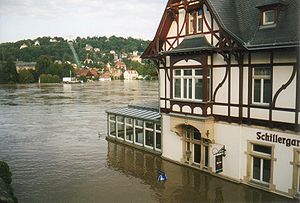
100-year flood
A one-hundred-year flood is calculated to be the level of flood water expected to be equaled or exceeded every 100 years on average. The 100-year flood is more accurately referred to as the 1% annual exceedance probability flood, since it is a flood that has a 1% chance of being equaled or exceeded...
caused by over a week of continuous heavy rains ravaged Europe
Europe
Europe is, by convention, one of the world's seven continents. Comprising the westernmost peninsula of Eurasia, Europe is generally 'divided' from Asia to its east by the watershed divides of the Ural and Caucasus Mountains, the Ural River, the Caspian and Black Seas, and the waterways connecting...
, killing dozens, dispossessing thousands, and causing damage of billions of euros in the Czech Republic
Czech Republic
The Czech Republic is a landlocked country in Central Europe. The country is bordered by Poland to the northeast, Slovakia to the east, Austria to the south, and Germany to the west and northwest....
, Austria
Austria
Austria , officially the Republic of Austria , is a landlocked country of roughly 8.4 million people in Central Europe. It is bordered by the Czech Republic and Germany to the north, Slovakia and Hungary to the east, Slovenia and Italy to the south, and Switzerland and Liechtenstein to the...
, Germany
Germany
Germany , officially the Federal Republic of Germany , is a federal parliamentary republic in Europe. The country consists of 16 states while the capital and largest city is Berlin. Germany covers an area of 357,021 km2 and has a largely temperate seasonal climate...
, Slovakia
Slovakia
The Slovak Republic is a landlocked state in Central Europe. It has a population of over five million and an area of about . Slovakia is bordered by the Czech Republic and Austria to the west, Poland to the north, Ukraine to the east and Hungary to the south...
, Poland
Poland
Poland , officially the Republic of Poland , is a country in Central Europe bordered by Germany to the west; the Czech Republic and Slovakia to the south; Ukraine, Belarus and Lithuania to the east; and the Baltic Sea and Kaliningrad Oblast, a Russian exclave, to the north...
, Hungary
Hungary
Hungary , officially the Republic of Hungary , is a landlocked country in Central Europe. It is situated in the Carpathian Basin and is bordered by Slovakia to the north, Ukraine and Romania to the east, Serbia and Croatia to the south, Slovenia to the southwest and Austria to the west. The...
, Romania
Romania
Romania is a country located at the crossroads of Central and Southeastern Europe, on the Lower Danube, within and outside the Carpathian arch, bordering on the Black Sea...
and Croatia
Croatia
Croatia , officially the Republic of Croatia , is a unitary democratic parliamentary republic in Europe at the crossroads of the Mitteleuropa, the Balkans, and the Mediterranean. Its capital and largest city is Zagreb. The country is divided into 20 counties and the city of Zagreb. Croatia covers ...
.
Development of the floods
While no single cause was ever identified for the rains that caused the flooding, the effects of El Niño are believed to be one of the causes although others disagree. The floods started with heavy rainfall in the Eastern AlpsEastern Alps
Eastern Alps is the name given to the eastern half of the Alps, usually defined as the area east of the Splügen Pass in eastern Switzerland. North of the Splügen Pass, the Posterior Rhine forms the border, and south of the pass, the Liro river and Lake Como form the boundary line.-Geography:The...
, which resulted in floods in Northern Italy
Italy
Italy , officially the Italian Republic languages]] under the European Charter for Regional or Minority Languages. In each of these, Italy's official name is as follows:;;;;;;;;), is a unitary parliamentary republic in South-Central Europe. To the north it borders France, Switzerland, Austria and...
, Bavaria
Bavaria
Bavaria, formally the Free State of Bavaria is a state of Germany, located in the southeast of Germany. With an area of , it is the largest state by area, forming almost 20% of the total land area of Germany...
and the Austrian states
States of Austria
Austria is a federal republic made up of nine states, known in German as Länder . Since Land is also the German word for a country, the term Bundesländer is often used instead to avoid ambiguity. The Constitution of Austria uses both terms...
of Salzburg
Salzburg (state)
Salzburg is a state or Land of Austria with an area of 7,156 km2, located adjacent to the German border. It is also known as Salzburgerland, to distinguish it from its capital city, also named Salzburg...
and Upper Austria
Upper Austria
Upper Austria is one of the nine states or Bundesländer of Austria. Its capital is Linz. Upper Austria borders on Germany and the Czech Republic, as well as on the other Austrian states of Lower Austria, Styria, and Salzburg...
. The floods gradually moved eastwards along the Danube
Danube
The Danube is a river in the Central Europe and the Europe's second longest river after the Volga. It is classified as an international waterway....
, although the damage in the large cities on its shores was not as severe as in the areas affected by the floods later.
When the rainfall moved northeast to the Bohemian Forest
Bohemian Forest
The Bohemian Forest, also known in Czech as Šumava , is a low mountain range in Central Europe. Geographically, the mountains extend from South Bohemia in the Czech Republic to Austria and Bavaria in Germany...
and to the source areas of the Elbe
Elbe
The Elbe is one of the major rivers of Central Europe. It rises in the Krkonoše Mountains of the northwestern Czech Republic before traversing much of Bohemia , then Germany and flowing into the North Sea at Cuxhaven, 110 km northwest of Hamburg...
and Vltava
Vltava
The Vltava is the longest river in the Czech Republic, running north from its source in Šumava through Český Krumlov, České Budějovice, and Prague, merging with the Elbe at Mělník...
rivers, the result were catastrophic water levels first in the Austrian areas of Mühlviertel
Mühlviertel
The Mühlviertel is an Austrian region belonging to the state of Upper Austria: it is one of four "quarters" of Upper Austria, the others being Hausruckviertel, Traunviertel, and Innviertel. It is named for the two rivers and .-Region:...
and Waldviertel
Waldviertel
The Waldviertel is the northwestern region of the Austrian state Lower Austria. It is bounded to the south by the Danube, to the southwest by Upper Austria, to the northwest and the north by the Czech Republic and to the east by the Manhartsberg , which is the survey point dividing Waldviertel...
and later in the Czech Republic, Thuringia
Thuringia
The Free State of Thuringia is a state of Germany, located in the central part of the country.It has an area of and 2.29 million inhabitants, making it the sixth smallest by area and the fifth smallest by population of Germany's sixteen states....
and Saxony
Saxony
The Free State of Saxony is a landlocked state of Germany, contingent with Brandenburg, Saxony Anhalt, Thuringia, Bavaria, the Czech Republic and Poland. It is the tenth-largest German state in area, with of Germany's sixteen states....
. Rivers changed their courses in unexpected ways, catching residents off guard . Several villages in Northern Bohemia
Bohemia
Bohemia is a historical region in central Europe, occupying the western two-thirds of the traditional Czech Lands. It is located in the contemporary Czech Republic with its capital in Prague...
, Thuringia and Saxony were more or less destroyed by rivers changing their courses or massively overflowing their banks.
Areas affected

Czech Republic
Prague
Prague is the capital and largest city of the Czech Republic. Situated in the north-west of the country on the Vltava river, the city is home to about 1.3 million people, while its metropolitan area is estimated to have a population of over 2.3 million...
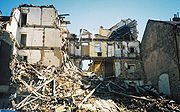
received significant damage from what were deemed to be the worst floods to hit the capital in 200 years. Among the regions of the capital city most severely affected were: Karlín
Karlín
Karlín is a cadastral area of Prague, part of Prague 8 municipal district, former independent town . It is bordered by the river Vltava and Holešovice to the north, Vítkov hill and Žižkov to the south, New Town to the west and Libeň to the east.-History:The building of the Karlín district began in...
, Kampa
Kampa Island
Kampa is an island in the Vltava river in central Prague on the side of Malá Strana. Charles Bridge crosses its northern tip and is connected to the island by the street Ulice na Kampě. It is separated from Malá Strana by a narrow artificial channel to the west called the Devil's Stream , a...
and Holešovice
Holešovice
Holešovice is a suburb in the north of Prague situated on a meander of the river Vltava, which makes up the main part of the district Prague 7...
, where there was significant risk of building collapse. Most of Prague's art work was saved due to advanced warning of high water levels, however there was significant damage to the Prague Metro
Prague Metro
The Prague Metro is a subway, underground public transportation network in Prague, Czech Republic. It is the fastest means of transportation around the city and serves about one and a half million passengers a day, which makes it the seventh busiest metro system in Europe and the most-used in the...
subway system, much of which was completely flooded.
Prague's Jewish Quarter
Josefov (Prague)
Josefov is a town quarter and the smallest cadastral area of Prague, today Czech Republic, formerly the Jewish ghetto of the town. It is completely surrounded by Old Town...
also received significant damage, a part of the estimated $30 million in damage to Czech cultural sites including: the Prague Municipal Library, Malá Strana
Malá Strana
Malá Strana is a district of the city of Prague, Czech Republic, and one of its most historic regions.The name translated into English literally means "Little Side", though it is frequently referred to as "Lesser Town", "Lesser Quarter", or "Lesser Side"...
, the National Theatre and Terezín
Terezín
Terezín is the name of a former military fortress and adjacent walled garrison town in the Ústí nad Labem Region of the Czech Republic.-Early history:...
.
The evacuations before the worst of the flooding have been cited as one of the reasons for relatively little loss of life in the capital. One of the most visible victims of the summer's flood was Gaston, a sea lion from the Prague Zoo who swam to Germany following the flooding of his aquarium. For some time, it was believed he would survive, however he died following capture in Dresden.
Germany
In Germany, the flooding was significant in that it destroyed a lot of the work that had been done throughout the country since unification in 1990, especially the town of GrimmaGrimma
Grimma is a town in the Free State of Saxony, Germany on the left bank of the Mulde, southeast of Leipzig. Founded in c. 1170, it is part of the Leipzig district.- Location :...
in the former East Germany.
Dresden
Dresden
Dresden is the capital city of the Free State of Saxony in Germany. It is situated in a valley on the River Elbe, near the Czech border. The Dresden conurbation is part of the Saxon Triangle metropolitan area....
received significant damage when the Elbe River reached an all-time high of 9.4 meters. More than 30,000 people were evacuated from various neighborhoods throughout the city and some of the city's cultural landmarks were considered to be at risk.
Dresden's Zwinger Palace, home to a significant number of Europe's artistic treasures including Raphael
Raphael
Raffaello Sanzio da Urbino , better known simply as Raphael, was an Italian painter and architect of the High Renaissance. His work is admired for its clarity of form and ease of composition and for its visual achievement of the Neoplatonic ideal of human grandeur...
's Sistine Madonna
Sistine Madonna
Sistine Madonna, also called La Madonna di San Sisto, is an oil painting by the Italian artist Raphael. Finished shortly before his death, ca. 1513–1514, as a commissioned altarpiece, it was the last of the painter's Madonnas and the last painting he completed with his own hands...
was at risk from the flooding Elbe, however all of the art works were able to be saved. The Semper Opera House also suffered damage.
Russia
The Black SeaBlack Sea
The Black Sea is bounded by Europe, Anatolia and the Caucasus and is ultimately connected to the Atlantic Ocean via the Mediterranean and the Aegean seas and various straits. The Bosphorus strait connects it to the Sea of Marmara, and the strait of the Dardanelles connects that sea to the Aegean...
Coast region was among the most severely hit regions of Russia
Russia
Russia or , officially known as both Russia and the Russian Federation , is a country in northern Eurasia. It is a federal semi-presidential republic, comprising 83 federal subjects...
with significant loss of life due to a tornado that hit the tourist region and destroyed homes. This was after earlier summer floods in southern Russia. All told, damage in the region was calculated at more than $400 million.
Regions spared
Although all of Europe was affected to some degree or another from the record rains that fell, some cities were spared the severe flooding that hit Dresden and Prague.Although the Danube reached record highs, both Bratislava
Bratislava
Bratislava is the capital of Slovakia and, with a population of about 431,000, also the country's largest city. Bratislava is in southwestern Slovakia on both banks of the Danube River. Bordering Austria and Hungary, it is the only national capital that borders two independent countries.Bratislava...
and Vienna
Vienna
Vienna is the capital and largest city of the Republic of Austria and one of the nine states of Austria. Vienna is Austria's primary city, with a population of about 1.723 million , and is by far the largest city in Austria, as well as its cultural, economic, and political centre...
were spared significant flooding. Bratislava's sparing was due to the city's flood protection measures, which withstood the water, while it was generally believed that Vienna
Vienna
Vienna is the capital and largest city of the Republic of Austria and one of the nine states of Austria. Vienna is Austria's primary city, with a population of about 1.723 million , and is by far the largest city in Austria, as well as its cultural, economic, and political centre...
was spared significant damage due the city's engineering, and plans were undertaken to see if such work could be applied to the other cities as well.
After effects
Once the water levels returned to normal and residents returned to their home, they faced not only the damage left by the rising waters but also threats of disease due to decaying waste and food. The damage increased due to flooding of sewage treatment plants and the risk of damage to chemical plants.Even once the waters began to recede, the work in the region was not yet complete. European leaders gathered in Berlin
Berlin
Berlin is the capital city of Germany and is one of the 16 states of Germany. With a population of 3.45 million people, Berlin is Germany's largest city. It is the second most populous city proper and the seventh most populous urban area in the European Union...
to discuss the effects of the floods and to create a better understanding of how to prevent such disaster in the future. This meeting garnered some criticism as Russia, which had suffered significant damage, was not invited to what was billed as a meeting of EU
European Union
The European Union is an economic and political union of 27 independent member states which are located primarily in Europe. The EU traces its origins from the European Coal and Steel Community and the European Economic Community , formed by six countries in 1958...
members and future members. The EU leaders did promise aid to the central European countries that suffered the most under the floods with monies coming from the EU's structural budget and this outreach to non-members was seen as symbolic in an effort to portray a truly united Europe.
See also
- 2002 Glasgow floods2002 Glasgow floodsThe 2002 Glasgow floods were a series of Flash floods that occurred after Thunderstorms in the Scottish Lowlands in late July and early August 2002. The heaviest rainfall fell on the night of Tuesday 30 July 2002....
- European Flood Alert SystemEuropean Flood Alert SystemThe European Flood Alert System project is a European Commission initiative to increase preparedness for riverine floods across Europe.- History :Over the last decades severe fluvial floods of trans-national dimensions have taken place in Europe...
- St. Mary Magdalene's floodSt. Mary Magdalene's floodSt. Mary Magdalene's flood was the largest recorded flood in central Europe with water levels exceeding those of the 2002 European floods. It occurred in July 1342 on and around the feast day of St...