

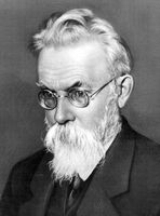
Vladimir Vernadsky

Encyclopedia
Vladimir Ivanovich Vernadsky was a Russian
/Ukrainian
and Soviet mineralogist and geochemist who is considered one of the founders of geochemistry
, biogeochemistry
, and of radiogeology. His ideas of noosphere
were an important contribution to Russian cosmism
. He also worked in Ukraine
where he founded the National Academy of Science of Ukraine
. He is most noted for his 1926 book The Biosphere in which he inadvertently worked to popularize Eduard Suess
’ 1885 term biosphere
, by hypothesizing that life is the geological force that shapes the earth. In 1943 he was awarded the Stalin Prize.
, Russian Empire
, on 12 March 1863, of mixed Russian
and Ukrainian
parents. His father, a descendent of Ukrainian Cossacks, had been a professor of political economy
in Kiev
before moving to Saint Petersburg, and his mother was a noblewoman of Russian ethnicity (Vernadsky considered himself both Russian and Ukrainian, and had some knowledge of the Ukrainian language.)
Vernadsky graduated from Saint Petersburg State University
in 1885. As the last mineralogist had died in 1887 in Russia, and Vasily Dokuchaev, a soil scientist, and Alexey Pavlov, a geologist, had been teaching Mineralogy for a while, Vernadsky chose to enter Mineralogy. He wrote to his wife Natasha on 20 June 1888 from Switzerland:
While trying to find a topic for his doctorate, he first went to Naples to study with crystallographer
Arcangelo Scacchi, who was senile
by that time. Scacchi's condition led Vernadsky to go to Germany to study under Paul Groth. Vernadsky learned how to use the modern equipment of Groth who had developed a machine to study the optical, thermal
, elastic, magnetic and electrical properties of crystal
s. He also gained access to the physics lab of Prof. Zonke, who was studying crystallisation during that period.
Vernadsky first popularized the concept of the noosphere
and deepened the idea of the biosphere
to the meaning largely recognized by today's scientific community. The word 'biosphere' was invented by Austria
n geologist
Eduard Suess
, whom Vernadsky met in 1911.
In Vernadsky's theory of the Earth's development, the noosphere
is the third stage in the earth's development, after the geosphere
(inanimate matter) and the biosphere
(biological life). Just as the emergence of life fundamentally transformed the geosphere, the emergence of human cognition
fundamentally transformed the biosphere. In this theory, the principles of both life and cognition are essential features of the Earth's evolution
, and must have been implicit in the earth all along. This systemic and geological analysis of living systems complements Charles Darwin
's theory of natural selection
, which looks at each individual species, rather than at its relationship to a subsuming principle.
Vernadsky's visionary pronouncements were not widely accepted in the West. However, he was one of the first scientists to recognize that the oxygen, nitrogen and carbon dioxide in the Earth's atmosphere result from biological processes. During the 1920s he published works arguing that living organisms could reshape the planets as surely as any physical force. Vernadsky was an important pioneer of the scientific bases for the environmental sciences.
Vernadsky was the founder and the first president of the Ukrainian Academy of Sciences in Kiev
, Ukraine (1918), founded the National Library of Ukrainian State
, and worked closely with the Tavrida University in Crimea
. During the Russian Civil War
, he hosted gatherings of the young intellectuals who later founded the émigré Eurasianism movement. Vernadsky was loyal to the Russian state and was opposed to Ukrainian independence
.
In the late 1930s and early 1940s Vernadsky played an early advisory role in the Soviet atomic bomb project
, as one of the most forceful voices arguing for the exploitation of nuclear power
, the surveying of Soviet uranium
sources, and having nuclear fission
research conducted at his Radium Institute. He died, however, before a full project was pursued.
Vernadsky's son George Vernadsky
(1887–1973) emigrated to the United States
where he published numerous books on medieval Russian history, medieval Ukrainian history, and modern Russian history.
A main street in Moscow
, and the Tavrida National University in Crimea
, are named in honor of Vladimir Vernadsky.
Russians
The Russian people are an East Slavic ethnic group native to Russia, speaking the Russian language and primarily living in Russia and neighboring countries....
/Ukrainian
Ukrainians
Ukrainians are an East Slavic ethnic group native to Ukraine, which is the sixth-largest nation in Europe. The Constitution of Ukraine applies the term 'Ukrainians' to all its citizens...
and Soviet mineralogist and geochemist who is considered one of the founders of geochemistry
Geochemistry
The field of geochemistry involves study of the chemical composition of the Earth and other planets, chemical processes and reactions that govern the composition of rocks, water, and soils, and the cycles of matter and energy that transport the Earth's chemical components in time and space, and...
, biogeochemistry
Biogeochemistry
Biogeochemistry is the scientific discipline that involves the study of the chemical, physical, geological, and biological processes and reactions that govern the composition of the natural environment...
, and of radiogeology. His ideas of noosphere
Noosphere
Noosphere , according to the thought of Vladimir Vernadsky and Teilhard de Chardin, denotes the "sphere of human thought". The word is derived from the Greek νοῦς + σφαῖρα , in lexical analogy to "atmosphere" and "biosphere". Introduced by Pierre Teilhard de Chardin 1922 in his Cosmogenesis"...
were an important contribution to Russian cosmism
Russian cosmism
Russian cosmism was a philosophical and cultural movement that emerged in Russia in the early 20th century. It entailed a broad theory of natural philosophy combining elements of religion and ethics with a history and philosophy of the origin, evolution and future existence of the cosmos and...
. He also worked in Ukraine
Ukraine
Ukraine is a country in Eastern Europe. It has an area of 603,628 km², making it the second largest contiguous country on the European continent, after Russia...
where he founded the National Academy of Science of Ukraine
National Academy of Science of Ukraine
The National Academy of Sciences of Ukraine is the highest government research body in Ukraine and one of the six state academies. Its presidium is located at 57 Volodymyr Street, across the street from the Building of Pedagogical Museum where used to preside the Central Rada during the...
. He is most noted for his 1926 book The Biosphere in which he inadvertently worked to popularize Eduard Suess
Eduard Suess
Eduard Suess was a geologist who was an expert on the geography of the Alps. He is responsible for hypothesising two major former geographical features, the supercontinent Gondwana and the Tethys Ocean.Born in London to a Jewish Saxon merchant, when he was three his family relocated toPrague,...
’ 1885 term biosphere
Biosphere
The biosphere is the global sum of all ecosystems. It can also be called the zone of life on Earth, a closed and self-regulating system...
, by hypothesizing that life is the geological force that shapes the earth. In 1943 he was awarded the Stalin Prize.
Biography
Vernadsky was born in Saint PetersburgSaint Petersburg
Saint Petersburg is a city and a federal subject of Russia located on the Neva River at the head of the Gulf of Finland on the Baltic Sea...
, Russian Empire
Russian Empire
The Russian Empire was a state that existed from 1721 until the Russian Revolution of 1917. It was the successor to the Tsardom of Russia and the predecessor of the Soviet Union...
, on 12 March 1863, of mixed Russian
Russians
The Russian people are an East Slavic ethnic group native to Russia, speaking the Russian language and primarily living in Russia and neighboring countries....
and Ukrainian
Ukrainians
Ukrainians are an East Slavic ethnic group native to Ukraine, which is the sixth-largest nation in Europe. The Constitution of Ukraine applies the term 'Ukrainians' to all its citizens...
parents. His father, a descendent of Ukrainian Cossacks, had been a professor of political economy
Political economy
Political economy originally was the term for studying production, buying, and selling, and their relations with law, custom, and government, as well as with the distribution of national income and wealth, including through the budget process. Political economy originated in moral philosophy...
in Kiev
Kiev
Kiev or Kyiv is the capital and the largest city of Ukraine, located in the north central part of the country on the Dnieper River. The population as of the 2001 census was 2,611,300. However, higher numbers have been cited in the press....
before moving to Saint Petersburg, and his mother was a noblewoman of Russian ethnicity (Vernadsky considered himself both Russian and Ukrainian, and had some knowledge of the Ukrainian language.)
Vernadsky graduated from Saint Petersburg State University
Saint Petersburg State University
Saint Petersburg State University is a Russian federal state-owned higher education institution based in Saint Petersburg and one of the oldest and largest universities in Russia....
in 1885. As the last mineralogist had died in 1887 in Russia, and Vasily Dokuchaev, a soil scientist, and Alexey Pavlov, a geologist, had been teaching Mineralogy for a while, Vernadsky chose to enter Mineralogy. He wrote to his wife Natasha on 20 June 1888 from Switzerland:
While trying to find a topic for his doctorate, he first went to Naples to study with crystallographer
Crystallography
Crystallography is the experimental science of the arrangement of atoms in solids. The word "crystallography" derives from the Greek words crystallon = cold drop / frozen drop, with its meaning extending to all solids with some degree of transparency, and grapho = write.Before the development of...
Arcangelo Scacchi, who was senile
Dementia
Dementia is a serious loss of cognitive ability in a previously unimpaired person, beyond what might be expected from normal aging...
by that time. Scacchi's condition led Vernadsky to go to Germany to study under Paul Groth. Vernadsky learned how to use the modern equipment of Groth who had developed a machine to study the optical, thermal
Thermal
A thermal column is a column of rising air in the lower altitudes of the Earth's atmosphere. Thermals are created by the uneven heating of the Earth's surface from solar radiation, and are an example of convection. The sun warms the ground, which in turn warms the air directly above it...
, elastic, magnetic and electrical properties of crystal
Crystal
A crystal or crystalline solid is a solid material whose constituent atoms, molecules, or ions are arranged in an orderly repeating pattern extending in all three spatial dimensions. The scientific study of crystals and crystal formation is known as crystallography...
s. He also gained access to the physics lab of Prof. Zonke, who was studying crystallisation during that period.
Vernadsky first popularized the concept of the noosphere
Noosphere
Noosphere , according to the thought of Vladimir Vernadsky and Teilhard de Chardin, denotes the "sphere of human thought". The word is derived from the Greek νοῦς + σφαῖρα , in lexical analogy to "atmosphere" and "biosphere". Introduced by Pierre Teilhard de Chardin 1922 in his Cosmogenesis"...
and deepened the idea of the biosphere
Biosphere
The biosphere is the global sum of all ecosystems. It can also be called the zone of life on Earth, a closed and self-regulating system...
to the meaning largely recognized by today's scientific community. The word 'biosphere' was invented by Austria
Austria
Austria , officially the Republic of Austria , is a landlocked country of roughly 8.4 million people in Central Europe. It is bordered by the Czech Republic and Germany to the north, Slovakia and Hungary to the east, Slovenia and Italy to the south, and Switzerland and Liechtenstein to the...
n geologist
Geologist
A geologist is a scientist who studies the solid and liquid matter that constitutes the Earth as well as the processes and history that has shaped it. Geologists usually engage in studying geology. Geologists, studying more of an applied science than a theoretical one, must approach Geology using...
Eduard Suess
Eduard Suess
Eduard Suess was a geologist who was an expert on the geography of the Alps. He is responsible for hypothesising two major former geographical features, the supercontinent Gondwana and the Tethys Ocean.Born in London to a Jewish Saxon merchant, when he was three his family relocated toPrague,...
, whom Vernadsky met in 1911.
In Vernadsky's theory of the Earth's development, the noosphere
Noosphere
Noosphere , according to the thought of Vladimir Vernadsky and Teilhard de Chardin, denotes the "sphere of human thought". The word is derived from the Greek νοῦς + σφαῖρα , in lexical analogy to "atmosphere" and "biosphere". Introduced by Pierre Teilhard de Chardin 1922 in his Cosmogenesis"...
is the third stage in the earth's development, after the geosphere
Geosphere
The term geosphere is often used to refer to the densest parts of Earth, which consist mostly of rock and regolith. The geosphere consists of the inside of the Earth or other planets or bodies....
(inanimate matter) and the biosphere
Biosphere
The biosphere is the global sum of all ecosystems. It can also be called the zone of life on Earth, a closed and self-regulating system...
(biological life). Just as the emergence of life fundamentally transformed the geosphere, the emergence of human cognition
Cognition
In science, cognition refers to mental processes. These processes include attention, remembering, producing and understanding language, solving problems, and making decisions. Cognition is studied in various disciplines such as psychology, philosophy, linguistics, and computer science...
fundamentally transformed the biosphere. In this theory, the principles of both life and cognition are essential features of the Earth's evolution
Evolution
Evolution is any change across successive generations in the heritable characteristics of biological populations. Evolutionary processes give rise to diversity at every level of biological organisation, including species, individual organisms and molecules such as DNA and proteins.Life on Earth...
, and must have been implicit in the earth all along. This systemic and geological analysis of living systems complements Charles Darwin
Charles Darwin
Charles Robert Darwin FRS was an English naturalist. He established that all species of life have descended over time from common ancestry, and proposed the scientific theory that this branching pattern of evolution resulted from a process that he called natural selection.He published his theory...
's theory of natural selection
Natural selection
Natural selection is the nonrandom process by which biologic traits become either more or less common in a population as a function of differential reproduction of their bearers. It is a key mechanism of evolution....
, which looks at each individual species, rather than at its relationship to a subsuming principle.
Vernadsky's visionary pronouncements were not widely accepted in the West. However, he was one of the first scientists to recognize that the oxygen, nitrogen and carbon dioxide in the Earth's atmosphere result from biological processes. During the 1920s he published works arguing that living organisms could reshape the planets as surely as any physical force. Vernadsky was an important pioneer of the scientific bases for the environmental sciences.
Vernadsky was the founder and the first president of the Ukrainian Academy of Sciences in Kiev
Kiev
Kiev or Kyiv is the capital and the largest city of Ukraine, located in the north central part of the country on the Dnieper River. The population as of the 2001 census was 2,611,300. However, higher numbers have been cited in the press....
, Ukraine (1918), founded the National Library of Ukrainian State
Vernadsky National Library of Ukraine
The Vernadsky National Library of Ukraine is the main academic library and main scientific information centre in Ukraine, one of the world's largest national libraries. It is located in the capital of the country – Kiev. The library contains about 15 million items...
, and worked closely with the Tavrida University in Crimea
Crimea
Crimea , or the Autonomous Republic of Crimea , is a sub-national unit, an autonomous republic, of Ukraine. It is located on the northern coast of the Black Sea, occupying a peninsula of the same name...
. During the Russian Civil War
Russian Civil War
The Russian Civil War was a multi-party war that occurred within the former Russian Empire after the Russian provisional government collapsed to the Soviets, under the domination of the Bolshevik party. Soviet forces first assumed power in Petrograd The Russian Civil War (1917–1923) was a...
, he hosted gatherings of the young intellectuals who later founded the émigré Eurasianism movement. Vernadsky was loyal to the Russian state and was opposed to Ukrainian independence
Ukrainian War of Independence
The Ukrainian War of Independence was a series of military conflicts between Ukrainian, Anarchist, Bolshevik, the Central Powers forces of Germany and Austria-Hungary, the White Russian Volunteer Army, and Second Polish Republic forces for control of the territory of modern Ukraine after the...
.
In the late 1930s and early 1940s Vernadsky played an early advisory role in the Soviet atomic bomb project
Soviet atomic bomb project
The Soviet project to develop an atomic bomb , was a clandestine research and development program began during and post-World War II, in the wake of the Soviet Union's discovery of the United States' nuclear project...
, as one of the most forceful voices arguing for the exploitation of nuclear power
Nuclear power
Nuclear power is the use of sustained nuclear fission to generate heat and electricity. Nuclear power plants provide about 6% of the world's energy and 13–14% of the world's electricity, with the U.S., France, and Japan together accounting for about 50% of nuclear generated electricity...
, the surveying of Soviet uranium
Uranium
Uranium is a silvery-white metallic chemical element in the actinide series of the periodic table, with atomic number 92. It is assigned the chemical symbol U. A uranium atom has 92 protons and 92 electrons, of which 6 are valence electrons...
sources, and having nuclear fission
Nuclear fission
In nuclear physics and nuclear chemistry, nuclear fission is a nuclear reaction in which the nucleus of an atom splits into smaller parts , often producing free neutrons and photons , and releasing a tremendous amount of energy...
research conducted at his Radium Institute. He died, however, before a full project was pursued.
Vernadsky's son George Vernadsky
George Vernadsky
George Vernadsky , Russian: Гео́ргий Влади́мирович Верна́дский) was a Russian-American historian and an author of numerous books on Russian history.- European years :...
(1887–1973) emigrated to the United States
United States
The United States of America is a federal constitutional republic comprising fifty states and a federal district...
where he published numerous books on medieval Russian history, medieval Ukrainian history, and modern Russian history.
A main street in Moscow
Moscow
Moscow is the capital, the most populous city, and the most populous federal subject of Russia. The city is a major political, economic, cultural, scientific, religious, financial, educational, and transportation centre of Russia and the continent...
, and the Tavrida National University in Crimea
Crimea
Crimea , or the Autonomous Republic of Crimea , is a sub-national unit, an autonomous republic, of Ukraine. It is located on the northern coast of the Black Sea, occupying a peninsula of the same name...
, are named in honor of Vladimir Vernadsky.
Works (selected)
- Geochemistry, published in Russian 1924
- The Biosphere, first published in Russian in 1926. English translations:
- Oracle, AZ, Synergetic Press, 1986, ISBN 0-907791-11-5, 86 pp.
- tr. David B. Langmuir, New York, Copernicus, 1998, ISBN 0-387-98268-X, 192 pp.
- Essays on Geochemistry & the Biosphere, tr. Olga Barash, Santa Fe, NM, Synergetic Press, ISBN 0-907791-36-0, 2006
Diaries
- Dnevniki 1917-1921: oktyabr 1917-yanvar 1920 (Diaries 1917-1921), Kiev, Naukova dumkaNaukova DumkaNaukova Dumka is a publishing house in Kiev, Ukraine.It was established by the National Academy of Sciences of Ukraine in 1922, and is one of the oldest scientific and academic publishing houses in the former USSR...
, 1994, ISBN 5-12-004641-X, 269 pp. - Dnevniki. Mart 1921-avgust 1925 (Diaries 1921-1925), Moscow, NaukaNaukaNauka is a Russian publisher of academic books and journals. Established in the USSR in 1923, it was called USSR Academy of Sciences Publisher until 1963. Until 1934 the publisher was based in Leningrad, then moved to Moscow. Its logo depicts an open book with Sputnik 1 above it.Nauka was the main...
, 1998, ISBN 5-02-004422-9, 213 pp. - Dnevniki 1926-1934 (Diaries 1926-1934), Moscow, Nauka, 2001, ISBN 5-02-004409-1, 455 pp.
- Dnevniki 1935-1941 v dvukh knigakh. Kniga 1, 1935-1938 (Diaries 1935-1941 in two volumes. Volume 1, 1935-1938), Moscow, Nauka, 2006,ISBN 5-02-033831-1,444 pp.
- Dnevniki 1935-1941 v dvukh knigakh. Kniga 2, 1939-1941 (Diaries 1935-1941. Volume 2, 1939-1941), Moscow, Nauka, 2006, ISBN 5-02-033832-X, 295 pp.
See also
- Gaia theory (science)
- NoosphereNoosphereNoosphere , according to the thought of Vladimir Vernadsky and Teilhard de Chardin, denotes the "sphere of human thought". The word is derived from the Greek νοῦς + σφαῖρα , in lexical analogy to "atmosphere" and "biosphere". Introduced by Pierre Teilhard de Chardin 1922 in his Cosmogenesis"...
- Pierre Teilhard de ChardinPierre Teilhard de ChardinPierre Teilhard de Chardin SJ was a French philosopher and Jesuit priest who trained as a paleontologist and geologist and took part in the discovery of both Piltdown Man and Peking Man. Teilhard conceived the idea of the Omega Point and developed Vladimir Vernadsky's concept of Noosphere...
- Russian philosophyRussian philosophyRussian philosophy includes a variety of philosophical movements. Authors who developed them are listed below sorted by movement.While most authors listed below are primarily philosophers, also included here are some Russian fiction writers, like Tolstoy and Dostoyevsky, who are also known as...
External links
- The grave of Vernadsky
- Behrends, Thilo, The Renaissance of V.I. Vernadsky, Newsletter of the Geochemical Society, #125, October 2005, http://www.geochemsoc.org/downloads/gn125.pdf retrieved Aug. 22, 2010
- Vernadsky, Vladimir Ivanovich, GEOCHEMISTRY AND THE BIOSPHERE. http://www.synergeticpress.com/vernadsky.html
- Electronic archive of writings from and about Vernadsky (Russian) http://vernadsky.lib.ru/