
Home      Discussion      Topics      Dictionary      Almanac
Signup       Login
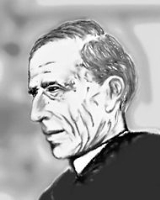
Pierre Teilhard de Chardin

Pierre Teilhard de Chardin

Overview
Pierre Teilhard de Chardin ' onMouseout='HidePop("63268")' href="http://www.absoluteastronomy.com/topics/Orcines">Orcines
Orcines
Orcines is a commune in the Puy-de-Dôme department in Auvergne in central France....

, France – 10 April 1955, New York City) was a French philosopher and Jesuit
Society of Jesus
The Society of Jesus is a Catholic religious order of clerks regular whose members are called Jesuits.Jesuits are the largest male religious order in the Catholic Church, with 18,815 members—13,305 priests, 2,295 scholastic students, 1,758 brothers and 827 novices—as of January 2008, although the...

 priest who trained as a paleontologist
Paleontology
Paleontology from Greek: παλαιός "old, ancient", ὄν, ὀντ- "being, creature", and λόγος "speech, thought" is the study of prehistoric life, including organisms' evolution and interactions with each other and their environments...

 and geologist
Geology
Geology is the science and study of the solid and liquid matter that constitutes the Earth. The field of geology encompasses the study of the composition, structure, physical properties, dynamics, and history of Earth materials, and the processes by which they are formed, moved, and changed...

 and took part in the discovery of Peking Man
Peking Man
Peking Man , also called Sinanthropus pekinensis , is an example of Homo erectus. A group of fossil specimens was discovered in 1923-27 during excavations at Zhoukoudian near Beijing , China...

.
Discussion
Ask a question about 'Pierre Teilhard de Chardin'
Start a new discussion about 'Pierre Teilhard de Chardin'
Answer questions from other users
Full Discussion Forum
 
Quotations

We only have to look around us to see how complexity and psychic temperature are still rising: and rising no longer on the scale of the individual but now on that of the planet. This indication is so familiar to us that we cannot but recognize the objective, experiential, reality of a transformation of the planet as a whole.

The Heart of Matter (1950)

The reality of spirit-matter is inevitably translated into and confirmed by a structure of the spirit.

A Sketch of a Personalistic Universe.

The day will come when, after harnessing space, the winds, the tides, gravitation, we shall harness for God the energies of love. And, on that day, for the second time in the history of the world, man will have discovered fire.

Peking, February 1934, "The Evolution of Chastity" in Toward the Future, London: Collins, 1975: 86-87.

By virtue of creation, and still more the incarnation, nothing here is profane for those who know how to see. :Le Phénomène Humain (1955)

Love alone is capable of uniting living beings in such a way as to complete and fulfill them, for it alone takes them and joins them by what is deepest in themselves. All we need is to imagine our ability to love developing until it embraces the totality of men and the earth.

A universal love is not only psychologically possible; it is the only complete and final way in which we are able to love.

If there were no internal propensity to unite, even at a prodigiously rudimentary level — indeed in the molecule itself — it would be physically impossible for love to appear higher up, with us, in hominized form. . . . Driven by the forces of love, the fragments of the world seek each other so that the world may come into being.

Encyclopedia
Pierre Teilhard de Chardin ' onMouseout='HidePop("63268")' href="http://www.absoluteastronomy.com/topics/Orcines">Orcines
Orcines
Orcines is a commune in the Puy-de-Dôme department in Auvergne in central France....

, France – 10 April 1955, New York City) was a French philosopher and Jesuit
Society of Jesus
The Society of Jesus is a Catholic religious order of clerks regular whose members are called Jesuits.Jesuits are the largest male religious order in the Catholic Church, with 18,815 members—13,305 priests, 2,295 scholastic students, 1,758 brothers and 827 novices—as of January 2008, although the...

 priest who trained as a paleontologist
Paleontology
Paleontology from Greek: παλαιός "old, ancient", ὄν, ὀντ- "being, creature", and λόγος "speech, thought" is the study of prehistoric life, including organisms' evolution and interactions with each other and their environments...

 and geologist
Geology
Geology is the science and study of the solid and liquid matter that constitutes the Earth. The field of geology encompasses the study of the composition, structure, physical properties, dynamics, and history of Earth materials, and the processes by which they are formed, moved, and changed...

 and took part in the discovery of Peking Man
Peking Man
Peking Man , also called Sinanthropus pekinensis , is an example of Homo erectus. A group of fossil specimens was discovered in 1923-27 during excavations at Zhoukoudian near Beijing , China...

. Teilhard conceived the idea of the Omega Point
Omega point
Omega Point is a term invented by the French Jesuit Pierre Teilhard de Chardin to describe a supreme level of complexity and consciousness towards which the universe appears to be evolving. The maximum level is only given to man made gods such as God, Allah, Yahweh, or Brahman...

 and developed Vladimir Vernadsky
Vladimir Vernadsky
Vladimir Ivanovich Vernadsky was a soviet mineralogist and geochemist whose ideas of noosphere were an important contribution to Russian cosmism. He also worked in Ukraine where he founded the National Academy of Science of Ukraine...

's concept of Noosphere
Noosphere
Noosphere , according to the thought of Vladimir Vernadsky and Teilhard de Chardin, denotes the "sphere of human thought"...

.

Teilhard's primary book, The Phenomenon of Man
The Phenomenon of Man
The Phenomenon of Man is a non-fiction book written by French philosopher, paleontologist and Jesuit priest Pierre Teilhard de Chardin. In this work, Teilhard describes evolution as a process that leads to increasing complexity, culminating in the unification of consciousness.The book was...

, set forth a sweeping account of the unfolding of the cosmos
Cosmos
In its most general sense, a cosmos is an orderly or harmonious system. It originates from a Greek term κόσμος meaning "order, orderly arrangement, ornaments," and is the antithetical concept of chaos. Today the word is generally used as a synonym of the word Universe . The words cosmetics and...

. He abandoned traditional interpretations of creation in the Book of Genesis in favor of a less strict interpretation. This displeased certain officials in the Roman Curia
Roman Curia
The Roman Curia is the administrative apparatus of the Holy See and the central governing body of the entire Roman Catholic Church, together with the Pope...

 and in his own order who thought that it undermined the doctrine of original sin developed by Saint Augustine. Teilhard's position was opposed by his church superiors, and his work was denied publication during his lifetime by the Roman Holy Office
Congregation for the Doctrine of the Faith
The Congregation for the Doctrine of the Faith , previously known as the Supreme Sacred Congregation of the Roman and Universal Inquisition, and sometimes simply called the Holy Office is the oldest of the nine congregations of the Roman Curia. Among the most active of these major Curial...

. The 1950 encyclical Humani generis
Humani Generis
Humani generis is a papal encyclical that Pope Pius XII promulgated on 12 August 1950 "concerning some false opinions threatening to undermine the foundations of Catholic Doctrine". Theological opinions and doctrines known as Nouvelle Théologie or neo-modernism and their consequences on the Church...

condemned several of Teilhard's opinions, while leaving other questions open. In 2009, the Pope
Pope Benedict XVI
Pope Benedict XVI is the 265th and reigning Pope, by virtue of his office of Bishop of Rome, the head of the Catholic Church and, as such, Sovereign of the Vatican City State...

 praised Teilhard and his work.

Early years


Pierre Teilhard de Chardin was born in Orcines
Orcines
Orcines is a commune in the Puy-de-Dôme department in Auvergne in central France....

, close to Clermont-Ferrand
Clermont-Ferrand
Clermont-Ferrand is a city and commune of France, in the Auvergne region, with a population of 140,700 . Its metropolitan area had 409,558 inhabitants at the 1999 census....

, in France on May 1, 1881. "De Chardin" is a vestige of a French aristocratic title and not properly his last name. He was formally known as "Pierre Teilhard". He was the fourth child of a large family. His father, an amateur naturalist, collected stones, insects and plants, and promoted the observation of nature in the household. Teilhard's spirituality was awakened by his mother. When he was 11, he went to the Jesuit college of Mongré, in Villefranche-sur-Saône
Villefranche-sur-Saône
Villefranche-sur-Saône is a commune in the Rhône department in eastern France.It lies 1 mile west of the Saône River, and is around north of Lyon...

, where he completed baccalaureates of philosophy and mathematics. Then, in 1899, he entered the Jesuit novitiate at Aix-en-Provence
Aix-en-Provence
Aix , or Aix-en-Provence to distinguish it from other cities built over hot springs, is a city in southern France, some north of Marseille...

 where he began a philosophical, theological and spiritual career.

As of the summer 1901, the Waldeck-Rousseau laws, which submitted congregational associations' properties to state control, prompted some of the Jesuits to exile themselves in the United Kingdom. Young Jesuit students continued their studies in Jersey
Jersey
The Bailiwick of Jersey is a British Crown Dependency off the coast of Normandy, France. As well as the island of Jersey itself, the bailiwick includes the nearly uninhabited islands of the Minquiers, Écréhous, the Pierres de Lecq and other rocks and reefs. Together with the bailiwick of Guernsey...

. In the meantime, Teilhard earned a licentiate in literature in Caen
Caen
Caen is a commune in north-western France. It is the prefecture of the Calvados department and the capital of the Basse-Normandie region...

 in 1902.

Jesuit training


From 1905 to 1908, he taught physics
Physics
Physics is a natural science; it is the study of matter and its motion through spacetime and all that derives from these, such as energy and force...

 and chemistry
Chemistry
Chemistry is the science concerned with the composition, behavior, structure, and properties of matter, as well as the changes it undergoes during chemical reactions...

 in Cairo
Cairo
Cairo is the capital of Egypt and the largest city in the Arab World. Nicknamed "The City of a Thousand Minarets" for its preponderance of Islamic architecture, Cairo has long been a center of the region's political and cultural life...

, Egypt
Egypt
Egypt , officially the Arab Republic of Egypt, is a country mainly in North Africa, with the Sinai Peninsula forming a land bridge in Western Asia...

, at the Jesuit College of the Holy Family. He wrote "...it is the dazzling of the East foreseen and drunk greedily... in its lights, its vegetation, its fauna and its deserts." (Letters from Egypt (1905–1908) — Éditions Aubier)

Teilhard studied theology in Hastings
Hastings
Hastings is a town and Borough on the coast of East Sussex in England. It includes originally separate settlements, as well as the inevitable growth of the town through the building of new estates....

, in Sussex
Sussex
Sussex , from the Old English Sūþsēaxe , is a historic county in South East England corresponding roughly in area to the ancient Kingdom of Sussex. It is bounded on the north by Surrey, east by Kent, south by the English Channel, and west by Hampshire, and is divided for local government into West...

 (United Kingdom), from 1908 to 1912. There he synthesized his scientific, philosophical and theological knowledge in the light of evolution. His reading of L'Évolution Créatrice
Creative Evolution (book)
Creative Evolution is a 1907 book by French philosopher Henri Bergson. Its English translation appeared in 1911. The book provides an alternate explanation for Darwin's mechanism of evolution, suggesting that evolution is motivated by an élan vital, a "vital impetus" that can also be understood...

(The Creative Evolution) by Henri Bergson
Henri Bergson
Henri-Louis Bergson was a major French philosopher, influential especially in the first half of the 20th century.- Overview :...

 was, he said, the "catalyst of a fire which devoured already its heart and its spirit." His views on evolution and religion particularly inspired the evolutionary biologist Theodosius Dobzhansky
Theodosius Dobzhansky
Theodosius Grygorovych Dobzhansky, also known as T. G. Dobzhansky, and sometimes Anglicized to Theodore Dobzhansky was a noted geneticist and evolutionary biologist, and a central figure in the field of evolutionary biology for his work in shaping the unifying modern evolutionary...

. Teilhard was ordained a priest on August 24, 1911, aged 30.

Paleontology


From 1912 to 1914, Teilhard worked in the paleontology
Paleontology
Paleontology from Greek: παλαιός "old, ancient", ὄν, ὀντ- "being, creature", and λόγος "speech, thought" is the study of prehistoric life, including organisms' evolution and interactions with each other and their environments...

 laboratory of the Musée National d'Histoire Naturelle, in Paris, studying the mammal
Mammal
Mammals are a class of vertebrate animals whose females are characterized by the possession of mammary glands while both males and females are characterized by sweat glands, hair, three middle ear bones used in hearing, and a neocortex region in the brain.Mammals are divided into three main...

s of the middle Tertiary
Tertiary
The Tertiary is a term for a geologic period 65 million to 2.588 million years ago. The Tertiary covered the time span between the superseded Secondary period and the Quaternary...

 sector. Later he studied elsewhere in Europe. In June 1912 he formed part of the original digging team, with Arthur Smith Woodward
Arthur Smith Woodward
Sir Arthur Smith Woodward was an English palaeontologist.-Biography:Woodward was born in Macclesfield, Cheshire, England and was educated there and at Owens College, Manchester. He joined the staff of the Department of Geology at the Natural History Museum in 1882. He became assistant Keeper of...

 and Charles Dawson
Charles Dawson
Charles Dawson was an amateur British archaeologist who is credited and blamed with discoveries that turned out to be imaginative frauds, including that of the Piltdown Man , which he presented in 1912...

, to perform follow-up investigations at the Piltdown site, after the discovery of the first fragments of the (fraudulent) "Piltdown Man
Piltdown Man
The "Piltdown Man" is a famous paleontological hoax concerning the finding of the remains of a previously unknown early human. The hoax find consisted of fragments of a skull and jawbone collected in 1912 from a gravel pit at Piltdown, a village near Uckfield, East Sussex, England...

." Professor Marcellin Boule
Marcellin Boule
Marcellin Boule was a French palaeontologist.He studied and published the first analysis of a complete Homo neanderthalensis. The fossil discovered in La Chapelle-aux-Saints was an old man, and Boule characterized it as brutish, bent kneed and not a fully erect biped...

 (specialist in Neanderthal
Neanderthal
The Neanderthal , or ), also spelled Neandertal, is an extinct member of the Homo genus that is known from Pleistocene specimens found in Europe and parts of western and central Asia. Neanderthals are either classified as a subspecies of humans or as a separate species...

 studies), who so early as 1915 astutely recognised the non-hominid origins of the Piltdown finds, gradually guided Teilhard towards human paleontology. At the museum's Institute of Human Paleontology, he became a friend of Henri Breuil
Henri Breuil
Henri Édouard Prosper Breuil , often referred to as Abbé Breuil, was a French archaeologist, anthropologist, ethnologist and geologist...

 and took part with him, in 1913, in excavations in the prehistoric painted caves in the northwest of Spain, at the Cave of Castillo.

Service in World War I


Mobilised in December 1914, Teilhard served in World War I as a stretcher-bearer in the 8th Moroccan Rifles
French Colonial Forces
The French Colonial Forces was a general designation for the military forces that garrisoned and were largely recruited from the French colonial empire from the late 17th century until 1960...

. For his valour, he received several citations including the Médaille Militaire and the Legion of Honour
Légion d'honneur
The Légion d'honneur or Ordre national de la Légion d'honneur is a French order established by Napoleon Bonaparte, First Consul of the First Republic, on 19 May 1802...

.

Throughout these years of war he developed his reflections in his diaries and in letters to his cousin, Marguerite Teillard-Chambon, who later edited them into a book: Genèse d'une pensée (Genesis of a thought). He confessed later: "...the war was a meeting ... with the Absolute." In 1916, he wrote his first essay: La Vie Cosmique (Cosmic life), where his scientific and philosophical thought was revealed just as his mystical life. He pronounced his solemn vows as a Jesuit in Sainte-Foy-lès-Lyon
Sainte-Foy-lès-Lyon
Sainte-Foy-lès-Lyon is a commune in the Rhône department in eastern France.It is a suburb of the city of Lyon, and is located to its north-northeast. It is thus a component of the metropolitan Urban Community of Lyon....

, on May 26, 1918, during a leave. In August 1919, in Jersey, he would write Puissance spirituelle de la Matière (the spiritual Power of Matter). The complete essays written between 1916 and 1919 are published under the following titles:
  • Ecrits du temps de la Guerre (Written in time of the War) (TXII of complete Works) – Editions du Seuil
  • Genèse d'une pensée (letters of 1914 to 1918) – Editions Grasset


Teilhard followed at the Sorbonne
University of Paris
The historic University of Paris was founded in the mid 12th century, likely between 1160 and 1170 , In 1970 it was reorganized as 13 autonomous universities...

 three unit degrees of natural science: geology
Geology
Geology is the science and study of the solid and liquid matter that constitutes the Earth. The field of geology encompasses the study of the composition, structure, physical properties, dynamics, and history of Earth materials, and the processes by which they are formed, moved, and changed...

, botany
Botany
Botany, plant science, phytology, or plant biology is a branch of biology and is the scientific study of plant life and development...

 and zoology
Zoology
Zoology, also spelled zoölogy, is the branch of biology that focuses on the structure, function, behavior, and evolution of animals. The zoologist's pronunciation of "zoology" is , though a common spelling pronunciation is .-Systems of classification:...

. His thesis treated of the mammals of the French lower Eocene
Eocene
The Eocene epoch, lasting from 55.8 ± 0.2 to 33.9 ± 0.1 Ma , is a major division of the geologic timescale and the second epoch of the Palaeogene period in the Cenozoic era. The Eocene spans the time from the end of the Paleocene epoch to the beginning of the Oligocene epoch. The start of the...

 and their stratigraphy. After 1920, he lectured in geology at the Catholic Institute of Paris, then became an assistant professor after being granted a science Doctorate in 1922.

Research in China


In 1923 he traveled to China with Father Emile Licent
Emile Licent
Emile Licent was a French Jesuit trained as a natural historian. He spent more than twenty-five years researching in Tianjin...

, who was in charge in Tianjin
Tianjin
' is the sixth largest city of the People's Republic of China in terms of urban population. Administratively it is one of the four municipalities that have provincial-level status, reporting directly to the central government...

 for a significant laboratory collaborating with the Natural History Museum in Paris and Marcellin Boule's laboratory. Licent carried out considerable basic work in connection with missionaries
Missionary
A missionary is a member of a religion who works to convert those who do not share the missionary's faith; someone who proselytizes. The word "mission" is derived from the Latin missioninimus A missionary is a member of a religion who works to convert those who do not share the missionary's faith;...

 who accumulated observations of a scientific nature in their spare time. He was known as 德日進 (pinyin: Dérìjìn) in China.

Teilhard wrote several essays, including La Messe sur le Monde (the Mass on the World), in the Ordos Desert
Ordos Desert
The Ordos Desert is a desert and steppe region lying on a plateau in the south of the Inner Mongolian Autonomous Region of the People's Republic of China . The soil of the Ordos is a mixture of clay and sand and, as a result, is poorly suited for agriculture. It extends over an area of...

. In the following year he continued lecturing at the Catholic Institute and participated in a cycle of conferences for the students of the Engineers' Schools. Two theological essays on "original sin
Original sin
Original sin is, according to a doctrine proposed in Christian theology, humanity's state of sin resulting from the Fall of Man. This condition has been characterized in many ways, ranging from something as insignificant as a slight deficiency, or a tendency toward sin yet without collective guilt,...

" sent to a theologian, on his request, on a purely personal basis, were wrongly understood.
  • July 1920: Chute, Rédemption et Géocentrie (Fall, Redemption and Geocentry)
  • Spring 1922: Notes sur quelques représentations historiques possibles du Péché originel (Notes on few possible historical representations of original sin
    Original sin
    Original sin is, according to a doctrine proposed in Christian theology, humanity's state of sin resulting from the Fall of Man. This condition has been characterized in many ways, ranging from something as insignificant as a slight deficiency, or a tendency toward sin yet without collective guilt,...

    ) (Works, Tome X)


The church hierarchy required him to give up his lecturing at the Catholic Institute and to continue his geological research in China.

Teilhard travelled again to China in April 1926. He would remain there more or less twenty years, with many voyages throughout the world. He settled until 1932 in Tientsin with Emile Licent then in Beijing
Beijing
Beijing is a metropolis in northern China and the capital of the People's Republic of China...

. From 1926 to 1935, Teilhard made five geological research expeditions in China. They enabled him to establish a first general geological map of China.

In 1926–1927 after a missed campaign in Gansu
Gansu
' is a province located in the northwest of the People's Republic of China. It lies between Quinghai, Inner Mongolia, and the Huangtu plateaus, and borders Mongolia to the north and Xinjiang to the west. The Yellow River passes the southern part of the province. It has a population of nearly 31...

 he travelled in the Sang-Kan-Ho valley near Kalgan (Zhangjiakou
Zhangjiakou
Zhangjiakou is a prefecture-level city in Hebei Province of North China. It has a population of 4.3 million, and covers 36,947 square kilometers. Zhangjiakou's mayor is Zheng Xuebi .-Names:...

) and made a tour in Eastern Mongolia
Mongolia
Mongolia is a landlocked country in East and Central Asia. It borders Russia to the north and the People's Republic of China to the south, east and west. Although Mongolia does not share a border with Kazakhstan, its western-most point is only 24 miles from Kazakhstan's eastern tip. Ulan Bator,...

. He wrote Le Milieu Divin (the divine Medium). Teilhard prepared the first pages of his main work Le Phénomène humain (The Human Phenomenon).

Joined the ongoing excavations of the Peking Man
Peking Man
Peking Man , also called Sinanthropus pekinensis , is an example of Homo erectus. A group of fossil specimens was discovered in 1923-27 during excavations at Zhoukoudian near Beijing , China...

 Site at Zhoukoudian
Zhoukoudian
Zhoukoudian or Choukoutien is a cave system in Beijing, China. It has yielded many archaeological discoveries, including one of the first specimens of Homo erectus, dubbed Peking Man, and a fine assemblage of bones of the gigantic hyena Pachycrocuta brevirostris...

 as an advisor in 1926 and continued in the role for the Cenozoic Research Laboratory
Cenozoic Research Laboratory
The Cenozoic Research Laboratory of the Geological Survey of China was established at the Peking Union Medical College in 1928 by Canadian paleoanthropologist Davidson Black and Chinese geologists Ding Wenjing and Weng Wenhao for the research and appraisal of Peking Man fossils unearthed at...

 of the Geological Survey of China
Geological Survey of China
The Geological Survey of China is a government-owned, not-for-profit, Chinese organization researching China's mineral resources. It is the largest Geoscience agency in China since being reconstructed in 1999....

 following its founding in 1928.

He resided in Manchuria
Manchuria
Manchuria is a historical name given to a vast geographic region in northeast Asia. Depending on the definition of its extent, Manchuria either falls entirely within China, or is divided between China and Russia...

 with Emile Licent, then stayed in Western Shansi (Shanxi
Shanxi
' is a province in the northern part of the People's Republic of China. Its one-character abbreviation is Jin , after the state of Jin that existed here during the Spring and Autumn Period....

) and northern Shensi (Shaanxi
Shaanxi
' is a province in the Northwest China region of the People's Republic of China, and includes portions of the Loess Plateau on the middle reaches of the Yellow River as well as the Qinling Mountains across the southern part of the province.-Romanization and Name:By regular Hanyu Pinyin rules, if...

) with the Chinese paleontologist C. C. Young and with Davidson Black
Davidson Black
Davidson Black, FRS was a Canadian paleoanthropologist, best known for his naming of Sinanthropus pekinensis . He was Chairman of the Geological Survey of China and a Fellow of the Royal Society...

, Chairman of the Geological Survey of China
Geological Survey of China
The Geological Survey of China is a government-owned, not-for-profit, Chinese organization researching China's mineral resources. It is the largest Geoscience agency in China since being reconstructed in 1999....

.

After a tour in Manchuria in the area of Great Khingan with Chinese geologists, Teilhard joined the team of American Expedition Center-Asia in the Gobi organised in June and July, by the American Museum of Natural History with Roy Chapman Andrews
Roy Chapman Andrews
Roy Chapman Andrews was an American explorer, adventurer and naturalist who became the director of the American Museum of Natural History. He is primarily known for leading a series of expeditions through the fragmented China of the early 20th century into the Gobi Desert and Mongolia...

.

Henri Breuil and Teilhard discovered that the Peking Man, the nearest relative of Pithecanthropus from Java, was a "faber" (worker of stones and controller of fire). Teilhard wrote L'Esprit de la Terre (the Spirit of the Earth).

Teilhard took part as a scientist in the famous "Croisiere Jaune" or"Yellow Cruise" financed by Andre Citroen
André Citroën
André-Gustave Citroën was a French-Jewish entrepreneur. He is remembered chiefly for the make of car named after him, but also for his application of double helical gears.- Life :...

 in Central Asia
Central Asia
Asia is a region of Asia from the Caspian Sea in the west to central China in the east, and from southern Russia in the north to northern India in the south. It is also sometimes known as Middle Asia or Inner Asia, and is within the scope of the wider Eurasian continent.Various definitions of its...

. Northwest of Beijing in Kalgan
Zhangjiakou
Zhangjiakou is a prefecture-level city in Hebei Province of North China. It has a population of 4.3 million, and covers 36,947 square kilometers. Zhangjiakou's mayor is Zheng Xuebi .-Names:...

 he joined the China group who joined the second part of the team, the Pamir
Pamir Mountains
The Pamir Mountains are a mountain range in Central Asia formed by the junction or knot of the Himalayas, Tian Shan, Karakoram, Kunlun, and Hindu Kush ranges. They are among the world’s highest mountains and since Victorian times they have been known as the "Roof of the World", translated from...

 group, in Aksu. He remained with his colleagues for several months in Urumqi
Ürümqi
Ürümqi or Ürümchi , formerly Dihua, is the capital of the Xinjiang Uyghur Autonomous Region of the People's Republic of China, in the northwest of the country....

, capital of Sinkiang
Xinjiang
Xinjiang is an autonomous region of the People's Republic of China and also claimed by the territory of the Republic of China.-Names:Older English-language reference works often refer to the area as Chinese Turkestan, Sinkiang, East...

. The following year the Sino-Japanese War (1937–1945)
Second Sino-Japanese War
The Second Sino-Japanese War was a military conflict fought between the Republic of China and the Empire of Japan. From 1937 to 1941, China fought Japan with some economic help from Germany and the Soviet Union...

 began.

Teilhard undertook several explorations in the south of China. He traveled in the valleys of Yangtze River
Yangtze River
The Yangtze River, or Chang Jiang , Tibetan: Bri-chu, is the longest river in China and Asia, and the third-longest in the world, after the Nile in Africa and the Amazon....

 and Szechuan (Sichuan
Sichuan
' is a province in Southwestern China with its capital in Chengdu. The current name of the province, 四川 , is an abbreviation of 四川路 , or "Four circuits of rivers", which is itself abbreviated from 川峡四路 , or "Four circuits of rivers and gorges", named after the division of the...

) in 1934, then, the following year, in Kwang-If and Guangdong
Guangdong
Guangdong is a province on the southern coast of People's Republic of China. The province was previously often written with the alternative English name Kwangtung Province...

. The relationship with Marcellin Boule was disrupted; the Museum cut its financing on the grounds that Teilhard worked more for the Chinese Geological Service than for the Museum.

During all these years, Teilhard strongly contributed to the constitution of an international network of research in human paleontology related to the whole Eastern and south Eastern zone of the Asian continent. He would be particularly associated in this task with two friends, the English/Canadian Davidson Black
Davidson Black
Davidson Black, FRS was a Canadian paleoanthropologist, best known for his naming of Sinanthropus pekinensis . He was Chairman of the Geological Survey of China and a Fellow of the Royal Society...

 and the Scot George B. Barbour. Many times he would visit France or the United States, only to leave these countries to go on further expeditions.

World travels


From 1927–1928 Teilhard stayed in France, based in Paris. He journeyed to Leuven
Leuven
Leuven is the capital of the province of Flemish Brabant in the Flemish Region, Belgium. It is located about 30 kilometers east of Brussels, with as other neighbouring cities Mechelen, Aarschot, Tienen, and Wavre.The township comprises the historical city of Leuven and the former municipalities of...

, Belgium
Belgium
The Kingdom of Belgium is a country in northwest Europe. It is a founding member of the European Union and hosts its headquarters, as well as those of other major international organizations, including NATO...

, to Cantal
Cantal
Cantal is a department in south-central France. It is named after the Cantal mountain range, a group of extinct, eroded volcanic peaks, which covers much of the department.- History :...

, and to Ariège
Ariège
Ariège is a department in southwestern France named after the Ariège River.- History :Ariège is one of the original 83 departments created during the French Revolution on March 4, 1790. It was created from the counties of Foix and Couserans....

, France. Between several articles in reviews, he met new people such as Paul Valéry
Paul Valéry
Ambroise-Paul-Toussaint-Jules Valéry was a French poet, essayist, and philosopher. His interests were sufficiently broad that he can be classified as a polymath...

 and Bruno de Solages, who were to help him in issues with the Catholic Church
Roman Catholic Church
The Catholic Church, also known as the Roman Catholic Church, is the world's largest Christian church. With more than a billion members, over half of all Christians and more than one-sixth of the world's population, the Catholic Church is a communion of the Western, or Latin Rite Church, and...

.

Answering an invitation from Henry de Monfreid
Henry de Monfreid
Henry de Monfreid was a French adventurer and author. Born in Leucate, Aude, France, he was the son of artist Georges-Daniel de Monfreid and knew Paul Gauguin as a child....

, Teilhard undertook a journey of two months in Obock
Obock
Obock is a small port town in Djibouti. It is located on the northern shore of the Gulf of Tadjoura, where it opens out into the Gulf of Aden. The population in 2003 was about 8,300 inhabitants....

 in Harrar and in Somalia
Somalia
Somalia , officially the Republic of Somalia and formerly known as the Somali Democratic Republic, is a country located in the Horn of Africa...

 with his colleague Pierre Lamarre, geologist, before embarking in Djibouti
Djibouti
Djibouti , officially the Republic of Djibouti, is a country in the Horn of Africa. It is bordered by Eritrea in the north, Ethiopia in the west and south, and Somalia in the southeast. The remainder of the border is formed by the Red Sea and the Gulf of Aden. On the other side of the Red Sea, on...

 to return to Tianjin
Tianjin
' is the sixth largest city of the People's Republic of China in terms of urban population. Administratively it is one of the four municipalities that have provincial-level status, reporting directly to the central government...

.

"Monfreid and I, we did not have anything any more European", joked Teilhard. "Once we dropped anchor, at night, along the basalt
Basalt
Basalt is a common extrusive volcanic rock. It is usually grey to black and fine-grained due to rapid cooling of lava at the surface of a planet. It may be porphyritic containing larger crystals in a fine matrix, or vesicular, or frothy scoria. Unweathered basalt is black or grey.On Earth, most...

ic cliffs where the incense grew. The men were going by dugout to fish odd fishes within the coral
Coral
Corals are marine organisms from the class Anthozoa and exist as small sea anemone-like polyps, typically in colonies of many identical individuals...

s. One day, Hissas sold us a kid goat
Goat
The domestic goat is a subspecies of goat domesticated from the wild goat of southwest Asia and Eastern Europe. The goat is a member of the Bovidae family and is closely related to the sheep: both are in the goat-antelope subfamily Caprinae. There are over three hundred distinct breeds of...

 with camel milk. The crew took this opportunity to 'dedicate' the ship. The old reheated Negro who served Monfreid in his whole adventures dyed with blood the rudder, the mast, the front part of the ship, then, later in the night, it was the song of the Qur'an
Qur'an
The Qur’an is the central religious text of Islam...

 in the medium of thick incense
Incense
Incense is composed of aromatic biotic materials, which release fragrant smoke when burned. The term incense refers to the substance itself, rather than to the odor that it produces....

 smoke." While in China, Teilhard developed a deep and personal friendship with Lucile Swan
Lucile Swan
Lucile Swan was an American sculptor and artist. In 1937, as the assistant of Dr. Franz Weidenreich, she worked on reconstructing the skull of the Peking Man, a Homo erectus hominid, on a paleontological dig in China. She also sculpted a bust of Jesuit priest Teilhard de Chardin, who was the...

.

From 1930–1931 Teilhard stayed in France and in the United States. During a conference in Paris, Teilhard stated: "For the observers of the Future, the greatest event will be the sudden appearance of a collective humane conscience and a human work to make."

From 1932–1933 he began to meet people to clarify issues with the Congregation for the Doctrine of the Faith
Congregation for the Doctrine of the Faith
The Congregation for the Doctrine of the Faith , previously known as the Supreme Sacred Congregation of the Roman and Universal Inquisition, and sometimes simply called the Holy Office is the oldest of the nine congregations of the Roman Curia. Among the most active of these major Curial...

, regarding Le Milieu Divin and L'Esprit de la Terre. He met Helmut von Terra, a German geologist in the International Geology Congress in Washington, DC. A few months later Davidson Black
Davidson Black
Davidson Black, FRS was a Canadian paleoanthropologist, best known for his naming of Sinanthropus pekinensis . He was Chairman of the Geological Survey of China and a Fellow of the Royal Society...

 died.

Teilhard participated in the 1935 Yale
Yale University
Yale University is a private research university in New Haven, Connecticut, and a member of the Ivy League. Founded in 1701 in the Colony of Connecticut, the university is the third-oldest institution of higher education in the United States. Yale has produced many notable alumni, including five...

Cambridge
University of Cambridge
The University of Cambridge , located in the City of Cambridge, Cambridgeshire, United Kingdom, is the second oldest university in the English-speaking world and the fourth oldest in Europe...

 expedition in northern and central India with the geologist Helmut von Terra and Patterson, who verified their assumptions on Indian Paleolithic
Paleolithic
The Paleolithic or Palaeolithic Age, Era, or Period, or Old Stone Age, is a prehistoric era distinguished by the development of the first stone tools, and covers roughly 99% of human technological history...

 civilisations in Kashmir
Kashmir
Kashmir is the northwestern region of the Indian subcontinent...

 and the Salt Range Valley.

He then made a short stay in Java, on the invitation of Professor Ralph van Koningsveld to the site of Java man. A second cranium, more complete, was discovered. This Dutch
Netherlands
The Netherlands is a country in Northwestern Europe, constituting the major portion of the Kingdom of the Netherlands. It is a parliamentary democratic constitutional monarchy. The Netherlands borders the North Sea to the north and west, Belgium to the south, and Germany to the east...

 paleontologist had found (in 1933) a tooth in a Chinese apothecary
Apothecary
Apothecary is a historical name for a medical professional who formulates and dispenses materia medica to physicians, surgeons and patients — a role now served by a pharmacist ....

 shop in 1934 that he believed belonged to a giant tall ape
Ape
An ape is any member of the Hominoidea superfamily of primates. Due to its ambiguous nature, the term ape is less suitable as a means of describing taxonomic relationships....

 that lived around half a million years ago.

In 1937 Teilhard wrote Le Phénomène spirituel (The Phenomenon of the Spirit) on board the boat the Empress of Japan, where he met the Raja
Raja
Raja is the Hindustani term for a monarch, or princely ruler of the Kshatriya varna...

 of Sarawak
Sarawak
Sarawak is one of two Malaysian states on the island of Borneo. Known as Bumi Kenyalang , it is situated on the north-west of the island...

. The ship conveyed him to the United States. He received the Mendel medal granted by Villanova University
Villanova University
Villanova University is a private university located in Radnor Township, a suburb northwest of Philadelphia, Pennsylvania in the United States...

 during the Congress of Philadelphia
Philadelphia, Pennsylvania
Philadelphia is the largest city in Pennsylvania and the sixth-most-populous city in the United States.In 2008, the population of the city proper was estimated to be over 1.4 million, while the metropolitan area's population of 5.8 million made it the country's fifth-largest...

 in recognition of his works on human paleontology. He made a speech about evolution
Evolution
In biology, evolution is change in the genetic material of a population of organisms from one generation to the next. Though changes produced in any one generation are normally small, differences accumulate with each generation and can, over time, cause substantial changes in the population, a...

, origins and the destiny of Man. The New York Times dated March 19, 1937 presented Teilhard as the Jesuit who held that the man descended from monkeys. Some days later, he was to be granted the Doctor Honoris Causa distinction from Boston College
Boston College
Boston College is a private research university located in the village of Chestnut Hill, Massachusetts. Its name reflects its early history as a liberal arts college and preparatory school in Boston's South End. It is a member of the 568 Group and the Association of Jesuit Colleges and Universities...

. Upon arrival in that city, he was told that the award had been cancelled.

He then stayed in France, where he was immobilized by malaria
Malaria
Malaria is a vector-borne infectious disease caused by a eukaryotic protist of the genus Plasmodium. It is widespread in tropical and subtropical regions, including parts of the Americas, Asia, and Africa. Each year, there are approximately 350–500 million cases of malaria, killing between one and...

. During his return voyage in Beijing he wrote L'Energie spirituelle de la Souffrance (Spiritual Energy of Suffering) (Complete Works, tome VII).

Death


Teilhard died on April 10, 1955 in New York City, where he was in residence at the Jesuit church of St Ignatius of Loyola, Park Avenue. He was buried in the cemetery for the New York Province of the Jesuits at the Jesuit novitiate, St. Andrew's-on-the-Hudson in Poughkeepsie
Poughkeepsie (city), New York
Poughkeepsie is a city in the state of New York, the United States, which serves as the county seat of Dutchess County. Poughkeepsie is located in the Hudson River Valley midway between New York City and Albany...

, upstate New York
Upstate New York
Upstate New York is the region of New York State north of the core of the New York metropolitan area.-Definition:There is no clear or official boundary between Upstate New York and Downstate New York, but the term "Upstate" is sometimes used to refer to the whole of the state besides New York City...

. In 1970 the novitiate was moved to Syracuse, New York
Syracuse, New York
Syracuse is a city in and the county seat of Onondaga County, New York, United States, and the fifth most populous city in the state. At the 2000 census, the city population was 147,306, and its metropolitan area had a population of 732,117. It is the economic and educational hub of Central New...

 (on the grounds of LeMoyne College) and the Culinary Institute of America
Culinary Institute of America
The Culinary Institute of America is a culinary school located in Hyde Park USA, founded in 1946. The CIA also has branch campuses in St. Helena, California, and San Antonio, Texas. It is a not-for-profit academic institution of higher learning...

 bought the old property, opening their school there a few years later. However, the cemetery remains on the grounds. A few days before his death Teilhard said "If in my life I haven't been wrong, I beg God to allow me to die on Easter Sunday". April 10 was Easter Sunday.

Controversy with Church officials


In 1925, Teilhard was ordered by the Jesuit Superior General Vladimir Ledochowski to leave his teaching position in France and to sign a statement withdrawing his controversial statements regarding the doctrine of original sin. Rather than leave the Jesuit order, Teilhard signed the statement and left for China.

This was the first of a series of condemnations by certain church officials that would continue until long after Teilhard's death. The climax of these condemnations was a 1962 monitum
Monitum
A monitum is a warning issued by the Congregation for the Doctrine of the Faith to an errant cleric, who is in danger of receiving an additional penalty.-Teilhard de Chardin:...

 (reprimand) of the Holy Office
Congregation for the Doctrine of the Faith
The Congregation for the Doctrine of the Faith , previously known as the Supreme Sacred Congregation of the Roman and Universal Inquisition, and sometimes simply called the Holy Office is the oldest of the nine congregations of the Roman Curia. Among the most active of these major Curial...

 denouncing his works. From the monitum:
Teilhard's writings, though, continued to circulate — not publicly, as he and the Jesuits observed their commitments to obedience, but in mimeographs that were circulated only privately, within the Jesuits, among theologians and scholars for discussion, debate and criticism.

As time passed, it seemed that the works of Teilhard were gradually returning to favor in the church. For example, on June 10, 1981, Cardinal Agostino Casaroli wrote on the front page of the Vatican newspaper, l'Osservatore Romano:
However, shortly thereafter the Holy See
Holy See
The Holy See is the episcopal jurisdiction of the Bishop of Rome, commonly known as the Pope, and is the preeminent episcopal see of the Catholic Church, forming the central government of the Church. As such, diplomatically, and in other spheres the Holy See acts and speaks for the whole Catholic...

 clarified that recent statements by members of the church, in particular those made on the hundredth anniversary of Teilhard's birth, were not to be interpreted as a revision of previous stands taken by the church officials. Thus the 1962 statement remains official church policy to this day.

Although some Catholic intellectuals defended Teilhard and his doctrine (including Henri de Lubac
Henri de Lubac
Henri-Marie de Lubac, SJ was a French Jesuit priest who became a Cardinal of the Roman Catholic Church, and is considered to be one of the most influential theologians of the 20th century...

), others condemned his teaching as a perversion of the Christian faith. These include Jacques Maritain
Jacques Maritain
Jacques Maritain was a French Catholic philosopher. Raised as a Protestant, he converted to Catholicism in 1906. An author of more than 60 books, he helped to revive St. Thomas Aquinas for modern times and is a prominent drafter of the Universal Declaration of Human Rights...

, Étienne Gilson
Étienne Gilson
Étienne Gilson was a French Thomistic philosopher and historian of philosophy. In 1946 he attained the distinction of being elected an "Immortal" of the French Academy.-Life:...

 and Dietrich von Hildebrand
Dietrich von Hildebrand
Dietrich von Hildebrand was a German Catholic philosopher and theologian who was called by Pope Pius XII "the 20th Century Doctor of the Church."...

.

Teachings


In his posthumously published book, The Phenomenon of Man, Teilhard writes of the unfolding of the material cosmos, from primordial particles to the development of life, human beings and the noosphere
Noosphere
Noosphere , according to the thought of Vladimir Vernadsky and Teilhard de Chardin, denotes the "sphere of human thought"...

, and finally to his vision of the Omega Point
Omega point
Omega Point is a term invented by the French Jesuit Pierre Teilhard de Chardin to describe a supreme level of complexity and consciousness towards which the universe appears to be evolving. The maximum level is only given to man made gods such as God, Allah, Yahweh, or Brahman...

 in the future, which is "pulling" all creation towards it. He was a leading proponent of orthogenesis
Orthogenesis
Orthogenesis, orthogenetic evolution, progressive evolution or autogenesis, is the hypothesis that life has an innate tendency to move in a unilinear fashion due to some internal or external "driving force". The hypothesis is based on essentialism and cosmic teleology and proposes an intrinsic...

, the idea that evolution
Evolution
In biology, evolution is change in the genetic material of a population of organisms from one generation to the next. Though changes produced in any one generation are normally small, differences accumulate with each generation and can, over time, cause substantial changes in the population, a...

 occurs in a directional, goal driven way. To Teilhard, evolution
Evolution
In biology, evolution is change in the genetic material of a population of organisms from one generation to the next. Though changes produced in any one generation are normally small, differences accumulate with each generation and can, over time, cause substantial changes in the population, a...

 unfolded from cell to organism to planet to solar system and whole-universe (see Gaia theory
Gaia philosophy
Gaia philosophy is a broadly inclusive term for related concepts that living organisms on a planet will affect the nature of their environment in order to make the environment more suitable for life. This set of theories holds that all organisms on an extraterrestrial life giving planet regulate...

). Such theories are generally termed teleological views of evolution.

Teilhard attempts to make sense of the universe by its evolutionary process. He interprets mankind as the axis of evolution into higher consciousness, and postulates that a supreme consciousness, God, must be drawing the universe towards him.

There is no doubt that The Phenomenon of Man represents Teilhard's attempt at reconciling his religious faith
Catholicism
Catholicism is a broad term for the body of the Catholic faith, its theologies and doctrines, its liturgical, ethical, spiritual, and behavioral characteristics, as well as a religious people as a whole...

 with his academic interests as a paleontologist. One particularly poignant observation in Teilhard's book entails the notion that evolution
Evolution
In biology, evolution is change in the genetic material of a population of organisms from one generation to the next. Though changes produced in any one generation are normally small, differences accumulate with each generation and can, over time, cause substantial changes in the population, a...

 is becoming an increasingly optional process
Process (science)
In science, a process is every sequence of changes of a real object/body which is observable using scientific method. Therefore, all sciences analyze and model processes....

. Teilhard points to the societal problems of isolation
Solitude
Solitude is a state of seclusion or isolation; i.e., lack of contact with people. It may stem from bad relationships, deliberate choice, contagious disease, disfiguring features, repulsive personal habits, mental illness, or circumstances of employment or situation .Short-term solitude is often...

 and marginalization
Marginalization
In sociology, marginalization is the social process of becoming or being made marginal ; "the marginalization of the underclass"; "marginalization of literature" and many other are some examples. in its most extreme form can exterminate groups...

 as huge inhibitors of evolution, especially since evolution requires a unification
Unification
In mathematical logic, in particular as applied to computer science, a unification of two terms is a join with respect to a specialisation order. That is, we suppose a preorder on a set of terms, for which t* ≤ t means that t* is obtained from t by substituting some term for one or more free...

 of consciousness
Higher consciousness
Higher consciousness, also called super consciousness , objective consciousness , Buddhic consciousness , cosmic consciousness, God-consciousness and Christ consciousness , are expressions used in various spiritual traditions to denote the consciousness of a human being who has reached a...

. He states that "no evolutionary future awaits anyone except in association with everyone else." This statement can effectively be seen as Teilhard's demand for unity insofar as the human condition necessitates it. He also states that "evolution is an ascent toward consciousness", and therefore, signifies a continuous upsurge toward the Omega Point
Omega point
Omega Point is a term invented by the French Jesuit Pierre Teilhard de Chardin to describe a supreme level of complexity and consciousness towards which the universe appears to be evolving. The maximum level is only given to man made gods such as God, Allah, Yahweh, or Brahman...

, which for all intents and purposes, is God
God
God is a deity in theistic and deistic religions and other belief systems, representing either the sole deity in monotheism, or a principal deity in polytheism....

.
Our century is probably more religious than any other. How could it fail to be, with such problems to be solved? The only trouble is that it has not yet found a God it can adore.

Teilhard's phenomenology


Teilhard himself claimed his work to be phenomenology.

Teilhard studied what he called the rise of spirit, or evolution of consciousness, in the universe. He believed it to be observable and verifiable in a simple law he called the Law of Complexity/Consciousness
Law of Complexity/Consciousness
The Law of Complexity/Consciousness is the tendency in matter to complexify upon itself and at the same time to increase in consciousness. The law was first formulated by Jesuit priest and paleontologist Pierre Teilhard de Chardin....

. This law simply states that there is an inherent compulsion in matter to arrange itself in more complex groupings, exhibiting higher levels of consciousness. The more complex the matter, the more conscious it is. Teilhard proposed that this is a better way to describe the evolution of life on earth, rather than Herbert Spencer
Herbert Spencer
Herbert Spencer was an English philosopher, prominent classical liberal political theorist, and sociological theorist of the Victorian era....

's "survival of the fittest
Survival of the fittest
"Survival of the fittest" is a phrase which is commonly used in contexts other than intended by its first two proponents - British polymath philosopher Herbert Spencer and Charles Darwin....

." The universe, he argued, strives towards higher consciousness, and does so by arranging itself into more complex structures.

Teilhard identified what he termed to be different stages in the rise of consciousness. These stages are analogous to what are termed the geosphere
Geosphere
The term geosphere is often used to refer to the densest parts of Earth, which consist mostly of rock and regolith.The term originally applies to the four nested geospheres identified since Aristotle's "Meteorologica" with the states of terrestrial matter: solid , liquid , gas , and plasma...

 and the biosphere
Biosphere
The biosphere is the global sum of all ecosystems. It can also be called the zone of life on Earth. From the broadest biophysiological point of view, the biosphere is the global ecological system integrating all living beings and their relationships, including their interaction with the elements...

. The Law of Complexity/Consciousness traces matter's path through these stages, as it 'complexifies' upon itself and rises in consciousness. Teilhard claimed that although it is not evident, consciousness (in an extremely limited degree) exists even in rocks, as the Law of Complexity/Consciousness
Law of Complexity/Consciousness
The Law of Complexity/Consciousness is the tendency in matter to complexify upon itself and at the same time to increase in consciousness. The law was first formulated by Jesuit priest and paleontologist Pierre Teilhard de Chardin....

 implies. In plants, matter is complex enough to exhibit a consciousness that is the very life of the plant. In animals, matter is complex enough to an extraordinary degree to where consciousness shows itself in a wide range of reactionary movement to the whole universe.

However, Teilhard here proposed another level of consciousness, to which human beings belong, because of their cognitive ability; i.e. their ability to 'think'. Human beings, Teilhard argued, represent the layer of consciousness which has "folded back in upon itself", and has become self-conscious. Julian Huxley
Julian Huxley
Sir Julian Sorell Huxley FRS was an English evolutionary biologist, humanist and internationalist. He was a proponent of natural selection, and a leading figure in the mid-twentieth century evolutionary synthesis...

, Teilhard's scientific colleague, described it like this: "evolution is nothing but matter become conscious of itself."

So in addition to the geosphere and the biosphere, Teilhard posited another sphere, which is the realm of human beings, the realm of reflective thought: the noosphere
Noosphere
Noosphere , according to the thought of Vladimir Vernadsky and Teilhard de Chardin, denotes the "sphere of human thought"...

.

In the noosphere
Noosphere
Noosphere , according to the thought of Vladimir Vernadsky and Teilhard de Chardin, denotes the "sphere of human thought"...

 Teilhard believed the same Law of Complexity/Consciousness to be at work, although not in a way previously seen. He argued that ever since human-beings first came into existence 200,000 years ago, the Law of Complexity/Conscious began to run on a different (higher) plane. Consciousness in the universe, he argued, now continues to rise in the complex arrangement and unification (Teilhard sometimes called it 'totalization' of mankind on earth. As human beings converge around the earth, he reasoned, unifying themselves in ever more complex forms of arrangement, consciousness will rise.

Finally, the keystone to his phenomenology is that because Teilhard could not explain why the universe would move in the direction of more complex arrangements and higher consciousness, he postulated that there must exist ahead of the moving universe, and pulling it along, a higher pole of supreme consciousness, which he called Omega Point
Omega point
Omega Point is a term invented by the French Jesuit Pierre Teilhard de Chardin to describe a supreme level of complexity and consciousness towards which the universe appears to be evolving. The maximum level is only given to man made gods such as God, Allah, Yahweh, or Brahman...

.

Teilhard re-interpreted many disciplines, including theology
Theology
The term "theology" literally means the study of God, deriving from the Greek word theos, meaning 'God', and the suffix -ology from the Greek word logos meaning "discourse", "theory", or "reasoning"...

, sociology
Sociology
Sociology is the scientific or systematic study of human societies. It is a branch of social science that uses various methods of empirical investigation and critical analysis to develop and refine a body of knowledge about human social structure and activity, often with the goal of applying such...

, metaphysics
Metaphysics
Metaphysics investigates principles of reality transcending those of any particular science. Cosmology and ontology are traditional branches of metaphysics. It is concerned with explaining the fundamental nature of being and the world...

, around this understanding of the universe. A main focus of his was to re-assure the converging mass of humanity not to despair, but to trust the evolution of consciousness as it rises through them.

Influence of Teilhard


Teilhard and his work have a continuing presence in the arts and culture. He inspired a number of characters in literary works. References range from occasional quotations—an auto mechanic quotes Teilhard in Philip K. Dick
Philip K. Dick
Philip Kindred Dick was an American novelist, short story writer, and essayist whose published work during his lifetime was almost entirely in the science fiction genre. Dick explored sociological, political and metaphysical themes in novels dominated by monopolistic corporations, authoritarian...

's A Scanner Darkly
A Scanner Darkly
A Scanner Darkly is a BSFA Award winning 1977 science fiction novel by Philip K. Dick. The semi-autobiographical story is set in a dystopian Orange County, California in the then-future of June 1994...

-- to serving as the philosophical underpinning of the plot, as Teilhard's work does in Julian May
Julian May
Julian May is an American science fiction writer, best known for her Saga of Pliocene Exile and Galactic Milieu books.-Biography:...

's 1987–94 Galactic Milieu Series
Galactic Milieu Series
Julian May's Galactic Milieu Series of science fiction novels is the sequel to her Saga of Pliocene Exile. It comprises four novels: Intervention, Jack the Bodiless, Diamond Mask and Magnificat...

. Teilhard also plays a major role in Annie Dillard
Annie Dillard
Annie Dillard is a Pulitzer Prize-winning American author, best known for her narrative nonfiction. She has also published two novels, poetry, essays, literary criticism, and memoir. She is married to the historical biographer Robert D...

's 1999 For the Time Being. Characters based on Teilhard appear in several novels, including Jean Telemond in Morris West
Morris West
Morris Langlo West was an Australian novelist and playwright, best known for his novels The Devil's Advocate , The Shoes of the Fisherman , and The Clowns of God . His books were published in 27 languages and sold more than 60 million copies worldwide...

's The Shoes of the Fisherman
The Shoes of the Fisherman
The Shoes of the Fisherman is a 1963 novel by the Australian author Morris West, as well as a 1968 film based on the novel.The book reached #1 on the New York Times bestseller list for adult fiction on 30 June 1963, and became the #1 bestselling novel in the United States for that year, according...

(mentioned by name and quoted by Oskar Werner
Oskar Werner
-Early life:Born Oskar Josef Bschließmayer in Vienna, Werner spent much of his childhood in the care of his grandmother, who entertained him with stories about the Burgtheater, the Austrian state theatre, where he was accepted at the age of eighteen by Lothar Müthel. He was the youngest person ever...

 playing Fr. Telemond in the movie version of the novel) and Father Lankester Merrin in William Peter Blatty
William Peter Blatty
William Peter Blatty is an American writer and filmmaker. He wrote the novel The Exorcist and the subsequent screenplay version for which he won an Academy Award.- Early life :...

's The Exorcist
The Exorcist
The Exorcist is a horror novel written by William Peter Blatty. It is based on a 1949 exorcism Blatty heard about while he was a student in the class of 1950 at Georgetown University, a Jesuit and Catholic school....

. In Dan Simmons
Dan Simmons
Dan Simmons is an American author most widely known for his Hugo Award-winning science fiction series, known as the Hyperion Cantos, and for his Locus-winning Ilium/Olympos cycle....

' 1989–97 Hyperion Cantos
Hyperion Cantos
The Hyperion Cantos form a tetralogy of science fiction novels by Dan Simmons.The Cantos is an epic science fiction series of novels. Set in the far future, and focusing more on plot and story development than technical detail, it falls into the soft science fiction category, and could be...

, Teilhard de Chardin has been canonized a saint
Saint
Saints, individuals of exceptional holiness, are significant in many religions, particularly Christianity.-General characteristics :Though the term is mostly used for Christians considered holy or virtuous, many religions use similar concepts to elevate people worthy of respect, e.g. see Hindu...

 in the far future. His work inspires the anthropologist priest character, Paul Duré. When Duré becomes Pope
Pope
The pope is the Bishop of Rome and, as such, is leader of the worldwide Catholic Church...

, he takes Teilhard I as his regnal name
Regnal name
A regnal name, or reign name, is a formal name used by some popes and monarchs during their reigns. Since medieval times, monarchs have frequently chosen to use a name different from their own personal name when they inherit a throne....

.
.

Teilhard appears as a minor character in the play "Fake" by Eric Simonson, staged by Chicago's Steppenwolf Theatre in 2009, involving a fictional solution to the infamous Piltdown Man hoax.

Teilhard's work has also inspired artworks such as French painter Afred Manessier's "L'Offrande de la terre ou Hommage à Teilhard de Chardin" and American sculptor Frederick Hart
Frederick Hart (sculptor)
Frederick Hart was an American sculptor, best known for his public monuments and works of art in bronze, marble, and clear acrylic .-Biography:...

's acrylic
Acrylic glass
Poly poly is a transparent thermoplastic. Chemically, it is the synthetic polymer of methyl methacrylate...

 sculpture The Divine Milieu: Homage to Teilhard de Chardin. A sculpture of the Omega Point by Henry Setter, with a quote from Teilhard de Chardin, can be found at the entrance to the Roesch Library at the University of Dayton
University of Dayton
The University of Dayton is a private Roman Catholic university operated by the Society of Mary located in Dayton, Ohio...

. Edmund Rubbra
Edmund Rubbra
Edmund Rubbra was a British composer. He composed both instrumental and vocal works for soloists, chamber groups and full choruses and orchestras. He was highly respected by fellow musicians and was at the peak of his public popularity in the mid-20th century. The most famous of his works are his...

's 1968 Symphony No. 8 is titled Hommage a Teilhard de Chardin.

Teilhard's influence is commemorated on numerous collegiate campuses. A building at the University of Manchester
University of Manchester
The University of Manchester is a "red brick" civic university located in Manchester, England. It is a member of the Russell Group of large research-intensive universities and the N8 Group for research collaboration...

 is named after him, as are residence dormitories at Gonzaga University
Gonzaga University
Gonzaga University is a private Catholic Jesuit university located in Spokane, Washington, United States. Founded in 1887 by the Society of Jesus, it is one of 28 member institutions of the Association of Jesuit Colleges and Universities and is named after the young Jesuit saint, Aloysius Gonzaga...

 and Seattle University
Seattle University
Seattle University is a Jesuit Catholic university located on Capitol Hill in Seattle, Wash. SU is the largest independent university in the Northwest with 7,500 students enrolled in undergraduate and graduate programs within eight schools, and is one of 28 member institutions of the Association...

. His stature as a biologist was honored by George Gaylord Simpson
George Gaylord Simpson
George Gaylord Simpson was an American paleontologist. Simpson was perhaps the most influential paleontologist of the twentieth century, and a major participant in the modern evolutionary synthesis, contributing Tempo and mode in evolution , The meaning of evolution and The major features of...

 in naming the most primitive and ancient genus of true primate, the Eocene
Eocene
The Eocene epoch, lasting from 55.8 ± 0.2 to 33.9 ± 0.1 Ma , is a major division of the geologic timescale and the second epoch of the Palaeogene period in the Cenozoic era. The Eocene spans the time from the end of the Paleocene epoch to the beginning of the Oligocene epoch. The start of the...

 genus Teilhardina
Teilhardina
Teilhardina was an early marmoset-like primate that lived in Europe, North America and Asia during in the Early Eocene epoch, about 56-47 million years ago. The paleontologist George Gaylord Simpson is credited with naming it after Jesuit paleontologist and philosopher Teilhard de Chardin...

.

The title of the short-story collection Everything That Rises Must Converge
Everything That Rises Must Converge
Everything That Rises Must Converge is a collection of short stories written by Flannery O'Connor during her final illness. The title of the collection and of the short story of the same name is taken from a passage from the work of Pierre Teilhard de Chardin. The collection was published...

by Flannery O'Connor
Flannery O'Connor
Mary Flannery O'Connor was an American novelist, short-story writer and essayist.An important voice in American literature, O'Connor wrote two novels and 32 short stories, as well as a number of reviews and commentaries...

 is a reference to Teilhard's work.

See also

  • Edouard Le Roy
    Edouard Le Roy
    Édouard Louis Emmanuel Julien Le Roy was a French philosopher and mathematician.Le Roy was received at the École Normale Supérieure in 1892, and at the agrégation in mathematics in 1895...

  • Vladimir Vernadsky
    Vladimir Vernadsky
    Vladimir Ivanovich Vernadsky was a soviet mineralogist and geochemist whose ideas of noosphere were an important contribution to Russian cosmism. He also worked in Ukraine where he founded the National Academy of Science of Ukraine...

  • Noosphere
    Noosphere
    Noosphere , according to the thought of Vladimir Vernadsky and Teilhard de Chardin, denotes the "sphere of human thought"...

  • Thomas Berry
    Thomas Berry
    The Rev. Fr. Thomas Berry, C.P. was a Catholic priest of the Passionist order, cultural historian and ecotheologian ....

  • List of science and religion scholars

Favourable to Teilhard


Unfavourable to Teilhard

  • Catholic church monitum (warning) in 1962, on the writings of Teilhard de Chardin
  • Review of The Phenomenon of Man by biologist Peter Medawar
    Peter Medawar
    Sir Peter Brian Medawar OM CBE FRS was a British zoologist. Medawar's work on graft rejection and the discovery of acquired immune tolerance was fundamental to the practice of tissue and organ transplants. He was awarded the 1960 Nobel Prize in Physiology or Medicine with Sir Frank Macfarlane Burnet...

    , from Mind, N.S., 70 (1961):99-106.
  • 1989 review of Wolfgang Smith's Teilhardism and the New Religion, an analysis and refutation of the teachings of Pierre Teilhard de Chardin
  • Teilhard, Darwin, and the Cosmic Christ –autumn 1999 newsletter, Southern Papist Perspective
  • Sean Hyland, Teilhard de Chardin: Rogue Theologian (establishing that the condemnations still stand)

Other