


Victor Trumper

Encyclopedia
Victor Thomas Trumper was an Australian cricketer known as the most stylish and versatile batsman of the Golden Age of cricket
, capable of playing match-winning innings on wet wickets his contemporaries found unplayable. Archie MacLaren said of him, "Compared to Victor I was a cab-horse to a Derby winner". Trumper was also a key figure in the foundation of rugby league in Australia
.
Trumper was educated at Crown Street Superior Public School and showed early ability as a batsman. When only 17 years old Trumper made 67 runs for a team of promising juniors against Andrew Stoddart
's touring English team at Sydney Cricket Ground
. In 1894-5 he played for New South Wales against South Australia
but made only 11 and 0 runs in his two innings. At his next attempt he also failed with the bat and was left out of representative cricket for two years. M. A. Noble
, always a good judge, was confident about young Vic's ability, but it was only after some controversy that Trumper was made a last minute selection for the 1899 Australian team to England. He soon showed his ability, scoring 135 not out against England at Lord's Cricket Ground
and 300 not out against Sussex
. After the Lord's innings in June 1899, the great English batsman W. G. Grace
approached the Australian dressing room and presented Trumper with his own bat, declaring, "From the present champion to the future champion." That bat now belongs to the Australian Museum collection in Canberra
.
Trumper's most remarkable Test season was played in England in 1902. It was one of the wettest summers on record, yet Trumper in 53 innings scored 2,570 runs, and without a single not out had an average of 48.49. Harry Altham
wrote: "From start to finish of the season, on every sort of wicket, against every sort of bowling, Trumper entranced the eye, inspired his side, demoralized his enemies, and made run-getting appear the easiest thing in the world."
C. B. Fry added, "He had no style, and yet he was all style. He had no fixed canonical method of play, he defied all orthodox rules, yet every stroke he played satisfied the ultimate criterion of style -- the minimum of effort, the maximum of effect."
"No one," wrote Plum Warner
, "ever played so naturally. Batting seemed just part of himself, and he was as modest as he was magnificent."
Trumper was modest, retiring and generous. A teetotaller and non-smoker, his general conduct was an example to his fellow players, and he was a great favourite with the public both in England and Australia. Monty Noble
had no hesitation in calling him the world's greatest batsman, a genius without compare.
In 1902, in arguably his greatest innings, he became the first player to achieve the very rare feat of making a century on the first morning of a Test match
, scoring 103 before lunch against England
at Old Trafford
.
In August 1904, Trumper, with Hanson Carter, opened a sports store in Market Street, Sydney
. Although he is best known for his prowess as a cricketer, Trumper was also a competent rugby player and can lay claim to being the prime mover in the development of rugby league in Australia
. He hosted meetings at his store during 1907 as discontent amongst players with the game's administration grew louder. On 8 August 1907 at Bateman's Crystal Hotel, George Street
, Sydney independent politician Henry Hoyle
chaired a meeting of fifty, comprising several leading rugby players and officials. The New South Wales Rugby Football League, the body that would go on to conduct the major national rugby league premiership of Australia, was founded and Trumper was elected its first treasurer.
Trumper's health during this period declined to the point where he missed the 1908-09 season due to illness.
At the begninning of the 1909 NSWRFL season the League, which was almost broke, had met and kicked out its founders, Trumper, Hoyle and J J Giltinan
.
In 1912 Trumper opened "Victor Trumper and Dodge Ltd.", a sports and mercery store in George Street, Sydney
.
Some notable highlight's of Trumper's career include scoring 292 against Tasmania, including a century before lunch (1908); scoring 100 in 58 minutes against Victoria (1906); 201 against South Australia (1913) and 293 against Canterbury (1914) to record the highest score by a number nine batsman. His last 68 first-class innings, in 1910-14, gave him an average of 60. His ability as a batsman, however, cannot be valued by averages or the number of runs scored. His mastership was shown on bad wickets, for when other batsmen were struggling merely to keep their wickets intact, he was still able to time the ball and execute strokes all round the wicket.
In February 1913 a match was played for his benefit between New South Wales and the rest of Australia which, with subscriptions, yielded nearly £3000.
Trumper's health declined rapidly in 1914 and he died as a result of Bright's disease
in Darlinghurst, Sydney
on 28 June 1915, aged 37. Trumper was buried in Waverley Cemetery
after the largest funeral procession ever seen in Sydney (with 20,000 mourners lining the route) and was survived by his wife Sarah, his son Victor and daughter Nancy.
Trumper's son, Victor Trumper (1913-1981), played seven first-class games for New South Wales
in 1940-41, he was also the uncle of Admiral
Sir Victor Smith
(1913-1998), the first Australian to be promoted to the rank of Admiral. Victor Thomas' maternal ancestry was of the Coughlin family which also included NSW's first female statistician and Australia's Northern Territory's Chief Minister Clare Martin
. The family was originally from County Offaly
, Ireland
until the Cromwell
invasion then left County Cork
in the 1850s just after the Potato Famine.
In the 1963 edition of Wisden Cricketers' Almanack
, Trumper was selected by Neville Cardus
as one of the Six Giants of the Wisden Century
. This was a special commemorative selection requested by Wisden for its 100th edition. The other five players chosen were Sydney Barnes
, Don Bradman, W G Grace, Jack Hobbs
and Tom Richardson
.
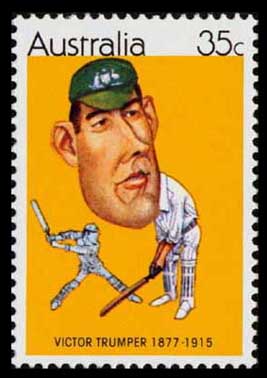
In 1981 he was honoured on a postage stamp
issued by Australia Post
depicting a cartoon image by Tony Rafty
http://www.australianstamp.com/images/large/0013200.jpg.
In 1996 he was made one of the ten inaugural inductees into the Australian Cricket Hall of Fame
, the others being Fred Spofforth
, John Blackham
, Clarrie Grimmett
, Bill Ponsford
, Sir Donald Bradman
, Bill O'Reilly
, Keith Miller
, Ray Lindwall
, and Dennis Lillee
.
The Sydney Cricket Ground Trust announced on 12 June 2008 that the new grandstand on the old hill at the SCG
was to be named in Trumper's honour.
On 2 November 2008 the SCG Trust hosted the first 'Victor Trumper Day', a sporting and cultural retrospective organised by Sydney school teacher David Strange to honour the life of Trumper on the 131st anniversary of his birth. Former internationals and celebrities including Greg Matthews
, Stuart MacGill
, Greg Page, Mick Molloy
and Tim Farriss
wore slatted pads, sausage gloves and 1907 skull caps to recreate the Golden Age of cricket
and raise money for charity in Trumper's name.
On 30 September 2009, Victor Trumper was one of five new members announced as part of the growing class of the ICC Cricket Hall of Fame. On 4 January 2010, he was formally inducted into the Hall of Fame.
Trumper Park Oval
in Paddington, New South Wales is also named in his honour, as is the Trumper Pavilion at Chatswood Oval
.
There is an internet message board named after Victor Trumper. It is a forum for cricket-related discussion, past, present and future used by members from all over the world.

Golden Age of cricket
The Golden Age of Cricket is a term that has often been applied in cricket literature to the period in English, Australian, and American cricket from the formation of the official County Championship in the 1890 season to the outbreak of World War I, which occurred just before the scheduled end of...
, capable of playing match-winning innings on wet wickets his contemporaries found unplayable. Archie MacLaren said of him, "Compared to Victor I was a cab-horse to a Derby winner". Trumper was also a key figure in the foundation of rugby league in Australia
Rugby league in Australia
Rugby league football is one of the most popular sports in Australia. It is the dominant winter sport on the eastern seaboard of Australia, including the states of New South Wales and Queensland as well as the Australian Capital Territory, which together comprise around half of the country's...
.
Life and Career
Trumper was probably born in Sydney; no definite record of his birth exists. Trumper's parents are believed to be Charles Thomas Trumper and his wife Louise, née Coghlan.Trumper was educated at Crown Street Superior Public School and showed early ability as a batsman. When only 17 years old Trumper made 67 runs for a team of promising juniors against Andrew Stoddart
Andrew Stoddart
Andrew Ernest Stoddart was an English cricketer and rugby union player. He was a Wisden Cricketer of the Year in 1893.-Cricket career:...
's touring English team at Sydney Cricket Ground
Sydney Cricket Ground
The Sydney Cricket Ground is a sports stadium in Sydney in Australia. It is used for Australian football, Test cricket, One Day International cricket, some rugby league and rugby union matches and is the home ground for the New South Wales Blues cricket team and the Sydney Swans of the Australian...
. In 1894-5 he played for New South Wales against South Australia
South Australia
South Australia is a state of Australia in the southern central part of the country. It covers some of the most arid parts of the continent; with a total land area of , it is the fourth largest of Australia's six states and two territories.South Australia shares borders with all of the mainland...
but made only 11 and 0 runs in his two innings. At his next attempt he also failed with the bat and was left out of representative cricket for two years. M. A. Noble
Monty Noble
Montague Alfred Noble was an Australian cricketer who played for New South Wales and Australia. A right-hand batsman, right-handed bowler who could deliver both medium pace and off-break bowling, capable fieldsman and tactically sound captain, Noble is considered as one of the great Australian...
, always a good judge, was confident about young Vic's ability, but it was only after some controversy that Trumper was made a last minute selection for the 1899 Australian team to England. He soon showed his ability, scoring 135 not out against England at Lord's Cricket Ground
Lord's Cricket Ground
Lord's Cricket Ground is a cricket venue in St John's Wood, London. Named after its founder, Thomas Lord, it is owned by Marylebone Cricket Club and is the home of Middlesex County Cricket Club, the England and Wales Cricket Board , the European Cricket Council and, until August 2005, the...
and 300 not out against Sussex
Sussex
Sussex , from the Old English Sūþsēaxe , is an historic county in South East England corresponding roughly in area to the ancient Kingdom of Sussex. It is bounded on the north by Surrey, east by Kent, south by the English Channel, and west by Hampshire, and is divided for local government into West...
. After the Lord's innings in June 1899, the great English batsman W. G. Grace
W. G. Grace
William Gilbert Grace, MRCS, LRCP was an English amateur cricketer who is widely acknowledged as one of the greatest players of all time, having a special significance in terms of his importance to the development of the sport...
approached the Australian dressing room and presented Trumper with his own bat, declaring, "From the present champion to the future champion." That bat now belongs to the Australian Museum collection in Canberra
Canberra
Canberra is the capital city of Australia. With a population of over 345,000, it is Australia's largest inland city and the eighth-largest city overall. The city is located at the northern end of the Australian Capital Territory , south-west of Sydney, and north-east of Melbourne...
.
Trumper's most remarkable Test season was played in England in 1902. It was one of the wettest summers on record, yet Trumper in 53 innings scored 2,570 runs, and without a single not out had an average of 48.49. Harry Altham
Harry Altham
Harry Surtees Altham, CBE, DSO, MC was an English cricketer who became an important figure in the game as an administrator, historian and coach. His Wisden obituary described him as "among the best known personalities in the world of cricket"...
wrote: "From start to finish of the season, on every sort of wicket, against every sort of bowling, Trumper entranced the eye, inspired his side, demoralized his enemies, and made run-getting appear the easiest thing in the world."
C. B. Fry added, "He had no style, and yet he was all style. He had no fixed canonical method of play, he defied all orthodox rules, yet every stroke he played satisfied the ultimate criterion of style -- the minimum of effort, the maximum of effect."
"No one," wrote Plum Warner
Plum Warner
Sir Pelham Francis Warner MBE , affectionately and better known as Plum Warner, or even "the Grand Old Man" of English cricket was a Test cricketer....
, "ever played so naturally. Batting seemed just part of himself, and he was as modest as he was magnificent."
Trumper was modest, retiring and generous. A teetotaller and non-smoker, his general conduct was an example to his fellow players, and he was a great favourite with the public both in England and Australia. Monty Noble
Monty Noble
Montague Alfred Noble was an Australian cricketer who played for New South Wales and Australia. A right-hand batsman, right-handed bowler who could deliver both medium pace and off-break bowling, capable fieldsman and tactically sound captain, Noble is considered as one of the great Australian...
had no hesitation in calling him the world's greatest batsman, a genius without compare.
In 1902, in arguably his greatest innings, he became the first player to achieve the very rare feat of making a century on the first morning of a Test match
Test cricket
Test cricket is the longest form of the sport of cricket. Test matches are played between national representative teams with "Test status", as determined by the International Cricket Council , with four innings played between two teams of 11 players over a period of up to a maximum five days...
, scoring 103 before lunch against England
English cricket team
The England and Wales cricket team is a cricket team which represents England and Wales. Until 1992 it also represented Scotland. Since 1 January 1997 it has been governed by the England and Wales Cricket Board , having been previously governed by Marylebone Cricket Club from 1903 until the end...
at Old Trafford
Old Trafford (cricket)
Old Trafford is a cricket ground situated on Talbot Road in Old Trafford, Greater Manchester. It has been the home of Lancashire County Cricket Club since its foundation in 1864, having been the ground of Manchester Cricket Club from 1857...
.
In August 1904, Trumper, with Hanson Carter, opened a sports store in Market Street, Sydney
Market Street, Sydney
Market Street is a cross street in the Central Business District of Sydney, New South Wales, Australia. It runs from Sussex Street near Darling Harbour in the west, to Elizabeth Street at St. James railway station in the east....
. Although he is best known for his prowess as a cricketer, Trumper was also a competent rugby player and can lay claim to being the prime mover in the development of rugby league in Australia
Rugby league in Australia
Rugby league football is one of the most popular sports in Australia. It is the dominant winter sport on the eastern seaboard of Australia, including the states of New South Wales and Queensland as well as the Australian Capital Territory, which together comprise around half of the country's...
. He hosted meetings at his store during 1907 as discontent amongst players with the game's administration grew louder. On 8 August 1907 at Bateman's Crystal Hotel, George Street
George Street
George Street may refer to:People:*George Edmund Street , British architect*George L. Street III , submariner in the United States Navy*George Street , English wicket-keeper...
, Sydney independent politician Henry Hoyle
Henry Hoyle
Henry "Harry" Clement Hoyle was an Australian politician and rugby league football administrator of the 1890s and 1900s...
chaired a meeting of fifty, comprising several leading rugby players and officials. The New South Wales Rugby Football League, the body that would go on to conduct the major national rugby league premiership of Australia, was founded and Trumper was elected its first treasurer.
Trumper's health during this period declined to the point where he missed the 1908-09 season due to illness.
At the begninning of the 1909 NSWRFL season the League, which was almost broke, had met and kicked out its founders, Trumper, Hoyle and J J Giltinan
J J Giltinan
James Joseph Giltinan was an Australian entrepreneur who helped to found the sport of rugby league football in Australia.On 8 August 1907 at Bateman's Crystal Hotel, George Street, Sydney politician Henry Hoyle chaired a meeting of fifty, comprising several leading rugby players and officials...
.
In 1912 Trumper opened "Victor Trumper and Dodge Ltd.", a sports and mercery store in George Street, Sydney
George Street, Sydney
George Street is one of Sydney's most notable city streets. There are more high rise buildings and more ASX 100 companies located here than anywhere else in Australia, and is well known for being busy around-the-clock...
.
Some notable highlight's of Trumper's career include scoring 292 against Tasmania, including a century before lunch (1908); scoring 100 in 58 minutes against Victoria (1906); 201 against South Australia (1913) and 293 against Canterbury (1914) to record the highest score by a number nine batsman. His last 68 first-class innings, in 1910-14, gave him an average of 60. His ability as a batsman, however, cannot be valued by averages or the number of runs scored. His mastership was shown on bad wickets, for when other batsmen were struggling merely to keep their wickets intact, he was still able to time the ball and execute strokes all round the wicket.
In February 1913 a match was played for his benefit between New South Wales and the rest of Australia which, with subscriptions, yielded nearly £3000.
Trumper's health declined rapidly in 1914 and he died as a result of Bright's disease
Bright's disease
Bright's disease is a historical classification of kidney diseases that would be described in modern medicine as acute or chronic nephritis. The term is no longer used, as diseases are now classified according to their more fully understood causes....
in Darlinghurst, Sydney
Sydney
Sydney is the most populous city in Australia and the state capital of New South Wales. Sydney is located on Australia's south-east coast of the Tasman Sea. As of June 2010, the greater metropolitan area had an approximate population of 4.6 million people...
on 28 June 1915, aged 37. Trumper was buried in Waverley Cemetery
Waverley Cemetery
The Waverley Cemetery opened in 1877 and is a cemetery located on top of the cliffs at Bronte in the eastern suburbs of Sydney. It is noted for its largely intact Victorian and Edwardian monuments. The cemetery contains the graves of many significant Australians including the poet Henry Lawson and...
after the largest funeral procession ever seen in Sydney (with 20,000 mourners lining the route) and was survived by his wife Sarah, his son Victor and daughter Nancy.
Trumper's son, Victor Trumper (1913-1981), played seven first-class games for New South Wales
New South Wales Blues
The New South Wales cricket team are an Australian first class cricket team based in Sydney, New South Wales...
in 1940-41, he was also the uncle of Admiral
Admiral (Australia)
Admiral is the highest active rank of the Royal Australian Navy and was created as a direct equivalent of the British Navy rank of Admiral. It is a four-star rank. Since World War II, in general, the only time the rank is held is when the Chief of the Defence Force is a Navy officer.Admiral is a...
Sir Victor Smith
Victor Smith
Admiral Sir Victor Alfred Trumper Smith AC, KBE, CB, DSC, RAN was a senior officer within the Royal Australian Navy, eventually becoming the first Australian to achieve the rank of admiral and serving as Chairman, Chiefs of Staff Committee; the professional head of the Australian Military.-Early...
(1913-1998), the first Australian to be promoted to the rank of Admiral. Victor Thomas' maternal ancestry was of the Coughlin family which also included NSW's first female statistician and Australia's Northern Territory's Chief Minister Clare Martin
Clare Martin
Clare Majella Martin is a former Australian politician. She is the current CEO of the Australian Council of Social Service . A former journalist, she was elected to the Northern Territory Legislative Assembly in a shock by-election win in 1995...
. The family was originally from County Offaly
County Offaly
County Offaly is a county in Ireland. It is part of the Midlands Region and is also located in the province of Leinster. It is named after the ancient Kingdom of Uí Failghe and was formerly known as King's County until the establishment of the Irish Free State in 1922. Offaly County Council is...
, Ireland
Ireland
Ireland is an island to the northwest of continental Europe. It is the third-largest island in Europe and the twentieth-largest island on Earth...
until the Cromwell
Oliver Cromwell
Oliver Cromwell was an English military and political leader who overthrew the English monarchy and temporarily turned England into a republican Commonwealth, and served as Lord Protector of England, Scotland, and Ireland....
invasion then left County Cork
County Cork
County Cork is a county in Ireland. It is located in the South-West Region and is also part of the province of Munster. It is named after the city of Cork . Cork County Council is the local authority for the county...
in the 1850s just after the Potato Famine.
Recognition
Trumper was named a Wisden Cricketer of the Year in 1903.In the 1963 edition of Wisden Cricketers' Almanack
Wisden Cricketers' Almanack
Wisden Cricketers' Almanack is a cricket reference book published annually in the United Kingdom...
, Trumper was selected by Neville Cardus
Neville Cardus
Sir John Frederick Neville Cardus CBE was an English writer and critic, best known for his writing on music and cricket. For many years, he wrote for The Manchester Guardian. He was untrained in music, and his style of criticism was subjective, romantic and personal, in contrast with his critical...
as one of the Six Giants of the Wisden Century
Six Giants of the Wisden Century
The "Six Giants of the Wisden Century" are six cricketers who were judged by Sir Neville Cardus in 1963 to have been the most notable players of the previous 100 years...
. This was a special commemorative selection requested by Wisden for its 100th edition. The other five players chosen were Sydney Barnes
Sydney Barnes
Sydney Francis Barnes was an English professional cricketer who is generally regarded as one of the greatest bowlers in the sport's history...
, Don Bradman, W G Grace, Jack Hobbs
Jack Hobbs
Sir John Berry "Jack" Hobbs was an English professional cricketer who played for Surrey from 1905 to 1934 and for England in 61 Test matches from 1908 to 1930....
and Tom Richardson
Tom Richardson
Tom Richardson was an English cricketer. A fast bowler, Richardson relied to a great extent on the break-back , a relatively long run-up and high arm which allowed him to gain sharp lift on fast pitches even from the full, straight length he always bowled...
.
In 1981 he was honoured on a postage stamp
Postage stamp
A postage stamp is a small piece of paper that is purchased and displayed on an item of mail as evidence of payment of postage. Typically, stamps are made from special paper, with a national designation and denomination on the face, and a gum adhesive on the reverse side...
issued by Australia Post
Australia Post
Australia Post is the trading name of the Australian Government-owned Australian Postal Corporation .-History:...
depicting a cartoon image by Tony Rafty
Tony Rafty
Tony Rafty OAM is a Greek Australian artist. He specialises in drawing caricatures.Rafty was born in Paddington, New South Wales...
http://www.australianstamp.com/images/large/0013200.jpg.
In 1996 he was made one of the ten inaugural inductees into the Australian Cricket Hall of Fame
Australian Cricket Hall of Fame
The Australian Cricket Hall of Fame is a part of the Australian Gallery of Sport and Olympic Museum in the National Sports Museum at the Melbourne Cricket Ground. This Hall of Fame commemorates the greatest Australian cricketers of all time....
, the others being Fred Spofforth
Fred Spofforth
Frederick Robert "Fred" Spofforth , also known as "The Demon Bowler", was arguably the Australian cricket team's finest pace bowler of the nineteenth century and was the first bowler to take 50 Test wickets, and the first to take a test hat-trick in 1879...
, John Blackham
Jack Blackham
John McCarthy Blackham was a Test cricketer who played for Victoria and Australia.A specialist wicket-keeper, Blackham played in the first Test match at the Melbourne Cricket Ground in March 1877 and the famous Ashes Test match of 1882...
, Clarrie Grimmett
Clarrie Grimmett
Clarence Victor "Clarrie" Grimmett was a cricketer; although born in New Zealand, he played most of his cricket in Australia. He is thought by many to be one of the finest early spin bowlers, and usually credited as the developer of the flipper.Grimmett was born in Caversham a suburb of Dunedin,...
, Bill Ponsford
Bill Ponsford
William Harold "Bill" Ponsford MBE was an Australian cricketer. Usually playing as an opening batsman, he formed a successful and long-lived partnership opening the batting for Victoria and Australia with Bill Woodfull, his friend and state and national captain...
, Sir Donald Bradman
Donald Bradman
Sir Donald George Bradman, AC , often referred to as "The Don", was an Australian cricketer, widely acknowledged as the greatest batsman of all time...
, Bill O'Reilly
Bill O'Reilly (cricketer)
William Joseph "Bill" O'Reilly , often known as Tiger O'Reilly, was an Australian cricketer, rated as one of the greatest bowlers in the history of the game. Following his retirement from playing, he became a well-respected cricket writer and broadcaster.O'Reilly was one of the best spin bowlers to...
, Keith Miller
Keith Miller
Keith Ross Miller MBE was an Australian Test cricketer and a Royal Australian Air Force pilot during World War II. Miller is widely regarded as Australia's greatest ever all-rounder. Because of his ability, irreverent manner and good looks he was a crowd favourite...
, Ray Lindwall
Ray Lindwall
Raymond Russell Lindwall MBE was a cricketer who represented Australia in 61 Tests from 1946 to 1960. He is widely regarded as one of the greatest fast bowlers of all time. He also played top-flight rugby league football with St...
, and Dennis Lillee
Dennis Lillee
Dennis Keith Lillee, AM, MBE is a former Australian cricketer rated as the "outstanding fast bowler of his generation"...
.
The Sydney Cricket Ground Trust announced on 12 June 2008 that the new grandstand on the old hill at the SCG
Sydney Cricket Ground
The Sydney Cricket Ground is a sports stadium in Sydney in Australia. It is used for Australian football, Test cricket, One Day International cricket, some rugby league and rugby union matches and is the home ground for the New South Wales Blues cricket team and the Sydney Swans of the Australian...
was to be named in Trumper's honour.
On 2 November 2008 the SCG Trust hosted the first 'Victor Trumper Day', a sporting and cultural retrospective organised by Sydney school teacher David Strange to honour the life of Trumper on the 131st anniversary of his birth. Former internationals and celebrities including Greg Matthews
Greg Matthews
Gregory Richard John "Mo" Matthews is a former New South Wales and Australian cricketer who is now a television cricket commentator....
, Stuart MacGill
Stuart MacGill
Stuart Charles Glyndwr MacGill is a former right-arm leg spin bowler of the Australian cricket team, with a domestic career at Western Australia, New South Wales, Nottinghamshire, Devon and Somerset...
, Greg Page, Mick Molloy
Mick Molloy
Michael "Mick" Molloy is an Australian comedian, writer and producer who has been active in the fields of radio, television, stand-up and film.-Biography:...
and Tim Farriss
Tim Farriss
Timothy William Farriss is a member of the rock band :INXS.-Early life and the formation of INXS:...
wore slatted pads, sausage gloves and 1907 skull caps to recreate the Golden Age of cricket
Golden Age of cricket
The Golden Age of Cricket is a term that has often been applied in cricket literature to the period in English, Australian, and American cricket from the formation of the official County Championship in the 1890 season to the outbreak of World War I, which occurred just before the scheduled end of...
and raise money for charity in Trumper's name.
On 30 September 2009, Victor Trumper was one of five new members announced as part of the growing class of the ICC Cricket Hall of Fame. On 4 January 2010, he was formally inducted into the Hall of Fame.
Trumper Park Oval
Trumper Park Oval
Trumper Park Oval is a sporting oval in Paddington, New South Wales.The oval is located at the corner of Glenmore Road & Hampden Street, Paddington and is named in honour of Victor Trumper. The oval caters for cricket as well as Australian Rules and athletics...
in Paddington, New South Wales is also named in his honour, as is the Trumper Pavilion at Chatswood Oval
Chatswood Oval
Chatswood Oval is located south of the Chatswood railway station in northern Sydney, Australia. It has four small pavilions and seating surrounding the oval. It is one of the Lower North Shore's largest sportsgrounds, and the home ground of the Gordon Rugby Football Club and Gordon District Cricket...
.
There is an internet message board named after Victor Trumper. It is a forum for cricket-related discussion, past, present and future used by members from all over the world.